New Book | A Cultural History of the Home
The 6 volumes appeared in 2020; the stand-alone volume on the Enlightenment became available in 2022 (see below); another option will appear in 2024.
Amanda Flather (anthology editor), A Cultural History of the Home, volumes 1–6 (London: Bloomsbury Academic, 2020), ISBN: 978-1472584410, $610.
 A Cultural History of the Home provides a comprehensive survey of the domestic space from ancient times to the present. Spanning 2800 years, the six volumes explore how different cultures and societies have established, developed and used the home. It reveals a great deal about how people have lived day-to-day in a range of regions and epochs by providing a historical focus on the location in which they will have spent much of their time: the domestic space.
1 Antiquity, 800 BCE–800 CE
2 Medieval Age, 800–1450
3 Renaissance, 1450–1648
4 Age of Enlightenment, 1648–1815
5 Age of Empire, 1815–1920
6 Modern Age, 1920–Present
Each volume discusses the same themes in its chapters:
• The Meaning of the Home
• Family and Household
• The House
• Furniture and Furnishings
• Home and Work
• Gender and Home
• Hospitality and Home
• Religion and Home
This structure offers readers a broad overview of a period within each volume or the opportunity to follow a theme through history by reading the relevant chapter across volumes.
Amanda Flather is Lecturer in the Department of History at the University of Essex. She is the author of Gender and Space in Early Modern England (2006).
◊ ◊ ◊ ◊ ◊
Clive Edwards, ed., A Cultural History of the Home in the Age of Enlightenment (London: Bloomsbury Academic, 2022), 264 pages, ISBN: 978-1472584250, $110. The paperback edition will be available in 2024.
 During the period of the Enlightenment, the word ‘home’ could refer to a specific and defined physical living space, the location of domestic life, and a concept related to ideas of roots, origins, and retreat. The transformations that the Enlightenment encouraged created the circumstances for the concept of home to change and develop in the following three ways. First to influence homemaking were the literary and cultural manifestations that included issues around attitudes to education, social order and disorder, sensibility, and sexuality. Secondly, were the roles of visual and material culture of the home that demonstrated themselves through print, portraiture, literature, objects and products, and dress and fashion. Thirdly, were the industrial and sociological aspects that included concepts of luxury, progress, trade and technology, consumption, domesticity, and the notions of public and private spaces within a home. The chapters in this volume therefore discuss and reflect upon issues relating to the home through a range of approaches. Enlightenment homes are examined in terms of signification and meaning; the persons who inhabited them; the physical buildings and their furniture and furnishings; the work undertaken within them; the differing roles of men and women; the nature of hospitality, and the important role of religion in the home. Taken together they give a valuable overview of the manners, customs, and operation of the Enlightenment home.
Clive Edwards is Emeritus Professor of Design History at Loughborough University. He is editor of The Bloomsbury Encyclopedia of Design (2015) and author of Turning Houses into Homes: A History of the Retailing and Consumption of Domestic Furnishings (2017), The Twentieth Century Interiors Sourcebook (2013), Interior Design: A Critical Introduction (2010), How to Read Pattern: A Crash Course in Textile Design (2009), Encyclopedia of Furnishing Textiles, Soft Furnishings and Floor Coverings (2007), British Furniture: 1600–2000 (2006), and Encyclopedia of Furniture Materials, Trades, and Techniques (2001).
c o n t e n t s
1 The Meaning of Home — Karen Lipsedge
2 Family and Household —Helen Metcalfe
3 The House — Stephen Hague
4 Furniture and Furnishings — Clive Edwards
5 Home and Work — Leonie Hannan
6 Gender and Home — Ruth Larsen
7 Hospitality and Home — Woodruff Smith
8 Religion and the Home — Matthew Neal
New Book | A Cultural History of Furniture, volumes 1–6
From Bloomsbury:
Christina Anderson (anthology editor), A Cultural History of Furniture, volumes 1–6 (London: Bloomsbury Academic, 2022), 1824 pages, ISBN: 978-1472577894, $550.
Furniture is an artifact, so what can it tell us about culture? What social, religious, political, and economic factors have shaped its form and functions? How does furniture demonstrate the transformations in private and public life across time and cultures?
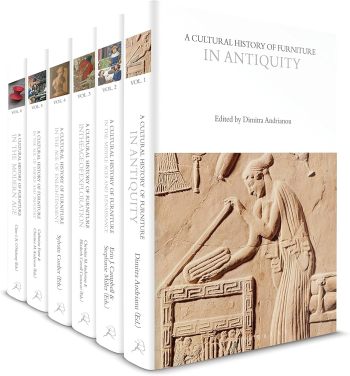 In a 6-volume work spanning 4,500 years, 70 experts chart the changing cultural framework within which furniture was designed, produced, and used in Western Europe. Individual volume editors ensure the cohesion of the whole, and, to make it as easy as possible to use, chapter titles are identical across each of the volumes. This gives the choice of reading about a specific period in one of the volumes or following a theme across history by reading the relevant chapter in each of the six.
1 Antiquity, 2500 BCE–500 CE
2 Middle Ages and Renaissance, 500–1500
3 Age of Exploration, 1500–1700
4 Age of Enlightenment, 1700–1800
5 Age of Empire and Industry, 1800–1900
6 Modern Age, 1900–Present
Chapters address: Design and Motifs; Makers, Making, and Materials; Types and Uses; The Domestic Setting; The Public Setting; Exhibition and Display; Furniture and Architecture; Visual Representations; and Verbal Representations. The total extent of the pack is approximately 1,824 pages. Each volume opens with a series preface, an introduction, and notes on contributors; each concludes with notes, bibliography, and an index.
A Cultural History of Furniture is part of the Cultural Histories Series. Titles are available both as printed hardcover sets for libraries needing just one subject or preferring a one-off purchase and tangible reference for their shelves, or as part of a fully searchable digital library available to institutions by annual subscription or on perpetual access.
Christina M. Anderson is Research Fellow, History Faculty and Ashmolean Museum, University of Oxford.
◊ ◊ ◊ ◊ ◊
Sylvain Cordier, Christina Anderson, and Laura Houliston, eds., Volume 4: A Cultural History of Furniture in the Age of Enlightenment (London: Bloomsbury Academic, 2022), ISBN: 9781472577856.
c o n t e n t s
List of Illustrations
Notes on Contributors
Series Preface
Introduction — M. B. Aldrich with Sylvain Cordier
1 Design and Motifs — Barbara Lasic
2 Makers, Making, and Materials — Yannick Chastang
3 Types and Uses — Mary-Eve Marchand
4 The Domestic Setting — Antonia Brodie
5 The Public Setting — Jeffrey Collins
6 Exhibition and Display — Frederic Dassas
7 Furniture and Architecture — Peter N. Lindfield
8 Visual Representations — Michael Decrossas and Sylvain Cordier
9 Verbal Representations — Tessa Murdoch
FHS Annual General Meeting
From the FHS (membership information is available here) . . .
Furniture History Society, Annual General Meeting
The East India Club, St James’s Square, London, 25 November 2023
The FHS Annual General Meeting for the year ending 30 June 2023 will be held at the East India Club. The meeting will start at 11.00am, with coffee from 10.30am. Talks will follow the business of the day. Admission to the AGM is free for members, but all members wishing to attend should notify the Events Secretary at least seven days in advance. Tickets for a sandwich lunch with a glass of wine (£22 per head) should also be booked with the Events Secretary at least seven days in advance. We plan to record the talks for those who cannot attend in person.
t a l k s
• Louis Platman (Curator at the Museum of the Home) will talk about Real Rooms, a massive redevelopment project that will see the construction on many new period rooms and immersive displays at the Museum. He will also provide updates on the Cotton Collection of English Regional Chairs and the recently acquired Cotton Archive.
• Dr Tessa Kilgariff (English Heritage Curator of Collections and Interiors, South London). Marble Hill is a villa situated on the banks of the river Thames in Twickenham, London. Built in the 1720s, it was home to the courtier Henrietta Howard, Countess of Suffolk. In the spring of 2022, English Heritage re-opened Marble Hill following an extensive National Lottery Heritage funded project. This talk will explore that project, Marble Hill Revived, by detailing the restoration of the house and gardens and sharing discoveries made in the course of research in the villa’s interiors, collections, and occupants. With a particular focus on the conservation of some important pieces of furniture, we will explore the history of Henrietta Howard’s riverside home.
• Stacey Clapperton (Curator of Works of Art for the Palace of Westminster) and Lucy Odlin (Collections Conservation Manager for the Palace of Westminster) on the history of the design and use of the Speaker’s State Coach (ca. 1690s). Full details will be in the November issue of the Newsletter and also on the website later in the year.
• Dr Amy Frost (Senior Curator at Bath Preservation Trust) will reveal the work currently underway at Beckford’s Tower in Bath to conserve the building and refit the museum, including how William Beckford’s collection and furniture will be presented and interpreted when the museum reopens in March 2024.
New Book | America’s Collection
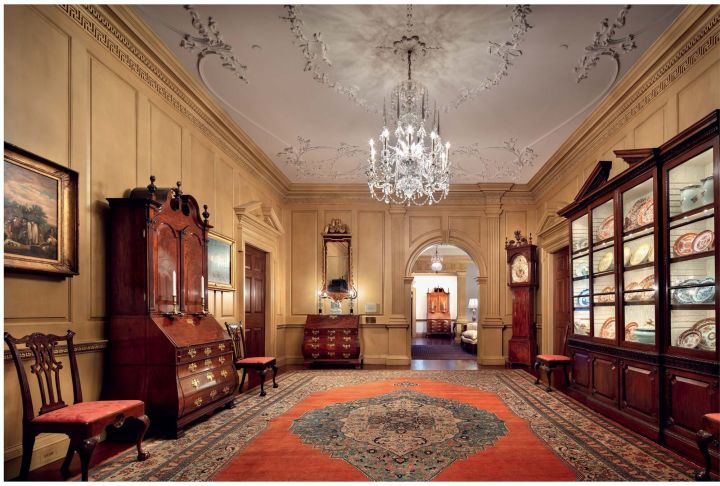
The entrance hall of the Diplomatic Reception Rooms at the U.S. Department of State; completed in 1979, the room includes a rococo ceiling taken in part from Philadelphia’s Powel House, now installed as a period room at the Philadelphia Museum of Art (Photograph by Durston Saylor). For more information on the book and the history of the reception rooms, see James Tarmy’s August 24th article for Bloomberg.
◊ ◊ ◊ ◊ ◊
From Rizzoli:
Virginia Hart, America’s Collection: The Art and Architecture of the Diplomatic Reception Rooms at the U.S. Department of State (New York: Rizzoli Electa, 2023), 352 pages, ISBN: 978-0847873272, $100. With a foreword by John Kerry and contributions by Bri Brophy, Allan Greenberg, Mark Alan Hewitt, Stacy Schiff, Elizabeth Mankin Kornhauser, Alice Cooney Frelinghuysen, Alexandra Alevizatos Kirtley, Elliot Bostwick Davis, Deborah Dependahl Waters, David Rubenstein, Carolyn Vaughan, and Laaren Brown.
The first volume in more than 20 years tells a new and modern story of the U.S. State Department’s Diplomatic Reception Rooms, one of the top collections of American fine and decorative arts in existence.
 The art of United States diplomacy has been conducted over more than two centuries with figures from all over the world, in peacetime and in conflict. For the last six decades, these negotiations have taken place in the rarified environment of the Diplomatic Reception Rooms at the U.S. Department of State. Tucked inside the modern Truman Building in the center of Washington, D.C., lies this special suite of rooms transformed by four renowned architects—gems of classical architecture brimming with exceptional American art and artifacts that tell the story of the nation’s founding and represent the singular ideals of the American character.
Housing one of the finest collections in the world, along with The Metropolitan Museum of Art and Winterthur, these rooms display more than 5,000 objects, including paintings by John Singleton Copley and Gilbert Stuart; silver and porcelain owned by George Washington and other presidents; fine furniture; maps and documents; prints and drawings, not to mention the very desk the Treaty of Paris that ended the Revolutionary War was signed on. With all-new photography and essays, this book captures the history of the rooms and explores more than 150 examples of the extraordinary American art that animates the exquisite spaces.
Virginia B. Hart is director and curator of the Diplomatic Reception Rooms and Bri Brophy is deputy chief curator. The Honorable John F. Kerry is U.S. Special Presidential Envoy for Climate, and former U.S. Secretary of State. Allan Greenberg is an architect and author. Mark Alan Hewitt is an architect and architectural historian. Stacy Schiff is a Pulitzer-Prize-winning author. Elizabeth Mankin Kornhauser is the Senior Curator for the 2026 Bicentennial at Frederic Chruch’s home Olana and Curator Emerita of American Paintings and Sculpture at The Metropolitan Museum of Art. Alice Cooney Frelinghuysen is the Anthony W. and Lulu C. Wang Curator of American Decorative Arts at The Metropolitan Museum of Art. Alexandra Alevizatos Kirtley is the Montgomery-Garvan Curator of American Decorative Arts at the Philadelphia Museum of Art. Elliot Bostwick Davis is Senior Editor, Harvard Social Impact Review, Arts and Culture and a former museum curator and director. Deborah Dependahl Waters is an independent decorative arts historian and part-time assistant professor at Parsons, New School University. David M. Rubenstein is a financier and philanthropist. Carolyn Vaughan is a writer and editor of art books and exhibition catalogues. Laaren Brown is a writer and editor for art and natural history topics. Durston Saylor is a photographer of contemporary interior design and architecture. Bruce M. White is a photographer of works of art and historic architecture. Sarah Gifford is an award-winning graphic designer.
New Book | Americana Insights, 2023
From Penn Press:
Robert Shaw, ed., Americana Insights, 2023 (Philadelphia: University of Pennsylvania Press, 2023), 288 pages, ISBN: 979-8988533108, $65.
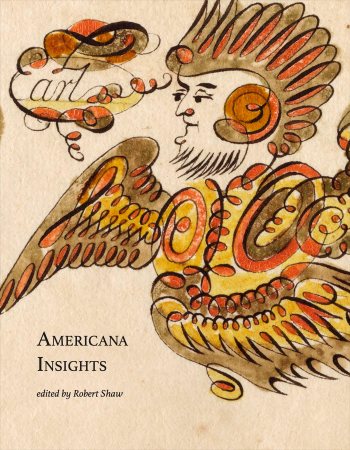 Americana Insights 2023 presents the latest research and discoveries on traditional American folk art and material culture. Groundbreaking essays by leading scholars provide a wealth of new insights on a wide array of artistic traditions. Covering a broad geographic area—including New England, the mid-Atlantic, South, and mid-West—and spanning the colonial era to early twentieth century, these essays enhance our understanding of the diverse American experience. This is the only interdisciplinary publication devoted exclusively to traditional Americana and folk art.
Contributors cover a range of topics including portraiture, furniture, jewelry, textiles, and works on paper. In the first volume, authors share groundbreaking research on the use of hooked rugs in the colonial revival era; revisit the work of a famed Connecticut portrait painter known as the Beardsley Limner and his namesake sitters; Rufus Porter’s work as an artist and entrepreneur; a distinctive group of paint-decorated dressing tables from New Hampshire; delicate cutworks made by an incarcerated inmate in Philadelphia’s Eastern State Penitentiary; painted tavern signs; jewelry in folk portraiture; New Jersey schoolmaster and calligrapher Thomas Earl; and signature quilts from the nineteenth century.
Contributors: Deborah M. Child, Pamela and Brian Ehrlich, Cynthia Fowler, Emelie Gevalt, Mark D. Mitchell, Eileen M. Smiles, Laura Fecych Sprague.
Robert Shaw is an independent curator and art historian who has written and lectured extensively on many aspects of American folk art. His many critically acclaimed books include Bird Decoys of North America: Nature History and Art (2010), American Quilts: The Democratic Art (2017), and American Weathervanes: The Art of the Winds (2021). He has curated exhibitions at the Dallas Museum of Natural History, the National Gallery of Art, the American Folk Art Museum, and the Shelburne Museum, where he served as curator from 1981 to 1994.
Americana Insights is a nonprofit publication dedicated to the study of Americana and American folk art. It was founded in 2021 by Jane Katcher in collaboration with David A. Schorsch, her longtime friend and mentor in the field, founding editor Robert Shaw, and a distinguished advisory board of museum professionals and scholars. In 2023, curator and scholar Lisa Minardi was appointed editor of Americana Insights. More information is available here»
Conference | Elizabeth Montagu and the Bluestocking Corpus Online
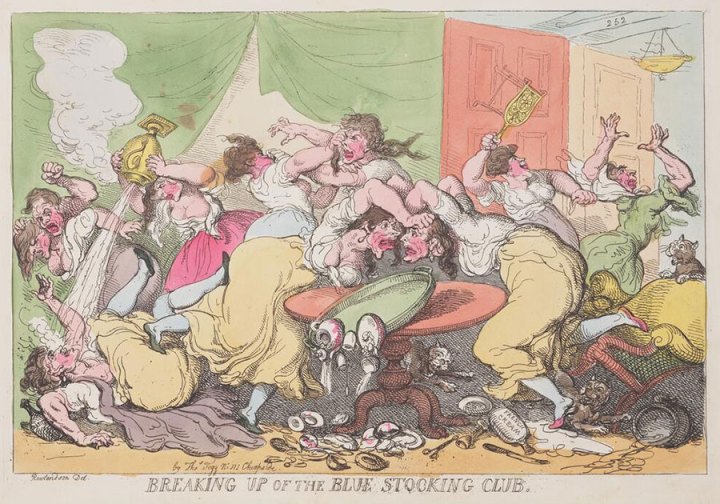
Thomas Rowlandson, Breaking Up of the Blue Stocking Club, 1815, hand-colored etching
(San Marino: Huntington Library, Art Museum, and Botanical Gardens)
◊ ◊ ◊ ◊ ◊
Next month at The Huntington:
Correspondence and Embodiment: The Bluestocking Corpus Online
The Huntington Library, Art Museum, and Botanical Gardens, San Marino, 8–9 December 2023
Organized by Elizabeth Eger and Nicole Pohl
This conference, organized in collaboration with the Elizabeth Montagu’s Correspondence Online (EMCO) project, explores themes related to The Huntington’s Elizabeth Montagu Papers. Topics include the letter as object, historical document, linguistic artifact, as well as a carrier of objects and messages about friendship, health, the mind and body, and politics. The Huntington’s collection of Elizabeth Montagu’s extensive correspondence has provided a rich source—as well as a practical challenge—for scholars working in a variety of fields, from social and economic history to histories of medicine, aesthetics, authorial selfhood, and literary genres.
Elizabeth Robinson Montagu (1718–1800) combined many roles: pioneering Shakespeare critic, businesswoman, manager of coalmines and agricultural estates, philanthropist, and patron of artists and writers. She pivoted between several important social, political, religious, and intellectual networks. Her letters connect people, places and concepts with graphic immediacy.
In 2017, the registered charity Elizabeth Montagu Correspondence Online (EMCO) was founded to fund the digitization of her 8000 extant manuscript letters, most of which are curated by The Huntington Library. This conference will explore themes connected to the archive, the letter as object, historical document, linguistic artifact, as well as a carrier of objects and messages about friendship, health, the mind and body, and politics.
This conference is organized by Elizabeth Eger (King’s College, London) and Nicole Pohl (Oxford Brookes, Oxford). Funding is provided by The Homer Crotty Lecture Endowment and the Edward A. Mayers Fellowship Endowment.
f r i d a y , 8 d e c e m b e r 2 0 2 3
8.45 Registration and Coffee
9.15 Welcome by Susan Juster (The Huntington Library) and Conveners
9.30 Session 1 | A History of the Montagu Collection at The Huntington
• Vanessa Wilkie (The Huntington Library)
• Karla Nielsen (The Huntington Library)
10.00 Break
10.30 Session 2 | EMCO: The Physical Archive and Its Virtual Other
Moderator: Joanna Barker (Durham and EMCO Senior Editor)
• Alexander Roberts (Swansea University)
• Daniel Archambault (Swansea University)
• Nicole Pohl (Oxford Brookes and EMCO Editor in Chief)
Noon Lunch
1.00 Session 3 | Gender and Knowledge
Moderator: Emily Anderson (University of Southern California)
• Rachael Scarborough King (UC Santa Barbara), Improving Letters: Self- and Literary Improvement in Women’s Epistolary Genres
• Nataliia Voloshkova, (Kazimierz Wielki University), Bluestockings and Science: Acquiring, Sharing, and Employing Knowledge, read by Nicole Pohl
2.30 Break
3.00 Session 4 | Absence and Presence
Moderator: Susan Carlile (Cal State Long Beach)
• Elizabeth Eger (King’s College London and EMCO Consultant Editor), Embodying Mind: Portraits of Elizabeth Montagu
• Felicity Nussbaum (UCLA), The Beloved Absent: The Correspondence between Elizabeth Montagu and Hester Thrale Piozzi
s a t u r d a y , 9 d e c e m b e r 2 0 2 3
8.30 Registration and Coffee
9.00 Session 5 | Embodying Language: The Letter and Creative and Critical Modes of Writing
Moderator: Nicole Pohl (Oxford Brookes)
• Betty A. Schellenberg (Simon Fraser University), Unclothed Bodies: The Problem of Enclosures in the Montagu Collection
• Mike Cousins (Historian), Keeping Track of Mrs. Montagu: Challenges in Dating Her Correspondence with Lord Lyttelton, and a Comparison with Unpublished Letter Collections of Some Other Contemporary Women Writers
10.30 Tours of the Library and Gallery
Noon Lunch
1.00 Session 6 | Bodies in Letters, Letters as Bodies
Moderator: Dena Goodman (University of Michigan)
• Lisa Forman Cody (Claremont McKenna College), Pregnant Pauses: Reproduction in—and as—Letter Writing
• Karen Harvey (University of Birmingham), ʽWe Must Chat about Invalids’: The Lived Body in British Women’s Letters, 1730–1800
2.30 Break
3.00 Session 7 | In Sickness and in Health: Bluestocking Friendship
Moderator: Karla Nielsen (The Huntington Library)
• Anna Senkiw (Oxford Brookes), ʽSeveral Weeks Indisposition, a Little Dastardly Fever Lurking about Me, Has Hinderd My Coming to the Adelphi’: Friendship with the Garricks, in Sickness and in Health
• Helen Deutsch (UCLA), Symptomatic Correspondences, Female Complaints: Authorship, Friendship and Illness in the Montagu Letters
4.30 Concluding Remarks
Panel Discussion | Caricature Collectors in Conversation
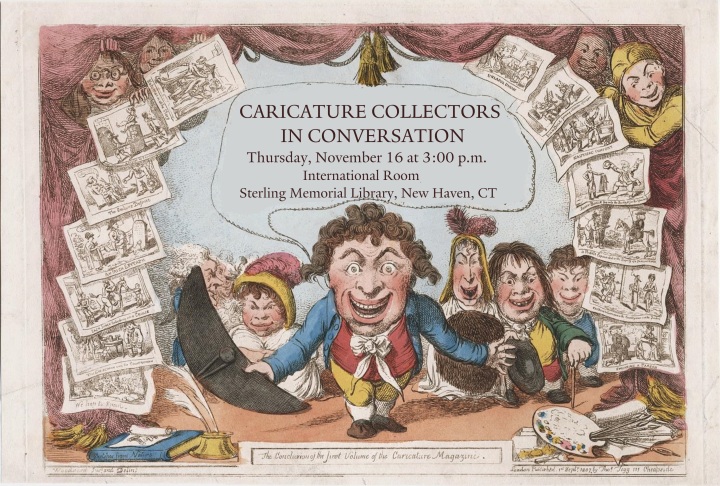
Modified version of Charles Williams, after George Moutard Woodward, The Conclusion of the First Volume of the Caricature Magazine, published by Thomas Tegg, 1807, hand-colored etching.
◊ ◊ ◊ ◊ ◊
Sponsored by The Lewis Walpole Library:
Panel Discussion | Caricature Collectors in Conversation
Sterling Memorial Library, New Haven, Thursday, 16 November 2023, 3pm
Please join us for a panel of distinguished private collectors and print curators for lively conversation about their interests, expertise, and adventures in building their collections of eighteenth- and early nineteenth-century British caricature and satiric prints. They will share stories of discovery and the pursuit of coveted acquisitions, and we will invite their thoughts on the role of appreciation, connoisseurship, and learning that grows along with the collection and the value that they find in engagement with fellow collectors and curators, and in research at library and museum print rooms. The program is free and open to the public.
Call for Papers | The First Public Museums, 18th–19th Centuries
From ArtHist.net:
The Public of the First Public Museums: II. Literary Discourses, 18th–19th Centuries
Durham, 23–24 May 2024
Proposals due by 22 December 2023
The upcoming workshop The Public of the First Public Museums: II. Literary Discourses, 18th–19th Centuries is part of the research project Visibility Reclaimed: Experiencing Rome’s First Public Museums, 1733–1870 — An Analysis of Public Audiences in a Transnational Perspective (FNS 100016_212922).
Marking the second of three encounters, this workshop delves into the examination of literary discourses vital to understanding the experiences of early museum-goers. Travel literature has long represented a privileged source for investigating the origins of the first public museums and the practices of access to public and private collections in Europe. However, in the light of recent studies aimed at deepening the material history of the museum and the encounter of the public with the institutions, these sources deserve a closer scrutiny in both methodological and critical terms. As museums sought to define and engage their public, literature often became both a mirror and a mould, reflecting and shaping societal perceptions. With a spotlight on interdisciplinary and transnational approaches, the Durham workshop calls for a deeper probe into the visual and material realms of museums, emphasizing the interplay between literary discourses and artworks, collections, display, space, audiences ‘narrated’ in the museum and the evolving institutional norms of the 18th and 19th centuries.
Following the inaugural Rome session centred on institutional sources, the Durham workshop turns its gaze towards the rich tapestry of literary narratives with the aim of analysing them also in a comparative perspective with the primary sources. Periegetic literature—inclusive of travel accounts, artist correspondences, poetic endeavours, and Grand Tourist insights—stands as a testament to the artistic engagement with museum spaces over two defining centuries. At the heart of this exploration is the figure of the writer as a museum visitor. These writers, often esteemed poets and authors, are not just passive observers; their perspectives and critiques actively shape museum dynamics and public perceptions. Such literary visits, sometimes critical towards the museum as institution, have left a lasting impact, influencing subsequent generations of museum-goers. The writer’s dual role as a visitor and critic underscores the need to reassess these literary accounts in the broader context of museum studies.
From the poetic allure of lyrical evocations that captured the emotions of an ambient to ekphrastic descriptions which meticulously transform artworks into written words, the literature of the time offered a multifaceted view of the museum experience. Anecdotes and reported conversations in situ provided a window into the immediacy of exchanges, offering insight into contemporaneous views and reactions. Reviews in periodicals played a pivotal role, often influencing broader public perceptions, while a comparison between published and unpublished literary accounts unveils disparities in representation and reception. Erudite exploits presented readers with insightful perspectives, illustrating the convergence of art, history, and scholarly pursuits. Museums emerged as hubs of social interaction, where the intellectual and cultural elite converged but not only. The belletristic narratives wove tales that blurred the lines between fact and fiction. Each genre added a unique voice, contributing to a comprehensive and nuanced understanding of the period. We aim to broaden the horizon by drawing parallels with analogous documentation from other cultural spaces that the project seeks to study in comparative terms. This includes libraries, academies, galleries, private collections, villas, both ancient and modern monuments, archaeological sites, places of worship, theatres, ateliers, and more.
The questions presented below are designed to stimulate discussions and kindle in-depth explorations into the confluence of literature and the publics of first public museums:
1 How do literary works contribute to the construction of common themes and stereotypes associated with museum audiences?
2 How has literature influenced and shaped the evolution of the culture of the museum guides or cicerones over time, and to what extent has this literary impact altered visitor experiences and expectations in museums?
3 What are the origins, characteristics, and specificities of literary genres targeted towards museum-goers, especially concerning guides, itineraries of visits, and public lectures? How do they transform based on the evolution and variations of museum audiences themselves?
4 How do notions of time during a museum visit compare and contrast with the temporal dynamics of literary narration?
5 How do ekphrastic descriptions in literature enhance our comprehension of the visitor’s gaze when engaging with artworks, architecture, museum displays?
6 How do various literary genres, such as periegetic literature, artist correspondence, diaries and reviews, serve as either sources or models for understanding the museum experience and the role of audiences?
7 How do the narratives and insights from published literary accounts of museum visits compare and contrast with those from unpublished sources, and what implications arise from these distinctions in shaping our understanding of museum-going experiences?
8 How does the concept of a museum as a space to ‘read’ differ from its traditional perception as a space to ‘visit’, and what are the implications of this distinction in literary and museological discourses?
9 How does literature play a pivotal role in crafting horizons of expectation for museum-goers influencing their anticipation and reception of museum exhibitions?
10 How did differences in gender, religion, social status, and cultural background influence writers’ portrayals of museums, and what do these varied perspectives reveal about the socio-cultural dynamics in museum narratives?
Key points of consideration:
• To foster dialogue around the most recent research endeavours, we especially encourage submissions from doctoral candidates and early-career researchers, who are currently delving into original themes and sources resonant with the seminar’s objectives.
• Preference will be given to applications showcasing interdisciplinary research approaches. This encompasses the melding of art history with literature, visual studies, and beyond. Proposals that venture beyond the traditional realms of art and architectural history, such as linguistic history, literature, tourism studies, and geography, are particularly sought after.
• Submissions emphasizing digital humanities are highly regarded. This includes, but is not limited to, cataloguing projects, databases concerning the relating in particular to literary sources concerning the visiting experiences and audiences of the first public museum and comparisons with other institutions and places (e.g., libraries, academies, galleries, villas, ancient and modern monuments).
• We highly value case studies adopting transnational and/or transregional perspectives. Proposals exploring underrepresented geographies within the sphere of Museum Studies are particularly encouraged.
• The primary focus of this workshop is on the 18th and 19th centuries. However, topics on the 17th and the early 20th century are also welcome, provided they maintain a strong engagement with or connection to these two centuries.
Contributors are invited to submit an abstract (max. 2,000 characters, including spaces) accompanied by a brief CV (max. 1,500 characters, including spaces) and a minimum of three keywords to: visibilityreclaimed@gmail.com.
• Accepted languages: Italian, English, French, Spanish
• Deadline for abstract submission: 22 December 2023
• Notification of acceptance: 10 January 2024
For further information, please contact the organising secretaries: Gaetano Cascino and Lucia Rossi at visibilityreclaimed@gmail.com.
Direction and scientific coordination
Carla Mazzarelli (Università della Svizzera italiana, Accademia di architettura di Mendrisio, Istituto di storia e teoria dell’arte e dell’architettura), carla.mazzarelli@usi.ch
Project Partners
Giovanna Capitelli (Università di Roma Tre), Stefano Cracolici (Durham University), David Garcia Cueto (Museo del Prado), Christoph Frank (Università della Svizzera italiana), Daniela Mondini (Università della Svizzera italiana), Chiara Piva (Sapienza Università di Roma)
Call of Papers | Rimini in the 18th Century
From ArtHist.net (which also includes the Call for Papers in Italian). . .
Rimini in the 18th Century: Between Art, Science, Antiquarianism, and the Grand Tour
Rimini nel Settecento: Tra arte, scienza, antiquaria e Grand Tour
Online / Università degli Studi di Bologna, Campus di Rimini, 26 January 2024
Proposals due by 23 December 2023
During the eighteenth century, Rimini opened to Europe, becoming a destination for artists, travelers, and curious intellectuals. These visitors came to discover the archaeological and artistic testimonies of the city and to observe its rediscovered natural realities. A center of “European local learning” (Raimondi) in dialogue with Enlightenment Europe, Rimini became a necessary stop of the Grand Tour to and from Rome along the Adriatic coast. Science, art, architecture, and erudite interests acted as catalysts to spotlight the city.
Throughout the eighteenth century, Rimini was in constant relationship with Rome and Bologna, and it thrived thanks to the contribution of many scholars and scientists, including the physician Giovanni Bianchi (1693–1775), refounder of the Lincei in Rimini and papal archiatra of honor, together with his most famous disciples (such as Giovanni Antonio Battarra, Giovanni Cristofano Amaduzzi, Gaetano Marini, Giuseppe Garampi), and the architect Gianfrancesco Buonamici (1692–1759), an antiquary and man of letters, an academician of honor of the Accademia Clementina in Bologna and the Accademia di San Luca in Rome.
This international workshop will investigate the different aspects of Rimini culture and the impact of foreigners on the coastal city through original, unpublished papers. The focus of this study will encompass the testimonies of travelers and amateurs, the role of architects and artists in the exchanges between Italy and Europe. If you would like to participate in the workshop by presenting a paper (20–25 minutes), please send an abstract (as a PDF file) to ilaria.bianchi5@unibo.it and valeria.rubbi2@unibo.it before 23 December 2023. The document should contain the title of your presentation, your name and affiliation, a 300-word abstract, and a brief CV. Applicants will be notified on the acceptance of proposals by 8 January 2024.
Dissertation Listings, 2020 and 2021
CAA publishes titles of dissertations in progress and completed by students at American and Canadian institutions. Clearly, however, there are problems (the index is neither timely nor comprehensive). Penn State University maintains its own list of “Art History Dissertations and Abstracts from North American Institutions,” as compiled by Catherine D. Adams and Carolyn J. Lucarelli. If your dissertation has been overlooked, please feel free to report it directly to them. I’m conflicted because I’m not in a position to maintain a list with any credibility on my own, but I also realize this is an incredibly frustrating system. Very belated congratulations to the four scholars named below and to many of you who have also finished more recently but are not yet named on either list. –CH
The CAA index for 2020 lists nine ‘eighteenth-century art’ dissertations in progress and one ‘eighteenth-century art’ dissertation completed:
• Christine Brander, “Addressing the Body: The Artless Art of Jean-Étienne Liotard” (Yale University, N. Suthor).
• Katherine Calvin, “Antiquity and Empire: The Construction of History in Western European Representations of the Ottoman Empire, 1650–1830” (The University of North Carolina at Chapel Hill). [Calvin’s dissertation is not noted on CAA’s index, but it appears at Penn State’s list.]
The CAA index for 2021 lists seventeen ‘eighteenth-century art’ dissertations in progress, and two ‘eighteenth-century art’ dissertations completed:
• Jennifer Baez, “Painting the Miracles of Altagracia: Art, Piety, and Memory in Hispaniola, 1751–1795,” (Florida State University, P. Niell).
• Emily Thames, “Empire, Race, and Agency in the Work of José Campeche, Artist and Subject in Late Spanish Colonial Puerto Rico, 1751–1809,” (Florida State University, P. Niell). [At Penn State’s list, Thames’s dissertation is listed under 2022.]










 Enfilade
leave a comment