Independence Seaport Museum Acquires Folk Art Watercolor
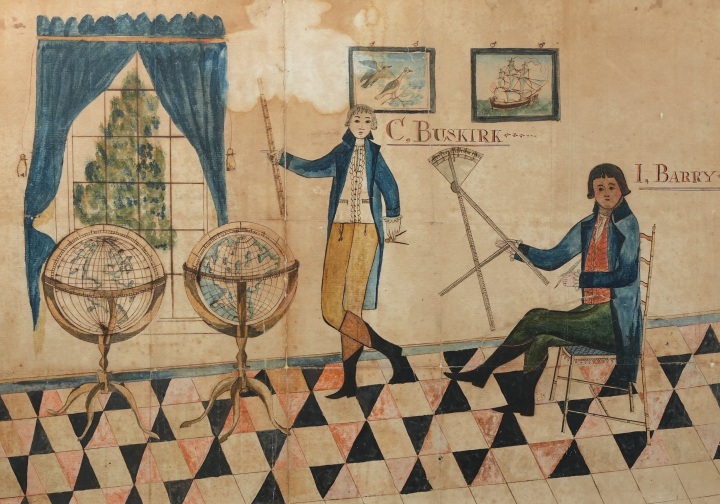
Attributed to Cornelius van Buskirk, Navigation Lesson, ca. 1780s–90s, watercolor and ink on paper
(Philadelphia: Independence Seaport Museum, gift of Maya Muir, 2023.010.001)
◊ ◊ ◊ ◊ ◊
From the press release (17 October 2023) . . .
In the late 1700s, when young boys were taught the art of navigation, it was common that they would have used a workbook to write out their examples and trigonometry equations and to explore navigational theories. An especially rare example—which includes not only these materials needed for study but also exquisitely rendered watercolor drawings of people, ships, charts, and a log from a voyage made in April 1799—was used by a boy named Cornelius van Buskirk (1776–1863). One such watercolor drawing, entitled Navigation Lesson, which had been removed from the workbook and retained by the artist’s descendent family, was recently given to the Independence Seaport Museum in Philadelphia to complement the actual workbook previously given to the museum by a direct descendant’s widow. What makes this already important drawing and larger document all the more extraordinary is that new research conducted by ISM staff shows that the figures in the drawing are of the young artist and his tutor, who is believed to be none other than Commodore John Barry (1745–1803), the man regarded as the father of the United States Navy.
“The Independence Seaport Museum is thrilled to have been given this wonderful watercolor,” said Peter Seibert, president and CEO of ISM. “Not only is it an artistic tour de force but we are also now able to reunite it with the original manuscript copy book in our collection. Together, they tell the story of both the father of the U.S. Navy and the young man who was his student.”
The watercolor, which relates in many ways to similar genre scenes from the Federal period, is especially well drawn. It shows ‘C. Buskirk’ receiving a lesson in navigation from ‘I. Barry’ in what appears to be a parlor or study of what is likely Barry’s home. (Van Buskirk Family tradition states that ‘I. Barry’ is Commodore John Barry as ‘I’ is a classical shorthand for ‘J.’) Typical of genre scenes of the time, the room features a black-and-white painted floor, and the overall symmetry of the piece relates it to coastal New England folk artists such as Joseph H. Davis (1811–1865). Similarly, Van Buskirk paid careful attention to the face and hair of the subjects, as did Pennsylvania German artist Jacob Maentel (1763–1863). The size of the drawing (24.5 × 31.5 inches) along with its accurate artistic attention to detail is impressive. Shown against a boldly colorful, geometric background, the scientific instruments carried by the figures are precisely rendered, suggesting that the artist had more than a passing familiarity with maritime navigational tools. Both subjects are holding instruments often used in 18th-century maritime navigation: Barry holds a radial arm protractor used to measure and draft angles on paper, while Van Buskirk holds a Gunter’s scale, which was used to calculate trigonometric functions. Van Buskirk is also standing next to two globes—one terrestrial and other celestial—showcasing the interplay of the heavens and the earth in early navigation practices, which relied on positions of the stars for seafaring. Another fascinating element of the work is the inclusion of a pair of naval engagement paintings that the artist incorporated into the background. Having a painting within a larger painting is a technique used by skilled artists to showcase and show off their talents. Such elements raise the artistic level of this work from the casual to the masterpiece.
New research conducted by the Independence Seaport Museum’s curatorial and archival staff support the tradition of the artist’s descendent family of ‘Barry’ being Commodore Barry, based upon stylistic comparisons, life events, and family provenance. The darker complexion and size of the older man matches scholarly descriptions of Barry as having a ruddy complexion and a considerably slimmer figure prior to 1790. As he and his fellow officers lost their jobs and were owed back pay after Congress disbanded the Continental Navy, taking small jobs like tutoring a young boy in maritime navigation is not farfetched. Given this, Barry would have been in his 40s and Van Buskirk approximately 10 years old, an ideal age to learn navigation.
“This painting drew me in instantly when the Independence Seaport Museum received it as a donation,” said Sarah Augustine, archivist at the Independence Seaport Museum. “It is a beautiful representation of early American folk art that provides a visual story of the scholarship and mystique surrounding 18th- century maritime navigation. Since we received this donation, I have been heavily involved in researching Van Buskirk, the context of the painting, and the potential connection to Commodore John Barry. I am thrilled that the public will now get to interact with this painting, which was cherished by five generations of Van Buskirk’s descendants.”
While it was previously speculated that the entire workbook was completed together in 1799, ISM research points to the first part of the manuscript, which contains the equations and drawings, to have been made prior to the 1799 voyage as it served as a later practicum for Van Buskirk.
In 1984, the navigation workbook from which this watercolor was removed, was donated to ISM by Mrs. Schuyler Cammann. In 2023, Maya Muir, Mrs. Cammann’s daughter, donated this painting as well as another watercolor and two portraits to the museum, reuniting the book with this work of art. The painting will be on view in ISM’s forthcoming exhibition that will serve as an introduction to the museum.
If true that Van Buskirk is the artist of Navigation Lesson, it would identify a new folk artist of considerable skill and talent whose other works have yet to be identified. Research by ISM staff continues on this important and rare document.
The Independence Seaport Museum (ISM), founded in 1960 as the Philadelphia Maritime Museum, encourages visitors to discover Philadelphia’s river of history and world of connections. Stewards of Cruiser Olympia and World War II-era Submarine Becuna, ISM is home to interactive and award-winning exhibitions, one of the largest collections of historic maritime artifacts in the world and a boatbuilding workshop. Accredited by the American Association of Museums since the 1970s, it is a premier, year-round destination on the Penn’s Landing waterfront.
Cleveland Acquires Works by Zoffany, Delacroix, and Emma Amos

Johann Zoffany, The Dutton Family in the Drawing Room of Sherborne Park, Gloucestershire, ca. 1772, oil on canvas; unframed: 102 × 127 cm
(The Cleveland Museum of Art, Leonard C. Hanna Jr. Fund, 2023.122).
◊ ◊ ◊ ◊ ◊
From the press release (19 October 2023) . . .
Recent acquisitions by the Cleveland Museum of Art (CMA) continue to add to the quality of the collection and to expand its depth and breadth. Visitors will soon be able to view a masterpiece by Johann Zoffany and important watercolors by Eugène Delacroix and Emma Amos.
Johann Zoffany, The Dutton Family in the Drawing Room of Sherborne Park, Gloucestershire
Conversation piece represents the culmination of Zoffany’s achievements in the genre
The Dutton Family in the Drawing Room of Sherborne Park, Gloucestershire is a masterpiece by Johann Zoffany, exemplifying the quintessentially English genre of which he was the most accomplished practitioner—the conversation piece. The Dutton family was painted around 1772, at the height of Zoffany’s career. The painting is in extraordinary condition, extensively published, has been a cornerstone of groundbreaking exhibitions, and twice achieved the record price for the artist at auction.
The CMA’s British paintings collection is distinguished primarily by great landscapes, individual portraits, and miniatures but has lacked that linchpin genre, the conversation piece. During the eighteenth century, these informal group portraits flourished among the newly wealthy middle class, for whom the genre provided the opportunity to perform the coded gestures of polite society and showcase the fashionable interiors that attested to their refinement. But the painting is also a timeless testament to that most intimate and complex network of relationships—the family. Conversation pieces give us an intimate glimpse into how British families socialized and decorated—or as importantly—how they wanted to be remembered as living.
The Dutton Family is among the final great conversation pictures remaining in private hands and represents the culmination of Zoffany’s achievements in the genre. This portrait depicts parents socializing with their son and daughter playing cards in a country house. The family is dressed in mourning following the death of a loved one. Executed with his trademark virtuosity and love of significant detail, this family portrait was so treasured by generations of Dutton heirs that it remained in the family collection for more than 150 years.
Eugène Delacroix, A Young Black Woman Fetching Water
Created in a new style consisting of bold colors and subject matter drawn from contemporary life

Eugène Delacroix, A Young Black Woman Fetching Water, 1832, graphite and watercolor on wove paper; sheet: 23 × 16 cm (The Cleveland Museum of Art, J. H. Wade Trust Fund, 2023.123).
Eugene Delacroix was among the most influential Romantic artists and, in the late 1820s, began to work on Orientalist images, the depiction of non-Western cultures by European artists. Young Black Woman Fetching Water presents a young Moroccan woman wearing a robe and headdress while holding a burnoose—a long, hooded cloak worn in Arab countries. She was almost certainly an enslaved African; from the Middle Ages, Morocco was a center of the international slave trade and continued to be so until the early twentieth century.
The watercolor is one of eighteen drawings that comprised the so-called ‘Mornay Album’ that the artist made during a diplomatic journey to Spain, Morocco, and Algeria in 1832 with the Count de Morney, the French ambassador to the Sultan of Morocco. Upon the completion of their travels together, Delacroix selected eighteen of his most prized watercolors and bound them in an album which he gave to de Mornay as a souvenir of their journey. These works are considered Delacroix’s greatest accomplishment in watercolor, a medium in which he was an avid and skilled practitioner. The drawings in the album were dispersed in 1877 in Mornay’s collection sale and are highly coveted today. Delacroix reconsidered the subject of these watercolor in 1834 in the celebrated painting Women of Algiers (Louvre Museum), which later modern artists from Vincent van Gogh to Paul Cezanne and Pablo Picasso each described as a direct inspiration for their work.
Emma Amos, The Gift
One of the African American artist’s most significant artworks
The Gift, one of the most significant works by the African American artist Emma Amos (1937–2020), comprises 48 individual watercolor portraits of women artists, writers, and curators in Amos’s community in New York in the early 1990s. The women pictured belong to different generations and are from a range of racial and ethnic backgrounds. Some of the subjects are well-known and others are not. Regardless of their status, every sitter is treated by Amos with curiosity, care, and attention that reflects the artist’s admiration of each woman she represents.
What motivated the artist to produce this formidable account of female creativity was a desire to make vivid to her daughter, India, the value of friendship and community. She created the work as a gift for India for her twentieth birthday. Especially remarkable for the confluence of ideas and histories that it brings together, The Gift is a manifestation of intergenerational feminist community building. In its content, it documents a particular cultural milieu. And in its form, it is an arresting work of portraiture. The Gift joins signature works in other media by Amos in the CMA’s collection: the painting Sandy and Her Husband, 1973 (2018.24), and the etching and aquatint Without Feather Boa, 1965 (2021.142).

Emma Amos, The Gift, 1990–94, 48 watercolor portraits; each: 66 × 50 cm; overall: 274 × 640 cm (The Cleveland Museum of Art, J. H. Wade Trust Fund, 2023.126).
A Portrait by Rosalba Carriera Newly Discovered

A Santini prayer found in Rosalba Carriera’s Portrait of a Tyrolese Lady helped identify the piece as an original by the artist (Photo from Tatton Park and the National Trust). For more information on these paper prayers, see the catalogue for the recent exhibition in Dresden, Rosalba Carriera: Perfection in Pastel.
◊ ◊ ◊ ◊ ◊
As reported recently by a few media outlets, including ArtNet:
Sarah Cascone, “A Frick Curator Has Just Identified Rosalba Carriera as the Artist Behind an Unknown Portrait Languishing in Storage for Decades,” ArtNet (16 October 2023). A Roman Catholic prayer card slipped between the portrait and its frame offered proof that this was an original Carriera.
For 35 years, a delicate pastel portrait languished in storage at Tatton Park, a historic estate in Knutsford, Cheshire, in the UK. Then came a call from a curator in New York, asking to take a look. The work, it turned out, was by Rosalba Carriera, the renowned Venetian Rococo painter and pastelist, and one of art history’s most successful women artists.

Rosalba Carriera, Portrait of a Tyrolese Lady, pastel (Tatton Park and the National Trust).
The rediscovery came courtesy of Xavier Salomon, curator and deputy director at New York’s Frick Collection, who became interested in the Italian artist after the museum received a donation of two of her works in 2020.
“The more I started working on her, I realized there was a need for a new catalogue raisonné and biography,” Salomon said in a phone interview. “It’s going to take many years because she has hundreds of pastels all around the world, and I am just trying to see every single one of them.”
To date, the curator has looked at more than 200 Carriera pastels—but he’s also seen plenty, that while attributed to the artist, were actually copies by other artists. Tatton Park was just one of five homes in the UK’s National Trust Salomon had on his itinerary, one of which had a suite of five that turned out to be the work of British artists. But he was hopeful about Tatton Park, which, according to the National Trust’s inventory, had owned the Portrait of a Tyrolese Lady, identified as the work of Carriera, since the 18th century. . .
The full article is available here»
Colonial Williamsburg Receives Historic Clothing Collection
From the press release (23 October 2023) . . .

Suit with coat, waistcoat, and breeches, Warsaw, Poland, 1787–95, owned by Lewis Littlepage. Coat: silk, linen, silver, gold, garnets, wood, paper; waistcoat: silk, copper, linen, wool, and paper; breeches: silk, linen, iron, wood, and paper (Colonial Williamsburg, Gift of The Valentine Museum, Richmond, 2023-21,1-3).
Adding to what is already a renowned assemblage of historic dress, The Colonial Williamsburg Foundation has recently received a gift of nearly 330 objects from The Valentine Museum in Richmond, Virginia as part of the redefinition of the museum’s holdings. The collection includes gowns, coats, trousers, breeches, waistcoats, vests, petticoats, underwear, accessories, hats, children’s clothing, and more, all of which predate 1840. Within the larger group is a 20-piece collection of garments that were owned by and descended through the stepfamily of Lewis Littlepage (1762–1802). It is the largest grouping of clothing owned by a single person to come into the Foundation’s collection.
“Historic dress allows us to look closely at the physical natures of people from the past, but we often know little about their lives,” said Ronald Hurst, the Foundation’s senior vice president for education and historic resources. “The Littlepage Collection provides a glimpse into the remarkable experiences of a Virginian whose path placed him in direct contact with world leaders at the end of the 18th century.”
Lewis Littlepage (1762–1802) was a Hanover County native whose story is as colorful as the garments he wore. It is a tale of diplomacy, adventure, war, friendship, enemies, debt, and deceit. Littlepage attended what was then known as the College of William and Mary in Williamsburg and later served with John Jay at the Court of Spain during the American Revolution. Due to problems with debt, he served with the Spanish Army during the attack on Minorca and the Siege of Gibraltar. By 1786 he was admitted to the Court of Poland where he served as a Chamberlain to King Stanislaw II until 1795. With war raging across Europe and the second partition of Poland, Littlepage was forced to leave the court and finally returned home in 1801. Possibly the best summary of Littlepage’s life comes from Lyon Gardiner Tyler, the president of William & Mary (as it is now called) from 1888 to 1919: “Perhaps a mere genius, Lewis Littlepage was the greatest that was ever born in Virginia. His story sounds like a fable taken from Arabian Nights. It far transcends that of Captain John Smith … his voluminous papers were nearly all destroyed by his executor, obedient to his direction. Had they been preserved, what tales of love and adventure at the Courts of Poland and Russia, and about subtle intrigues and secret conspiracies of Kings, Generals, and great diplomats, may have been disclosed.”

Waistcoat: Warsaw, Poland, 1785–95, wool, silk, wood, linen, owned by Lewis Littlepage (Colonial Williamsburg, Gift of The Valentine Museum, Richmond, VA, 2023-26).
When Littlepage died a bachelor in Fredericksburg, only nine months after returning from Europe, the inventory taken of his estate was fairly sparse in the way of the customary furniture, ceramics, and other saleable goods. It contained, however, a two-page, detailed list of his “cloathes [sic] and decorations,” worth $340. Aside from the typical items, such as one hat and 24 pairs of under drawers, the inventory contained objects including one green cloak given to him by the king of Poland, two coats given to him by the king of Spain, a pair of Cossack pistols, a pair of German pistols, and a Spanish sword. His small estate was left to his stepbrother Waller Holladay; the surviving objects passed directly through the Holladay family until gifted to The Valentine in 1952 by Mr. and Mrs. A. Randolph Holladay II.
Among the highlights of the collection to come to Colonial Williamsburg is a three-piece suit that, it is believed, Littlepage wore while at the Court of Catherine II of Russia. The suit—originally constructed in 1787 and comprised of a fully embroidered court coat, a single-breasted waistcoat, and matching breeches—saw continual wear as Littlepage did not become a member of the Order of Saint Stanislaus until 1790, when the badge was probably added to the breast of the coat. Made from a compound woven silk with several stripes of brown, blue, and white with a tiny blue check overtop, the coat was embroidered with a silver bullion edge with grey and white floral sprays down the center front, around and on the pocket flaps, cuffs, collar, the edge of the front pleat, and down the center back vent. The order was made on pasteboard or layers of paper, which shows inked drawings to indicate the pattern the embroiderer was to follow. The central motifs were made from a silvered disc with the royal monogram set in garnets of “SAR” (Stanislaus Augustus Rex). Around the embroidered monogram is the Latin motto “Praemiando Incitat” (Encouraged by Reward), and surrounding the phrase is a laurel wreath from which radiates an eight-pointed star worked in spangles and bullion. The matching waistcoat is embroidered with blue, white, and grey floral sprays. The borders down the center front were worked with copper bullion that is coated to make them blue. This waistcoat is made adjustable by two very large buckles attached at the back; buckles such as these are usually associated with the backs of breeches to make them adjust and are possibly a unique feature of Polish clothing. The breeches are made from a complex woven silk, lined throughout with plain off-white linen. They have a flap front that extends from side seam to side seam with five buttons at the top and two on each side. The waistband of the pocket contains two watch pockets with a button and buttonhole to close it. The back of the waistband retains its original iron buckle for adjustability. Beneath the flap there are two internal white linen pockets. Each knee closes with five buttons and buttonholes and a garter made to fit a set of knee buckles. Each of the garters are embroidered to match the rest of the suit.
“The Littlepage Collection offers a unique opportunity to study an individual’s style and how world politics affected their fashion,” said Neal Hurst, Colonial Williamsburg’s curator of historic dress and textiles. “It is such an amazing collection of clothing that tells an unbelievable story.”

Order of Saint Stanislaus Ribbon, Warsaw, Poland, 1790, silk, copper, enamel, glass, owned by Lewis Littlepage (Colonial Williamsburg, Gift of The Valentine Museum, Richmond, VA, 2023-23).
Another featured garment in this collection is a buff-colored, twilled woolen waistcoat with a tall, standing collar that Littlepage probably wore while he served as a Chamberlain and diplomat to the Court of Poland between 1785 and 1795. It is embroidered with silk threads in geometric patterns that resemble egg- and dart-like motifs. The front has two large cross or welt pockets with pocket bags made from white linen. At some point, the center back was enlarged with a wedge down its middle and the adjustable tapes were removed. The buttons and buttonhole are unusually closely spaced. Fascinatingly, found in the pocket was a piece of paper that reads “Si vous dedaignez mon vin je serais au désespoir,” (If you disdain my wine, I’ll be in despair).
In 1790, King Stanisław August Poniatowski of Poland awarded Lewis Littlepage the Order of Saint Stanislaus. This ribbon is yet another highlight of the recently acquired Littlepage Collection. The sash, a red-and-white silk moiré ribbon, was worn over the shoulder with an enameled badge that hung from the bottom. The badge is in the form of a Maltese cross and is made from paste stones with red foils set behind them. It is mounted around a green-bordered, central white enamel circle showing St. Stanislaus wearing vestments with the letters “SS” to each side of him. Between each of the points of the cross, enameled Polish eagles radiate from the center. The Littlepage Collection contains two surviving ribbons, one with its badge and one with the badge missing.
For a further look at the Littlepage Collection, please visit https://emuseum.history.org/, type “Littlepage” in the search, and all of the objects can be seen in full-color images along with interpreted text for each item.
New Book | Shirts, Shifts, and Sheets of Fine Linen
From Bloomsbury:
Pam Inder, Shirts, Shifts, and Sheets of Fine Linen: British Seamstresses from the 17th to the 19th Centuries (London: Bloomsbury Visual Arts, 2024), 328 pages, ISBN: 978-1350252967, $115.
 In the 17th and early 18th centuries, seamstressing was a trade for women who worked in linen and cotton, making men’s shirts, women’s chemises, underwear and baby linen; some of these seamstresses were consummate craftswomen, able to sew with stitches almost invisible to the naked eye. Few examples of their work survive, but those that do attest to their skill. However, as the ready-to-wear trade expanded in the 18th century, women who assembled these garments were also known as seamstresses, and by the 1840s, most seamstresses were outworkers for companies or entrepreneurs, paid unbelievably low rates per dozen for the garments they produced, notorious examples of downtrodden, exploited womenfolk. Drawing on a range of original and hitherto unpublished sources, including business diaries, letters, and bills, Shirts, Shifts, and Sheets of Fine Linen explores the seamstress’s change of status in the 19th century and the reasons for it, hinting at the resurgence of the trade today given so few women today are skilled at repairing and altering clothes. Illustrated with 60 images, the book brings seamstresses into focus as real people, granting new insights into working class life in 18th- and 19th-century Britain.
Pam Inder is an independent scholar and was formerly Curator of Applied Arts at first Exeter and then Leicestershire Museums (specialising in dress history), after being an Assistant Curator at Birmingham City Art Gallery. She has also taught at Staffordshire and De Montfort Universities.
c o n t e n t s
List of Plates
List of Illustrations
List of Tables
Acknowledgements
Introduction
1 ‘The Art and Mystery of Simistry’ in the 17th and 18th Centuries
2 ‘Well-handed Needlewomen’
3 The Development of Ready-to-Wear
4 ‘Linnen Drapery at Reasonable Rates’, 1720–1820
5 Slops and Slop-sellers
6 ‘Seam and Gusset and Band’
7 ‘Society Came and Shuddered’
8 Bespoke Needlework
9 Real Lives
10 The Seamstress in Art and Literature
Conclusion
New Book | The Modern Venus
From Bloomsbury:
Elisabeth Gernerd, The Modern Venus: Dress, Underwear, and Accessories in the Late 18th-Century Atlantic World (London: Bloomsbury Visual Arts, 2023), 280 pages, ISBN: 978-1350293380 (hardback), £85 ($115) / ISBN: 978-1350293373 (paperback), £28 ($38).
From rumps and stays to muffs and handkerchiefs, underwear and accessories were critical components of the 18th-century woman’s wardrobe. They not only created her shape, but expressed her character, sociability, fashionability, and even political allegiances. These so-called ephemeral flights of fashion were not peripheral and supplementary, but highly charged artefacts, acting as cultural currency in contemporary society.
 The Modern Venus highlights the significance of these elements of a woman’s wardrobe in 1770s and 1780s Britain and the Atlantic World, and shows how they played their part in transforming fashionable dress when this was expanding to new heights and volumes. Dissecting the female silhouette into regions of the body and types of dress and shifting away from a broad-sweeping stylistic evolution, this book explores these potent players within the woman’s armoury. Marrying material, archival and visual approaches to dress history, and drawing on a rich range of sources—including painted portraiture, satirical prints, diaries, memoirs—The Modern Venus unpacks dress as a medium and mediator in women’s lives. It demonstrates the importance of these overlooked garments in defining not just a woman’s silhouette, but also her social and cultural situation, and thereby shapes our understanding of late 18th-century life. With over 125 color images, The Modern Venus is a remarkable resource for scholars, students, and costume lovers alike.
Elisabeth Gernerd is a historian of 18th-century dress, art, and material culture. She is a lecturer in design cultures at De Montfort University, and a former postdoctoral fellow at Historic Royal Palaces, UCLA, and the Paul Mellon Centre for Studies in British Art.
c o n t e n t s
List of Figures
Acknowledgements
List of Abbreviations
Introduction: Fashioning the Modern Venus
1. Head First: Brimmed Hats and Calashes on the Tides of Fashion
2 ‘Let Us Examine Their Tails’: The Material and Satirical Lifecycles of Cork Rumps and Bums
3 By Hand: Silk and Fur Muffs
4 Tight Lacing: The Motifs and Materiality of Stays
Conclusion: ‘The Fickle Goddess’
Bibliography
Index
◊ ◊ ◊ ◊ ◊
Note (added 27 October 2023) — This posting originally appeared on October 27, it was moved to October 24 to align with other related postings from that day.
Call for Papers | The Public Country House

From the Call for Papers:
The Public Country House: ‘Treasure of Quiet Beauty’ or a Site for Public Histories?
Victoria and Albert Museum, London, 16–17 May 2024
Proposals due by 2 January 2024
§ “I venture to think that the country houses of Britain with their gardens, their parks, their pictures, their furniture and their peculiar architectural charm, represent a treasure of quiet beauty.” –Philip Kerr, 11th Marquess of Lothian and former owner of NT Blickling Hall, 1937.
§ “[There is] a growing awareness of the complexity and significance of the country house in all is manifold and multifarious ways, from slavery to gender, the local community to the British Empire, horticulture to transport, politics to recreation.” –David Cannadine, “The British Country House Revisited,” in D. Cannadine and J. Musson (eds), The Country House: Past, Present, Future (Rizzoli, 2018), p. 15.
§ “Understanding the importance of imperial wealth and artefacts to the purchase, building and furnishing of … country houses underscores how these built environments—far from being exclusively British or English—were shaped by long histories of global interaction.” –Margot Finn and Kate Smith, “Introduction,” in M. Finn and K. Smith (eds), The East India Company at Home, 1757–1857 (UCL Press, 2018), p. 12.
The British country house: family home or public cultural asset? Glorious exemplar of historic taste or contested site of public history? A visually enthralling historic stage set, or a site to inform understanding of our national histories? There are millions of visits to country houses every year in the UK, and recent events have demonstrated how the public country house is emerging as a new front line of public history. In England, the Country House Scheme, first established in the 1930s by Lord Lothian, has allowed many of the most significant country houses and their estates to transfer ownership to the National Trust through acceptance in lieu of taxation. This has meant that in England, Wales and Northern Ireland, country houses—sometimes with their collections—could be saved for the nation to enjoy as a “treasure of quiet beauty.” Nearly ninety years on, the research landscape surrounding country houses has transformed, encompassing topics beyond questions of patronage, the histories of interior taste and style, to also address collective histories of people and place, and local, regional, national and global histories and object provenance.
The country house is no longer only a unique index of aristocratic or elite artistic and architectural taste over time, it is also a living cultural resource for its increasingly diverse audiences. How are these multi-layered sites—at once former and present family homes, public museums, heritage attractions, and exemplars of global exchange networks in microcosm—curated, presented and interpreted in the present? What does this shift and the accompanying research mean for the way these sites present and interpret their houses, gardens and collections? And what might the country house of the future look like?
Taking place online and at the V&A South Kensington on 16th and 17th May 2024, this two-day conference explores what role the country house plays in our national understanding of social and global histories, art and culture, and the axes of change around which such sites are turning, including diverse audience expectation, the climate crisis, and national historical narratives. The conference will focus on public country houses: i.e. those owned, opened, and managed by charitable organisations with an obligation to provide public benefit.
The Public Country House: ‘Treasure of Quiet Beauty’ or a Site for Public Histories? will bring together an international community of colleagues working across heritage, museums, arts and culture, and academia to explore the past, present, and potential future/s of the country house. Through panels, roundtable discussions, and creative interventions, together we will map the barriers to presentation and interpretation in publicly accessible country houses, share ideas and examples of innovative curatorial and interpretative practice internationally, and develop tools and methodologies for change that cut across disciplinary boundaries. We invite proposals for 15- to 20-minute presentations of any format. We also welcome full panel proposals as well as roundtable discussions, workshops, and creative submissions.
Proposals might engage with, but are not limited to, the following themes:
Researching the Country House
• Narratives of loss and destruction: the history of the saving of the country house in the 21st century, fifty years on from the V&A’s Destruction of the Country House exhibition
• Authenticity: Understanding the significance and preservation of the material past
• The potential for country houses to act as case studies in shared national histories
• Exploring the received family histories of place alongside the plural significance of local, regional, national, and global histories, including of contested histories or marginalised histories
21st-Century Meanings of the Public Country House and Its Evolving Roles
• Imagining and celebrating the country house of the future
• Country houses and estates as the nuclei around which entire communities and big historical moments are contingent
• Climate change, the environment, and the country house
• Country houses as sites of creativity and innovation: the dialogues between historic collections and contemporary art
Evolving Methodologies for Interpretation and Display for a Range of Different Audiences
• The future of country house audiences and visiting trends
• Critique of country house re-presentations for different audiences: national and international case studies
• Tools and methodologies for audience engagement, particularly regarding presentation and interpretation—e.g. immersive and sensory presentation, interpretation and experience
The above themes may be interpreted as broadly or creatively as you wish. We are particularly keen to hear from those working in heritage spaces, museums, galleries, cultural organisations, or as creative practitioners. Abstracts of about 250 words (with a brief bio) should be sent to the project’s principal investigator, Dr Oliver Cox (o.cox@vam.ac.uk) by 9.00am (GMT) on Tuesday, 2 January 2024. We would be grateful if you could also let us know if you have any access requirements (e.g. online-only attendance). If you’re not sure how or where your proposal might fit, please don’t hesitate to get in touch.
This conference is part of ‘Private’ spaces for public benefit? Historic houses as sites for research and knowledge exchange innovation, a collaborative project led by the V&A and the National Trust. The project is generously supported by a British Academy Innovation Fellowship Award.
Cultural Heritage Magazine, October 2023

Detail from one of a pair of Spanish-colonial screens depicting a landscape in the Japanese style, possibly made in Mexico City, perhaps 1660s, pigments on paper embellished with embossed and gilded clouds and arches, each screen 249 × 340 cm (Ham House, Surrey, NT 1139576, photograph by Leah Ban).
◊ ◊ ◊ ◊ ◊
Cultural Heritage Magazine is published twice each year, in May and October by the National Trust:
Cultural Heritage Magazine, issue 3 (October 2023)
4 Welcome — John Orna-Ornstein, the National Trust’s Director of Curation and Experience, introduces the autumn issue
6 Briefing: News, events, and publications, plus research and conservation round-ups
Taking the plunge | Archaeological excavations in the basement below Bath Assembly Rooms have revealed the remains of a rare 18th-century cold bath. It is thought to be the only one of its kind located in a historic assembly room, which in the 18th and 19th centuries was a popular place of entertainment, conversation, dancing, and gambling in fashionable towns. In the 18th century, medical practitioners recommended cold bathing as beneficial for various physical and mental ailments, including gout. As a result, plunge pools and cold baths surged in popularity . . . (7).
14 In Conversation — James Rothwell talks to John Benjamin about the National Trust’s under-explored jewellery collections
24 Textile Transmissions — James Clark and Emma Slocombe on repurposing church vestments in the Reformation

Nostell, West Yorkshire, neo-classical lodge, designed by Robert Adam, 1776–77, sandstone ashlar (purchased with HLF funds, 2002). Included in 60 Remarkable Buildings of the National Trust.
34 Set in Stone — George Clarke and Elizabeth Green discuss their shared love of built heritage
Preview of Green’s 60 Remarkable Buildings of the National Trust (National Trust Cultural Heritage Publishing, 2023), which includes an introduction by Clarke.
42 Modern Lives — John Chu and Sean Ketteringham on new research into 20th-century art collections
50 Election Threads — Helen Antrobus on dress, domesticity, and politics
60 Borrowing a Landscape — Emile de Bruijn on a Japanese-style folding screen at Ham House
Preview of de Bruijn’s Borrowed Landscapes: China and Japan in the Historic Houses and Gardens of Britain and Ireland (National Trust and Bloomsbury, 2023).
68 Acquisitions: Selected highlights, 2022–23
Acquisition of an important group of items historically associated with Chirk Castle, Wrexham (acquired by purchase, 2023) . . . The acquisition includes four important early 18th-century landscape paintings depicting the Chirk estate, three by the artist Pieter Tillemans (1684–1734) and one by John Wootton (c.1682–1764); family portraits by artists including Sir Godfrey Kneller and Sir Peter Lely; rare 17th-century furniture in the Servants’ Hall; estate documents including a manuscript of 1563 that shows the first known depiction of Chirk; Neo-classical furniture by Ince and Mayhew; and historic artefacts including items associated with the English Civil War and a rare 17th-century Puritan hat (69).
74 Meet the Expert, Heather Caven, Head of Collections Management and Care
New Book | Borrowed Landscapes
From Bloomsbury:
Emile de Bruijn, Borrowed Landscapes: China and Japan in the Historic Houses and Gardens of Britain and Ireland (London: Philip Wilson Publishers, 2023), 256 pages, ISBN: 978-1781300985, £35 / $45.
 The art and ornament of China and Japan have had a deep impact in the British Isles. From the seventeenth century onwards, the design and decoration of interiors and gardens in Britain and Ireland was profoundly influenced by the importation of Chinese and Japanese luxury goods, while domestic designers and artisans created their own fanciful interpretations of ‘oriental’ art. Those hybrid styles and tastes have traditionally been known as chinoiserie and japonisme, but they can also be seen as elements of the wider and still very relevant phenomenon of orientalism, or the way the West sees the East. Illustrated with a wealth of new photography and published in association with the National Trust, Borrowed Landscapes is an engaging survey of orientalism in the Trust’s historic houses and gardens across England, Wales, and Northern Ireland. Drawing on new research, Emile de Bruijn demonstrates how elements of Chinese and Japanese culture were simultaneously desired and misunderstood, dismembered and treasured, idealised, and caricatured.
Emile de Bruijn studied Japanese at the University of Leiden and museology at the University of Essex. After working for the auctioneers Sotheby’s, he joined the National Trust, where he currently works as a decorative arts curator. Among his previous publications is Chinese Wallpaper in Britain and Ireland (Philip Wilson Publishers, 2017).
c o n t e n t s
Acknowledgements
Introduction
1 A Pattern Emerges, 1600–1690
2 Emblems of Aspiration, 1690–1735
3 Peak Chinoiserie, 1735–1760
4 Fictions Have Their Own Logic, 1760–1780
5 Competing Perspectives, 1780–1870
6 The Age of Japonisme, 1870–1900
7 New and Old Orientalisms, the 20th Century
Picture Credits
Notes
Bibliography
Index
Call for Articles | Irish Heritage Studies

Vicereines of Ireland: Portraits of Forgotten Women exhibition at Dublin Castle, 2021, curated by Myles Campbell
(Photo by Kenneth O’Halloran, courtesy of Office of Public Works, Dublin Castle)
◊ ◊ ◊ ◊ ◊
From Ireland’s Office of Public Works:
Irish Heritage Studies: The Annual Research Journal of the Office of Public Works, Inaugural Issue
Abstracts due by 15 December 2023; final texts due by 29 September 2024
The Office of Public Works, Ireland, is pleased to announce the launch of its annual research journal, Irish Heritage Studies, and invites submissions for the first volume to be published in spring 2025. The journal will showcase original critical research rooted in the substantial portfolio of material culture in the care of or managed by the OPW: built heritage; historic, artistic, literary, and scientific collections; the national and international histories associated with these places and objects; and its own long organisational history. Papers will contribute to a deeper understanding of this important collection of national heritage and investigate new perspectives on aspects of its history. The journal is designed for a broad public, specialist, and professional readership.
Established in 1831 (and with antecedents dating back to 1670), the Office of Public Works is a central government office currently with three principal areas of responsibility: managing much of the Irish State’s property portfolio; managing Ireland’s flood risk; and maintaining and presenting 780 heritage sites including national monuments, historic landscapes, buildings, and their collections.
We invite submissions on the following historical themes, ranging from the early medieval period to the close of the twentieth century:
• the design history of properties, demesnes, and parks in the care of or managed by OPW
• the furniture, archives, libraries, historical botanical collection, fine and decorative art collections in the care of OPW—including the State Art Collection—and items of material culture held elsewhere with connections to these properties and collections
• the social, political, biographical, and global histories connected with these properties and collections
• previously marginalised historical narratives connected to these properties and collections, such as women’s voices, Ireland minority ethnic/global majority heritage, queer lives, and disability history
• the organisational history of public works bodies in Ireland since the seventeenth century such as the Surveyor General’s activities for the crown in Ireland and the Barrack Board, prior to the formalisation of the OPW. The full spectrum of OPW’s diverse history since 1831 including civil engineering, famine relief, loan administration, architectural builds and conservation, archaeological conservation, curatorship, and interpretation of monuments and historical sites. This remit encompasses activities at properties owned or managed by the OPW, as well as OPW work undertaken at other State-owned properties (for example: Leinster House, the Four Courts)
We welcome scholarly papers from a range of perspectives, including (but not limited to) art, architectural, social, scientific and book history, cultures of collecting and display, museum and conservation studies, contested history and provenance research. We are also interested in interdisciplinary approaches and innovative methodologies. Discrete single-object case studies should seek to place the chosen subject within its broader cultural and historical context. We welcome submissions from academics, post-graduate students, allied professionals, independent researchers, and OPW personnel, and actively encourage the work of early career scholars. Submissions should draw on original and unpublished research. Manuscripts will be blind peer-reviewed before definitive acceptance for publication. The journal will be published in hardcopy, with later release for e-book sales and finally open access online.
Each volume will consist of eight to twelve papers. Final manuscripts will be 4000–8000 words (plus endnotes), typically with twelve illustrations. In addition to these more traditional essays, we welcome shorter pieces of above 1000 words (plus endnotes), typically with six illustrations. Submissions should be in English, and multi-authored contributions are welcome.
The timeline for volume one is as follows:
• deadline for submission of abstracts: 15 December 2023
• feedback to authors: 15 January 2024
• deadline for selected contributions (text and images) from authors: 17 June 2024
• peer-review process completed and final text returned by authors: 29 September 2024
• publication: spring 2025
Abstracts are welcome at any time for future volumes.
If you are interested in proposing a paper, please email an abstract of approximately 500 words (300 words for shorter case studies) with a provisional title and a brief biographical note (not CV) to Caroline Pegum, editorial manager, at IHSjournal@opw.ie by 15 December 2023. All submissions will be acknowledged. Informal enquiries are welcome at the same email address.










 Enfilade
leave a comment