Call for Papers | Art and Architecture in the British Empire
From the Call for Papers:
On the Eve of Independence: Art and Architecture in the British Empire
The Washington Presidential Library at Mount Vernon, 31 May — 2 June 2024
Proposals due by 15 November 2023
In 1774, on the eve of the American Revolution, George Washington began a major expansion of his home, a building whose foundations dated to the 1730s. It was a project that he maintained throughout the war and that he continued after his triumphant return to Mount Vernon. Inspired by the work that began 250 years ago, and that endures today through the Mount Vernon Ladies’ Association, the George Washington Presidential Library is hosting an international and interdisciplinary symposium in the spring of 2024 that explores the art and architecture of the British Atlantic in the long-eighteenth century. The symposium is especially interested in exploring the Atlantic connections between and comparisons of British and American practices in the years preceding and surrounding the American Revolution.
The symposium organizers invite applications from scholars from any field whose work can bear new insight into the art and architecture of the British Empire, especially its North American colonies, during the colonial era and the American Revolution. Potential topics include, but are not limited to:
• The role of cultural emulation and ideas of independence in colonial North America before and after the American Revolution
• Artistic and architectural taste-making in the eighteenth-century Atlantic World
• Styles of British and American artwork, and changes to them, in the age of the American Revolution
• The training and practice of artists in the eighteenth century
• British influences on American art, and the creation of distinct American styles
• House and building design and use in the eighteenth-century Atlantic World
• Regional differences in architecture, and the environmental, social, and cultural factors that created these differences
• The practices, skills, and trades behind housebuilding in colonial America
• The role of labor and gender in art, architecture, and uses of space
• The effect of urban and rural landscapes on architecture
• The influence of Indigenous and African practices and knowledge on American art and architecture in the Atlantic World
• Influences outside of the British Empire on American art and architecture
• Analysis of current historic preservation practices at seventeenth- and eighteenth-century sites and homes and discussions of what this work has revealed and continues to reveal about the past
Presenters are asked to submit a detailed 500- to 750-word proposal for their talk along with a CV. Each presenter will be asked to deliver a thirty- to forty-minute lecture with PowerPoint encouraged. The audience is a mix of scholars, professionals, highly informed collectors and specialists, and history enthusiasts. Proposed talks should be delivered with this type of audience in mind. Selected presenters will have travel expenses covered and receive an honorarium. Mount Vernon may commission a volume after the symposium, and presenters may have an opportunity to publish in it. Conference organizers may compose panels, but they are not accepting panel proposals at this time. Proposals are due by the end of day 15 November 2023. Decisions will be made by early 2024. Please direct questions and email complete packages to SymposiumCFP@MountVernon.org.
Exhibition | Seeing the Light: Turner’s Discovery of Italy in 1819
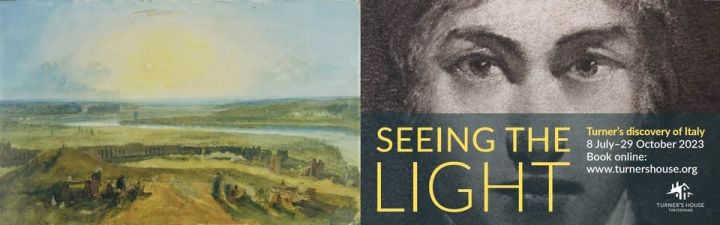
Left: J. M. W. Turner, The Roman Campagna from Monte Testaccio, Sunset, 1819, gouache, graphite, and watercolour on paper, 25 × 40 cm
(London: Tate, accepted by the nation as part of the Turner Bequest 1856, D16131).
◊ ◊ ◊ ◊ ◊
Closing this month at Turner’s House:
Seeing the Light: Turner’s Discovery of Italy in 1819
Turner’s House, Twickenham, 7 July — 29 October 2023
In the summer of 1819, the landscape artist J.M.W. Turner (1775–1851) set off on a journey to Italy that would have a profound impact on his life and work. Visitors to Turner’s House will be able to enjoy an exhibition of evocative watercolours capturing some of the painter’s first impressions of the place he was to later call the “land of all bliss,” and which provided inspiration for the rest of his career. Seeing the Light provides an exciting opportunity for the public to see some of Italy’s most well known and loved sites—Venice, Rome, Naples—through Turner’s eyes, in the unique setting of his then rural retreat in Twickenham. Visitors to this tightly-focussed exhibition will also be able to appreciate Turner’s evolving use of colour and light before and after 1819, thanks to generous loans from Tate, the Guildhall Art Gallery, and a private collection.
New Book | Exhibiting Antonio Canova
From Amsterdam UP:
Christina Ferando, Exhibiting Antonio Canova: Display and the Transformation of Sculptural Theory (Amsterdam: Amsterdam University Press, 2023), 296 pages, ISBN: 978-9463724098, €157 / $177.
 Exhibiting Antonio Canova: Display and the Transformation of Sculptural Theory argues that the display of Canova’s sculptures in the late eighteenth and early nineteenth centuries acted as a catalyst for discourse across a broad range of subjects. By enshrining his marble figures alongside plaster casts of ancient works, bathing them in candlelight, staining and waxing their surfaces, and even setting them in motion on rotating bases, Canova engaged viewers intellectually, physically, and emotionally. These displays inspired discussions on topics as diverse as originality and artistic production, the association between the sculptural surface, flesh, and anatomy, the relationship between painting and sculpture, and the role of public museums. Beholders’ discussions also shaped the legacy of important sculptural theories. They helped usher in their modern definitions and created the lenses through which we experience and interpret works of art, establishing modern attitudes not just towards sculpture, but towards cultural patrimony in general.
Christina Ferando is the Dean of Jonathan Edwards College and Lecturer in the Department of History of Art at Yale University.
c o n t e n t s
List of Illustrations
Acknowledgments
Introduction: Canova on Display
1 Imagining Sculptural Practice
2 Reevaluating Ancients and Moderns
3 Anatomizing the Female Nude
4 Challenging the Supremacy of Painting
5 Defining Modern Sculpture
Conclusion: Aftereffects
Bibliography
Index
Exhibition | Hub of the World: Art in 18th-Century Rome

Gaspar van Wittel, known as Vanvitelli, The ‘Casino’ of Cardinal Annibale Albani on the Via Aurelia, 1719, oil on canvas, 74 × 135 cm
(Private Collection, United Kingdom)
◊ ◊ ◊ ◊ ◊
From the press release (via Art Daily) for the exhibition:
Hub of the World: Art in 18th-Century Rome
Nicholas Hall Gallery, New York, 6 October — 30 November 2023
This fall, Nicholas Hall presents Hub of the World: Art in 18th-Century Rome, organized in association with the Milanese Galleria Carlo Orsi. Presented at the Upper East Side gallery in New York, the exhibition celebrates the legacy of esteemed American scholar, connoisseur, and artist Anthony M. Clark (1923–1976), who would have turned 100 this year.

Pompeo Batoni, Saint Louis Gonzaga, ca. 1744, oil on canvas, oval, in an 18th-century frame, 81 × 67 cm (Private Collection, NY).
Considered one of the most influential and admired museum professionals of his generation, Clark made a profound impact on American collecting trends in the 1950s and 1960s through his taste for art made in 18th-century Rome, especially the paintings of the Pompeo Batoni. The exhibition brings together more than 60 works by artists who lived in or traveled to Rome in the 18th century, along with a selection of Clark’s personal notebooks and a portrait photograph on loan from the National Gallery of Art in Washington, DC.
After graduating from Harvard, Clark began his career in 1955 at the Rhode Island School of Design before going on to prominent curatorial roles at the National Gallery of Art, the Metropolitan Museum of Art, and the Minneapolis Institute of Arts, of which he later became director. He also taught art history at the Institute of Fine Arts, NYU and at Williams College, Williamstown. During his tenure at Mia and The Met, Clark made significant acquisitions for the institutions and organized world-class exhibitions as a pioneering American scholar of 18th-century Rome.
The Hub of the World brings to light the fundamental role Clark played in the revival of interest among American museums in collecting work from this period. Clark deeply believed in the importance of Roman Settecento painting, drawing, and sculpture, and this passion is brilliantly reflected in his scholarship and writings. As a curator, he consistently created a historic context for art by showing sculpture and decorative arts alongside paintings and drawings at a time when it was customary to maintain a ‘hierarchy’ of the arts by studying and displaying the mediums separately.

Domenico Corvi, The Liberation of Saint Peter, 1770, oil on canvas, 63 × 49 cm (Private Collection, Paris).
Tragically Clark succumbed to a heart attack at age 53 while jogging in his favorite city, where, at the time, he was a fellow at the American Academy in Rome. Born in Philadelphia, Clark worked closely with curators at the Philadelphia Museum of Art over the course of his career; and, in 2000, the PMA—in partnership with the Museum of Fine Arts, Houston—mounted The Splendor of 18th-Century Rome, which was dedicated to his memory.
In the words of Nicholas Hall: “Anthony Clark was a larger-than-life character who changed the way we look at Old Masters. He rescued the art of 18th-century Rome from obscurity by dint of his own personal enthusiasm and brilliant scholarship. He had enormous personal charm: the son of the owner of two works in the exhibition remembers how, as a boy, he enjoyed Clark’s visits to see his parents. Clark, an avid ornithologist, later bequeathed to him a stuffed Green Woodpecker. Our exhibition is an homage to a great scholar, a tastemaker, and a dedicated museum professional.”
Hub of the World highlights the richness of the culture of 18th-century Rome with its extraordinary mixture of patronage, from popes and cardinals, to Roman aristocrats and visiting foreigners—including the German writer and poet Johann Wolfgang von Goethe, from whom the exhibition borrows its title. Goethe deemed Rome the “hub of the world,” writing that “the entire history of the world is linked up with this city.” Hall and Orsi have gathered a diverse selection of paintings, drawings, sculpture, and decorative arts that will provide a rare opportunity to experience the cosmopolitan appeal of 18th-century Rome.

Hubert Robert, Colonnade and Gardens at the Villa Medici, 1759, oil on canvas, 75 × 64 cm (Assadour O. Tavitian Trust).
Headlining the exhibition is View of the Villa Medici by Hubert Robert (1733–1808), painted in 1759 during the artist’s transformative time in Rome and on loan from the Assadour O. Tavitian Trust. A recent discovery, the exceptional work has rarely been on view to the public—previously only exhibited in the U.S. briefly at the National Gallery of Art. Other works on view include the Hemp Harvest in Caserta, executed by Jackob Philipp Hackert for the King of Naples; a portrait of the Cardinal Carlo Rezzonico by Anton Raphael Mengs that remained in the sitter’s family until the last decade; a unique view of the Villa Albani by Vanvitelli, recorded in the inventory of Cardinal Albani; a pair of oil on coppers by Angelika Kauffmann based on James Thomson’s pastoral poetry that newly resurfaced from a private Kenyan collection; a caricature painting by Joshua Reynolds, recently discovered at the estate where it has hung for over two centuries; A Vestal by Jacques-Louis David painted in Rome; a harbor scene painted on copper by Claude Joseph Vernet; Anton von Maron’s Portrait of Two English Gentlemen before the Arch of Constantine; the Rockingham Silenus, a 1st-century sculpture reworked by the celebrated Roman sculptor Bartolomeo Cavaceppi; a set of candelabras in the form of Antonius-Osirus by Luigi Valadier; and a console table designed by Antonio Asprucci, made for the Egyptian Room of the Palazzo Borghese. The exhibition pays tribute to Clark as an expert on Pompeo Batoni, as represented by a painting of Saint Louis Gonzaga and its preparatory drawing in red chalk, among several other works. Once belonging to Clark, a painting of the artist Paolo de Matteis by Pier Leone Ghezzi will also be showcased.
In conjunction with the exhibition, Nicholas Hall and Galleria Carlo Orsi will publish a fully illustrated catalogue with original essays by Italian art experts and renowned historians Edgar Peters Bowron, Alvar Gonzáles-Palacios, Melissa Beck Lemke, and J. Patrice Marandel.

Pier Leone Ghezzi, Four Samples of Classical Polychrome Marbles, 1726, watercolor on paper; from top left clockwise: ‘Diaspro Verde Fiorito, 16 × 21 cm, ‘Bianco e negro antico’, 19 × 24 cm, ‘Broccatello’, 19 × 21 cm, ‘Alabastro Orientale’, 19 × 23 cm (Private Collection, Italy). To be published by Dr. Adriano Aymonino in his upcoming book from MIT press, Paper Marbles: Pier Leone Ghezzi’s Studio di Molte Pietre (1726).
Talk and Exhibition | The Jews, the Medici, and the Ghetto of Florence
From the Medici Archive Project (MAP):
Piergabriele Mancuso and Alice S. Legé | The Jews, the Medici, and the Ghetto of Florence: History and Challenges of an Exhibition
Online, The Medici Archive Project, 10 October 2023, 5pm (EDT)

Ketubah (Marriage Contract), 1739 (Archivio di Stato di Firenze)
The exhibition The Jews, the Medici, and the Ghetto of Florence (Gli ebrei, i Medici, e il Ghetto di Firenze)—on view from 23 October 2023 until 20 January 2024 at the Palazzo Pitti—offers a comprehensive exploration of a relatively understudied aspect of the Medici and Jewish history. Delving into the intricate evolution of the Florentine Ghetto, the exhibition traces the site’s history from its establishment under the Grand Duke Cosimo I de’ Medici in 1570 to its eventual dissolution in the 19th century. Visitors will see a rich array of artifacts, including illuminated manuscripts, paintings, archival documents, photographs, maps, and sculptures. These items provide insights into the complex relationship between the Jewish community and the Grand Duchy of Tuscany.
This talk by the exhibition’s curators will focus on the creation of the exhibition, prompting important inquiries into topics such as segregation, protective measures, urban integration, and the invaluable cultural contributions made by the Jewish populace during the Florentine Renaissance.
To watch this talk, click here on Tuesday, 10 October, at 5pm (EDT).
New Book | The Ingenious Mr Flitcroft
Coming this fall from Lund Humphries:
Gill Hedley, with an introduction by Charles Saumarez Smith, The Ingenious Mr Flitcroft: Palladian Architect, 1697–1769 (London: Lund Humphries, 2023), 192 pages, ISBN: 978-1848226500, £50.
 Henry Flitcroft was first employed by the leading aristocratic architect of the time, Richard Boyle, Lord Burlington, who helped him to establish his long career. Flitcroft had about 50 clients over 40 years, working for many dynasties, including the royal family, the Bedfords, the Yorke/Hardwickes, and the Malton/Rockinghams. Remarkably, he was employed regularly by the Duke of Montagu and his family from 1725 to 1765, and the Hoare family from 1728 to his death in 1769, and was responsible for some of the great country houses of the period including Wimpole, Woburn Abbey, and Wentworth Woodhouse. This is the first book which details his life and examines his complete body of work. It sets Flitcroft within his social context, providing insights into those for whom he worked as well as his fellow architects. Flitcroft waged fierce battles to maintain his professional positions at Westminster Abbey and St Paul’s, and the documents are revealed here for the first time. The book dissects the dramatic story of Flitcroft’s insane son and the legal cases that ensued that link Flitcroft and G.E. Street, who inherited Flitcroft’s own house in Hampstead. In addition, Flitcroft’s furniture designs are assessed along with his notable churches and London buildings including Chatham House, Benjamin Franklin House, and Pushkin House. Finally, his last great project at Stourhead is re-examined.
Gill Hedley started her career as a curator in museums, organising exhibitions for the British Council and later, as Director of the Contemporary Art Society. She has recently worked as a freelance exhibition curator, museum consultant, and advisor to individual artists. She now writes full time.
c o n t e n t s
Introduction by Sir Charles Saumarez-Smith
1. Hampton Court, Apprencticeship, and Lord Burlington
2 Twickenham, Marriage, and Bower House
3 Amesbury, Montagu House, and St Giles-in-the-Fields
4 St Giles-in-the-Fields
5 Wentworth Woodhouse and Ditchley
6 St Olave’s, Savannah, Stoke Edith, Wimborne, and Frognal
7 Wimpole and Hampstead
8 Shobdon, Windsor, and Woburn
9 Stourhead
10 Stourhead, Redlynch, and Kingston House
11 Henry Flitcroft, Junior
12 Reputation
Online Book Launch | Pevsner’s Oxfordshire
From The Mellon Centre:
Simon Bradley, Nikolaus Pevsner, and Jennifer Sherwood, Oxfordshire: Oxford and the South-East, Pevsner Architectural Guides: Buildings of England (New Haven: Yale University Press, 2024), 800 pages, ISBN: 978-0300209297, $85.
Book Launch with Simon Bradley, Geoffrey Tyack, and James Davies
Online, Paul Mellon Centre for Studies in British Art, London, 2 November 2023, 6pm
 Simon Bradley, series editor of the Pevsner Architectural Guides, will discuss the latest volume in the series with Geoffrey Tyack of Kellogg College, Oxford. The book addresses half a century of change and development since the original edition of 1974 by Nikolaus Pevsner and Jennifer Sherwood, completing the revision of Oxfordshire initiated with Alan Brooks’s North and West volume of 2017. Fresh accounts are provided of the many ambitious new buildings for the university and its colleges, familiar landmarks such as the Bodleian Library and the Radcliffe Camera are reinterpreted and the many renovations and extensions are described and assessed. Oxford’s commercial buildings, suburbs, and houses are explored in depth, including much that is published here for the first time. The accompanying county area extends from the outskirts of Oxford to Henley-on-Thames, following the historic Thames-side boundary of Oxfordshire and taking in the hills of the southern Chilterns. Here the volume includes enhanced accounts of major country houses such as Nuneham Courtenay and Thame Park, new assessments of church restorations, furnishings and stained glass, more inclusive coverage of post-war buildings, and a fuller selection of vernacular and rural architecture across the whole of this attractive and rewarding quarter of rural England. The evening will also include a contribution from James O. Davies, who will talk about the challenges and rewards of taking photographs of the region’s best buildings for the new volume.
Yale University Press is delighted to offer attendees of the virtual launch a special discount price for the new Pevsner guide to Oxfordshire. Attendees will receive a discount code with their Eventbrite confirmation email.
Book online tickets here»
Simon Bradley is series editor of the Pevsner Architectural Guides and co-author of four other Buildings of England volumes: London 1: The City, London 6: Westminster, Cambridgeshire, and Berkshire.
Geoffrey Tyack is Fellow Emeritus of Kellogg College, Oxford, where he has taught urban and architectural history for many years. He is co-author of the Pevsner Architectural Guides’ Berkshire volume and has also published widely on 19th- and 20th-century architectural subjects. His recent books include The Historic Heart of Oxford University (2022).
James Davies has worked as an architectural photographer for thirty years. He has published widely, with books on English prisons, tin mining, post-war buildings, Stonehenge, and many Pevsner volumes, as well as in magazines including Wallpaper, The World of Interiors, Country Life, and Blueprint.
New Book | Dr Andrew Coltée Ducarel
Available for pre-order from Bernard Quaritch Ltd:
Robin Myers, with Andrew Burnett and Renae Satterley, ‘I do not eat the bread of idleness’: Dr Andrew Coltée Ducarel (1713–1785), Huguenot, Advocate, Librarian, Architectural Historian, Numismatist, and Antiquary (Leicester: The Garendon Press, 2023), 264 pages, £45.
 This volume brings together revised versions of four of Robin Myers’s papers on aspects of Andrew Ducarel’s life and work published between 1994 and 2002, and “The Life and Times of the Ducarel Brothers,” her recent introductory essay to Two Huguenot Brothers: Letters of Andrew and James Coltée Ducarel, 1732–1773 (The Garendon Press, 2019), which has been updated with a section by Adam Pollock on the life of the Ducarel children among other Huguenot families in Greenwich. It also contains new essays by Robin Myers on the collaboration and developing friendship between Ducarel and Philip Morant (1700–1770), historian of Essex, and on Doctors’ Commons, an institution whose name most know but few understand. To complement these, Renae Satterley, Librarian of the Middle Temple, contributes an essay on Doctors’ Commons Library, and Andrew Burnett, former Keeper of Coins and Medals at the British Museum, on Ducarel as numismatist. The appendix comprises a family tree from Ducarel to the present day, an annotated list of works of Andrew Ducarel, a timeline of Ducarel’s life, and bibliography. Penelope Bulloch, Christine Ferdinand, and Lorren Boniface helped to edit the work.
Dr Andrew Coltée Ducarel (1713–1785) and his two younger brothers were brought to England in 1722 as infants by their widowed mother fleeing persecution for her faith. Ducarel became a civilian or advocate of Doctors’ Commons, the Inn of Court specialising in Roman and Canon law which dealt with ecclesiastical law, marriage, divorce, and probate, and maritime law in the High Court of Admiralty. Ducarel made a good living as an advocate, which fully occupied him in term time, while his vacations were given to his work as Librarian of Lambeth Palace from 1754. He was an active member of the Society of Antiquaries, pioneered the study of Norman architecture, and was a keen book and coin collector.
‘I do not eat the bread of idleness’ has been designed by Robert Dalrymple. Consisting of 264 pages, measuring 285 x 170 mm, it is profusely illustrated with portraits, coins from Ducarel’s collection, plates from works by Andrew Ducarel, and other contemporary prints sourced by Penelope Bulloch; it has attractive endpapers, sewn binding, rounded and backed and an eye-catching jacket. It is designed as a companion piece to Two Huguenot Brothers and will appeal to those who appreciate excellence in book production.
The Burlington Magazine, September 2023
The eighteenth century in the September issue of The Burlington:
The Burlington Magazine 165 (September 2023)

Bed, by Ince and Mayhew, 1768, mahogany and other woods, with original blue silk ‘flowered tabby’ in the ‘Large Antique Headboard’, tester and cornice, height 356 cm (Stamford: The Burghley House Collection).
a r t i c l e r e v i e w
• Lucy Wood, “The Industry and Ingenuity of William Ince and John Mayhew,” pp. 996–1001.
Fifty years ago, the question was asked what had become of the furniture made by Ince and Mayhew, one of the most successful and long-lasting firms of cabinetmakers in eighteenth-century London? A monograph by Hugh Roberts and Charles Cator, decades in the making, provides the answer in a revelatory picture of the achievements of these rivals of Thomas Chippendale.
r e v i e w s
• Christoph Martin Vogtherr, Review of the exhibition Rosalba Carriera – Perfection in Pastel (Gemäldegalerie Alte Meister, Zwinger, Dresden, 2023), pp. 1007–10.
• Christopher Baker, Review of the Redevelopment of the National Portrait Gallery, London (reopened in June 2023), pp. 1013–17.
• Raha Shahidi, Review of the exhibition catalogue L’Amour en scène! François Boucher, du théâtre à l’opéra, ed. by Hélène Jagot, Jessica Degain, and Guillaume Kzerouni (Éditions Snoeck, 2022), pp. 1029–31.
• Christopher Rowell, Review of Tessa Murdoch, ed., Great Irish Households: Inventories from the Long Eighteenth Century (John Adamson, 2022) and Conor Lucey, ed., House and Home in Georgian Ireland: Spaces and Cultures of Domestic Life (Four Courts Press, 2022), pp. 1038–40.
• Armin Kunz, Review of Mareike Hennig and Neela Struck, eds., Zeichnen im Zeitalter Goethes: Zeichnungen und Aquarelle aus dem Freien Deutschen Hochstift (Hirmer, 2022), pp. 1040–42.

Sewell Bequest, 2008,3008.1). Room 18 of the National Portrait Gallery, London, showing the newly acquired Portrait of Mai (Omai) by Joshua Reynolds (c. 1776) as the centrepiece of a group of eighteenth-century portraits (Photography by Dave Parry).
Print Quarterly, September 2023
The long eighteenth century in the latest issue of Print Quarterly:
Print Quarterly 40.3 (September 2023)
a r t i c l e s
 • Vitalii Tkachuk, “Averkiy Kozachkovskyi and Western Sources of Kyiv Prints, 1720s–40s,” pp. 265–86.
This article features the oeuvre of the Ukrainian engraver Averkiy Kozachkovskyi (active 1721–46), whose illustrated output by the press of the Orthodox monastery Kyiv of the Caves (Kyiv Pechersk Lavra) numbers about forty engravings. He primarily produced book illustrations, but also illustrated printed oaths taken by new members of the local student confraternity. His sources derived largely from seventeenth- and eighteenth-century Catholic imagery from German, Flemish, and French schools, several of which are discussed in detail throughout the article, especially the compositions of Peter Paul Rubens. Such borrowings testify to the willingness of Orthodox recipients to accept imagery—unaltered in iconography or style—stemming from other denominations and cultures. The paper contributes to our knowledge of Ukrainian engraving and to the study of the global transfer of images during the early modern period.
• Nicholas J.S. Knowles, “Thomas Rowlandson’s The Women of Muscovy and Other Russeries after Jean-Baptiste Le Prince,” pp. 287–301.
This article discusses a previously unidentified series of prints by Thomas Rowlandson (1757–1827), after Jean-Baptiste Le Prince (1734–1781), mentioned only as a single lot in the sale of his art collection and studio contents. No definitive set of these “Various Dresses of the Women in Muscovy” has been found, but the author has identified several substantial groups in public and private collections; the largest of these, with twenty-two prints, is in the British Museum. Most of these Rowlandson impressions reside among Le Prince originals and have previously been catalogued as by or after Le Prince. As a series overall, five hundred and forty impressions are claimed to have been produced in the lot description. The article continues with an in-depth discussion of the series and its context. An appendix lists all known impressions of Rowlandson’s Women of Muscovy prints and their location.
n o t e s a n d r e v i e w s
• Mark McDonald, Review of Susan Stewart, The Ruins Lesson: Meaning and Material in Western Culture (The University of Chicago Press, 2020), pp. 322–25. This book explores the significance of ruins in Western art and literature, paying close attention to the evidentiary role of prints and how the printmaking process parallels the ruinous lifecycle of its subject matter. In the review, Piranesi is cited as a fascinating example of creating trompe l’oeil in his prints, while later discussions focus on the discovery and metaphorical associations of Rome’s antique ruins in the eighteenth century.
• David Bindman, Review of the exhibition catalogue, Edina Adam and Julian Brooks, William Blake: Visionary (Getty Publications, 2020), pp. 330–31. This brief review pertains to a previously rescheduled, now forthcoming, exhibition on William Blake at the J. Paul Getty Museum. The author examines the collecting of Blake in America and some of the curatorial choices for this anticipated show.
 • Patricia Mainardi, Review of Pascal Dupuy and Rolf Reichardt, La caricature sous le signe des révolutions. Mutations et permanences, XVIIIe–XIXe siècles (Presses Universitaires de Rouen et du Havre, 2021), pp. 331–34. This book and review introduce the origins and rapid development of caricature during the French Revolutionary period, focusing on how topical imagery and signs manifested into an accessible visual language capable of being understood by ordinary citizens at the time. More importantly, many of these signifying tropes, such as severed heads and raids on government buildings have become universally recognisable up to the present day.
• Mark Bills, Review of Tim Clayton, James Gillray: A Revolution in Satire (Paul Mellon Centre for Studies in British Art, 2022), pp. 353–57. This extensive review of the latest monograph on James Gillray highlights the British artist’s unique achievements in the world of graphic satire. The book bravely tackles some of his previously neglected areas, such as very early and pornographic prints, or previously unpublished ones that can now be contextualised. The same is true of Gillray’s interplay of word and image (his titles, conversations and commentary of the images), which the author believes is Clayton’s most original piece of scholarship in this book.
• Jeannie Kenmotsu, Review of the exhibition catalogue, Hans Bjarne Thomsen, ed., Japanische Holzschnitte: Aus der Sammlung Ernst Grosse / Japanese Woodblock Prints: From the Ernst Grosse Collection (Michael Imhof Verlag, 2018), pp. 357–60. This review recognises the value of this catalogue in bringing Ernst Grosse and his collecting practices to a larger audience, especially since the Museum Natur und Mensch’s collection of Japanese woodblock prints was a historically important case of intersection between European japonisme and ethnological approaches to non-Western cultures. Most of Grosse’s acquisitions were made through the art dealer Hayashi Tadamasa.










 Enfilade
leave a comment