At Sotheby’s | Delamarre’s Portrait of a Small Poodle
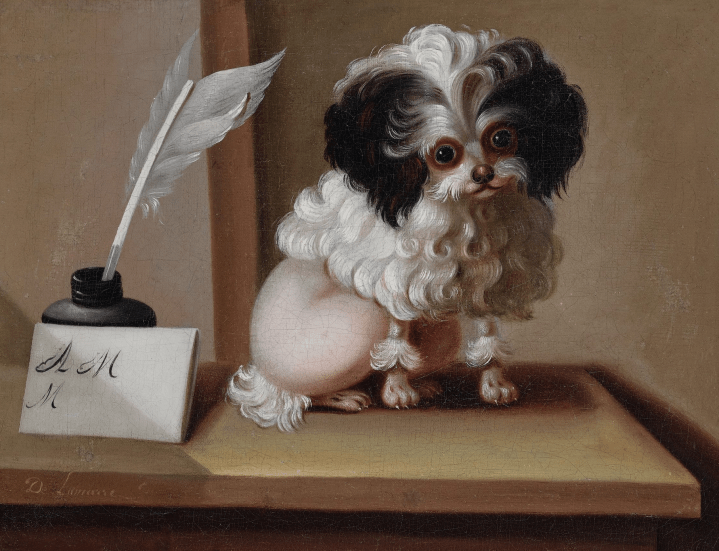
Jacques Barthélémy Delamarre, Portrait of a Small Poodle, Said to be ‘Pompon,’ a Beloved Dog of Marie Antoinette, oil on canvas, 34 × 41 cm
(Sotheby’s)
◊ ◊ ◊ ◊ ◊
For anyone who missed this story from a few months back . . . As reported by HyperAllergic:
Elaine Velie, “Portrait of Marie Antoinette’s Dog Skyrockets at Auction,” HyperAllergic (26 May 2023). Jacques Barthélémy Delamarre’s 18th-century canine portrait, said to depict the French queen’s beloved ‘Pompon’, sold for a whopping $280K.
A delightful little dog portrait made a royal showing at Sotheby’s this morning (26 May 2023), where it sold for $279,400 including fees—nearly 56 times its high estimate of $5,000. Jacques Barthélémy Delamarre’s late 18th-century oil painting is thought to be a depiction of Marie Antoinette’s ‘Pompon’, one of the French queen’s many canine companions. Mystery shrouds the subject of the portrait, but little is known about the artist, too. . .
The full article is available here»
New Book | Venice: City of Pictures
Coming this fall from Thames & Hudson:
Martin Gayford, Venice: City of Pictures (London: Thames & Hudson, 2023), 384 pages, ISBN: 978-0500022665, $40.
 A visual journey through five centuries of the city known for centuries as, ‘La Serenissima’—a unique and compelling story for both lovers of Venice and lovers of its art.
Enchanting, captivating, precious—Venice is one of the most cherished cities in the world. For centuries it was the heart of a global maritime power and a crossroads for diverse cultures. Today the city attracts millions of visitors each year, enticed by its irresistible beauty. Art lovers are drawn here by the paintings, prints, drawings, and films made by generations of artists who have captured its magical allure. It is through images—both of the city and the art created there—that Venice’s identity has been forged and spread so powerfully. Venice was a major center of art in the Renaissance: the city where the medium of oil on canvas became the norm. The achievements of the Bellini brothers, Vittore Carpaccio, Giorgione, Titian, Tintoretto, and Paolo Veronese are a key part of this story. Nowhere else has been depicted by so many great painters in so many diverse styles and moods. Venetian views were a specialty of native artists such as Canaletto and Francesco Guardi, but the city has also been represented by outsiders: William Turner, Claude Monet, John Singer Sargent, Howard Hodgkin, and many more. Then there are those who came to look at and write about art. The reactions of Henry James, George Eliot, Richard Wagner, and others enrich this tale. Nor is the story over. Since the advent of the Venice Biennale in the 1890s, the city has become a shop window for the contemporary art of the whole world. In this elegant volume, Martin Gayford takes us on a visual journey through the past five centuries of the city known as “La Serenissima,” the ‘Most Serene’.
Martin Gayford is art critic for The Spectator. His books include Man with a Blue Scarf; Modernists and Mavericks; Spring Cannot Be Cancelled, with David Hockney; A History of Pictures, with David Hockney; Shaping the World, with Antony Gormley; and Love Lucian: The Letters of Lucian Freud, 1939–1954, with David Dawson.
Exhibition | Drawings by Giambattista and Domenico Tiepolo
Opening this fall at The Morgan:
Spirit and Invention: Drawings by Giambattista and Domenico Tiepolo
The Morgan Library & Museum, New York, 27 October 2023 — 28 January 2024
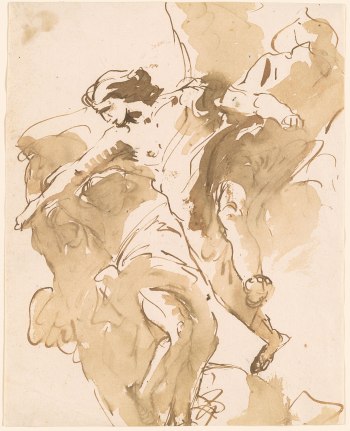
Giovanni Battista Tiepolo, Three Angels in Flight, 1754, pen and brown ink, with brown wash on paper, 26 × 20 cm (New York: The Morgan Library & Museum, IV, 95a).
The Morgan is home to one of the world’s largest and most important collections of drawings by Giambattista Tiepolo (1696–1770) and his eldest son Domenico (1727–1804), with more than 300 representative examples of their lively invention and masterful techniques. Combining highlights from the Morgan’s collection with carefully selected loans, this exhibition will provide a comprehensive look at the the Tiepolos’ work as draftsmen, focusing on the role of drawing in their creative process and the distinct physical and stylistic properties of their graphic work.
At the core of the collection and exhibition are substantial groups of Giambattista’s drawings that relate to major ceiling fresco projects of the 1740s and 1750s. A fresh look at the style, function, and material properties of these working drawings has yielded new insights into their purposes. Most significantly, the exhibition presents for the first time extremely rare pen studies for Tiepolo’s magnum opus, the ceiling fresco above the staircase of the Würzburg Residenz of 1752, and a group of bold sketches newly connected with his ceiling fresco of 1754 at the Venetian church of Santa Maria della Pietà. Other sections of the exhibition highlight the introduction of Domenico to the family workshop, the exchanges between father and son, and the great series drawings by both: Giambattista’s fantastic heads and figures seen di sotto in su, and Domenico’s drawings of animals, biblical scenes, and contemporary life. The exhibition will end with a wall including striking examples from Domenico’s late Punchinello series.
r e l a t e d p r o g r a m m i n g
Friday, 27 October 2023, 6.00pm
Lecture by John Marciari (Charles W. Engelhard Curator, Drawings and Prints), A Magical Performance: Drawings by Giambattista and Domenico Tiepolo
Thursday, 16 November 2023, 7.30pm
Concert — I Gemelli, A Room of Mirrors: Music by d’India, Marini, Frescobaldi, Calestani, and Gregori | Emiliano Gonzalez Toro, director and tenor; Zachary Wilder, tenor
Since 1980, the Boston Early Music Festival has been at the forefront for excellence in the field of Early Music throughout North America; BEMF began co-presenting concerts and opera productions at the Morgan in 2006.
Friday, 15 December 2023, 5.30pm
Gallery Talk by John Marciari (Charles W. Engelhard Curator, Drawings and Prints)
Exhibition | La Serenissima: Drawing in 18th-Century Venice
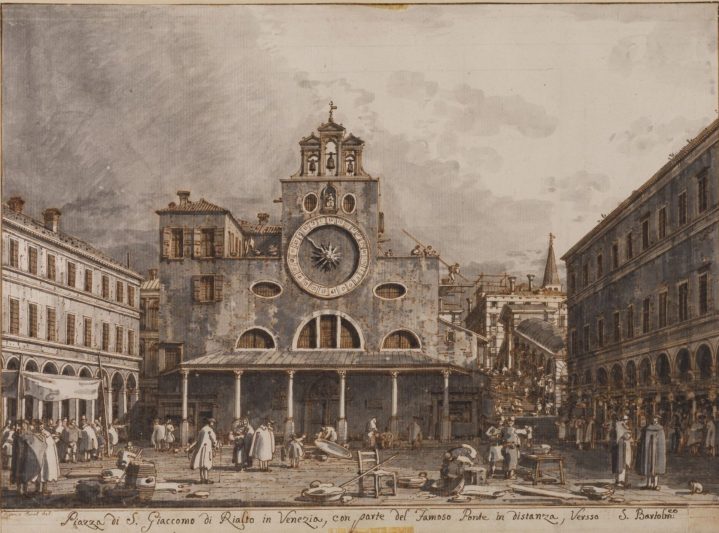
Giovanni Antonio Canaletto, Piazza San Giacomo di Rialto, 1760–69
(London: The Courtauld)
◊ ◊ ◊ ◊ ◊
Opening in October at The Courtauld:
La Serenissima: Drawing in 18th-Century Venice
The Courtauld, London, 14 October 2023 — 11 February 2024
Curated by Marco Mansi with Ketty Gottardo
La Serenissima: Drawing in 18th-Century Venice presents an outstanding group of around twenty Venetian drawings from The Courtauld’s collection. They evoke the energy and creativity of Venice at a time when the city flourished as one of the great cultural capitals of Europe. At the dawn of the 18th century, Venice was a magnet for visitors from across Europe, drawn by its architecture, history, and cosmopolitan atmosphere. Many of the artists featured in this exhibition produced works for an international clientele, who avidly collected images of the city, its inhabitants, and its colourful traditions. Landmarks such as St Mark’s Square and the Grand Canal set the stage for Canaletto’s celebrated views of the city’s lively streets and waterways. Piazzetta’s evocative head studies and Giambattista Tiepolo’s playful caricatures depict an early modern metropolis populated by a myriad of characters of different social backgrounds, while Guardi’s panoramic Feast of Ascension Day records the formal splendour and ceremony of the city known as La Serenissima—the most serene.
The display is curated by Marco Mansi, PhD candidate and Print Room Assistant at the Courtauld, under the supervision of Ketty Gottardo, Curator of Drawings.
Exhibition | Allegories for Learning: Italian Works on Paper

Guido Reni, Allegory of Learning (Seated Woman Holding a Tablet and Compass, alongside a Winged Putto), detail, ca. 1600–40, etching, Bartsch XVIII.289.16 (Athens: Georgia Museum of Art).
◊ ◊ ◊ ◊ ◊
Now on view at the Frost Art Museum in Miami:
Allegories for Learning:
16th- to 18th-Century Italian Works on Paper from the Georgia Museum of Art
Patricia & Phillip Frost Art Museum, Florida International University, Miami, 10 June — 10 September 2023
Curated by Nelda Damiano
Drawing became valued as an independent art form in Europe around the end of the 14th century. In studios and academies, apprentices repeatedly copied prints and drawings to improve their observational skills and hone their technique. With increased proficiency came more challenging exercises, such as using plaster casts and live models for arts instruction. This exhibition of works on paper illuminates how a drawing’s appearance reflects its geographical origin and the hand of an artist. The work’s formal qualities—media, support, variation of the lines—can point to a specific region in Italy. The location then makes it easier to narrow the list of contenders for authorship. This attribution process illustrates how influential artists who primarily lived in cultural centers, such as Florence, Bologna, and Venice, shaped generations of pupils and followers throughout Italy and beyond. Drawing played a central role in the creative process, the transmittal of ideas, and the spread of artistic styles. The works included here reinforce the power of drawings as a rich and varied medium. The exhibition is curated by Nelda Damiano, the Pierre Daura Curator of European Art at the Georgia Museum of Art in Athens.
New Book | Lauritz de Thurah: Architecture and Worldviews
From Strandberg Publishing:
Peter Thule Kristensen, ed., with contributions by Thomas Lyngby, Else Marie Bukdahl, Martin Søberg, Sanne Maekelberg, Natalie Körner, and Nina Ventzel Riis, Lauritz de Thurah: Architecture and Worldviews in 18th-Century Denmark (Copenhagen: Strandberg Publishing, 2023), 432 pages, ISBN: 978-8794102704, £70.
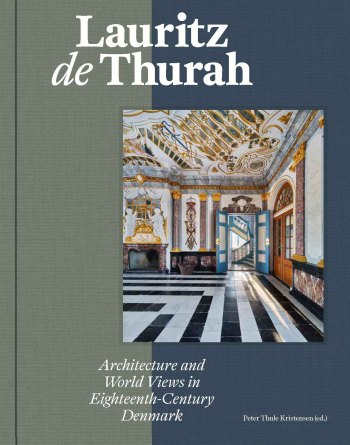 Lauritz de Thurah (1706–1759) was one of Denmark’s most significant architects of the Baroque period. He created several important buildings—including the Hermitage Hunting Lodge, the Royal Palace in Roskilde, Gammel Holtegaard, and the famous spire of the Church of Our Saviour in Copenhagen—and masterminded conversions and extensions of properties such as Ledreborg, Frederiksberg Castle, Børglum Kloster, and the now demolished summer residence Hirschholm Palace (widely known as the ‘Versailles of the North’). The mainstay of this monograph is Peter Thule Kristensen’s presentation of Thurah’s rich and complex architecture. The other chapters—written by experts Else Marie Bukdahl, Martin Søberg, Thomas Lyngby, Natalie Patricia Körner, Sanne Maekelberg, and Nina Ventzel Riis—describe Thurah’s roles as a leading architectural historian, topographer, grand tour traveller, civil servant, military man, and trailblazer within the new social structure in Denmark under absolute rule. The book also sheds light on the Baroque period in a broader sense, delving into the era’s court culture, garden design, and church architecture. Finally, the afterlife of Thurah’s works is addressed: how do his buildings function in our present day, having been adapted to the needs and users of a new era?
Peter Thule Kristensen is Professor, Head of the Master Programme Spatial Design at the Royal Danish Academy – Institute of Architecture and Design and a Core Scholar at the Centre for Privacy Studies at University of Copenhagen. He is M.Arch. from The Royal Danish Academy of Fine Arts, School of Architecture (1994), Ph.D. in architectural history from the same institution (2014), and dr.phil. in art history from Aarhus University (2014).
New Book | The Architecture of Empire
From McGill-Queen’s University Press:
Gauvin Alexander Bailey, The Architecture of Empire: France in India and Southeast Asia, 1664–1962 (McGill-Queen’s University Press, 2022), 488 pages, ISBN: 978-0228011422, $74.
 Most monumental buildings of France’s global empire—such as the famous Saigon and Hanoi Opera Houses—were built in South and Southeast Asia. Much of this architecture, and the history of who built it and how, has been overlooked. The Architecture of Empire considers the large-scale public architecture associated with French imperialism in seventeenth- and eighteenth-century India, Siam, and Vietnam, and nineteenth- and twentieth-century Indochina, the largest colony France ever administered in Asia. Offering a sweeping panorama of the buildings of France’s colonial project, this is the first study to encompass the architecture of both the ancien régime and modern empires, from the founding of the French trading company in the seventeenth century to the independence and nationalist movements of the mid-twentieth century.
Gauvin Bailey places particular emphasis on the human factor: the people who commissioned, built, and lived in these buildings. Almost all of these architects, both Europeans and non-Europeans, have remained unknown beyond—at best—their surnames. Through extensive archival research, this book reconstructs their lives, providing vital background for the buildings themselves. Much more than in the French empire of the Western Hemisphere, the buildings in this book adapt to indigenous styles, regardless of whether they were designed and built by European or non-European architects. The Architecture of Empire provides a unique, comprehensive study of structures that rank among the most fascinating examples of intercultural exchange in the history of global empires.
Gauvin Alexander Bailey is professor and Alfred and Isabel Bader Chair in Southern Baroque Art at Queen’s University and the author of Architecture and Urbanism in the French Atlantic Empire.
c o n t e n t s
Acknowledgments
1 Introduction: Architecture, Empire, and Hubris
2 Origins: Fort Dauphin, Surat, Pondicherry, ca 1672
3 DipLomacy: Ayutthaya, ca 1688
4 Grandeur: Pondicherry, ca 1752
5 Interregnum: Diên Khánh, ca 1793
6 Semblance: Saigon and Hanoi, ca 1900
7 Appropriation: Phnom Penh, ca 1917
8 Association: Saigon and Hanoi, ca 1925
9 Hybridity: India and Southeast Asia, 1738–1962
Notes
Bibliography
Index
Sweden Nationalmuseum Acquires Portrait of Axel von Fersen
From the press release (9 August 2023). . .
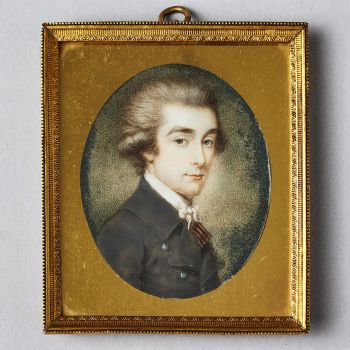
Unknown British artist, Portrait of Axel von Fersen, 1778 (Stockholm: Nationalmuseum; photo by Stockholms Auktionsverk).
Nationalmuseum has acquired a portrait of Axel von Fersen at the age of 23, painted in London in the summer of 1778. The superb miniature by an unknown British artist depicts a self-assured young man, perhaps on account of his intended marriage to a rich heiress. It was unusual for British artists to paint portraits of Swedish subjects in the latter half of the 18th century.
Axel von Fersen (1755–1810) has become known around the world for his close relationship with Queen Marie-Antoinette. As the current exhibition at the Archives Nationales in Paris makes clear, his affections were reciprocated [Louis XVI, Marie-Antoinette et la Révolution: La famille royale aux Tuileries, 1789–1792]. The two first met at a masked ball in January 1774. Some months later, Fersen travelled to London. Although he did not stay long, he learned some English, which was unusual for a Swede in the 18th century. Fersen returned to the British capital in April 1778 for a visit lasting four months, during which time he sat for an unidentified portrait painter. The graphic nature of the portrait, where the hair and face are made up of a combination of lines and dots in brown tones against a gridlike background, is typical of British miniature painting of the time. In contrast to this vibrant depiction, the subject’s grey coat appears somewhat muted, with a few shaded areas.
Why did the young Fersen commission this portrait of himself during his time in London? Did it have something to do with his intended marriage to Catharina, the daughter of Henrik Leijel (Henry Lyell), a wealthy Swedish-British merchant? Nothing came of this prospective marriage of convenience. Instead, Fersen returned to Paris and embarked on a military career. Two years later, he travelled to North America as aide-de-camp to the head of the French expeditionary force, General Count de Rochambeau. Fersen’s knowledge of English proved very useful in this role, since General George Washington did not speak French. For three years, Fersen acted as interpreter between the allies in their war against the British colonial power. On returning to Paris in the summer of 1783, he was appointed colonel of the Royal Suédois regiment, but soon after was ordered to accompany King Gustav III of Sweden on a year-long trip to Italy.
The rest of the story is well known: Fersen’s love affair with Marie-Antoinette, his repeated attempts to save her and other members of the royal family during the French Revolution, and his own tragic death at the hands of a mob on the streets of Stockholm. The portrait of the young Fersen eventually came into the possession of one of his siblings and remained in the family’s ownership for many years before its recent acquisition by Nationalmuseum.
Magnus Olausson, emeritus director of collections at Nationalmuseum, said: “The portrait of the young Axel von Fersen represents a rare interlude in 18th-century Swedish-British relations. As far as we know, few Swedes were immortalised by British artists in those days. This iconic portrait of Fersen is an unusually fine work by an unknown British miniaturist, in a style somewhat reminiscent of stipple engraving, which was the great innovation of the time.”
Nationalmuseum receives no state funds with which to acquire design, applied art and artwork; instead the collections are enriched through donations and gifts from private foundations and trusts. The Axel von Fersen portrait acquisition was generously funded by the Hjalmar and Anna Wicander Foundation.
Museum Tour | Art and Aroma at the Met: 18th-C. France

François Boucher, The Toilette of Venus, detail, 1751, oil on canvas
(New York: The Metropolitan Museum of Art)
◊ ◊ ◊ ◊ ◊
From Eventbrite:
Jessica Murphy, Art and Aroma at the Met: 18th-Century France
The Metropolitan Museum of Art, New York, Saturday, 9 September 2023, 2.00–3.30pm
Engage your senses of sight and smell in a gallery tour that explores the history of French perfumery at the Metropolitan Museum of Art.
Sophisticated … seductive … classic. The phrase ‘French perfume’ often evokes these ideas. But how did France become known as the center of Western perfumery? This genre-blending gallery tour will illustrate France’s fragrant history in the 1700s through works of art and design in the Metropolitan Museum of Art, spotlighting some of the events and individuals behind perfume’s ascendance as one of France’s signature luxury goods. Experiencing these spaces and objects as a small group, we’ll sample and sniff aromatic materials while we simultaneously educate our eyes and noses. A ticket for this 90-minute gallery tour ($45) includes access to the rest of the Met after the event. Please arrive 30 minutes early to allow time for security checkpoints and weekend crowds.
Jessica Murphy is a museum professional with a passion for perfume. She holds a PhD in art history and has worked at the Philadelphia Museum of Art, the Metropolitan Museum of Art, and the Brooklyn Museum. Meanwhile, she has also been writing about fragrance since 2007 at Now Smell This and her own blog Perfume Professor. Since 2015 she has taught and lectured about the history and culture of fragrance through venues including the Brooklyn Brainery, the Institute for Art and Olfaction, the New Jersey Council for the Humanities, the Timken Museum, and the Fashion Institute of Technology. You can follow her on Instagram @tinselcreation.
New Book | Book Parts
This collection of essays from Oxford University Press was first published in 2019; it’s just out in paperback.
Dennis Duncan and Adam Smyth, eds., Book Parts (Oxford: Oxford University Press, 2023), 352 pages, ISBN: 978-0198885443 (paperback), $25.
 What would an anatomy of the book look like? There is the main text, of course, the file that the author proudly submits to their publisher. But around this, hemming it in on the page or enclosing it at the front and back of the book, there are dozens of other texts—page numbers and running heads, copyright statements and errata lists—each possessed of particular conventions, each with their own lively histories. To consider these paratexts—recalling them from the margins, letting them take centre stage—is to be reminded that no book is the sole work of the author whose name appears on the cover; rather, every book is the sum of a series of collaborations. It is to be reminded, also, that not everything is intended for us, the readers. There are sections that are solely directed at others—binders, librarians, lawyers parts of the book that, if they are working well, are working discreetly, like a theatrical prompt, whispering out of the audience’s ear-shot
Book Parts is a bold and imaginative intervention in the fast growing field of book history: it pulls the book apart. Over twenty-two chapters, Book Parts tells the story of the components of the book: from title pages to endleaves; from dust jackets to indexes—and just about everything in between. Book Parts covers a broad historical range that runs from the pre-print era to the digital, bringing together the expertise of some of the most exciting scholars working on book history today in order to shine a new light on these elements hiding in plain sight in the books we all read.
Dennis Duncan is writer, translator, and lecturer in English at University College, London, and was formerly a British Academy Postdoctoral Fellow at the Bodleian Library, Oxford, then Munby Fellow in Bibliography at Cambridge. His research interests include book history, translation, and avant-garde literature, particularly French groups like the Oulipo and the Collège de ‘Pataphysique. His most recent books include Index, A History of the (Penguin, 2021) and The Oulipo and Modern Thought (Oxford University Press, 2019).
Adam Smyth is Professor of English Literature and the History of the Book at Balliol College, Oxford. His most recent books include Material Texts in Early Modern England (Cambridge University Press, 2018), Autobiography in Early Modern England (Cambridge University Press, 2010), A History of English Autobiography (edited, Cambridge University Press, 2016), and Book Destruction from the Medieval to the Contemporary (edited with Gill Partington, Palgrave, 2014). He is the co-editor of Routledge’s book series Material Readings in Early Modern Culture. He also enjoys discussing his work beyond the academy: he writes regularly for the London Review of Books and has appeared on TV and radio in the UK and abroad. Smyth is the co-host of the literary discussion podcast and radio show, Litbits.
c o n t e n t s
List of Figures
List of Plates
Contributors
A Note on the Type
1 Introductions — Adam Smyth and Dennis Duncan
2 Dust-jackets — Gill Partington
3 Frontispieces — Luisa Calè
4 Title Pages — Whitney Trettien
5 Imprints, Imprimaturs, and Copyright Pages — Shef Rogers
6 Tables of Contents — Joseph Howley
7 Addresses to the Reader — Meaghan J. Brown
8 Acknowledgements and Dedications — Helen Smith
9 Printer’s Ornaments and Flowers — Hazel Wilkinson
10 Character Lists — Tamara Atkin
11 Page Numbers, Signatures, and Catchwords — Daniel Sawyer
12 Chapter Heads — Nicholas Dames
13 Epigraphs — Rachel Sagner Buurma
14 Stage Directions — Tiffany Stern
15 Running Titles — Claire M. L. Bourne
16 Woodcuts — Alexandra Franklin
17 Engravings — Sean Roberts
18 Footnotes — Jenny Davidson
19 Errata Lists — Adam Smyth
20 Indexes — Dennis Duncan
21 Endleaves — Sidney Berger
22 Blurbs — Abigail Williams
Select Bibliography
Index










 Enfilade
leave a comment