Display | Works by José Campeche and Francisco Oller at MFA, Boston
From the press release (20 June 2023) . . .
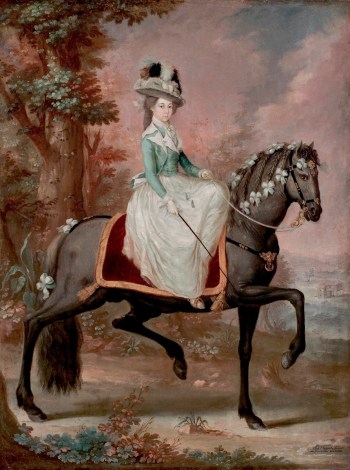
José Campeche y Jordán, Lady on Horseback, 1785, oil on panel, 40 × 30 cm (Museo de Arte de Ponce, Luis A. Ferré Foundation).
Paintings by legendary Puerto Rican artists José Campeche and Francisco Oller are presented in dialogue with art from the same period in the MFA’s collection. The Museo de Arte de Ponce continues to share its collection with museums worldwide as it rebuilds its Edward Durell Stone-designed building damaged by the January 2020 earthquakes.
The Museum of Fine Arts, Boston (MFA) and the Museo de Arte de Ponce (MAP) jointly announce that important works by José Campeche y Jordán (1751–1809) and Francisco Oller y Cestero (1833–1917)—the most influential Puerto Rican artists of the 18th and 19th centuries—are now on display at the MFA (as of 29 June 2023). This special installation features five paintings by Campeche and Oller from MAP’s collection, including one of the most iconic works in the history of Puerto Rican art, Campeche’s Lady on Horseback (1785). Oller’s famed Hacienda Aurora (1898), as well as two rare paintings on ceramic plates, open conversations about histories of the Puerto Rican landscape and artistic exchanges across Europe and the Americas.
“This partnership with the Museo de Arte de Ponce creates an unprecedented opportunity for us to introduce our audiences to Campeche and Oller, two deeply significant Puerto Rican painters who remain understudied outside of the island,” said Matthew Teitelbaum, Ann and Graham Gund Director. “Displayed in our Art of the Americas Wing alongside important works of colonial art and landscape painting from our collection, these special loans from MAP will highlight the contributions of Puerto Rican artists and offer a new point of connection for Boston’s vibrant Puerto Rican community.”
The paintings will be highlighted during tours at the MFA’s annual Latinx Heritage Night on September 21 as well as through additional programs.
The collection of the Museo de Arte de Ponce consists of approximately 4,500 works of art and is recognized for important examples of Baroque, Pre-Raphaelite, and Victorian art. The renowned collection of Puerto Rican art makes up about one-third of the museum’s holdings, including works from the 18th to 21st centuries. Following a catastrophic series of earthquakes in January 2020 that damaged the internationally recognized Edward Durell Stone-designed building, the main galleries of MAP have remained closed to the public.
As the galleries are rebuilt, MAP remains committed to keeping the collection accessible through collaborations with institutions on the island and beyond. In New York City, the Metropolitan Museum of Art is currently displaying five Victorian masterpieces, including Flaming June by Frederic Leighton, John Everet Millais’s The Escape of a Heretic, 1559, and Edward Burne-Jones’s Small Briar Rose series. From September 2022 to June 2023, Chicago’s National Museum of Puerto Rican Arts and Culture exhibited Nostalgia for My Island: Puerto Rican Painting from the Museo do Arte de Ponce (1786–1962). Additional loans are expected to be announced in other major cities in the United States, as well as in Europe.
“Not only is the museum a cultural institution ingrained in the fabric of Puerto Rican society, but it is also internationally renowned because of the extraordinary collections it houses, “said Cheryl Hartup, Director of the Museo de Arte de Ponce. “When the works travel, a conversation is created within the ecosystem of international art institutions and their collections and audiences. We couldn’t be more thrilled to share iconic paintings by Puerto Rican artists with the MFA, Boston as the museum is repaired.”
The Museo de Arte de Ponce expects to fully reopen in 2024.
New Book | Textile in Architecture
From Routledge:
Didem Ekici, Patricia Blessing, Basile Baudez, eds., Textile in Architecture: From the Middle Ages to Modernism (Routledge, 2023), 240 pages, ISBN: 978-1032250441 (hardback), $136 / ISBN: 978-1032250427 (paperback), $39.
 This book investigates the interconnections between textile and architecture via a variety of case studies from the Middle Ages through the twentieth century and from diverse geographic contexts.
Among the oldest human technologies, building and weaving have intertwined histories. Textile structures go back to Palaeolithic times and are still in use today and textile furnishings have long been used in interiors. Beyond its use as a material, textile has offered a captivating model and metaphor for architecture through its ability to enclose, tie together, weave, communicate, and adorn. Recently, architects have shown a renewed interest in the textile medium due to the use of computer-aided design, digital fabrication, and innovative materials and engineering. The essays edited and compiled here, work across disciplines to provide new insights into the enduring relationship between textiles and architecture. The contributors critically explore the spatial and material qualities of textiles as well as cultural and political significance of textile artifacts, patterns, and metaphors in architecture.
Textile in Architecture is organized into three sections: “Ritual Spaces,” which examines the role of textiles in the formation and performance of socio-political, religious, and civic rituals; “Public and Private Interiors” explores how textiles transformed interiors corresponding to changing aesthetics, cultural values, and material practices; and “Materiality and Material Translations,” which considers textile as metaphor and model in the materiality of built environment. Including cases from Morocco, Samoa, France, India, the UK, Spain, the Ancient Andes and the Ottoman Empire, this is essential reading for any student or researcher interested in textiles in architecture through the ages.
Didem Ekici is Assistant Professor in the Department of Architecture and Built Environment at the University of Nottingham. She is the co-editor of Housing and the City (Routledge, 2022). Healing Spaces, Modern Architecture, and the Body (Routledge, 2017) as well as the author of numerous articles on modern architecture culture. She is currently working on her monograph titled Body, Cloth, and Clothing in Architecture from the Age of Mass Manufacture to the First World War.
Patricia Blessing is Assistant Professor of Islamic Art History in the Department of Art & Archaeology at Princeton University. Her first book, Rebuilding Anatolia after the Mongol Conquest: Islamic Architecture in the Lands of Rūm, 1240–1330 (Ashgate, 2014) investigates the relationship between patronage, politics, and architectural style after the integration of the region into the Mongol empire. Her second book, Architecture and Material Politics in the Fifteenth-Century Ottoman Empire (Cambridge University Press, 2022) analyses how transregional exchange and the use of paper shaped building practices across the Ottoman realm.
Basile Baudez is Assistant Professor of architectural history in the Art & Archaeology department at Princeton University. His first book Architecture et Tradition Académique au Siècle des Lumières (2012) questions the role of architects in early modern European academies. He co-edited several volumes dedicated to French architecture and curated exhibitions on architectural drawings at the Ecole des Beaux-Arts and the Courtauld Institute of Art. His latest book, Inessential Colors: Architecture on Paper in Early Modern Europe (Princeton University Press, 2021) questions the role of color in Western architectural representation from the Renaissance to the nineteenth century. He currently works on an urban history of textiles in 18th-century Venice.
c o n t e n t s
Part 1 | Ritual Spaces
Introduction to Part One — Didem Ekici
1 The Red Tent in the Red City: The Caliphal Qubba in Almohad Marrakesh — Abbey Stockstill
2 ‘He will Lift off the Covering Which is Over All the Peoples’: Seeing Through Medieval Lenten Veils — Clare Frances Kemmerer
3 Architectural Space and Textiles: Tying Samoan Society Together — Anne E. Guernsey Allen
Part 2 | Public and Private Interiors
Introduction to Part Two — Basile Baudez
4 Le Rideau Tire: Interior Drapery, Architectural Space, and Desire in Eighteenth-Century France — Mei Mei Rado
5 The Fabric of the New: Mediating Architectural Change in Late Colonial India — Abigail McGowan
6 Contrast and Cohesion: Textiles and Architecture in 1930’s London — Emily M. Orr
Part 3 | Materiality and Material Translations
Introduction to Part Three — Patricia Blessing
7 Textiles by Other Means: Seeing and Conceptualizing Textile Representations in Early Islamic Architecture — Theodore Van Loan
8 The Textility of the Alhambra — Olga Bush
9 The Textile Foundations of Ancient Andean Architecture — Andrew James Hamilton
10 The Ruler’s Clothes and the Manifold Dimensions of Textile Patterns on Muslim Funeral Architecture in the Mausoleum of the First Crimean Khans — Nicole Kancal-Ferrari
11 A Tented Baroque: Ottoman Fabric (and) Architecture in the Long Nineteenth Century — Ashley Dimmig
Sarah Turner Appointed Director of the Paul Mellon Centre
From the press release (29 June 2023) from the Mellon Centre:
 Dr Sarah Victoria Turner has been appointed Director of the Paul Mellon Centre. Sarah Turner has been Acting Director of the Centre since March 2023 and will take up the post from July 2023. She follows Mark Hallett as the sixth Director of the Paul Mellon Centre and will be its first female Director since its founding in 1970.
Sarah Turner’s directorship will build on her eight years at the Centre, first as Assistant Director for Research and lately as Deputy Director, during which time she has overseen many innovative programmes and collaborative projects with partners in the UK and internationally, including establishing the national art writing competition, Write on Art, with Art UK, co-leading the London-Asia research project, and co-writing and co-hosting the Sculpting Lives podcast. She is editor-in-chief of the award-winning, open-access journal British Art Studies (since its founding in 2015). During her time at the Paul Mellon Centre, Dr Turner has had oversight of the archive & library, digital activities, book and online publications, and the research programme.
Sarah Turner read History of Art at Pembroke College, Cambridge. At the University of Leeds, she studied for an MA in Sculpture Studies, run in partnership with the Henry Moore Institute, and then completed her PhD at the Courtauld Institute of Art. She began her academic career at the University of York where she was first a Teaching Fellow and then a Lecturer in the Department of History of Art. As an art historian, she has published widely and has co-curated several major exhibitions, and much of her writing has focused on the entangled relationships between Britain, the British Empire, and South Asia.
Susan Gibbons, Vice Provost for Collections and Scholarly Communication, Yale University, and ex-officio Chief Executive of the Paul Mellon Centre commented: “I am delighted to announce the appointment of Sarah Victoria Turner. Her energy and passion for collaboration as a scholar and curator, and her strong leadership skills, make her an exceptional appointee.”
Sarah Turner said: “I am thrilled to be leading an outstanding team of people at the Paul Mellon Centre. I look forward to working closely with the Yale community, particularly our partner institution, the Yale Center for British Art, to take the Centre forward in its mission to promote activities that expand and enhance understandings of British art. The Paul Mellon Centre offers incredible resources that support research, curating and education activities. One of my aims as Director is to share these as widely as possible and to open up new conversations, ideas and narratives about the histories of British art. I am excited about the future direction of work that the Centre will shape and support. As Director, I will be a vocal champion for the value of art and architectural history and research on visual culture more broadly in helping us navigate some of the most complex questions of our time.”
Portrait at Greenwich Reattributed to Gainsborough
From the press release, via Art Daily:
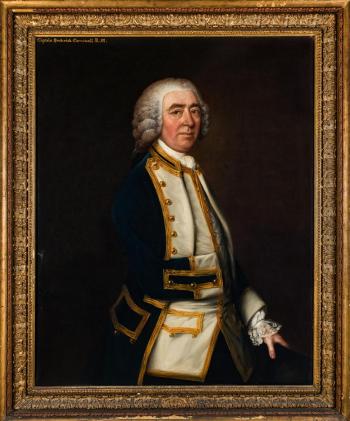
Thomas Gainsborough, Portrait of Captain Frederick Cornewall, ca. 1762 (Greenwich: National Maritime Museum).
Royal Museums Greenwich has announced the discovery of a portrait by famed eighteenth-century artist Thomas Gainsborough (1727–1788). Recent research into the Portrait of Captain Frederick Cornewall (ca. 1762) by Hugh Belsey and RMG curators has led to the exciting reattribution to Gainsborough.
Gainsborough was a leading artist in the second half of the eighteenth century. He is celebrated for his intimate and characterful portraits produced with lively brushwork. He was a founding member of the Royal Academy and has had a lasting influence in British art. The three-quarter-length portrait of Captain Frederick Cornewall (1706–1788) entered the RMG collection in 1960. It was recorded as a Gainsborough, but the curator at the time did not deem it of a high enough quality. It was attributed to an unknown artist and has been in storage for at least three decades.
Hugh Belsey had discovered a photograph of Cornewall’s portrait from the early twentieth century when the painting was owned by the London dealers, Agnew’s. He then traced the painting through several sales to the collector, Edward Peter Jones, but here the trail went cold. Unbeknownst to Belsey, Jones had bequeathed the painting to RMG in 1960. It was not until 2022, when Belsey’s friend was looking through the illustrated catalogue of the National Maritime Museum’s collection, that Belsey became aware that the painting may be in the RMG collection. Belsey requested to see the portrait in the museum stores in February 2022 and, on inspection of the painting, it became clear from the warm palette and unrivalled draughtsmanship that it was a Gainsborough.
Belsey has dated the painting to about 1762 when Gainsborough was working in Bath and sees it as an impressive example of the painter’s work from this period. Cornewall stands against a plain brown background in undress uniform and a bag wig. Gainsborough’s delicate brushwork is especially obvious in the most detailed areas of the picture, such as the lace cuff around Cornewall’s left wrist. Society columns from newspapers of the time show that Cornewall visited Bath in March 1762. The painting was presumably commissioned during this visit. It was perhaps intended to commemorate Cornewall’s retirement from active naval service the previous year. Cornewall had lost his arm during the Battle of Toulon (1744) and Gainsborough highlights the injury, styling Cornewall as a courageous fighter. The sleeve of his coat attached by a small loop to a button on his waistcoat in imitation of the traditional eighteenth-century pose where men were often painted tucking one hand into their waistcoat.
Fundraising has now started to conserve the painting and frame for display. Urgent treatment is needed as the paint layer is loose and there is flaking in some areas. As the painting has not been displayed for some time, there is a layer of dust over the surface of the front and back of the painting, which creates a dull appearance. A layer of conservation grade varnish, which is resistant to yellowing with age, will be applied to re-saturate the pigments. RMG’s crowdfunding campaign will aim to raise £60,000 towards the conservation, which will return the portrait to something closer to Gainsborough’s original intentions in preparation for display at the Queen’s House. The fundraising page went live on Monday, 10 July.
Katherine Gazzard, curator, said: “It is thrilling to be able to rescue this lost masterpiece from obscurity. Those of us lucky enough to see the portrait in the museum stores knew it was something special, but it was only with Hugh’s help that we were able to piece together the full story. We are excited about sharing the painting with the public, but it is currently too fragile for display. The fundraising campaign will enable us to perform the remedial work that the portrait desperately needs. Once the conservation is complete, the painting will hang in the Queen’s House, where our visitors will be able to enjoy this rediscovered masterpiece for themselves.”
Hugh Belsey said: “I have been studying Gainsborough’s works for over forty years, and during that time I have taken every opportunity to look at as many paintings and drawings as possible. I am delighted that this splendid portrait is now identified as a fine early work by Gainsborough. Gainsborough’s work was developing at a very fast pace in the early 1760s, and during the decade and as he attracted more commissions, his style became more assured and his brushwork freer.”
Captain Frederick Cornewall was born in 1706 in Shropshire. He had an active naval career, serving in two high profile battles, the Battle of Toulon (1744) and Battle of Minorca (1756). Both received public scrutiny and criticism with some officers being accused of inaction and cowardice.
At the Battle of Toulon, Cornewall was wounded which resulted in the amputation of his right arm. He served on the Marlborough one of the few British ships that engaged with the Franco-Spanish fleet. In the portrait, Cornewall is positioned with his right arm towards the viewer, emphasising his war wound. The composition could be interpreted as Cornewall distinguishing himself as a participant in the main action thereby portraying himself as a dutiful and willing officer, unlike his colleagues who had failed to engage the enemy at Toulon.
At the Battle of Minorca, fought against the French, the British Navy came under scrutiny once more. The battle ended in failure and ultimately led to Minorca being captured by the French. The British public reacted with outrage. Vice-Admiral John Byng, who commanded the fleet, was court-martialled and sentenced to death. Although the court recommended clemency, the public’s appetite for punishment, political divisions, and George II’s personal reluctance to grant a royal pardon led to Byng’s execution. Cornewall’s testimony played a key role in his sentencing.
New Book | Tempest
From Yale UP:
James Davey, Tempest: The Royal Navy and the Age of Revolutions (New Haven: Yale University Press, 2023), 448 pages, ISBN: 978-0300238273, $35.
 The French Revolutionary Wars catapulted Britain into a conflict against a new enemy: Republican France. Britain relied on the Royal Navy to protect its shores and empire, but as radical ideas about rights and liberty spread across the globe, it could not prevent the spirit of revolution from reaching its ships. In this insightful history, James Davey tells the story of Britain’s Royal Navy across the turbulent 1790s. As resistance and rebellion swept through the fleets, the navy itself became a political battleground. This was a conflict fought for principles as well as power. Sailors organized riots, strikes, petitions, and mutinies to achieve their goals. These shocking events dominated public discussion, prompting cynical—and sometimes brutal—responses from the government. Tempest uncovers the voices of ordinary sailors to shed new light on Britain’s war with France, as the age of revolution played out at every level of society.
James Davey teaches at the University of Exeter. He was formerly curator of naval history at the National Maritime Museum and is the author of In Nelson’s Wake: The Navy and the Napoleonic Wars.
c o n t e n t s
List of Illustration and Maps
Acknowledgments
Note on Conventions
Prologue
Introduction
1 Lawless Mobs and a Gore of Blood: Naval Mobilisation and Impressment
2 War of Principle: Naval Conflict in Europe, 1793–5
3 ‘We the Seamen’: Protest and Resistance at Sea
4 Tides, Currents, and Winds: Navy and Empire, 1793–7
5 Splintering the Wooden Walls: The Threat of Invasion, 1796–8
6 The Delegates in Council: The Naval Mutinies of 1797
7 A Tale of Two Sailors: Camperdown and Naval Propaganda
8 Bad Luck to the British Navy! Mutiny and Naval Warfare, 1798–1801
Epilogue
Conclusion
Notes on Sources
Notes
Bibliography
Index
New Book | Hersilia’s Sisters
From the Getty:
Norman Bryson, Hersilia’s Sisters: Jacques-Louis David, Women, and the Emergence of Civil Society in Post-Revolution France (Los Angeles: Getty Research Institute, 2023), 352 pages, ISBN 978-1606067710, $75.
 Political and cultural history and the arts combine in this engaging account of 1790s France.
In 1799, when the French artist Jacques-Louis David (1748–1825) exhibited his Intervention of the Sabines, a history painting featuring the ancient heroine Hersilia, he added portraits of two contemporary women on either side of her—Henriette de Verninac, daughter of Charles-François Delacroix, minister of foreign affairs, and Juliette Récamier, a well-known and admired socialite. Drawing on many disciplines, Norman Bryson explains how such a combination of paintings could reveal the underlying nature of the Directoire, the period between the vicious and near-dictatorial Reign of Terror (1793–94) and the coup in 1799 that brought Napoleon to power. Hersilia’s Sisters illuminates ways that cultural life and civil society were rebuilt during these years through an extraordinary efflorescence of women pioneers in every cultural domain—literature, the stage, opera, moral philosophy, political theory, painting, popular journalism, and fashion. Through a close examination of David’s work between The Intervention of the Sabines (begun in 1796) and Bonaparte Crossing the Alps (begun in 1800), Bryson explores how the flowering of women’s culture under the Directoire became a decisive influence on David’s art.
Norman Bryson is a professor of art history at the University of California, San Diego. He has published widely in the areas of eighteenth-century art history, critical theory, and contemporary art.
c o n t e n t s
Acknowledgments
Introduction
1 The Festival of the Sabine Women
2 David in the Louvre in 1800
3 The Portrait of Henriette de Verninac
4 The Portrait of Juliette Récamier
5 Ancient Liberty, Modern Freedom
6 Aspasia, the Merveilleuse
7 Hersilia’s Accomplished Sisters
8 Salonnières
9 Brumaire
Bibliography
About the Author
Illustration Credits
Index
New Book | Revolutionary Things: Material Culture and Politics
From Yale UP:
Ashli White, Revolutionary Things: Material Culture and Politics in the Late Eighteenth-Century Atlantic World (New Haven: Yale University Press, 2023), 392 pages, ISBN: 978-0300259018, $50.
 How objects associated with the American, French, and Haitian revolutions drew diverse people throughout the Atlantic world into debates over revolutionary ideals
Historian Ashli White explores the circulation of material culture during the American, French, and Haitian revolutions, arguing that in the late eighteenth century, radical ideals were contested through objects as well as in texts. She considers how revolutionary things, as they moved throughout the Atlantic, brought people into contact with these transformative political movements in visceral, multiple, and provocative ways. Focusing on a range of objects—ceramics and furniture, garments and accessories, prints, maps, and public amusements—White shows how material culture held political meaning for diverse populations. Enslaved and free, women and men, poor and elite—all turned to things as a means to realize their varied and sometimes competing visions of revolutionary change.
Ashli White is associate professor of history at the University of Miami. She is the author of Encountering Revolution: Haiti and the Making of the Early Republic.
New Book | Nicolas-Guy Brenet (1728–1792)
From Arthena:
Marie Fournier, with a preface by Christine Gouzi, Nicolas-Guy Brenet (1728–1792) (Paris: Arthena, 2023), 360 pages, ISBN: 978-2903239718, €110.
 Peintre emblématique du renouveau de la peinture d’Histoire avant la Révolution française, Nicolas-Guy Brenet fut l’élève de Charles Antoine Coypel, de François Boucher et de Carle Vanloo. Sa brillante carrière académique illustre l’ascension sociale et institutionnelle d’un homme issu d’un milieu modeste de graveurs. Après sa participation au cycle de l’histoire de Saint Louis pour la chapelle de l’École militaire en 1773, le succès des Honneurs rendus au connétable Du Guesclin par la Ville de Randon exposé au Salon de 1777 (Paris, musée du Louvre) fit de lui l’artiste le plus sollicité pour les commandes destinées à encourager la peinture d’Histoire sous le règne de Louis XVI. Ses nombreux retables peints pour les églises de province illustrent le dynamisme encore trop méconnu des commandes du clergé jusqu’à la Révolution. Professeur reconnu, il forma de nombreux élèves, dont le baron Gérard et Jean-Germain Drouais, mais demeura sans véritable postérité artistique et la critique du XIXe siècle lui reprocha d’incarner le “goût de son époque, répandu dans ses tableaux.” La découverte d’oeuvres inédites et de nouveaux documents d’archives permet d’éclairer la production d’un peintre talentueux, témoin des évolutions artistiques de la fin du siècle des Lumières.
Diplômée de l’École du Louvre et docteur en histoire de l’art de Sorbonne-Université où elle a été chargée de cours, Marie Fournier a soutenu sa thèse sur le peintre Nicolas-Guy Brenet en janvier 2022. Chercheuse indépendante, elle rédige des catalogues pour des collectionneurs et collabore scientifiquement à des projets d’expositions avec des galeries et des musées.
Call for Papers | Anna Dorothea Therbusch in Context
From the Call for Papers:
Anna Dorothea Therbusch in Context: 18th Century (Women) Artists in Berlin and Europe
Kulturforum, Staatliche Museen zu Berlin, 26–27 September 2024
Organized by Nuria Jetter and Sarah Salomon
Proposals due by 17 September 2023
Born into the Prussian painter family Lisiewsky, Anna Dorothea Therbusch (1721–1782) achieved a remarkable international career in the 18th century, at a time when women’s access to artistic training and academies was structurally impeded. After training with her father Georg Lisiewsky and being influenced by the artistic taste of the Frederician Rococo (Watteau, Pesne, and others), Therbusch devoted herself to the education of her children for twenty years. It was not until 1761, at the age of almost forty, that she began to vigorously pursue her artistic ambitions in a professional manner.
After artistically productive stations at the courts of Stuttgart and Mannheim and admission to the academies of Stuttgart and Bologna, Anna Dorothea Therbusch spent about two years in Paris from summer 1766 to fall 1768. There, not without resistance, she was accepted into the Académie royale with a candlelight painting inspired by Dutch art. She exhibited at the Salon and socialized, among others, with the encyclopedist and art critic Denis Diderot, the engraver Johann Georg Wille, and Prince Golitsyn, who worked as an art agent for Catherine II. In 1768 Therbusch was admitted to the Vienna Academy of Fine Arts. She returned to Berlin via Brussels and the Netherlands.
Back in Berlin since 1769, the painter occupied a studio on Unter den Linden in 1772/73, where she worked temporarily with her brother Christoph Friedrich Reinhold Lisiewsky. She became a sought-after portraitist of Berlin high society, also working for the Russian court, and her mythological history paintings had success with Frederick II.
The Berlin Gemäldegalerie is currently conducting an art-historical and art-technological research project on Anna Dorothea Therbusch’s paintings held in the collections of the Staatliche Museen in Berlin. The resulting publication will provide new insights into the materials and working methods used by the artist and, with the participation of other public collections in Berlin and Brandenburg, will also present their holdings of Therbusch’s works. This is the occasion to further broaden the view of the artist and her work within the framework of a specialist symposium. It is to bring together researchers in order to illuminate Therbusch’s work in larger art historical contexts, to share insights, and to point out further research perspectives.
Of particular interest are proposals for presentations on the following topics:
1 Therbusch’s artistic models and her working environment
Which artists did she orientate herself on, which paintings and collections was she able to study in Prussia and on her travels? What was Therbusch’s working environment like and how did she relate to other artists?
2 Therbusch’s working methods and the thematic range of her oeuvre
What can be said about the processes of creation and execution of Therbusch’s paintings on the basis of art-technological findings and comparisons of works? Where can she be located concerning her painting technique? What were the significance and function of her genre and historical paintings? What modes of representation did she choose for her portraits?
3 Therbusch’s networks and career strategies
How did Therbusch obtain her commissions in Prussia, Stuttgart, Mannheim, Paris (and possibly beyond)? Which acquaintances and family or aristocratic connections could she have used for this purpose? Who were her clients and patrons? How did she promote herself?
4 The early reception of the painter and her work by contemporaries and up to the early 19th century
Please submit your proposal for a 20-minute presentation (preliminary title, abstract of 300 words max., short biography) in English or German by 17 September 2023 to Nuria Jetter (n.jetter@smb.spk-berlin.de) and Dr. Sarah Salomon (s.salomon@smb.spk-berlin.de). The symposium will take place on 26 and 27 September 2024 at the Kulturforum near Potsdamer Platz (Staatliche Museen zu Berlin, Matthäikirchplatz). If funds are available, a travel allowance will be granted.
s e l e c t e d b i b l i o g r a p h y
Reidemeister 1924
Leopold Reidemeister, “Anna Dorothea Therbusch – ihr Leben und Werk,” Dissertation Friedrich-Wilhelms-Universität zu Berlin, unveröffentlicht (Typoskript), Berlin 1924.
Ausst.-Kat. Potsdam-Sanssouci 1971
Anna Dorothea Therbusch 1721–1782. Ausstellung zum 250. Geburtstag im Kulturhaus „Hans Marchwitza“, Ausst.-Kat. Staatliche Schlösser und Gärten Potsdam-Sanssouci 1971, bearb. v. Gerd Bartoschek, Potsdam 1971.
Berckenhagen 1987
Eckhart Berckenhagen, “Anna Dorothea Therbusch,” in: Zeitschrift des deutschen Vereins für Kunstwissenschaft XLI, Heft 1, 1987, 118–160.
Dalinghaus 1987
Ruth Irmgard Dalinghaus, “Anna Dorothea Therbusch,” in: Das verborgene Museum I. Dokumentation der Kunst von Frauen in Berliner öffentlichen Sammlungen, Ausst.-Kat. Neue Gesellschaft für Bildende Kunst, Berlin, 1987–88, Berlin 1987, 112–116.
Küster-Heise 1999
Katharina Küster-Heise, “Sie war in allem Betracht eine seltene und verdienstvolle Frau. Anna Dorothea Therbusch, die Berliner Porträtistin Carl Theodors,” in: Lebenslust und Frömmigkeit. Kurfürst Carl Theodor (1724–1799) zwischen Barock und Aufklärung, Bd. 1: Handbuch, Ausst.-Kat. Städtisches Reiss-Museum Mannheim 1999, hrsg. v. Alfried Wieczorek u. Hansjörg Probst, Regensburg 1999, 255–260.
Bajou 2000
Thierry Bajou, “Eine deutsche Künstlerin im Paris des 18. Jahrhunderts. Anna Dorothea Therbusch,” in: Jenseits der Grenzen. Französische und deutsche Kunst vom Ancien Régime bis zur Gegenwart. Thomas W. Gaehtgens zum 60. Geburtstag, Bd. 1: Inszenierung der Dynastien, hrsg. v. Uwe Fleckner, Martin Schieder, Michael F. Zimmermann u. Thomas W. Gaehtgens, eine Veröffentlichung des Deutschen Forums für Kunstgeschichte (Paris), Köln 2000, 149–268.
Ausst.-Kat. Ludwigsburg 2002
Der freie Blick. Anna Dorothea Therbusch und Ludovike Simanowiz. Zwei Porträtmalerinnen des 18. Jahrhunderts, Ausst.-Kat. Städtisches Museum Ludwigsburg 2002/3, bearbeitet von Katharina Küster und Beatrice Scherzer, Heidelberg 2002.
Michaelis 2002
Die Deutschen Gemälde des 18. Jahrhunderts. Kritischer Bestandskatalog, Staatliche Museen zu Berlin – Gemäldegalerie, Berlin 2002 [darin Eintrag zu Therbusch und ihren Gemälden der Gemäldegalerie, 224–234].
Küster-Heise 2008
Katharina Küster-Heise, “Anna Dorothea Therbusch, geb. Lisiewska 1721–1782. Eine Malerin der Aufklärung. Leben und Werk,” Dissertation Ruprecht-Karls-Universität Heidelberg, 2008. [Als Mikrofilm in Bibliotheken verfügbar].
Bartoschek 2010
“Gemeinsam stark? Anna Dorothea Therbusch und ihre Zusammenarbeit mit Christoph Friedrich Reinhold Lisiewsky,” in: Christoph Friedrich Reinhold Lisiewsky (1725–1794), Ausst.-Kat. Kulturstiftung DessauWörlitz/Staatliches Museum Schwerin 2010-11, Berlin/München 2010, 77–84.
Kovalevski 2010
Bärbel Kovalevski, “‘Es ist eine Ehre, sich auf dem Niveau der großen Künstler zu sehen […].’ (Barbara Rosina de Gasc, 1768). Malerinnen der Familie Lisiewsky,” in: Ausst.-Kat. Kulturstiftung DessauWörlitz/Staatliches Museum Schwerin 2010–11, Berlin/München 2010, 77–84.
Lange 2017
Justus Lange, “Ehefrau – Schwester – Lehrerin. Anna Dorothea Therbuschs Doppelbildnis in Kassel im Kontext unterschiedlicher Deutungen,” in: Künstlerinnen. Neue Perspektiven auf ein Forschungsfeld der Vormoderne, hrsg. v. Birgit Ulrike Münch, Andreas Tacke, Markwart Herzog, Sylvia Heudecker, Petersberg 2017.
Kovalevski 2022
Bärbel Kovalevski, Barbara Rosina Lisiewska (1713–1783). Hofmalerin in Berlin und Braunschweig. Bildnisse mit Geschichten, Berlin 2022.
Vogtherr 2022
Christoph Martin Vogtherr, “Anna Dorothea Therbusch’s ‘Morceau de reception’ for the Académie royale de peinture et de sculpture,” in: Mélanges autour du dessin en l’honneur d’Emmanuelle Brugerolles, Mailand 2022, 213–216.
Wadsworth Atheneum Acquires a Portrait by Rosalba Carriera
From the press release (10 July 2023). . .
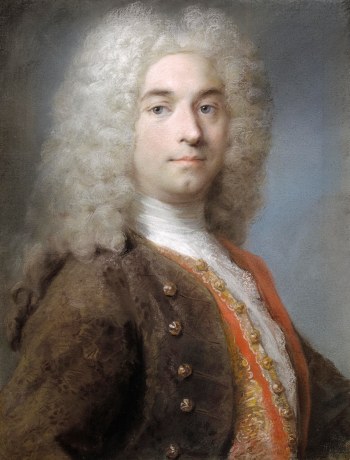
Rosalba Carriera, Portrait of a Gentleman, ca. 1730, pastel on paper, laid down on canvas, 24 × 18 inches (Hartford, CT: Wadsworth Atheneum Museum of Art, Charles H. Schwartz Endowment Fund).
The Wadsworth Atheneum has acquired an outstanding work by Rosalba Carriera (widely known as ‘Rosalba’), the most famous woman artist working in the eighteenth century and admired as a pioneering and brilliant pastellist. Portrait of a Gentleman (ca. 1730), was created when she reached the height of her career, portraying the upper echelons of society with a deft hand and observational sensitivity. It is the first example of the artist’s work in the Wadsworth Atheneum’s collection.
Rosalba (1675–1757) started her career as a miniaturist, but she became best known for her skill with pastels—her technical and artistic innovations elevating the uniquely powdery medium to great popularity among artists and collectors. Royalty, cardinals, and cognoscenti across Europe commissioned portraits and allegories from her. It quickly attracted admirers and younger followers such as Jean-Étienne Liotard and Maurice Quentin de la Tour.
“Portrait of a Gentleman is a work of rare elegance and grace—it is also an exemplary work by Rosalba. The freshness and radiance of the colors as well as the vaporous quality of the surface truly distinguish this work and lend to its liveliness. That we are as yet unable to definitively identify the sitter is secondary to the captivating beauty of this portrait,” said Oliver Tostmann, Susan Morse Hilles Curator of European Art at the Wadsworth.
The figure depicted was first identified as the legendary art collector Pierre Crozat, and later as Louis Armand II de Bourbon, Prince de Conti; neither suggestion, however, has been verified. The sitter poses with torso in profile and his head positioned toward the viewer, nearly achieving contact while maintaining a slight aloofness. With his magnificent shoulder length wig, damask justaucorps coat, and splendid red vest embellished with gold embroidery and buttons, this handsome sitter was clearly someone of status and rank.
“This breathtaking portrait will greatly enrich our growing collection of works on paper. Not only is it a work of the highest quality, but it is also from the hand of the most celebrated pastellist of the eighteenth century. We are proud to welcome Portrait of a Gentleman into the Wadsworth’s collection and look forward to sharing Rosalba Carriera’s brilliance with our visitors very soon,” said Matthew Hargraves, Director of the Wadsworth Atheneum.










 Enfilade
leave a comment