Call for Papers | Anna Dorothea Therbusch in Context
From the Call for Papers:
Anna Dorothea Therbusch in Context: 18th Century (Women) Artists in Berlin and Europe
Kulturforum, Staatliche Museen zu Berlin, 26–27 September 2024
Organized by Nuria Jetter and Sarah Salomon
Proposals due by 17 September 2023
Born into the Prussian painter family Lisiewsky, Anna Dorothea Therbusch (1721–1782) achieved a remarkable international career in the 18th century, at a time when women’s access to artistic training and academies was structurally impeded. After training with her father Georg Lisiewsky and being influenced by the artistic taste of the Frederician Rococo (Watteau, Pesne, and others), Therbusch devoted herself to the education of her children for twenty years. It was not until 1761, at the age of almost forty, that she began to vigorously pursue her artistic ambitions in a professional manner.
After artistically productive stations at the courts of Stuttgart and Mannheim and admission to the academies of Stuttgart and Bologna, Anna Dorothea Therbusch spent about two years in Paris from summer 1766 to fall 1768. There, not without resistance, she was accepted into the Académie royale with a candlelight painting inspired by Dutch art. She exhibited at the Salon and socialized, among others, with the encyclopedist and art critic Denis Diderot, the engraver Johann Georg Wille, and Prince Golitsyn, who worked as an art agent for Catherine II. In 1768 Therbusch was admitted to the Vienna Academy of Fine Arts. She returned to Berlin via Brussels and the Netherlands.
Back in Berlin since 1769, the painter occupied a studio on Unter den Linden in 1772/73, where she worked temporarily with her brother Christoph Friedrich Reinhold Lisiewsky. She became a sought-after portraitist of Berlin high society, also working for the Russian court, and her mythological history paintings had success with Frederick II.
The Berlin Gemäldegalerie is currently conducting an art-historical and art-technological research project on Anna Dorothea Therbusch’s paintings held in the collections of the Staatliche Museen in Berlin. The resulting publication will provide new insights into the materials and working methods used by the artist and, with the participation of other public collections in Berlin and Brandenburg, will also present their holdings of Therbusch’s works. This is the occasion to further broaden the view of the artist and her work within the framework of a specialist symposium. It is to bring together researchers in order to illuminate Therbusch’s work in larger art historical contexts, to share insights, and to point out further research perspectives.
Of particular interest are proposals for presentations on the following topics:
1 Therbusch’s artistic models and her working environment
Which artists did she orientate herself on, which paintings and collections was she able to study in Prussia and on her travels? What was Therbusch’s working environment like and how did she relate to other artists?
2 Therbusch’s working methods and the thematic range of her oeuvre
What can be said about the processes of creation and execution of Therbusch’s paintings on the basis of art-technological findings and comparisons of works? Where can she be located concerning her painting technique? What were the significance and function of her genre and historical paintings? What modes of representation did she choose for her portraits?
3 Therbusch’s networks and career strategies
How did Therbusch obtain her commissions in Prussia, Stuttgart, Mannheim, Paris (and possibly beyond)? Which acquaintances and family or aristocratic connections could she have used for this purpose? Who were her clients and patrons? How did she promote herself?
4 The early reception of the painter and her work by contemporaries and up to the early 19th century
Please submit your proposal for a 20-minute presentation (preliminary title, abstract of 300 words max., short biography) in English or German by 17 September 2023 to Nuria Jetter (n.jetter@smb.spk-berlin.de) and Dr. Sarah Salomon (s.salomon@smb.spk-berlin.de). The symposium will take place on 26 and 27 September 2024 at the Kulturforum near Potsdamer Platz (Staatliche Museen zu Berlin, Matthäikirchplatz). If funds are available, a travel allowance will be granted.
s e l e c t e d b i b l i o g r a p h y
Reidemeister 1924
Leopold Reidemeister, “Anna Dorothea Therbusch – ihr Leben und Werk,” Dissertation Friedrich-Wilhelms-Universität zu Berlin, unveröffentlicht (Typoskript), Berlin 1924.
Ausst.-Kat. Potsdam-Sanssouci 1971
Anna Dorothea Therbusch 1721–1782. Ausstellung zum 250. Geburtstag im Kulturhaus „Hans Marchwitza“, Ausst.-Kat. Staatliche Schlösser und Gärten Potsdam-Sanssouci 1971, bearb. v. Gerd Bartoschek, Potsdam 1971.
Berckenhagen 1987
Eckhart Berckenhagen, “Anna Dorothea Therbusch,” in: Zeitschrift des deutschen Vereins für Kunstwissenschaft XLI, Heft 1, 1987, 118–160.
Dalinghaus 1987
Ruth Irmgard Dalinghaus, “Anna Dorothea Therbusch,” in: Das verborgene Museum I. Dokumentation der Kunst von Frauen in Berliner öffentlichen Sammlungen, Ausst.-Kat. Neue Gesellschaft für Bildende Kunst, Berlin, 1987–88, Berlin 1987, 112–116.
Küster-Heise 1999
Katharina Küster-Heise, “Sie war in allem Betracht eine seltene und verdienstvolle Frau. Anna Dorothea Therbusch, die Berliner Porträtistin Carl Theodors,” in: Lebenslust und Frömmigkeit. Kurfürst Carl Theodor (1724–1799) zwischen Barock und Aufklärung, Bd. 1: Handbuch, Ausst.-Kat. Städtisches Reiss-Museum Mannheim 1999, hrsg. v. Alfried Wieczorek u. Hansjörg Probst, Regensburg 1999, 255–260.
Bajou 2000
Thierry Bajou, “Eine deutsche Künstlerin im Paris des 18. Jahrhunderts. Anna Dorothea Therbusch,” in: Jenseits der Grenzen. Französische und deutsche Kunst vom Ancien Régime bis zur Gegenwart. Thomas W. Gaehtgens zum 60. Geburtstag, Bd. 1: Inszenierung der Dynastien, hrsg. v. Uwe Fleckner, Martin Schieder, Michael F. Zimmermann u. Thomas W. Gaehtgens, eine Veröffentlichung des Deutschen Forums für Kunstgeschichte (Paris), Köln 2000, 149–268.
Ausst.-Kat. Ludwigsburg 2002
Der freie Blick. Anna Dorothea Therbusch und Ludovike Simanowiz. Zwei Porträtmalerinnen des 18. Jahrhunderts, Ausst.-Kat. Städtisches Museum Ludwigsburg 2002/3, bearbeitet von Katharina Küster und Beatrice Scherzer, Heidelberg 2002.
Michaelis 2002
Die Deutschen Gemälde des 18. Jahrhunderts. Kritischer Bestandskatalog, Staatliche Museen zu Berlin – Gemäldegalerie, Berlin 2002 [darin Eintrag zu Therbusch und ihren Gemälden der Gemäldegalerie, 224–234].
Küster-Heise 2008
Katharina Küster-Heise, “Anna Dorothea Therbusch, geb. Lisiewska 1721–1782. Eine Malerin der Aufklärung. Leben und Werk,” Dissertation Ruprecht-Karls-Universität Heidelberg, 2008. [Als Mikrofilm in Bibliotheken verfügbar].
Bartoschek 2010
“Gemeinsam stark? Anna Dorothea Therbusch und ihre Zusammenarbeit mit Christoph Friedrich Reinhold Lisiewsky,” in: Christoph Friedrich Reinhold Lisiewsky (1725–1794), Ausst.-Kat. Kulturstiftung DessauWörlitz/Staatliches Museum Schwerin 2010-11, Berlin/München 2010, 77–84.
Kovalevski 2010
Bärbel Kovalevski, “‘Es ist eine Ehre, sich auf dem Niveau der großen Künstler zu sehen […].’ (Barbara Rosina de Gasc, 1768). Malerinnen der Familie Lisiewsky,” in: Ausst.-Kat. Kulturstiftung DessauWörlitz/Staatliches Museum Schwerin 2010–11, Berlin/München 2010, 77–84.
Lange 2017
Justus Lange, “Ehefrau – Schwester – Lehrerin. Anna Dorothea Therbuschs Doppelbildnis in Kassel im Kontext unterschiedlicher Deutungen,” in: Künstlerinnen. Neue Perspektiven auf ein Forschungsfeld der Vormoderne, hrsg. v. Birgit Ulrike Münch, Andreas Tacke, Markwart Herzog, Sylvia Heudecker, Petersberg 2017.
Kovalevski 2022
Bärbel Kovalevski, Barbara Rosina Lisiewska (1713–1783). Hofmalerin in Berlin und Braunschweig. Bildnisse mit Geschichten, Berlin 2022.
Vogtherr 2022
Christoph Martin Vogtherr, “Anna Dorothea Therbusch’s ‘Morceau de reception’ for the Académie royale de peinture et de sculpture,” in: Mélanges autour du dessin en l’honneur d’Emmanuelle Brugerolles, Mailand 2022, 213–216.
Wadsworth Atheneum Acquires a Portrait by Rosalba Carriera
From the press release (10 July 2023). . .
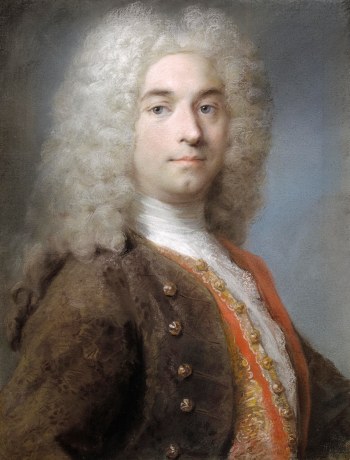
Rosalba Carriera, Portrait of a Gentleman, ca. 1730, pastel on paper, laid down on canvas, 24 × 18 inches (Hartford, CT: Wadsworth Atheneum Museum of Art, Charles H. Schwartz Endowment Fund).
The Wadsworth Atheneum has acquired an outstanding work by Rosalba Carriera (widely known as ‘Rosalba’), the most famous woman artist working in the eighteenth century and admired as a pioneering and brilliant pastellist. Portrait of a Gentleman (ca. 1730), was created when she reached the height of her career, portraying the upper echelons of society with a deft hand and observational sensitivity. It is the first example of the artist’s work in the Wadsworth Atheneum’s collection.
Rosalba (1675–1757) started her career as a miniaturist, but she became best known for her skill with pastels—her technical and artistic innovations elevating the uniquely powdery medium to great popularity among artists and collectors. Royalty, cardinals, and cognoscenti across Europe commissioned portraits and allegories from her. It quickly attracted admirers and younger followers such as Jean-Étienne Liotard and Maurice Quentin de la Tour.
“Portrait of a Gentleman is a work of rare elegance and grace—it is also an exemplary work by Rosalba. The freshness and radiance of the colors as well as the vaporous quality of the surface truly distinguish this work and lend to its liveliness. That we are as yet unable to definitively identify the sitter is secondary to the captivating beauty of this portrait,” said Oliver Tostmann, Susan Morse Hilles Curator of European Art at the Wadsworth.
The figure depicted was first identified as the legendary art collector Pierre Crozat, and later as Louis Armand II de Bourbon, Prince de Conti; neither suggestion, however, has been verified. The sitter poses with torso in profile and his head positioned toward the viewer, nearly achieving contact while maintaining a slight aloofness. With his magnificent shoulder length wig, damask justaucorps coat, and splendid red vest embellished with gold embroidery and buttons, this handsome sitter was clearly someone of status and rank.
“This breathtaking portrait will greatly enrich our growing collection of works on paper. Not only is it a work of the highest quality, but it is also from the hand of the most celebrated pastellist of the eighteenth century. We are proud to welcome Portrait of a Gentleman into the Wadsworth’s collection and look forward to sharing Rosalba Carriera’s brilliance with our visitors very soon,” said Matthew Hargraves, Director of the Wadsworth Atheneum.
Exhibition | New Nation, Many Hands
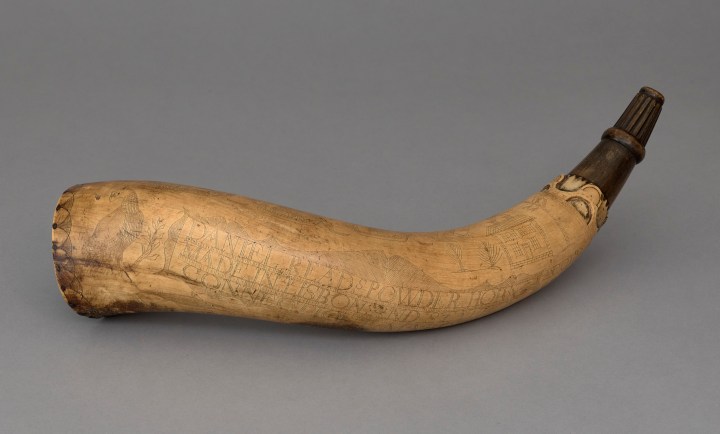
Unidentified maker, Powder Horn, 1802, Lisbon, Connecticut, cow horn, pine, and iron (Wadsworth Atheneum Museum of Art, James L. Goodwin Art Purchase Fund, 2023.22.1).
◊ ◊ ◊ ◊ ◊
Now on view at the Wadsworth Atheneum:
New Nation, Many Hands
Wadsworth Atheneum Museum of Art, Hartford, Connecticut, June 29–ongoing
Curated by Philippe Halbert
Political independence from Great Britain in 1783 transformed American society, and citizens celebrated the promise of their young republic through art. Acknowledging the complexities and contradictions of the era, New Nation, Many Hands presents a cross-section of objects from the permanent collection that shaped emerging American identities and the ongoing fight for freedom. Household goods, from ceramics and furniture to metalwork and textiles, combined practicality with patriotism in the early years of the United States. Some of the objects reflect changing fashions, distinct regional styles, and expanded trade networks. Others express pride in the new nation and hope for its future. All reveal stories of the people who created, used, cherished, and benefited from them during a formative moment in American history.
New Book | French Silver in the J. Paul Getty Museum
From the Getty:
Charissa Bremer-David, with contributions by Jessica Chasen, Arlen Heginbotham, and Julie Wolfe, French Silver in the J. Paul Getty Museum (Los Angeles: J. Paul Getty Museum, 2023), 178 pages, ISBN: 978-1606068281, $55, with digital copies available free.
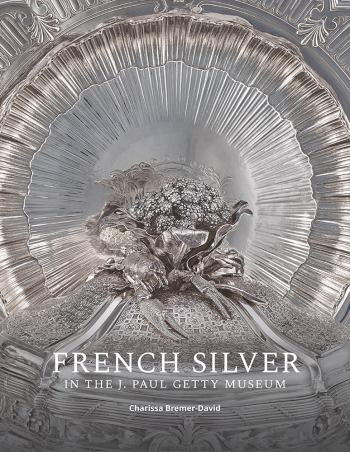 Vividly illustrated, this is the first comprehensive catalogue of the J. Paul Getty Museum’s celebrated collection of seventeenth- and eighteenth-century French silver.
The collection of seventeenth- and eighteenth-century French silver at the J. Paul Getty Museum is of exceptional quality and state of preservation. Each piece is remarkable for its beauty, inventive form, skillful execution, illustrious provenance, and the renown of its maker. This volume is the first complete study of these exquisite objects, with more than 250 color photographs bringing into focus extraordinary details such as minuscule makers’ marks, inscriptions, and heraldic armorials. The publication details the formation of the Museum’s collection of French silver, several pieces of which were selected by J. Paul Getty himself, and discusses the regulations of the historic Parisian guild of gold- and silversmiths that set quality controls and consumer protections. Comprehensive entries catalogue a total of thirty-three pieces with descriptions, provenance, exhibition history, and technical information. The related commentaries shed light on the function of these objects and the roles they played in the daily lives of their prosperous owners. The book also includes maker biographies and a full bibliography.
Reflecting Getty’s commitment to open content, the free online edition of this publication is available here, with 360-degree views and zoomable high-resolution photography. Also available are free PDF and EPUB downloads of the book, and JPG downloads of the main catalogue images. For readers who wish to have a bound reference copy, this paperback edition is available for sale.
Charissa Bremer-David retired in 2020 from her role as curator in the Department of Sculpture and Decorative Arts at the J. Paul Getty Museum.
Jessica Chasen is an associate objects conservator at the Los Angeles County Museum of Art. Previously, she was an assistant conservator in Decorative Arts and Sculpture Conservation at the J. Paul Getty Museum and in Science at the Getty Conservation Institute.
Arlen Heginbotham is conservator of decorative arts and sculpture at the J. Paul Getty Museum.
Julie Wolfe is conservator of decorative arts and sculpture at the J. Paul Getty Museum.
c o n t e n t s
Foreword by Timothy Potts
Acknowledgments
Introduction: J. Paul Getty as a Silver Collector and the Formation of the Museum’s French Silver Collection
Note to the Reader I: Stamps and Marks
Note to the Reader II: Historic Units of Measure and Currency
Catalogue
1 Water Fountain (Fontaine), transformed from a Water Flagon (Buire), with Technical Summary by Jessica Chasen
2 Lidded Bowl (Écuelle couverte)
3 Pair of Tureens, Liners, and Stands (Paire de terrines, doublures et plateaux)
4 Pair of Decorative Bronzes: Sugar Casters in the Form of Cane Field Laborers (Sucriers à poudre en forme d’ouvriers des champs de canne)
5 Two Sugar Casters (Deux sucriers à poudre)
6 Pair of Lidded Tureens, Liners, and Stands (Paire de pots à oille couverts, doublures et plateaux)
7 Tray for Lidded Beakers (Gantière pour gobelets couverts)
8 La Machine d’Argent, or Centerpiece for a Table (Surtout de table)
9 Sauceboat on Stand (Saucière sur support)
10 Two Girandoles (Deux girandoles)
• Maker Biographies
• Appendix: Silver Alloy Analysis by X-ray Fluorescence Spectroscopy — Jessica Chasen, Arlen Heginbotham, and Julie Wolfe
Bibliography
About the Authors
Exhibition | Porcelain from Versailles: Vases for a King & Queen
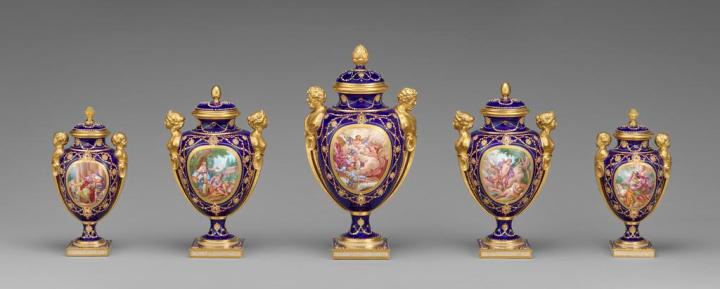
Five Lidded Vases, 1781, Sèvres porcelain manufactory; soft-paste porcelain. A set of vases des âges (‘vases of the ages’), this garniture of five vases, originally owned by King Louis XVI, includes three sizes referencing different stages of life: a large central vase with handles in the shape of bearded male heads, a pair of smaller vases with heads of young women, and a pair of still smaller vases with the heads of boys. The scenes painted on the fronts of the vases show episodes from The Adventures of Telemachus, one of the king’s favorite books. The Getty Museum owns three of the original five vases, while the two smallest now belong to the Walters Art Museum in Baltimore. More information is available here»
◊ ◊ ◊ ◊ ◊
Now on view at The Getty:
Porcelain from Versailles: Vases for a King & Queen
Getty Center, Los Angeles, 14 February 2023 — 3 March 2024

Lidded Vase, 1775–76, Sèvres porcelain manufactory; hard-paste porcelain with gilt-bronze mounts (National Museum of the Palaces of Versailles and Trianon). This is the center vase from a garniture of three vessels owned by Queen Marie-Antoinette.
This exhibition brings together two of the most extraordinary surviving sets of vases owned by King Louis XVI and Queen Marie-Antoinette of France during the late 1700s. The vases are among the highest achievements of the Sèvres porcelain manufactory made before the French Revolution, becoming personal treasures of the royal family at the time. They were initially kept at the Palace of Versailles outside Paris, the royal family’s primary residence, and are a testament to the exemplary skills of the artists who took part in their creation. This exhibition reunites all eight vases, which were separated during the Revolution, offering the rare opportunity to appreciate the craftsmanship and design of the ensembles.
The loan of the queen’s vases is part of an artistic exchange between the J. Paul Getty Museum and Versailles, where an important desk made for Louis XVI from the Museum’s collection is currently on long-term loan. This exhibition is presented in English and Spanish. Esta exhibición se presenta en inglés y en español.
Exhibition | The Petit Trianon during the Empire
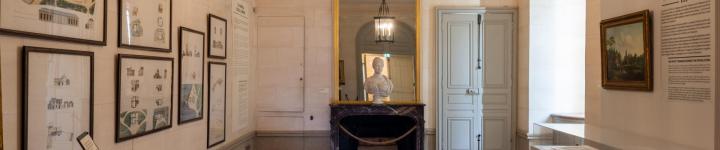
Installation view of The Petit Trianon during the Empire, 2023
(Photo by Sebastien Giles)
◊ ◊ ◊ ◊ ◊
On view this summer at the Château de Versailles:
The Petit Trianon during the Empire
Petit Trianon, Château de Versailles, 13 May — 17 September 2023
Presented by the Palace of Versailles, The Petit Trianon during the Empire tells the story of the restoration undertaken to turn Trianon into a country residence for Napoleon and Marie-Louise. The exhibition explains the work ordered by the emperor to restore the houses in the Hamlet, the farm, and the orangery—work that had become essential after twenty years of neglect.
During the Empire, the Petit Trianon was chosen as a country residence by Napoleon Bonaparte and his wife, Marie-Louise of Habsburg. Two decades of neglect, however, had left the houses in the Hamlet, the farm, and the orangery in urgent need of restoration. The work was carried out between 1805 and 1811, overseen by the architect Guillaume Trepsat and his assistant, Alexandre Dufour.

Installation view of The Petit Trianon during the Empire, 2023 (Photo by Sebastien Giles).
The working dairy, the barn, and the farmer’s cottage were all demolished. The farm was converted into a guard house, while the rest of the structures were restored and the thatched rooves repaired. The external staircases were removed, apart from the spiral staircase on the Queen’s House, which was replaced by a straight, covered staircase. The houses in the Hamlet reverted to the same use as under the Ancien Régime, with all the furniture and wall hangings replaced by classical, Empire-style pieces made by the cabinet-makers Jacob-Desmalter and Marcion, and the bronze-worker Galle.
Napoleon and Marie-Louise hosted several parties at the theatre and in the French Garden between 2 and 11 August 1810, and again, the following year, on 25 August, in the English Garden and the restored Hamlet, to celebrate the birth of their son. These parties harked back to the wonderful celebrations organised by Marie-Antoinette. The restoration work meant the heritage of the Petit Trianon was both protected and revived.
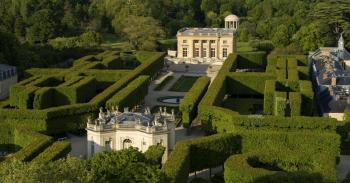
The Petit Trianon with the French Pavilion in the foreground at the left (Photo: Thomas Garnier).
During the French Revolution, from 1792, the Petit Trianon and the Queen’s Hamlet were emptied of their inhabitants and all their contents. The furniture, artworks, and everyday household items, such as mattresses, sheets, and cookware, as well as the fish in the lakes, were all auctioned off. The palace was rented to a restaurateur, while the garden became a public recreation area. The French Pavilion was turned into a café, the farm was rented to and worked by a farmer, and another restaurateur moved into the Queen’s House in the Hamlet.
By the beginning of the 19th century, the Hamlet was overgrown and decrepit. The roofs of several of the houses had collapsed and the external staircases were rotten. Two of the agricultural buildings—the barn and the working dairy—lay in ruins and the farm had been partially destroyed by fire. Sketches made by the English traveller and draughtsman John Claude Nattes in 1802 illustrate this state of neglect.
Exhibition | 1923 —The Domaine de Sceaux: Origins of a Renaissance
From Silvana Editoriale:
1923 — The Domaine de Sceaux: Origins of a Renaissance
Musée du Domaine départemental de Sceaux, 10 March — 9 July 2023
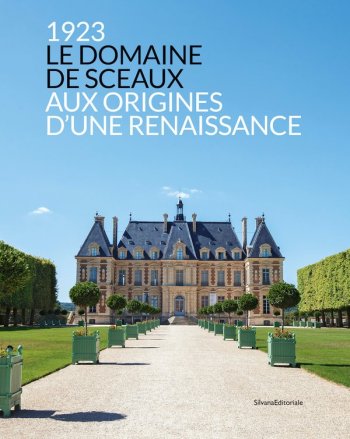 The Domaine de Sceaux was acquired in 1923 by the Hauts-de-Seine department, leading to the estate’s restoration and its opening to the public. This exhibition (installed in the former stables) brings together archival documents, posters, photographs, drawings, and paintings to tell the story of the place during this last eventful century. The exhibition traces the history of the estate from its first major transformation to the 1950s.
L’histoire du Domaine de Sceaux entre 1850 et 1950 reste peu connue du grand public. Après la Révolution, la propriété traversa plusieurs phases de déclin et de renouveau. Les aménagements d’aujourd’hui s’inspirent donc à la fois du parc ancien et des ouvrages classés du XVIIe s., et ils intègrent aussi le décor du XIXe s., introduit par les ducs de Trévise. Si vous êtes familier des lieux ou en quête d’histoire sur le Grand Paris, vous ressentirez d’autant plus cette métamorphose : celle d’un somptueux château à la campagne devenu un site muséal préservé et ouvert à tous.
Site historique et patrimonial majeur de la région parisienne, le Domaine départemental de Sceaux fut créé en 1670 par Jean-Baptiste Colbert, qui y appela les plus grands artistes de son temps, d’André Le Nôtre à Charles Le Brun, de Jules Hardouin-Mansart à Antoine Coysevox. Passé entre les mains du marquis de Seignelay, fils du ministre de Louis XIV, puis entre celles du duc et de la duchesse du Maine, du duc de Penthièvre et enfin du duc et de la duchesse de Trévise, cet ensemble remarquable, bientôt menacé par l’extension galopante de la banlieue, était appelé à une disparition quasi certaine lorsqu’en 1923, à la suggestion du maire de Sceaux, il fut acquis in extremis par le département de la Seine à la princesse de Cystria, née Trévise, dernière propriétaire. 2023 marque ainsi le centenaire du passage de ce domaine exceptionnel du statut de propriété privée à celui de bien public, devenu en 1970 l’un des fleurons du département des Hauts-de-Seine qui en assure depuis l’entretien et la valorisation. L’exposition revient sur le contexte, sur les raisons et sur les conditions de cette acquisition qui permit l’heureuse renaissance du domaine de Sceaux.
David Baurain and Céline Barbin, eds., 1923 — Le Domaine de Sceaux: Aux origines d’une renaissance (Milan: Silvana Editoriale, 2023), 208 pages, ISBN: 978-8836654239, €30.
New Book | The Coming of the Railway
From Yale UP:
David Gwyn, The Coming of the Railway: A New Global History, 1750–1850 (New Haven: Yale University Press, 2023), 416 pages, ISBN: 978-0300267891, $35.
 The first global history of the epic early days of the iron railway.
Railways, in simple wooden or stone form, have existed since prehistory. But from the 1750s onward the introduction of iron rails led to a dramatic technological evolution—one that would truly change the world. In this rich new history, David Gwyn tells the neglected story of the early iron railway from a global perspective. Driven by a combination of ruthless enterprise, brilliant experimenters, and international cooperation, railway construction began to expand across the world with astonishing rapidity. From Britain to Australia, Russia to America, railways would bind together cities, nations, and entire continents. Rail was a tool of industry and empire as well as, eventually, passenger transport, and developments in technology occurred at breakneck speed—even if the first locomotive in America could muster only 6 mph. The Coming of the Railway explores these fascinating developments, documenting the early railway’s outsize social, political, and economic impact—carving out the shape of the global economy as we know it today.
David Gwyn is a historian of the industrial and modern period. He is actively involved in the railway heritage movement, serving as a trustee of the Ffestiniog Railway and as chairman of the Bala Lake Railway Company.
c o n t e n t s
List of Illustration and Maps
Acknowledgments
Introduction
1 Trade, Transport, and Coal, 1767–1815
2 ‘Rails Best Adapted to the Road’: Cast-iron Rails and Their Alternatives in Britain, 1762–1832
3 Canal Feeders, Quarry Railways, and Construction Sites
4 ‘Art Has Supplied the Place of Horses’: Traction, 1767–1815
5 War and Peace, 1814–1834
6 ‘Geometrical Precision: Wrought-Iron Rails, 1808–1834
7 ‘Most Suitable for Hilly Countries’: Rope and Chain Haulage, 1815–1834
8 ‘That Truly Astonishing Machine’: Locomotives, 1815–1834
9 Coal Carriers, 1815–1834
10 Internal Communications, 1815–1834
11 The First Main Lines, 1824–1834
12 Coming of Age: The Public Railway, 1830–1834
13 ‘The New Avenues of Iron Road’, 1834–1850
14 ‘You Can’t Hinder the Railroad’
A Note on Sources and Terminology
Notes
Bibliography
Index
New Book | Frames that Speak
From Brill, with the ebook available for free as an open-access publication:
Chet Van Duzer, Frames that Speak: Cartouches on Early Modern Maps (Leiden: Brill, 2023), 272 pages, ISBN: 978-9004505186, $144.
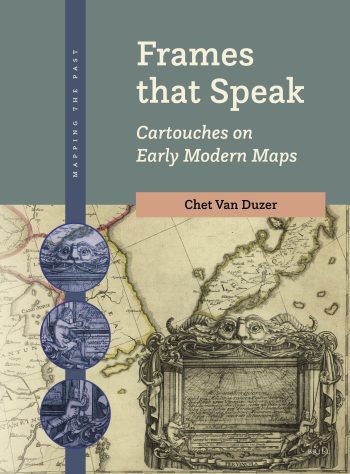 This lavishly illustrated book is the first systematic exploration of cartographic cartouches, the decorated frames that surround the title, or other text or imagery, on historic maps. It addresses the history of their development, the sources cartographers used in creating them, and the political, economic, historical, and philosophical messages their symbols convey. Cartouches are the most visually appealing parts of maps, and also spaces where the cartographer uses decoration to express his or her interests—so they are key to interpreting maps. The book discusses thirty-three cartouches in detail, which range from 1569 to 1821, and were chosen for the richness of their imagery. The book will open your eyes to a new way of looking at maps.
Chet Van Duzer is a leading historian of cartography and manages the projects involving maps and globes for the Lazarus Project at the University of Rochester, which brings multispectral imaging to cultural institutions around the world.
C O N T E N T S
Acknowledgments
List of Figures
Introduction
• Definition of ‘Cartouche’
• Names for Cartouches
• Two Ornamental Motifs of Sixteenth-Century Cartouches
• Early Cartouches, and Some Cartouche Firsts
• The Sources of Cartouches
• The Development of the Cartouche, Sixteenth to Nineteenth Centuries
• The Decline of Cartouches
• The Ontology of Cartouches
• Cartouches and Emblems: Two Distinct Genres
• The Cartouches in the Body of This Book
• The Hand-Coloring of Cartouches
• The Theatricality of Cartouches
1 Covering Emptiness with a Hope for Peace: Gerard Mercator, Nova et aucta orbis terrae descriptio ad usum navigantium, 1569
2 The Gaze of the Sea Monster: Ignazio Danti’s map of Sardinia in the Galleria delle carte geografiche, 1580–82
3 An Exotic Medicine from the Tombs of Egypt Daniel Cellarius, Asiae nova descriptio, c.1590
4 New Personifications of the Continents: Jodocus Hondius, Nova et exacta totius orbis terrarum descriptio, 1608
5 Cosmographers in the Southern Ocean: Pieter van den Keere, Nova totius orbis mappa, c.1611
6 Ingratitude Bites Kindness: Jodocus Hondius, Novissima ac exactissima totius orbis terrarum descriptio, 1611 / 1634
7 Eurocentrism on Display: Arnold Floris van Langren, terrestrial globe, 1630–32
8 The Giddy Pleasures of Mise en Abyme: Willem Hondius, Nova totius Brasiliae et locorum a Societate Indiae Occidentalis captorum descriptio, 1635
9 The Cartographer’s Self-Portrait: Georg Vischer, Archiducatus Austriae inferioris, 1670 / 1697
10 Scheming for Control in the New World: Claude Bernou, Carte de l’Amerique septentrionale et partie de la meridionale, c.1682
11 Unveiling Text, Interpreting Allegory: Vincenzo Coronelli, terrestrial globe, 1688
12 Concealing and Revealing the Source of the Nile: Vincenzo Coronelli, L’Africa divisa nelle sue parti, 1689
13 Propaganda in a Cartouche: Vincenzo Coronelli, Paralello geografico dell’antico col moderno archipelago, 1692
14 If It Bleeds, It Leads: David Funck, Infelicis regni Siciliae tabula, c.1693
15 Celebrating a Triumph of Engineering: Jean-Baptiste Nolin, Le canal royal de Languedoc, 1697
16 The Battle between Light and Darkness: Heinrich Scherer, Repraesentatio totius Africae, 1703
17 A Map in the Map as Prophesy: Nicolas Sanson and Antoine de Winter, Geographiae Sacrae Tabula, 1705
18 ‘One of the Most Singular Stories of Extreme Hardships’: Pieter van der Aa, Scheeps togt van Iamaica gedaan na Panuco en Rio de las Palmas, 1706
19 Crimson Splendor: Nicolas Sanson, Téatre de la Guerre en Flandre & Brabant, c.1710
20 Generals Presenting Maps to the Emperor: Johann Baptist Homann, Leopoldi Magni Filio Iosepho I. Augusto Romanorum & Hungariae Regi …, c.1705–11
21 How to Build a Giant Cartouche: Nicolas de Fer, Carte de la mer du Sud et de la mer du Nord, 1713
22 Advertising Makes Its Entrance: George Willdey, Map of North America, 1715
23 The Collapse of the Mississippi Bubble: Matthäus Seutter, Accurata delineatio Ludovicianae vel Gallice Louisiane, c.1728
24 ‘The Link of the Human Race for Both Utility and Pleasure’: Matthäus Seutter, Postarum seu cursorum publicorum diverticula en mansiones per Germaniam, c.1731
25 Kill the Cannibals and Convert the Rest: Jean-Baptiste Nolin, II, L’Amerique dressée sur les relations les plus recentes, 1740
26 The Cartographer and the Shogun: Matthäus Seutter, Regni Japoniae nova mappa geographica, c.1745
27 The Illusionistic Roll of the Cartouche: Gilles and Didier Robert de Vaugondy, Carte de la terre des Hebreux ou Israelites, 1745
28 A Cartographic Balancing Act: Matthäus Seutter, Partie orientale de la Nouvelle France ou du Canada, c.1756
29 Impartial Border, Partisan Cartouche: Juan de la Cruz Cano y Olmedilla, Mapa geográfico de America Meridional, 1775
30 A Tactile Illusion That Legitimates the Map: Henry Pelham, A Plan of Boston in New England with its Environs, 1777
31 Fighting Back against Colonial Cartography: José Joaquim da Rocha, Mappa da Comarca do Sabará pertencente a Capitania de Minas Gerais, c.1778
32 The Actors Begin to Leave the Stage: Jean Janvier, Maps of 1761, 1769, and 1774; Robert de Vaugondy, Map of 1778; John Purdy, Map of 1809
33 A Map on a Map on a Map: John Randel, Jr., The City of New York as Laid Out by the Commissioners, 1821
Conclusions
Index
Call for Essays | Art and Memory in Early Modern Central Europe
From ArtHist.net:
Art and Memory in Early Modern Central Europe
Edited Volume
Proposals due by 1 September 2023; completed essays due by 1 December 2023
This edited volume will explore the culture of commemoration in early modern Central Europe as a testimony to the tectonic changes in the period’s social, religious, and political life. Memorials, tomb sculptures, and portraits reflected not only the desire of early modern elites to maintain family memory and highlight their confessional identity but also the emergence of ‘collective memory’ and national identity crystallised and secured in artefacts.
During the early modern period, which was marked by political conflicts and upheavals and profound changes in religious culture exemplified by the Reformation, the culture of commemoration including its visual expression changed substantially. While Western European commemorative practices were the focus of several recent edited volumes, the Central and Eastern European culture of commemoration remains rather understudied and leaves us asking about the possible dialogue if not entanglement in the domain of commemoration between Western and East-Central Europe in early modern times.
Therefore, we encourage submissions on the following topics:
• Art and Commemoration Practices
• Memory in Religious Controversies
• Memory and Social Identity
• Cultural Practices in Politics of Memory
• Art and the ‘Places of Memory’
We are looking for papers of 5,000–8,000 words including a bibliography. Interdisciplinary and transcultural contributions are particularly welcome. Please submit a 500-word abstract and a brief biography to Stefaniia Demchuk (demchuk@phil.muni.cz) by 1 September 2023. The selected authors will be expected to deliver a full paper by 1 December 2023. All submissions will be peer-reviewed.










 Enfilade
leave a comment