New Book | A Cultural History of Color in the Age of Enlightenment
From Bloomsbury Publishing:
Carole Biggam and Kirsten Wolf, eds., A Cultural History of Color in the Age of Enlightenment (London: Bloomsbury Academic, 2022), 288 pages, ISBN: 978-1474273725, $110. Volume 4 in the Cultural History of Color set.
 A Cultural History of Color in the Age of Enlightenment covers the period 1650 to 1800. From the Baroque to the Neo-classical, color transformed art, architecture, ceramics, jewelry, and glass. Newton, using a prism, demonstrated the seven separate hues, which encouraged the development of color wheels and tables, and the increased standardization of color names. Technological advances in color printing resulted in superb maps and anatomical and botanical images. Identity and wealth were signalled with color, in uniforms, flags, and fashion. And the growth of empires, trade, and slavery encouraged new ideas about color.
Color shapes an individual’s experience of the world and also how society gives particular spaces, objects, and moments meaning. The 6-volume set of the Cultural History of Color examines how color has been created, traded, used, and interpreted over the last 5000 years. The themes covered in each volume are color philosophy and science; color technology and trade; power and identity; religion and ritual; body and clothing; language and psychology; literature and the performing arts; art; architecture and interiors; and artefacts.
Carole P. Biggam is Honorary Senior Research Fellow in English Language and Linguistics at the University of Glasgow. Kirsten Wolf is Professor of Old Norse and Scandinavian Linguistics at the University of Wisconsin-Madison.
c o n t e n t s
1 Philosophy and Science — Anna Marie Roos
2 Technology and Trade — Alexander Engel
3 Power and Identity — Monika Barget
4 Religion and Ritual — Felicity Loughlin
5 Body and Clothing — Mechthild Fend and Amelia Rauser
6 Language and Psychology — João Paulo Silvestre
7 Literature and the Performing Arts — Timothy Campbell
8 Art — Karin Leonhard
9 Architecture and Interiors — Basile Baudez
10 Artefacts — Clive Edwards
Exhibition | Black Founders: The Forten Family of Philadelphia
Now on view at the Museum of The American Revolution:
Black Founders: The Forten Family of Philadelphia
Museum of The American Revolution, Philadelphia, 11 February — 26 November 2023
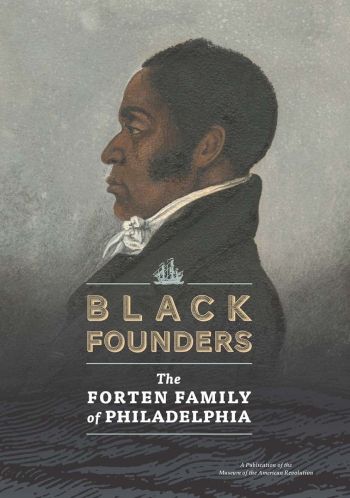 When James Forten (1766–1842) walked the streets of Philadelphia as a young man in the 1770s, he was surrounded by the sights and sounds of transformation. He heard the words of the Declaration of Independence read aloud for the first time in 1776 before setting sail to fight for independence in 1781. Born a free person of African descent, Forten built upon his coming-of-age in a revolutionary city and his wartime experience to forge himself into a changemaker in Philadelphia and the young United States, becoming a successful businessman, philanthropist, and stalwart abolitionist.
In our new special exhibition Black Founders: The Forten Family of Philadelphia, the Museum introduces visitors to Forten and his descendants as they navigated the American Revolution and cross-racial relationships in Philadelphia to become leaders in the abolition movement in the lead-up to the Civil War and the women’s suffrage movement. Using objects, documents, and immersive environments, Black Founders: The Forten Family of Philadelphia explores the Forten family’s roles in the Revolutionary War, business in Philadelphia, and abolition and voting rights from 1776 to 1876.
The exhibition features more than 100 historical artifacts, works of art, and documents from 38 different lenders, including both institutions and private collectors, as well as the Museum’s own collection. Rare historical objects on loan from descendants of the Forten family are on view for the very first time in a public exhibit.
The unique journey and exceptional story of this family of Revolutionaries explores the legacy of the American Revolution, the history of the American experiment of liberty, equality, and self-government, and the ongoing work to improve the nation’s dedication to the principle that “all men are created equal.”
Black Founders: The Forten Family of Philadelphia (Philadelphia: Museum of the American Revolution, 2023), ISBN: 978-1933153445, $38.
New Book | Woodland Imagery in Northern Art, c.1500–1800
From Lund Humphries:
Leopoldine van Hogendorp Prosperetti, Woodland Imagery in Northern Art, c.1500–1800: Poetry and Ecology (London: Lund Humphries, 2022), 160 pages, ISBN: 978-1848224940, £45 / $80.
 Woodland Imagery in Northern Art reconnects us with the woodland scenery that abounds in Western painting, from Albrecht Dürer’s intense studies of verdant trees, to the works of many other Northern European artists who captured ‘the truth of vegetation’ in their work. These incidents of remarkable scenery in the visual arts have received little attention in the history of art, until now. Prosperetti brings together a set of essays which are devoted to the poetics of the woodlands in the work of the great masters, including Claude Lorrain, Jan van Eyck, Jacob van Ruisdael, Peter Paul Rubens, Rembrandt and Leonardo da Vinci, amongst others. Through an examination of aesthetics and eco-poetics, this book draws attention to the idea of lyrical naturalism as a conceptual bridge that unites the power of poetry with the allurement of the natural world. Engagingly written and beautifully illustrated throughout, Woodland Imagery in Northern Art strives to stimulate the return of the woodlands to the places where they belong—in people’s minds and close to home.
Leopoldine Prosperetti is a writer and academic. She is Instructional Professor in the School of Art at the University of Houston, and has written and edited a number of books including Green Worlds in Early Modern Italy: Art and the Verdant Earth (Amsterdam University Press, 2019) and Landscape and Philosophy in the Art of Jan Brueghel (Ashgate, 2009).
C O N T E N T S
Preface
Introduction
Kindle’s Promise
Dürer’s Linden
Jan van Eyck’s Adoration of the Lamb
The Poet’s Catalogue
The Copse
Survivor Sole
Sights of Tivoli
Love in a Ducal Forest
In the Heart of the Forest
Down by the Riverside
Epilogue
Bibliography
Illustrations
Exhibition | Dutch and Flemish Paintings from Woburn Abbey

Aelbert Cuyp, A Landscape near Calcar with the Artist Sketching, ca. 1652
(Woburn Abbey Collection)
◊ ◊ ◊ ◊ ◊
The collection of Netherlandish works at Woburn Abbey was assembled primarily in the eighteenth and early nineteenth centuries. From the press release for the exhibition:
Mastering the Market: Dutch and Flemish Paintings from Woburn Abbey
The Barber Institute of Fine Arts, University of Birmingham, 17 June — 24 September 2023
Curated by University of Birmingham MA students alongside experts from the Barber and Woburn Abbey
This summer, the Barber Institute of Fine Arts, University of Birmingham, presents a dazzling selection of Dutch and Flemish 17th-century masterpieces from Woburn Abbey, the ancestral home of the Dukes of Bedford. Featuring a dozen Old Master paintings, the exhibition Mastering the Market: Dutch and Flemish Paintings from Woburn Abbey is one of the largest and most significant group of such works from this important ducal collection to be exhibited in a public gallery since the 1950s.
Focused on the themes of patronage and collecting, Mastering the Market is curated by four Art History and Curating MA students from the University of Birmingham, with guidance and supervision from experts at both the Barber Institute and Woburn Abbey. Other aspects of the innovative and dynamic 17th-century Dutch art market will also be explored—from the unique character of artistic culture in the newly independent Dutch Republic, through art dealership and attribution, to the demand for and development of new genres. The burgeoning wealth and rise of the merchant classes in the Netherlands in the 17th century sparked huge demand for portrait commissions, also examined here through fresh interpretations of the works from Woburn Abbey.
Assembled principally by the 4th, 5th, and 6th Dukes of Bedford between the 1730s and 1830s, the Woburn Abbey collection of Dutch and Flemish paintings is one of the finest in private hands in the UK. Works include superb portraits and head studies by Rembrandt Van Rijn, Frans Hals, and Anthony Van Dyck, exquisite landscapes and seascapes by Aelbert Cuyp and Jan van de Cappelle, and lively subject pictures by Jan Steen and David Teniers. The exceptional opportunity to see these paintings together in a public gallery has arisen due to the extensive and ongoing refurbishment of the Abbey.
Key loans include Rembrandt’s Portrait of a Bearded Old Man, 1643, Hals’s Portrait of a Man, c. 1635–38, Van Dyck’s Portrait of a Married Couple, identified as Daniel Mytens and his Wife, c. 1632–34, Cuyp’s A Landscape near Calcar with the Artist Sketching, c. 1652, Steen’s Twelfth Night or ‘Le Roi Boit’, 1670–71, and Van de Cappelle’s A Dutch Harbour with Numerous Fishing Boats, c. 1652–54.
Complementing the Woburn masterpieces is a small selection of the outstanding Dutch and Flemish paintings in the Barber’s own permanent collection, notably Jan Steen’s The Wrath of Ahasuerus, c. 1668–70, Van Dyck’s Ecce Homo, c.1625–26, and Portrait of François Langlois, early 1630s (jointly owned with the National Gallery, London), plus Hals’s Portrait of a Man Holding a Skull, c. 1611–12.
Robert Wenley, Barber Institute Deputy Director, Research and Collections, says: “The exhibition will present the public with the rare opportunity to view these works up close in a gallery setting and facilitate an appreciation of the ways in which patronage and collecting reflected and contributed to a dynamic period of European history. Our talented young team of student curators will also explore the tastes and achievements of the successive Dukes of Bedford as collectors of Dutch and Flemish paintings in the decades following their first purchases on the art market of works from these schools in the early 18th century.”
Professor Jennifer Powell, Director of the Barber Institute, says: “We are delighted to present works from this important collection in Birmingham. The Barber is proud to support this unique opportunity for students of the University of Birmingham to co-curate an exhibition of such exceptional quality in its main gallery programme.”
Matthew Hirst, Curator of the Woburn Abbey Collection, says: “We are delighted to have the opportunity to present these masterpieces from Woburn Abbey alongside other works by the same masters from the Barber’s own choice collection. This opportunity to compare these works and consider the phenomenon of the Dutch and Flemish market is only possible due to the input of the students at this unique time whilst Woburn Abbey is closed to undergo a generational refurbishment project.”
Woburn Abbey houses an outstanding collection of works of art brought together by the family over nearly 500 years. During the closure, there is an active loans programme to share some of these treasures so they can be enjoyed in different contexts. Woburn has partnered with a number of prestigious venues since 2020, including Royal Museums Greenwich, the Holburne Museum, Worcester City Art Gallery, and Gainsborough’s House. Many of the important works of art from the collection have been exhibited in new ways due to these partnerships. Full restoration and renewal of the roof at Woburn Abbey has led to a prolonged closure period. This has enabled these partnerships to continue and expand offering more opportunities to share Woburn’s impressive art collection with a wider audience.
Allegorical Painting of Two Ladies Acquired by Compton Verney

Unidentified painter (British School), Allegorical Painting of Two Ladies Wearing Beauty Patches, detail, ca. 1650s, oil on canvas, 64 × 75 cm. The painting sold at Trevanion, Fine Art and Antiques sale on 23 June 2021 (lot 564) for £220,000.
◊ ◊ ◊ ◊ ◊
From the press release from Compton Verney:
An extremely rare 17th-century painting has been acquired by Compton Verney. Allegorical Painting of Two Ladies, an English School work dating to around 1650 was at risk of permanently leaving the UK after being sold at auction in 2021, but now with generous support from the National Heritage Memorial Fund (NHMF) and V&A Purchase Grants, it will go on display at Compton Verney for the public to enjoy.
This almost unique painting shows two women, one Black and one white, side by side, presented as companions and equals, wearing similar dress, hair, and jewellery. The portrayal of a Black female sitter is highly unusual in this period, especially in showing an adult rather than a child in a position of subservience, thereby inviting important debate about race and gender during the period.
Another remarkable aspect of the painting is the depiction of beauty patches on both the women. Although in vogue at the time, the painting appears to condemn wearing these ‘spots’ as the inscription above the two women declares beauty patches to be a sin of pride, a widespread opinion in the 17th century. This style of work gives the painting an affinity with popular woodcut prints at the time, making it clear the work is allegorical and associating it with satirical verse, pamphlets, and sermons.
Following its sale at auction in 2021, the Reviewing Committee on the Export of Works of Art and Objects of Cultural Interest (RCEWA) agreed the work should remain the nation because of its “outstanding significance” to the study of race and gender in 17th-century Britain. The recent resurfacing of the painting has generated new possibilities for exploring the early history of Black culture in Britain.
Purchased with support from the Arts Council England/V&A Purchase Grant Fund and from the National Heritage Memorial Fund, Two Ladies will go on public display in the UK next year. The painting will now undergo conservation, before being unveiled in a display at Compton Verney in 2024, allowing its complicated narratives to be widely studied and understood.
Geraldine Collinge, Compton Verney CEO says: “We are absolutely delighted to be able to add this hugely important painting to the Compton Verney collection. We are also pleased to be able to work with our colleagues at Yale—their world-class conservation facilities and expertise will restore the work to the highest standard for UK display, along with providing further insight and greater understanding of the painting and its context.”
Dr Simon Thurley CBE, Chair of the National Heritage Memorial Fund, said: “We are delighted that the National Heritage Memorial Fund has been able to support the acquisition of this unique painting and that it will become part of the collection at Compton Verney in perpetuity. This dual portrait provides great opportunities to enrich our understanding of race and gender in the 17th century. We look forward to hearing the outcomes of the research that will be undertaken at Yale and, after the conservation work, seeing the painting displayed at Compton Verney for the UK public to admire and enjoy.”
Andrew Hochhauser KC, Chair of the RCEWA, said: “The Committee and I are extremely pleased that Allegorical Painting of Two Ladies has been saved for the nation and will be on display at Compton Verney. This anonymous mid-17th-century painting is a great rarity: it shows two women with beauty patches, one Black and one white, side by side, presented as companions and equals. The painting will delight audiences and encourage debate about and research into race and gender during the period.”
Call for Papers | The English Georgian North, 1714–1830
From the Call for Papers:
The English Georgian North, 1714–1830: Rethinking Cultures and Connections
Institute of Medieval and Early Modern Studies, Durham University, 15 September 2023
Proposals due by 14 July 2023
This symposium builds on conversations that have been taking place at Durham University over the last fifteen months as part of the IMEMS research strand The Georgian North, designed and led by Professor Fiona Robertson. It sets out to develop new approaches to the intellectual and creative cultures of the northern counties of England in the Georgian period, 1714–1830. Important contributions to knowledge, interpretation, creative practice, and scientific advance were made in the north country during this still largely rural and early industrial period in its history. They took shape in social, professional, and discursive networks of considerable complexity and reach, bringing together artists, abolitionists, antiquaries, architects, writers, theologians, musicians, astronomers, philosophers, mathematicians, botanists, landscape designers, linguists, clergy, social and political reformers, actors, and archaeologists. Yet there has been little connected cross-disciplinary exploration of these cultures, their significance, and their legacies.
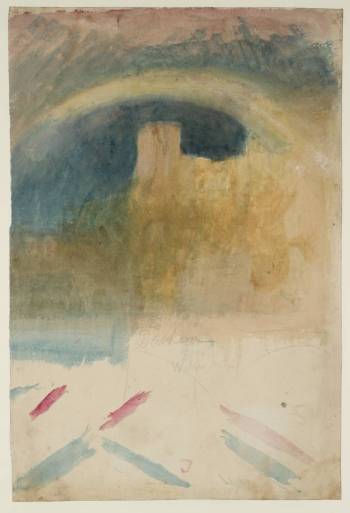
J.M.W. Turner, Durham Cathedral with a Rainbow, ca.1817, graphite and watercolour on paper, 55 × 37 cm (London: Tate, D25247).
We invite proposals for 15-minute papers or presentations to contribute to a day of informal and investigative discussion. Topics of interest include, but are not restricted to
• Environment and conservation
• Abolition, reform, and intervention
• Originality and innovation
• Scientific enquiry, speculation, and new worlds
• Practices of collecting, curation, and display
• Performance: players, theatres, audiences
• Composition: music, painting, poetry, prose fiction, architecture, design
• Ancient pasts: theories and artefacts
• Cultures of belief
• Depletion and rediscovery (buildings, communities, habitats, traditions)
• International and intercultural connections; connections across languages and traditions
• Conversation and exchange (social, professional, and discursive networks, philosophical and historical societies, bookshops, print cultures)
The region under discussion comprises the historic counties of northern England: County Durham, the North Riding of Yorkshire, Northumberland, Cumberland, and Westmorland. Of particular interest, because especially under-researched, is present-day County Durham and the areas immediately bordering it, but we welcome work on all relevant locales and communities. Of the many individuals active in the intellectual and creative cultures of the period, some were permanently settled in the northern counties, while others were here for shorter periods, often under-researched relative to the wider body of scholarship on their work. They are all of significance to our discussion, as are, also equally, the natural and constructed environments of the northern English counties—private and public buildings, landscapes and treescapes, theatres and observatories. All these environments helped shape the formation and development of ideas and many are now lost or under-regarded.
This is a free, in-person symposium, open to researchers across disciplines, with papers and roundtables and an emphasis on discussion and exchange. Teas, coffees, and a light lunch will be provided. There will be at least one online-only follow-up session later in 2023. We invite 300-word proposals for 15-minute papers or presentations. Please submit your proposal via this form by 14 July 2023.
If you cannot attend but are interested in receiving information about the Research Strand and follow-up sessions, you can use the above link to register your interest. We shall respond to all proposal submissions no later than 28 July, after which time further details and the registration link will be made available.
Symposium | Evoking the Incommensurable: Painting the Sublime

Philip James De Loutherbourg, An Avalanche in the Alps, 1803, oil on canvas, 110 × 160 cm
(London: Tate, T00772).
◊ ◊ ◊ ◊ ◊
From the conference website:
Evoking the Incommensurable: Painting the Sublime
In person and online, Friedrich Schiller University, Jena, 26–28 July 2023
Organised by Johannes Grave, Sonja Scherbaum, and Arno Schubbach
Collaborative Research Center (SFB) 1288 “Practices of Comparing,” Bielefeld University, and Research Center for European Romanticism, Friedrich Schiller University Jena.
In the 18th century, the concept of the sublime constitutes a genuine novelty and a driving force for advancements in the theoretical reflection on the arts throughout Europe. Edmund Burke and Immanuel Kant distinguished the sublime sharply from the beautiful, i.e., the traditional organizing subject of treatises on painting and literature, and emphasized its excessive strain on the senses, its incommensurability with any measure, and its irreducibility to any bounded shape. It thus constituted a harsh contrast to the beautiful and challenged the aesthetic values of pictorial or literary representation.
Moreover, the sublime was also a challenge to artistic practice. Theoretical discourse concerning the sublime often referred much more directly to our experience of nature than to our experience of artistic works. Particularly in the case of Kant, it was not evident that the arts are at all able to evoke anything sublime. Nevertheless, various attempts to paint the sublime can be seen in the genre of landscape painting. The sublime stimulated painters to push the limits of painting and to explore its capabilities anew.
The international conference Evoking the Incommensurable: Painting the Sublime will discuss the question of how artists purposefully explored and exploited the limits and capabilities of painting in order to evoke the incommensurable and paint the sublime. Participation is possible both on-site or via Zoom. Please register at paintingthesublime@uni-jena.de by 24 July 2023. The conference will be held in a hybrid format. Please let us know if you would like to attend in person or via Zoom.
w e d n e s d a y , 2 6 j u l y 2 0 2 3
13.00 Arrival and Registration
13.30 Welcome and Introduction
14.00 Panel 1
Chair: Johannes Grave
• Aris Sarafianos (Ioannina), Hard Imitation and the Sublime Real: Art, Exhibitions, Panoramas, Casts, and Displays at the Far Ends of Visibility, c. 1800
• Elisabeth Ansel (Jena), ‘Most Magnificent and Sublime’: Ossian, Blindness, and the Sublime in the Visual Arts
• Hélène Ibata (Strasbourg), Temporal Vertigo and the Historical Sublime in Turner’s Venice Paintings
17.30 Coffee Break
18.00 Keynote Lecture
• Robert Doran (Rochester), ‘Moving Us to Pity’: Visual Art and Sublimity in Burke, Du Bos, and Kant
20.00 Conference Dinner
t h u r s d a y , 2 7 j u l y 2 0 2 3
9.15 Welcome
9.30 Panel 2
Chair: Mira Claire Zadrozny
• Yvon Le Scanff (Paris), Victor Hugo, ‘Bringing out the Sublime’
• Caroline van Eck (Cambridge), The Animal Sublime, c. 1800
• Sarah Gould (Paris), Mary Somerville’s Scientific Sublime: Picturing the Immaterial
13.00 Lunch Break
14.30 Panel 3
Chair: Britta Hochkirchen
• Laure Cahen-Maurel (Bonn), Viewing beyond the Visible: The Power of the Imagination from the Kantian to the Romantic Sublime
• Mark Cheetham (Toronto), The Incommensurability of Arctic Sublimity: Environmental Stereotypes and the Specificity of the Sublime
• Craig Hanson (Grand Rapids), Before & After: Temporal Strategies for Effecting the Sublime
19.30 Reception at Schillers Gartenhaus
f r i d a y , 2 8 j u l y 2 0 2 3
9.15 Welcome
9.30 Panel 4
Chair: Arno Schubbach
• Marie-Louise Monrad Møller (Leipzig), Pauelsen, Dahl, Lundbye: Aspects of the Sublime in Scandinavian Landscape Painting
• Adèle Akamatsu (Paris), Fjords, Waterfalls and High Mountains: Painting the ‘Rough’ and ‘Grand’ Landscapes of Norway from Germany, 1820s–1860s
• Nikita Mathias (Oslo), Painting the Sublime beyond Painting: From the Easel to the Cinema
13.00 Concluding Discussion
Call for Essays | Interpretations of Longinus in the Early Modern Period
From ArtHist.net:
Interpretations of Longinus in the Literature, Painted and Printed Imagery of the Early Modern Period
Edited Volume of Essays To Be Published in 2025
Proposals due by 15 July 2023; final chapters due by 1 July 2024
This volume of the series Trends in Classics (to be published by De Gruyter) seeks to explore aspects of Longinian ideas, addressing in particular the concept of the sublime. It will bring together scholars of art history, history of ideas, literature, and philosophy to reflect upon the reception of these ideas in the literature and the art of Italy, Spain, and the Low Countries from the 15th through the 18th century. Considering that there is probably no direct evidence concerning the Longinian sublime as a productive theory in the early modern times, the primary interest lies in possible interpretations of works in certain artistic media (paintings and prints) as well as re-readings of the Peri hypsus in the literature of the period.
The starting point is the relationship among artists, literati, and patrons; the connections of artworks to various textual sources; the existence of sublime/Longinian literature in libraries of the period; and the tracing of relevant text dissemination. The network of acquaintance with the notion of the sublime may be opened up towards other directions, such as politics, the treatment of the human body, the aesthetics of antiquity, and the Renaissance. The tackling of a complex problem such as the reception of Longinian ideas, makes cross-disciplinary research imperative.
The completed volume will be published in 2025. Drafts from participants will be discussed during an online workshop in February 2024. The presentations will be 20 minutes long. Contributors are invited to submit their proposals in English. There is a two-stage submission procedure.
15 July 2023
Please send a 250-word proposal (in English) and a short cv (500 words) to all the members of the editorial board:
• Ianthi Assimakopoulou, National Kapodistrian University of Athens, ianthiassim@icloud.com
• Nafsika (Nancy) Litsardopoulou, Athens School of Fine Arts, nancylitsardo@hotmail.com
• Evina Sistakou, Aristotle University of Thessaloniki, sistakou@gmail.com
15 September 2023
Selected abstracts will be invited to participate in the online international workshop in February 2024, under the aegis of the National and Kapodistrian University of Athens – Department of History and Archaeology.
February 2024
Online workshop.
1 July 2024
Submission of final versions of the papers (up to 7000 words, excluding bibliography). Following a peer review process, the editorial board will make final decisions on the acceptance of papers.
Exhibition | Sensing Naples
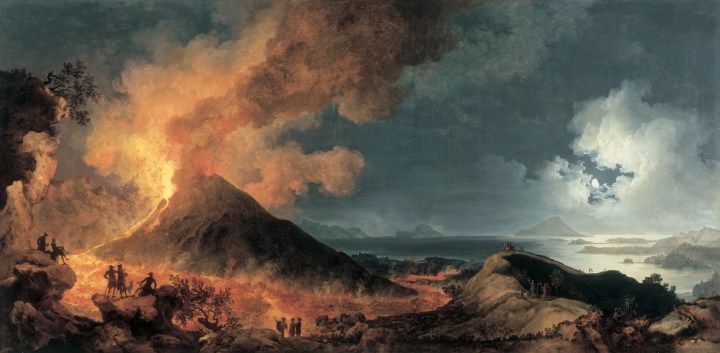
Pierre-Jacques Volaire, An Eruption of Vesuvius by Moonlight, 1774, oil on canvas, 130 × 260 cm (Compton Verney; photo by John Hammond). As noted at ArtUK, this is the largest of Volaire’s many views of the volcano.
◊ ◊ ◊ ◊ ◊
With scents in the gallery, readers may recall The Essence of a Painting: An Olfactory Exhibition on view last summer at the Prado. From Madrid to Compton Verney:
Sensing Naples
Compton Verney, Warwickshire, 1 April — 31 December 2023
Come and be transported to Naples—where the scent of orange blossom drifts on the air and the spectacle of Vesuvius smoulders in the distance. Bringing to life the smells, sounds, sights, tastes, and sensations of visiting this vibrant Italian city, Sensing Naples will see the exquisite historic works in our Naples Collection rehung and reimagined. Interactive elements and new wall texts will foreground exciting new research into objects in the collection undertaken in collaboration with the University of Oxford and the Centre for the Art and Architectural History of Port Cities, Naples.

Installation view of Sensing Naples at Compton Verney, 2023.
The display features new interactive elements, including samples of music from the period and six bespoke fragrances, which are paired with specific paintings. Developed in collaboration with a specialist fragrance house, the scents have been designed to highlight elements within the paintings and to evoke the experience of visiting the city of Naples in the period 1600–1800. Some are pleasant, others not so: they include the smells of the Bay of Naples, perfumed gloves, a fish market, tobacco smoke, a floral still life, and an eruption of Mount Vesuvius. You will also find a new, interactive play table modelled on an erupting Vesuvius, a permanent fixture in the galleries aimed at engaging our youngest visitors.
Additional works on display include examples of souvenirs made from the lava of Vesuvius and brought back to Britain in the eighteenth and nineteenth centuries, as well as two new commissions produced by artists working today.

Aaron McPeake, Commissioned work for the exhibition, three bronze bells suspended from the ceiling above a lava rock. More information is available here.
The new artworks respond to the theme of the senses and also to works in the historic collection, and have been commissioned in partnership with disability arts platform Unlimited. DYSPLA, a neuro-divergent led award-winning arts studio, have created a work that speaks to Lorenzo Vaccaro’s marble busts of The Four Continents, through four new performative digital sculptures. Accessed via a QR code, these holographic sculptures invite you to engage with your own physicality through touch. The senses of sight, hearing, and touch are further addressed in the second new artwork, which takes the form of three bronze bells suspended above a piece of Vesuvius lava rock. The bells, which can be gently rung, were created for Compton Verney by Aaron McPeake, an artist whose practice explores his own experience of sight loss later in life.
Lecture | Alessia Attanasio on Neapolitan Art in English Collections
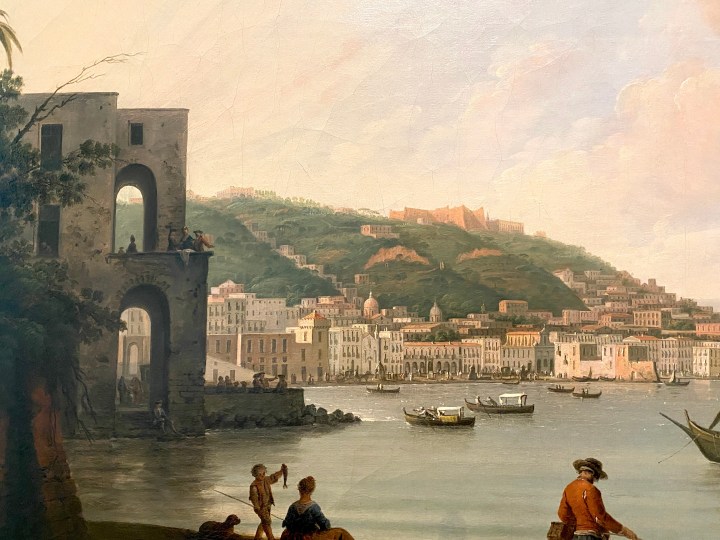
Pietro Fabris, The Bay of Naples from Posillipo, detail, ca. 1770, oil on canvas, 75 × 128 cm
(Compton Verney, Warwickshire)
◊ ◊ ◊ ◊ ◊
From The Wallace Collection:
Alessia Attanasio, The Fortunes of Baroque Neapolitan Art in English Collections during the Grand Tour, 1680–1800
Wallace Collection Seminars on the History of Collections and Collecting
Online and in-person, The Wallace Collection, London, Monday, 26 June 2023, 5.30pm
This talk aims to provide an overview of the history of collecting Baroque Neapolitan art in England from 1680s to 1800s, a period when many English artists and collectors travelled to Naples during the Grand Tour. Based on Alessia Attanasio’s PhD research, it will introduce artists from the Kingdom of Naples who enjoyed considerable success among English patrons, demonstrating how the Grand Tour influenced the market for Baroque Neapolitan art—not just for the newly discovered antiquities in Pompeii, Herculaneum, and Stabiae.
Today, Baroque Neapolitan paintings form a significant part of private and public English art collections; yet there is no publication exploring the significance of these collections as a whole. Therefore, the lecture aims to fill this gap by identifying and locating Neapolitan art in public and private English collections, now disclosed in an up-to-date database. The database will include images, references, notes on subject, author, and context, as well as acquisition and provenance details, providing the first comprehensive view of Neapolitan paintings in England. Alessia will focus on specific private British collections held in country houses such as Compton Verney, with the new redisplay of its unique Neapolitan collection, and Holkham Hall, which owns several Neapolitan paintings, both of which reflect the changes in art collecting in England. The lecture will bring together different fields of study, from the history of art to the art market, and shed new light on the material conditions that made art collecting possible.
Alessia Attanasio is a PhD candidate at the University of Birmingham, focusing on Baroque Neapolitan art that was collected in England during the Grand Tour (1680s–1820s), with particular interests in country houses, history of collecting, and museum studies. Alessia’s interest in museums is supported by eight years of experience working in museums as an assistant curator and museum educator, including Capodimonte Museum in Naples, and the Royal Collection Trust in London. Most recently, Alessia has been undertaking research into Baroque artworks in the Neapolitan Collection of Compton Verney, contributing to the curation of its permanent redisplay, Sensing Naples.










 Enfilade
leave a comment