Conference | The Mutability of Collections
From ArtHist.net and the Seminar on Collecting and Display website:
The Mutability of Collections: Transformation, Contextualisation, and Re-interpretation
Online and in-person, Birkbeck College, London, 7 July 2023
Registration due by 7 June 2023
This one-day conference concentrates on the ways in which objects in collections are added, exchanged or disposed of, translated and transformed. Items can be moved to new surroundings and different decorative settings, resulting in altered contexts of display, meaning, and significance. This conference thus aims to explore the various issues underlying the mutability of collections:
• the ways in which intentionality, taste, and the periodically fluctuating finances of collectors influenced the composition and display of a collection, sometimes more than once within a collection’s biography
• the ways in which fashion may have directed a collector towards particular groups of objects, as well as their alteration according to the taste of the time
• the ways in which collections may be reinterpreted and take on new meanings according to the spaces in which they were displayed
• the different associations and meanings given to individual objects through their changing representations, displays, or associations
Conference Fees
Regular booking fee (including lunch and tea & coffee), £42
Student booking fee, £25
Conference dinner on Friday evening (to be paid on the evening), £30
Zoom participation only, £15
Booking information is available here, or email collectingdisplay@gmail.com in case of difficulties.
P R O G R A M M E
9.00. Introduction
9.15. Morning Session
• Laura Moretti — Object History and Museum Display: The Adventurous Life of the Berlin Adorante
• Vincent Pham — Vernacular Veneration: Lord Chesterfield’s Library Portraits and Their afterlives
• Lara Pitteloud — From a Private to an Imperial Cabinet: The Various Re-interpretations of the Comte de Baudoin’s Collection
• Emily Monty — Prints and Books in the Dutch Fagel Collection: Continuity and Disjuncture in the London Market around 1800
• Ludovica Scalzo — Collections on Display in the Braccio Nuovo: A New Interpretation
12.45 Lunch Break
13.30 Afternoon Session
• Hannah McIsaac — Dutch Botanical Gardens: Visual Representation and the Impermanence of Collections
• Michal Mencfel — The Pulawian Relics of Unhappy Lovers, or the Poetics of Framing
• Solmaz Kive — Framing the Other: Decorative Art at the South Kensington Museum
• Maria Silina — Re-making Soviet Collections: Knowledge Production and Border Divisions, via Zoom
• Renata Komiƈ Marn — ‘Sammlung Attems’: The Identity of the Collection in Its Changing Contexts
16.40 Closing Discussion
Online Talk | Kate Hunter on Three Maps
From the SHARP listserv and Eventbrite:
Kate Hunter | Unexpected Adventures Told in Three Maps: Western Australia, the Indian Ocean, and Captain James Cook’s First Voyage
Online, Thursday, 8 June 2023, 1pm (EDT)
Kate Hunter, Senior Specialist at Daniel Crouch Rare Books, in conversation with Arthur Dunkelman, Curator of the Jay Kislak Collection, University of Miami Libraries
The University of Miami Special Collections cordially invites you to a ‘Conversation on Cartography’. Kate Hunter will share stories about three maps. The first is a map of Western Australia, where she grew up. The second is a Dutch East India Company [VOC] 18th-century chart of the Indian Ocean on vellum that helped the company establish a trade route that netted a fortune. Last, Hunter will look at a silver punch bowl whose upside-down surface includes an engraved early rendering of Captain James Cook’s first voyage (1769–70).
Kate Hunter has helped private collectors and institutional libraries to acquire and catalog maps, globes, and atlases the world over. Currently, she is the senior specialist at the New York office of Daniel Crouch Rare Books. She is also consulting curator and cataloger for the Map and Atlas Museum of La Jolla, California. During her three-decade career, Hunter has witnessed great changes, from a landscape over-populated by independent bookshops, to one almost bereft of them. According to Hunter, much of today’s commerce takes place online, and that has transformed the way collectors collect—from compulsive completists focused with detailed wish-lists to trophy-hunting connoisseurs.
The program will be followed by an audience question and answer session. Free and open to the public, the event will be hosted via Zoom. It will also be streamed via Facebook Live. All events in this series will be recorded for on-demand access following the broadcasts.
The Burlington Magazine, May 2023
The eighteenth century in the May issue of The Burlington . . .
The Burlington Magazine 165 (May 2023)
E D I T O R I A L
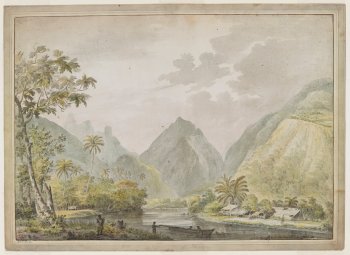
John Webber, A View Looking up the Vaitepiha River with Two Tahitians in a Canoe in the Foreground and Two Others on the Bank with Tahitian Houses to the Right. August 1777, 1777, pen, wash, and watercolour, 45 × 63 cm (London: British Library, Add. 15513, No.13).
• Digitizing the Conway and Witt Libraries, p. 491.
L E T T E R S
• Peter Barber, “The Background of Portrait of Mai,” pp. 492–93.
“Given Reynolds’s lack of interest in landscape painting, but the special place of the portrait of Mai in his oeuvre, it is at least possible that Reynolds may have decided to paint an authentically Tahitian background in order to add further ‘authenticity’. Given his high opinion of [John] Webber, it would have been natural to have copied the scene from one of his friend’s ‘excellent’ paintings of Vaitepiha Bay” (493).
• Christina Strunck, “Laguerre’s Painted Hall at Chatsworth,” p. 493.
“Since in his article ‘A Modello by Louis Laguerre and the Programme of the Painted Hall at Chatsworth’, published in The Burlington Magazine in August 2022 (pp. 760–67), François Marandet came to the same conclusions [that I did in my 2021 monograph Britain and the Continent, 1660–1727: Political Crisis and Conflict Resolution in Mural Paintings at Windsor, Chelsea, Chatsworth, Hampton Court and Greenwich], I thought your readers might like to be referred to the more extended analysis of the programme in both my book and an article I published in January 2022 that discusses the channels through which the two versions of Maratta’s painting may have been known to Laguerre and his patron, William Cavendish.”
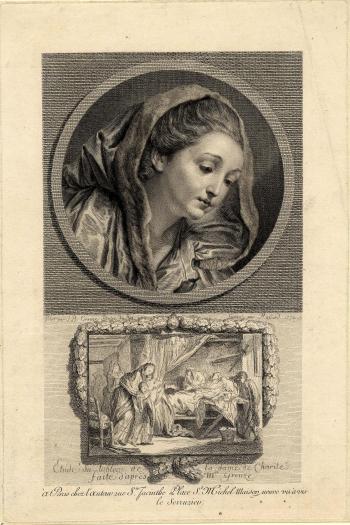
Jean Massard, after Jean Baptiste Greuze, A Woman (Madame Greuze) with a Fur-trimmed Hood Drawn over Her Head, Detail from Greuze’s ‘La Dame de Charité’ above a Sketch of the Painting, 1772, etching and engraving, 24 × 16 cm (London: British Museum, 1978,0121.291).
R E V I E W S
• Mark Evans, Review of Leopoldine van Hogendorp Prosperetti, Woodland Imagery in Northern Art, c.1500–1800: Poetry and Ecology (Lund Humphries, 2022), pp. 568–69.
• Alastair Lang, Review of Yuriko Jackall, Jean-Baptiste Greuze et ses têtes d’expression: La fortune d’une genre (CTHS and INHA, 2022), pp. 569–71.
• Lisa Monnas, Review of Michael Peter, Gewebtes Gold: Eine Kleine Geschichte der Metallfadenweberei von der Antike bis um 1800 (Abegg-Stiftung, 2022), p. 576.
• Alexandre Maral, Review of Christopher Tadgell, The Louvre and Versailles: The Evolution of the Proto-Typical Palace in the Age of Absolutism (Routledge, 2020), pp. 576–77.
• Wim Nys, Review of Beatriz Chadour-Sampson, Sandra Hindman, and Carla Van De Puttelaar, eds., Liber Amicorum in Honour of Diana Scarisbrick: A Life in Jewels (Ad Ilissvm, 2022), p. 577.
O B I T U A R Y
• Elizabeth Pergam, Obituary for Duncan Robinson (1943–2022), p. 578–79.
Successively the Director of the Yale Center for British Art, New Haven, and the Fitzwilliam Museum, Cambridge, Duncan Robinson had a major influence on the appreciation, study, and collecting of historic and modern British art in both the United States and the United Kingdom.
Call for Papers | Early Dance Symposium
From the Call for Papers:
New Work on Old Dance: A Pre-1800 Dance Studies Symposium
Online, 22–24 February 2024
Proposals due by 15 September 2023
What does it look like for historical expressions of dancing and movement arts to break out of traditional academic and performative boxes? How do scholars and practitioners escape the boundaries of discipline, chronology, geography, and methodology subsumed under the conventional appellation of ‘early dance’? Conversely, how can we demonstrate the ways in which our work complements and completes the work of other disciplines in light of these distinctions? This symposium explores early dance as an idea, a time, a place, a locus of cultural meaning and aims to draw together scholars working across disciplines and geographies who are nevertheless invested in ‘early’ dance and movement.
We invite papers for this virtual symposium from scholars across disciplines, exploring aspects of dance and movement from all methodological perspectives, nding commonality in the antecedental nature of their work. Whether looking at the musical, literary, cultural, political, religious, or social contexts of dance, or expanding knowledge of its somatic and kinesthetic dimensions, we nd unity in the chronological earliness of our work. We encourage papers that explore dance outside of Western European frameworks of knowledge and movement production, including comparative or transhistorical perspectives on pre-1800 or ‘early’ dance.
Possible Themes for Papers
• Dance, music, and choreomusicology
• Notation and choreographies
• Transmission, translation, and circulation
• Expanding geographies (pre-1800 dance across Asia, SWANA, the Americas and beyond)
• Race and racialization in pre-1800 dance practices
• Literature, textuality, and dance
• Representations of dance in art and literature
• Dance as metaphor/metaphors of dance
• Intersections of dance and/in theology, philosophy, theory, theater, art, philosophy, economics, etc.
• Theories and philosophies of dance
• Dance practices from page to stage: recreation, reconstruction, reenactment
• Costuming, clothing, and vestments
• Body politics/political bodies in historical dance
• Sociability and social life
• Translation problems: languages, historical periods, cultures
• Dance or movement as aide-memoire/embodied cognition
• Dance ontologies and dance as a way of knowing
Possible Themes for Roundtables and Forums
• What is ‘early dance’? Definitions and boundaries
• Early dance in global perspectives: expanding geographies
• Scholar/Practitioner: How does dance training aid or hinder research on early dance?
• Methodologies in research
• Graduate studies in early dance studies
• Interdisciplinary scholarship and dance studies: barriers and openings?
• Dance as knowledge production within academia
The program committee welcomes proposals for presentations in a variety of formats. Alternative formats may also be proposed. Graduate students, junior scholars, and unaffiliated scholars and performers are especially encouraged to submit proposals.
• Paper presentations (20 minutes)
• Work-in-progress presentations (5–10 minutes)
• Lecture-performances
• Workshops
• Roundtables (for themes listed above or entirely new roundtables)
• A collaborative performance, paper, manifesto, video, etc.
Please submit a proposal via the submission portal by 15 September 2023. Proposals should include your name, affiliation (if any), and email address; an abstract of 250–350 words; a short bibliography (optional); and a brief bio (100 words). All submissions materials must be in English, though presentations in other languages may be possible (please contact organizers).
This symposium is organized by members of the Early Dance Working Group of the Dance Studies Association. Please contact chair of the Organization Committee, Mary Channen Caldwell (maryca@sas.upenn.edu), with any questions.
Call for Papers | Sound, Image, Text

François Denis Née, after Joseph Barthélemy Le Bouteux, Le Concert (detail) in Jean Benjamin de Laborde, Choix de Chansons, 4 vols. (Paris: De Lormel, 1773). Binding with the arms of Marie-Antoinette (Paris: Bibliothèque nationale de France, Cotes RES-YE-778, Cotes RES-YE-779, Cotes RES-YE-780, Cotes RES-YE-781). The Bibliothèque Condé at the Château de Chantilly possesses a unique example printed on vellum bound with the original designs for the engravings; more information is available here.
◊ ◊ ◊ ◊ ◊
From the Call for Papers:
Sound, Image, Text
Australian National University, Canberra, 24–25 August 2023
Proposals due by 23 June 2023
This symposium hosted by the Centre for Art History and Theory in the ANU School of Art and Design will be of interest to scholars, curators, or creative practitioners interested in the relationship between sound, image, and text in the history of music, art, and literature. The event is inspired by the digital critical edition of Jean-Benjamin de Laborde’s Choix de Chansons (1773), developed by an interdisciplinary team of art historians, musicologists, and literary scholars from the Australian National University, University of Sydney, University of Oxford, and the Sorbonne. The project explores the interrelation and interactivity of images, music, and text in the Choix de Chansons and similar cultural objects in the eighteenth century.

François Denis Née, after Joseph Barthélemy Le Bouteux, Le Concert in Jean Benjamin de Laborde, Choix de Chansons, 1773 (Paris: Bibliothèque nationale de France, Cotes RES-YE-778, Cotes RES-YE-779, Cotes RES-YE-780, Cotes RES-YE-781). The inscription below the image reads “Vos yeux commencent nos tourmens, / Et vos doigts charmans / Achévent leur ouvrage” (Your eyes commence our torments / And your charming fingers / Accomplish their work). More information is available here.
We seek papers and interventions from artists, curators, publishers, and academics that include, but are not limited to, the following themes:
• Digital publication
• Multimedia research
• Interrelations of sound, image, and text.
• Digital methods for art history/musicology/literary studies
• Digital methods for researching the eighteenth century
• Book history (especially relating to music)
• History of image and text in performance
• Print culture and music
We strongly encourage participation from scholars, visual artists, and musicians who seek to develop, remake, rework, or remix the sound, image, and text of the digital critical edition of Choix de Chansons.
The symposium runs in conjunction with the Choix de Chansons exhibition at the School of Art and Design Gallery, which opens on Thursday, 24 August, and a concert of selected music from the Choix de Chansons held at the School of Music on Friday, 25 August. Modest bursaries to contribute towards travel and accommodation will be provided to international and interstate delegates. Please direct enquiries and paper submissions to Robert Wellington, Director, Centre for Art History and Art Theory, ANU at robert.wellington@anu.edu.au.
Conference | Ephemerality and Materiality in France
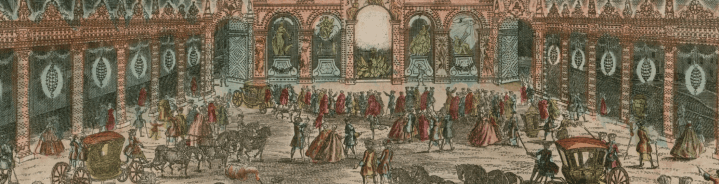
From the conference programme:
Here Today, Gone Tomorrow? Ephemerality and Materiality in France in the Long 18th Century: Arts, Theatre, and Spectacle
Università Ca’ Foscari, Venice, 27–28 June 2023
Organized by Elisa Cazzato
The Greek etymology of ephemeral, ephḗmeros, denotates something that only lasts for one day. In many ways, the ephemeral has become a key subject for our 21st-century lives, via temporary architecture and installations, digital art, but also new forms of media and social communication. However, with the invention of photography and videorecording in the late 19th century, and with new digital technologies in contemporary times, the ephemeral has also found new ways to become enduring, sustainable, and collectable in new archival forms. Yet ephemeral art and ways of being that existed before are more difficult to trace.
The study of 18th-century artistic and performance culture has naturally focused mostly on material objects that have survived in physical or representational forms, like paintings, decorative arts, written texts, and musical scores. But what happens to those forms of art whose material nature is short-lived, fleeting, or perishable? Does the absence of a surviving object preclude the possibility of its examination?
This conference investigates the topic of ephemerality in French culture in the long 18th-century, embracing both artistic, theatrical, and performance practices created through fragile and temporal media like theatre settings, sketches, fireworks, or spectacles that were performed but never replicated or transcribed, as well as trends in modes of dress, walking, and ways of being. In order to exist, however, ephemerality needs materiality, since any creative process intersects with the material requirements that both artworks and performances need: materials, location, scripts, costumes, instruments. How do ephemerality and materiality connect within the cultural context of 18th-century France?
This conference seeks to foster a debate not only about the aesthetic significance of ephemerality but also about the political and cultural meanings of the ephemeral. It questions whether, and how, short-lived forms of art had a role in communicating ideas of power. The conversation also embraces the politics of absence: What is the long-term effect of ephemerality? How can we create a history of the ephemeral? How do we deal with the relative paucity of sources? And how might our failure to deal with ephemerality exclude certain groups or cultures.
With the support of the Centre de Musique Baroque de Versailles
Zoom link:
https://unive.zoom.us/meeting/register/tZAsduyhqDIsHNGv0kOSqXNP7nqM3wZAf7t4
Organization
Elisa Cazzato, Marie Skłodowska-Curie Research Fellow, Department of Linguistics and Comparative Cultural Studies, Ca’ Foscari University of Venice
Information
elisa.cazzato@unive.it
Scientific Committee
Renaud Bret-Vitoz (Sorbonne Université)
Elisa Cazzato (Università Ca’ Foscari)
Emanuele De Luca (Université Côte d’Azur)
Meredith Martin (NYU)
Barbara Nestola (CMBV)
Gerardo Tocchini (Università Ca’ Foscari)
T U E S D A Y , 2 7 J U N E 2 0 2 3
10.00 Welcome
10.15 Greetings and Conference Introduction
• Elisa Cazzato (Università Ca’ Foscari), Nicoletta Bortoluzzi (Università Ca’ Foscari – research advisor), and Barbara Nestola (CMBV)
10.30 Session 1 | Ephemerality in French Theater
Chair: Paola Perazzolo (Università degli Studi di Verona)
• Renaud Bret-Vitoz (Sorbonne Université), L’expérience éphémère d’Ériphyle (Voltaire, 1732) à la scène: matériaux tangibles d’une dramaturgie avant reprises et réécritures
• Pierre Frantz (Sorbonne Université), L’éphémère et la circonstance, réflexion sur le théâtre de la Révolution française
• Ilaria Lepore (Università degli Studi La Sapienza), L’art du comédien au tournant des Lumières. Souci d’éphémère et sensibilité mémorielle
12.00 Session 2 | Architectures and Urban Settings
Chair and discussant: Emanuele De Luca (Univeristé Côte D’Azur)
• Alessandra Mignatti (Università Cattolica del Sacro Cuore, Milano), Tra utopia e ricerca del consenso: gli apparati effimeri di epoca napoleonica a Milano
• Annamaria Testaverde (Università degli Studi di Bergamo), Una via triumphalis per «Florence la belle ville»: dall’apparato effimero al progetto stabile, 1608–1810
13.00 Lunch Break
15.00 Session 3 | Ephemerality in Dance
Chair and discussant: Stefania Onesti (Università degli Studi di Padova/Università Aldo Moro Bari)
• Olivia Sabee, (Swarthmore College), Noverre on 18th-Century Dance Theory and Ephemerality
• Cornelis Vanistendal (Independent Scholar), Ephemerality on the Fringe: Power Quadrilles in Brussels on the Eve of Waterloo
16.00 Session 4 | Researching Ephemerality in Arts and Costumes
Chair: Carlotta Sorba (Università degli Studi di Padova)
• Daniella Berman (New York University), “…even in the midst of the terrible movements and variables of the Revolution”: Jacques-Louis David’s Joseph Bara and the Unrealized Fête of the 10th of Thermidor
• Brontë Hebdon (New York University), ‘The Right to Dress Plainly’: Embroidery and the Ephemeral in Napoleonic Court Costumes
• Petra Dotlačilová (Stockholm University / CMBV), Witnesses of the Past: Studying Costumes as Material Evidence of the Ephemeral Performance
W E D N E S D A Y , 2 8 J U N E 2 0 2 3
9.30 Session 5 | Reconstructing Feasts, Settings, and Special Effects
Chair: Barbara Nestola (CMBV)
• Christine Jeanneret (University of Copenhagen), Ephemeral Spaces, Ephemeral Costumes, and Ephemeral Arts: The Bal des Ifs at Versailles in 1745
• Gerardo Tocchini (Università Ca’ Foscari Venezia), Lorsqu’une scénographie devient ‘la’ preuve: « Orfeo ed Euridice » de Ch. W. Gluck, opéra maçonnique
• Emanuele De Luca (Univeristé Côte d’Azur), Poudres, feux, couleurs: les artifices des Ruggieri à Paris au XVIII siècle
11.00 Session 6 | The Specter of Race
Chair and discussant: Michele Matteini (New York University)
• Noémie Etienne (University of Vienna) and Meredith Martin (New York University), The Comte d’Artois and the Spectacle of Otherness in Pre-Revolutionary Paris
12.00 Keynote Lecture
• Mark Ledbury (University of Sydney), “Et le lendemain matin… Afterlives of the Ephemeral”
Call for Essays | Material Metamorphosis
From the Call for Essays for a project with Brepols:
Material Metamorphosis: Natural Resources, Artmaking, and Sustainability in the Early Modern World
Volume edited by Louise Arizzoli and Susanna Caviglia
Proposals due by 15 July 2023, with final papers due 15 May 2024
Between the sixteenth and the early nineteenth century, raw materials circulated globally to be traded, studied, and transformed into luxury goods for the consumption of Europeans, whose mishandling of the colonies’ natural resources turned some of the potentially wealthiest countries into the poorest ones. This volume proposes to investigate craftsmanship and artmaking against the backdrop of colonial trade and in relation to current issues such as environmental, social, cultural, and economic sustainability. The focus will be on natural resources, in particular their materiality, extraction, migration, and transformation through labor and manufacturing processes as well as on the effects of their cultivation and the exploitation of territories.
Global trade routes interconnecting distant parts of the world existed since Antiquity. The famous Silk Road allowed to bring silk and spices from China to Rome in exchange of wool, gold, or silver; the Incense Route facilitated the transport of frankincense and myrrh from Southern Arabia to the Mediterranean; and the Amber Road permitted to carry the precious homonymous stone from the Baltic Sea to the Mediterranean. These well-established complex networks of commercial trade boosted economies but were also vital means of intercultural exchanges. Global trade soared in the fifteenth and sixteenth centuries, with the lead of the Portuguese and the Spanish who opened new maritime routes, followed in the seventeenth century by the Dutch, the English, and the French. Renewed commercial relationships with India, China, Japan, and the Americas were the occasion for the Europeans to establish a stronghold on local economies and make profit on the trade of local products; the infamous triangular trade between Europe, Africa, and the Americas from the sixteenth to the nineteenth century represents one of the apexes of these exploitative systems.
These systems and their long-lasting impact on people, labor, production, and the landscape have gathered renewed scholarly interest. Here, we aim to investigate the effects of global trade routes on the exploitation of natural resources as related to artistic production, since raw materials were imported to Europe from abroad to produce goods of all kinds. The aim is to approach these objects not as finished products but as the final results of a long production process anchored in the exploitation of natural resources that contributed to the increasing environment’s degradation and led to question the relationship between the human being and nature.
We seek papers dealing with materials that travelled from Asia, the Americas, and Africa to Europe (such as sugar, coffee, tobacco, wood, cotton, indigo as well as gold, iron, and ivory). Papers could interrogate the fate of such natural resources and ask, in particular, how they were received, transformed, represented, collected, displayed, or consumed. In general, we welcome research that deconstructs the artwork and looks at the material itself, its origin, exploitation, metamorphosis, reuse, preservation, and consumption through the lenses of global exchange and development related to the modern concept of sustainability, the prodromes of which appear in the seventeenth century. This period coincides indeed with the occurrence of the first ecological damages (deforestation, soil erosion, silted rivers, drought, etc.) which can be directly related to the new commercial strategies.
The volume will be articulated around three areas of the world where Europe founded colonies and exploited natural resources. For example:
• Asia: silk, cotton, spices, precious stones, tea, cotton
• Africa: ivory, wood, iron, horn, gold, cloth
• The Americas: silver, gold, pigments, sugar, tobacco, coffee, cotton
This inquiry welcomes a variety of media, including but not limited to: the decorative arts, ephemeral arts (theatre, exhibitions, masquerades), visual arts, textiles, cabinets of curiosities, and jewelry. Please send proposals to Louise Arizzoli (larizzol@olemiss.edu) and Susanna Caviglia (susanna.caviglia@duke.edu). Include in your proposal: name and affiliation, paper title (maximum of 15 words), abstract (maximum of 200 words), and a brief CV (maximum of 300 words, in ordinary CV format) by 15 July 2023.
Submission Timeline
• 15 July 2023 — submit your abstract
• 1 September 2013 — notification of acceptance
• 15 May 2024 — submission of your contribution (information on publication format and guidelines available upon acceptance)
Call for Papers | Women, Opera, and the Public Stage in 18th-C. Venice
From the Call for Papers:
Women, Opera, and the Public Stage in Eighteenth-Century Venice
Norwegian University of Science and Technology (NTNU), Trondheim, 11–13 April 2024
Proposals due by 15 August 2023
This conference is organised within the framework of the 5-year research project Women, Opera, and the Public Stage in Eighteenth-Century Venice (WoVen), funded by the Norwegian Research Council and based at the Music Institute, NTNU. The project explores the role of women in European operatic culture during the Enlightenment. More specifically, WoVen focuses on Venice, a hub for critical debate and a prominent operatic centre of international significance in the eighteenth century. WoVen seeks to uncover how opera and operatic women contributed to the ‘women question’ through their multiple activities within and around the opera world in Venice at a time of profound change for women throughout Europe. We invite contributions for 20-minute papers (or 30-minute papers with performance/demonstration) within these four thematic areas:
1 Women’s Roles and Images of Femininity on the Venetian Stage
2 Performing Celebrity on the Venetian Stage
3 Audiences, Patrons and Women’s Participation in the Opera Business in Venice
4 Performing Eighteenth-Century Operatic Women and Gender: A Practice-Based Approach
Proposals for unpublished individual papers must be submitted as Word files with the following information: presenter’s name, paper title, session for which the paper is being proposed, abstract (maximum of 300 words), short biography (maximum of 150 words), institutional affiliation, and email address. The official language of the conference is English. Proposals must be sent to woven@musikk.ntnu.no by 15 August 2023 to be evaluated by 15 September 2023. Please indicate the subject of your email as: ‘WoVen—Call for Papers’. The scientific committee will select the best papers presented at the conference for peer-reviewed publication.
Accommodation for three nights is covered by WoVen. WoVen will also cover or contribute towards travel expenses for participants without or with only limited institutional support. For more information about the potential for travel support, please see the full Call for Papers.
Scientific Committee
Melania Bucciarelli (NTNU)
Tatiana Korneeva (NTNU)
Francesca Menchelli-Buttini (Conservatorio di Musica ‘G. Rossini’, Pesaro)
New Book | Venice and the Doges
From Rizzoli:
Toto Bergamo Rossi, with photographs by Matteo de Fina, an introduction by Count Marino Zorzi, and contributions by Diane von Furstenberg and Peter Marino, Venice and the Doges: Six Hundred Years of Architecture, Monuments, and Sculpture (New York: Rizzoli Electa, 2023), 364 pages, ISBN: 978-0847899296, $135.
 While Venice is better known for soft light and atmospheric painters, this elegant new volume transforms our understanding of Venetian sculpture and its place in the city’s artistic tradition. A feast for the eyes and an entertaining, erudite read, this book opens with an illustrated survey of the 120 doges who led the Venetian Republic before continuing with a detailed survey of the incredible array of sculptures and monuments that memorialize them. Although celebrated for painting and music, Venice has a sculptural tradition that was overshadowed by Florence and Rome. Based on new scholarship, this volume reveals the true magnificence of six centuries of Venetian sculpture. With the oldest works dating to the thirteenth century, these masterpieces fill the city’s churches and include pieces by great masters from the Lombardo family to Antonio Rizzo, Jacopo Sansovino, Alessandro Vittoria, and Baldassare Longhena. The sculptural marvels of Venice tell the story of a procession of doges—politicians, scholars, conquerors, merchants, and even a saint, Pietro Orseolo—over a thousand-year history. Engaging text highlights the adventurous, eventful, and sometimes glorious lives of these legendary figures, while the newly commissioned photography showcases the grandeur and beauty of a neglected aspect of Venice’s cultural history.
Francesco ‘Toto’ Bergamo Rossi has been the head of the Venetian Heritage Foundation since 2010. Matteo de Fina specializes in photographing art, interiors, and architecture. Count Marino Zorzi, former director of the Biblioteca Marciana, comes from one of the oldest Venetian families with a doge in their lineage. Diane von Furstenberg is a noted philanthropist and celebrated fashion designer, best known for the wrap dress, as well as founding her eponymous global luxury lifestyle brand. She is International Ambassador for the Venetian Heritage Foundation. Peter Marino, FAIA, is the principal of Peter Marino Architect PLLC, the New York–based architecture firm he founded in 1978. Known for his residential and retail work for the most iconic names in fashion and art, he is also Chairman of the Venetian Heritage Foundation and serves on the board of directors for International Committee of L’Union Centrale des Arts Décoratifs.
New Book | Tiepolo und das Kostüm
Franziska Kleine’s review of the book (in German) appeared at ArtHist.net earlier this month (16 May 2023). From Gebr. Mann Verlag:
Torsten Korte, Tiepolo und das Kostüm: Konstruktion von Geschichte im Historienbild (Berlin: Gebr. Mann Verlag, 2023), 332 pages, ISBN: 978-3786128922, €79.
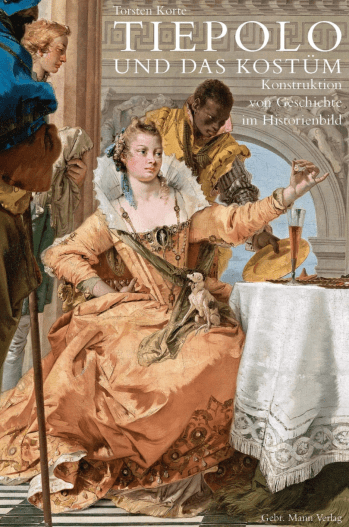 Luxuriöse, fantasievolle Gewänder in Tiepolos Bildwelten des Rokoko
Giambattista Tiepolos Malerei ist reich an prächtigen, fantasievollen Gewändern, die zum besonderen Reiz seiner Bildwelten beitragen. In den historisierenden und orientalisierenden Gewändern drückt sich ein Blick des 18. Jahrhunderts auf Geschichte und kulturelle Identitäten aus, dem das Buch durch bildtheoretische Reflexionen nachgeht.
Die Anziehungskraft der Malerei von Giambattista Tiepolo (1696–1770) beruht besonders auf der Darstellung von Kostümen. Die Helden und Heldinnen seiner Historienbilder sind in aufwendige, luxuriöse und fantasievolle Gewänder gekleidet. Dabei handelt sich keineswegs um dekoratives Beiwerk—vielmehr setzt Tiepolo historische und orientalisierende Kleider kenntnisreich ein und visualisiert dadurch komplexe Geschichtskonzepte. Anhand ausgewählter Hauptwerke des Künstlers wirft Torsten Korte einen neuen Blick auf diesen bisher kaum beachteten Aspekt. Seine theoretische Reflexion zur Gattung des Historienbildes reicht dabei über das 18. Jahrhundert hinaus.
Torsten Korte, Studium der Kunstgeschichte, Philosophie und Musikwissenschaft in Bonn und Venedig, Promotion an der Humboldt-Universität zu Berlin. Seit 2021 wissenschaftlicher Mitarbeiter an der Fachhochschule Nordwestschweiz.










 Enfilade
leave a comment