Exhibition | The Shape of Time: Art and Ancestors of Oceania
A portion of The Met’s Oceanic Collection, now on view in Shanghai at the Museum of Art Pudong:
The Shape of Time: Art and Ancestors of Oceania
Museum of Art Pudong, Shanghai, 1 June — 20 August 2023
National Museum of Qatar, Doha, 16 October 2023 — 15 January 2024
Accompanies the reopening of The Michael C. Rockefeller Wing at The Metropolitan Museum of Art, Spring 2025

Maori Weaving Peg (Turuturu), late 18th–early 19th century, wood, 14 inches high (NY: The Metropolitan Museum of Art, The Michael C. Rockefeller Memorial Collection, Bequest of Nelson A. Rockefeller, 1979.206.1600. ‘Ko te taura whiri, he whiri i te tangata’ (‘The woven cord is like the cord that connects people’). –Māori proverb
The exhibition The Shape of Time: Art and Ancestors of Oceania from The Metropolitan Museum of Art is produced by the Lujiazui (Group) Co., Ltd., and co-organized by The Metropolitan Museum of Art (The Met) and the Museum of Art Pudong (MAP). The exhibition marks the first time that MAP collaborates with The Met, a world-renowned art institution. Meanwhile, it is also the first time ever that an exhibition taken entirely from The Met’s collection has come to Shanghai, China, adding extraordinary historical significance to the event.
The Shape of Time centers around The Met’s Oceanic art collection, showing the exuberant and diverse culture of Oceania. Divided into three main sections— Voyaging, Ancestors, and Time—the exhibition displays more than 110 valuable artworks from the past four centuries. Encompassing the arts and cultures of the Pacific Islands, The Met’s collection of Oceanic art comprises over 2,800 works that reflect the rich history of creative expression and innovation that is emblematic of the region. Since joining in The Met’s permanent collection, these treasures of Oceania have never left New York. The exhibition The Shape of Time therefore is the first time after about half a century that these works will travel out of the United States, and MAP is honoured to be the first stop of this historic voyage.
From The Met’s catalogue entry for the weaving peg (at right):
This weaving peg incorporates a distinctively carved male figure with elaborate designs that accentuate his tattooed skin (moko). Carved in the round, intricate low-relief carvings cover the entire surface of the figure’s body except for the back of his head, which is the seat of an individual’s mana or personal sanctity. With elbows resting on each knee, the arms extend up towards the chin, which is supported by five-fingered hands. The face is dynamic—serial notching accentuates the pronounced arch of each brow, giving way to more fluid grooves, lengthened lines that delineate elongated eyes and the contours of the lips and mouth. The nostrils flare, the mouth is wide open and gaping, as if to consume this flow of energy. Spiral designs on each knee spill over onto the top section of the polished shaft and create a characteristic double spiral motif. This feature frames the face of a further face which faces the other direction, drawing the eye around to the back, creating an energy and dynamism much admired in Māori figural sculpture. . . . The process of twining began when the weaver drove two pegs into the ground and stretched between them a single cord from which the strands of flax were hung. The left-hand peg was always left plain, while the right-hand one was carved and dedicated to the female deity associated with the moon, Hine-te-iwaiwa. The more complex form of carved weaving pegs, such as this one, were designed to incorporate the spiritual potency associated with the goddess whose efficacy was believed to become integrated into the bound texture of the cloak, thus enhancing the spiritual armature of the wearer. . .
The catalogue is published by Yale UP:
Maia Nuku, Oceania: The Shape of Time (New Haven: Yale University Press, 2023), 208 pages, ISBN: 978-1588397669, $50.
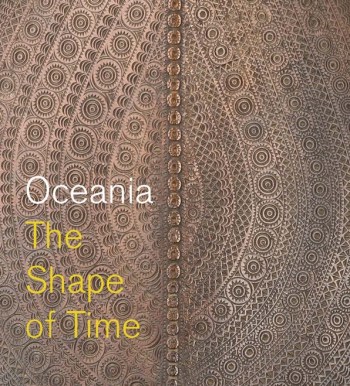 The visual arts of Oceania tell a wealth of dynamic stories about origins, ancestral power, performance, and initiation. This publication explores the deeply rooted connections between Austronesian-speaking peoples, whose ancestral homelands span Island Southeast Asia, Australia, Papua New Guinea, and the island archipelagoes of the northern and eastern Pacific. Unlike previous books, it foregrounds Indigenous perspectives, alongside multidisciplinary research in art history, ethnography, and archaeology, to provide an intimate look at Oceania, its art, and its culture. Stunning new photography highlights more than 130 magnificent objects, ranging from elaborately carved ancestral figures in ceremonial houses, towering slit drums, and dazzling turtle-shell masks to polished whale ivory breastplates. Underscoring the powerful interplay between the ocean and its islands, and the ongoing connection with spiritual and ancestral realms, Oceania: The Shape of Time presents an art-focused approach to life and culture while guiding readers through the artistic achievements of Islanders across millennia.
Maia Nuku is Evelyn A. J. Hall and John A. Friede Associate Curator for Oceanic Art at The Metropolitan Museum of Art.
Conference | HECAA@30
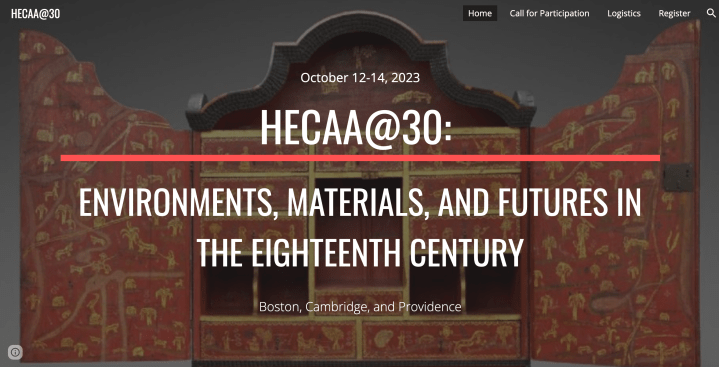
Registration is now open! It’s an extraardinary programme with terrific small session offerings. If you’ve not (yet) been part of HECAA, please know that you would be very welcome—whether you’re an academic, a museum or heritage professional, or simply someone interested in the eighteenth century. –CH
From the conference website:
HECAA@30: Environments, Materials, and Futures in the Eighteenth Century
Boston, Cambridge, and Providence, 12–14 October 2023
On the land of the Massachusett and neighboring Wampanoag and Nipmuc peoples, Boston developed in the eighteenth century as a major colonized and colonizing site. Its status today as a cultural and intellectual hub is shaped by that context, making it a critical location to trace the cultural legacies of racism and social injustice between the eighteenth century and today. For whom is ‘eighteenth-century art and architecture’ a useful category? What eighteenth-century materials, spaces, and images offer tools or concepts for shaping our collective futures? This conference marks HECAA’s 30th year as a scholarly society dedicated to facilitating communication and collaboration among scholars of eighteenth-century art to expand and promote knowledge of all aspects of the period’s visual culture.
The standard registration fee is $125; the discounted fee is $30. HECAA membership is required of all conference attendees. And please consider making a contribution to help cover travel costs for unfunded colleagues. Register here.
T H U R S D A Y , 1 2 O C T O B E R 2 0 2 3
Morning Panels at Bartos Auditorium, List Visual Arts Center, MIT, Cambridge
8.00 Registration
9.00 Introduction
9.15 Panel: Timing Aesthetics and the Aesthetics of Time
Chairs: Megan Baker (University of Delaware) and Joseph Litts (Princeton University)
• Carole Nataf (Courtauld Institute of Art), Shell Grottos and the Aesthetics of Deep Time in Georges-Louis Leclerc de Buffon’s Theories of the Earth
• Elizabeth Bacon Eager (Southern Methodist University), Peter Hill’s Regulator: Considering the Materiality of Time in the Context of American Slavery
• Daniella Berman (Institute of Fine Arts, New York University), Mismatched and Out of Time: Aesthetics of Contingency in 1800
• Lea C. Stephenson (University of Delaware), Reviving the Alabaster Portrait: J.P. Morgan’s Eighteenth-Century Collection and Whiteness
10.30 Coffee
11.00 Roundtable Panel: What’s Race Got To Do With It? Part I
Chair: Karen Lipsedge (University of Kingston)
Respondent: Victoria Barnett-Woods (Loyola University, Maryland)
• Stephen Hague (Rowan University), A Long S-Shaped Shadow from in the Long Eighteenth Century
• Lisa Vandenbossche (University of Michigan), Oceans of (In)stability: Race and Gender from Shore to Sea
• Chloe Wigston Smith (University of York), Race, Material Culture, and Women’s Work
• Adrienne L. Childs (Independent Scholar), Ornamental Blackness: What, Why, So What?
• Laura Keim (Stenton Historic House), Granting Her Requests: Dinah’s Freedom, Dinah’s Family, Dinah’s Place
12.30 Lunch
2.30 Afternoon Small Group Sessions in and around Cambridge
Sign up during conference registration.
House Tour and Roundtable Session | What’s Race Got to Do with It? Part II
Royall House and Slave Quarters (15 George Street, Medford)
Chair: Karen Lipsedge (University of Kingston)
Respondent: Kyera Singleton (Royall House and Slave Quarters)
• Nuno Grancho (Centre for Privacy Studies, Copenhagen), Domestic Space, Race and Gender in the Eighteenth-Century Danish Colonial Home
• Laura Engel (Duquesne University), The Paradox of Pearls: Gender, Race, Embodiment, and Domestic Space
• Caroline Fowler (Williams College, The Clark Art Institute), Privacy
• Sarah Lund (Harvard University), Republican Motherhood and Republican Equality: Female Engravers and the ‘Ideals’ of the French Revolution
• Tori Champion (University of St. Andrews), Race, Liminality, and the Floral Garland in French Portraiture
Object Session and Panel | For a Better Future: Networks of Pastel Painting
Art Study Center, Harvard Art Museums (32 Quincy Street, Cambridge)
Chairs: Valérie Kobi (Université de Neuchâtel) and Iris Brahms (Universität Hamburg)
• Alexa McCarthy (University of Southern Maine), Blue on Blue: The Tonality of Skin and Eighteenth-Century Pastel
• Heather McPherson (University of Alabama at Birmingham), ‘Pastel Crayons as Paintbrushes’: Chardin’s Portrait of a Man (1773)
• Isabelle Masse (Musée national des beaux-arts du Québec), Chardin’s Pastel Materials: A Hypothesis
Gallery Tour | Islamic and South Asian Painting
Harvard Art Museums (32 Quincy Street)
Led by Ayşin Yoltar-Yildirim (Harvard Art Museums)
Gallery Tour | Eighteenth-Century European and American Art
Harvard Art Museums
Led by Maher Fellow TBA (Harvard Art Museums)
Object Session | Legacies of the Enlightenment
Houghton Library (Harvard Yard, near Quincy and Harvard Streets)
Led by John Overholt (Houghton Library), Elizabeth Rudy (Harvard Art Museums), and Kristel Smentek (MIT)
Gallery Tour | Time, Life, and Matter: Colonial Science
Historical Scientific Instruments Collection, Harvard University Science Center (1 Oxford Street)
Led by Sara J. Schechner (Harvard University)
Suggestions for Self-Guided Visits
• Harvard Art Museums permanent collection galleries and exhibits including Disrupt the View: Arlene Schechet. Present your HECAA@30 conference badge for free admission to the HAM on Thursday afternoon.
• Resetting the Table: Food and Our Changing Tastes, and Glass Flowers: The Ware Collection of Blaschka Glass Models of Plants, Peabody Museum of Archaeology and Ethnology (11 Divinity Avenue), $15 general admission.
• MIT Special Collections Library, Self-guided viewing of volumes of a first-edition folio of Diderot and d’Alembert’s Encyclopédie.
5.30 Reception and Viewing Session at the Boston Athenaeum
Wine and cheese reception generously co-sponsored by the Boston Athenaeum for all conference attendees. Eighteenth-century highlights from the Atheneum’s rare books and prints collection will be on view in the Study Room, and significant 18th- and 19th-century American paintings are hung throughout the building.
F R I D A Y , 1 3 O C T O B E R 2 0 2 3
Morning Panels at Bartos Auditorium, List Visual Arts Center, MIT, Cambridge
9.00 Introduction
9.15 Rethinking the Material Afterlives of Animals
Chairs: Sarah Grandin (Clark Art Institute) and Catherine Girard (St. Francis Xavier University)
• Dani Ezor (Southern Methodist University), Tortoiseshell: From Sea Turtle to Snuffbox
• Kaitlin Grimes (Auburn University), The Elephant and the Lathe: The Intimate Materiality of Monarchical Ivory Portraits in Early Modern Denmark-Norway
• Sylvia Houghteling (Bryn Mawr), The Silk and the Worm: Writing Sericulture into the History of South Asian Textiles
• Cynthia Kok (Yale University), Thinking into Early Modern Mother-of-Pearl, Materiality and Liveliness
10.30 Coffee
11.00 Workshop: Quilt! Inclusivity in Eighteenth-Century Studies
Chairs: HECAA DEI Committee
12.30 Lunch
2.30 Afternoon Small Group Sessions at MFA Boston, Part I
Sign up during conference registration.
Object Session and Panel | Mining for Mica at the MFA, 90-minute session
Morse Study Room, MFA Prints and Drawings
Chair: Ruth Ezra (University of St. Andrews)
• Margaret Masselli (Brown University), A Glittering Ghagra: Women’s Clothing, Shisha Embroidery, and Mica Mining in Eighteenth-Century India
• Katherine A. P. Iselin (Emporia State University), Materiality and Image on Folding Fans
• Ruth Ezra (University of St Andrews), Brilliant Boxes
Object Session and Panel | Paying Attention: Materials, Materiality, and the Definitions of Technical Art History, 90-minute session
Voss Seminar Room, MFA Conservation Center
Chair: Daniella Berman (Institute of Fine Arts, NYU)
• Josephina de Fouw (Rijksmuseum), The Whole is Greater than the Sum of Its Parts: Research into the Rijksmuseum Collection of Dutch Eighteenth-Century Decorative Interior Paintings
• Courtney Books and Amy Torbert (St Louis Art Museum), Bridging the Apparent Divide: Thoughts from the Field on ‘Responsible Art History’ and ‘Technical Art History’
• Heidi Strobel (University of North Texas), Picking at Threads: A Material Analysis of an Embroidered Picture
• Andy Schulz (University of Arizona), The Collaborative Creation of Meaning in a Hand-Colored Set of Goya’s Caprichos
Object Session and Panel | Ivory: Animal Body and Artistic Material, 90-minute session
MFA Center for Netherlandish Art Seminar Room
Chairs: Katherine Fein (Columbia University) and Deepthi Murali (George Mason University)
• Erika Riccobon (Leiden University), Folding Fans in Translation: Ivory as Painting Medium and Site of Crosscultural Design in the Early Phase of the Canton Trade
• Maggie Keenan (The Nelson-Atkins Museum of Art), Disembodied Eyes: The Fragility of Flesh and Ivory Appeal
• Marina Wells (Boston University), Incisions into the Gendered History of American Marine Ivory
• Kristine Korzow Richter (Harvard University), Ivory as a Biomineral: Relationships between Biomechanical Structure, Interspecies Life Histories, and Tool Functionality
Gallery Session | Art of the Americas
MFA Art of the Americas Wing, Ground Floor Galleries
Chair: Ethan Lasser (MFA Boston)
• Michele Navakas (Miami University of Ohio), Coral, Women, Labor: Joseph Blackburn’s Isaac Winslow and His Family (1755)
• Wendy Bellion (University of Delaware), Benjamin West’s King Lear
• Matthew Gin (University of North Carolina, Charlotte), Uncanny Encounters in Cindy Sherman’s Madame de Pompadour (née Poisson) Tea Service (1990)
Gallery Session | European Porcelain and Decorative Arts
MFA Gallery 142
Chair: Michael Yonan (University of California, Davis)
• Amy Freund (Southern Methodist University), Sinceny Manufactory, France, Tray with Chinoiserie (?) Hunting Scene, c. 1750
• Maura Gleeson (Independent Scholar), Meissen Manufactory, Germany, Modeled by Johann Joachim Kändler, Macaw, c. 1732
• Thomas Michie (Museum of Fine Arts, Boston), Alcora Manufactory, Spain, Console Table, c. 1761–63
• Sarah Williams (Millsaps College), Nicolas Lancret, Le Déjeuner de jambon, 1735
• Michael Yonan (University of California, Davis), Franz Xaver Messerschmidt, A Hypochondriac, c. 1775–80
Gallery Tour | Jewish Ritual Silver in Eighteenth-Century Europe and America
MFA Galleries
Led by Simona Di Nepi (MFA Boston)
3.30 Afternoon Small Group Sessions at MFA Boston, Part II
Sign up during conference registration.
Gallery Session | New Approaches to Silver
MFA Firestone Gallery, 141A
Chair, Dani Ezor (Southern Methodist University)
• Agnieszka A. Ficek (CUNY Graduate Center)
• Brittany Luberda (Baltimore Museum of Art)
• Ben Miller (S.J. Shrubsole)
Gallery Session | Tiny Treasures: The Magic of Miniatures
MFA Rabb Gallery
Chair: Courtney Harris (MFA Boston)
• Gerri Strickler (MFA Boston), Nevers Glass
• Lauren DiSalvo (Utah Tech), Miniaturizing the Picturesque Landscape through Micromosaic Souvenirs
• Damiet Schneeweisz (Courtauld Institute of Art), Rethinking the Potency of the Early Modern Miniature in the Americas
Gallery Tour | Porcelain, Painting, and Scholar Rocks of the Qing Dynasty
MFA Chinese Art Galleries
Led by Nancy Berliner (MFA Boston) and Dawn Odell (Lewis and Clark College)
4.30 Roundtable: The Politics of Materiality
Alfond Auditorium, MFA Boston
Chairs: Jennifer Chuong (Universität zu Berlin) and Elizabeth Bacon Eager (Southern Methodist University)
• Sarah Cohen (University at Albany, SUNY)
• Edward S. Cooke, Jr. (Yale University)
• Kathryn Desplanque (UNC Chapel Hill)
• Kailani Polzak (UC Santa Cruz)
• Jennifer Van Horn (University of Delaware)
S A T U R D A Y , 1 4 O C T O B E R 2 0 2 3
Morning Panels at Brown University
8.30 Bus departs from the Marriott Cambridge to Providence, Rhode Island
Please sign up during registration for a seat on the bus.
10.00 Global Sacred Garden Encounters
Chair: Emily Everhart (Art Academy of Cincinnati)
• Lelaine Bangilan Little (Misericordia University), Firstfruits of the Land: Vegetal Motifs in Art and Architecture of the Spanish Philippines
• Susan Taylor-Leduc (Independent Scholar), Mesdames at Bellevue: Collecting Plants, Sacralizing the French Picturesque, 1775–92
• Emily Thompson (Washington University, St Louis), Sacred Translations: Giambologna’s Samson and Its European Encounters
11.30 Lunch
12.30 Panel: Indigenous Imprints
Chair: Douglas Fordham (University of Virginia)
• Monica Anke Hahn (Community College of Philadelphia), Reproducing ᎤᏍᏔᎾᏆ (Otacite Ostenaco), 1762–2023
• Eleanore Neumann (University of Virginia), Living Proof: Retrospective Agency in Judy Watson’s experimental beds (2012)
• Laura M. Golobish (Ball State University), James Lavadour’s Lithographic Geologies and Stewardship of the Land
• Kimberly Toney and Pedro Germano Leal (John Carter Brown Library and John Hay Library, Brown University), The John Carter Brown’s Americana Platform: A Digital Tool for Researching the History and Culture of the Early Americas
2.30 Afternoon Small Group Session in Providence, RI
Sign up during conference registration.
Object Session | Fashion, Race, and Power in the Eighteenth Century
RISD Musuem, Textile Study Center (20 North Main Street)
Chair: Amelia Rauser (Franklin and Marshall College)
• Priscilla Sonnier (University College, Dublin), Flax, Fashion, and Free-Trade: Manufacturing Gendered Patriotism in Ascendancy Ireland
• Emma Pearce (University of Edinburgh), Plaided Products: Checked Cloth in Caribbean Textile Markets
• Marina Kliger (Harvard Art Museums), “Cut into Pieces”: The Politics of the “Robe de Cachemire” and the Fashions of the Franco-Persian Alliance in Paris, 1808–15
Gallery Session | Indulging the Self, Stimulating the Globe: Chocolate, Sugar, Empire, Enslavement
RISD Museum, Trading Earth: Ceramics, Commodities, and Commerce exhibition
Chairs: Tara Zanardi (Hunter College) and Elizabeth Williams (RISD Museum)
• Alicia Caticha (Northwestern University), Rethinking a Wedgwood Creamware Basket or, the Secret History of Sugar Sculpture
• Nina Dubin (University of Illinois Chicago) and Meredith Martin (New York University), Gods of the Indies
• Katherine Calvin (Kenyon College), The Cape Coast Castle Platter: Currency and Consumption across the Atlantic
Gallery Tour | East and South Asian Works on Paper
RISD Museum Print Study Room
Led by Wai Yee Chiong (RISD Museum)
Object Session | The Visual Culture of War in the Global Eighteenth Century
Hay Library Special Collections
Chair: Dominic Bate (Brown University)
• Chloe Northrop (Tarrant County College), “Rodney Triumphant”: James Gillray and 1782 Satirical Prints of the American War for Independence
• Remi Poindexter (The Graduate Center, CUNY), Cooper Willyams’ “A Scene at St. Pierre” and the French Revolution in Martinique
• Rebecca Szantyr (The New York Public Library), Keeping Tabs on the British Empire
• Heather Belnap (Brigham Young University), “Les Amours Prussiens” and Other Narratives of Sexual Politics in Allied-Occupied Paris
• Enrique Ramirez (Taubman College, University of Michigan), Airs Apparent: Chemistry and Aeronautics on the Brink of War
Object Session | How To Teach with Collections
Hay Library Special Collections
Led by Heather Cole (Brown University Library)
Object Session | Native American Collections
Special Collections, John Carter Brown Library
Led by Kimberly Toney (John Carter Brown Library)
House Tour | Mahogany at the John Brown House
John Brown House (52 Power Street)
Led by John Brown House docents
Architecture Walking Tour | Colonial Providence
Benefit Street
4.00 Roundtable | The Interstitial Eighteenth Century: Objects, Actors, and Ideas ‘In-Between’
Chairs: Emily Casey (University of Kansas) and Matthew Gin (University of North Carolina, Charlotte)
• Bart Pushaw (University of Copenhagen), A Queer Qulleq and Inuit Art History between Rhetoric and Reality
• Joseph D. Litts (Princeton University), Capsized Aesthetics: Risk Management, Shipwrecks, and Vernet
• Lauren Cannady (University of Maryland, College Park), Green Infrastructure: An Extramural Garden as Case Study
• Caitlin Meehye Beach (Fordham University), Yamqua, In Between
5.30 Wine and Cheese Reception
6.45 Bus departs from Providence to the Marriott Cambridge
Please sign up during registration for a seat on the bus.
Workshop | Across the Seas: Denmark and the World
From ArtHist.net:
Across the Seas: Denmark and the World in Art and Visual Culture in the Early Modern Period
Kunsthistorisches Institut, Christian-Albrechts-Universität zu Kiel, 9–10 June 2023
Organised by Caecilie Weissert, Johannes von Müller, and Benjamin Asmussen
In cooperation with the Maritime Museum of Denmark, Copenhagen
Registration due by 8 June 2023
The workshop Across the Seas: Denmark and the World in Art and Visual Culture in the Early Modern Period takes an interdisciplinary perspective combining art historical questions with those of the histories of politics and economics. The sea serves as a common denominator allowing for bridging such disparate standpoints. Furthermore, it presents itself as a backdrop against which early modern Denmark keeps oscillating between centre and periphery.
With this framework, the workshop seeks to dislodge the presented objects from a conventional frame of reference. They will be addressed as ‘nodes’, making interrelations and itineraries visible and mapping them out, finally revealing themselves as factors that contribute to constituting the very structures they disclose. Next to a series of case studies dedicated to the material and artistic cultures of exchange between Denmark and non-European regions, notably China, and investigating the circulation of both art and artistic materials via the sea, the workshop will engage with both the challenges and methodological potential of an ‘oceanic turn’.
Please register before 8 June 2023 by email, vonmueller@kunstgeschichte.uni-kiel.de.
Workshop Organizers
Prof. Dr. Caecilie Weissert (Christian-Abrechts-Universität zu Kiel)
Dr. Johannes von Müller (Christian-Abrechts-Universität zu Kiel)
Dr. Benjamin Asmussen (Maritime Museum of Denmark, Copenhagen)
Friday, 9 June | Denmark and the World
14.00 Arrival
14.30 Welcome and Opening Remarks — Caecilie Weissert (Kiel)
14.50 Benjamin Asmussen (Copenhagen) — Chinese Export Paintings as Sources of Danish Early Modern Trade and the Industrialisation of Art
15.40 Kee Il Choi Jr. (Zurich) — Models and Marketing in Canton: Two Chinese Export Porcelain Punch-bowls Made for the Danish Market
16.30 Coffee Break
17.00 Winnie Wong (Berkeley) — The Clay Portraits of the Danish Kunstkammer: Chinese Sources on a European Demand
Saturday, 10 June | Maritime Art History
9.15 Arrival
9.30 Opening Remarks — Johannes von Müller (Kiel)
9.50 Michèle Seehafer (Amsterdam) — Immersion in Foreign Worlds: Lacquer at the Danish Court
10.40 Margit Thøfner (Milton Keynes) — ‘Through Various Tracts of Sea’: Anna of Denmark-Norway and the Trinity Panels
11.30 Coffee Break
12.00 Anne Haack Christensen (Copenhagen) — Materials at Sea: Trading Painters’ Supplies in 17th-Century Denmark
12.50 Closing Discussion
Exhibition | Visions in Porcelain: A Rake’s Progress
Opening this week at the Soane Museum:
Visions in Porcelain: A Rake’s Progress
Sir John Soane’s Museum, London, 7 June — 10 September 2023
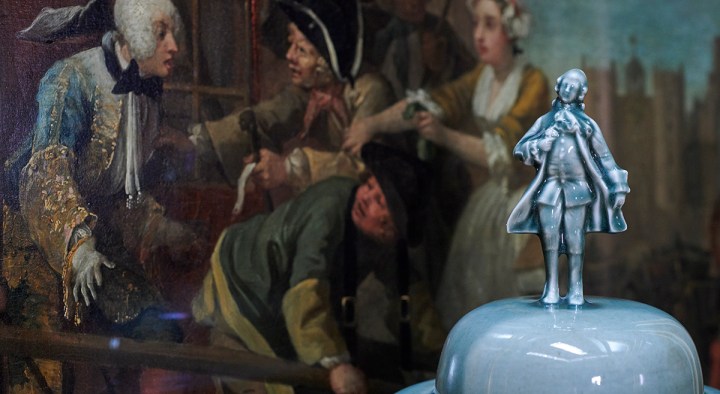
Bouke de Vries’ latest work—beautifully displayed in the Museum’s Foyle Space— responds to William Hogarth’s A Rake’s Progress.
Inspired by Hogarth’s series of original paintings at the Soane Museum, de Vries draws on his love of storytelling, and talent for symbolism through ceramics, with eight newly created porcelain vases presented in various states of (dis)repair. Starting with an immaculate celadon vase, de Vries treats the following seven increasingly deteriorating vases with a variety of restoration processes and glazes, which parallel the moral and physical degeneration of Hogarth’s anti-hero Tom Rakewell. Cracks appear in the surface, the vessels slump and implode—with obvious and drastic methods of repair failing to save the vase or Rake from their ultimate demise.
Originally working in fashion before retraining as a restorer, Bouke de Vries began creating his works of art in 2008. He has since gained a significant following and now has work in an impressive range of international public collections, including the National Museum of Scotland; the National Museum of Art, Architecture, and Design in Oslo; and the Philadelphia Museum of Art. De Vries sees an inherent value in the discarded objects he reinvents, giving a new lease of life to a broad spectrum of ceramics otherwise destined to be thrown away.
Bouke de Vries in Conversation with Louisa Buck
13 June 2023, 7pm BST
To celebrate the opening of his new exhibition Visions in Porcelain: A Rake’s Progress, ceramic artist Bouke de Vries will discuss his latest work with Louisa Buck, a contributing editor and London contemporary art correspondent for The Art Newspaper and a regular reviewer and commentator on BBC radio and TV. The evening includes an exclusive out-of-hours viewing of the exhibition and the opportunity to view Hogarth’s paintings that inspired the series in the Picture Room.
Book tickets here»
Lecture Series | Peter Miller on Conservation as a Human Science
From the Warburg:
Peter Miller, On Conservation as a Human Science
E. H. Gombrich Lecture Series
In-person and online, Warburg Institute, London, 13, 14, 15 June 2023
‘Conservation’, ‘preservation’, ‘care’—these words are frequently used today, but by different people, speaking to different audiences. On Conservation as a Human Science makes the case for treating conservation as a single human activity with an intellectual history of its own. Then, focusing more particularly on the kind of conservation done to man-made things it explores the entwined relationship between conservation and history. Like archaeology, to which it bears a close resemblance, conservation explores the depth of time stratigraphically to answer questions about what was in the past from what survives into our present. But, turned around, history, too, can function as a form of conservation—indeed, this was an initial self-definition that persisted into the age of modern, academic history. The ambition of this project is to shift how we understand conservation for a twenty-first century in which climate change will make the task of conservation and the challenge to conservation a more urgent part of public and private life. Moreover, rethinking conservation as a human science also opens up a new perspective on the organization of knowledge at a time when inherited distinctions between disciplines and fields and ‘pure’ and ‘applied’ learning, like those between the ‘head’ and the ‘hand’, are being reconsidered.
Lecture 1 | Tuesday, 13 June, 5.30–7.00pm
In Search of Conservation’s History
Lecture 2 | Wednesday, 14 June, 5.30–7.00pm
Conservation as History
Lecture 3 | Thursday, 15 June, 5.30–7.00pm
History as Conservation
Free and open to all with advance booking, in person at the Warburg Institute, or online via Zoom.
Organised by the Warburg Institute and sponsored by Princeton University Press, the E. H. Gombrich Lecture Series features prominent humanities scholars who address pressing concerns in art, literature, and ideas, across historical periods.
Peter N. Miller is Dean and Professor of Cultural History at the Bard Graduate Center in New York City, and incoming President of the American Academy in Rome. He is the author of a series of books on the early seventeenth-century antiquarian, Nicolas Fabri de Peiresc, on the history of antiquarianism, and on the modern study of objects as evidence. He co-curated Dutch New York between East and West: The World of Margarieta van Varick (BGC, 2009); What Is the Object? (BGC, 2022); and Conserving Active Matter (BGC, 2022), the exhibition and website that concluded the ten-year long project he directed, “Cultures of Conservation,” funded by the Andrew W. Mellon Foundation. His main current interest is in the how and why of research, whether done by professional historians or by curators, conservators or artists. He has been at Bard since 2001. He previously taught at the University of Cambridge, University of Chicago, and University of Maryland, College Park. He was a research fellow at the Warburg Institute, the Wissenschaftskolleg zu Berlin, and visiting professor at the École des Hautes Études en Sciences Sociales in Marseille and École Normale Supérieure in Paris. He has been the recipient of fellowships from the National Endowment for the Humanities, the John Simon Guggenheim Foundation, and the John D. and Catherine T. MacArthur Foundation.
Conference | The Mutability of Collections
From ArtHist.net and the Seminar on Collecting and Display website:
The Mutability of Collections: Transformation, Contextualisation, and Re-interpretation
Online and in-person, Birkbeck College, London, 7 July 2023
Registration due by 7 June 2023
This one-day conference concentrates on the ways in which objects in collections are added, exchanged or disposed of, translated and transformed. Items can be moved to new surroundings and different decorative settings, resulting in altered contexts of display, meaning, and significance. This conference thus aims to explore the various issues underlying the mutability of collections:
• the ways in which intentionality, taste, and the periodically fluctuating finances of collectors influenced the composition and display of a collection, sometimes more than once within a collection’s biography
• the ways in which fashion may have directed a collector towards particular groups of objects, as well as their alteration according to the taste of the time
• the ways in which collections may be reinterpreted and take on new meanings according to the spaces in which they were displayed
• the different associations and meanings given to individual objects through their changing representations, displays, or associations
Conference Fees
Regular booking fee (including lunch and tea & coffee), £42
Student booking fee, £25
Conference dinner on Friday evening (to be paid on the evening), £30
Zoom participation only, £15
Booking information is available here, or email collectingdisplay@gmail.com in case of difficulties.
P R O G R A M M E
9.00. Introduction
9.15. Morning Session
• Laura Moretti — Object History and Museum Display: The Adventurous Life of the Berlin Adorante
• Vincent Pham — Vernacular Veneration: Lord Chesterfield’s Library Portraits and Their afterlives
• Lara Pitteloud — From a Private to an Imperial Cabinet: The Various Re-interpretations of the Comte de Baudoin’s Collection
• Emily Monty — Prints and Books in the Dutch Fagel Collection: Continuity and Disjuncture in the London Market around 1800
• Ludovica Scalzo — Collections on Display in the Braccio Nuovo: A New Interpretation
12.45 Lunch Break
13.30 Afternoon Session
• Hannah McIsaac — Dutch Botanical Gardens: Visual Representation and the Impermanence of Collections
• Michal Mencfel — The Pulawian Relics of Unhappy Lovers, or the Poetics of Framing
• Solmaz Kive — Framing the Other: Decorative Art at the South Kensington Museum
• Maria Silina — Re-making Soviet Collections: Knowledge Production and Border Divisions, via Zoom
• Renata Komiƈ Marn — ‘Sammlung Attems’: The Identity of the Collection in Its Changing Contexts
16.40 Closing Discussion
Online Talk | Kate Hunter on Three Maps
From the SHARP listserv and Eventbrite:
Kate Hunter | Unexpected Adventures Told in Three Maps: Western Australia, the Indian Ocean, and Captain James Cook’s First Voyage
Online, Thursday, 8 June 2023, 1pm (EDT)
Kate Hunter, Senior Specialist at Daniel Crouch Rare Books, in conversation with Arthur Dunkelman, Curator of the Jay Kislak Collection, University of Miami Libraries
The University of Miami Special Collections cordially invites you to a ‘Conversation on Cartography’. Kate Hunter will share stories about three maps. The first is a map of Western Australia, where she grew up. The second is a Dutch East India Company [VOC] 18th-century chart of the Indian Ocean on vellum that helped the company establish a trade route that netted a fortune. Last, Hunter will look at a silver punch bowl whose upside-down surface includes an engraved early rendering of Captain James Cook’s first voyage (1769–70).
Kate Hunter has helped private collectors and institutional libraries to acquire and catalog maps, globes, and atlases the world over. Currently, she is the senior specialist at the New York office of Daniel Crouch Rare Books. She is also consulting curator and cataloger for the Map and Atlas Museum of La Jolla, California. During her three-decade career, Hunter has witnessed great changes, from a landscape over-populated by independent bookshops, to one almost bereft of them. According to Hunter, much of today’s commerce takes place online, and that has transformed the way collectors collect—from compulsive completists focused with detailed wish-lists to trophy-hunting connoisseurs.
The program will be followed by an audience question and answer session. Free and open to the public, the event will be hosted via Zoom. It will also be streamed via Facebook Live. All events in this series will be recorded for on-demand access following the broadcasts.
The Burlington Magazine, May 2023
The eighteenth century in the May issue of The Burlington . . .
The Burlington Magazine 165 (May 2023)
E D I T O R I A L
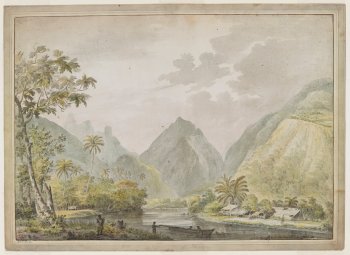
John Webber, A View Looking up the Vaitepiha River with Two Tahitians in a Canoe in the Foreground and Two Others on the Bank with Tahitian Houses to the Right. August 1777, 1777, pen, wash, and watercolour, 45 × 63 cm (London: British Library, Add. 15513, No.13).
• Digitizing the Conway and Witt Libraries, p. 491.
L E T T E R S
• Peter Barber, “The Background of Portrait of Mai,” pp. 492–93.
“Given Reynolds’s lack of interest in landscape painting, but the special place of the portrait of Mai in his oeuvre, it is at least possible that Reynolds may have decided to paint an authentically Tahitian background in order to add further ‘authenticity’. Given his high opinion of [John] Webber, it would have been natural to have copied the scene from one of his friend’s ‘excellent’ paintings of Vaitepiha Bay” (493).
• Christina Strunck, “Laguerre’s Painted Hall at Chatsworth,” p. 493.
“Since in his article ‘A Modello by Louis Laguerre and the Programme of the Painted Hall at Chatsworth’, published in The Burlington Magazine in August 2022 (pp. 760–67), François Marandet came to the same conclusions [that I did in my 2021 monograph Britain and the Continent, 1660–1727: Political Crisis and Conflict Resolution in Mural Paintings at Windsor, Chelsea, Chatsworth, Hampton Court and Greenwich], I thought your readers might like to be referred to the more extended analysis of the programme in both my book and an article I published in January 2022 that discusses the channels through which the two versions of Maratta’s painting may have been known to Laguerre and his patron, William Cavendish.”
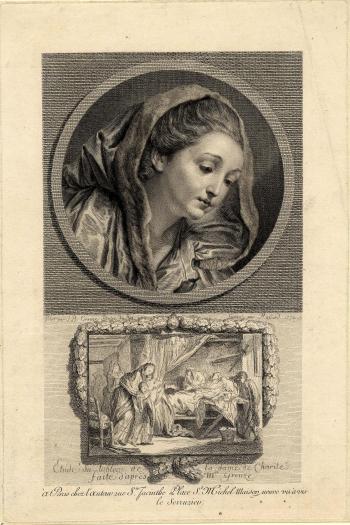
Jean Massard, after Jean Baptiste Greuze, A Woman (Madame Greuze) with a Fur-trimmed Hood Drawn over Her Head, Detail from Greuze’s ‘La Dame de Charité’ above a Sketch of the Painting, 1772, etching and engraving, 24 × 16 cm (London: British Museum, 1978,0121.291).
R E V I E W S
• Mark Evans, Review of Leopoldine van Hogendorp Prosperetti, Woodland Imagery in Northern Art, c.1500–1800: Poetry and Ecology (Lund Humphries, 2022), pp. 568–69.
• Alastair Lang, Review of Yuriko Jackall, Jean-Baptiste Greuze et ses têtes d’expression: La fortune d’une genre (CTHS and INHA, 2022), pp. 569–71.
• Lisa Monnas, Review of Michael Peter, Gewebtes Gold: Eine Kleine Geschichte der Metallfadenweberei von der Antike bis um 1800 (Abegg-Stiftung, 2022), p. 576.
• Alexandre Maral, Review of Christopher Tadgell, The Louvre and Versailles: The Evolution of the Proto-Typical Palace in the Age of Absolutism (Routledge, 2020), pp. 576–77.
• Wim Nys, Review of Beatriz Chadour-Sampson, Sandra Hindman, and Carla Van De Puttelaar, eds., Liber Amicorum in Honour of Diana Scarisbrick: A Life in Jewels (Ad Ilissvm, 2022), p. 577.
O B I T U A R Y
• Elizabeth Pergam, Obituary for Duncan Robinson (1943–2022), p. 578–79.
Successively the Director of the Yale Center for British Art, New Haven, and the Fitzwilliam Museum, Cambridge, Duncan Robinson had a major influence on the appreciation, study, and collecting of historic and modern British art in both the United States and the United Kingdom.
Call for Papers | Early Dance Symposium
From the Call for Papers:
New Work on Old Dance: A Pre-1800 Dance Studies Symposium
Online, 22–24 February 2024
Proposals due by 15 September 2023
What does it look like for historical expressions of dancing and movement arts to break out of traditional academic and performative boxes? How do scholars and practitioners escape the boundaries of discipline, chronology, geography, and methodology subsumed under the conventional appellation of ‘early dance’? Conversely, how can we demonstrate the ways in which our work complements and completes the work of other disciplines in light of these distinctions? This symposium explores early dance as an idea, a time, a place, a locus of cultural meaning and aims to draw together scholars working across disciplines and geographies who are nevertheless invested in ‘early’ dance and movement.
We invite papers for this virtual symposium from scholars across disciplines, exploring aspects of dance and movement from all methodological perspectives, nding commonality in the antecedental nature of their work. Whether looking at the musical, literary, cultural, political, religious, or social contexts of dance, or expanding knowledge of its somatic and kinesthetic dimensions, we nd unity in the chronological earliness of our work. We encourage papers that explore dance outside of Western European frameworks of knowledge and movement production, including comparative or transhistorical perspectives on pre-1800 or ‘early’ dance.
Possible Themes for Papers
• Dance, music, and choreomusicology
• Notation and choreographies
• Transmission, translation, and circulation
• Expanding geographies (pre-1800 dance across Asia, SWANA, the Americas and beyond)
• Race and racialization in pre-1800 dance practices
• Literature, textuality, and dance
• Representations of dance in art and literature
• Dance as metaphor/metaphors of dance
• Intersections of dance and/in theology, philosophy, theory, theater, art, philosophy, economics, etc.
• Theories and philosophies of dance
• Dance practices from page to stage: recreation, reconstruction, reenactment
• Costuming, clothing, and vestments
• Body politics/political bodies in historical dance
• Sociability and social life
• Translation problems: languages, historical periods, cultures
• Dance or movement as aide-memoire/embodied cognition
• Dance ontologies and dance as a way of knowing
Possible Themes for Roundtables and Forums
• What is ‘early dance’? Definitions and boundaries
• Early dance in global perspectives: expanding geographies
• Scholar/Practitioner: How does dance training aid or hinder research on early dance?
• Methodologies in research
• Graduate studies in early dance studies
• Interdisciplinary scholarship and dance studies: barriers and openings?
• Dance as knowledge production within academia
The program committee welcomes proposals for presentations in a variety of formats. Alternative formats may also be proposed. Graduate students, junior scholars, and unaffiliated scholars and performers are especially encouraged to submit proposals.
• Paper presentations (20 minutes)
• Work-in-progress presentations (5–10 minutes)
• Lecture-performances
• Workshops
• Roundtables (for themes listed above or entirely new roundtables)
• A collaborative performance, paper, manifesto, video, etc.
Please submit a proposal via the submission portal by 15 September 2023. Proposals should include your name, affiliation (if any), and email address; an abstract of 250–350 words; a short bibliography (optional); and a brief bio (100 words). All submissions materials must be in English, though presentations in other languages may be possible (please contact organizers).
This symposium is organized by members of the Early Dance Working Group of the Dance Studies Association. Please contact chair of the Organization Committee, Mary Channen Caldwell (maryca@sas.upenn.edu), with any questions.
Call for Papers | Sound, Image, Text

François Denis Née, after Joseph Barthélemy Le Bouteux, Le Concert (detail) in Jean Benjamin de Laborde, Choix de Chansons, 4 vols. (Paris: De Lormel, 1773). Binding with the arms of Marie-Antoinette (Paris: Bibliothèque nationale de France, Cotes RES-YE-778, Cotes RES-YE-779, Cotes RES-YE-780, Cotes RES-YE-781). The Bibliothèque Condé at the Château de Chantilly possesses a unique example printed on vellum bound with the original designs for the engravings; more information is available here.
◊ ◊ ◊ ◊ ◊
From the Call for Papers:
Sound, Image, Text
Australian National University, Canberra, 24–25 August 2023
Proposals due by 23 June 2023
This symposium hosted by the Centre for Art History and Theory in the ANU School of Art and Design will be of interest to scholars, curators, or creative practitioners interested in the relationship between sound, image, and text in the history of music, art, and literature. The event is inspired by the digital critical edition of Jean-Benjamin de Laborde’s Choix de Chansons (1773), developed by an interdisciplinary team of art historians, musicologists, and literary scholars from the Australian National University, University of Sydney, University of Oxford, and the Sorbonne. The project explores the interrelation and interactivity of images, music, and text in the Choix de Chansons and similar cultural objects in the eighteenth century.

François Denis Née, after Joseph Barthélemy Le Bouteux, Le Concert in Jean Benjamin de Laborde, Choix de Chansons, 1773 (Paris: Bibliothèque nationale de France, Cotes RES-YE-778, Cotes RES-YE-779, Cotes RES-YE-780, Cotes RES-YE-781). The inscription below the image reads “Vos yeux commencent nos tourmens, / Et vos doigts charmans / Achévent leur ouvrage” (Your eyes commence our torments / And your charming fingers / Accomplish their work). More information is available here.
We seek papers and interventions from artists, curators, publishers, and academics that include, but are not limited to, the following themes:
• Digital publication
• Multimedia research
• Interrelations of sound, image, and text.
• Digital methods for art history/musicology/literary studies
• Digital methods for researching the eighteenth century
• Book history (especially relating to music)
• History of image and text in performance
• Print culture and music
We strongly encourage participation from scholars, visual artists, and musicians who seek to develop, remake, rework, or remix the sound, image, and text of the digital critical edition of Choix de Chansons.
The symposium runs in conjunction with the Choix de Chansons exhibition at the School of Art and Design Gallery, which opens on Thursday, 24 August, and a concert of selected music from the Choix de Chansons held at the School of Music on Friday, 25 August. Modest bursaries to contribute towards travel and accommodation will be provided to international and interstate delegates. Please direct enquiries and paper submissions to Robert Wellington, Director, Centre for Art History and Art Theory, ANU at robert.wellington@anu.edu.au.










 Enfilade
leave a comment