Call for Articles | Thresholds 52: Disappearance
From the Call for Papers via e-flux:
Thresholds 52: Disappearance, Spring 2024
Edited by Samuel Dubois and Susan Williams
Submissions of about 3000 words due by 15 June 2023 (extended from 1 June 2023)
Thresholds, the annual peer-reviewed journal produced by the MIT Department of Architecture and published by MIT Press, is now accepting submissions to be published Spring 2024.
 Some disappearances are pointedly more conspicuous than others. In 1983, magician David Copperfield ominously dropped a curtain revealing an empty black sky, having just made the Statue of Liberty vanish from sight. As Lady Liberty’s disappearance was watched with amazement by television viewers, Copperfield cautioned his audience: “Sometimes we don’t realize how important something is until it is gone.” Constructing illusions, playing tricks, and deceiving audiences, magicians challenge what is real, imagined, or just an illusion of the eye. But even a playful disappearance in a magic trick can reveal deeper implications.
Thresholds 52: Disappearance will explore the ways art and architecture negotiate the elusive topic of disappearance. We seek contributions that aim to discover how disappearances are spatially manifested (material/symbolic, living/non-living, human/non-human) and how the appearances of certain things have led to the disappearances of others. Submissions can address any time period or geographic setting. We are interested in scholarly articles and other artistic and intellectual contributions that engage the notion of disappearance by clarify, complicate, and challenge our collective understandings of architecture, art history, and other related disciplines and practices.
Disappearance is an ambiguous term—an occurrence, a process, or an outcome. While a disappearance can stay within the binary state of visibility to invisibility, it can also make something become less common through a slow process towards non-existence. If disappearance itself is a fascinating subject, what enables something to survive after its raison d’être disappears may be just as intriguing. Scientific determinism tells us that, materially speaking, nothing actually disappears. The law of mass conservation establishes that while matter can neither be created nor destroyed, it can be rearranged in space. But this scientific truth becomes convoluted when the lived spatial and visual experiences of humans are accounted for. How can these two opposing views exist—or not exist—within the same world?
Disappearances can be manifested in various ways, scales, and contexts:
• stolen art and historical artifacts
• start and end of various artistic movements or media
• visualization and spatial design as strategies of tracking disappearance
untraceable actions of internet culture
• phantasmagoric vanishing experiences in haunted spaces
• dematerialization of analog skills in architectural design and practice
• concealed or implied structural systems over real structures
• construction sites intrinsically being replaced with actual buildings
• disappearance of materials and techniques when better ones emerge
• sinking of coastal cities
• evaporating biodiversity
• or just anything or anyone hidden in plain sight
Please send your submission to thresh@mit.edu. Written submissions should be in English, approximately 3000 words in length, and formatted in accordance with the current Chicago Manual of Style. All submissions should include a cover letter (maximum of 200 words) as well as a biography (maximum of 50 words) and contact information for each author. Text submissions should be sent as .doc files. Where applicable, images should be submitted at 72 dpi as uncompressed .tif files. All scholarly submissions are subject to a double-blind peer review. Other creative proposals are not limited in size, medium, or format.
New Books | Recent Historical Fiction
From Penguin Random House:
Celia Bell, The Disenchantment: A Novel (New York: Pantheon, 2023), 368 pages, ISBN: 978-0593317174, $28.
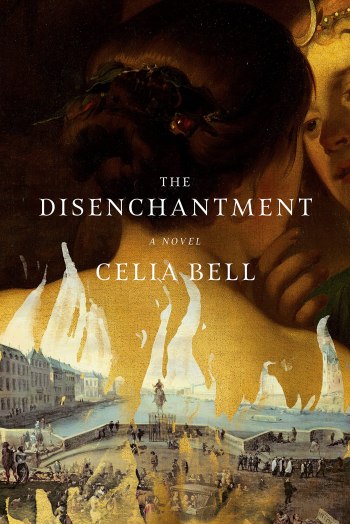 In 17th-century Paris, everyone has something to hide. The noblemen and women and writers consort with fortune tellers in the confines of their homes, servants practice witchcraft and black magic, and the titled poison family members to obtain inheritance. But for the Baroness Marie Catherine, the only thing she wishes to hide is how unhappy she is in her marriage, and the pleasures she seeks outside of it. When her husband is present, the Baroness spends her days tending to her children and telling them elaborate fairy tales, but when he’s gone, Marie Catherine indulges in a more liberated existence, one of forward-thinking discussions with female scholars in the salons of grand houses, and at the center of her freedom: Victoire Rose de Bourbon, Mademoiselle de Conti, the androgynous, self-assured countess who steals Marie Catherine’s heart and becomes her lover. Victoire possesses everything Marie Catherine does not—confidence in her love, and a brazen fearlessness in all that she’s willing to do for it. But when a shocking and unexpected murder occurs, Marie Catherine must escape. And what she discovers is the dark underbelly of a city full of people who have secrets they would kill to keep. The Disenchantment is a stunning debut that conjures an unexpected world of passion, crime, intrigue, and black magic.
Celia Bell has written short fiction for VQR, The White Review, The Sewanee Review, The Southern Review, and Bomb Magazine. She is the winner of the 2018 VQR Emily Clark Balch Prize for Fiction and holds an MFA from the New Writers Project at the University of Texas. She lives in Austin, Texas.
◊ ◊ ◊ ◊ ◊
From Macmillan (in September):
David Diop, translated from the French by Sam Taylor, Beyond the Door of No Return: A Novel (New York: Farrar, Straus and Giroux, 2023), ISBN: 978-0374606770, $27.
 The highly anticipated new novel by David Diop, winner of the International Booker Prize.
Paris, 1806. The renowned botanist Michel Adanson lies on his deathbed, the masterwork to which he dedicated his life still incomplete. As he expires, the last word to escape his lips is a woman’s name: Maram. The key to this mysterious woman’s identity is Adanson’s unpublished memoir of the years he spent in Senegal, concealed in a secret compartment in a chest of drawers. Therein lies a story as fantastical as it is tragic: Maram, it turns out, is none other than the fabled revenant. A young woman of noble birth from the kingdom of Waalo, Maram was sold into slavery but managed to escape from the Island of Gorée—a major embarkation point of the transatlantic slave trade—to a small village hidden in the forest. While on a research expedition in West Africa as a young man, Adanson hears the story of the revenant and becomes obsessed with finding her. Accompanied by his guide, he ventures deep into the Senegalese bush on a journey that reveals not only the savagery of the French colonial occupation but also the unlikely transports of the human heart. Written with sensitivity and narrative flair, David Diop’s Beyond the Door of No Return is a love story like few others. Drawing on the richness and lyricism of Senegal’s oral traditions, Diop has constructed a historical epic of the highest order.
David Diop was born in Paris and was raised in Senegal. He is the head of the Arts, Languages, and Literature Department at the University of Pau, where his research includes such topics as eighteenth-century French literature and European representations of Africa in the seventeenth and eighteenth centuries. His second novel, At Night All Blood Is Black, was awarded the International Booker Prize and the Los Angeles Times Book Prize for fiction.
Sam Taylor has written for The Guardian, Financial Times, Vogue, and Esquire; he has translated such works as the award-winning HHhH by Laurent Binet and the internationally-bestselling The Truth about the Harry Quebert Affair by Joël Dicker.
◊ ◊ ◊ ◊ ◊
From Penguin Random House:
Tania James, Loot (New York: Knopf, 2023), 304 pages, ISBN: 978-0593535974, $28.
 Abbas is just seventeen years old when his gifts as a woodcarver come to the attention of Tipu Sultan, and he is drawn into service at the palace in order to build a giant tiger automaton for Tipu’s sons, a gift to commemorate their return from British captivity. His fate—and the fate of the wooden tiger he helps create—will mirror the vicissitudes of nations and dynasties ravaged by war across India and Europe. Working alongside the legendary French clockmaker Lucien du Leze, Abbas hones his craft, learns French, and meets Jehanne, the daughter of a French expatriate. When Du Leze is finally permitted to return home to Rouen, he invites Abbas to come along as his apprentice. But by the time Abbas travels to Europe, Tipu’s palace has been looted by British forces, and the tiger automaton has disappeared. To prove himself, Abbas must retrieve the tiger from an estate in the English countryside, where it is displayed in a collection of plundered art.
Tania James is the author of three works of fiction, most recently the novel The Tusk That Did the Damage (Knopf), which was named a Best Book of 2015 by The San Francisco Chronicle, The Guardian, and NPR, and shortlisted for the International Dylan Thomas Prize and the Financial Times Oppenheimer Award. Her short stories have appeared in One Story, The New Yorker, Granta, Freeman’s Anthology, Oxford American, and other venues. James is an associate professor of creative writing at George Mason University and lives in Washington, DC.
◊ ◊ ◊ ◊ ◊
From Simon & Schuster:
Neil Jordan, The Ballad of Lord Edward and Citizen Small: A Novel (Pegasus Books, 2023) 352 pages, ISBN: 978-1639364534, $27.
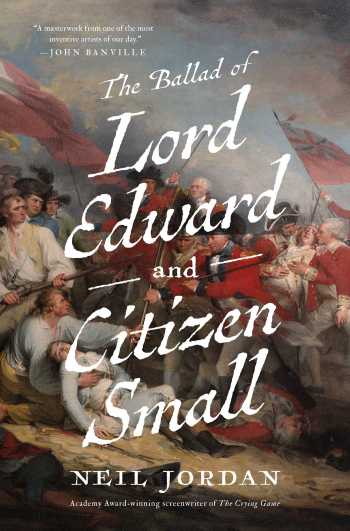 From Academy Award-winning film director Neil Jordan comes an artful reimagining of an extraordinary friendship spanning the revolutionary tumult of the eighteenth century.
South Carolina, 1781: the American Revolution. An enslaved man escaping to his freedom saves the life of Lord Edward Fitzgerald, a British army officer and the younger son of one of Ireland’s grandest families. The tale that unfolds is narrated by Tony Small, the formerly enslaved man who becomes Fitzgerald’s companion—and best friend. While details of Lord Edward’s life are well documented, little is known of Tony Small, who is at the heart of this moving novel. In this gripping narrative, his character considers the ironies of empire, captivity, and freedom, mapping Lord Edward’s journey from being a loyal subject of the British Empire to becoming a leader of the disastrous Irish rebellion of 1798. This powerful new work of fiction brings Neil Jordan’s inimitable storytelling ability to the revolutions that shaped the eighteenth century—in America, France, and, finally, in Ireland.
Neil Jordan is an award-winning Irish film director, screenwriter, and novelist. His first book, Night in Tunisia, won the Somerset Maugham Award and the Guardian Fiction Prize. He is the winner of an Academy Award, the Rooney Prize for Irish Literature, the Irish PEN Award, a BAFTA, and the Kerry Group Irish Fiction Award. Jordan’s films include Interview with the Vampire, Angel, The Crying Game, Michael Collins, The End of the Affair, and The Butcher Boy. He lives in Dublin.
◊ ◊ ◊ ◊ ◊
From Penguin Random House:
Stephanie Marie Thornton, Her Lost Words: A Novel of Mary Wollstonecraft and Mary Shelley (New York: Berkley Press, 2023), 448 pages, ISBN: 978-0593198421, $17.
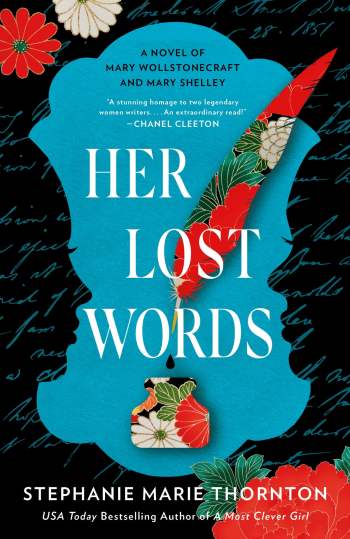 1792. As a child, Mary Wollstonecraft longed to disappear during her father’s violent rages. Instead, she transforms herself into the radical author of the landmark volume A Vindication of the Rights of Woman, in which she dares to propose that women are equal to men. From conservative England to the blood-drenched streets of revolutionary France, Mary refuses to bow to society’s conventions and instead supports herself with her pen until an illicit love affair challenges her every belief about romance and marriage. When she gives birth to a daughter and is stricken with childbed fever, Mary fears it will be her many critics who recount her life’s extraordinary odyssey…
1818. The daughter of infamous political philosopher Mary Wollstonecraft, passionate Mary Shelley learned to read by tracing the letters of her mother’s tombstone. As a young woman, she desperately misses her mother’s guidance, especially following her scandalous elopement with dashing poet Percy Bysshe Shelley. Mary struggles to balance an ever-complicated marriage with motherhood while nursing twin hopes that she might write something of her own one day and also discover the truth of her mother’s unconventional life. Mary’s journey will unlock her mother’s secrets, all while leading to her own destiny as the groundbreaking author of Frankenstein.
A riveting and inspiring novel about a firebrand feminist, her visionary daughter, and the many ways their words transformed our world.
Stephanie Marie Thornton is a high school history teacher and lives in Alaska with her husband and daughter.
Call for Papers | HECAA Open Session at UAAC 2023, Banff
Apologies for the short notice, but this open session at October’s UAAC/AAUC Conference is still accepting proposals (until Wednesday). –CH
Open Session Sponsored by the Historians of Eighteenth-Century Art and Architecture
Universities Art Association of Canada / l’association d’art des universités du Canada
Banff, 19–21 October 2023
Chaired by Kathryn Desplanque (UNC Chapel Hill)
Proposals due by 31 May 2023
HECAA works to stimulate, foster, and disseminate knowledge of all aspects of eighteenth-century visual culture. This open session welcomes papers that examine any aspect of art and visual culture from the 1680s to the 1830s. Special consideration will be given to proposals that employ innovative methodological approaches, study marginalized communities, and challenge Eurocentrism. Applicants should send a 250-word abstract with “HECAA Open Session” as the subject heading to Kathryn Desplanque at desplanq@ad.unc.edu.
Kathryn adds: “University Arts Association of Canada is Canada’s College Art Association, but more intimate and friendly! This year, we are so fortunate to be hosted at the Banff Centre for Arts & Creativity. Banff and Lake Louise are nestled in the Rocky Mountains and is one of the most gorgeous destinations in Canada. Please join me in visiting it for the first time. The conference takes place 19–21 October 2023 (the leaves should be spectacular). Of particular note is UAAC’s Annual Graduate Student Essay award. Graduate students who’ve presented papers at the UAAC conference can submit complete versions of their essays for consideration. The winning essay is awarded $250CAD and will be published in the spring 2024 issue of the Canadian Art Review (RACAR). As a past recipient of the award, I’m eager to coach a graduate student through this process.”
New Book | Eighteenth-C. Engravings and Visual History in Britain
From Routledge:
Isabelle Baudino, Eighteenth-Century Engravings and Visual History in Britain (New York: Routledge, 2023), 202 pages, ISBN: 978-1032153643, $160.
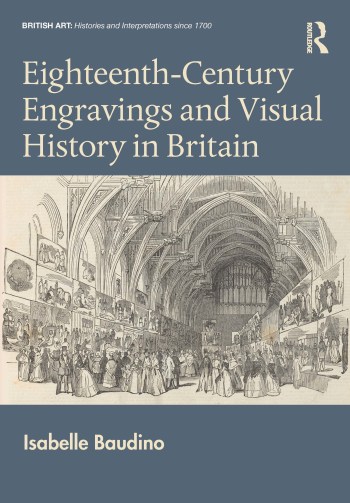 Extending the scholarly discussion of visual history, this book examines eighteenth-century engraved book illustrations in order to outline the genealogy of the modern visualisation of the past in Britain. This study is based on a body of more than a hundred engraved historical plates designed in the second half of the eighteenth century in Britain and published in more than a dozen pictorial histories. Focusing on these previously unstudied engravings, this work contributes to the study of eighteenth-century visual culture and is informed by current interdisciplinary approaches at the intersection of visual and book studies. Eighteenth-Century Engravings and Visual History in Britain is about the urge to envision the past and about the establishment of the new relationship between visual media, visuality, and history in eighteenth-century Britain.
Isabelle Baudino is Senior Lecturer at the École normale supérieure de Lyon, France.
C O N T E N T S
List of Illustrations
Acknowledgments
Introduction
1 Picturing History
2 Reinventing the Past
3 The Historical Genre
4 Visual History as a New Language
Appendix
Select Bibliography
Index
Exhibition | Style & Society: Dressing the Georgians

Installation view of Style & Society: Dressing the Georgians at the Queen’s Gallery, Buckingham Palace, London, 2023.
◊ ◊ ◊ ◊ ◊
From the press release (20 April 2023) for the exhibition:
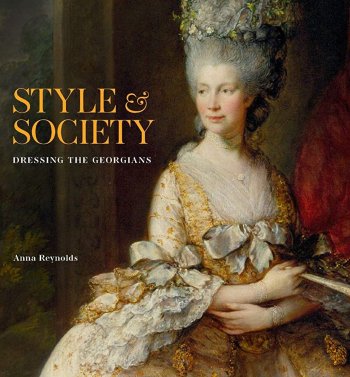
Style & Society: Dressing the Georgians
The Queen’s Gallery, Buckingham Palace, London, 21 April – 8 October 2023
The King’s Gallery, Palace of Holyroodhouse, Edinburgh, 22 March — 22 September 2024
Curated by Anna Reynolds
The wedding dress of George IV’s daughter Princess Charlotte of Wales, on display for the first time in over a decade, is among more than 200 works from the Royal Collection on view at The Queen’s Gallery in the exhibition Style & Society: Dressing the Georgians.

Thomas Gainsborough, Portrait of Queen Charlotte, ca. 1781, oil on canvas, 239 × 159 cm (London: Royal Collection, RCIN 401407). As noted at the exhibition website, this full-length portrait, “usually hangs in the White Drawing Room at Windsor Castle. Painted by candlelight, it depicts the Queen in a magnificent gown, worn over a wide hoop and covered with gold spangles and tassels.”
The exhibition explores what fashion can tell us about life in Georgian Britain, a period rocked by social, political, and technological revolutions. Alongside paintings, prints, and drawings by artists such as Gainsborough, Zoffany, and Hogarth are rare surviving examples of clothing, jewellery, and accessories. Together, they provide a fascinating insight into what was worn across all levels of society, from the practical dress of laundry maids to the glittering gowns at court.
Princess Charlotte was George IV’s only legitimate child, but died in childbirth at the age of 21 in 1817. Her marriage to Prince Leopold a year earlier was considered one of the most important royal weddings of the era. Her silk embroidered bridal gown is the only royal wedding dress that survives from the Georgian period, though it appears to have been significantly altered from its original form, in keeping with the Georgian practice of repurposing and recycling clothing. The Princess followed the tradition for European royal brides to wear silver, despite white wedding dresses becoming popular by the end of the 18th century.
Princess Charlotte’s mother, Caroline of Brunswick, also wore silver for her wedding to the future George IV in 1795. On display for the first time is a portrait of the wedding ceremony by John Graham, displayed alongside the original silver and gold dress samples supplied for the bride and other royal guests, on loan from Historic Royal Palaces. While the royal couple and their congregation made a glittering spectacle, their highly embellished clothing and wide skirts would have been noticeably outdated in fashionable circles, reflecting the increasing association of the court with old-fashioned styles of dress rather than cutting-edge trends.
Anna Reynolds, curator of Style & Society, said, “Dress is so much more than just what we see on the surface, and it’s fascinating what we can learn about a period when looking at it through a fashion history lens. Visitors might be surprised to learn how much the Georgian period has in common with the fashion landscape we know today, from influencers and fashion magazines to ideas about the value of clothes and how they can be recycled and repurposed.”
At the heart of the exhibition is a full-length portrait by Thomas Gainsborough, ca.1781, depicting Queen Charlotte wearing a magnificent court gown. It will be shown alongside a beautifully preserved gown of a similar style, worn at Queen Charlotte’s court in the 1760s, on loan from the Fashion Museum Bath. Portraits throughout the exhibition will demonstrate how artists rendered magnificent gowns such as these in paint in exquisite detail, from the metallic woven silk in Antoine Pesne’s Duchess of Saxe-Wessenfels, to the bows and fine lace of Francis Cotes’ Princess Louisa and Princess Caroline.
Allan Ramsay’s life-size coronation portraits of George III and Queen Charlotte demonstrate how ceremonial clothing was carefully chosen to emphasise themes of continuity, tradition, and spectacle. Queen Charlotte wears a gown heavily embroidered with gold thread and a stomacher panel covered with diamonds. This stomacher, which no longer survives, was valued by a contemporary spectator at £60,000—the equivalent of almost £10 million today.
The exhibition trailer (above), engages with the painting St James’s Park and the Mall, by an unknown painter, ca. 1745, oil on canvas, 104 × 139 cm (London: Royal Collection, RCIN 405954).
◊ ◊ ◊ ◊ ◊
With the rise of a professional class, more women earning wages, and cheaper fabrics available, the 18th century saw fashion becoming more accessible to the masses. Pleasure gardens, theatres, and coffee houses provided new settings to show off the latest styles, and the first fashion periodicals spread up-to-the-minute trends, many inspired by clothing previously reserved for working-class or sporting pursuits. Pages from influential French fashion periodicals, on display for the first time, recommend looks inspired by men’s riding dress and military uniforms, both of which became popular everyday styles for women.
 The Georgian period saw specific forms of children’s clothing introduced, designed with comfort, practicality and freedom of movement in mind. In Benjamin West’s 1782 portrait of Prince Octavius, the 13th child of George III and Queen Charlotte, the three-year-old wears a skeleton suit—a new style of children’s dress inspired by the working-class clothing of sailors and fishermen. The young prince, perhaps playing at being king, is shown carrying his father’s sword, which will be shown alongside the painting, both on public display for the first time.
Georgian jewellery was often highly personal and sentimental. Items on display include diamond rings given to Queen Charlotte on her wedding day and a bracelet with nine lockets, six containing locks of hair and one with a miniature of the left eye of Princess Charlotte of Wales. As with textiles, jewellery was often repurposed; a striking necklace was made from pearl-adorned dress-coat buttons that had belonged to George III. Other accessories that may be less familiar to visitors will include jewel-encrusted snuffboxes and chatelaines, which were attached to the waist and used to carry items from pocket watches to perfume bottles.
The exhibition also explores the hair, cosmetics, and grooming tools used by Georgian men and women to achieve their elaborate styles, as well as 18th-century developments in eyewear and dentistry. On show for the first time is a silver-gilt travelling toilet service, acquired by the future George IV as a gift for his private secretary at a cost of £300, the equivalent of more than £20,000 today. The toilet service gives a remarkable insight into a Georgian gentleman’s grooming routine, containing more than 100 objects including razors, combs, ear spoons, and tongue scrapers—as well as tools for cleaning guns and making hot chocolate.
Anna Reynolds, Style & Society: Dressing the Georgians (London: Royal Collection Trust, 2023), 344 pages, ISBN: 978-1909741850, £40 / $50.
◊ ◊ ◊ ◊ ◊
Note (added 20 April 2024) — The posting was updated to include information on the exhibition as presented in Edinburgh.
Call for Papers | J.M.W. Turner: State of the Field
From ArtHist.net:
J.M.W. Turner: State of the Field
Online, hosted by the Yale Center for British Art, 22 September 2023
Proposals due by 7 July 2023
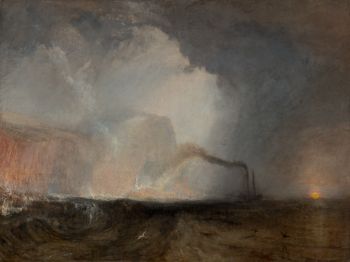
J.M.W. Turner, Staffa, Fingal’s Cave, 1831–32, oil on canvas, 91 × 121 cm (New Haven: Yale Center for British Art, Paul Mellon Collection).
On 22 September 2023, the Yale Center for British Art will host a one-day, online symposium titled J.M.W. Turner: State of the Field. This symposium will critically consider the state and meaning of Turner scholarship in advance of the 250th anniversary of Turner’s birth in 2025. Thinking through the extensive Turner historiography, the symposium seeks to explore the key ideas, underlying assumptions, and future direction of Turner research, and to consider its place within the broader field of British studies. We are particularly interested in critical analyses of the literature and studies that identify or exemplify potential new perspectives and approaches. We welcome proposals from established and emerging scholars on any topic within Turner studies and encourage participants to be imaginative in their approach.
Themes for consideration include but are not limited to
• The role of art historians, critics, curators, and institutions in building and maintaining Turner’s artistic prominence
• Turner’s place within past and contemporary approaches to British studies
• Turner’s place within discourses of modernity
• Turner’s own contribution to the construction of his artistic reputation
• ‘Realism’ and ‘idealism’ in Turner’s works
• Narrative and intentional meanings in Turner’s works, and what these might tell us about the artist’s broader social, cultural, and political positioning
• Issues of nationalism, race, and empire in Turner’s work
• Gaps that remain in studies of Turner’s artistic practice, including but not limited to his professional persona, relationships, and networks, and his engagement with the contemporary art market and/or print culture
• Innovative approaches to understanding Turner and his works, including new methodologies, critical perspectives, and future directions
Please submit an abstract of no more than 250 words and a short biography by 7 July 2023. Final presentations should not exceed twenty minutes in length.
New Book | Wedgwood: Craft & Design
From Thames & Hudson:
Catrin Jones, with a foreword by Tristram Hunt, Wedgwood: Craft & Design (London: Thames & Hudson, 2023), 144 pages, ISBN: 978-0500480755, $20.
 Looking back at key moments in Wedgwood’s design history, this book celebrates the manufacturer’s visual power and great design from its founding in 1759 to the present day.
The name Wedgwood has come to stand for something far beyond its illustrious and energetic founder: it has united art and industry; introduced design and artistic collaborations; and pioneered the development ofthe firm’s iconic blue-and-white jasperware. This book tells that story through design, reflecting the continuing role that Wedgwood and its designers, artists, and employees have played in setting trends—including collaborations with many British artists and designers such as Christopher Dresser, Eric Ravilious, and Keith Murray. Wedgwood continuously responds to the market and produces high-quality, desirable ceramicsfor a broad range of consumers, yet remains faithful to the traditions established by Josiah Wedgwood in the eighteenth century. The book presents highlights from the internationally renowned V&A Wedgwood Collection, praised by the Art Fund—one of the UK’s leading art organizations—as “one of the most important industrial archives,” containing around 80,000 objects. This archive reflects the unique proposition of Wedgwood’s business: by operating in both the ‘ornamental’ and ‘useful’ markets, Wedgwood has been able to bring innovative ceramic design to a broad and increasingly international clientele. These ceramics and their stories demonstrate the artistic heritage, craft, and innovation that have become synonymous with the Wedgwood name for more than 250 years.
Catrin Jones is a curator specializing in historic and contemporary applied arts. She joined the V&A in 2020 as Chief Curator, V&A Wedgwood Collection.
Tristram Hunt is the Director of the V&A and former Member of Parliament for Stoke-on-Trent, where the Wedgwood factory is located.
Symposium | Unpacking the V&A Wedgwood Collection
Unpacking the V&A Wedgwood Collection
Barlaston (Stoke-on-Trent) and London, 7–8 July 2023
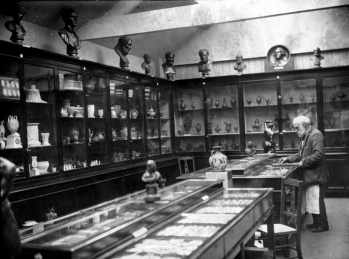
Isaac Cook, curator of the first Wedgwood Museum at the Etruria factory, sorting trays of Josiah Wedgwood’s trials © Fiskars.
Join leading ceramic artists, scholars, and emerging voices for a two-day symposium exploring fresh avenues of research into Wedgwood. We look forward to conversations that expand our understanding of Wedgwood and push scholarship in new directions. This dual-site landmark conference honours Gaye Blake-Roberts MBE, former curator of the V&A Wedgwood Collection, and her contribution to ceramic research. It will take place at the V&A Wedgwood Collection in Barlaston, Stoke-on-Trent (Friday) and at the V&A South Kensington, London (Saturday). A small number of bursaries for early career professionals will be available (generously funded through the Paul Mellon Centre); please send a 300-word application to wedgwood@vam.ac.uk by 5 June, outlining how attending the conference will benefit your professional development.
Book Day 1 here»
Book Day 2 here»
Please scroll down to ‘related events’ to book afternoon options and the evening dinner.
F R I D A Y , 7 J U L Y 2 0 2 3
Barlaston, Stoke-on-Trent, 10.00–17.00
• Kate Turner (Acting Chief Curator, V&A Wedgwood Collection) — Welcome
• Robin Emmerson (former Head of Decorative Art Department, National Museums Liverpool) — Gaye Blake-Roberts MBE: The Story So Far
Panel 1 | Beyond Josiah Wedgwood: Re-examining the Narrative
Chair: Oliver Cox (Head of Academic Partnerships VARI, NAL and Archives)
• Iris Moon (Assistant Curator European Sculpture and Decorative Arts, Metropolitan Museum of Art) — Phantom Urn: Wedgwood’s Disability
• Nicola Scott (Curator of Decorative Art, National Museums Liverpool) — Joseph Mayer (1803–1886): Portrait of a Victorian Wedgwood Collector
• Rebecca Klarner (Assistant Curator, V&A Wedgwood Collection, PhD Researcher University of Leeds) — Who Made It? Questions of Authorship, Authorising, and Authority in Wedgwood’s 20th-Century Design and Marketing
Bookable Afternoon Options for Day 1
2.00 Randeep Atwal and Lucy Lead — Extraordinary Wedgwood Women: Celebrating the Lives of Mary Euphrasia Wedgwood and Lucie Wedgwood
2.30 Alice Walton — Impressions from a Contemporary Ceramic Maker
2.00 Kate Turner — Wedgwood’s Anti-Slavery Medallion: A Re-display at the V&A Wedgwood Collection
2.00 Isabel Clanfield — Highlights of the Museum Store: A Guided Handling Session
A Wedgwood factory tour and have-a-go pot throwing sessions are also available to book.
Panel 2 | Impressions of the Past and Contemporary Ceramic Making
Chair: Catrin Jones (Chief Curator, V&A Wedgwood Collection)
• Matt Smith (Artist and Curator) — Remaking the Museum
Clare Twomey (Artist and Researcher) — Wedgwood: Identity and Practice
• Adam Hemming (Vice President of Marketing, Fiskars) — Making Wedgwood Today
Evening at Lunar restaurant, to be booked separately
With dinner speakers Tristram Hunt (Director, Victoria and Albert Museum) and Aileen Dawson (Former Curator, 1660–1800, Britain, Europe and Prehistory, British Museum)
S A T U R D A Y , 8 J U L Y 2 0 2 3
South Kensington, 10.00–17.30
• Antonia Boström (Director of Collections, V&A South Kensington) — Welcome
Panel 3 | Narratives of Creativity, Technology, Economics, and Labour
Chair: Caroline McCaffrey-Howarth (Lecturer in History of Art, 1650–1900, University of Edinburgh)
• Paul Greenhalgh (Director, Zaha Hadid Foundation) — Mimesis, Method, and Money: Wedgwood and His Forebears
• Claire Blakey (Curator of Modern Decorative Arts, National Museums Scotland) — Wedgwood and the Industrial Museum of Scotland
• Samantha Lukic-Scott (PhD Researcher, University of York) — Wedgwood and Pictorial Translation
• Paul Scott (Artist and Researcher) — Wedgwood’s American Transferware Patterns: New American Scenery, Archives, and Insights
Bookable Afternoon Options for Day 2
1.45 Angus Patterson — Cut Steel Dress Accessories with Jasperware Plaques: A Collaboration between Josiah Wedgwood and Matthew Boulton
2.05 Simon Spier and Florence Tyler — Wedgwood at the V&A South Kensington
Panel 4 | Global Wedgwood
Chair: Patricia Ferguson (Independent Researcher)
• Kate Smith (Associate Professor in 18th-Century History, University of Birmingham) — Clay, Labour, and Heat: Making Ceramics in a Global World
• Brigid von Preussen (Junior Research Fellow in History of Art, University of Oxford) — Model Colonies: Australian Clay, British Moulds, and the New Etruria
• Raffaella Ausenda (Professor, Freelance Historian of Italian Ceramics, Milan) — Italian Creamware ‘ad uso d’Inghilterra’ in Northern Italy and Beyond
• Rachel Gotlieb (Curator of Ceramics, Crocker Art Museum) — Viola Frey (1933–2004): Disrupting Josiah Wedgwood’s Portland Vase in Northern California
Colonial Williamsburg in 2023

The Foundations of the Governors Palace in 1930. (Visual Resources, John D. Rockefeller Jr. Library, The Colonial Williamsburg Foundation; photo by Thomas Layton). As Jennifer Scheussler writes, Colonial Williamsburg is now “a 301-acre complex consisting of more than 60 restored or reconstructed 18th-century buildings, 30 gardens, five hotels, three theaters, two art museums and a long, tangled history of grappling with questions of authenticity, national identity and what it means to get the past ‘right’.”
◊ ◊ ◊ ◊ ◊
Schuessler’s feature article on Williamsburg is useful for both the history of the Foundation and its present-day vision and commitments. –CH
Jennifer Schuessler, with photographs by Matt Eich, “Building a Better Colonial Williamsburg,” The New York Times (8 May 2023). Virginia’s reconstructed colonial capital, long criticized as presenting an idealized image of the American Revolution, brings its history into the 21st century.
“. . . After decades of declining attendance and financial instability, the Colonial Williamsburg Foundation, the private entity that owns and operates the site, is rethinking not just some of its structures, but also the stories it tells, adding or expanding offerings relating to Black, Native American, and L.G.B.T.Q. history.
And it’s doing so amid a fierce partisan battle over American history, when the date “1776”—emblazoned on souvenir baseball hats on sale here—has become a partisan rallying cry.
Some conservative activists have accused Colonial Williamsburg of going “woke,” a charge also lobbed against Monticello and Montpelier, James Madison’s home. But Cliff Fleet, a former tobacco executive who took over as the foundation’s president and CEO in early 2020, firmly rejects it. Fleet describes his approach as leaning into Colonial Williamsburg’s longtime mission of presenting “fact-based history,” grounded in rigorous research. “That’s true to our brand,” he said. “Everything is going to be what actually happened. That’s who we are.”
Recounting “what actually happened” is no simple matter, as any historian will tell you. But when it comes to the state of contemporary Colonial Williamsburg, some facts speak powerfully.
In 2021, the foundation raised a record-breaking $102 million, up 42 percent from the previous high in 2019. To date, it has collected more than $6 million for the excavation and reconstruction of the First Baptist Church, home to one of the earliest Black congregations in the United States (founded in 1776), and more than $8 million for the restoration of the Bray School, which educated free and enslaved Black children in the 1760s and ’70s.
Those projects have won support across the political spectrum, including from Gov. Glenn Youngkin. In February, the governor—a Republican who on his first day in office signed an executive order banning the teaching of critical race theory and other “inherently divisive concepts” in public schools—spoke at an event for the Bray School, citing the need “to teach all of our history, all of it, the good and the bad.”
For some longtime Williamsburg-watchers, the institution’s leadership has deftly steered through today’s choppy political waters by staying true to the past.
“It’s a remarkable shift, but in some ways a return to C.W.’s original mission,” said Karin Wulf, a historian and the former executive director of the Omohundro Institute, an independent research group at the College of William & Mary. “The scholarship of decades has shown us this fuller, richer picture of Early America,” Wulf said. “It’s diverse, it’s complex, it’s violent. But it’s the real thing.” . . .
After World War II, Colonial Williamsburg became a patriotic shrine and “symbol of democracy in the troubled world,” as a top executive put it. The Bicentennial brought a new boom, with annual paid attendance peaking in the mid-1980s at 1.1 million visitors, many of whom bedded down in period-style inns (or snapped up authorized colonial-style home products).
But not everyone appreciated the tastefully spic-and-span aesthetic. Writing in The New York Times in 1963, the architecture critic Ada Louise Huxtable called it a “superbly executed vacuum,” which fostered “an unforgivable fuzziness between the values of the real and the imitation.”
The carefully tended history also stirred criticism, particularly as social history, with its emphasis on ordinary people and marginalized groups, surged in the academy.
In the 1770s, more than half of the town’s 1,800 residents were Black, though visitors to the modern-day recreation would not always have known it. . . .
“True” is a word heard often at Williamsburg, where interpreters—including one portraying Oconostota, an 18th-century Cherokee diplomat who came to Williamsburg in 1777—regularly break character to explain the evidence behind their stories.
The foundation’s audience research, Fleet said, indicates that showing your work helps built trust. “One of the most important things to do, particularly in this age of polarization, is to let them know how you know,” he said.
The First Baptist Church project exemplifies how Colonial Williamsburg’s storytelling is literally built from the ground up, and rooted in discoveries—and rediscoveries—on site. . . .
The full article is available here»
At Auction | Significant Colonial Notes
From the press release (via Art Daily) for the sale:
Significant Colonial Notes from the John J. Ford Collection
Live Online Sale, Kagin’s Auctions, Tiburon, California, 20 May and 23 September 2023
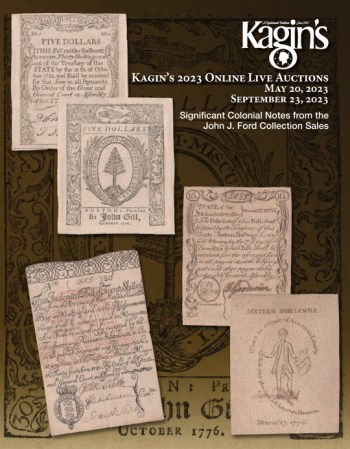 Historic, colonial-era paper money printed by Benjamin Franklin and Paul Revere with provenance from a famous collection formed starting in the 1940s is coming to market. The first of two auctions of the rare, early American money will be conducted online by Kagin’s Auctions of Tiburon, California on 20 May 2023, with the second sale scheduled for 23 September.
“These important notes were previously in the collection of John J. Ford, a prominent New York City collector and influential dealer who passed away at the age of 81 in 2005. Some of the notes are unique with no other examples known, and many others are the finest surviving 18th-century notes of their kind,” explained Dr. Donald Kagin, president of the auction company.
Notes from all 13 original colonies and Georgia are represented in the auctions, including a dozen notes produced by Franklin and 34 made by Revere. Writer, inventor and statesman Benjamin Franklin printed money for Delaware, New Jersey, and Pennsylvania. Those notes’ designs include the words, “Printed by B. Franklin,” or, “Printed by B. Franklin and D. Hall.” David Hall emigrated to Philadelphia from Scotland and was an early American printer, publisher, and business partner with Franklin. Boston silversmith, engraver, and patriot Paul Revere printed money for Massachusetts and New Hampshire without placing his name or initials on the money. One of the notes has the authorization signature of a signer of the Declaration of Independence, William Ellery of Rhode Island.
Kagin states: “John J. Ford began assembling his collection of early American money in the 1940s. There are 375 of Ford’s Colonial and Revolutionary War era notes that will be offered in the two auctions, and 58 of them were used as illustrations in the standard reference book on the topic, The Early Paper Money of America, [by Eric Newman, the first edition of which appeared in 1967]. These are examples of the types of money printed in the colonies in the mid-1700s and used by the public for daily commerce or to pay soldiers fighting in the Revolutionary War. All of these notes are early American history you can hold in your hands.”
Nearly four dozen notes in the May 20 auction were printed with the unmistakable warning, “To Counterfeit is DEATH.” Denominations of some notes are in English Pence, Shillings, or Pounds; others are in dollar denominations depending on when and where the notes were printed. A few notes are even denominated in both Pounds and Dollars. Some carry patriotic messages or symbolism, such as the “sword in hand” design on some notes printed by Revere. Those depict a Colonial era man holding a sword in one hand and a copy of the Magna Carta in the other. The motto above him reads “IN DEFENSE OF AMERICAN LIBERTY” and below in Latin is a phrase translated as “By arms he seeks tranquility under freedom.”










 Enfilade
leave a comment