Exhibition | Giuseppe Marchesi (il Sansone)

Giuseppe Marchesi, known as il Sansone, Moses and the Daughters of Jethro / Mosé e le figlie di Jethro, ca. 1720–25, oil on canvas
(Private Collection)
◊ ◊ ◊ ◊ ◊
Bologna’s Musei Civici d’Arte Antica hosts the first monographic exhibition on the early career of the painter Giuseppe Marchesi, known as Samson.
Leggiadro Barocco: L’attività giovanile di Giuseppe Marchesi detto il Sansone
Collezioni Comunali d’Arte, Palazzo d’Accursio, Bologna, 1 April — 2 September 2023
Curated by Antonella Mampieri and Angelo Mazza
Giuseppe Marchesi (1699–1771)—of restless temperament and imposing build, to which he owed his nickname ‘Samson’—was among the most fruitful painters in cosmopolitan 18th-century Bologna, where the art scene was as lively as ever. He was, however, forgotten as a result of changes in the history of taste. Leggiadro Barocco: L’attività giovanile di Giuseppe Marchesi detto il Sansone aims to rediscover this significant painter from the classicist side of the Bolognese school. A pupil of leading artists of the previous generation, including Aureliano Milani and Marcantonio Franceschini, Marchesi was part of the local painting tradition that found an indispensable model in the Carracci and their pupils—particularly Guido Reni, Francesco Albani, and Domenichino.
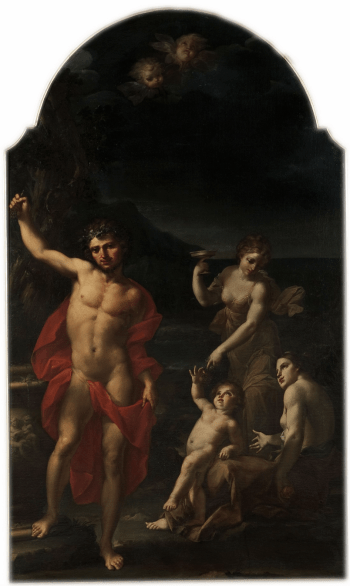
Giuseppe Marchesi, known as il Sansone, Autumn, from The Four Seasons, ca. 1725, oil on canvas (Bologna: Pinacoteca Nazionale).
This stylistic orientation was also supported and promoted by the city’s main artistic institution, the Accademia Clementina, to which Marchesi belonged, holding a variety of positions, didactic and directorial, until his appointment as Principe in 1752. His subsequent artistic evolution led him to the gradual abandonment of an Arcadian classicism in favor of an almost Mannerist style, similar to that of Francesco Monti and Vittorio Maria Bigari. Marchesi’s biography, present only in the manuscript lives composed by the Bolognese scholar Marcello Oretti in the second half of the century, is missing in Luigi Crespi’s Felsina Pittrice (1739) and appears only marginally in the Storia dell ’ Accademia Clementina by Giampietro Zanotti (1739), who nevertheless recognized, along with Luigi Lanzi, Marchesi’s remarkable artistic qualities for “a manner of painting so beautiful and so strong, that all delight, and good, and great fame comes to him.”
Early on there was overlap between Marchesi’s work and that of his contemporary Ercole Graziani, so much so that at the 1935 Mostra del Settecento Bolognese, which marked the resurgence of interest in this period of local art history, many of the works now ascribed to Marchesi were attributed to Graziani. It was up to critic Renato Roli to make a brilliant first reconstruction of Marchesi’s oeuvre in 1971, distinguishing the hands of the two painters. Subsequent studies, conducted mainly by Antonella Mampieri and Angelo Mazza, expanded the catalogue of known paintings, adding specimens of graphics and engravings made from Marchesi’s drawings. The ability to blend warm colors and strong musculature, derived from the Carracci, with the Arcadian grace of drawing, typical of Franceschini’s painting, made Samson a fashionable painter, up to date with the post-Baroque trends that were already in vogue in France and Austria, appreciated by the public and his colleagues.
A prolific and garrulous petit maître, his lively narrative vein yielded extremely pleasing results, especially in his younger years. The culmination of this phase was the fresco decoration of the vault and apse of the church of Santa Maria di Galliera, in Bologna, Marchesi’s first great public commission (1732–44), which established his reputation as a painter at home, in other Italian regions, and in other European countries, including England and Holland.
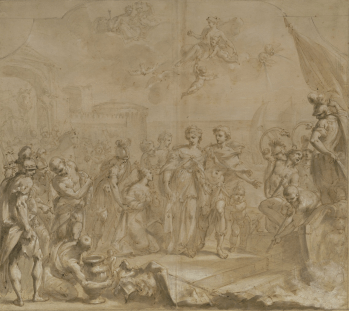
Giuseppe Marchesi, known as il Sansone, The Abduction of Helen, 1725 (Bologna: Collezioni d’Arte e di Storia della Cassa di Risparmio).
The exhibition, designed for the Collezioni Comunali d’Arte, which keeps in its permanent collection the painting Clement VIII Returning the Keys of the City to the Elders of Bologna, focuses on the early period of the artist’s elegant and graceful career: his relationship with Marcantonio Franceschini, who transmitted to him his moderate Arcadian taste, to 1725, the conventional starting point of Marchesi’s independent career. Two paintings recently found on the antiques market and exhibited here for the first time from a private collection—Moses and the Daughters of Jethro and Solomon Censoring the Idols, the success of which is demonstrated by the presence of copies at the Museo Diocesano in Imola—and other examples of paintings of sacred and profane themes demonstrate the artist’s youthful style. These include the Four Seasons from the Pinacoteca Nazionale in Bologna and The Drunkenness of Noah, now in a private collection. Completing the exhibition are a miniature Portrait of a Maiden preserved at the Museo Civico d’Arte Industriale and Galleria Davia Bargellini and two lively drawings from the the Fondazione Cassa di Risparmio in Bologna: The Abduction of the Sabine Women and The Abduction of Helen, preparatory projects for a large painting to be made in the hall of honor of the house that later belonged to the Buratti merchants, promoters of the arts and various Bolognese artists. Only the second one, dated 1725, was later realized by the painter, opening his documented career.
Leggiadro Barocco: L’attività giovanile di Giuseppe Marchesi detto il Sansone proposes a renewed reading of this protagonist of the Bolognese ’barocchetto’, allowing new hypotheses on the chronological ordering of his early work. The exhibition is accompanied by a publication edited by Antonella Mampieri and Angelo Mazza, with the collaboration of Silvia Battistini, a preface by Massimo Medica, text by Mirko Bonora, and essays by Antonella Mampieri and Angelo Mazza.
Exhibition | Louis XVI, Marie-Antoinette, and the Revolution
From the French National Archives and the Boutiques de musées:
Louis XVI, Marie-Antoinette, and the Revolution: The Royal Family at the Tuileries, 1789–1792
Archives Nationales / Hôtel de Soubise, Paris, 29 March — 6 November 2023
Curated by Isabelle Aristide-Hastir, Jean-Christian Petitfils, and Emmanuel de Waresquiel
 A period of almost three years separated the end of the ancien régime from the collapse of the French monarchy. Between 1789 and 1792, the royal family, forced to leave Versailles and its splendour, lived under house arrest in Paris, in the Tuileries Palace. Through archival documents, engravings, works of art, and pieces of furniture from the Tuileries, this tumultuous period is presented in the exhibition with a particular focus on the daily life of the royal couple, Marie-Antoinette’s secret correspondence with the Swedish Count Axel de Fersen, and the intimacy of a palace that has since disappeared.
Les Archives nationales éclairent d’un jour nouveau la période méconnue qui a suivi les événements de 1789. Cette exposition rassemble une centaine de documents, tableaux, gravures et plusieurs éléments de mobilier, et propose une immersion dans le quotidien de la famille royale, depuis son départ de Versailles pour les Tuileries jusqu’à la chute de la monarchie.
Comment la famille royale a-t-elle vécu la période de grande tension politique qui a suivi le déclenchement de la Révolution ? À quoi ressemblait la vie de la cour dans l’enceinte des Tuileries ? De quelle manière le roi et la reine ressentaient-ils le tumulte de la rue et la pression de l’opinion publique ? Autant de questions qui sont au cœur de l’exposition Louis XVI, Marie-Antoinette et la Révolution. La famille royale aux Tuileries, 1789–1792, présentée par les Archives nationales, à l’hôtel de Soubise, du 29 mars au 6 novembre 2023.
Riche en événements politiques, cet épisode de mille jours est bien représenté dans les archives et l’iconographie. Entre autres documents inédits ou méconnus, les visiteurs pourront ainsi découvrir le prAdolf Ulrik Wertmüller, Portrait de la reine Marie-Antoinette, vers 1785–1788. Marie-Antoinette est ici représentée dans une tenue d’intérieur. Le peintre suédois Wertmüller a aussi peint la reine en 1785 avec ses deux enfants dans le jardin de Trianon, et en 1788 en habit d’amazone. Collection particulièreé-cieux journal de Louis XVI (« Mardi 14 juillet : rien ») ouvert aux pages des années 1791–1792, son manifeste politique aux Français (20 juin 1791), un portrait de la reine très rarement exposé et la correspondance secrète entre Marie-Antoinette et le comte de Fersen. Pour la première fois, le contenu de leurs lettres codées, chiffrées et caviardées sera révélé au grand public. L’une des facettes les plus fascinantes de cette période fondatrice de l’histoire de France, marquée Lettre de Marie-Antoinette à Fersen (copie faite par Fersen), avec passages caviardés. Autographe, 26 septembre 1791par la fin d’un règne et la naissance d’un monde nouveau.
Isabelle Aristide-Hastir, Jean-Christian Petitfils, Emmanuel de Waresquiel, Lucien Bély, and Philip Mansel, Louis XVI, Marie-Antoinette et la Révolution: La famille royale aux Tuileries, 1789–1792 (Paris: Éditions Gallimard, 2023), 192 pages, ISBN: 978-2072974618, €30.
The cover of the catalogue comes from a print after Jean-Louis Prieur, Siege and Capture of the Château des Tuileries on 10 August 1792 / Siège et prise du château des Tuileries le 10 août 1792, ca. 1792 (Paris: Archives nationales, AE/II/3019).
New Book | Barnave: The Revolutionary
From Yale UP:
John Hardman, Barnave: The Revolutionary Who Lost His Head for Marie Antoinette (New Haven: Yale University Press, 2023), 416 pages, ISBN: 978-0300270846, $40.
 A major new biography of Antoine Barnave—the politician and writer who advocated for a constitutional monarchy in revolutionary France
Antoine Barnave was one of the most influential statesmen in the early French Revolution. He was a didactic man of austere morals and vaulting ambition who dressed as an English dandy, running up considerable tailor’s bills. Before his execution at age thirty-two, he played a decisive role in revolutionary politics and even governed France in 1791 through a secret correspondence with Marie-Antoinette. In the first biography for more than a century, John Hardman traces Barnave’s life from his youth in Dauphiné to his role in the Constituent Assembly and his part in forming the Feuillants, the party dedicated to the moderate cause. Despite his early death, Barnave left a remarkable volume of material, from published works to thousands of manuscript pages. Hardman uses this rich archive to explore the life of this elusive writer, politician, and thinker—and sheds new light on the revolutionary period.
John Hardman is one of the world’s leading experts on the French Revolution and the author of several distinguished books on the subject, including Marie-Antoinette and The Life of Louis XVI, which was shortlisted for the Elizabeth Longford Prize for Historical Biography and won the Franco-British Society Prize.
C O N T E N T S
Introduction
1 Reluctant Lawyer
2 The Origins of the French Revolution according to Barnave
3 Political Awakening: Barnave in the Pre-Revolution, 1787–89
4 The Assemblies at Romans: The Last Estates of Dauphiné
5 From Estates-General to National Assembly
6 The Decisive Phase, 14 July – 6 October 1789
7 The Year 1790
8 Barnave’s Private Life
9 Barnave and the Court before the Flight to Varennes
10 Barnave on the Defensive
11 Varennes and Its Repercussions
12 The Revision of the Constitution
13 Governing in Secret
14 The Return of the Native: January – August 1792
15 A Long Incarceration
16 Trial and Death
Conclusion
Endnotes
Bibliography
Index
Lecture | Michael Yonan on the Bavarian Rococo
This week in Chicago, at Northwestern:
Michael Yonan | The Bavarian Rococo, the Outlier of Eighteenth-Century Art
Block Museum of Art, Northwestern University, Evanston, Illinois, Wednesday, 17 May 2023, 5pm

Wieskirche, designed by the Zimmermann brothers, near Steingaden, Germany, 1745–55, view toward altar (Wikimedia Commons, 2019).
Bavarian rococo art and architecture has long received both attention and derision from art historians. It is incredibly sophisticated in design and seemingly totally out of sync with the broader narrative of European art: backward-looking, regionally influential, and exuberantly unrestrained in its abundant use of ornamentation. As part of the Warnock Lecture Series, this talk will explore what we can do with this visually arresting art and suggest that it deserves a firmer place in art history.
Michael Yonan is Professor of Art History and Alan Templeton Endowed Chair in the History of European Art, 1600–1830, at the University of California, Davis. His areas of research are eighteenth-century European art, the decorative arts, material culture studies, and art historical historiography and methodology. He is the author of Empress Maria Theresa and the Politics of Habsburg Imperial Art (2011), Messerschmidt’s Character Heads: Maddening Sculpture and the Writing of Art History (2018), and with Stacey Sloboda is co-editor of Eighteenth-Century Art Worlds: Global and Local Geographies of Art (2019). In 2022 he was visiting guest professor at the Institute for Culture and Aesthetics, Stockholm University, Sweden. He is currently writing a book on materiality in art history.
Online Conversation | Material Cultures of the Global 18th Century
Material Cultures of the Global 18th Century: Art, Mobility, and Change
HECAA Zoom Event, Wednesday, 17 May 2023, 6.30–8.00pm EST
 This upcoming Zoom event, sponsored by the Historians of Eighteenth Century Art and Architecture (HECAA), celebrates the publication of a new volume dedicated to global eighteenth-century material cultures. The editors, Wendy Bellion and Kristel Smentek, will offer remarks and invite conversation. There will also be presentations by select authors: Douglas Fordham, Yve Chavez, Matthew Gin, and Tara Zanardi.
This online event is open to all; HECAA membership is not required. Please register in advance here».
Wendy Bellion and Kristel Smentek, eds., Material Cultures of the Global Eighteenth Century: Art, Mobility, and Change (London: Bloomsbury Visual Arts, 2023), 288 pages, ISBN: 978-1350259034, $115. Also available as an ebook.
Exhibition | The Van de Veldes: Greenwich, Art, and the Sea

Willem van de Velde the Younger, A Royal Visit to the Fleet in the Thames Estuary, 1672, detail, 1672–94, oil on canvas, 165 × 330 cm (Greenwich: National Maritime Museum, BHC0299). More information is available here»
◊ ◊ ◊ ◊ ◊
Now on view at Greenwich:
The Van de Veldes: Greenwich, Art, and the Sea
Queen’s House, Greenwich, 2 March 2023 — 14 January 2024
Curated by Allison Goudie and Imogen Tedbury
In the winter of 1672–73, two celebrated Dutch artists arrived in London. Willem van de Velde the Elder (1610/11–1693) was renowned for his highly accurate drawings of ships and maritime life. He would even go to sea himself, paper in hand, to capture naval battles as they were raging. His son, Willem van de Velde the Younger (1633–1707), was a famed painter. From calm coastal scenes to fierce storms, his work captured the many moods of the ocean.

The Burning of the Royal James at the Battle of Solebay, 28 May 1672, tapestry designed by Willem Van de Velde the Elder, made by Thomas Poyntz, 1672 (Greenwich: National Maritime Museum).
King Charles II offered them a studio space at the Queen’s House in Greenwich and each a salary of £100 a year to create drawings and paintings of ‘Sea Fights’. Here they worked, creating magnificent paintings and tapestries, as well as thousands of detailed sketches, drawings, and designs. The National Maritime Museum has the largest collection of works by the Van de Veldes in the world, and now, 350 years on from their first arrival in England, the Queen’s House will once again become a home for these artists, whose work would inspire generations of marine painters, including J.M.W. Turner. The Van de Veldes: Greenwich, Art and the Sea follows the journey of these émigré artists and explores how they changed the course of British maritime art.
“The Van de Velde collection at Greenwich is remarkable not only for its sheer size but for what it reveals about how a 17th-century artist’s studio functioned,” says Dr. Allison Goudie, Curator of Art. “This exhibition celebrates this extraordinary aspect of the Van de Velde collection here, and the unique connection it now has with the Queen’s House, the location of the Van de Veldes’ studio for over 20 years.”
◊ ◊ ◊ ◊ ◊
Note (added 8 October 2023) — The posting was updated to include Dr. Goudie and Dr. Tedbury as the curators of the exhibition.
Conference | The Power of Flowers, 1500–1750
From ArtH.net and the conference website:
The Power of Flowers, 1500–1750
Museum voor Schone Kunsten, Ghent, 14–15 June 2023
Organized by Jaya Remond and Catherine Powell-Warren
Flowers and fruits have been mobilized as expressions of power and counter-power since long before the poet Allen Ginsberg coined the slogan ‘Flower Power’ in 1965 to encourage nonviolent protest, and Hippies in San Francisco’s Haight-Ashbury area weaved flowers in their hair. In the newly founded Dutch Republic, the house of Orange-Nassau relied on the orange not only as a short-hand for its name, but also a signifier of the trading empire it developed. Sultan Süleiman the Magnificent was known for his taste in gardens and incorporated flowers in his official insignia (Tughra), a complex work of calligraphy conveying the power and legitimacy of his rule. During the early modern (re)discovery of nature, flowers and their fruits (local and foreign) offered unique promises for profit while their pictorial representations promoted their commercial potential and could also stand as artistic objects. This interdisciplinary conference aims to investigate how flowers and the fruits they produce represented power in a myriad of ways in the early modern world. The speakers will address the function of flowers—including the flowering process, culminating in fruit—as tools of political, religious, or commercial power, as instruments of global and local knowledge transfer and appropriation, as well as their role in art-making, science, and the construction of gender from around 1500 to 1750.
The conference will take place in person at the Museum of Fine Arts, Ghent; presentations will not be live-streamed or recorded. Conference registration is required. The registration fee of 20 euros (10 euros for students) includes two lunches and a reception following the keynote address. The conference is organized by Prof. dr. Jaya Remond, Assistant Professor of Early Modern Art History at Ghent University, and Dr. Catherine Powell-Warren, FWO Postdoctoral Researcher in Art History at Ghent University. For any practical questions, please contact Lien Vandenberghe (lien.vandenberghe@ugent.be) or Lisa Schepens (l.schepens@ugent.be).
W E D N E S D A Y , 1 4 J U N E 2 0 2 3
9.00 Registration and Coffee
9.30 Welcome Remarks
9.45 Far Removed from the Hortus Conclusus: Women Harnessing Flowers and Power, Part I
• Zara Kesterton (Cambridge) — Flower Girls: Pastoralism, Fashioning, and Gender Politics in 18th-Century France
• Lucia Querejazu Escobari (Zurich) — A Rose from Lima and Kantutas for Pomata: Saint Rose of Lima, Our Lady of Pomata, and the Construction of the Symbolical Garden of the Colonial Andes
11.00 Coffee Break
11.15 Far Removed from the Hortus Conclusus: Women Harnessing Flowers and Power, Part II
• Henrietta Ward (Cambridge) — Exchanging Seeds: Agnes Block and Her Flower Drawings
• Bożena Popiołek and Anna Penkała-Jastrębska (Krakow) — The Private Garden as a Symbol of Innovation and Power at the Noble Women’s Courts in Polish-Lithuanian Commonwealth in the First Half of the 18th Century
12.30 Lunch Break
14.00 Philosophy and Medicine: The Intrinsic Power of Flowers & Fruits, Real and Imagined, Part I
• Fabrizio Baldassarri (Venice) — The Silence of the Lambs: Sensitive and Vegetative Powers in Plantanimals
• Océane Magnier (Tours) — Violet Powder: The Perfume of the Flower and the Scent of the Iris
15.15 Coffee Break
15.30 Re-Centering the Garden: The Garden as a Backdrop for Memory, Art, and Networking
• Arjan van Dixhoorn (Utrecht) — Re-Centering the Garden in Philosophical Life: Hondius’s Dapes inemptae of 1618/1621
• Tine L. Meganck (Brussels) — Bruegel’s Spring Garden as Mastery of Nature
• Klara Alen (Antwerp) — From Rubens’s Garden to The Swan Inn: Tulips and Trust in Early Modern Antwerp
17.30 Keynote Address
• Claudia Swan (St Louis) — Handling Flowers in Early Modern Europe: A Florilegium of Gestures
18.45 Reception
T H U R S D A Y , 1 5 J U N E 2 0 2 3
9.30 Trading, Exchanging, and Controlling Plants and Flowers, Part I
• Philippe Depairon (Kyoto) — New Flowers in Old Yamato
• Elena Falletti (Castellanza) — How Botanical Gardens Helped to Shape International Law
10.45 Coffee Break
11.00 Trading, Exchanging, and Controlling Plants and Flowers, Part II
• James M. Córdova (Boulder) — Art in Bloom: The Polysemy of Flowers in Colonial Mexican Visual Culture
• Daniel Margócsy (Cambridge) — The Flowers of St Thomas: Colonial Botany and the Hortus malabaricus, c. 1680
12.15 Lunch Break
13.30 Philosophy and Medicine: The Intrinsic Power of Flowers & Fruits, Real and Imagined, Part II
• Anna Svensson (Uppsala) — Arvid Månsson’s Örta-Book: Translating Medicinal Plant Knowledge in 17th-Century Sweden
• Dominic Olariu (Marburg) — Herbal Books at Court as a Gesture of Medical Erudition and Medical Providence
14.45 Coffee Break
15.00 Paper Plants and the Epistemic Power of Flower Imagery, Part I
• Clio Rom (Springdale, Arkansas) — On Being Planted and Portrayed: Horticulture and Floral Imagery in Seicento Rome through the works of Anna Maria Vaiani
• Lara de Mérode (Brussels) — Hortus floreus Archiducis Leopoldi or the Power of Flowers at the Service of the Archduke Leopold Wilhelm (1614–1662)
16.15 Paper Plants and the Epistemic Power of Flower Imagery, Part II
• Sheila Barker (Philadelphia) — Giovanni Battista Ferrari’s “Flora, overo Cultura dei fiori” (1638)
• Katherine M. Reinhart (Broome County, New York) — Painting Plants, Engraving Gloire
17.30 Concluding Remarks
Symposium | Dutch and Flemish Drawings, 1500–1800

Rembrandt van Rijn, Landscape with Canal and Boats, ca. 1652–55, pen in brown ink with brown wash on paper, framing lines in brown ink, 10 × 20 cm (The University of North Carolina, Chapel Hill, Ackland Art Museum, Peck Collection, 2017.1.67). From The Peck Collection: “In 2017 the Ackland Art Museum . . . received its largest gift to date. Donated by UNC alumnus Dr. Sheldon Peck and his late wife Leena, the gift included 134 largely seventeenth- and eighteenth-century Dutch and Flemish drawings as well as a generous endowment to support a new curator of European and American art before 1950, future acquisitions, exhibitions, educational materials, and public programming related to the collection.”
◊ ◊ ◊ ◊ ◊
From ArtHist.net:
Making, Collecting, and Understanding Dutch and Flemish Drawings, 1500–1800
Rijksmuseum, Amsterdam, 1–2 June 2023
The Peck Drawings Symposium celebrates Old Master drawings on the occasion of the exhibition The Art of Drawing: Master Drawings from the Age of Rembrandt in the Peck Collection at the Ackland Art Museum, on view in Amsterdam at the Rembrandt House Museum (18 March – 11 June 2023).
Research in early modern Dutch and Flemish drawings touches on a wide variety of issues, including the study of materials and techniques; issues of attribution and oeuvre cataloguing; and expanding our understanding of the provenance, collecting, and display of works on paper. This symposium offers scholars a chance to come together to present and discuss recent research in this specialized field, which now evolves to encompass new methodologies and concerns.
Registration is available here»
T H U R S D A Y , 1 J U N E 2 0 2 3
9.00 Registration, with Coffee and Tea
9.30 Welcome Remarks
9.45 Session 1
• The Case of Pieter Vlerick: A Netherlandish Draughtsman’s ‘Many Beautiful Views of the City on the Tiber’ — Stijn Alsteens (Christie’s)
• (Re)Introducing Jan Snellinck (1544/49–1638) as a Draughtsman — Maud van Suylen (Rijksmuseum)
• Drawings Made to be Engraved: Paul Vredeman de Vries and Claes Jansz. Visscher — Peter Fuhring (Fondation Custodia, Frits Lugt Collection, Paris)
• A Helmet Design by Johannes Lutma the Elder? — Reiner Baarsen (Rijksmuseum)
11.05 Coffee and Tea
11:35 Session 2
• The Portable Studio: Navigating the Early Netherlandish Sketchbook — Daantje Meuwissen (Vrije Universiteit, Amsterdam)
• Deconstructing the Antique: The Ornamental Language in the Sketchbook of the Cornelis Anthonisz. Workshop — Oliver Kik (Royal Institute for Cultural Heritage in Brussels (KIK-IRPA)
• Playground and Repository: Maarten van Heemskerck’s Roman Sketchbook — Tatjana Bartsch (Bibliotheca Hertziana, Rome)
• Fresh Eyes on Old Sketchbooks: Revisiting the Content and Function of 17th-Century Dutch Sketchbooks — Yvonne Bleyerveld (RKD Netherlands Institute for Art History, The Hague/Leiden University)
13.00 Lunch
14.00 Session 3
• Making the Invisible Visible: New Digital Technologies in the Study of Drawings — Thomas Ketelsen and Carsten Wintermann (Klassik Stiftung Weimar)
• Local Landscapes on Paper from Afar: The Connoisseurial Relevance of Washi in the Drawn Oeuvres of Dutch Artists — Sanne Steen (Erasmus University, Rotterdam)
• Hunting Moldmates of 17th-Century Dutch Drawings — C. Richard Johnson, Jr. (Utrecht University)
• Rembrandt’s Drawings: The Cut — Birgit Reissland (RCE – Cultural Heritage Agency of the Netherlands, Amsterdam)
15.20 Coffee and Tea
15.50 Session 4
• Aert Schouman’s Animal Drawings in Teylers Museum — Marleen Ram (Teylers Museum, Haarlem)
• Beyond Academies: The Inaugural Drawing Session at Felix Meritis in 1789 — Charles Kang (Rijksmuseum)
• Life on Paper: New Insights into the Drawing Practice of Christina Chalon (1749–1808) — Austėja Mackelaitė (Rijksmuseum)
17.30 Exclusive visit to the Rembrandt House Museum to view the Peck Collection exhibition
F R I D A Y , 2 J U N E 2 0 2 3
8.00 Exclusive visit to the Vermeer exhibition at the Rijksmuseum
9.00 Coffee and Tea
9.45 Session 5
• The Less Well-known Side of Andries Both as a Draughtsman — Jane Shoaf Turner (Master Drawings; formerly Rijksmuseum)
• ‘Alle de posturen, die de soldaten in ‘t hanteren van hare wapenen behoren te gebruycken’: Jacques de Gheyn’s Drawings for The Exercise of Arms For Calivers, Muskettes, and Pikes — Susanne Bartels (University of Geneva)
• The Drawing Oeuvre of Pieter Quast (c.1605–1647): An Assessment — Jochai Rosen (University of Haifa)
• A Sea of Drawings: The Van de Veldes at the Queen’s House, Greenwich — Allison Goudie, Emmanuelle Largeteau and Imogen Tedbury (Royal Museums, Greenwich)
11.05 Coffee and Tea
11.35 Session 6
• Wallerant Vaillant (1623–1667): A Dutch Artist in the Vienna Collection of Prince Dmitry M. Golitsyn — Catherine Phillips (Independent Scholar)
• The Bookseller and Publisher Isaac Tirion and His Collection of Drawings — Everhard Korthals Altes (Delft Technical University)
• Johann Friedrich von Uffenbach (1687–1769) as Collector of Drawings — Anne-Katrin Sors (Göttingen University)
• Rediscovering Pieter de Hooch: 18th-Century Dutch Reproductive Drawings and the Auction Market — Junko Aono (Meiji Gakuin University, Tokyo)
13.00 Lunch
14.10 Session 7
• On the 17th-Century Reception of Pieter Saenredam’s Drawing Practice — Lorne Darnell (Courtauld Institute)
• Material Sympathies: Paper as Water in 17th-Century Dutch Landscape Drawings — Sarah W. Mallory (Harvard University)
• Still a Hot Case: Reconsidering the ‘Du-Gardijn’ Inscriptions — Annemarie Stefes (Independent Scholar)
• Copious Copies: On the Trail of a Drawing Practice and Its Aesthetic and Material Implications — Christien Melzer (Kupferstichkabinett, Berlin)
15.30 Coffee and Tea
16.00 Final Session
• TBA
17.00 Drinks and Appetizers
Conference | The Dutch Museum of Freemasonry
From ArtHist.net:
‘A Heritage Collection, Unparalleled in the World’: An Introduction to the Dutch Museum of Freemasonry
The Hague, 25 May 2023
Registration due by 22 May 2023

The Vrijmetselarij Museum / Dutch Museum of Freemasonry. Designed by the architects A.P. Smits and J. Fels., the building was constructed in 1908 for the furniture manufacturer Harmen Pander. (Photo: Wikimedia Commons, September 2010).
Freemasonry is one of the oldest social networks in the world. It has been active in the Netherlands since 1721 and is distinguished by a remarkable ritual tradition. For over three centuries the initiation society produced an impressive cultural heritage. Through strict collection policy, this earned a museum status in the middle of the 19th century under the rule of Grand Master Prince Frederick (1797–1881) and subsequently grew into a heritage collection of (inter)national importance. The Vrijmetselarij Museum or Dutch Museum of Freemasonry is located in The Hague.
The museum consists of three interlinked collections: historical archives, scientific library (including the famous Bibliotheca Klossiana, acquired by Prince Frederick), and historical objects. The collection not only reflects the development of freemasonry, its tolerant ideas, and ritual tradition. It also documents 300 years of the social, political, and cultural history of the Netherlands and its international contacts, as well as the lives and works of 70,000 members. From the history of Western expansion to the emancipation of women, from art history to gender studies, the collection is a gold mine for researchers from all disciplines within the humanities.
The Dutch Museum of Freemasonry is internationally renowned amongst academic researchers, although it is less well known to the wider Dutch public. Ample reason therefore exists to put this best kept ‘secret’ in The Hague in the spotlight with an international conference. Experts from different countries and disciplines will discuss the founding of the collection and its relevance as heritage of international calibre, with lectures in English. A special guest speaker from America (via Zoom) is Dr. Margaret Jacob, author of The Radical Enlightenment and Living the Enlightenment. She consulted the Dutch lodge archives for her groundbreaking research. This conference provides a unique introduction to a collection that has been preserved in The Hague for more than 150 years, and which should continue to be cherished in the future.
The event will be held at the Carlton Ambassador Hotel in The Hague, which is conveniently located near the Dutch Museum of Freemasonry, and another significant venue: the lodge rooms designed by Karel de Bazel in 1916. These rooms, which were created by the renowned architect, Freemason, and Theosopher, are now a protected monument and part of the Beeld & Geluid Den Haag building complex. Guided tours of the museum and the lodge rooms will be organized for participants.
The conference is open to students, researchers, and heritage professionals, as well as to lodge members and anyone with a love of history or cultural heritage. Advance registration is required, and availability is limited. Participation fee: €75 regular rate / €50 OVN donors / €35 students (please enclose a copy of your student ID). The fee covers coffee, tea, and drinks at the closing reception, along with a copy of the conference publication and tours. To register, please email info@stichtingovn.nl. After sending your email, you will receive a registration form and additional information. Places will be allocated on a first-come, first-served basis, and will be confirmed only upon receipt of payment.
Preliminary conference program, 9.30–18.00
• Opening by Vera Carasso, Director Dutch Museums Association
• The Dutch Museum of Freemasonry and the Study of Humanities (via Zoom) — Margaret C. Jacob, Professor Emerita, Department of History, UCLA
• From 18th-Century Club Archive to National Heritage: The Dutch Museum of Freemasonry — Andréa Kroon, Kroon & Wagtberg Hansen / Guest Curator Vrijmetselarij Museum, Den Haag
• The Kloss Library: A Goldmine for Researchers — Jan Snoek, Professor of Ritual and Religious Studies, University of Heidelberg
• Archive, Library, Objects: The Unique Hybrid Nature of Masonic Collections — Martin Cherry, Librarian of the Museum of Freemasonry, London
• Western Esotericism and the Dutch Museum of Freemasonry (via Zoom) — Henrik Bogdan, Professor of Religious Studies, Department of Literature, History of Ideas, and Religion, University of Göteborg
• Egyptology and Freemasonry: An Example of Interdisciplinary Research Opportunities — Eugène Warmenbol, Professor Emeritus, Department of History, Art, and Archaeology, Université libre de Bruxelles
• Freemasonry and the Study of Religion: Opportunities for Collaboration — Ab de Jong, Scientific Director of the Leiden Centre for Religious Sciences
• From Private to Public Collections: The Future of Masonic Museums — Andrew Prescott, Digital Humanities Department, Glasgow University
At Bonhams | Watches and Wristwatches

Lot 55: Joseph Martineau, Senr, London, gold and ruby-set key wind triple case pocket watch with shagreen outer case (441 individually set rubies), ca. 1760 (estimate: £20,000–30,000). Note (added 16 May 2023) — it sold for £48,180, as noted by the post-sale press release via Art Daily.
◊ ◊ ◊ ◊ ◊
From the press release for the sale:
Watches and Wristwatches
Bonhams, London, 11 May 2023
Bonhams Watches and Wristwatches sale on 11 May will offer staple designs from names including Rolex, Patek Philippe, Audemars Piguet, and IWC, along with a significant single-owner collection of exquisite 17th- and 18th-century pocket watches. The 14 pocket watches, come from the collection of T. P. Camerer Cuss, renowned for his discerning eye for special timepieces. Included are designs by the father of English clockmaking Thomas Tompion (1639–1713), alongside works by George Graham and Joan Dellavos.
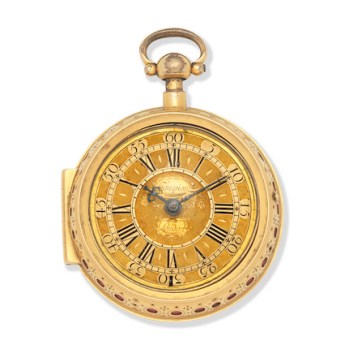
Lot 58: Thomas Tompion, 18K gold and gilt metal key wind quarter repeating pair case pocket watch, London Hallmark for 1709–10. It appears to have been made for Mary Montagu, Duchess of Montagu (1689–1751), daughter of the 1st Duke of Marlborough (estimate: £20,000–30,000).
Penelope Andrews, Bonhams Head of Watches in London, said: “It’s a privilege to offer such a significant collection of early pocket watches from the esteemed Camerer Cuss Collection in the Knightsbridge sale. The timepieces represent some of the leading names of watchmaking including Tompion and Graham. The watches are truly works of art; they transcend from being simply a watch into exceptional decorative pieces. We look forward to presenting the outstanding horological selection to our clients.”
Leading the sale is a fine and rare 18K gold and gilt metal key wind quarter repeating pair case pocket watch by esteemed maker Thomas Tompion (Lot 58, estimate: £20,000–30,000). Tompion was known for his exceptional designs and high society patrons, creating arguably some of the world’s greatest clocks. The watch on offer, from around 1709, represents an important quarter repeating watch of the highest quality; it is one of the earliest surviving with jewelled bearings and diamond end stones for the balance, complete with a beautiful watch dial featuring a central cherub and garland cartouche design. The timepiece was made for Mary, Duchess of Montagu (1689–1751), as indicated by the cypher ‘MM’ on the outer case below the coronet; it is believed to be one of only three watches that Tompion made for a female.

Lot 59: George Graham. 18K gold key wind repeating pair case pocket watch with repousse decoration. London Hallmark for 1718–19. Pierced and engraved outer case with repousse depicting Hercules being led, possibly by Hermes, to Cerberus with four embossed shells to the quarters depicting busts of classical figures (estimate: £15,000–20,000).
A fine and rare 18K gold key wind repeating pair case pocket watch with repousse decoration by George Graham, ca. 1718, is also included in the sale (Lot 59: estimate: £15,000–20,000). Featuring a finely produced repousse outer case depicting Hercules being led by a figure in classical armour, the watch is an exquisite example of the art of watchmaking and the art of the goldsmith from an esteemed maker rarely seen on the market. Also on offer is a Joan Dellavos fine and rare gold key wind open face pocket watch, ca. 1765, with a striking enamel scene depicting Venus blindfolding Cupid set within a decorative cartouche surround (estimate: £15,000–20,000).
Outside of the Camerer Cuss Collection, another important lot is a Joseph Martineau, fine and rare gold and ruby-set key wind triple case pocket watch with a shagreen outer case made in about 1760. It includes 441 individually set rubies forming a radiating circle to the back and bezel of the middle case and further decoration to the white enamel dial (Lot 55: estimate: £20,000–30,000).
Other Highlights from the T. P. Camerer Cuss Collection
• A William Snow fine and rare silver and leather key wind pair case pocket watch with pin decoration. The watch, ca. 1670, has a silver dial with a central engraved rosette, and the decorative pin work on the back of the leather covered outer case features exuberant floral designs. Offered with an estimate of £12,000–18,000.
• A John Snow silver key wind pair case ‘puritan’ pocket watch, ca. 1640. The early design was fashionable between 1630 and 1660 and features a silver dial along with an early method of fitting the crystal ‘glass’ held in place by tags around the underside of the bezel. Offered with an estimate of £12,000–15,000.
Additional Sale Highlights
• Rolex Cosmograph Daytona, reference 16523, ca. 1999. The stainless steel and 18K gold automatic chronograph bracelet watch has a sunburst champagne and diamond set dial. Offered with an estimate of £12,000–18,000.
• Rolex Submariner ‘Kermit’, stainless steel automatic calendar bracelet watch, reference 16610, ca. 2004. The special edition submariner with a green and black dial is offered with an estimate of £10,000–15,000.
• IWC limited edition 18K rose gold automatic calendar wristwatch, ca. 2015. The big pilots watch ‘Le Petit Prince’ with sunburst blue dial is offered with an estimate of £8,000–12,000.










 Enfilade
leave a comment