New Book | Shakespeare, Hogarth & Garrick
Happy Shakespeare Day! . . . Distributed by Paul Holberton Publishing and The University of Chicago Press:
Robin Simon, Shakespeare, Hogarth, and Garrick: Plays, Painting and Performance (London: Hogarth Press,, 2023), 256 pages, ISBN: 978-1913645441, £55 / $65.
 In London in 1770 Georg Christoph Lichtenberg (1742–1799) remarked, “What a work could be written on Shakespeare, Hogarth and Garrick! There is something similar in the genius of all three.” Two-and-a-half centuries on, Robin Simon’s highly original and illuminating book takes up the challenge.
William Hogarth (1697–1764) and David Garrick (1717–1779) closely associated themselves with Shakespeare, embodying a relationship between plays, painting, and performance that had been understood since Antiquity and which shaped the rules for history painting drawn up by the Académie royale in Paris in the seventeenth century. History painting was considered the highest form of art: a picture illustrating a moment drawn from just a few lines in a revered text. Hogarth’s David Garrick as Richard III (1745) transformed those ideas because, although it looked like a history painting, it was also a portrait of an actor in performance. With it, Hogarth established the genre of theatrical portraiture, a new and distinctively British kind of history painting. This book offers a fresh examination of theatrical portraits through close analysis of the pictures and of the texts used in performance. It also examines the central role of the theatre in British culture, while highlighting the significance of Shakespeare, Hogarth, and Garrick in the European Enlightenment and the rise of Romanticism. In this context another trio of genius features prominently: Lichtenberg, Gotthold Ephraim Lessing, and Denis Diderot. Familiar paintings and performances are seen in an entirely new light, while unfamiliar pictures are also introduced, including major paintings and drawings that have never been published. The final chapter shows that the inter-relationship between plays, painting, and performance survived into the age of cinema, revealing the pictorial sources of Laurence Olivier’s legendary film Richard III.
Robin Simon FSA is Editor of The British Art Journal and author of the acclaimed Hogarth, France, and British Art: The Rise of the Arts in Eighteenth-Century Britain (2007). He is Visiting Professor in the Department of English, University College London, and Professorial Research Fellow in the History of Art at Buckingham University.
Exhibition | Rear View
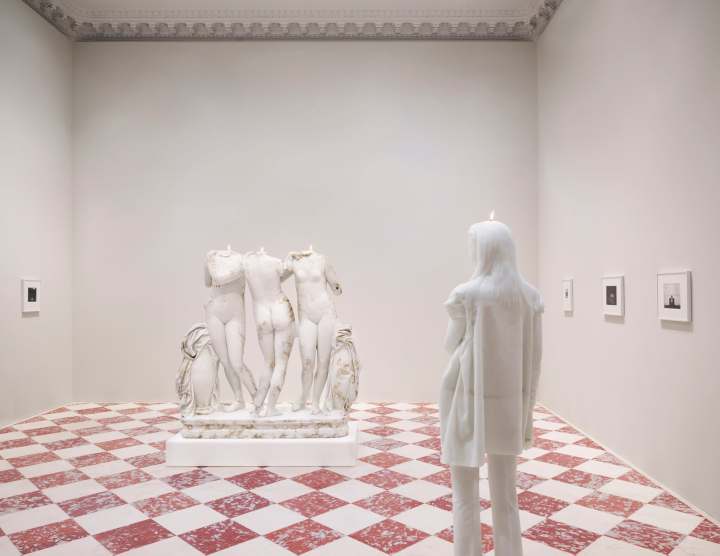
Urs Fischer, Divine Interventions, 2023, wax, based on the Metropolitan Museum of Art’s Roman sculpture The Three Graces (second century CE), with a wax portrait in the foreground of Pauline Karpidas, the contemporary art patron who once owned the ancient work. Installation view of a gallery at LGDR, 2023.
◊ ◊ ◊ ◊ ◊
It’s not an eighteenth-century show, but I’m left wishing that it were: an exploration of where classicism(s) and Romanticism meet, with Rococo impulses in-between. The emotional tenor of works varies widely; Carrie Mae Weems’s photographs strike me as especially powerful. See Jason Farago’s review for The New York Times (20 April 2023). –CH. From the press release for the exhibition:
Rear View
LGDR, New York, 18 April — 1 June 2023
Spanning two floors of LGDR’s landmark Beaux-Arts-style townhouse, Rear View presents a transhistorical selection of over sixty paintings, sculptures, works on paper, and photographs that explore representation of the human figure as seen from behind—an enduring, wide-ranging paradigm that has exerted potent influence upon modern and contemporary artists. In addition to rare twentieth-century masterworks by Félix Vallotton, Edgar Degas, René Magritte, Francis Bacon, Egon Schiele, Paul Cadmus, Aristide Maillol, and others, Rear View brings together seminal works by a diverse group of living artists spanning generations.
Long before the term Rückenfigur was popularized in the nineteenth century by Caspar David Friedrich, painters and sculptors from as far back as antiquity deployed the human figure seen from behind as a conceptual and formal device. Rear View provides a lens onto this specific genre as it pertains to artists’ desire to capture a range of human states and emotions—contemplation, longing, voyeurism, refusal, fetishism, and defiance—while drawing our attention to the act of looking itself and to the viewer’s role in constructing meaning and identity.
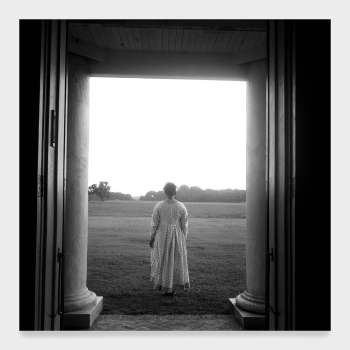
Carrie Mae Weems, Passageway II, 2003 (Jack Shainman Gallery, New York and LGDR).
Many contemporary artists have engaged the Rückenfigur trope, deliberately harnessing its critical potential. In one of the most compelling examples, Carrie Mae Weems has photographed herself in canonical landscapes and charged historical sites over many years, as a means of addressing complex issues around race, gender, and class, while also subjecting the signature paradigm of Romanticism to radical, politicized revision.
From the idealized bodies celebrated in Hellenistic sculpture to the bathers glimpsed in snapshot-like paintings and drawings by Impressionists and early modernists, images of nude bodies portrayed from behind have been integral to the unfolding story of figuration in the West. Urs Fischer directly quotes the Classical origins of this art historical paradigm in a monumental new candle sculpture made specifically for Rear View. Divine Interventions (2023) reprises one of the Metropolitan Museum of Art’s Roman marble Three Graces (second century CE), turning the trio of iconic feminine paragons, Aglaia (Beauty), Euphrosyne (Mirth), and Thalia (Abundance), into ephemeral forms cast in wax. Admiring this sculptural group—and in essence joining the Graces—is a wax effigy of Pauline Karpidas, the legendary contemporary art patron who once owned the ancient work that the Met would come to acquire.
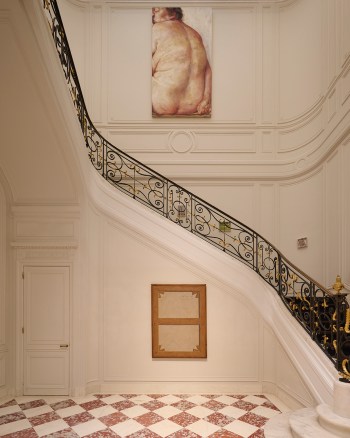
Installation view of Rear View at LGDR with work by Jenny Saville, Juncture (1994), top, and Domenico Gnoli, Back View (1968), below (Photo by Jason Schmidt).
The eroticism of ‘rear view’ images emerges not only from the frisson of nudity—the iconography of the human derrière emerges as a whole transhistorical subject onto itself—but from the narrative implication of intimacy between the depicted subject and the artist, the viewer’s fantasizing gaze and the sensuousness of the image on canvas. The trope of the mirror, the ritual of bathing, and the lounging or sleeping body are typical rear view scenarios taken up by artists across the centuries—from Edgar Degas to René Magritte, from Félix Vallotton to Barkley L. Hendricks, through to our present day. Fernando Botero’s painting The Bathroom (1989) features a woman, at once monumental and delicate, gazing at herself in the mirror, wearing only heels and a headband. The figure’s unselfconscious posture suggests she is unaware of the artist, invested only in herself.
By contrast, John Currin’s Nude in a Convex Mirror (2015) looks over her shoulder, presumably at the painter who is depicting the curves of her accentuated buttocks—but also at the viewer observing the action. The subject of Paul Cadmus’s ca. 1965 crayon drawing Standing Male Nude (NM 48) likewise peeks over his shoulder at the artist and the viewer, but with a loaded glance and flirtatious pose—one foot ever so slightly lifted to reveal its sole—that encode a sexual charge of mutual male gazes into an otherwise classical image. Jared French, who was part of the homosocial circle of artists around Cadmus, are represented in the exhibition by emblematic, dreamlike paintings populated uniquely by idealized male figures. The performative signifiers of masculinity emerge as an important subtheme of Rear View, evident in Giorgio de Chirico’s hyper-stylized Gladiatori (1928), Francis Bacon’s tormented figure in Study for Portrait of John Edwards (1986), and Andy Warhol’s abstracted depiction of a butch man’s hind quarters.

John Currin, Nude in a Convex Mirror, 2015, oil on canvas, 42 inches.
In their foreclosure of a complete picture, turned figures such as Currin’s nude also signal fetishism, another theme explored in Rear View. A number of works in the exhibition illuminate ways in which contemporary painting has absorbed the cinematic motif of the rear view, translating the camerawork of film noir and Hitchcockian thrillers like Rear Window (1954) into paint on canvas or rich black-and-white photographic images. Eric Fischl and Danielle Mckinney, for example, draw upon our collective cinematic imagination in composing their deeply narrative scenes, often populated by mysterious figures shown from the back and seemingly unaware of being observed. By contrast, but with no less enigmatic intensity, Harry Callahan’s mid-century rear-view photographs of his beloved wife, Eleanor, testify to the impact of cinematic vision when personalized to a single, deceptively simple subject.
In this context, another thematic trope of Rear View manifests in the work of Edgar Degas. Second only to his images of ballet dances, Degas’s voyeuristic bathing scenes dominate his vast oeuvre. On view in the exhibition, the artist’s delicate 1889–92 pastel Femme se peignant depicts a young nude female, seen from behind, combing her raven-colored tresses over her head. Degas’s scopophilic gaze focuses on the model’s flowing mane—a visual and psychological effect echoed by Domenico Gnoli’s sumptuous large-scale canvas Curly Red Hair (1969), which lingers over the texture of auburn curls cascading down a woman’s back. Tightly cropped to the subject at hand and denying the identifying details of the figure, this painting reveals Gnoli’s seeming uninterest in the body, except as a support for signifying ornament.

Félix Vallotton, Étude de fesses / Study of Buttocks, ca. 1884, oil on canvas, 38 × 46 cm (Private Collection).
The fragmented, fetishized human body emerged as a loaded trope in art history, according to esteemed feminist scholar Linda Nochlin in her study The Body in Pieces: The Fragment as a Metaphor of Modernity (1994). Spurred by the violence and social upheaval of the French Revolution, Nochlin notes, artists began to systematically deploy radical spatial cropping as well as isolating specific body parts, in order to explore the specific conditions of modern urban life—alienation, desire, suffering, obsession, ambiguous anonymous experiences. Nochlin’s observations find a contemporary echo in Issy Wood’s intimate canvas on view in the exhibition: Health and Hotness (2018) shows only the muscular back and bottom of a swimmer framed by her purple bathing suit. Wood’s enigmatic image is also a meditation on the impact of compressed and splitting planes and shapes—a study of the body as an abstraction.
Political refusal and personal irreverence also figure into art historical manifestations of the rear view. Six photographs from Anselm Kiefer’s polemical 1969 series Occupations (Besetzungen) take up this political mantle. In this series, the young artist photographed himself—often shown from behind, mimicking the heroic stance of Friedrich’s Rückenfigur—performing the Nazi salute in front of European monuments and natural sites. Of the series, controversial then as now, art historian Benjamin Buchloh remarked that it is “a real working through of German history. You have to inhabit it to overcome it.”
“String bottoms together in place of signatures for petition of peace.” This is how Yoko Ono described her infamous Film No. 4 (Bottoms) (1966–67)—an 80-minute montage of 365 human bottoms, featuring different genders, races, and body types. Marshaling her conceptual Fluxus rigor and sly humor into a powerful political protest against the Vietnam War, Ono’s provocative film retains its antiwar bite as well as its universalizing humanism today.
In the diptych that Francesco Clemente created for Rear View, Gold on Green, Green on Gold (2023), the artist slyly questions the front/back logic that underpins the exhibition as well as the binary thinking that governs so much of Western culture. Using gold leaf and a radically reduced palette, Clemente portrays ambiguous, gender-indeterminate figures that appear to be engaged in oral sex. The artist muses, “Maybe our mistaken ideas—based on duality, based on ‘us against them’—begin with the fact that we can only see half of what there is. We can only face one direction. We feel incomplete because we can never see completely ourselves. Painting may repair that, offering a vision of totality.”
As a pendant presentation to Rear View, Full Frontal (exhibited on the gallery’s second floor) explores the opposite art historical trope: frontal nudity. As the idiom of the title suggests, debates around moral propriety and censorship in art and popular culture often ascribe a confrontational value to front-facing nudes. While the naked body has always been present in visual culture, shifting social values have influenced representational approaches to the subject. Featured in Full Frontal are works by Miriam Cahn, Jenna Gribbon, and Barkley L. Hendricks, among others.
New Book | Environment, Society, and The Compleat Angler
Coming in June from Penn State UP (Walton’s text appeared in multiple editions throughout the eighteenth century) . . .
Marjorie Swann, Environment, Society, and The Compleat Angler (University Park: The Pennsylvania State University Press, 2023), 268 pages, ISBN: 978-0271095196, $125.
 First published in 1653, The Compleat Angler is one of the most influential environmental texts ever written. Addressing a politically and religiously polarized nation devastated by warfare, disease, ecological degradation, and climate change, Izaak Walton’s famous fishing treatise stages a radical thought experiment: how might humanity’s enhanced relationship with the natural world generate a new kind of sustaining—and sustainable—social order beyond the traditional boundaries of the church, the state, and the biological family?
Challenging the current scholarly consensus that reads Walton’s how-to manual as a conservative polemic camouflaged by fishlore, Marjorie Swann examines this richly complicated portrayal of the natural world through an ecocritical lens and explores other neglected aspects of Walton’s writings, including his depictions of social hierarchy, gender, and sexuality. In the process, Swann analyzes a host of noncanonical environmental texts and provides a groundbreaking reappraisal of Charles Cotton’s “Part II” of The Compleat Angler. This study extends the hydrological turn in early modern ecocriticism and demonstrates how, as a genre, angling manuals provide new insights into the environmental, cultural, social, and literary history of early modern England. Taking its place alongside landmark works of ecocriticism such as Green Shakespeare and Milton and Ecology, this fresh and timely reassessment of The Compleat Angler rightly ranks Izaak Walton among the most important environmental writers of the early modern era.
Marjorie Swann is Professor of English at Ottawa University. She is the author of Curiosities and Texts: The Culture of Collecting in Early Modern England and editor of a new critical edition of The Compleat Angler (Oxford University Press, 2014).
New Book | Versed in Living Nature: Wordsworth’s Trees
Marking Earth Day (with Arbor Day just around the corner, on April 28) . . . distributed by The University of Chicago Press:
Peter Dale and Brandon Yen, Versed in Living Nature: Wordsworth’s Trees (London: Reaktion Books, 2022), 256 pages, ISBN: 978-1789146448, $40.
 Verdant with illustrations, a meditation upon the rootedness of trees in Wordsworth’s writing and beyond.
This is the first book to address William Wordsworth’s profound identification of the spirit of nature in trees. It looks at what trees meant to him, and how he represented them in his poetry and prose: the symbolic charm of blasted trees, a hawthorn at the heart of Irish folk belief, great oaks that embodied naval strength, yews that tell us about both longevity and the brevity of human life. Linking poetry and literary history with ecology, Versed in Living Nature explores intricate patterns of personal and local connections that enabled trees—as living things, cultural topics, horticultural objects, and even commodities—to be imagined, theorized, discussed, and exchanged. In this book, the literary past becomes the urgent present.
Peter Dale lives in Essex. His previous books include The Irish Garden: A Cultural History. Brandon C. Yen divides his time between the United Kingdom and Taiwan. He is the author of ‘The Excursion’ and Wordsworth’s Iconography.
C O N T E N T S
Preface
1 Between the Royal Oak and the Liberty Tree
2 An Ash Tree in Cambridge
3 Yews and the Earth
4 Ways of Seeing
5 Gardens and Parklands
6 Peregrinations
7 Scotland, 1803
8 Burns Taking Root in Cumbria
9 A Voyage to Ireland
Epilogue
References
Further Reading
Acknowledgments
Photo Acknolwedgments
Index
Exhibition | In a New Light: Paintings from the YCBA
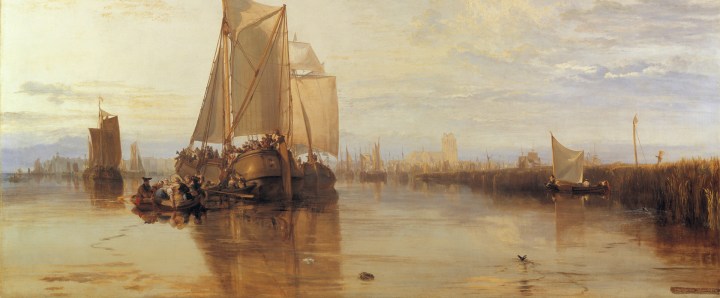
J. M. W. Turner, Dort or Dordrecht: The Dort Packet-Boat from Rotterdam Becalmed, detail, 1818, oil on canvas
(New Haven: Yale Center for British Art, Paul Mellon Collection)
◊ ◊ ◊ ◊ ◊
From the YCBA:
In a New Light: Paintings from the Yale Center for British Art
Yale University Art Gallery, New Haven, 24 March — 3 December 2023
More than fifty paintings from the Yale Center for British Art will be on view at the Yale University Art Gallery through December 3, 2023. The exhibition offers visitors the opportunity to engage with the YCBA’s collection while the museum is closed to the public for a building conservation project. The exhibition spans four centuries of British landscape and portraiture traditions, with works by Mary Beale, John Constable, Thomas Gainsborough, William Hogarth, Gwen John, Angelica Kauffman, George Stubbs, and Joseph Mallord William Turner, among others. Several of these paintings were on view at the Gallery in 2015, where they were featured in The Critique of Reason: Romantic Art, 1760–1860, the first major collaborative exhibition between the two Yale art museums.
In a New Light will occupy the special-exhibition galleries on the fourth floor of the Gallery’s Kahn building, which opened in 1953 and was the architect’s first significant commission and the first modernist structure on Yale’s campus. Directly across the street, Kahn’s final building, the YCBA, was completed after his death and opened to the public in 1977.
Exhibition | Léopold and Aurèle Robert
From the Musée d’art et d’histoire in Neuchâtel:
Léopold et Aurèle Robert. Oh saisons…
Musée des beaux-arts, La Chaux-de-Fonds / Musée d’art et d’histoire, Neuchâtel, 14 May — 12 November 2023
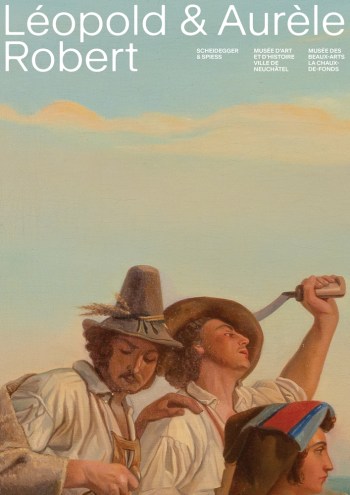 The Neuchâtel artist Léopold Robert (1794–1835), who enjoyed European acclaim during his lifetime, embodies the myth of the Romantic painter, doomed to a tragic fate and shrouded in mystery.
Educated in Paris at the École des Beaux-Arts and later in the studio of Jacques-Louis David, Robert moved to Italy in 1818. His genre paintings brought him great popular success during the first half of the 19th century but were less fulsomely received by the critics. The Musée d’art et d’histoire de Neuchâtel and the Musée des beaux-arts de La Chaux-de-Fonds have joined forces to pay tribute to the work of Léopold Robert and his brother Aurèle (1805–1871). The exhibition also re-examines Aurèle’s role, considering him not only as a ‘disseminator’ of Léopold’s oeuvre, but also as an artist in his own right. The joint exhibition focuses on Léopold Robert’s unfinished Seasons cycle and features works from both institutions as well as several prestigious loans. The exhibition in La Chaux-de-Fonds is given over to ‘Spring’, while Neuchâtel celebrates ‘Summer’ and ‘Winter’. The exhibition also explores how these masterpieces were produced and circulated, and examines their depiction of music, dance, and the beauty ideal. The exhibition is enriched by contributions from artist Gina Proenza that offer a direct, contemporary response to the historical works of Léopold and Aurèle Robert.
The catalogue (in French) is distributed by ACC Art Books:
David Lemaire and Antonia Nessi, eds., Léopold & Aurèle Robert (Scheidegger & Spiess, 2023), 240 pages, ISBN: 978-3858818874, £45.
◊ ◊ ◊ ◊ ◊
Note (added 26 October 2023) — The posting was updated to correct the dates of the exhibition (here originally given as 15 May — 15 October).
Call for Papers | Léopold Robert and Aurèle Robert
From the Call for Papers:
Frères d’art: Léopold et Aurèle Robert
Neuchâtel / La Chaux-de-Fonds, 9–10 November 2023
Proposals due by 31 May 2023 (extended from 14 May 2023)
Dans le cadre de l’exposition Léopold et Aurèle Robert présentée conjointement au Musée des beaux-arts de La Chaux-de-Fonds et au Musée d’art et d’histoire de Neuchâtel du 14 mai au 12 novembre 2023, l’Institut d’histoire de l’art et de muséologie de l’Université de Neuchâtel souhaite encourager la réflexion et l’échange d’idées à propos de ces deux figures artistiques à l’occasion d’un colloque international. Celui-ci se tiendra en présentiel le jeudi 9 novembre 2023 au Musée d’art et d’histoire de Neuchâtel, et le vendredi 10 novembre 2023 au Musée des beaux-arts de La Chaux-de-Fonds.
Graveur à ses débuts, encouragé à la peinture par son maître Jacques-Louis David, Leopold Robert développe, à partir des années 1820, une peinture de genre ennoblie à mi-chemin entre classicisme et romantisme. En y évoquant une vision idéalisée de l’Italie et de ses habitants, il séduit un important public européen nourri des écrits romantiques. Ses nombreuses commandes l’amènent rapidement à rationaliser sa production picturale selon des principes de déclinaison et de combinaison de motifs, et à solliciter l’aide de son cadet, Aurèle, dès 1822. Excellent dessinateur et peintre, Aurele Robert joue dès lors un rôle fondamental dans la promotion du travail de son frère. Du vivant de ce dernier comme après son décès tragique, Aurèle Robert assure, par la gravure, le dessin et la peinture, non seulement une large diffusion des œuvres de son aîné, mais en construit également la persona de créateur mélancolique et génial.
Afin d’enrichir les connaissances au sujet du travail de Léopold et Aurèle Robert, et d’encourager la recherche sur ces derniers, ce colloque international souhaite offrir un espace de débat en conviant aussi bien des jeunes chercheur.se.s que des chercheur.se.s avancé.e.s, et en invitant des spécialistes des questions évoquées. Les communications individuelles seront limitées à 30 minutes, celles en binôme à 40 minutes. Elles peuvent aborder les axes thématiques suivants mais sont également libres d’explorer d’autres pistes de réflexion :
• La fabrique picturale de Léopold et Aurèle Robert (pratiques d’atelier ; hiérarchie, statuts et rôles ; processus créateur, stratégies picturales, procédés compositionnels, rationalisation de la création)
• La peinture d’histoire et le regard ‘ethnographique’ de Léopold Robert (perception et normativité des corps ; idéalisation et genre ; fascination pour les costumes, objets, rites et musiques vernaculaires)
• L’intermédialité de l’œuvre et sa réception (diffusion multimédiale de l’œuvre peint; production d’œuvres falsifiées ou épigonales)
• Léopold et Aurèle Robert au prisme de leurs écrits (correspondance, carnets de voyage)
• Les réseaux et scènes artistiques et marchandes (amis, collègues, collectionneurs et mécènes, galeristes, etc.)
• Léopold et Aurèle Robert dans la presse et dans la littérature contemporaines
• La construction d’une figure artistique et le développement du culte de l’artiste (diffusion et promotion de l’œuvre ; mise en récit de la vie du peintre, etc.)
• Aspects mémoriels (tombeau vénitien de Léopold Robert et reliques de l’artiste, etc.)
• Aspects matériels des œuvres encore conservées, dans des perspectives de restauration ou d’attribution
Nous invitons toute personne désireuse de participer à ce colloque à soumettre une proposition de communication en français, allemand ou anglais. Les propositions doivent comprendre un titre, une esquisse de la communication (300 mots max.), et une brève biographie, et sont à envoyer sous forme de document PDF d’ici au 31 mai 2023 au courriel suivant: robert2023.iham@unine.ch. Les réponses seront communiquées début juin 2023.
Comité scientifique
Diane Antille (MAHN), Sarah Burkhalter (SIK-ISEA), Lisa Cornali (UNINE), Marie Gaitzsch (MBAC), Valérie Kobi (UNINE), David Lemaire (MBAC), Clara May (UNINE), Antonia Nessi (MAHN)
◊ ◊ ◊ ◊ ◊
Note (added 15 May 2023) — The due date has been extended from May 14 to May 31.
Research Lunch | Fionn Montell-Boyd on 18th-C Photography

David Allan, Lead Processing at Leadhills: Pounding the Ore, detail, 1780s, oil on canvas, 38 × 58 cm
(Edinburgh: National Galleries Scotland)
◊ ◊ ◊ ◊ ◊
From the Mellon Centre:
Fionn Montell-Boyd | Manufacturing Pictures: Photographic Experimentation at the End of the Eighteenth Century
Paul Mellon Centre for Studies in British Art, London, 5 May 2023, 1pm
In the decades before photography was announced to the public in 1839, a number of individual experimenters devised ways of using the light-sensitive properties of metallic salts to form images. This paper takes up two sets of investigations of particular significance, carried out between 1780 and 1802: those of Elizabeth Fulhame, an amateur chemist working in Edinburgh, who used metallic reductions to adorn textiles, and of Thomas Wedgwood, son of the famous Staffordshire potter Josiah, who developed a process by which images of objects of varying transparency could be formed on samples of prepared paper and leather.
Fulhame used photochemistry to transform pieces of silk, linen and calico into lustrous novelties, with elite consumption in mind. Creating maps of cities and waterways in silver and gold, her vision of commercial utility aligned with contemporary developments in the Forth valley, including the modernisation of the cloth trade and the introduction of a network of canals, described by Adam Smith in The Wealth of Nations as “the greatest of all improvements.” Wedgwood’s experiments, too, were enmeshed in an industrial landscape: new methods of chemical image transfer were on the rise in the potteries, a setting in which the division of labour had grown apace, stimulated by new mass markets and long-distance trade. Working in different parts of Britain, Fulhame and Wedgwood appear not to have been in contact, yet they moved in overlapping circles of industrialists and reformers who sought to define chemistry as an enterprise of public benefit.
Examining the ways in which these experiments were tied into industrial networks by way of both the materials from which they were made and their pictorial function, this paper traces early photography’s response to the demands of the manufacturing economy. Fulhame and Wedgwood’s published accounts both came to be cited by later experimenters in 1839, yet their roles have been minimised within a history of photography centred on figures for whom there are large bodies of extant photographs. This rereading of Fulhame and Wedgwood’s experiments seeks to open up the discussion over photography’s origins, providing an expanded frame through which to consider the medium’s relationship to modern industry.
Book tickets here»
Fionn Montell-Boyd is a doctoral candidate in history of art at the University of Oxford, whose thesis examines the political economy of the emergence of photography in Britain between 1780 and 1841, with a focus on the role of silver as the commodity which formed photography’s light-sensitive basis. Her research foregrounds the materials of photography and the labour behind their production; themes she has developed through teaching and exhibition making. Prior to her doctoral studies, she obtained degrees from the University of Oxford and University College London and worked as a curatorial researcher for the Ashmolean Museum.
Mellon Foundation Postdoc | Smarthistory
While Enfilade does not circulate regular job postings, postdoctoral fellowships are occasionally included. From Smarthistory:
Smarthistory, Andrew W. Mellon Foundation Postdoctoral Fellow
Applications due by 26 May 2023
Smarthistory is seeking applications for an Andrew W. Mellon Foundation Postdoctoral Fellow to develop public art history content. This is a one-year full-time position, beginning September 2023. Applicants will have a PhD in art history (within the last two years) as well as teaching experience. Applicants with diverse backgrounds are particularly encouraged to apply.
The successful applicant will have a commitment to public scholarship and teaching. The successful candidate will be self-motivated and comfortable working remotely for a small organization. Ideally, the candidate will have some facility with content management systems, audio and video editing, or an interest in learning these tools. The candidate will work closely with Smarthistory founders and Executive Directors Dr. Beth Harris and Dr. Steven Zucker on a range of activities including editing, producing, and publishing essays and video content for Smarthistory, working with contributors and content editors, seeking new contributors, reorganizing content as new material is added, and working to create consistency across the site. The candidate will contribute essays in their area of expertise.
The Fellow will receive professional development mentoring, periodic performance evaluations, and will be supported in developing professional relationships with academic contributors over the course of the year. This is a temporary full-time position with an annual salary of $55,000 (plus a generous health insurance option and a retirement match). The Andrew W. Mellon Foundation Postdoctoral Fellow can work remotely.
Smarthistory is a not-for-proft organization dedicated to making engaging yet rigorous art history accessible to learners around the world for free. Learn more about the organization and our mission here. We encourage applications from those who contribute to our diversity. Use this form to apply.
Online Conversation | Paris Spies-Gans, A Revolution on Canvas
From the invitation:
Paris Spies-Gans and Martina Droth in Conversation | A Revolution on Canvas: The Rise of Women Artists in Britain and France, 1760–1830
Online, 3 May 2023, 12.00pm (Eastern Daylight Time)

Maria Cosway, The Duchess of Devonshire as Cynthia from Spenser’s ‘Faerie Queene’, 1781–82 oil on canvas (Chatsworth: The Devonshire Collection).
Please join the MA State Committee of the National Museum of Women in the Arts (MA-NMWA) and our sister committees in the UK and France for an exciting virtual event on Wednesday, 3 May 2023. Paris Spies-Gans and Martina Droth will discuss Spies-Gans’ important first book, A Revolution on Canvas: The Rise of Women Artists in Britain and France, 1760–1830.
Just as the National Museum of Women in the Arts founder Wilhelmina Cole Holladay sought to challenge the assumption that there have been ‘no great women artists’ by collecting and publicly exhibiting many indisputably ‘great’ works of artist women, so too has Paris Spies-Gans investigated the same assumption, through evidence-based analysis. Her body of work includes site and time-specific research that reveals how women have found ways to achieve critical and commercial success despite the obstacles they have faced. Both women—Wilhelmina, the collector, and Paris, the scholar—intend their work not as end-points but as part of ongoing discussion and learning. Tracing the activity of more than 1,300 women who exhibited more than 7,000 works of art across genres at premier exhibition venues in London and Paris throughout the Revolutionary era, the book demonstrates that women artists professionalized in significant numbers a century earlier than scholars have previously thought.
Paris Spies-Gans’s scholarship and resultant discoveries complement the mission of the National Museum of Women in the Arts and its committees, three of which are presenting this event. Martina Droth, as interlocutor, will use her expertise to contextualize the material in A Revolution on Canvas: The Rise of Women Artists in Britain and France, 1760–1830. We hope you can join us for what promises to be a fascinating discussion. Although this event is free of charge, advance registration is required; details about the event will then be sent to registered attendees. International guests are invited to use this email to register: contact@ma-nmwa.org.
Paris Spies-Gans is a historian and historian of art with a focus on women, gender, and the politics of artistic expression. She holds a PhD and MA in History from Princeton University, an MA in Art History from the Courtauld Institute of Art, and an AB in History and Literature from Harvard University. Her work prioritizes women artists and their writings, paintings, drawings, sculptures, prints, illuminating how women have navigated sociopolitical barriers to participate in their societies through diverse forms of intellectual and creative expression, even with the obstacles they regularly faced—and especially at moments of political revolution and change. Her first book, A Revolution on Canvas: The Rise of Women Artists in Britain and France, 1760–1830, was published by the Paul Mellon Centre for Studies in British Art in Association with Yale University Press in June 2022. It was named one of the top art books of 2022 by The Art Newspaper and The Conversation and received the American Society for Eighteenth-Century Studies’ Louis A. Gottschalk Prize, Honorable Mention, for an outstanding historical or critical study on the eighteenth century. She is currently working on her second book, A New Story of Art (Doubleday/US and Viking/UK).
Martina Droth is Deputy Director and Chief Curator of the Yale Center for British Art, where she oversees collections, exhibitions, and publications. Her curatorial work and research focus on sculpture and British art. She was the Chair of the Association of Research Institutes in Art History from 2016 to 2022. Current and recent curatorial projects include: Bill Brandt | Henry Moore (Hepworth, Sainsbury Center, and YCBA, 2020–23); Things of Beauty Growing: British Studio Pottery (YCBA and Fitzwilliam Museum, 2017–18); and Sculpture Victorious: Art in an Age of Invention, 1837–1901 (YCBA and Tate Britain, 2014–15). Prior to joining the Center, she was at the Henry Moore Institute in Leeds, where her exhibitions included Taking Shape: Finding Sculpture in the Decorative Arts (HMI and John Paul Getty Museum, 2008–2009) and Bronze: The Power of Life and Death (HMI, 2005). Her forthcoming projects include an exhibition on Hew Locke.










 Enfilade
leave a comment