Masterclass in Palermo | European Collectors as Patrons
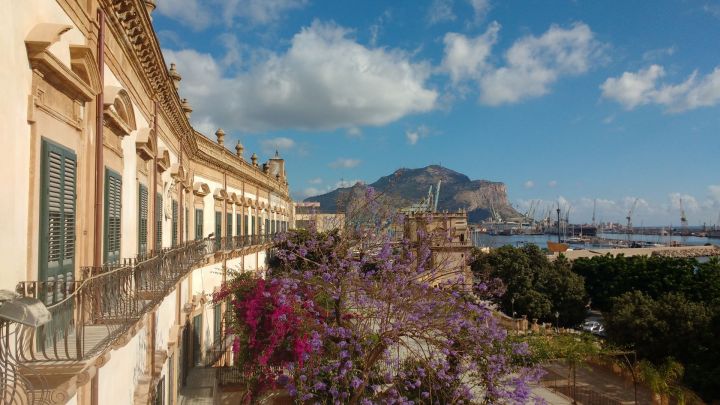
The oldest portions of the Palazzo Butera date to the early eighteenth century, when the Duke of Branciforti constructed a grand house according to designs produced by the Palermo architect Giacomo Amato. In 1759, fire destroyed a portion of the palazzo. Prince Butera responded by acquiring the adjacent property and rebuilding, doubling the size of the Palazzo Butera. More information is available here»
◊ ◊ ◊ ◊ ◊
From ArtHist.net and the Palazzo Butera:
Masterclass in Palermo: European Collectors as Patrons
Palazzo Butera, Palermo, 28–30 June 2023
Applications due by 30 April 2023
European Collectors as Patrons is a three-day masterclass based in Palermo, Sicily focused on how patronage supports and defends artistic and cultural activity. Bertrand du Vignaud and Claudio Gulli will outline how over the last three centuries a range of historical and current European patrons have advocated for art and culture by building their own private collections. These individuals have contributed both to social progress and urban development. Examples will include the Roman Cardinals Alessandro Albani and Pietro Ottoboni, along with the English amateur-architects Lord Burlington and Sir John Soane, and the Spanish Count Alexandre Aguado. From more recent history, we will consider Harry Kessler, Vittorio Cini, and Calouste Gulbenkian. Professors Andrea Rurale and Piergiacomo Mion, of the SDA Bocconi School of Management, will discuss the economic longevity and long-term impact of these enterprises.
During these three days, lectures will take place at Palazzo Butera, and visits across the city will include both well-known and lesser known places. In the evenings, private dinners have been arranged in historic houses and other places of significant cultural importance. The dinners are designed as an integral part of the masterclass allowing for a greater depth of understanding. They also offer time for discussion and reflection on the days’ experiences and learning.
The use of Palazzo Butera as host to this masterclass is intentional as it represents a fine example of the sort of enlightened patronage being discussed. This eighteenth-century seafront palace, once the home of the Branciforti family, was purchased by Francesca and Massimo Valsecchi in 2016. The new owners privately undertook a complete restoration of the building and have transferred their art collection to the palazzo. Since the 1960s the Valsecchi’s collecting has been guided by a fascination in cultural exchanges and the cross-pollination of ideas. Assembled quietly over decades of intense research, the collection opened to the public in the spring of 2021. The main works in the collection arrived in Palermo after long-term loans to the Fitzwilliam Museum in Cambridge and the Ashmolean Museum in Oxford (2016–2020).
Classes will be held in English. The course fee, excluding dinners, is €350; including dinners, the cost is €700. It is possible to receive a grant to cover €350 (applicants will be selected by Bertrand du Vignaud and Claudio Gulli). Lunch is included in the price, except on June 29, when lunch will take place at Villa Tasca. Registration is open to anybody, there is no age limit, and an educational qualification is not a requirement. To register, please send an email to info@palazzobutera.it. For those applying for a grant, please include your CV and a personal statement. We also advise staying in Palermo, if possible, some days prior to or after the course, so as to visit the city’s main points of interest.
W E D N E S D A Y , 2 8 J U N E 2 0 2 3
10.00 Visit to the Francesca and Massimo Valsecchi Collection
12.00 Meet with Francesca and Massimo Valsecchi
15.00 Lecture by Bertrand du Vignaud and Claudio Gulli — European Collectors as Patrons, Part 1
18.30 Visit to the Chiaramonte Bordonaro Collection
Dinner at Villa Chiaramonte Bordonaro (optional)
T H U R S D A Y , 2 9 J U N E 2 0 2 3
10.00 Visit to Villa Tasca
15.00 Lecture by Bertrand du Vignaud and Claudio Gulli — European Collectors as Patrons, Part 2
19.00 Visit to Palazzo Mazzarino
Dinner at Palazzo Mazzarino (optional)
F R I D A Y , 3 0 J U N E 2 0 2 3
10.00 Lecture by Bertrand du Vignaud — Heritage at Risk
11.00 Lecture by Andrea Rurale — Art Orientation vs Market Orientation
12.00 Lecture by Piergiacomo Mion — A New Model for Cultural Business: Key Issues Faced by Art Managers
15.00 The Financing of Restorations, Museums, and Heritage. Attended by Bertrand du Vignaud, Claudio Gulli, Andrea Rurale, and Piergiacomo Mion (open to the public)
16.15 Walking Tour of Palermo’s Historical Center: Restored Churches and Churches To Be Restored, curated by Claudio Gulli
17.30 Gallery of Francesco Pantaleone
18.15 Meeting with Alexandre Giquello and Cocktails
S I T E S
Villa Chiaramonte Bordonaro alle Croci
In 1892, Ernesto Basile designs an extension for Gabriele Chiarmonte Bordonaro’s (1835–1914) villa to house his art collection. Assembled at the end of the 19th century, it included works by Giotto, Botticelli, and Van Dyck. Today you can still see many of these works here, even though the collection was divided in three parts in 1950.
Villa Tasca
The origins of Villa Tasca date from the 16th century, though it was restored with its current decorations beginning in 1855. It has since been called the ‘Villa Borghese of Palermo’ because of the eight hectares of surrounding park, preserved to this day. It includes a swan lake and a temple to Ceres. Richard Wagner was a long-time guest of the villa and during his stay in Palermo wrote much of Parsifal. The park opened to the public in 2020. The visit will be guided by Giuseppe Tasca owner and CEO of Villa Tasca.
Palazzo Mazzarino
Within walking distance of Teatro Massimo, Palazzo Mazzarino, belongs to Marquis Berlingieri. Historically it has been one of the city’s most important palazzi, because of its links to the Lanza family. In the Minerva Hall, where a sculpture of Valerio Villareale towers, you will also find butterfly paintings by Damien Hirst. The palazzo is a showcase for this type of cross-pollination between new and old. The visit will be guided by Marialda Berlingeri.
FPAC
Contemporary art gallery founded in Palermo by Francesco Pantaleone in 2003, located at the Quattro Canti.
House of Alexandre Giquello
Alexandre Giquello is co-owner of the Parisian auction house Binoche-Giquello and president of Drouot. He owns an apartment in Palermo at the Quattro Canti.
L E C T U R E R S
Art historian Bertrand du Vignaud has been Chairman of Christie’s Monaco and Vice-Président of Christie’s France. Passionate about the safeguarding the world cultural heritage, he has been President of the World Monuments Fund organisations for Europe, France, and Italy. Currently, he advises the Fondation Evergète in Geneva and is the scientific advisor of Dassault Histoire et Patrimoine in France and is the President of the Comité International des Amis de la Bibliothèque Vaticane in Rome. For more than 40 years, he has launched numerous projects to save and restore masterpieces of cultural heritage in danger or in urgent need of work around the world: from baroque churches in Peru, Brazil, and Austria, to the Queens’ Theatre at Trianon, from the Carracci Gallery in Rome to the Palace of Dario in Persepolis; the most original and iconic of these was the reinstallation of the spectacular decors of an 18th-century mansion, the Hôtel de Voyer d’Argenson, or Chancellerie d’Orléans, in Paris. He is also a great nephew of the painter Henri de Toulouse-Lautrec, and through his writing and lectures, works to make the little-know aspects of this artist’s life better known to the public. His last book, Les Thellusson. was published in French and English by In Fine in 2021 and is dedicated to an important European family of collectors and art patrons.
Claudio Gulli was born in Palermo in 1987. He read History of Art at the Università degli Studi di Siena and gained his PhD at the Scuola Normale Superiore in Pisa, with a thesis on the late-nineteenth century Chiaramonte Bordonaro collection (published by Officina Libraria in 2021). Between 2009 and 2011, he worked in the Paintings Department of the Louvre Museum in Paris, where his contributions to the research on Leonardo da Vinci focused on the literary popularity of the master’s Saint John the Baptist (2009) and Saint Anne (2011). He is involved in the project of Palazzo Butera in Palermo, where he is now director, since the acquisition of the building by Francesca and Massimo Valsecchi
Andrea Rurale is a Lecturer at the Department of Marketing at Università Bocconi. At SDA Bocconi, he is the Director of the Master in Arts Management and Administration (MAMA). He has conducted research and education projects with major enterprises. His research activities focus on cultural marketing, consumer behaviour, experiential marketing, CRM, and marketing communication. He is the author of books and articles on his topics of interest. His works have been published in Psychology and Marketing. He has been a Visiting Professor in many international universities, including Simon Fraser in Vancouver (Canada), Tinsgua University in Beijing (China), SMU in Dallas (USA), UTS in Sydney (Australia), and Universidad de Aguascalientes (Mexico). He is President of the Istituto musicale superiore Monteverdi Conservatory in Cremona. Andrea earned a degree from Università Bocconi and a PhD in Marketing from Universitat de València. He is President of the Lombardy Delegation of FAI – Fondo Ambiente Italiano.
Piergiacomo Mion Dalle Carbonare is SDA Junior Lecturer of the Government, Health and Non-Profit Division and Coordinator of the Master in Arts Management and Administration (MAMA) at SDA Bocconi School of Management. He is Deputy Director of the Master of Science in Economics and Management for Arts, Culture, Media, and Entertainment (ACME) at Bocconi University where he also teaches courses related to Cultural Policies, Public Management, and Territorial Marketing. He holds a PhD in Marketing from the University of Valencia. He has been visiting scholar at SMU Dallas. Piergiacomo is also Head of the Milan Delegation of FAI – Fondo Ambiente Italiano.
New Book | Piranesi@300
From Artemide Edizioni:
Mario Bevilacqua and Clare Hornsby, eds., Piranesi@300 (Rome: Artemide Edizioni, 2023), 296 pages, ISBN: 978-8875754327, €48.
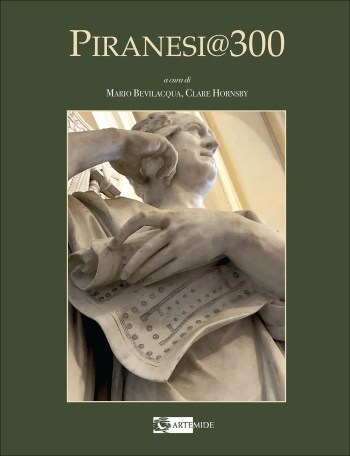 A volume of essays celebrating the 300th anniversary of the birth of Giovanni Battista Piranesi (1720–1778).
Piranesi: printmaker, architect, antiquarian, art theorist, art dealer, and polemicist, passionate in his praise of the greatness of Rome. He was a protagonist in 18th-century European arts and letters, a brilliant artistic innovator, and a controversial and exuberant personality, universally celebrated and admired. The 26 essays in this volume—from a wide range of authors writing in Italian, English, and French—include the contributions to the 2021 conference celebrating the 300th anniversary of his birth, a collaboration between architectural historian Mario Bevilacqua, director of the Centro di Studi sulla Cultura e l’Immagine di Roma, and art historian Clare Hornsby, Research Fellow at the British School at Rome; they are also the editors of this volume published by Artemide Edizioni. The essays represent new research on the artist, on the collecting of his work internationally, and on his profound and long lasting influence in Europe and beyond, from the age of the Grand Tour until now.
C O N T E N T S
Piranesi incisore, architetto, antiquario e teorico
• Ginevra Mariani — Progetto Piranesi: il catalogo generale delle matrici di Piranesi, 2010–2020. Riflessioni e nuovi dati
• Lucia Ghedin — Deduzioni e ipotesi sulla tecnica incisoria di Piranesi
• Giovanna Scaloni — Piranesi riflette su Montano: la genesi della pianta del Campo Marzio
• Maria Grazia D’Amelio, Fabrizio De Cesaris — Giovanni Battista Piranesi e l’architettura pratica
• Paolo Pastres — Fantasia al potere: Piranesi, Algarotti e la lezione di Antonio Conti
• Lola Kantor-Kazovsky — Piranesi’s Invenzioni capric di carceri and the Cartesian concept of dream
• Silvia Gavuzzo-Stewart — La dedica di Piranesi a Lord Charlemont nella tavola II delle Antichità Romane
• Adriàn Fernàndez Almoguera — Rêver le Nil depuis le Tibre: le regard de Piranèse sur la question égyptienne
• Eleonora Pistis — The thinkability of architecture: Piranesi without images
• Heather Hyde Minor — Piranesi’s Epistolic Art
Collezionare Piranesi
• Ebe Antetomaso — Materiali piranesiani nella collezione Corsini: appunti dai bibliotecari
• Georg Schelbert, Charleen Rethmeyer — Piranesi in Prussia: spotlights on a variable relationship
• Gudula Metze — 1720–1778: Giovanni Battista Piranesi and the Kupferstich-Kabinett Dresden
• Delfin Rodríguez Ruiz — Piranesi e la Spagna: rapporti culturali, artistici e architettonici durante l’illuminismo spagnolo
L’influenza di Piranesi: Europa e oltre
• Clare Hornsby — Piranesi’s Ichnographiam Campi Martii Antiquae Urbis: an investigation into its sources and innovations and its influences on the work of Robert Adam
• Valeria Mirra — Dalla fortuna di Giovanni Battista Piranesi in Francia allo stabilimento dei Piranesi frères a Parigi
• Olga Medvedkova — La Dévideuse italienne ou habiter la Ruine
• Aleksander Musiał — Beyond capriccio: Piranesi’s transgressive classicism and its Eastern European receptions
• Mario Bevilacqua — Piranesi in eighteenth-century America
• Angela Rosch Rodrigues — Piranesi at the Brazilian National Library: a trajectory of the ruine parlanti from Rome to Rio de Janeiro
• Helena Perez Gallardo — Sotto il cielo di Parigi: Piranesi negli incisori e fotografi francesi nel 1850
• Hiromasa Kanayama — Piranesi nel Giappone dell’Ottocento: le vicende della collezione Kamei
Piranesi XX–XXI secolo
• Victor Plahte Tschudi — Carceri and Cubism
• Giacomo Pala — Architetto postumo, o il postmoderno e ‘Piranesi’
• Angelo Marletta — Forma Urbis forma Architecturae: Piranesi, Kahn e i frammenti di Roma
• Jeanne Britton, Michael Gavin, Zoe Langer, Jason Porter — The Digital Piranesi
Call for Papers | Visualizing Antiquity: The Apelles-Problem
From ArtHist.net, which includes the German version:
Visualizing Antiquity: On the Episteme of Early Modern Drawings and Prints — Part I: The ‘Apelles-Problem’
Bildwerdung der Antike: Zur Episteme von Zeichnungen und Druckgrafiken der Frühen Neuzeit — I: Das ‚Apelles-Problem‘
Berlin-Brandenburg Academy of Sciences and Humanities, 28–29 September 2023
Organized by Ulrich Pfisterer, Cristina Ruggero, and Timo Strauch
Proposals due by 30 April 2023
The academy project Antiquitatum Thesaurus: Antiquities in European Visual Sources from the Seventeenth and Eighteenth Centuries, hosted at the Berlin-Brandenburg Academy of Sciences and Humanities (thesaurus.bbaw.de), and the Zentralinstitut für Kunstgeschichte Munich (zikg.eu) are organizing a series of colloquia in 2023–2024 on the topic Visualizing Antiquity: On the Episteme of Drawings and Prints in the Early Modern Period. These colloquia will examine the significance of drawings and prints for ideas, research, and the circulation of knowledge about ancient artifacts, architecture, and images in Europe and neighboring areas from the late Middle Ages to the advent of photography in the mid-19th century.
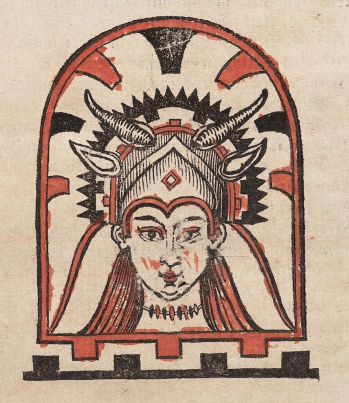
Detail of a hand-colored woodcut print from Giovanni Battista Casali, De profanis et sacris veteribus ritibus (Rome 1644), p. 67 (UB Heidelberg). More information is available here»
The first colloquium inquires into a form of the ‘Apelles problem’. According to Pliny, the Greek painter knew how to depict “what lies outside the realm of painting.” For the representation of ancient artifacts, therefore, the question is asked how in drawings and prints can ‘unrepresentable’ qualities of the depicted object—such as color, material properties, proportions, three-dimensionality, and the like—nevertheless be conveyed? In terms of colorfulness, for example, colored hand drawings have an advantage over prints, but they do not have the same range. Is an attached scale key sufficient to clarify dimensions? And what possibilities do new techniques of representation open up? Or can accompanying texts, commentaries, annotations, source citations, etc. do justice to the difficulties of depicting the above-mentioned characteristics, or help to classify and interpret the artifact depicted? These are some of the central questions posed; suggestions beyond these are welcome.
We welcome proposals for 20-minute papers in English, French, German, or Italian. Presentations will ideally combine case study and larger perspective. Publication in extended form is planned. Proposals (max. 400 words) can be submitted until 30 April 2023, together with a short CV (max. 150 words) to thesaurus@bbaw.de. Travel and hotel expenses (economy-class flight or train; 2 nights’ accommodation) will be reimbursed according to the Federal Law on Travel Expenses (BRKG).
Subsequent colloquia in the series will address other aspects of the creation of images of antiquity:
• Find and Display, Fragment and Whole
• Fake News? Fantasy Antiquities
• Collectors, Artists, Scholars: Knowledge and Intention in Collection Catalogs
Conceived by Antiquitatum Thesaurus (Ulrich Pfisterer, Cristina Ruggero, Timo Strauch)
New Book | Mudlark’d: Hidden Histories from the River Thames
Mudlarking depends upon tides, and the Thames is particularly affected by robust tidal churning (as the Seine is not, as noted by Jason Goodwin in a 2019 Country Life essay). From Princeton UP:
Malcolm Russell, Mudlark’d: Hidden Histories from the River Thames (2022), 224 pages, ISBN: 978-0691235783, $35.
 A captivating history of London as told through objects recovered from the muddy banks of the Thames and the lives of the people who owned them.
Mudlark’d combines insights from two hundred rare objects discovered on the foreshore of the River Thames with a wealth of breathtaking illustrations to uncover the hidden histories of ordinary people from prehistory to today. Malcolm Russell tells the stories behind each find, revealing the habits, customs, and artistry of the people who created and used it.
In the eighteenth and nineteenth centuries, London was the busiest port in the world, exchanging goods and ideas with people from every continent. The shores of the Thames have long been densely packed with taverns, brothels, and markets, and the river’s muddy banks are a repository of intriguing and precious objects that evoke long-forgotten ways of life. With Russell as your guide, a bottleneck of a jug is shown to be a talisman to counter the ill effects of witchcraft. Glass beads expose the brutal realities of the transatlantic slave trade. Clay tobacco pipes uncover the lives of Victorian magicians. A scrap of Tudor cloth illuminates the experiences of Dutch and French religious refugees. These are just some of the stories told in Mudlark’d, which also contains a primer, giving advice on how to mudlark on tidal rivers around the world and outlining the tools and equipment you will need.
Malcolm Russell has contributed to publications such as Treasure Hunting, The Searcher, and Beachcombing. A lifelong mudlark, he studied history at the University of Sheffield, where he was recently an honorary research fellow in the Department of History. His remarkable finds were featured in the Thames Festival exhibition Foragers of the Foreshore.
New Book | Enslaved: The Sunken History
From Simon & Schuster:
Sean Kingsley and Simcha Jacobovici, with a preface by Brenda Jones, Enslaved: The Sunken History of the Transatlantic Slave Trade (New York: Pegasus Books, 2023), 336 pages, ISBN: 978-1639362387, $29.
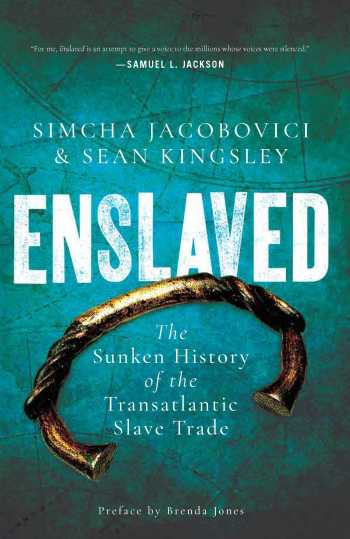 From the writers behind the acclaimed documentary series Enslaved (starring Samuel L. Jackson), comes a rich and revealing narrative of the true global and human scope of the transatlantic slave trade. The trade existed for 400 years, during which 12 million people were trafficked, and 2 million would die en route.
In these pages we meet the remarkable group, Diving with a Purpose (DWP), as they dive sunken slave ships all around the world. They search for remains and artifacts testifying to the millions of kidnapped Africans that were transported to Europe, the Americas, and the Caribbean. From manilla bracelets to shackles, cargo, and other possessions, the finds from these wrecks bring the stories of lost lives back to the surface.
As we follow the men and women of DWP across eleven countries, Jacobovici and Kingsley’s rich research puts the archaeology and history of these wrecks that lost between 1670 to 1858 in vivid context. From the ports of Gold Coast Africa, to the corporate hubs of trading companies of England, Portugal and the Netherlands, and the final destinations in the New World, Jacobovici and Kingsley show how the slave trade touched every nation and every society on earth.
Though global in scope, Enslaved makes history personal as we experience the divers’ sadness, anger, reverence, and awe as they hold tangible pieces of their ancestors’ world in their hands. What those people suffered on board those ships can never be forgiven. Enslaved works to ensure that it will always be remembered and understood, and is the first book to tell the story of the transatlantic slave trade from the bottom of the sea.
Sean Kingsley is a marine archaeologist who has explored over 350 wrecks from Israel to America. Off the UK he identified the world’s earliest Royal African Company English ‘slaver’ ship. Dr. Kingsley writes for National Geographic and is the founder of Wreckwatch Magazine about the world’s sunken wonders.
Simcha Jacobovici is a three-time Emmy winning Israeli/Canadian filmmaker, New York Times bestselling author, and an internationally acclaimed journalist. He is also an adjunct professor in the Department of Religion at Huntington University in Ontario. Jacobovici was Showrunner/Director of the 6-part series Enslaved: The Lost History of the Transatlantic Slave Trade, for which he has received numerous awards including two NAACP Image Award nominations. Enslaved is his fourth book. He divides his time between Toronto and Israel.
New Book | The Odyssey of Phillis Wheatley
From Macmillan:
David Waldstreicher, The Odyssey of Phillis Wheatley: A Poet’s Journeys through American Slavery and Independence (New York: Farrar, Straus and Giroux, 2023), 496 pages, ISBN: 978-0809098248, $30.
A paradigm-shattering biography of Phillis Wheatley, whose extraordinary poetry set African American literature at the heart of the American Revolution.
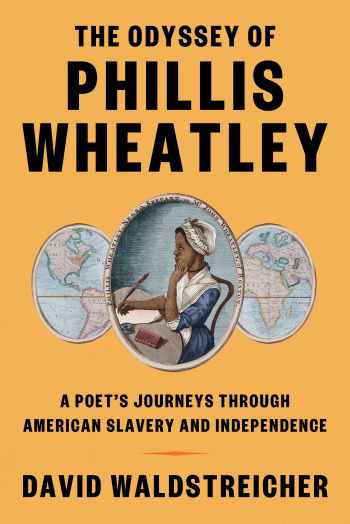 Admired by George Washington, ridiculed by Thomas Jefferson, published in London, and read far and wide, Phillis Wheatley led one of the most extraordinary American lives. Seized in West Africa and forced into slavery as a child, she was sold to a merchant family in Boston, where she became a noted poet at a young age. Mastering the Bible, Greek and Latin translations, and the works of Pope and Milton, she composed elegies for local elites, celebrated political events, praised warriors, and used her verse to variously lampoon, question, and assert the injustice of her enslaved condition. “Can I then but pray / Others may never feel tyrannic sway?” By doing so, she added her voice to a vibrant, multisided conversation about race, slavery, and discontent with British rule; before and after her emancipation, her verses shook up racial etiquette and used familiar forms to create bold new meanings. She demonstrated a complex but crucial fact of the times: that the American Revolution both strengthened and limited Black slavery. In this new biography, the historian David Waldstreicher offers the fullest account to date of Wheatley’s life and works, correcting myths, reconstructing intimate friendships, and deepening our understanding of her verse and the revolutionary era. Throughout The Odyssey of Phillis Wheatley, he demonstrates the continued vitality and resonance of a woman who wrote, in a founding gesture of American literature, “Thy Power, O Liberty, makes strong the weak / And (wond’rous instinct) Ethiopians speak.”
David Waldstreicher teaches history at the City University of New York Graduate Center and is the author of Slavery’s Constitution: From Revolution to Ratification and Runaway America: Benjamin Franklin, Slavery, and the American Revolution. He has written for The New York Times Book Review, Boston Review, and The Atlantic, among other publications.
◊ ◊ ◊ ◊ ◊
From Jennifer Schuessler’s review for The NY Times:
Jennifer Schuessler, “A Fresh Look at a Pioneering Black Voice of Revolutionary America,” The New York Times (2 March 2023). A new biography places the poet Phillis Wheatley in her own time — and in the middle of the current hot debate about the American Revolution and slavery.
. . . Waldstreicher, who teaches at the Graduate Center of the City University of New York, is known for deeply researched, tightly written studies, which aim to complicate any comforting idealization of the founding. . . .
His books (which include a study of Ben Franklin and slavery) and his blunt intellectual style haven’t always made him popular. Some traditionalists in the field, he said tartly, prefer to “pretend I don’t exist.”
Waldstreicher is also a longtime scourge of “Founders’ Chic,” as historians refer to reverential best sellers extolling the character of the founders (often by exaggerating their opposition to slavery). But his new book, published by Farrar, Straus and Giroux, is itself a founder biography of sorts, treating Wheatley not only as the progenitor of the African American literary tradition but an important political voice in the creation of the nation itself. . . .
New Book | Scripts of Blackness
From Penn Press—and see Ellen Welch’s recent review for Journal18 . . .
Noémie Ndiaye, Scripts of Blackness: Early Modern Performance Culture and the Making of Race (Philadelphia: University of Pennsylvania Press, 2022), 376 pages, ISBN: 978-1512822632, $65. RaceB4Race: Critical Race Studies of the Premodern series
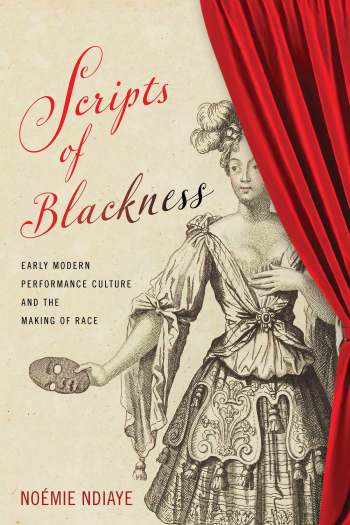 Scripts of Blackness shows how the early modern mass media of theatre and performance culture at-large helped turn blackness into a racial category, that is, into a type of difference justifying emerging social hierarchies and power relations in a new world order driven by colonialism and capitalism. Noemie Ndiaye explores the techniques of impersonation used by white performers to represent Afro-diasporic people in England, France, and Spain in the sixteenth and seventeenth centuries, using a comparative and transnational framework. She reconstructs three specific performance techniques―black-up (cosmetic blackness), blackspeak (acoustic blackness), and black dances (kinetic blackness)―in order to map out the poetics of those techniques, and track a number of metaphorical strains that early modern playtexts regularly associated with them. Those metaphorical strains, the titular scripts of blackness of this book, operated across national borders and constituted resources, as they provided spectators and participants with new ways of thinking about the Afro-diasporic people who lived or could/would ultimately live in their midst. Those scripts were often gendered and hinged on notions of demonization, exclusion, exploitation, animalization, commodification, sexualization, consensual enslavement, misogynoir, infantilization, and evocative association with other racialized minorities. Scripts of Blackness attempts to grasp the stories that Western Europeans told themselves through performative blackness, and the effects of those fictions on early modern Afro-diasporic subjects.
Noémie Ndiaye is Assistant Professor of English at the University of Chicago.
C O N T E N T S
Introduction: Performative Blackness in Early Modern Europe
1 A Brief History of Baroque Black-Up: Cosmetic Blackness and Religion
2 A Brief History of Baroque Black-Up: Cosmetic Blackness, Gender, and Sexuality
3 Blackspeak: Acoustic Blackness and Accents of Race
4 Black Moves: Race, Dance, and Power
Post-Script: Ecologies of Racial Performance
Appendix: Selection of Early Modern Plays Featuring Black Characters
Notes
Bibliography
Index
Acknowledgments
New Book | Boundaries of Belonging
From Penn Press:
April Lee Hatfield, Boundaries of Belonging: English Jamaica and the Spanish Caribbean, 1655–1715 (Philadelphia: University of Pennsylvania Press, 2023), 320 pages, ISBN: 978-1512824018, $45.
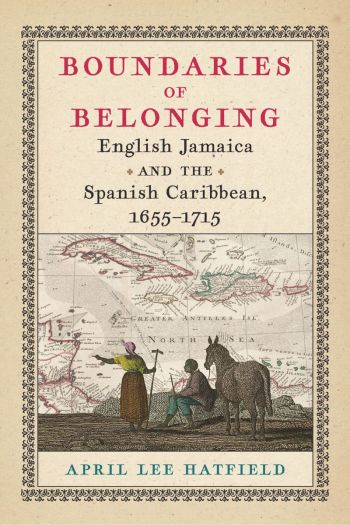 In the decades following England’s 1655 conquest of Spanish Jamaica, the western Caribbean became the site of overlapping and competing claims—to land, maritime spaces, and people. English Jamaica, located in the midst of Spanish American port towns and shipping lanes, was central to numerous projects of varying legality, aimed at acquiring Spanish American wealth. Those projects were backdrop to a wide-ranging movement of people who made their own claims to political membership in developing colonial societies, and by extension, in Atlantic empires.
Boundaries of Belonging follows the stories of these individuals—licensed traders, smugglers, freedom seekers, religious refugees, pirates, and interlopers—who moved through the contested spaces of the western Caribbean. Though some were English and Spanish, many others were Sephardic, Tule, French, Kalabari, Scottish, Dutch, or Brandenberg. They also included creole people who identified themselves by their local place of origin or residence–as Jamaican, Cuban, or Panamanian.
As they crossed into and out of rival imperial jurisdictions, many either sought or rejected Spanish or English subjecthood, citing their place of birth, their nation or ethnicity, their religion, their loyalty, or their economic or military contributions to colony or empire. Colonial and metropolitan officials weighed those claims as they tried to impose sovereignty over diverse and mobile people in a region of disputed and shifting jurisdictions. These contests over who belonged in what empire and why, and over what protections such belonging conferred, in turn helped to determine who would be included within a developing law of nations.
April Lee Hatfield is Associate Professor of History at Texas A&M University and author of Atlantic Virginia: Intercolonial Relations in the Seventeenth Century, also available from the University of Pennsylvania Press.
C O N T E N T S
List of Maps
Introduction ‘In the Midst of the Spaniards’
1 ‘The Lawless Motions of Privateers’
2 ‘A Mungrel Breek of Spaniards’
3 ‘Free Negroes Must Not Be Sold’
4 ‘Amongst the White and Civilized People of the World’
5 ‘Our Holy Catholic Faith and the Asiento’
6 ‘The Trading World’
7 ‘In the Hands of Creolians’
Conclusion: ‘The Law of Nations’
Notes
Index
Acknowledgments
Conference | Shifting Tides: Art in the 18th-Century Caribbean

A New & Correct Map of the Trading Part of the West Indies: Including the Seat of War between Gr. Britain and Spain: Likewise the British Empire in America, with the French and Spanish Settlements adjacent Thereto: Adorn’d with Prospects of ye Most considerable Towns, Ports, Harbours &c. therein Contained from the Latest & Best Observations (London: Printed for and sold by Henry Overton, at the White Horse without Newgate, 1741), “Dedicated to the Honble. Edward Vernon Esqr., Vice Admiral of the Blue and Commander in chief of all his Majs. ships in the West Indies, by H.O.”
◊ ◊ ◊ ◊ ◊
From Winterthur:
Shifting Tides: Art in the 18th-Century Caribbean
Online and in-person, Winterthur Museum, Garden & Library, Wilmington, Delaware, 20–21 April 2023
Join leading and emerging scholars, museum professionals, and community partners as we rethink narratives surrounding colonial art in the Caribbean region. Shifting Tides: Art in the 18th-Century Caribbean aims to reimagine the relationship between American historical collections in public institutions and the communities they serve. The conference is made up of an in-person symposium followed by a virtual study day, with livestreamed roundtable discussion and an examination of paintings in the Winterthur collection. The conference is free, with a box lunch available for purchase. Register here»
Shifting Tides centers the Caribbean region to explore new pathways in the history of eighteenth-century art. Histories of colonial and viceregal American art tend to privilege art produced in continental spaces as they came to be organized as nation states, overlooking the interrelatedness of early Caribbean and continental colonies, and the significance of the Caribbean region.
The Caribbean basin, spanning the coastal areas as well as the islands which lie in the Caribbean Sea, was a central space for the making and circulation of European wealth. It was a space of competition between empires; a space of resistance against imperial exploitation; a space of porous boundaries that facilitated inter-imperial crossings and exchanges between creators and their patrons. This interconnectedness had a profound impact on artistic creation in the early Americas. Artists like José Campeche, Peter Bentzon, John Greenwood, Josef Francisco Xavier de Salazar y Mendoza, Antonio José and Juan José Landaeta, and Agostino Brunias, worked outside and across borders; between social classes and races; and beyond sovereignties which historical narratives have organized for the eighteenth century. Abundant evidence also shows that John Singleton Copley, Luis Paret y Alcázar, and Benjamin West’s careers were profoundly impacted by their patrons’ connections to the Caribbean.
Shifting Tides brings together scholars, conservators, community partners, artists, and curators to discuss cutting edge scholarship and initiatives that explore the significance of the art created in and in relation to the Caribbean. We will explore new understandings of art making between American spaces, and reflect on their impact on how institutions frame colonial art in the Americas.
T H U R S D A Y , 2 0 A P R I L 2 0 2 3
8.00 Registration and coffee
8.30 Welcome
• Chris Strand, Charles F. Montgomery Director and CEO, Winterthur
• Alexandra Deutsch, John L. and Marjorie P. McGraw Director of Collections, Winterthur
8.40 Panel 1 | Sources and Perspectives: Rethinking the 18th-Century Caribbean
Scholars will introduce new perspectives on comparative colonialism in the Americas, on the Caribbean, and the Atlantic world and their role in renewing our understanding of the Americas in the eighteenth century. The panel will also reflect on the ways the field of United States American and Latin American art history have engaged with this recent historiography.
• José Luis Lazarte Luna (The Metropolitan Museum of Art)
• Christelle Lozère (Université des Antilles)
• Pedro Luengo (Universidad de Sevilla)
• Eveline Sint Nicolaas (Rijksmuseum)
11.00 Panel 2 | Centering the Caribbean
Panelists will present new sources that are currently employed by art historians, scholars of material culture, and conservators in their research on eighteenth-century art and material culture. The speakers will discuss how their sources have been key to the emergence of new ways of seeing the nature of artmaking in American colonies, the mobility of creators, the role of enslaved individuals, knowledge transfer, and mixed-race artists and artisans.
• Emily Casey (University of Kansas)
• Janeth Rodríguez Nóbrega (Universidad Central de Venezuela)
• Sophie White (University of Notre Dame)
12.30 Lunch
1.30 Panel 3 | Beyond Boundaries: Artists and Creators
This panel will focus on individual-centered narratives emerging from research on creators, as well as curatorial practice. The speakers will talk about their projects and discuss how such individual-centered approaches present models for shifting our approach to what American art as a field of study should encompass.
• Alexis Callender (Smith College)
• Iraida Rodríguez-Negrón (Museo de Arte de Ponce)
• Marc Vermeulen (National Archives, UK)
• Michael Wilson (Temple University)
3.45 Panel 4 | Color and Artistic Creation
This panel will center questions of race and colorism in Caribbean art. Speakers will discuss research and projects that address the various roles that enslaved people and free people of African and Indigenous descent played in artmaking in the Caribbean, as well as their relationships with artistic practices in continental colonies.
• Mark Aronson (Yale University)
• Jorge Rivas Pérez (Denver Art Museum)
• Lucia Noor Melita (Victoria and Albert Museum)
F R I D A Y , 2 1 A P R I L 2 0 2 3
9.00 Study Session
Physical examination and discussion of colonial paintings in the Winterthur collection, highlighting their Caribbean connections. The selected group of paintings include those by John Greenwood, Benjamin West, William Williams, John Smibert, John Wollaston, and Robert Feke.
• Stephanie Delamaire (Carnegie Museum of Art)
• Matthew Cushman (Winterthur Museum, Garden & Library)
• Mina Porell (The Barnes Foundation)
* Due to space constraints, the Study Day will be filmed and available online only; registrants will receive further information with a link to the recording.
12.00 Lunch Break
2.00 Livestream Roundtable | Research, Methodologies, and Institutional Initiatives
Concluding the conference, this online roundtable will bring together scholars, museum and historic site administrators, and community partners who have contributed to initiatives that are creating spaces for Caribbean art in their institutions and communities. They will discuss new trends and opportunities for an expanded view of the significance of eighteenth-century Caribbean art in various regional and national institutions.
• Rocío Aranda-Alvarado (Ford Foundation)
• Rafael Damast (Taller Puertorriqueño)
• Wim Klooster (Clark University)
• Louis Nelson (University of Virginia)
Speaker biographies are available here»
Exhibition | American Art from the Spanish Empire
From the press release for the exhibition:
From the Andes to the Caribbean: American Art from the Spanish Empire
Harvard Art Museums, Cambridge, 3 March — 30 July 2023
Organized by Horace Ballard

Artist active in the Viceroyalty of Peru, after Diego de Ocaña (1585–1608), Our Lady of Guadalupe at Extremadura, 1730–80, oil on canvas (Carl & Marilynn Thoma Collection, TL42430.6; photo by Jamie Stukenberg).
This spring, the Harvard Art Museums invite visitors to discover a more expanded story of American art through an unparalleled collection of Spanish colonial paintings. From the Andes to the Caribbean: American Art from the Spanish Empire presents 26 works from the Carl & Marilynn Thoma Foundation—the premier U.S. private collection of 17th- to 19th-century paintings from South America and the Caribbean—together with works from the Harvard Art Museums and other Harvard University collections. The presentation marks the museums’ first ever exhibition combining religious and secular art of the Spanish Americas.
The exhibition has been organized for the Harvard Art Museums by Horace D. Ballard, the Theodore E. Stebbins, Jr. Associate Curator of American Art, and is Ballard’s first major exhibition at Harvard since joining the museums in 2021. Natalia Ángeles Vieyra, Associate Curator of American Art at the Worcester Art Museum, contributed to the early thinking of the show when she served as the 2019–22 Maher Curatorial Fellow of American Art at the Harvard Art Museums. From the Andes to the Caribbean will be on display March 3 through July 30, 2023, in the museums’ special exhibitions gallery on Level 3. All in-gallery materials are being presented bilingually, in Spanish and English.
The Spanish empire and its mercantile companies were the dominant colonial force in America from 1492 to 1832. Five years before Portugal established American settlements and nearly a century before Britain and France claimed land in the hemisphere, wealth from America’s colonial territories (viceroyalties) of New Spain and Peru made Spain the richest nation on Earth. Though Spain is no longer an empire, its colonial past continues to inform the art and culture of the Americas.
From the Andes to the Caribbean emphasizes three key themes related to culture and empire: the political and spiritual work of Catholic icons; the ways in which empire begets hybrid cultural identities; and the relationship between labor, wealth, and luxury. Paintings from present-day Bolivia, Cuba, Ecuador, Peru, Puerto Rico, and Venezuela are presented alongside works on paper and design objects made with Cuban and Honduran mahogany, Mexican cochineal, and Peruvian silver, underlining the great diversity of works of art broadly referred to as either ‘Viceregal’, ‘Spanish colonial’, or simply ‘American’.
“My hope for this exhibition is to begin to unravel decades-long assumptions and half-truths about the definitions and origins of American art,” said Ballard. “In exploring works of print and design, as well as painted icons and portraiture from the 17th and 18th centuries in the Viceroyalties of Peru and New Spain, I aim to expand the narratives that many North American collections, including the Harvard Art Museums, have told for generations.”
The 50 objects on view include 26 paintings on loan from the Carl & Marilynn Thoma Foundation, dating from roughly 1600 to the mid-19th century, including exquisitely rendered depictions of Christian saints, angels, and the Holy Family, as well as portraits of those who had political and military influence within the royal court of Spain; 18th-century wood furniture and silver tableware from the Harvard Art Museums’ collections; samples of pigments and metals from the Straus Center for Conservation and Technical Studies that show some of the materials mined by Indigenous laborers and used by Spanish colonial artists in their work; a 1729 volume of The English Pilot, a series of sea atlases produced in England that chart the major ports and cities in the Americas, on loan from the Harvard Map Collection; and on loan from Harvard’s Arnold Arboretum Library, a 1787 French text that explains the production of carmine, a highly prized pigment whose secrets of manufacture were closely guarded by the Spanish.
“The names of many of the artists of the works in the exhibition are unknown to scholars, as racism, market factors, customs of religious humility, and the ethos of the guilds or workshops in which the works were created makes it difficult to assign authorship,” said Ballard.
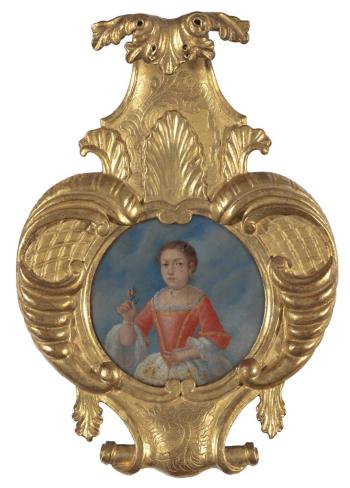
Diego Antonio de Landaeta, Portrait of Petronila Méndez, 1763, oil on panel, 6.5 × 7.5 inches (Carl & Marilynn Thoma Collection, TL42430.26; photo by Jamie Stukenberg).
However, key examples of paintings from three African diasporic makers are on display: Juan Pedro López (1724–1787), considered the finest artist active in 18th-century Venezuela; José Campeche y Jordán (1751–1809), arguably the greatest religious painter born in America during the centuries of colonial rule and occupation; and Diego Antonio de Landaeta (active 1749–1799), a member of a large family of artists working in 18th-century Caracas. López’s Our Lady of Guidance (1765–70) depicts a statue that was installed in a niche within the Catholic church of San Mauricio in Caracas, Venezuela, in 1704. Tobias and the Angel (1787), by Campeche y Jordán, is based on a narrative from around 300–200 BCE, in which the archangel Raphael disguises himself and accompanies the blind Tobias on a long journey. Landaeta’s portrait of Petronila Méndez (1763), a wealthy child from colonial Venezuela, is the only extant work by the artist that has been identified.
Importantly, the exhibition also explores materials that artists used in their work and that were traded extensively across the world, including copper, silver, gold, cochineal, and mahogany. Silver from the Viceroyalty of Peru (present-day Bolivia) was extremely significant in the world economy, including colonial-era Boston. It is estimated that 60–80 percent of the world’s silver during America’s colonial era came from Potosí, an Inkan settlement in the Andes. A majority of the eight silver works on display, including casters, sugar vessels, and coins from the Harvard Art Museums’ collections, are believed to be molded from silver mined at Potosí. A tea chest, tea table, and bombé secretary desk of English design provide elegant examples of transatlantic furnishings crafted from mahogany, a prized shipbuilding material with a history inseparable from colonialism and the enslaved labor used to grow, fell, and process the wood for manufacture.
Loans and exhibition coordination courtesy of the Carl & Marilynn Thoma Foundation. Support for the exhibition is provided by the Henry Luce Foundation Fund for the American Art Department; the Bolton Fund for American Art, Gift of the Payne Fund; the Alexander S., Robert L., and Bruce A. Beal Exhibition Fund; and the Gurel Student Exhibition Fund. Related programming is supported by the M. Victor Leventritt Lecture Series Endowment Fund.
The curatorial team extend their special thanks to artist and educator Gabriel Sosa, who served as the chief translator of exhibition materials; curator and scholar Suzanne Stratton-Pruitt; Kathryn Santner, 2022–24 Mayer Center Fellow, Denver Art Museum; Thomas B.F. Cummins, Dumbarton Oaks Professor of Pre-Columbian and Colonial Art, Harvard University; and colleagues at the Harvard Map Collection, the Harvard University Herbaria & Libraries, and Harvard’s David Rockefeller Center for Latin American Studies.










 Enfilade
leave a comment