Symposium | Spain and the Hispanic World

Giovanni Vespucci, World Map, 1526, ink and colour on four sheets of parchment, 85 × 262 cm
(New York: The Hispanic Society of America)
◊ ◊ ◊ ◊ ◊
This week at the RA, in connection with the exhibition Spain and the Hispanic World, on view until 10 April 2023:
Spain and the Hispanic World Symposium: Cross-Cultural Exchanges
Royal Academy of Arts, London, 24 March 2023
The Royal Academy of Arts will host an academic symposium exploring the global exchange of Spanish art and culture—from the Islamic legacy of Al-Andalus to the transatlantic connections between Spain and Latin America. This interdisciplinary symposium, timed to coincide with our exhibition of treasures from the Hispanic Society Museum & Library, explores current academic perspectives on the histories of cultural exchange surrounding the Spanish and Latin American worlds.
We begin by considering material cultures through the movement of objects, tracing global exchange in the contexts of empire and colonialism. We move on to consider global imperialism through the lens of faith, studying religious art and objects. From the society of Al-Andalus to the history of Spanish Catholicism in Mexico, we look beyond the export of Spanish culture, to the influences and exchanges that were simultaneously being brought back into Iberia. Finally, we explore the legacies of Spanish art and literature in Latin America, investigating the layers of cultural difference caused by colonialism, as well as using a materials-based approach to investigate how these layers appear in objects and artworks. The symposium concludes with an artist in-conversation with Ana Maria Pachecho, exploring how the themes and ideas discussed throughout the day are still relevant to contemporary artist practice.
This intensive one-day symposium is a key moment in driving forward conversations and discussions on the art of the Latin world and is open to scholars, enthusiasts, and anyone wanting to know more about this groundbreaking exhibition. Ticket fees (£45 / £15) include exclusive early-morning access to the RA’s exhibition Spain and the Hispanic World starting at 8:30am and a drinks reception at 6:00pm.
This will be the first iteration of an annual symposium made possible by the Armando Garza-Sada Sr. Endowment for the Arts.
S P E A K E R S
Andrew M. Beresford is Professor of Medieval and Renaissance Studies at the University of Durham, and has published widely on Iberian art and literature, focusing principally on the cults of the saints and the signifying potential of the human body. His most recent book (2020) offered a study of the flaying of St Bartholomew.
Caroline Egan is Assistant Professor of Colonial Latin American Literature in the Department of Spanish and Portuguese at Northwestern University. Her research examines the portrayal of Indigenous languages in the sixteenth and seventeenth centuries, focusing especially on works composed in and about Nahuatl, Quechua, and Tupi and their circulation in the transatlantic world. Dr Egan has published in the Bulletin of Hispanic Studies, Hispanic Review, and Latin American Literature in Transition Pre-1492-1800, edited by Rocío Quispe-Agnoli and Amber Brian (Cambridge University Press).
Akemi Luisa Herráez Vossbrink is a Researcher at Nicolás Cortés Gallery in Madrid, an Old Master gallery focusing on Spanish, Italian, and Latin American art from the fifteenth century to the early twentieth century. She has been the Enriqueta Harris Frankfort Curatorial Fellow at the Wallace Collection, as well as a curatorial fellow at the National Gallery and the Meadows Museum. Her doctoral thesis at Cambridge focused on Spanish seventeenth-century artist Francisco de Zurbarán and his reception in the Americas.
Claudia Hopkins is Director of the Zurbarán Centre for Spanish and Latin American Art at Durham University, and Associate Editor of the Getty-funded journal Art in Translation. She has published widely on nineteenth- and twentieth-century Spanish art and curated the exhibition La España romántica. David Roberts y Genaro Pérez Villaamil (Real Academia de Bellas Artes de San Fernando, Madrid, 2021–22). Her forthcoming book discusses Spanish art in relation to attitudes to al-Andalus and Morocco (from Romantic liberalism in the 1830s, to colonial discourse before Moroccan independence in 1956).
IIona Katzew is Curator and Department Head of Latin American Art at the Los Angeles County Museum of Art (LACMA). Her most recent exhibition Archive of the World: Art and Imagination in Spanish America, 1500–1800 (2022) foregrounds the museum’s notable holdings of viceregal art. She was project director and co-curator of Painted in Mexico, 1700–1790: Pinxit Mexici (2017–18), which travelled to the Metropolitan Museum of Art and Fomento Cultural Banamex, Mexico City. She holds fellowships from the Metropolitan Museum of Art, the Getty, and Fulbright. In 2018 she was selected by Artsy as one of the top 20 international curators taking a cutting-edge approach to art history.
Emmanuel Ortega is the Marilynn Thoma Scholar and Assistant Professor in Art of the Spanish Americas at the University of Illinois at Chicago, and a Scholar in Residence at the Newberry Library for 2022–23. Ortega has lectured internationally on images of autos-de-fe, nineteenth-century Mexican landscape painting, and visual representations of the New Mexico Pueblo peoples in Novohispanic Franciscan martyr paintings. Ortega has curated the exhibition Contemporary Ex-Votos: Devotion Beyond Medium, at the New Mexico State University Art Museum.
Adjoa Osei is a Research Fellow at Trinity College, University of Cambridge. She is a cultural historian whose research explores themes that are at the intersection of Performing Arts, Afro-Latin American Studies, and Francophone Studies. Her PhD, from the University of Liverpool, was in Latin American Studies, and her MPhil, from the University of Oxford, was in Portuguese Studies. Her research has been published in journals including Atlantic Studies and the Journal of Romance Studies, and she is a BBC New Generation Thinker.
Gabriela Siracusano is Scientific Researcher at CONICET (National Research Council, Argentina) and Director of the Centro MATERIA at the Universidad Nacional de Tres de Febrero (UNTREF), as well as Chair Professor at the Universidad de Buenos Aires. She has been a Guggenheim Fellow and a Getty Scholar, and has authored books including Pigments and Power in the Andes (London, Archetype, 2011) and Materia Americana (2020) (in co-edition with Agustina R. Romero). She received the 2022 Gratia Artis Award by the National Academy of Fine Arts.
Lucy West is Assistant Curator at Dulwich Picture Gallery, where her focus is on the Spanish and Italian paintings. She was previously Assistant Curator of Paintings at the Royal Collection Trust, London, and has worked across curatorial departments at the Ferens Art Gallery, Hull; the National Gallery, London; and Compton Verney, Warwickshire. Lucy is also completing an AHRC-funded PhD with the National Gallery, the Bowes Museum, and Leeds University, interrogating the roles of art dealers and agents in the market for Old Master paintings in nineteenth-century Britain.
Ana Maria Pachecho is a Brazilian artist who has lived in England since 1973. Pacheco is best known for her dramatic polychrome wooden sculptures. Her work draws upon the rich diversity of Latin American culture with echoes of African art, a reminder of the slave trade’s links with Brazil. She was the National Gallery’s Associate Artist between 1997 and 2000, when she produced the monumental multi-figured sculpture Dark Night of the Soul, inspired by the work of the sixteenth-century Spanish mystic, Saint John of the Cross. Her work has been shown in Cathedrals at Chichester, Norwich, and Salisbury, and most recently at the Galway International Arts Festival in 2022.
Colin Wiggins was Head of Education and Special Projects Curator at the National Gallery. He was responsible for the Associate Artist scheme and worked with artists such as Paula Rego, Peter Blake, and Michael Landy.
New Book | The Art of Witnessing
From the University of Toronto Press:
Michael Iarocci, The Art of Witnessing: Francisco de Goya’s Disasters of War (Toronto: University of Toronto Press, 2022), 296 pages, ISBN: 978-1487543785, $90 / ISBN: 978-1487545277, $35.
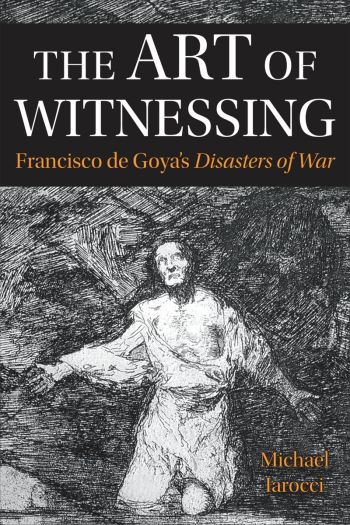 Widely acknowledged as a major turning point in the history of visual depictions of war, Francisco de Goya’s renowned print series The Disasters of War remains a touchstone for serious engagement with the violence of war and the questions raised by its artistic representation. The Art of Witnessing provides a new account of Goya’s print series by taking readers through the forty-seven prints he dedicated to the violence of war. Drawing on facets of Goya’s artistry rarely considered together before, the book challenges the notion that documentary realism and historical testimony were his primary aims. Michael Iarocci argues that while the depiction of war’s atrocities was central to Goya’s project, the lasting power of the print series stems from the artist’s complex moral and aesthetic meditations on the subject. Making novel contributions to longstanding debates about historical memory, testimony, and the representation of violence, The Art of Witnessing tells a new story, print by print, to highlight the ways in which Goya’s masterpiece extends far beyond conventional understandings of visual testimony.
Michael Iarocci is a professor of Spanish Literature and Culture at the University of California, Berkeley.
C O N T E N T S
Preface
Introduction
1 Tristes presentimientos de lo que ha de acontecer
2 Con razón o sin ella
3 Lo mismo
4 Las mujeres dan valor
5 Y son fieras
6 Bien te se está
7 Qué valor!
8 Siempre sucede
9 No quieren
10 Tampoco
11 Ni por ésas
12 Para eso habéis nacido
13 Amarga presencia
14 Duro es el paso!
15 Y no hay remedio
16 Se aprovechan
17 No se convienen
18 Enterrar y callar
19 Ya no hay tiempo
20 Curarlos y a otra
21 Será lo mismo
22 Tanto y más
23 Lo mismo en todas partes
24 Aún podrán servir
25 También éstos
26 No se puede mirar
27 Caridad
28 Populacho
29 Lo merrecía
30 Estragos de la guerra
31 Fuerte cosa es
32 Por qué?
33 Qué hay que hacer más?
34 Por una navaja
35 No se puede saber por qué
36 Tampoco
37 Esto es peor
38 Bárbaros!
39 Grande hazaña! Con muertos!
40 Algún partido saca
41 Escapan entre llamas
42 Todo va revuelto
43 Tambien esto
44 Yo lo vi
45 Y esto también
46 Esto es malo
47 Así sucedió
Afterword
Notes
Bibliography
Print Quarterly, March 2023
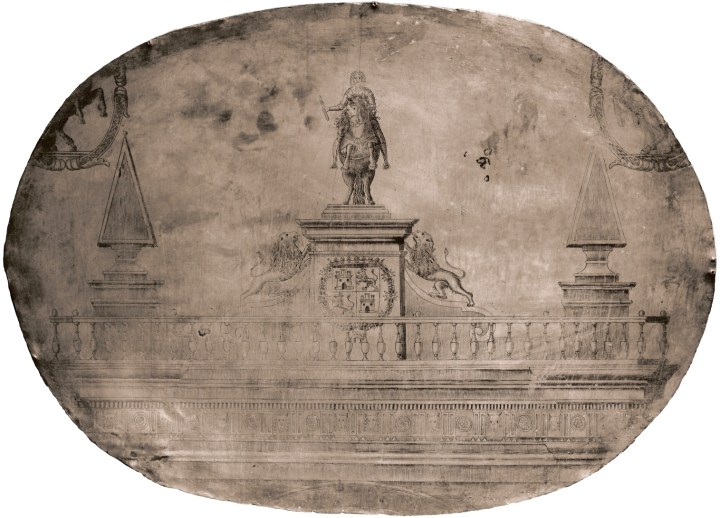
Juan Francisco Rosa, Equestrian Monument to Philip V, ca. 1738–45, engraved copper-plate, 26 × 36 cm (Chicago: Carl and Marilynn Thoma Foundation). The plate was cut into an oval, likely from what was originally a rectangle, and used as a support for an oil painting; on the other side is The Christ Child with St Joseph.
◊ ◊ ◊ ◊ ◊
The long eighteenth century in the latest issue of Print Quarterly:
Print Quarterly 40.1 (March 2023)
A R T I C L E S
• Emily C. Floyd with Suzanne Stratton-Pruitt, “Juan Francisco Rosa: Engraver to the Elite in Eighteenth-Century Lima,” pp. 33–51.
This article explores the life and works of the limeño engraver Juan Francisco Rosa (active in Lima, Peru, 1735–1756), with in-depth discussions pertaining to popular themes in his prints, patrons and contributions to the historic documentation of events and lost works in Lima. It adds two remarkable works to his oeuvre—a copperplate, now cut in two, and an illumination associated with a patent of nobility. The plate documents a famous statue of Philip V that was placed in 1738 on the bridge over the river Rímac and soon destroyed in the 1746 earthquake. The article demonstrates that Rosa produced important commissions for powerful organizations and individuals in the viceregal hierarchy, suggesting his prominence as an artist in mid-eighteenth-century Lima.
N O T E S A N D R E V I E W S
• Antony Griffiths, “Altered Plates,” pp. 63–66. Drawing attention to an anecdote in a 1726 biography of the London publisher, newspaper editor, and controversialist Abel Roper, this note charts the chronology of an altered plate by William van de Passe depicting the Duke of Buckingham on horseback in the first state, published 1625. The plate was then modified around 1630/32 in the second state to represent James, 1st Duke of Hamilton, before being transformed again in the third state of 1654–58 to portray Oliver Cromwell as Lord Protector. The plate is documented to have been subjected to a fourth “very profitable” change, altered to portray William III, though no impression has yet been found.

Romeyn de Hooghe, Les Monarches Tombants (James II falls off the back of a unicorn at left, Louis XIV on a globe at right, while William III is raised on a shield in the background), 1689, etching, sheet includes letterpress text below the image (Amsterdam: Rijksmuseum).
• Peter van der Coelen, Review of Meredith McNeill Hale, The Birth of Modern Political Satire: Romeyn de Hooghe (1645–1708) and the Glorious Revolution (Oxford University Press, 2020), pp. 66–68. Peter van der Coelen is persuaded by Hale’s argument that the satires De Hooghe produced between 1688 and 1690 were decisive for the development of political satire as a genre and that the birth of the genre should therefore be located not in eighteenth-century England but in the Dutch Republic of the late seventeenth century.
• Helmut Gier, Review of Eckhard Leuschner and Friedrich Polleross, eds., “Der Augsburger Kupferstecher und Verleger Johann Ulrich Kraus (1655–1719),” in Frühneuzeit-Info 32 (2021), pp. 68–71. A review of nine conference papers addressing Johann Ulrich Kraus, one of whose most important contributions to the history of art was the reception and dissemination in central Europe of the art favoured at the court of Louis XIV.
• Stephen Salel, Review of Timothy Clark, Hokusai: The Great Picture Book of Everything (British Museum Press, 2021), pp. 71–73.
• Janis A. Tomlinson, Review of the exhibition catalogue, Véronique Gerard, ed., Goya: Génie d’Avant-Garde. Le Maître et son École (Musée des Beaux-Arts and Éditions Snoeck, 2020), and “Goya peintre,” in Technè 53 (2022), pp. 73–75. Did Goya have a workshop? Whereas Goya’s prints seem to be a well-defined body of work, whose technique has been well-studied, as have their preparatory drawings and visual and historical sources, the paintings are another matter. Imitations, copies and forgeries began to circulate within a decade of Goya’s death and continue to complicate our understanding of his oeuvre. . . [These] two contributions . . . address some of these questions in very different ways.
• Heather Hyde Minor, Review of Ginevra Mariani, ed., Giambattista Piranesi: Matrici incise 1743–1753 (Edizioni Gabriele Mazzotta, 2010); Giambattista Piranesi: Matrici incise 1756–1757. Le Antichità Romane Lettere di giustificazione 2 (Edizioni Gabriele Mazzotta, 2014); Giambattista Piranesi: Matrici incise 1761–1765 (Editalia, 2017); and Giambattista Piranesi: Matrici incise 1762–1769 (De Luca Editori d’arte, 2020), pp. 102–06. This review explores the four-volume series of publications dedicated to cataloguing and discussing the 964 autograph printing plates by Giovanni Battista Piranesi in the collection of the Istituto Centrale per la Grafica in Rome. Further Matrici incise volumes are expected to be published in due course.
• Roger Kneebone, Review of the exhibition catalogue, Monique Kornell, ed., Flesh and Bones: The Art of Anatomy (Getty Research Institute, 2022), pp. 106–11. This review highlights the complex intersections between artists, engravers, anatomists and clinicians over four centuries. Worthy of note are the ways multiple perspectives from different kinds of parties informed the appearance of anatomical illustrations depending on their purpose and audience, resulting in images that were not always neutral in their ‘factual’ representations.
New Book | The Sewing Girl’s Tale
John Sweet’s book The Sewing Girl’s Tale was recently awarded a Bancroft Prize in American History and Diplomacy. Sweet will be speaking at the American Philosophical Society next week.
John Wood Sweet, The Sewing Girl’s Tale
American Philosophical Society, Philadelphia, 23 March 2023, 6pm
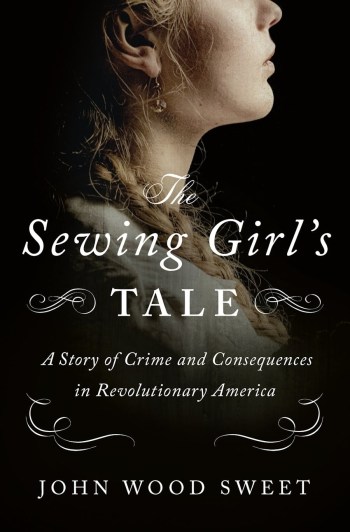 On a moonless night in the summer of 1793 a crime was committed in the back room of a New York brothel―the kind of crime that even victims usually kept secret. Instead, seventeen-year-old seamstress Lanah Sawyer did what virtually no one in US history had done before: she charged a gentleman with rape. Her accusation sparked a raw courtroom drama and a relentless struggle for vindication that threatened both Lanah’s and her assailant’s lives. The trial exposed a predatory sexual underworld, sparked riots in the streets, and ignited a vigorous debate about class privilege and sexual double standards. The ongoing conflict attracted the nation’s top lawyers, including Alexander Hamilton, and shaped the development of American law. The crime and its consequences became a kind of parable about the power of seduction and the limits of justice. Eventually, Lanah Sawyer did succeed in holding her assailant accountable―but at a terrible cost to herself. Based on rigorous historical detective work, this book takes us from a chance encounter in the street into the sanctuaries of the city’s elite, the shadows of its brothels, and the despair of its debtors’ prison. The Sewing Girl’s Tale shows that if our laws and our culture were changed by a persistent young woman and the power of words two hundred years ago, they can be changed again.
John Wood Sweet, The Sewing Girl’s Tale: A Story of Crime and Consequences in Revolutionary America (New York, Henry Holt and Co., 2022), 384 pages, ISBN: 978-1250761965, $30.
John Wood Sweet is a professor of history at the University of North Carolina at Chapel Hill and former director of UNC’s Program in Sexuality Studies. He graduated from Amherst College (summa cum laude) and earned his PhD in History at Princeton University. His first book, Bodies Politic: Negotiating Race in the American North, was a finalist for the Frederick Douglass Prize. He has served as a Distinguished Lecturer for the Organization of American Historians, and his work has been supported by fellowships from the National Endowment for the Humanities, the Mellon Foundation, the National Humanities Center, the Institute for Arts and Humanities at UNC, the Gilder Lehrman Center at Yale, the McNeil Center at Penn, and the Center for Global Studies in Culture, Power, and History at Johns Hopkins.
New Book | Courtly Gifts and Diplomacy, British-Russian Relations
From Brill:
Louise Hardiman, ed., Courtly Gifts and Cultural Diplomacy: Art, Material Culture, and British-Russian Relations (Leiden: Brill, 2023), 400 pages, ISBN: 978-3506793768, $155. From Brill’s Russian History and Culture series, volume 24.
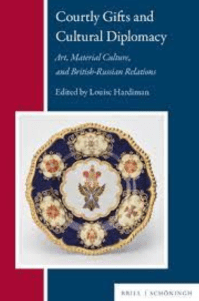 Courtly Gifts and Cultural Diplomacy explores the history of British-Russian state relations from the perspective of art and material culture. This richly illustrated book presents manifold practices of courtly gift-giving and vivid case studies of British-Russian artistic diplomacy over the centuries. It traces a visual and material history of cross-cultural dialogue that starts with an early English map of Russia made in the 16th century and ends with gifts of Fabergé art objects and domestic photographs exchanged between the British royal family and the family of Tsar Nicholas II in late Imperial Russia. Twelve expert authors from academia, the arts, and the museum sectors in Britain, Russia, and the United States present new narratives and critical interpretations based on material from previously unexplored archives. Their diverse approaches reveal the importance of artistic diplomacy and the agency of gifts of art and material culture in courtly and state relations.
Louise Hardiman is an independent academic and lecturer specialising in Russian, Ukrainian, and Soviet art and the history of British-Russian cultural relations. Her publications and ongoing research focus mainly on the art and design history of late imperial Russia and the involvement of women in cross-cultural artistic exchange. She has also published two illustrated books of Russian folk tales by the nineteenth-century artist Elena Polenova.
C O N T E N T S
Acknowledgements
List of Illustrations
Notes on Contributors
Conventions
1 Introduction: Visual Culture and the History of British-Russian Relations — Louise Hardiman
Part I: Art and Diplomacy
2 Art and Acculturation: Sir Godfrey Kneller’s Portraits of Petr Potemkin (1682) and Peter the Great (1698) — Louise Hardiman
3 Catherine II, the Cathcarts, and Russian Anglophilia — Anthony Cross
4 Prince Grigorii Potemkin, Sir Joshua Reynolds, and Anglo-Russian Artistic Diplomacy in the Age of Catherine the Great — Elizaveta Renne
Part II: The Agency of Gifts
5 ‘Give with One Hand and Take with the Other’: British Diplomatic Gifts to Russia, 1795–97 — Ekaterina Heath
6 Courtly Splendour and Cultural Identity: Nineteenth-Century Russian Imperial Gifts for the British Royal Family — Caroline de Guitaut
7 Alfred, Lord Tennyson and an Imperial Russian Gift — Olga Sobolev
8 Fabergé Hardstone in Imperial Gifting from Russia to England — Cynthia Coleman Sparke
Part III: Travels and Dialogues
9 Gavriil Skorodumov and James Walker: Printmaking and British-Russian Relations in the Late Eighteenth Century — Zalina Tetermazova
10 ‘Smart Travels’: The Encounters of Grand Duke Nicholas with British Art and Artists, 1816–17 — Irina Marisina
11 Tsar Alexander I, Sir Thomas Lawrence, and George Dawe: Masculinity and the Development of the St Petersburg Military Gallery — Allison Leigh
Part IV: Dynasties and Domesticities
12 The Wedding of Alfred, Duke of Edinburgh and Maria Alexandrovna of Russia in 1874 and its Visual Commemoration — Stephen Patterson
13 Images of Nicholas II: (Mis-)interpreting the Last Tsar — Wendy Slater
Index
New Book | Chinese Rank Badges
Distributed by The University of Chicago Press:
David Hugus, Chinese Rank Badges: Symbols of Power, Wealth, and Intellect in the Ming and Qing Dynasties (Hong Kong University Press, 2022), 280 pages, ISBN: 978-9627956457, $65.
 Both utilitarian objects and examples of textile design of wondrous beauty, Chinese rank badges were developed in the Ming and Qing dynasties to indicate the bearer’s station in the civil or military bureaucracies. David Hugus centers his study on their chronology and iconography, accompanying his work with beautiful color illustrations. Beginning with the earliest dynastic period to the end of the imperial period, and beyond to the present day, Hugus’s analyses of the style and iconography of Chinese rank badges provide the reader with the tools to recognize the circumstances of individual badge design and to develop a basis for connoisseurship.
David Hugus is a longtime collector of Chinese rank badges. He is the co-author of Ladder to the Clouds.
New Book | The Full-Length Mirror
Distributed by The University of Chicago Press:
Wu Hung, The Full-Length Mirror: A Global Visual History (London: Reaktion Books, 2023), 288 pages, ISBN: 978-1789146103, $35.
 Beautifully illustrated, a stirring and wide-ranging reflection on art, technology, culture—and the full-length mirror.
This book tells two stories about the full-length mirror. One story, through time and space, crisscrosses the globe to introduce a broad range of historical actors: kings and slaves, artists and writers, merchants and craftsmen, courtesans, and commoners. The other story explores the connections among objects, painting, and photography, the full-length mirror providing a new perspective on historical artifacts and their images in art and visual culture. The Full-Length Mirror represents a new kind of global art history in which ‘global’ is understood in terms of both geography and visual medium, a history encompassing Europe, Asia, and North America, and spanning over two millennia from the fourth century BCE to the early twentieth century.
Wu Hung is the Harrie A. Vanderstappen Distinguished Service Professor, director for the Center for the Art of East Asia, and consulting curator at the Smart Museum of Art, all at the University of Chicago.
C O N T E N T S
Prelude A Prehistory of the Full-Length Mirror
Part One: Object and Reflection
1 From Versailles to the Forbidden City: The Global Invention of the Full-Length Mirror
2 From the House of Green Delights to the Hall of Mental Cultivation: Mirror-Screens in the Literary and Visual Imagination
Part Two: Medium and Subjectivity
3 From Europe to the World: The Global Circulation of Full-Length Mirror Photography
4 From Iconography to Subjectivity: Discovering the Self in the Full-Length Mirror
Coda: Disenchantment of the Full-Length Mirror
References
Select Bibliography
Photo Acknowledgments
Index
Lectures | John Finlay and Kristel Smentek on China and France
From BGC:
John Finlay and Kristel Smentek | China and France in the Intercultural 18th Century
Bard Graduate Center, New York, 19 April 2023, 6.00pm
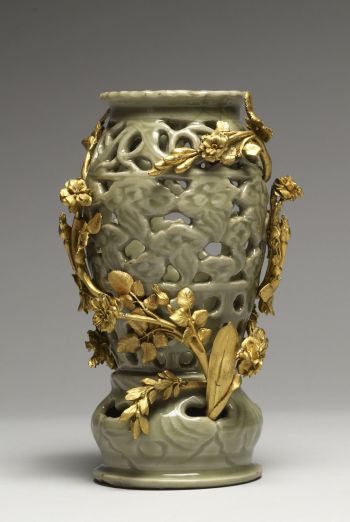
Long Quan celadon lamp, 15th–16th century, Ming dynasty, porcelain, with French gilt mounts, mid-18th century, gilt bronze (Baltimore: The Walters Art Museum, 49.1508).
A Françoise and Georges Selz Lecture Duet on Eighteenth- and Nineteenth-Century French Decorative Arts and Culture with John Finlay and Kristel Smentek. In this pairing of mini-lectures, scholars John Finlay and Kristel Smentek offer complementary views on arts and intercultural exchange between France and China in the eighteenth century.
John Finlay | Henri Bertin and the Representation of China in 18th-Century France
The role of Henri-Léonard Bertin (1720–1792), who served as a minister of state under Louis XV, is crucial to understanding the encounters between China and France in the eighteenth century. Bertin first established his contact with the French Jesuits in Beijing through two Chinese Catholic priests, Aloys Ko and Étienne Yang. When the missionaries returned to China in 1765, they took with them an important set of gifts to be presented to the Qianlong emperor. Not to be misconstrued as tribute from France to China, these gifts were intended to stimulate Chinese interest in French culture and French artistic production.
Kristel Smentek | Disorienting China: Negotiating the Foreign in 18th-Century France
As European trade with the Qing empire accelerated in the eighteenth century, France was flooded with objects from China whose technologies, materials, and motifs challenged European understanding. These ranged from the lacquers and porcelains with which historians are familiar, to scroll paintings, bronzes, and worked jades whose presence in eighteenth-century Europe is far less studied. This talk investigates the display and material alteration of Asian imports in France and the design of new objects in response to them—strategies by which the French negotiated the pleasures and disorientations of China’s arts.
Formerly a curator of Chinese art, John Finlay is an independent scholar based in Paris, affiliated with the Centre d’Études sur la Chine Moderne et Contemporaine (CECMC). He began his academic career studying paintings and prints produced for the Qing imperial court in the eighteenth century. His current research focuses on Henri-Léonard Bertin (1720–1792), who served as a minister of state under Louis XV. His passion for all things Chinese placed him at the center of intersecting networks of like-minded individuals who shared his vision of China as a nation from which France had much to learn.
Kristel Smentek is associate professor of art history in the Department of Architecture at MIT. Her research focuses on eighteenth-century European graphic and decorative arts in their transcultural contexts. She is the author of Mariette and the Science of the Connoisseur in Eighteenth-Century Europe (2014), co-curator of Dare to Know: Prints and Drawings in the Age of Enlightenment recently on view at the Harvard Art Museums, and co-editor of its accompanying catalogue. She is currently completing Disorient: Arts from China in Eighteenth-Century France, a book investigating French responses to Chinese imports over the course of the long eighteenth century.
Registration is available here»
New Book | In Asian Waters
From Princeton UP:
Eric Tagliacozzo, In Asian Waters: Oceanic Worlds from Yemen to Yokohama (Princeton: Princeton University Press, 2022), 512 pages, ISBN: 978-0691146829, £30 / $35.
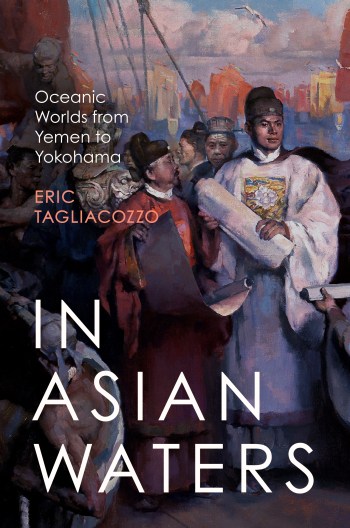 A sweeping account of how the sea routes of Asia have transformed a vast expanse of the globe over the past five hundred years, powerfully shaping the modern world.
In the centuries leading up to our own, the volume of traffic across Asian sea routes—an area stretching from East Africa and the Middle East to Japan—grew dramatically, eventually making them the busiest in the world. The result was a massive circulation of people, commodities, religion, culture, technology, and ideas. In this book, Eric Tagliacozzo chronicles how the seas and oceans of Asia have shaped the history of the largest continent for the past half millennium, leaving an indelible mark on the modern world in the process. Paying special attention to migration, trade, the environment, and cities, In Asian Waters examines the long history of contact between China and East Africa, the spread of Hinduism and Buddhism across the Bay of Bengal, and the intertwined histories of Islam and Christianity in the Philippines. The book illustrates how India became central to the spice trade, how the Indian Ocean became a ‘British lake’ between the seventeenth and nineteenth centuries, and how lighthouses and sea mapping played important roles in imperialism. The volume ends by asking what may happen if China comes to rule the waves of Asia, as Britain once did. A novel account showing how Asian history can be seen as a whole when seen from the water, In Asian Waters presents a voyage into a past that is still alive in the present.
Eric Tagliacozzo is the John Stambaugh Professor of History at Cornell University. His books include Secret Trades, Porous Borders: Smuggling and States along a Southeast Asian Frontier, 1865–1915 and The Longest Journey: Southeast Asians and the Pilgrimage to Mecca.
The table of contents is available here»
Exhibition | Across Shared Waters
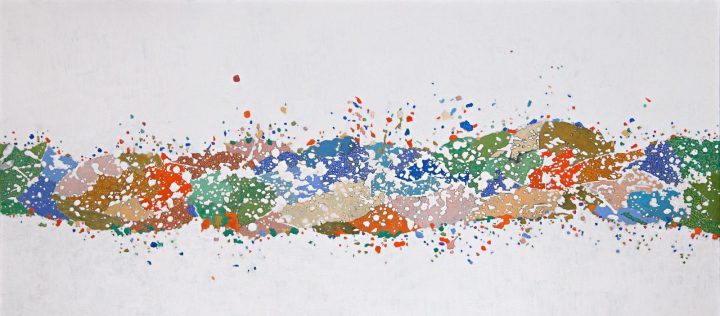
Pema Rinzin, Abstract Sound #4, 2010, ground mineral pigment on wooden panel. Rinzin was born in 1966 in Tibet; studied in Dharamsala, India; lived and worked in Nagano, Japan and Wurzburg, Germany; and now lives and works in New York City.
◊ ◊ ◊ ◊ ◊
From the press release for the exhibition:
Across Shared Waters: Contemporary Artists in Dialogue with Tibetan Art from the Jack Shear Collection
Williams College Museum of Art, Williamstown, Massachusetts, 17 February — 16 July 2023
Organized by Ariana Maki, with Elizabeth Gallerani and Nicholas Liou, with research support from Priya Rajbhandary and Tibetan translation by Rongwo Lugyal
The Williams College Museum of Art (WCMA) is delighted to present Across Shared Waters: Contemporary Artists in Dialogue with Tibetan Art from the Jack Shear Collection, on view from 17 February through 16 July 2023. Much as the headwaters of Asia’s major rivers form in the Tibetan plateau and flow into the world’s seas, interest in Tibetan art and culture has circulated globally, inspiring artists within Tibetan regions and throughout the world. Across Shared Waters presents works by 11 contemporary artists of Himalayan heritage alongside traditional Tibetan Buddhist rolled paintings, or thangka, from the Jack Shear Collection, a juxtaposition that highlights the richness and diversity of Tibetan artistic expression and fosters greater understanding and appreciation of Himalayan histories and identities.
 Traditional works in Across Shared Waters are part of a generous initiative by collector Jack Shear to foster collaboration among the art museums of Williams, Skidmore, and Vassar Colleges. The paintings and other objects comprising the gift will be used for education, research, and informed display. Across Shared Waters is the second in a series of exhibitions of the Jack Shear Collection of Tibetan Art. The first, Mastery and Merit: Tibetan Art from the Jack Shear Collection, was on view at the Loeb Center at Vassar College in the spring and summer of 2022. The third exhibition will be on view at the Tang Teaching Museum at Skidmore College beginning in August 2023.
The WCMA exhibition is organized by guest curator Ariana Maki, the Associate Director of the University of Virginia Tibet Center and Bhutan Initiative, with Elizabeth Gallerani, Curator of Mellon Academic Programs, and Nicholas Liou, Mellon Curatorial Fellow and MA ’24, along with research support from Curatorial Intern Priya Rajbhandary ’25. Tibetan translation is provided by Rongwo Lugyal.
Pamela Franks, Class of 1956 Director of WCMA, said, “The Williams College Museum of Art is thrilled to participate in this visionary, collaborative approach that engages three leading liberal arts colleges and expands our collective research and teaching capacities to appropriately present this important work. This initiative highlights WCMA’s ongoing commitment of both sharing the art itself and collaborating across institutions to strengthen the pedagogical approaches and research resources within our teaching museum. I am so grateful to Jack Shear, our colleagues at the Skidmore and Vassar museums, and for the engaged scholarship of guest curator Ariana Maki throughout the development of these three exhibitions. We look forward to collaboration long into the future.”
“The Shear Collection provides remarkable examples of traditional Tibetan Buddhist art and its wide range of uses and meanings,” Maki said. “As the academic approach to Buddhism is generally text-focused, the paintings and 3-D objects from Shear offer faculty an incredible set of resources to further enrich their courses and help broaden student understanding of Buddhist practices. Displaying these works allows everyone direct access to better study and appreciate how historical artists masterfully gave form to highly sophisticated philosophical principles.
“It’s exciting to experience the traditional works alongside contemporary paintings and photography. The juxtaposition reflects the innovations and incredible creativity of Himalayan makers, whose works invite us into their lived experiences and challenge us to consider issues that both impact them as individuals and all of us as members of a global society,” Maki said.
Created between the 18th and 20th centuries, the thangka feature elaborate depictions of Buddhist narratives, deities, and practices. Talented, highly trained artists produced engaging scenes detailing the lives of the Buddha, chronicled incarnation lineages, and transmitted teaching stories. Some works would be used by initiates to support advanced meditation techniques while others depict deities who aid Buddhist practitioners with everyday concerns, granting blessings of wealth, long life, protection, or healing.
The traditional thangka are displayed in conversation with contemporary works by featured artists based around the world, including Marie-Dolma Chophel, Dedron, Nyema Droma, Gonkar Gyatso, Tenzin Norbu Lama, Kesang Lamdark, Tashi Norbu, Karma Phuntsok, Pema Rinzin, Rabkar Wangchuk, and Palden Weinreb. While some draw inspiration from Tibetan cultural markers, including repurposing or reimagining Buddhist imagery, others source inspiration completely outside those frames. Exploring themes of identity, consumerism, place, and cultural expectations, the artists employ a diverse range of media, from ground mineral pigments to acrylic paint, digital photography, mixed media works, and resin cast sculptures.
A complete press kit including images can be found here»
Poster Images Left: Lama Tashi Norbu, Accepting Flowers’ Culture, 2013, mixed media (Shelley and Donald Rubin Private Collection). Norbu was born 1974 in Jigmenang, Bhutan, studied in Dharamsala, India and Ghent, Belgium; and now lives and works in Emmen, The Netherlands.
Right: Unidentified maker, Shakyamuni Buddha with Arhats and Four Guardian Kings, eighteenth century, distemper on cloth, Central Tibetan style (Jack Shear Collection of Himalayan Art).










 Enfilade
leave a comment