Iris Moon and Rachel Silberstein on Feminist Revisions of Chinoiserie
An upcoming research seminar at the Paul Mellon Centre:
Iris Moon and Rachel Silberstein on Feminist Revisions of Chinoiserie
Online and in-person, Paul Mellon Centre, London, Wednesday, 22 March 2023, 5–7pm
Part of the series ‘In Conversation: New Directions in Art History’, which will explore the changing modes and methodologies of approaching visual and material worlds. Book tickets here.
Iris Moon — The Woman in the Mirror
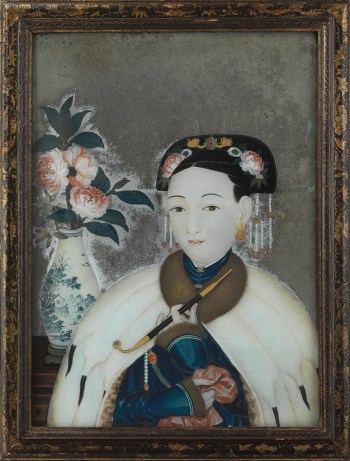
Woman with a Pipe, ca. 1760–80, reverse-painted crown glass, imitation lacquer frame, 52 × 40 × 3 cm (New York: The Metropolitan Museum of Art, Larry and Ann Burns Gift, in honor of Austin B. Chinn, 2022.52).
Chinoiserie, a style of decoration that emerged in early modern Europe, has typically been pictured as a neutral, harmless, and nostalgic fantasy of the ‘exotic’ Far East, one that was embodied by the traffic, trade and ravenous consumption of luxury objects such as mirrors, wallpaper, furniture, and porcelain. Though Chinoiserie is often pictured as encompassing a wide field of material production, it has rarely been considered as part of the contested forms of subjectivity that emerged in the eighteenth century. This presentation proposes that we rethink the history of Chinoiserie. It asks what a feminist approach to Chinoiserie might look like, and what the ramifications are for British decorative arts in positioning Chinoiserie at the inflection point of racialised and gendered forms of subjectivity that continue to exert a hold on the present. Building on a rich and growing body of critical and theoretical literature, the presentation nonetheless anchors the discussion of Chinoiserie in a formal analysis of a group of reverse-painted mirrors made for the British market. These eighteenth-century mirrors picture women, both real and imagined, in different modes of dress and postures, painted on the reverse side of the glass scraped of its reflective surface. Scholars have relegated these export objects to a secondary status, considering them as trade paintings of little artistic merit, refusing in turn to probe the subtle and complex questions they raise about gender, identity, power, representation, and reflection. Yet these are the questions that materialise when standing before the mirrors. You ask: Who is the woman in the mirror? Myself or another? Where do I position myself? Who am I supposed to be?
Iris Moon is an assistant curator in the European Sculpture and Decorative Arts Department at The Metropolitan Museum of Art, where she is responsible for European ceramics and glass. At The Met, she participated in the reinstallation of the British Galleries, and she is currently planning an exhibition on Chinoiserie, women, and the porcelain imaginary that will open in 2025. She is the author of Luxury after the Terror, and co-editor with Richard Taws of Time, Media, and Visuality in Post-Revolutionary France. A new book on Wedgwood, generously supported by a publication grant from the Paul Mellon Centre, will be published next year with MIT Press. In addition to curatorial work, she teaches at Cooper Union.
◊ ◊ ◊ ◊ ◊
Rachel Silberstein — The Women on the Garment
Chinese material culture offers several routes for a feminist approach to Chinoiserie. One could counter its insistence on the generic Chinese woman by exploring histories of specific Chinese women: the Qing dynasty social counterparts of the privileged European women who purchased Chinoiserie silks, porcelains, and mirrors. Their consumption, especially of textiles and fashion, offers an arena of specificity, agency, and control that refutes Chinoiserie’s imagined Qing beauties: languorous and ahistorical. Alternatively, one could consider a different counterpart: Qing society’s engagement with images of European women. Though such imagery may not have travelled far beyond the imperial palace, recent scholarship has clarified how European textiles, architecture, and dress fascinated those elites able to access such new visualities, introduced by Jesuit missionaries, print culture, and the East India Companies.
But perhaps most intriguing when considering Chinoiserie’s potential for contesting female subjectivities is to understand it not as a European fantasy unrelated to Chinese practice, but rather a shared global visual space whose dynamic was driven by fashion. Accordingly, the presentation focuses on a genre of Qing fashion: the embroidered figures of beauties that adorned the fabrics and trimmings of the mid-late period jackets, robes, and accessories. Similar to the eighteenth-century mirror designed for a European consumer, these embroideries depict women, both real and imagined, in different postures and dress. In the same way as the eighteenth-century mirror, the embroideries derived from imagery circulating in pattern books and print culture. Yet, these embroideries were produced for Chinese female consumers and, in an intriguing act of self-referentiality, the female figures were placed on the very surface that covered the female wearer’s body. By showing how this fashion trend traversed different media, cities, and classes, this presentation explores how it allowed Chinese women a way of exploring identity by playing with narrative, and how this figural bricolage can be understood alongside European women’s consumption of Chinoiserie.
Rachel Silberstein is currently an adjunct assistant professor in the Department of Art History at the University of Florida. She has also taught courses in fashion history and art history at Rhode Island School of Design, the University of Washington, and the University of Puget Sound. Her research focuses on textiles, dress, and fashion in Chinese and global history. Her monograph, A Fashionable Century: Textile Artistry and Commerce in the Late Qing (University of Washington Press, 2020)—a study of fashion and textile handicrafts in early modern China—won the Costume Society of America’s Millia Davenport Publication Award 2021. Rachel has published widely on Qing fashion in the journals West 86th, Fashion Theory, Costume, and Late Imperial China. Forthcoming publications include an essay on Ming-Qing Fashion in the Cambridge Encyclopedia of Global Fashion. She has also served as a consultant on Chinese dress collections and exhibits at museums including the Fine Arts Museums of San Francisco, Rhode Island School of Design Museum, Seattle’s Museum of History & Industry, and the Cooper Hewitt Smithsonian Design Museum.
New Book | Pearl: Nature’s Perfect Gem
Distributed by The University of Chicago Press:
Fiona Lindsay Shen, Pearl: Nature’s Perfect Gem (London: Reaktion Books, 2022), 256 pages, ISBN: 978-1789146219, $35.
 From their creation in the maw of mollusks to lustrous objects of infatuation and conflict, a revealing look at pearls’ dark history.
This book is a beautifully illustrated account of pearls through millennia, from fossils to contemporary jewelry. Pearls are the most human of gems, both miraculous and familiar. Uniquely organic in origin, they are as intimate as our bodies, created through the same process as we grow bones and teeth. They have long been described as an animal’s sacrifice, but until recently their retrieval often entailed the sacrifices of enslaved and indentured divers and laborers. While the shimmer of the pearl has enticed Roman noblewomen, Mughal princes, Hollywood royalty, mavericks, and renegades, encoded in its surface is a history of human endeavor, abuse, and aspiration—pain locked in the layers of a gleaming gem.
Fiona Lindsay Shen is an art historian and director of the Escalette Permanent Collection of Art at Chapman University in California.
C O N T E N T S
Preface: Sarah Siddons’s Necklace
1 The Oyster’s Autobiography
2 Harvest
3 Culturing Pearls, Capturing Markets, Cultivating Brands
4 The Seven Pearly Sins
5 And the Seven Virtues
6 Embodied
References
Bibliography
Acknowledgments
Photo Acknowledgments
Index
Sweden Nationalmuseum Acquires Self-Portrait by Périn-Salbreux
From the press release (1 March 2023) . . .

Lié-Louis Périn-Salbreux, Self-Portrait, ca. 1800–10, black crayon, stumped and elevated with white crayon, on paper, 26.5 × 22 cm (Stockholm: Nationalmuseum NMB 2819; photo by Anna Danielsson).
Nationalmuseum has acquired a self-portrait by Lié-Louis Périn-Salbreux, a French miniaturist. The piece is one of the artist’s later works and, unlike many of his other self-portraits, is unusually modest and largely free from affectation. Périn was heavily influenced by the Swedish artist Peter Adolf Hall and enjoyed his greatest success during the years immediately before and after the French Revolution.
Lié-Louis Périn-Salbreux (1753–1817) was born in Reims, the son of a wool manufacturer. At the age of 19, he arrived in Paris to be a pupil in the studio of Jean-Baptiste Vien. By the following year, 1773, he had already been admitted to the academy of fine arts as a student, as Vien was the academy’s director. There, Périn encountered other influential artists, including Alexander Roslin, the Swedish-born portrait painter. His friendship with Roslin was to prove crucial to his future success, giving him access to several high-ranking clients, including members of the royal family, of whom Périn painted small, intimate portraits in oils. But it was as a miniature portraitist that Périn was to make his name. His training in this art form was acquired privately rather than at the academy, and the best-known of his teachers was Louis Marie Sicardi.
Roslin was generous with his support, not only referring clients but also commissioning Périn to paint portraits of Roslin himself and his wife, Marie Suzanne Giroust, which are now in the Nationalmuseum collection. The miniaturist also painted other family members, including Roslin’s daughter-in-law Adélaïde and grandson Abraham—a portrait acquired by Nationalmuseum fairly recently. What was more, Roslin entrusted Périn with creating miniature replicas of Roslin’s own oil portraits. Quite frequently, clients simply wanted a reduced version of their existing portrait, and it fell to Roslin’s younger colleague to carry out the job. One such example is a miniature replica of Roslin’s pastel portrait of the ill-fated Crown Prince Louis. Throughout the 1780s, Périn enjoyed a productive and successful career as a miniaturist without being elected to the academy. When the art world became more democratic during the Revolutionary period, he was able to exhibit at the Salon for eight years from 1791.
Périn soon adopted the free style of Swedish miniaturist Peter Adolf Hall, with its vibrating brushwork, and through Roslin he made direct contact with Hall. Like Hall, Périn employed elegant accents in the form of clothing and draperies. Both also liked to place their models in natural or parkland settings. However, Périn’s depiction of the models’ faces was more affected, with distinctive, almond-shaped eyes. Like Hall, Périn suffered when his wealthy clients emigrated during the French Revolution. As a result of monetary depreciation, Périn lost his capital and left Paris in 1799 to take charge of his family’s woollen mill in Reims. The newly married artist appended his wife’s maiden surname, Salbreux, to his own. Back in his hometown, he continued working as a portraitist, but mainly in oils and pastels. Hence his choice of technique for the self-portrait in black crayon, drawn sometime between 1800 and 1810, which was recently acquired by Nationalmuseum. Over many years, Périn produced self-portraits using various techniques, both in oils and in miniature format. These were often somewhat pretentious, indicating that the artist had a good conceit of himself, but in this relatively late work he takes a more restrained approach. The image is drawn with fine gradations in black crayon, stumped with elevations in white. Given the palpably graphic nature of the work, it is not surprising that it later provided the basis for an engraving by Henri-Joseph Dubouchet, many years after Périn’s death.
“In this sensitive self-portrait by Lie-Louis Perin-Salbreux, we see an artist with no great pretensions, with a gentle, understanding expression. This new acquisition joins Nationalmuseum’s collection of self-portraits by miniaturists, which is the only one of its kind in the world. So we are delighted to put this significant artwork on display in the Treasury,” said Magnus Olausson, director of collections.
Nationalmuseum receives no state funds with which to acquire design, applied art and artwork; instead the collections are enriched through donations and gifts from private foundations and trusts. This acquisition has been made possible by a generous donation from the Hjalmar and Anna Wicander Foundation.
Exhibition | Pierre Varignon (1654–1722)
Now on view at the Mazarin Library in Paris:
Pierre Varignon (1654–1722): Pratique et transmission des mathématiques à l’aube des Lumières
Bibliothèque Mazarine, Paris, 18 January — 15 April 2023
Curated by Sandra Bella, Jeanne Peiffer, and Patrick Latour
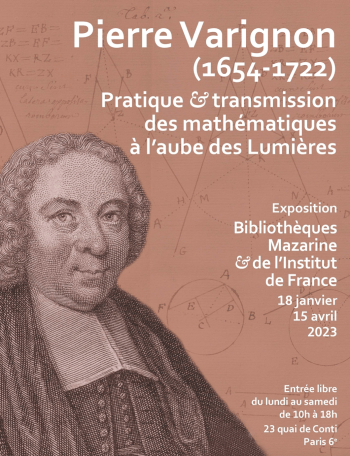 La carrière de Pierre Varignon, né à Caen en 1654 et mort à Paris en 1722, s’articule essentiellement autour de ses activités d’enseignant et d’académicien. Titulaire de la première chaire de mathématiques de l’Université de Paris, établie au Collège Mazarin dès l’ouverture de celui-ci en 1688, il fut aussi lecteur au Collège royal à partir de 1706, et contribua ainsi à la formation de nombreux savants et ingénieurs. L’Académie des sciences, dont il devint membre en novembre 1688 et au sein de laquelle il joua un rôle important, lui procura par ailleurs un cadre privilégié pour ses recherches, en facilitant leur diffusion à travers les périodiques académiques (Mémoires de l’Académie royale des sciences et Journal des savants).
En tant que géomètre, Varignon a su reconnaître le pouvoir d’innovation de l’analyse leibnizienne, dont il fut en France l’un des premiers défenseurs. Mais son activité scientifique se déploie sur de plus amples territoires. Sa carrière est encadrée par deux ouvrages, le Projet d’une nouvelle mechanique, qui lui ouvre en 1687 les portes du monde savant, et la Nouvelle mecanique ou statique, publiée de manière posthume en 1725. De fait ses apports à la mécanique sont aussi décisifs que variés, tant dans ses aspects théoriques (transposition en termes analytiques leibniziens des lois de la dynamique newtonienne, unification de la statique, travaux sur les forces centrales…) que dans ses applications pratiques.
Savant presque « ordinaire » à l’aube des Lumières, sans laisser d’œuvre aussi conséquente que certains de ses contemporains et correspondants européens comme Leibniz (1646–1716), Newton (1643–1727) ou encore les frères Jacques (1654–1705) et Jean (1667–1748) Bernoulli, Varignon contribue néanmoins, par son enseignement et ses travaux, à la constitution d’une tradition d’application des mathématiques et au développement de la mécanique analytique.
Commissariat
Sandra Bella (Université Paris Cité, Laboratoire SPHere)
Jeanne Peiffer (Centre Alexandre Koyré)
Patrick Latour (Bibliothèque Mazarine)
Exhibition | Crafting Worldviews: Art and Science in Europe, 1500–1800

Set of 24 Microscope Slides (signed: “AYpelaar & comp”), Netherlands, ca. 1808–11, brass, glass, ivory, mahogany, natural specimens, and a handwritten inscription in brown ink (Yale Peabody Museum, The Lentz Collection).
◊ ◊ ◊ ◊ ◊
From the press release for the exhibition:
Crafting Worldviews: Art and Science in Europe, 1500–1800
Yale University Art Gallery, New Haven, 17 February — 25 June 2023
Organized by Jessie Park and Paola Bertucci
The Yale University Art Gallery presents Crafting Worldviews: Art and Science in Europe, 1500–1800, an exhibition that showcases nearly 100 objects from across Yale University’s collections, including the Gallery, the Yale Peabody Museum, the Beinecke Rare Book and Manuscript Library, the Harvey Cushing/John Hay Whitney Medical Library, the Yale Center for British Art, and the Lewis Walpole Library, as well as the collection of Thomas Lentz, Professor Emeritus of Cell Biology at the Yale University School of Medicine. Co-organized by Jessie Park, the Nina and Lee Griggs Assistant Curator of European Art, and Paola Bertucci, Associate Professor, History of Science and Medicine Program at Yale University and Curator of the History of Science and Technology Division, Yale Peabody Museum, Crafting Worldviews examines the inseparable relationship among art, science, and European colonialism from the 16th through the 18th century—an era of voyage, trade, and Europe’s territorial dominance on a global scale. The objects included reveal histories of invention and appropriation, consumption and exploitation, collaboration and conflict.
The works featured in this multidisciplinary exhibition cross the modern-day boundaries of art and science and range from the everyday, such as books, maps, globes, drafting tools, microscopes, playing cards, and sundials, to the more unusual, such as a hand-cranked model of the solar system, an automaton clock, and anatomical figures. Crafted from both locally and globally obtained materials, including brass, ivory, mahogany, and ebony, these objects are remarkable not just for their exquisite design but also their intricate construction. Together, they illuminate the role that art and science have played in shaping Europeans’ understanding of the world and their place within it.
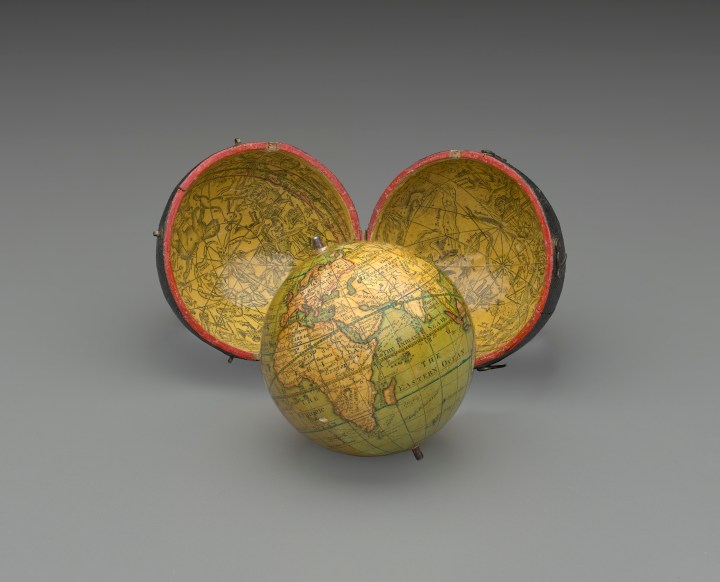
Pocket Globe with a Case (signed: “LANE’s Improved GLOBE | London”), England, ca. 1783–1803, hand-colored gores and steel; case: shagreen and brass (The Lentz Collection, on loan to the Yale Peabody Museum).
◊ ◊ ◊ ◊ ◊
The exhibition also addresses the intellectual, artistic, and scientific foundations of European colonialism, whose legacy continues in the present. According to Jessie Park, “In our current age of reckoning with racism and exploitation, we found it imperative to call our attention to the foundations of such forms of injustice. Visitors will encounter not only objects of noteworthy craftsmanship but also the realities of their production and consumption in the era of colonialism, which laid the groundwork for ongoing discrimination.”
Paola Bertucci notes that, for her, the exhibition “is a dream come true. I’ve always wanted to display scientific instruments to tell stories that we don’t typically associate with science. Early modern scientific instruments are usually presented in art museums as intriguing marvels. I was eager to emphasize instead the role of these objects in shaping European taste, everyday life, and a sense of superiority toward other cultures.”

Portable Sundial with a Compass (signed: “Butterfield AParis”), France, ca. 1690, silver, glass, and blued steel (The Lentz Collection, on loan to the Yale Peabody Museum of Natural History).
The exhibition is thematically divided into six sections. Serving as an introduction to the exhibition, “Voyages of Conquest” details the colonization of new lands through oceanic navigation, foregrounding objects such as the sextant, octant, compass, and theodolite as tools of power and dominance. Building on this introductory section is “Workshops of Power,” which explores how colonialism impacted and shaped the manufacture of both scientific instruments and everyday items made by skilled artisans. “Clockwork Cosmologies” features a variety of geared mechanisms—real and imagined—such as watches, astrolabes, and mills, to examine the ways in which Europeans visualized an orderly universe, measured time, or promoted colonial projects. “Consuming Science,” which presents the role of science in the education and social life of the elites, includes objects like tobacco pipes, shagreen-covered microscopes, and electrical machines made of mahogany. “Bodies of Nature” showcases anatomical illustrations, books on natural history, and other objects to address how scholars regarded scientific research as a hunt for the secrets of nature. Finally, “Worlds Seen and Unseen” examines the ways in which contemporary stereotypes about non-European worlds were articulated in portrayals of nature and people from Asia, Africa, and the Americas.
To assist the co-curators in sensitively addressing the topics presented in the exhibition, the Gallery formed an advisory committee. Members included Salwa Abdussabur (Founder and Creative Director, Black Haven), Marisa Bass (Professor, History of Art, Yale University), Adrienne L. Childs (Adjunct Curator at the Phillips Collection, Washington, D.C., and independent scholar), Meleko Mokgosi (Associate Professor and Director of Graduate Studies, Painting/Printmaking, Yale School of Art), Ayesha Ramachandran (Associate Professor, Comparative Literature, Yale University), Romita Ray (Associate Professor and Director of Undergraduate Studies, History of Architecture, Syracuse University), and Carolyn Roberts (Assistant Professor, History of Science and History of Medicine, and African American Studies, Yale University). Their insights were crucial for shaping this project.
New Book | Birth Figures
From The University of Chicago Press:
Rebecca Whiteley, Birth Figures: Early Modern Prints and the Pregnant Body (Chicago: The University of Chicago Press, 2023), 312 pages, ISBN: 978-0226823126, $49.
 The first full study of ‘birth figures’ and their place in early modern knowledge-making.
Birth figures are printed images of the pregnant womb, always shown in series, that depict the variety of ways in which a fetus can present for birth. Historian Rebecca Whiteley coined the term and here offers the first systematic analysis of the images’ creation, use, and impact. Whiteley reveals their origins in ancient medicine and explores their inclusion in many medieval gynecological manuscripts, focusing on their explosion in printed midwifery and surgical books in Western Europe from the mid-sixteenth to the mid-eighteenth century. During this period, birth figures formed a key part of the visual culture of medicine and midwifery and were widely produced. They reflected and shaped how the pregnant body was known and treated. And by providing crucial bodily knowledge to midwives and surgeons, birth figures were also deeply entangled with wider cultural preoccupations with generation and creativity, female power and agency, knowledge and its dissemination, and even the condition of the human in the universe. Birth Figures studies how different kinds of people understood childbirth and engaged with midwifery manuals, from learned physicians to midwives to illiterate listeners. Rich and detailed, this vital history reveals the importance of birth figures in how midwifery was practiced and in how people, both medical professionals and lay readers, envisioned and understood the mysterious state of pregnancy.
Rebecca Whiteley is a British Academy Postdoctoral Fellow at Birkbeck, University of London.
C O N T E N T S
List of Illustrations
A Note on Terminology
Introduction: Picture Pregnancy
Part I: Early Printed Birth Figures, 1540–1672
1 Using Images in Midwifery Practice
2 Pluralistic Images and the Early Modern Body
Part II: Birth Figures as Agents of Change, 1672–1751
3 Visual Experiments
4 Visualizing Touch and Defining a Professional Persona
Part III: The Birth Figure Persists, 1751–1774
5 Challenging the Hunterian Hegemony
Conclusion
Color Plates
Acknowledgments
Notes
Bibliography
Index
New Book | Phenomena: Doppelmayr’s Celestial Atlas
From The University of Chicago Press:
Giles Sparrow, with a foreword by Martin Rees, Phenomena: Doppelmayr’s Celestial Atlas (Chicago: The University of Chicago Press, 2022), 256 pages, ISBN: 978-0226824116, $65.
 Lavishly illustrated volume revealing the intricacies of a 1742 map of the cosmos.
The expansive and intricate Atlas Coelestis, created by Johann Doppelmayr in 1742, set out to record everything known about astronomy at the time, covering constellations, planets, moons, comets, and more, all rendered in exquisite detail. Through stunning illustrations, historical notes, and scientific explanations, Phenomena contextualizes Doppelmayr’s atlas and creates a spectacular handbook to the heavens.
Phenomena begins by introducing Doppelmayr’s life and work, placing his extraordinary cosmic atlas in the context of discoveries made in the Renaissance and Enlightenment and highlighting the significance of its publication. This oversized book presents thirty beautifully illustrated and richly annotated plates, covering all the fundamentals of astronomy—from the dimensions of the solar system to the phases of the moon and the courses of comets. Each plate is accompanied by expert analysis from astronomer Giles Sparrow, who deftly presents Doppelmayr’s references and cosmological work to a modern audience. Each plate is carefully deconstructed, isolating key stars, planets, orbits, and moons for in-depth exploration. A conclusion reflects on the development of astronomy since the publication of the Atlas and traces the course of the science up to the present day. Following the conclusion is a timeline of key discoveries from ancient times onward along with short biographies of the key players in this history.
Giles Sparrow is an author, editor, and consultant specializing in popular science, astronomy, and space technology. His books include The Stargazer’s Handbook, Physics in Minutes: 200 Key Concepts Explained in an Instant and The Cosmic Gallery: The Most Beautiful Images of the Universe.
New Book | Seventeenth-Century Water Gardens
From Oxbow Books:
Stephen Wass, Seventeenth-Century Water Gardens and the Birth of Modern Scientific Thought in Oxford: The Case of Hanwell Castle (Oxford: Windgather Press, 2022), 240 pages, ISBN: 978-1914427169, £40.
 Based on a decade of archaeological investigation and historical research, this book tells the story of the Copes of Hanwell Castle in north Oxfordshire and the creation of a garden with links to the development of scientific thinking in Oxford in the late seventeenth century. New research using Robert Plot’s Natural History of Oxfordshire as a starting point has uncovered details of a remarkable family and their rise and tragic downfall, their social circle, that included some great names in the development of early scientific thinking, and their garden that in effect became a place dedicated to the wonders of technology. The complex tale weaves together the activities of a royalist agent, Richard Allestree, a prodigious musician, Thomas Baltzar, John Claridge, a Hanwell Shepherd with a penchant for weather forecasting, and Sir Anthony Cope who in an atmosphere of secrecy and distrust began to gather together a community that eventually was named by Plot as The New Atlantis, a reference to a book published earlier in the century by Sir Francis Bacon in which he suggests a model for a Utopian science-focused society.
The book also chronicles the programme of archaeological excavation that has uncovered several unusual garden features and, most significantly of all, describes in detail the unique collection of seventeenth-century terracotta garden urns, an assemblage that is unparalleled in post-medieval archaeology. This collection was destroyed in a single episode of vandalism around 1675 and has been preserved in deeply buried deposits of mud and silt. Their analysis and reconstruction is opening new insights into the decorative schemes of seventeenth-century gardens. There is coverage of other gardens of the period and their surviving features as well as an examination of early science and how gardens impacted on its development in many ways.
Stephen Wass completed his MA in historical archaeology at the University of Leicester and then established himself as a freelance consultant specialising in historic gardens. Much of his work has been for the National Trust including major sites such as Chastleton House, Packwood House, Croft Castle, and Stowe Landscape Gardens. The current volume arises from a programme of doctoral research at the University of Oxford.
C O N T E N T S
Preface: Robert Plot and Sir Anthony Cope
1 Introduction
• The Study of Gardens in Theory and Practice
• Hanwell: Geology, Geography, Archaeology, and History
2 The Sixteenth Century
• William Cope and the Building of Hanwell House
• The Origins of Early Modern Water Gardens
• Water Gardens in the Sixteenth Century
3 The Seventeenth Century
• Continental Engineers and Their Influence
• The Copes in Ascendancy
• Walter Cope’s Water Maze
• Francis Bacon, Gardening, and The New Atlantis
• Thomas Bushell and the Enstone Marvels
• Other Early Seventeenth-Century Water Gardens
4 At Hanwell House
• The Archaeology of the Gardens, 1600–1660
• Sir Anthony Cope, the Fourth Baronet
• Sir Anthony Cope in His Social Setting
• Hanwell, Cope, and Plot
• Sir Anthony’s Companions
• The Archaeology of the Gardens, 1660–1675
• Reconstructing the House of Diversion
• The Hanwell Pots and Other Finds
5 The End of it All
• The Aftermath, the Family and Estate after 1675
• The Archaeology of the Gardens from 1675 to the Present Day
6 Oxford, Science, and Gardening
• Oxford, Hanwell, and Early Scientific Thinking
• Gardens and Science
• The Tangley Mystery and Hanwell as the New Atlantis
Conclusions
New Book | Thomas White (c. 1736–1811)
From Oxbow Books:
Deborah Turnbull and Louise Wickham, Thomas White (c. 1736–1811): Redesigning the Northern British Landscape (Oxford: Windgather Press, 2021), 272 pages, ISBN: 978-1914427008, £40 / $55.
 This volume aims to restore the reputation of Thomas White, who in his time was as well respected as his fellow landscape designers Lancelot ‘Capability’ Brown and Humphry Repton. By the end of his career, White had produced designs for at least 32 sites across northern England and over 60 in Scotland. These include nationally important designed landscapes in Yorkshire such as Harewood House, Sledmere Hall, Burton Constable Hall, Newby Hall, and Mulgrave Castle, as well as Raby Castle in Durham, Belle Isle in Cumbria, and Brocklesby Hall in Lincolnshire. He had a vital role in the story of how northern English designed landscapes evolved in the 18th century. The book focuses on White’s known commissions in England and sheds further light on the work of other designers such as Brown and Repton, who worked on many of the same sites. White set up as an independent designer in 1765, having worked for Brown from 1759, and his style developed over the next thirty years. Never merely a ‘follower of Brown’, as he is often erroneously described, White was admired for his designs, which influenced the later, more informal styles of the picturesque movement. The improvement plans he produced for his clients demonstrate his surveying and artistic skills. These plans were working documents but at the same time works of art in their own right. Over 60 of his beautifully-executed coloured plans survive as a testament to the value his clients placed on them. This book makes available for the first time over 90% of the known plans and surveys by White for England. Also included are plans by White’s contemporaries, together with later maps, estate surveys, and contemporary illustrations to understand which parts of improvement plans were implemented.
C O N T E N T S
Acknowledgements
List of Figures
Abbreviations
1 Thomas White in Context
2 Early Career and Working with Brown
3 First Commissions, 1765–68
4 Established Landscape Designer, 1769–80
5 Later Career, 1781–1803
6 Getting the Commission
7 His Landscape Designs
8 Working Methods
9 Arboricultural Activities
10 Thomas White in Scotland by Christopher Dingwall
11 White’s Sites in England
Bibliography
Index
New Book | Humphry Repton: Designing the Landscape Garden
From Rizzoli:
John Phibbs, with photographs by Joe Cornish, Humphry Repton: Designing the Landscape Garden (New York: Rizzoli, 2021), 288 pages, ISBN: 978-0847863549, $75.
 Widely acknowledged as the last great landscape designer of the eighteenth century, Humphry Repton created work that survives as a bridge between the picturesque theory of Capability Brown and the pastoral philosophy of Frederick Law Olmsted. By turns inspired by and in opposition to the grandeur of Brown’s estates, Repton’s contribution to the British landscape encompassed a tremendous range, from subtle adjustments that emphasized the natural features of the countryside to deliberate interventions that challenged the notion of the picturesque. This remarkable book explores 15 of Repton’s most celebrated landscapes—from the early maturity of his gardens at Courteenhall and Mulgrave Castle to more adventurous landscapes at Stanage, Brightling, and Endsleigh that would point the way toward how we envision parkland today. With photography by Joe Cornish commissioned specially for the book, and including reproductions of key illustrations and plans for garden design from the famous red books that shed light on Repton’s vision and process, this book illuminates some of Britain’s most beautiful gardens and parks—and the masterful mind behind their creation.
John Phibbs is a renowned garden historian with more than 30 years’ experience in the management and restoration of historic landscapes. He is the author of Capability Brown: Designing the English Landscape. Joe Cornish is an award-winning landscape photographer and an honorary fellow of the Royal Photographic Society, with a studio and gallery in Yorkshire.










 Enfilade
leave a comment