ASECS 2023, St. Louis
From ASECS:
2023 American Society for Eighteenth-Century Studies Conference
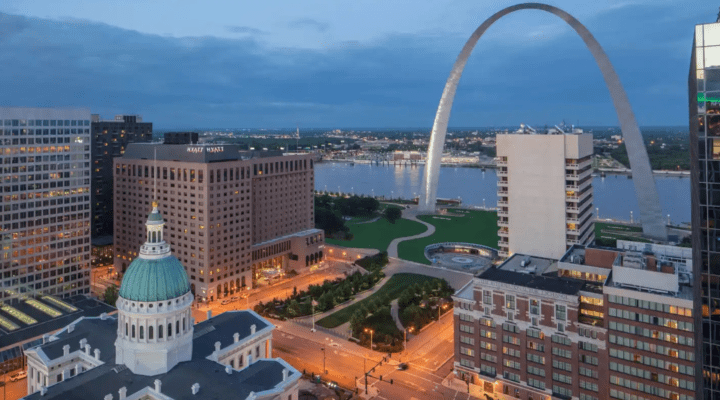
Hyatt Regency at the Arch, St. Louis, 9–11 March 2023
The 53rd annual meeting of the American Society for Eighteenth-Century Studies takes place in St. Louis. HECAA will be represented by the Anne Schroder New Scholars’ Session, chaired by Emily Casey and Amy Torbert, on Friday, starting at 11.30am. In addition to delivering the presidential address on Saturday, Wendy Roworth will chair a tribute session in honor of Christopher Johns on Thursday afternoon. To close out the conference, HECAA has organized a happy hour for Saturday evening. A selection of 18 additional panels is included below (of the 179 sessions scheduled, many others will, of course, interest HECAA members). For the full slate of offerings, see the program.
◊ ◊ ◊ ◊ ◊
T H U R S D A Y , 9 M A R C H 2 0 2 2
Westminster Abbey Revisited
Thursday, 8:00–9:30am, Sterling 9
Chair: Bradford MUDGE, University of Colorado Denver
1. Cedric REVERAND, University of Wyoming, “Westminster Abbey’s Invisible Architect”
2. Laura ENGEL, Duquesne University, “‘She will not allow one to look elsewhere’: Queen Elizabeth I, Westminster Abbey, and the Uncanny Seduction of Wax”
3. David VINSON, Auburn University, “(Re)Making Major John André: Britain’s Revisionary Strategies for Masking Wartime Failures”
◊ ◊ ◊ ◊ ◊
All Things Great and Small: Miniatures and Monstrosities
Thursday, 8:00–9:30am, Sterling 8
Chair: Daniella BERMAN, Institute of Fine Arts, New York University
1. Michelle MOSELEY-CHRISTIAN, Virginia Tech, “Miniature, Microscopy & Magnification: Scale and the Dutch Luxury Dollhouse during the Long 18th Century”
2. Katherine CALVIN, Kenyon College, “Palmyra’s Arch, Reproduced”
3. Blythe C. SOBOL, Nelson-Atkins Museum of Art and Institute of Fine Arts, NYU, “Colonialism in Miniature: John Smart’s Journey to India, 1785–1795”
◊ ◊ ◊ ◊ ◊
Plagier, citer, détourner / Plagiarizing, (Mis)quoting, and Rewriting (Society for Eighteenth-Century French Studies)
Thursday, 9:45–11:15, Sterling 2
Chair: Rudy Le MENTÉOUR, Bryn Mawr College
1. David EICK, Grand Valley State University, “The Original Sin of the Dictionnaire de Trévoux (1704)”
2. Kaitlyn QUARANTA, Brown University, “Between Citation and Censorship: Abridging the Encyclopédie”
3. Ryan BROWN, University of Chicago, “18th-Century ‘Celebrity Autobiography’ and the Plague of Plagiarism: The Case of Voltaire’s Commentaire historique”
4. Anna RIGG, Metropolitan Museum of Art, “Art Criticism as Anecdote: Souvenirs of Sophie Arnould”
◊ ◊ ◊ ◊ ◊
Asia
Thursday, 9:45–11:15, Sterling 8
Chair: Susan SPENCER, University of Central Oklahoma, Emerita
1. Yuefan WANG, University of Illinois Urbana-Champaign, “Landscape into Gardens, Gardens into Landscape: Poetry of the Banana Garden Women in Late-Seventeenth-Century Hangzhou”
2. Laura NUFFER, Colby College, “Beasts and Brides: Tales of Otherkind Marriage in Early-Modern Japanese Trosseaus”
3. Han CHEN, Penn State University, “Trading Aesthetics in the Early 18th Century: The Eccleston Screen and the Transcultural Visual Trope”
4. Lina JIANG, Fordham University, “Naturalizing the ‘Chinese Lady’ in ‘Her New English Garb’: Thomas Percy’s Translation of the Chinese Fiction Hau Kiou Choaan (1761)”
◊ ◊ ◊ ◊ ◊
Special Session, Lightning Round: ‘Sex Objects’ and Unstable Luxury
Thursday, 9:45–11:15, Sterling 9
Chair: Joelle DEL ROSE, College for Creative Studies
1. Mary PEACE, Sheffield Hallam University, “The Divan Club and the Contradictions of Enlightenment”
2. George WILLIAMS, Independent Scholar, “Geisha and Yuna: Bathhouse Culture, Desire, and the Shifting Roles of Women during the Kensai Reforms of the Late 18th Century’”
3. Elena DEANDA-CAMACHO, Washington College, “Condoms and Dildos in 18th-Century Europe: Spain and France”
4. Michelle LYONS-MCFARLAND, Case Western Reserve University, “The Sexiest Silver Ever: Valuation and ‘Virtue’ in Defoe’s Roxana”
◊ ◊ ◊ ◊ ◊
Poetry and the Arts
Thursday, 9:45–11:15, Mills 5
Chair: Amy TORBERT, Saint Louis Art Museum
1. Chip BRADLEY, University of California, Davis, “Phillis Wheatley Peters’ Desire to Look: Ekphrasis and Lyric Interiority”
2. Johannah KING-SLUTZKY, Columbia University, “Poetic Energy and Literature as a Response to Resource Scarcity in the Long 18th Century”
3. Elizabeth GIARDINA, University of California, Davis, “The Portland Vase and the Mysterious Initiations of Erasmus Darwin’s Visual Poetics”
◊ ◊ ◊ ◊ ◊
Roundtable: Performing Challenges to Imperialism
Thursday, 11:30–1:00, Sterling 6
Chair: Kristina STRAUB, Carnegie Mellon University
1. Jean I. MARSDEN, University of Connecticut, “Adaptation and Imperialism”
2. Allison CARDON, College of Wooster, “Samuel Foote’s Nabob and Imperialism Turned Inward”
3. Monica Anke HAHN, Community College of Philadelphia, “Tinsel and Toy Theaters: Decolonizing the British Empire at Home”
4. Lisa A. FREEMAN, University of Illinois Chicago, “Race and the Failures of Imperial Imagination in Edward Young’s The Revenge”
◊ ◊ ◊ ◊ ◊
Rome, Italian Art, and the Catholic Enlightenment: A Tribute to Christopher M.S. Johns (Presidential Session)
Thursday, 4:30–6:00, Regency E
Chair: Wendy Wassyng ROWORTH, University of Rhode Island
1. Carole PAUL, University of California, Santa Barbara, “Rome and the Motivations for Public Art Museums”
2. Jeffrey COLLINS, Bard Graduate Center, “Seeing is Believing: Marchionni and Bergondi at the Crossing of Saint Peter’s”
3. Rebecca MESSBARGER, Washington University St. Louis, “Betwixt Trent and Beccaria: The Pope’s ‘Moderately Modern’ Criminal Justice Reforms”
◊ ◊ ◊ ◊ ◊
Indigenous, Black, Asian, and Mixed-Race Architects and Builders in the Americas
Thursday, 4:30–6:00, Sterling 5
Chair: Luis Gordo PELÁEZ, California State University, Fresno, and Juan Luis BURKE, University of Maryland
1. Luis J. CUESTA, Universidad Iberoamericana, “Labor Force and the Architect’s Self Image: Indios, Mestizos and Criollos during New Spain’s Town Planning under the Bourbon Reform. The Case of ‘D. Ignacio Castera, maestro de architectura’”
2. Cody BARTEET, University of Western Ontario, “Maya Masons, Carpenters, and Masters in 18th-Century Yucatán: Pre-Contact Legacies in the Colonial Era”
3. Sabina DE CAVI, Universidade Nova, Lisboa, “Aleijadinho, creole sculptor-architect from Minas Gerais: Expressionism, Myth, and Artistic Practice in 18th-Century Brazil”
◊ ◊ ◊ ◊ ◊
Making Knowledge in the Atlantic World
Thursday, 4:30–6:00, Mills 3
Chair: Daniella BERMAN, Institute of Fine Arts, New York University
1. Sahai COUSO DIAZ, Vanderbilt University, “Antonio Parra’s Collection: Material Culture, Displays, and Trans-Atlantic Networks”
2. E. Bennett JONES, The Huntington Library, Art Museum, and Botanical Gardens, “The Entire Skin of the Bird: Whooping Cranes, Indigenous Expertise, and Mark Catesby”
3. Jacob EDMOND, University of Otago, “Total Confusion: Making and Confounding Knowledge in 18th-Century Cross-Readings from the Newspaper”
◊ ◊ ◊ ◊ ◊
Amateur Art
Chair: Katherine A. P. ISELIN, University of Missouri
Thursday, 4:30–6:00, Mills 7
1. Fiona BRIDEOAKE, American University, “Inside and Outside at A La Ronde”
2. Brittany LUBERDA, Baltimore Museum of Art, “Paper & Paste, Shell & Hair: The Bonnell Sisters and Craft”
3. Jennifer VAN HORN, University of Delaware, “Flora’s Profile: Enslavement, Resistance, and the Silhouette”
4. Andrea PAPPAS, Santa Clara University, “‘My Will and Pleasure’: Art and Enslavement in Two Massachusetts Pictorial Embroideries, 1756–1758”
◊ ◊ ◊ ◊ ◊
F R I D A Y , 9 M A R C H 2 0 2 2
‘Nature Display’d’: Visualizing the Natural World
Friday, 8:00–9:30am, Mills 3
Chair: Anne Nellis RICHTER, Independent Scholar, and Melinda MCCURDY, Huntington Library, Art Museum, and Botanical Gardens
1. Elisa CAZZATO, Università Ca’ Foscari/NYU, “The Spectacle of Nature: Theatre Sets and Gardens in 18th-Century Paris”
2. Angela ESCOTT, Independent Scholar, “The Environment and Commercial Prosperity Considered in Hannah Cowley’s Scottish Village (1787 and 1813) and Oliver Goldsmith’s Deserted Village (1770)”
3. Dani EZOR, Southern Methodist University, “A Colonial Arboretum: Tropical Hardwoods at the Toilette Table in the French Caribbean and France”
4. Tori CHAMPION, University of St. Andrews, “Boundaries, Borders, and Women’s Naturalisms: Marie-Thérèse Reboul Vien’s Illustrations for the Histoire naturelle du Sénégal, coquillages”
◊ ◊ ◊ ◊ ◊
‘L’homme mêle et confond les climats’: Jean-Jacques Rousseau and the Anthropocene (German Society for Eighteenth Century Studies)
Friday, 9:45–11:15, Regency F
Chair: Jürgen OVERHOFF, Universität Münster
1. Tim ZUMHOF, Universität Trier, Germany, and Nicole BALZER, University of Münster, Germany, “Rousseau’s Critique of the Anthropocene and the Legacy of Enlightenment: A New Materialist Perspective”
2. Célia ABELE, Princeton University, “‘J’aperçois une manufacture de bas’: Industry, Colonies, and Nature in Rousseau’s ‘Seventh Promenade’”
3. Giulia PACINI, William & Mary, “Deforestation and the French Climate Literature of François-Antoine Rauch and Jean-Baptiste Rougier de la Bergerie”
4. James SWENSON, Rutgers University, “A Rediscovered Text by Rousseau on the Notion of Climate”
5. Jason KELLY, Indiana University Purdue University Indianapolis, “Making ‘Nature’ in the Anthropocene”
6. Charlee BEZILLA, George Washington University, “L’art de ‘se circonscrire’: Rousseau on Living in the Anthropocene”
◊ ◊ ◊ ◊ ◊
Anne Schroder New Scholars Session (HECAA)
Friday, 11:30–1:00, Sterling 9
Chair: Emily CASEY, University of Kansas, and Amy TORBERT, Saint Louis Art Museum
1. Kaitlin R. GRIMES, Auburn University, “The Metonymic Colonial Materiality of Ivory Ships in Early Modern Denmark-Norway”
2. Elisabeth (Lizzie) RIVARD, University of Virginia, “Discipline and Disorder: 18th-Century British Drawing Practice in the Age of Academies”
3. Sabina SULLIVAN, Boston College, “Pack Up Your Jewels: Beauty, Currency, and Character in the Work of Penelope Aubin”
4. Demetra VOGIATZAKI, Harvard University, “The Curious Case of Louis François Petit-Radel (1739–1818)”
◊ ◊ ◊ ◊ ◊
The Enlightened Body? Part I
Friday, 11:30–1:00, Sterling 5
Chair: Anne SEUL, Washington University in St. Louis
1. Amelia RAUSER, Franklin & Marshall College, “Fashion, Abjection, and the Enlightened Body”
2. Eleonora DEL RICCIO, Sapienza University of Rome, “The Tabulae Anatomicae by Pietro da Cortona: A Question Still to Be Explored”
3. Jacob SIDER JOST, Dickinson College, “Medicine and Politeness in Shaftesbury’s Askemata and Soliloquy”
◊ ◊ ◊ ◊ ◊
Presidential Session: Awards, Business Meeting, and Presidential Address
Friday, 2:45–4:15, Regency C
Wendy Wassyng ROWORTH, Professor Emerita of Art History University of Rhode Island, “Close Encounters and Stranger Things: Angelica Kaufman’s First Years in London”
◊ ◊ ◊ ◊ ◊
S A T U R D A Y , 9 M A R C H 2 0 2 2
Building the 18th Century: Histories of Physical Form
Saturday, 8:00–9:30am, Sterling 3
Chair: Janet R. WHITE, UNLV School of Architecture
1. Dylan Wayne SPIVEY, University of Virginia, “Palladianism and Print: Architectural Style and Representation in 18th-Century British Architecture”
2. Julie PARK, Penn State University, “Follies and Fictions of Gothic Space in 18th-Century Landscapes”
3. Luis GORDO PELÁEZ, California State University, Fresno, “The Architecture of Cigar Making: Tobacco Industry and Infrastructure in Bourbon New Spain”
◊ ◊ ◊ ◊ ◊
Enlightenment Afterlives, Part II
Saturday, 8:00–9:30am, Regency F
Chair: Joseph DRURY, Villanova University
1. David A. BREWER, The Ohio State University, “The Friends of English Magic”
2. Tekla BABYAK, Independent Scholar, “Christianity without Enlightenment: 19th-Century Musical Evocations of the 18th Century”
3. Steve NEWMAN, Temple University, “Haunted by the Enlightenment: Robert Burns, the Black Atlantic, and the Resources of Lyric in Shara McCallum’s No Ruined Stone”
4. Rachel HARMEYER, Rice University, “Lost in Austen: The Cinematic Afterlife of Angelica Kauffman (1741–1807)”
◊ ◊ ◊ ◊ ◊
Off the Beaten Path: New Perspectives on the Grand Tour
Saturday, 8:00–9:30am, Sterling 8
Chair: Sarah CARTER, University of Chicago, and Lauren DISALVO, Utah Tech University
1. Megan BAKER, University of Delaware, “The Roman Genesis of a New Franco- British Masculinity”
2. Dominic BATE, Brown University, “Coming Home: The Artistic Education of a Catholic Jacobite in the Papal States”
3. Peter DEGABRIELE, Mississippi State University, “Lady Mary Steals Some Antiquities: The Legacy of Cultural Imperialism”
◊ ◊ ◊ ◊ ◊
Inventing the Global and Discovering the World: Global Imagination, Part II
Saturday, 2:00–3:30, Mills 5
Chair: Idolina HERNANDEZ, Lindenwood University, and Heesoo CHO, Washington University in Saint Louis
1. Matt J. SCHUMANN, Bowling Green State University, “Persia in the European ‘World View’, ~1720–1747”
2. Amy FREUND, Southern Methodist University, “Killing Crocodiles at Versailles: Louis XV’s ‘Foreign Hunt’ Paintings”
3. Sarah R. COHEN, University at Albany, SUNY, “Globalizing the Caribbean for the European Dessert Table”
◊ ◊ ◊ ◊ ◊
HECAA Happy Hour
Saturday, 5:00–8:00pm, Sterling
◊ ◊ ◊ ◊ ◊
Note (added 8 March 2023) — The original posting did not include the session on Enlightenment Afterlives or the HECAA Happy Hour.
New Book | French Suite: A Book of Essays
Distributed by The University of Chicago Press:
Michael Fried, with an introduction by Stephen Bann, French Suite: A Book of Essays (London: Reaktion Books, 2022), 356 pages, ISBN : 978-1789146042, $45.
 French Suite examines a range of important French painters and two writers, Baudelaire and Flaubert, from the brothers Le Nain in the mid-seventeenth century to Manet, Degas, and the Impressionists in the later nineteenth century. A principal theme of Michael Fried’s essays is a fundamental concern of his throughout his career: the relationship between painting and the beholder. Fried’s typically vivid and strongly argued essays offer many new readings and unexpected insights, examining both familiar and lesser-known French artistic and literary works.
Art critic, art historian, literary critic-historian, and poet Michael Fried is the J. R. Herbert Boone Emeritus Professor of Humanities and the History of Art at Johns Hopkins University. His many books include The Moment of Caravaggio.
Stephen Bann, CBE, is professor emeritus of the history of art and a senior research fellow at Bristol University. His recent books include Distinguished Images: Prints in the Visual Economy of Nineteenth-Century France and Stonypath Days: Letters between Ian Hamilton Finlay and Stephen Bann, 1970–72.
C O N T E N T S
Preface
Introduction by Stephen Bann
1 Being Seen and Seeing: Thoughts on the Le Nains
2 Hubert Robert and the ‘Pastoral’ Conception of Painting
3 The Hand on the Page: Three Works by Théodore Géricault
4 Painting Memories: On Baudelaire’s Salon of 1846
5 Facingness Meets Mindedness: Manet’s Luncheon in the Studio and Balcony
6 Degas and Antitheatricality
7 Chapter One of L’Education sentimentale as a Work of Writing
8 Corot’s Figure Paintings and the Apotheosis of Touch
9 Unknown Daubigny
10 The Moment of Impressionism
Coda: The House at Rueil
References
Acknowledgments
List of Illustrations
Index
Exhibition | Claude Gillot: Satire in the Age of Reason

Claude Gillot, Scene of the Two Carriages / Les Deux carrosses, ca. 1710–12, oil on canvas, 127 × 160 cm
(Paris: Musée du Louvre, RF2405)
◊ ◊ ◊ ◊ ◊
Now on view at The Morgan:
Claude Gillot: Satire in the Age of Reason
The Morgan Library & Museum, New York, 24 February — 28 May 2023
Curated by Jennifer Tonkovich
Around 1700, as an increasingly pious Louis XIV withdrew to Versailles, Paris flourished. The dynamic artistic scene included specialists such as Claude Gillot (1673–1722) who forged a career largely outside of the Royal Academy, designing everything from opera costumes to tapestries.
 Known primarily as a draftsman, Gillot specialized in scenes of satire. He found his subjects among the irreverent commedia dell’arte performances at fairground theaters, in the writings of satirists who waged the Quarrel of the Ancients and Moderns, and in the antics of vice-ridden satyrs whose bacchanals exposed human folly. Gillot’s amusing critiques and rational perspective heralded the advent of the Age of Reason while his innovative approach attracted the most talented artists of the next generation, Antoine Watteau and Nicolas Lancret, to his studio.
With over seventy drawings, prints, and paintings, including an exceptional contingent from the Louvre, Claude Gillot: Satire in the Age of Reason explores the artist’s inventive and highly original draftsmanship and places his work in the context of the artistic and intellectual activity in Paris at the dawn of a new century.
The catalogue accompanying the exhibition, published by Paul Holberton, will provide the first comprehensive account of Gillot’s career.
Jennifer Tonkovich, Claude Gillot: Satire in the Age of Reason (London: Paul Holberton, 2023), 240 pages, ISBN: 978-1913645373, $60.
Exhibition | Sublime Ideas: Drawings by Giovanni Battista Piranesi
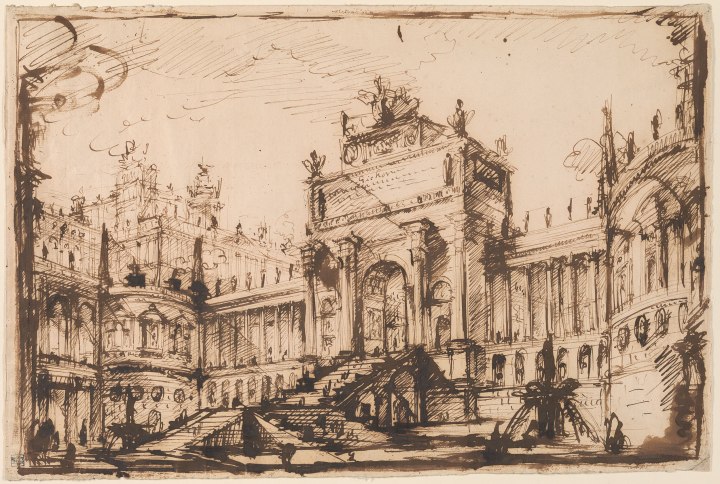
Giovanni Battista Piranesi, Fantasy of a Magnificent Forum, ca. 1765, pen and brown ink and wash, 33 × 49 cm
(New York: Morgan Library & Museum, 1974.27)
◊ ◊ ◊ ◊ ◊
From the press release for the exhibition:
Sublime Ideas: Drawings by Giovanni Battista Piranesi
The Morgan Library & Museum, New York, 10 March — 4 June 2023
Curated by John Marciari
In a letter written near the end of his life, Giovanni Battista Piranesi (1720–1778) explained to his sister that he had lived away from his native Venice because he could find no patrons there willing to support “the sublimity of my ideas.” He resided instead in Rome, where he became internationally famous working as a printmaker, designer, architect, archaeologist, theorist, dealer, and polemicist. While Piranesi’s lasting fame is based above all on his etchings, he was also an intense, accomplished, and versatile draftsman, and much of his work was first developed in vigorous drawings.
The Morgan holds the largest and most important collection of Piranesi’s drawings, well over 100 works that encompass his early architectural capricci, studies for prints, measured design drawings, sketches for a range of decorative objects, a variety of figural drawings, and views of Rome and Pompeii. These form the core of the exhibition, which will also include seldom-exhibited loans from a number of private collections. Accompanied by a publication offering a complete survey of Piranesi’s work as a draftsman, the exhibition will be the most comprehensive look at Piranesi’s drawings in more than a generation.
 This exhibition begins with Piranesi’s interest in theoretical architecture, showing works that combine an imaginative and fantastic approach to architectural study with a bookish understanding of ancient buildings and a Romantic appreciation of ruins. This blend of fantasy and theory would eventually give birth to the Invenzioni caprici di carceri (Capricious Inventions of Prisons), his most famous work. The drawings in the Morgan’s collection show how Piranesi’s work developed from precise architectural drawings to imaginative fantasies. Later sections of the exhibition document Piranesi’s study of the inventive work of Tiepolo in a series of trips to his native Venice, his turn from architectural theory and fantasy to archaeology, and his work as a practicing architect and as a designer and dealer of classicizing interior decoration.
The exhibition also highlights the role of paper in Piranesi’s working practice, showing his use and reuse of earlier drawings in later works. Close study of his surviving sheets makes clear that Piranesi preserved drawings in the workshop to serve as inspiration for future projects, and many sheets have reworking that can be dated years after the original drawing, a testament to the continual reuse of his archive.
Highlights of the exhibition include Design for a Ceremonial Gondola (1745–47), a large and fanciful design for a craft that was surely never set afloat; Piranesi nonetheless reused much of the decorative language in subsequent works. Piranesi’s Fantasy of a Magnificent Forum (ca. 1765) is one of his most accomplished fantasies, showing a play on ancient Roman architecture in a dramatic sketch that was likely dashed off as a command performance of his skill as a draftsman. The Proposed Alteration of San Giovanni in Laterano, with Columnar Ambulatory (ca. 1763–64) is Piranesi’s largest architectural drawing, a rendering almost five feet wide with an ambitious plan for the expansion of one of the largest churches in Rome. In addition, this exhibition includes a number of preparatory designs for his etchings, including very rare proof impressions of his printed views of Rome and Tivoli with drawn corrections by the artist. The exhibition ends with a group of large drawings of Pompeii, made in the bold style that Piranesi adopted in the last few years of his life.
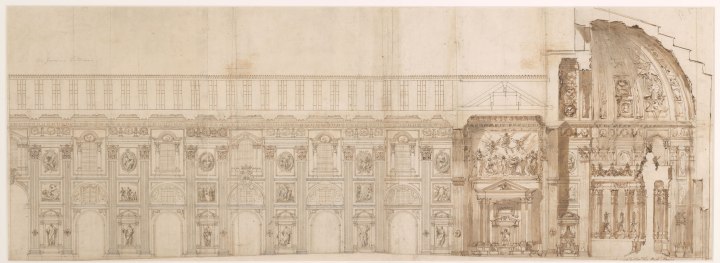
Giovanni Battista Piranesi and workshop, Proposal for the Alteration of San Giovanni in Laterano, with Columnar Ambulatory, ca. 1763-64, pen and brown ink and wash, and gray wash, over graphite, on paper, 21 × 58 inches (New York: Morgan Library & Museum, 1966.11:55).
◊ ◊ ◊ ◊ ◊
The Morgan’s Director, Colin B. Bailey, said, “Given the depth of our collection of drawings by Giovanni Battista Piranesi, the Morgan has long been a leading institution in the study of his works. This new exhibition, the most complete showing of our Piranesis since 1989, reflects long study as well as new discoveries, and will bring Piranesi alive to a new generation of visitors.”
This exhibition is curated by John Marciari, Charles W. Engelhard Curator, Head of the Department of Drawings and Prints, and Curatorial Chair. Marciari is also the author of the accompanying publication, which reaches beyond the Morgan’s collections to offer a complete survey of Piranesi’s work as a draftsman. Marciari explains, “Very few of Piranesi’s drawings were carefully finished works made for sale or exhibition, but in looking closely at the hundreds of working drawings that survive, we not only see the artist devising new ideas and working through problems, but also understand how the archive of drawings served his workshop as a constant source of inspiration.”
John Marciari, Sublime Ideas: Drawings by Giovanni Battista Piranesi (London: Paul Holberton Publishing, 2023), 224 pages, ISBN: 978-1913645380, £40 / $60.
◊ ◊ ◊ ◊ ◊
Note (added 6 March 2023) — The exhibition was originally planned for 2020 (May–September) to mark the 300th anniversary of Piranesi’s birth; like so many other things, it had to be rescheduled for obvious reasons.
Exhibition | Cabinet of Dutch Drawings: The 18th Century

Isaac de Moucheron, Italian Landscape with Trees and a Port / Paysage italien avec arbres et un port, 1738
(Brussels: Musées Royaux des Beaux-Arts de Belgique; photo by J. Geleyns)
◊ ◊ ◊ ◊ ◊
Now on view at the Fondation Custodia / Collection Frits Lugt:
Cabinet of Dutch Drawings: The 18th Century, from the Collection of the Royal Museums of Fine Arts of Belgium / Cabinet de dessins néerlandais: Le XVIIIe siècle
Musées royaux des Beaux-Arts de Belgique, Brussels, 1 February — 23 May 2019
Rijksmuseum Twenthe, Enschede, 2020
Fondation Custodia / Collection Frits Lugt, Paris, 25 February — 14 May 2023
Curated by Stefaan Hautekeete, Robert-Jan te Rijdt, and Charles Dumas
The Fondation Custodia presents a selection of eighty eighteenth-century drawings, assembled by three generations in the city of Breda, in the province of North Brabant. The entire collection was bequeathed to the Belgian state in 1911, and the works were deposited in the Musées royaux des Beaux-Arts de Belgique.

Bernard Picart, Nu féminin assis, sanguine, 30 × 36 cm (Brussels: Musées Royaux des Beaux-Arts de Belgique).
Many eighteenth-century drawings are preparatory studies for paintings. But drawings were also made for a different purpose, created to be sold as works of art in their own right, albeit on paper. This presupposes a large number of collectors who kept drawings in folders and albums, and who viewed and enjoyed them with fellow enthusiasts or in a family context. The phenomenon became widespread throughout the century and artists capitalised on this market. More than ever, they produced highly finished drawings which were appreciated by collectors of sophisticated taste.
The works in the exhibition provide a better understanding and appreciation of the art of drawing at a time when commerce, science, and culture were experiencing unprecedented development in the Netherlands. At the beginning of the century, historical and mythological scenes were in fashion, but public taste changed and tended to favour representations of an ‘ideal world’, before moving towards greater realism with a production that focused more on landscapes, city views, and interior scenes. Draughtsmen also did not hesitate to take inspiration from the old masters of the 17th century.
 The exhibition is a collaboration with the Royal Museums of Fine Arts of Belgium in Brussels, where it was presented in 2019. It was then shown at the Rijksmuseum Twenthe, in Enschede, in 2020. The exhibition is accompanied by a thoroughly documented catalogue published in French and in Dutch. It is vividly written by a group of specialists led by Stefaan Hautekeete, Curator of Drawings at the Royal Museums of Fine Arts of Belgium, who, together with experts Robert-Jan te Rijdt and Charles Dumas, was responsible for the selection of works.
Cabinet des plus merveilleux dessins: Dessins néerlandais du XVIIIe siècle issus des collections des Musées royaux des Beaux-Arts de Belgique (Ghent: Snoeck Publishers, 2019), 223 pages, ISBN: 978-9461615176 (French version) / ISBN: 978-8461615169 (Dutch version), €29.
Exhibition | Drawing in Britain, 1700–1900, New Acquisitions
Opening in April at the National Gallery of Art in DC:
Drawing in Britain, 1700–1900: New Additions to the Collection
National Gallery of Art, Washington DC, 2 April — 6 August 2023
Curated by Stacey Sell

John Hoppner, A Young Boy Seated beneath a Tree, ca. 1790s/1810, red and black chalk with brush and grey and black ink (Washington, DC: National Gallery of Art, 2022.78.1).
Selected entirely from the National Gallery’s permanent collection, this exhibition of approximately 80 recently acquired drawings and watercolors provides an overview of two centuries of British art.
Works on view reveal European influences on British art starting in the 1700s. They trace the development of watercolor as a national specialty and introduce the varied approaches that emerged during the Victorian era. Drawing in Britain not only includes significant examples of the landscapes that are traditionally associated with British art, but it also highlights portraits, history scenes, and nude studies. Works by British women provide glimpses into the lives and work of several fascinating yet little-known artists.
The exhibition is curated by Stacey Sell, associate curator of old master drawings, National Gallery of Art, Washington.
6th Annual Ricciardi Prize from Master Drawings
From Master Drawings:
Sixth Annual Ricciardi Prize from Master Drawings
Submissions due by 15 November 2023

Édouard Manet, Woman Writing, brush and black ink on paper (Clark Art Institute, MA).
Master Drawings is now accepting submissions for the Sixth Annual Ricciardi Prize for Young Scholars. The $5,000 award is given to the best new and unpublished article on a drawing topic (of any period) by a scholar under the age of 40. The winning submission will be published in a 2024 issue of Master Drawings. Information about past winners and finalists is available here.
The average article length is between 2,500 and 3,750 words, with five to twenty illustrations. Submissions should be no longer than 10,000 words and have no more than 100 footnotes. Please note that all submissions must be in article form, following the format of the journal. We will not consider submissions of seminar papers, dissertation chapters, or other written material that has not been adapted into the format of a journal article. Written material that has been previously published, or is scheduled for future publication, will not be eligible. Articles may be submitted in any language. Be sure to include a 100 word abstract outlining the scope of your article with your submission, along with a current CV or resume, as well as your birth date. Please submit your application online by 15 November 2023. If the file is too large, please use Wetransfer.com addressed to administrator@masterdrawings.org.
Call for Articles | Spring 2024 Issue of J18: Color
From the Call for Papers:
Journal18, Issue #17 (Spring 2024) — Color
Issue edited by Ewa Lajer-Burcharth and Thea Goldring
Proposals due by 1 April 2023; finished articles will be due by 1 September 2023
The question of color has been at the center of artistic debates at least since the seventeenth century, and it has remained a key issue in the historiography of art. What may be at stake in reconsidering color in its historical dimensions now? Recent research on the issue has gone in two directions. On the one hand, color has been studied as a material substance and a technology. Scholars have documented the relation between technological, industrial, and commercial developments and the quality, range, and availability of pigments and colorants available to artists, manufacturers, and consumers. Another approach has focused on the key role of color in the construction of social, racial, and gender hierarchies. Recent scholarship has revealed the intimate connection between aesthetic debates on chroma and the development of the modern discourse of race. Moreover, the eighteenth century’s feminization of color entangled with the notions of make-up and artifice has been reexamined. Clearly, it is no longer viable to think of color in purely aesthetic, ideologically innocent terms.
This issue of Journal18 aims to consider how the current interest in materiality and the matter of art could be harnessed to alter–enrich, complicate, or challenge–our understanding of the historical functions and social and cultural meanings of color in the long eighteenth century. In what ways may the materialist discussion of color as a substance inflect the account of its ideological and discursive functions? What were the new meanings and effects of color as the physical product and sign of growing global trade networks, colonial and slave economies, and expanding empires? How did colored materials—pigments, dyes, feathers, shells, mineral—serve as tools of hybridity and a means to delineate cultural difference? Can color’s inherent capacity for infinite nuance offer modern art historians alternative lenses onto to the past? We welcome papers that are attuned to color’s mobility, look beyond Western Europe, and decentralize Euro-centric narratives. We are especially interested in papers that consider the broader methodological questions raised by their subject and seek to develop tools to address the urgent issues posed by color.
Issue Editors
Ewa Lajer-Burcharth, Harvard University
Thea Goldring, Harvard University
To submit a proposal, send an abstract (250 words) and brief biography by 1 April 2023 to the following three addresses: editor@journal18.org, burchart@fas.harvard.edu, and tgoldring@g.harvard.edu. Articles should not exceed 6000 words (including footnotes) and will be due by 1 September 2023. For further details on submission and Journal18 house style, see Information for Authors.
Conference | Rethinking British and European Romanticisms
From ArtHist.net and Friedrich-Schiller-Universität Jena:
Rethinking British and European Romanticisms in Transnational Dimensions
Friedrich-Schiller-Universität Jena, Rosensäle, 28–30 March 2023
Organized by Elisabeth Ansel, Johannes Grave, Richard Johns, Christin Neubauer, and Elizabeth Prettejohn

J.M.W. Turner, A Paddle-steamer in a Storm, ca. 1841, watercolor, graphite, and scratching out on medium, slightly textured, cream wove paper (New Haven: Yale Center for British Art, Paul Mellon Collection, B1977.14.4717).
The workshop is a first-time cooperation between the History of Art Departments of the University of York and the Friedrich Schiller University Jena. Considering the institution’s main research areas, the event aims to discuss the different concepts of Europe present in the art and culture of Romanticism.
In recent years, national tendencies have challenged the European idea, exemplified by the wake of Brexit and its aftermath. In this context, the question arises to what extent European and national identity concepts can be reconciled. Today’s debate between Britain and Europe still roots in the divergent notions of national identity that manifested in several European countries in the 1800s. This workshop, therefore, addresses the relationship between visual images and constructions of nationality and questions how European Romanticism can be understood. In contrast to literary studies, investigating transnational transfer processes of Romantic movements has been a desideratum in art historical research. Considering transcultural methods, the participants will reflect national patterns of thought and Romantic identities not as fixed but as processual and hybrid phenomena within the framework of the binational exchange. Based on individual case studies, the event aims to reevaluate the complex interplay of alterity and reciprocity of the relations between cultural spaces. For questions or more information, please contact, europaeischeromantik@uni-jena.de.
Funded by the Deutsche Forschungsgemeinschaft (DFG, German Research Foundation)
T U E S D A Y , 2 8 M A R C H 2 0 2 3
9.00 Welcome and Introduction — Elisabeth Ansel and Christin Neubauer
9.30 Introductory Lecture
• Johannes Grave (Jena) — Romantic Temporalities
10.15 Early Romantic Relations
• Johannes Rößler (Jena) — Towards a Modern Theory of Illustration: August Wilhelm Schlegel on John Flaxman
• Tilman Schreiber (Jena) — Gavin Hamilton and the Aesthetics of Dilettantism
12.15 Transcultural Romanticism and Peripheries
• Helena Cox (York) — Bohemian Romanticism
13.00 Lunch
14.30 Transcultural Romanticism and Peripheries, continued
• Elisabeth Ansel (Jena) — Visual Ossianism: Artistic Circulations, Transculturality, and Romanticism
• Rhian Addison (York) — George Morland’s ‘Emblematic Palette’: The Afterlives of Self-Fashioning Landscape Artist
• Lars Zieke (Jena) — Becoming Watteau: Artistic Self-Definition and Painted Art Theory in Turner’s Watteau Study by Fresnoy’s Rules
17.15 Evening Lecture
• Richard Johns (York) — Art of the Living Dead
20.00 Dinner
W E D N E S D A Y , 2 9 M A R C H 2 0 2 3
9.15 Greeting
9.30 Aesthetic Discourses and Translation Processes
• Sonja Scherbaum (Jena) — ‘Great Beyond All Comparison’: The Sublime as a Comparative Aesthetic Experience
• Miguel Gaete Caceres (York) — The German Picturesque: Between a (British) Landscape Aesthetic Category, a Scientific Method, and a Racial Label
11.00 Coffee
11.30 Origins and Afterlives
• David Grube-Palzer (Jena) — Copy and Self-Repetition in the Age of Genius: Using the Example of Caspar David Friedrich
• Sammi Lukic-Scott (York) — Images into Objects: Reproductions and Translations
13.00 Lunch
14.30 Romanticism in the Context of New Turns
• Marte Stinis (York) — Depicting Romantic Music-Making
• Mira Claire Zadrozny (Jena) — European Romantic Ruins? The ‘Architectural Uncanny’ in Nineteenth-Century French and British Landscape Painting
• Caitlin Doley (York) — Venerable Vulnerability? Violence against Animals in Romantic Artwork
18.30 Reception at Schillers Gartenhaus, home of the poet, ca. 1800
T H U R S D A Y , 3 0 M A R C H 2 0 2 3
9.15 Greeting
9.30 The Late Romantics
• Nicholas Dunn-McAfee (York) — Breath, Flesh, Warmth: The Pre-Raphaelite Brotherhood’s Immortal Keats
• Kayleigh Williams (York) — Picturing John Keats
• Christin Neubauer (Jena) — The Romantic Embodiment in Pre-Raphaelite Visual Art
12.15 Concluding Discussion
Afternoon Field Trip to Weimar
14.30 Graphische Sammlung, Vulpius-Galerie, Herzogin Anna Amalia Bibliothek
18.00 Goethes Wohnhaus, Goethe’s home from 1782 until his death in 1832
20.00 End of Workshop
◊ ◊ ◊ ◊ ◊

Herzogin Anna Amalia Bibliothek, Rokokosaal (Photo by Maik Schuck).
The Herzogin Anna Amalia Bibliothek in Weimar was named in 1991 for Anna Amalia who in the 1760s moved the ducal book collection to the newly constructed Rococo library—famous since then for its oval hall—within the Grünes Schloss (‘Green Palace’). The Vulpius Gallery honors Goethe’s wife, Christiane Vulpius, and brother-in-law, Christian August Vulpius, the latter having worked at the library from 1797 to 1826. Much of the library was destroyed by fire in 2004; it reopened in October 2007 following an $18million restoration. –CH
New Book | The Temple of Fame and Friendship
Distributed by The University of Chicago Press:
Annette Richards, The Temple of Fame and Friendship: Portraits, Music, and History in the C. P. E. Bach Circle (Chicago: The University of Chicago Press,) 336 pages, ISBN: 978-0226806266, $55.
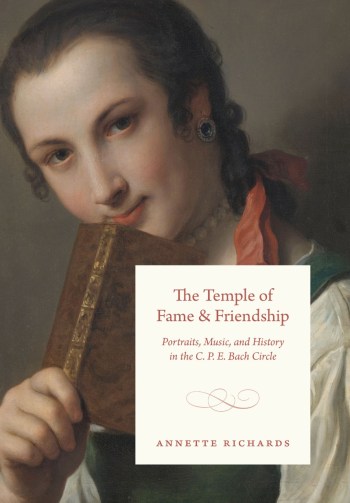 One of the most celebrated German composers of the eighteenth century, C. P. E. Bach spent decades assembling an extensive portrait collection of some four hundred music-related items—from oil paintings to engraved prints. The collection was dispersed after Bach’s death in 1788, but with Annette Richards’s painstaking reconstruction, the portraits once again present a vivid panorama of music history and culture, reanimating the sensibility and humor of Bach’s time. Far more than a mere multitude of faces, Richards argues, the collection was a major part of the composer’s work that sought to establish music as an object of aesthetic, philosophical, and historical study.
The Temple of Fame and Friendship brings C. P. E. Bach’s collection to life, giving readers a sense of what it was like for visitors to tour the portrait gallery and experience music in rooms thick with the faces of friends, colleagues, and forebears. She uses the collection to analyze the ‘portraitive’ aspect of Bach’s music, engaging with the influential theories of Swiss physiognomist Johann Caspar Lavater. She also explores the collection as a mode of cultivating and preserving friendship, connecting this to the culture of remembrance that resonates in Bach’s domestic music. Richards shows how the new music historiography of the late eighteenth century, rich in anecdote, memoir, and verbal portrait, was deeply indebted to portrait collecting and its negotiation between presence and detachment, fact and feeling.
Annette Richards is Given Foundation Professor in the Humanities and university organist at Cornell University, where she is also professor of music and director of the Cornell-Westfield Center for Historical Keyboard Studies. She is the author of The Free Fantasia and the Musical Picturesque; the editor of C. P. E Bach Studies; coeditor, with Mark Franko, of Acting on the Past; and the founding editor of Keyboard Perspectives.
C O N T E N T S
Introduction
1 Exhibiting: The Bach Gallery and the Art of Self-Fashioning
2 Collecting: C. P. E. Bach and Portrait Mania
3 Speculation: Likeness, Resemblance, and Error
4 Character: Faces, Physiognomy, and Time
5 Friendship: Portrait Drawings and the Trace of Modern Life
6 Feeling: Objects of Sensibility and the ‘Portrait of Myself’
7 Memorializing: Portraits and the Invention of Music History
Acknowledgments
Notes
Bibliography
Index










 Enfilade
leave a comment