Call for Articles | Spring 2024 Issue of J18: Color
From the Call for Papers:
Journal18, Issue #17 (Spring 2024) — Color
Issue edited by Ewa Lajer-Burcharth and Thea Goldring
Proposals due by 1 April 2023; finished articles will be due by 1 September 2023
The question of color has been at the center of artistic debates at least since the seventeenth century, and it has remained a key issue in the historiography of art. What may be at stake in reconsidering color in its historical dimensions now? Recent research on the issue has gone in two directions. On the one hand, color has been studied as a material substance and a technology. Scholars have documented the relation between technological, industrial, and commercial developments and the quality, range, and availability of pigments and colorants available to artists, manufacturers, and consumers. Another approach has focused on the key role of color in the construction of social, racial, and gender hierarchies. Recent scholarship has revealed the intimate connection between aesthetic debates on chroma and the development of the modern discourse of race. Moreover, the eighteenth century’s feminization of color entangled with the notions of make-up and artifice has been reexamined. Clearly, it is no longer viable to think of color in purely aesthetic, ideologically innocent terms.
This issue of Journal18 aims to consider how the current interest in materiality and the matter of art could be harnessed to alter–enrich, complicate, or challenge–our understanding of the historical functions and social and cultural meanings of color in the long eighteenth century. In what ways may the materialist discussion of color as a substance inflect the account of its ideological and discursive functions? What were the new meanings and effects of color as the physical product and sign of growing global trade networks, colonial and slave economies, and expanding empires? How did colored materials—pigments, dyes, feathers, shells, mineral—serve as tools of hybridity and a means to delineate cultural difference? Can color’s inherent capacity for infinite nuance offer modern art historians alternative lenses onto to the past? We welcome papers that are attuned to color’s mobility, look beyond Western Europe, and decentralize Euro-centric narratives. We are especially interested in papers that consider the broader methodological questions raised by their subject and seek to develop tools to address the urgent issues posed by color.
Issue Editors
Ewa Lajer-Burcharth, Harvard University
Thea Goldring, Harvard University
To submit a proposal, send an abstract (250 words) and brief biography by 1 April 2023 to the following three addresses: editor@journal18.org, burchart@fas.harvard.edu, and tgoldring@g.harvard.edu. Articles should not exceed 6000 words (including footnotes) and will be due by 1 September 2023. For further details on submission and Journal18 house style, see Information for Authors.
Conference | Rethinking British and European Romanticisms
From ArtHist.net and Friedrich-Schiller-Universität Jena:
Rethinking British and European Romanticisms in Transnational Dimensions
Friedrich-Schiller-Universität Jena, Rosensäle, 28–30 March 2023
Organized by Elisabeth Ansel, Johannes Grave, Richard Johns, Christin Neubauer, and Elizabeth Prettejohn

J.M.W. Turner, A Paddle-steamer in a Storm, ca. 1841, watercolor, graphite, and scratching out on medium, slightly textured, cream wove paper (New Haven: Yale Center for British Art, Paul Mellon Collection, B1977.14.4717).
The workshop is a first-time cooperation between the History of Art Departments of the University of York and the Friedrich Schiller University Jena. Considering the institution’s main research areas, the event aims to discuss the different concepts of Europe present in the art and culture of Romanticism.
In recent years, national tendencies have challenged the European idea, exemplified by the wake of Brexit and its aftermath. In this context, the question arises to what extent European and national identity concepts can be reconciled. Today’s debate between Britain and Europe still roots in the divergent notions of national identity that manifested in several European countries in the 1800s. This workshop, therefore, addresses the relationship between visual images and constructions of nationality and questions how European Romanticism can be understood. In contrast to literary studies, investigating transnational transfer processes of Romantic movements has been a desideratum in art historical research. Considering transcultural methods, the participants will reflect national patterns of thought and Romantic identities not as fixed but as processual and hybrid phenomena within the framework of the binational exchange. Based on individual case studies, the event aims to reevaluate the complex interplay of alterity and reciprocity of the relations between cultural spaces. For questions or more information, please contact, europaeischeromantik@uni-jena.de.
Funded by the Deutsche Forschungsgemeinschaft (DFG, German Research Foundation)
T U E S D A Y , 2 8 M A R C H 2 0 2 3
9.00 Welcome and Introduction — Elisabeth Ansel and Christin Neubauer
9.30 Introductory Lecture
• Johannes Grave (Jena) — Romantic Temporalities
10.15 Early Romantic Relations
• Johannes Rößler (Jena) — Towards a Modern Theory of Illustration: August Wilhelm Schlegel on John Flaxman
• Tilman Schreiber (Jena) — Gavin Hamilton and the Aesthetics of Dilettantism
12.15 Transcultural Romanticism and Peripheries
• Helena Cox (York) — Bohemian Romanticism
13.00 Lunch
14.30 Transcultural Romanticism and Peripheries, continued
• Elisabeth Ansel (Jena) — Visual Ossianism: Artistic Circulations, Transculturality, and Romanticism
• Rhian Addison (York) — George Morland’s ‘Emblematic Palette’: The Afterlives of Self-Fashioning Landscape Artist
• Lars Zieke (Jena) — Becoming Watteau: Artistic Self-Definition and Painted Art Theory in Turner’s Watteau Study by Fresnoy’s Rules
17.15 Evening Lecture
• Richard Johns (York) — Art of the Living Dead
20.00 Dinner
W E D N E S D A Y , 2 9 M A R C H 2 0 2 3
9.15 Greeting
9.30 Aesthetic Discourses and Translation Processes
• Sonja Scherbaum (Jena) — ‘Great Beyond All Comparison’: The Sublime as a Comparative Aesthetic Experience
• Miguel Gaete Caceres (York) — The German Picturesque: Between a (British) Landscape Aesthetic Category, a Scientific Method, and a Racial Label
11.00 Coffee
11.30 Origins and Afterlives
• David Grube-Palzer (Jena) — Copy and Self-Repetition in the Age of Genius: Using the Example of Caspar David Friedrich
• Sammi Lukic-Scott (York) — Images into Objects: Reproductions and Translations
13.00 Lunch
14.30 Romanticism in the Context of New Turns
• Marte Stinis (York) — Depicting Romantic Music-Making
• Mira Claire Zadrozny (Jena) — European Romantic Ruins? The ‘Architectural Uncanny’ in Nineteenth-Century French and British Landscape Painting
• Caitlin Doley (York) — Venerable Vulnerability? Violence against Animals in Romantic Artwork
18.30 Reception at Schillers Gartenhaus, home of the poet, ca. 1800
T H U R S D A Y , 3 0 M A R C H 2 0 2 3
9.15 Greeting
9.30 The Late Romantics
• Nicholas Dunn-McAfee (York) — Breath, Flesh, Warmth: The Pre-Raphaelite Brotherhood’s Immortal Keats
• Kayleigh Williams (York) — Picturing John Keats
• Christin Neubauer (Jena) — The Romantic Embodiment in Pre-Raphaelite Visual Art
12.15 Concluding Discussion
Afternoon Field Trip to Weimar
14.30 Graphische Sammlung, Vulpius-Galerie, Herzogin Anna Amalia Bibliothek
18.00 Goethes Wohnhaus, Goethe’s home from 1782 until his death in 1832
20.00 End of Workshop
◊ ◊ ◊ ◊ ◊

Herzogin Anna Amalia Bibliothek, Rokokosaal (Photo by Maik Schuck).
The Herzogin Anna Amalia Bibliothek in Weimar was named in 1991 for Anna Amalia who in the 1760s moved the ducal book collection to the newly constructed Rococo library—famous since then for its oval hall—within the Grünes Schloss (‘Green Palace’). The Vulpius Gallery honors Goethe’s wife, Christiane Vulpius, and brother-in-law, Christian August Vulpius, the latter having worked at the library from 1797 to 1826. Much of the library was destroyed by fire in 2004; it reopened in October 2007 following an $18million restoration. –CH
New Book | The Temple of Fame and Friendship
Distributed by The University of Chicago Press:
Annette Richards, The Temple of Fame and Friendship: Portraits, Music, and History in the C. P. E. Bach Circle (Chicago: The University of Chicago Press,) 336 pages, ISBN: 978-0226806266, $55.
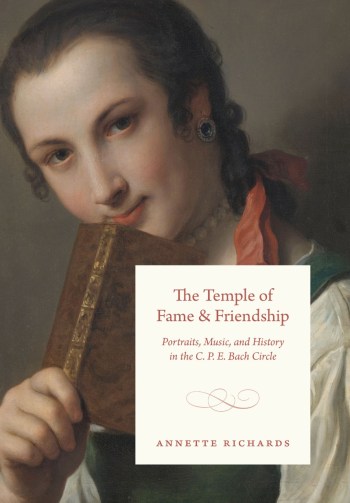 One of the most celebrated German composers of the eighteenth century, C. P. E. Bach spent decades assembling an extensive portrait collection of some four hundred music-related items—from oil paintings to engraved prints. The collection was dispersed after Bach’s death in 1788, but with Annette Richards’s painstaking reconstruction, the portraits once again present a vivid panorama of music history and culture, reanimating the sensibility and humor of Bach’s time. Far more than a mere multitude of faces, Richards argues, the collection was a major part of the composer’s work that sought to establish music as an object of aesthetic, philosophical, and historical study.
The Temple of Fame and Friendship brings C. P. E. Bach’s collection to life, giving readers a sense of what it was like for visitors to tour the portrait gallery and experience music in rooms thick with the faces of friends, colleagues, and forebears. She uses the collection to analyze the ‘portraitive’ aspect of Bach’s music, engaging with the influential theories of Swiss physiognomist Johann Caspar Lavater. She also explores the collection as a mode of cultivating and preserving friendship, connecting this to the culture of remembrance that resonates in Bach’s domestic music. Richards shows how the new music historiography of the late eighteenth century, rich in anecdote, memoir, and verbal portrait, was deeply indebted to portrait collecting and its negotiation between presence and detachment, fact and feeling.
Annette Richards is Given Foundation Professor in the Humanities and university organist at Cornell University, where she is also professor of music and director of the Cornell-Westfield Center for Historical Keyboard Studies. She is the author of The Free Fantasia and the Musical Picturesque; the editor of C. P. E Bach Studies; coeditor, with Mark Franko, of Acting on the Past; and the founding editor of Keyboard Perspectives.
C O N T E N T S
Introduction
1 Exhibiting: The Bach Gallery and the Art of Self-Fashioning
2 Collecting: C. P. E. Bach and Portrait Mania
3 Speculation: Likeness, Resemblance, and Error
4 Character: Faces, Physiognomy, and Time
5 Friendship: Portrait Drawings and the Trace of Modern Life
6 Feeling: Objects of Sensibility and the ‘Portrait of Myself’
7 Memorializing: Portraits and the Invention of Music History
Acknowledgments
Notes
Bibliography
Index
New Book | From the Ruins of Enlightenment
Distributed by The University of Chicago Press:
Richard Kramer, From the Ruins of Enlightenment: Beethoven and Schubert in Their Solitude (Chicago: The University of Chicago Press, 2022), 264 pages, ISBN: 9780226821634, $50.
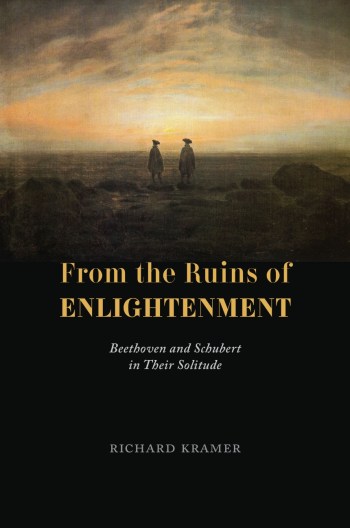 Richard Kramer follows the work of Beethoven and Schubert from 1815 through to the final months of their lives, when each were increasingly absorbed in iconic projects that would soon enough inspire notions of ‘late style’.
Here is Vienna, hosting a congress in 1815 that would redraw national boundaries and reconfigure the European community for a full century. A snapshot captures two of its citizens, each seemingly oblivious to this momentous political environment: Franz Schubert, not yet twenty years old and in the midst of his most prolific year—some 140 songs, four operas, and much else; and Ludwig van Beethoven, struggling through a midlife crisis that would yield the song cycle An die ferne Geliebte, two strikingly original cello sonatas, and the two formidable sonatas for the “Hammerklavier,” opp. 101 and 106. In Richard Kramer’s compelling reading, each seemed to be composing ‘against’—Beethoven, against the Enlightenment; Schubert, against the looming presence of the older composer even as his own musical imagination took full flight.
From the Ruins of Enlightenment begins in 1815, with the discovery of two unique projects: Schubert’s settings of the poems of Ludwig Hölty in a fragmentary cycle and Beethoven’s engagement with a half dozen poems by Johann Gottfried Herder. From there, Kramer unearths previously undetected resonances and associations, illuminating the two composers in their “lonely and singular journeys” through the “rich solitude of their music.”
Richard Kramer is distinguished professor emeritus of music at the Graduate Center of the City University of New York. A fellow of the American Academy of Arts and Sciences, he is the author of the award-winning Distant Cycles: Schubert and the Conceiving of Song, as well as Unfinished Music and Cherubino’s Leap: In Search of the Enlightenment Moment.
C O N T E N T S
Preamble: 1815 and Beyond
In the Silence of the Poem
1 Hölty’s Nightingales, and Schubert’s
2 Herder’s Hexameters, and Beethoven’s
3 Whose Meeres Stille?
Toward a Poetics of Fugue
4 Gradus ad Parnassum: Beethoven, Schubert, and the Romance of Counterpoint
5 Con alcune licenze: On the Largo before the Fugue in Op. 106
Sonata and the Claims of Narrative
Beethoven
6 On a Challenging Moment in the Sonata for Pianoforte and Violoncello, Op. 102, No. 2
Schubert
7 Against the Grain: The Sonata in G (D 894) and a Hermeneutics of Late Style
Last Things, New Horizons
8 Final Beethoven
9 Posthumous Schubert
Postscript: . . . and Beyond
Acknowledgments
List of Tables, Examples, and Figures
Works Cited
Index
Seminar | Anthony Downey and Maya Ganesh on AI and Images
◊ ◊ ◊ ◊ ◊
From the PMC:
Anthony Downey and Maya Ganesh | Neo-Colonial Visions: Artificial Intelligence and Epistemic Violence
In-person and online, Paul Mellon Centre for Studies in British Art, London, 15 March 2023, 5pm
Part of the series In Conversation: New Directions in Art History, which will explore the changing modes and methodologies of approaching visual and material worlds. Running from January to March 2023.
Artificial Intelligence (AI), often presented as an objective ‘view from nowhere’, constitutes a regime of power that further establishes historical forms of bias and evolving models of subjugation. A key component in this process, this presentation will suggest, involves the extraction of data from digital images in order to train AI. How, therefore, do we understand the transformation of images from their symbolic and representational contexts to their contemporary function as sources of digital data? Bringing together researchers in the field of visual culture and AI technology, and taking as its starting point the representational biases of colonial imagery, Anthony Downey and Maya Indira Ganesh will explore how the digital image has increasingly become the means to extract, archive and repurpose information. Based on the extraction and statistical repurposing of data, they will observe how AI renders entire communities susceptible to encoded and overt forms of epistemological violence. Designed for the purpose of training machine vision and the apparatus of AI, these repurposed “images” reveal, furthermore, how the extractive practices of colonialism have become inexorably aligned with corporate interests and neo-colonial economies of data extraction.
Book tickets here»
Anthony Downey is an academic, author, and editor. He is Professor of Visual Culture in the Middle East and North Africa (Birmingham City University). He sits on the editorial boards of Third Text (Routledge), Journal of Digital War (Palgrave Macmillan), and Memory, Mind & Media (Cambridge University Press). He is the series editor for Research/Practice (Sternberg Press, 2019–ongoing). Recent and upcoming publications include Algorithmic Anxieties and Post-Digital Futures (forthcoming, MIT Press, 2024); Nida Sinnokrot: Palestine is Not a Garden (Sternberg Press and MIT Press, 2023); Khalil Rabah: Falling Forward/Works (1995–2025) (Sharjah Art Foundation and Hatje Cantz, 2022); Topologies of Air: Shona Illingworth (Sternberg Press and the Power Plant, 2021); and Heba Y Amin: The General’s Stork (Sternberg Press, 2020). Downey is the cultural and commissioning lead on a four-year multi-disciplinary AHRC Network Plus award, where his research focuses on cultural practices, digital methods, and educational provision for children with disabilities in Lebanon, the Occupied Palestinian Territories, and Jordan (2020–2024). This award was preceded by an AHRC Development award in 2019. In 2020, Downey curated Heba Y. Amin: When I See the Future (at the Mosaic Rooms, London), and in 2022, he curated Heba Y. Amin: When I See the Future, Chapter II (Zilberman Gallery, Berlin).
Maya Indira Ganesh is a cultural scientist, researcher, and writer working on the social and cultural politics of AI, autonomous and machine learning systems. She is a senior researcher at the Leverhulme Centre for the Future of Intelligence and an assistant professor, co-teaching a masters programme on AI, ethics, and society at the University of Cambridge. Ganesh earned her PhD in cultural sciences from Leuphana University, Lüneburg. Her work examined the reshaping of the ‘ethical’ through the driverless car, an apparatus of automation and automobility, big data, cultural imaginaries of robots, and practices of statistical inference. Before turning to academic work, Maya Indira Ganesh spent a decade as a feminist activist working at the point of intersection of gender justice, digital security, and digital freedoms of expression. Her work has consistently brought questions of power, justice, and inequality to those of the body, the digital, and knowledge making.
Call for Papers | Intellectual Histories of Art and the Archive
From the Paul Mellon Centre:
The Intellectual Histories of Art and the Archive
Paul Mellon Centre, London, 10 May 2023
Proposals due by 15 March 2023
Organized by Chloe Julius and Ambra D’Antone
For those interested in art’s intellectual histories, the archive offers a multitude of possibilities—especially those archives that hold the papers of art historians and critics. While the development of an idea can be traced through drafts, notes, and annotations, correspondence allows a wider intellectual context to be mapped. Yet these archives also pose certain problems, raising questions around authorship, authority, and authenticity. Given the selective and often partial nature of archive collections, what place should the discoveries they yield be afforded in a wider research project? Moreover, given the move from paper to a digital record, are the same kinds of research journeys still possible with email?
This event will bring together scholars working directly with the archives of art historians and critics to discuss the methodological questions and issues posed by archive-driven intellectual histories. While there is no geographical or historical restriction for the presentations, they should be rooted in a discussion of a particular archive. Presentations on early-stage research projects are encouraged.
This event has been organised in conjunction with the workshop Abiding Present: Challenges of Time in Art History, which will take place 11–12 May 2023 at The Warburg Institute. The workshop will explore anew art history’s complex dealings with time and the relationship between the present and the past in art history, initiating a dialogue that critically considers old and new methods in our field.
Please submit a one-hundred word abstract for a fifteen-minute presentation by 11.59pm (GMT) on Monday, 15 March 2023 listing “The Intellectual Histories of Art and the Archive” as the subject line to: events@paul-mellon-centre.ac.uk. Incomplete or late submissions will not be considered.
This is a collaboration between the Paul Mellon Centre for Studies in British Art and the Warburg Institute, London. The co-convenors of this workshop are Chloe Julius, current holder of the PMC’s Archive & Library Fellowship, and Ambra D’Antone, Research Associate, Bilderfahrzeuge International Research Project, Max Weber Stiftung.
New Book | Edward Geoffrey Stanley, A Grand Tour Journal, 1820–22
From Fonthill Media:
Edward Geoffrey Stanley, with an introduction and notes by Angus Hawkins, A Grand Tour Journal, 1820–1822: The Awakening of the Man (Stroud: Fonthill Media, 2022), 224 pages, ISBN: 978-1781558904, £25 / $35.
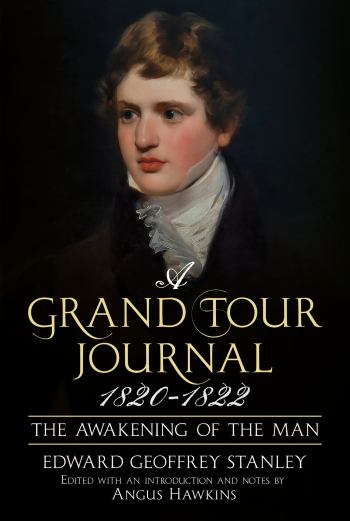 In December 1820, at twenty-one years old, Edward Geoffrey Stanley, the future 14th earl of Derby and three-times prime minister, began an extensive tour of continental Europe. By the time of his return to England twenty months later, he had visited many of the foremost centres for art and culture in Europe, and mostly in Italy. In his travel diaries he recorded his intensive social life, his visits to historical sites, his viewings of art collections, his comments on architecture, his admiration of landscapes, and his impressions of foreign societies. He was energetic, enthusiastic, and discerning: the bridge of Augustus in Umbria gave him “a stupendous idea of Roman grandeur”; the charm of the towns crowning the Tuscan hills struck him with the same delight that he felt when gazing at one of Poussin’s paintings; the waterfall at Terni, which dropped 370 feet into an abyss of spray, was “awfully magnificent”; while the ceremonies of the Italian Catholic Church he judged to be a blend of mummery, superstition, and bigotry. Sights and experiences like these influenced him for the rest of his life. This precious collection of diaries—found only recently and published here for the first time—reveal Edward Stanley to have been a young man of diligence, courage, and decisiveness: a future leader with a conspicuous and burgeoning sense of political and social justice. It was these characteristics, seen in early development within these pages, that shaped the man and the extraordinary career to come.
Edward Geoffrey Stanley (1799–1869), later Lord Stanley and the 14th earl of Derby, was the first British statesman to become prime minister three times and remains the longest serving party leader in modern British politics.
Angus Hawkins (1953–2020) was a fellow of the Royal Historical Society and director of the Research Centre in Victorian Political Culture at Keble College, University of Oxford. Professor Hawkins wrote an acclaimed two-volume biography of Edward Geoffrey Stanley, The Forgotten Prime Minister, published by Oxford University Press in 2007 and 2008.
New Book | Politics and the English Country House, 1688–1800
From McGill-Queen’s University Press:
Joan Coutu, Jon Stobart, and Peter Lindfield, eds., Politics and the English Country House, 1688–1800 (Montreal: McGill-Queen’s University Press, 2023), 344 Pages, ISBN: 978-0228014027, $95.
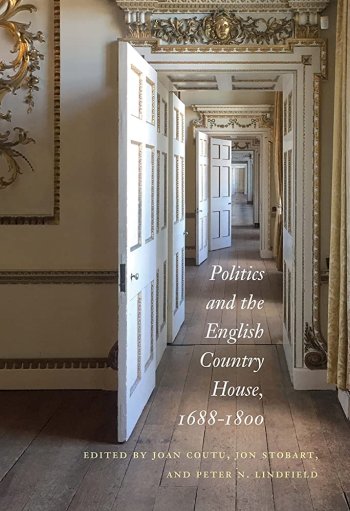 Politics has always been at the heart of the English country house, in its design and construction, as well as in the activities and experiences of those who lived in and visited these places. As Britain moved from an agrarian to an imperial economy over the course of the eighteenth century, the home mirrored the social change experienced in the public sphere. This collection focuses on the relationship between the country house and the mutable nature of British politics in the eighteenth century. Essays explore the country house as a stage for politicking, a vehicle for political advancement, a symbol of party allegiance or political values, and a setting for appropriate lifestyles. Initially the exclusive purview of the landed aristocracy, politics increasingly came to be played out in the open, augmented by the emergence of career politicians—usually untitled members of the patriciate—and men of new money, much of it created on Caribbean plantations or in the employ of the East India Company. Politics and the English Country House, 1688–1800 reveals how, during this period of profound change, the country house remained a constant. The country house was the definitive tangible manifestation of social standing and, for the political class, owning one became almost an imperative. In its consideration of the country house as lived and spatial experience, as an aesthetic and symbolic object, and as an economic engine, this book offers a new perspective on the complexity of political meaning embedded in the eighteenth-century country house—and on ourselves as active recipients and interpreters of its various narratives, more than two centuries later.
Joan Coutu is professor of art history and visual culture at the University of Waterloo.
Jon Stobart is professor of social history at Manchester Metropolitan University.
Peter Nelson Lindfield is lecturer in history at Manchester Metropolitan University.
C O N T E N T S
Table and Figures
Acknowledgements
1 Introduction — Joan Coutu, Jon Stobart, and Oliver Cox
Part One: Political Positioning after the Glorious Revolution
2 Introduction — Oliver Cox
3 For Politics, Progresses, or Posterity? Some Alternative Reasons for Building State Apartments — Amy Lim
4 Holding Court at Marlborough House: The London Residence of Sarah, Duchess of Marlborough — Juliet Learmouth
Part Two: The Question of Style
5 Introduction — Anne Bordeleau
6 Gothic Architecture and the Liberty Trope — Matthew M. Reeve
7 ‘Whig Gothic’: An Antidote to Houghton Hall — Peter N. Lindfield
8 The House with Two Faces: From Baroque to Palladian at Wentworth Woodhouse — Dylan Wayne Spivey
Part Three: The Social Politics of the Country House
9 Introduction — Jon Stobart
10 Burke’s Exemplum: The ‘Natural Family Mansion’ and Wentworth Woodhouse — Joan Coutu
11 House Painting: Place and Position in Estate Portraiture, circa 1770 — John Bonehill
12 The House and Estate of a Rich West Indian: Two Slaveholders in Eighteenth-Century East Anglia — Elisabeth Grass
Part Four: Houses and Homes
13 Introduction — Kate Retford
14 The Clives at Home: Self-Fashioning, Collecting, and British India — Kieran Hazzard
15 William Pitt the Younger, 1759–1806: Reshaping the Political Home — Rowena Willard-Wright
Afterword: Whose Country House? — Dana Arnold
Bibliography
Contributors
Index
New Book | The Story of Follies
Distributed by The University of Chicago Press:
Celia Fisher, The Story of Follies: Architectures of Eccentricity (London: Reaktion Books, 2023), 398 pages, ISBN: 978-1789146356, $50.
 Are they frivolous or practical? Follies are buildings constructed primarily for decoration, but they suggest another purpose through their appearance. In this visually stunning book, Celia Fisher describes follies in their historical and architectural context, looks at their social and political significance, and highlights their relevance today. She explores follies built in protest, follies in Oriental and Gothic styles, animal-related follies, waterside follies and grottoes, and, finally, follies in glass and steel. Featuring many fine illustrations, from historical paintings to contemporary photographs and prints, and taking in follies from Great Britain to Ireland, throughout Europe, and beyond, The Story of Follies is an amusing and informative guide to fanciful, charming buildings.
Celia Fisher has lectured and written widely on the history of plants and gardens in art. Her books include Flower: Paintings by Forty Great Artists and Tulip, the latter also published by Reaktion Books.
C O N T E N T S
Preface
Introduction: A Taste of Follies
1 Seeking out the Origins
2 Some Names to Conjure with
3 Telling a Story
4 Concepts of Freedom and Victory
5 Hunting and Husbandry
6 Waterside Follies and Grottos
7 The Lure of the East
8 From Ruins to Gothic and Picturesque
9 Hermitages and Tree Hoses
10 Into the Future
References
Further Reading
Acknowledgments
Photo Acknowledgments
Index
New Book | The Bridges of Robert Adam
From Triglyph Books:
Benjamin Riley, The Bridges of Robert Adam: A Fanciful and Picturesque Tour (London: Triglyph Books, 2023), 156 pages, ISBN: 978-1916355477, £45 / $60.
 The bridge has always stood as a transitional structure—not purely a work of engineering, nor simply a work of architecture. Its functional requirements are more stringent than those of the average building; it not only must stand up; it must stand up, support those who cross it, and effectively span the space over which it stands. As Samuel Johnson said, “the first excellence of a bridge is strength … for a bridge that cannot stand, however beautiful, will boast its beauty but a little while.” The Scottish architect Robert Adam (1728–1792) understood these precepts well, continually building bridges that were not just structurally sound, but also aesthetically pleasing. Unlike his contemporaries, Adam did not view bridges as mere skeletons upon which to apply ornament. Rather, he sought to achieve architectural totality, incorporating his bridge designs into greater architectural programs, thereby producing aesthetically pleasing and contextually specific designs. From the Pulteney Bridge in Bath to the ruined arch and viaduct at Culzean Castle in Ayrshire, The Bridges of Robert Adam: A Fanciful and Picturesque Tour will take the reader across Britain, shedding new light on an understudied aspect of the great architect’s career.
Benjamin Riley is the managing editor of The New Criterion, a monthly review of the arts and intellectual life based in New York. He holds degrees from Dartmouth College and the Courtauld Institute of Art, where his dissertation focused on the bridges of Robert Adam, becoming the basis for this book. His writing has appeared in The Georgian Group Journal, The New Criterion, The Spectator, and The Wall Street Journal, among other outlets. He lives in New York.










 Enfilade
leave a comment