Tallying Enslavers and Confederates Depicted at the U.S. Capitol

John Trumbull, General George Washington Resigning His Commission, 23 December 1783, installed in the Capitol in 1824, oil on canvas, 12 × 18 feet (Washington, DC: Capitol Rotunda). As noted in The Post article, 19 of the 31 people identified in the painting were enslavers.
◊ ◊ ◊ ◊ ◊
From The Washington Post:
Gillian Brockell, “Art at Capitol Honors 141 Enslavers and 13 Confederates. Who Are They?,” The Washington Post (27 December 2022). The Post examined more than 400 statues, paintings, and other artworks in the U.S. Capitol. This is what we found.
As part of a year-long investigation into Congress’s relationship with slavery, The Washington Post analyzed more than 400 artworks in the U.S. Capitol building, from the Crypt to the ceiling of the Capitol Rotunda, and found that one-third honor enslavers or Confederates. Another six honor possible enslavers—people whose slaveholding status is in dispute. . . .
Just as governments and institutions across the country struggle with the complex and contradictory legacies of celebrated historical figures with troubling racial records, so too does any effort to catalogue the role of the Capitol artworks’ subjects in the institution of slavery. This analysis, for example, includes at least four enslavers—Benjamin Franklin, John Dickinson, Rufus King, and Bartolomé de las Casas—who voluntarily freed the people they enslaved and publicly disavowed slavery while they were living. Other people, such as Daniel Webster and Samuel Morse, were vocal defenders of slavery but did not themselves enslave people; artworks honoring them are not counted in The Post’s tally. . . .
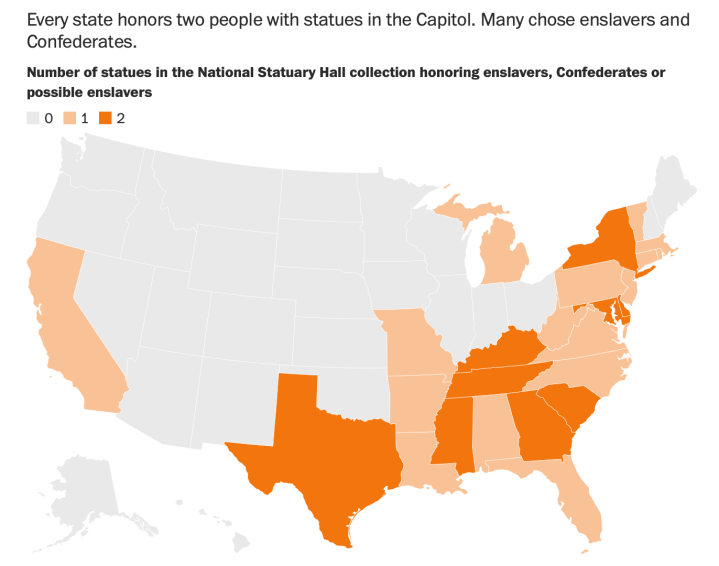
All 11 states that joined the Confederacy have at least one statue depicting an enslaver or Confederate. But the homages to enslavers are by no means restricted to these states: Except for New Hampshire, all of the original 13 states have statues depicting enslavers or possible enslavers.
Massachusetts, for example, is represented by John Winthrop, who is best known for proclaiming a “shining city on a hill” but who also enslaved at least three Pequot people and, as colonial governor, helped legalize the enslavement of Africans.
Both of New York’s statues honor enslavers. One is Declaration of Independence co-writer Robert R. Livingston, who came from a prominent slave-trading family and personally enslaved 15 people in 1790. He also owned brothels that housed Black women who may have been enslaved. The other is former vice president George Clinton, who served under Jefferson and Madison and enslaved at least eight people in his lifetime. . . .
The full article is available here»
New Book | American Inheritance: Liberty and Slavery
From Norton:
Edward Larson, American Inheritance: Liberty and Slavery in the Birth of a Nation, 1765–1795 (New York: W. W. Norton & Company, 2023), 368 pages, ISBN: 978-0393882209, $32.
 From a Pulitzer Prize winner, a powerful history that reveals how the twin strands of liberty and slavery were joined in the nation’s founding.
New attention from historians and journalists is raising pointed questions about the founding period: was the American revolution waged to preserve slavery, and was the Constitution a pact with slavery or a landmark in the antislavery movement? Leaders of the founding who called for American liberty are scrutinized for enslaving Black people themselves: George Washington consistently refused to recognize the freedom of those who escaped his Mount Vernon plantation. And we have long needed a history of the founding that fully includes Black Americans in the Revolutionary protests, the war, and the debates over slavery and freedom that followed.
We now have that history in Edward J. Larson’s insightful synthesis of the founding. With slavery thriving in Britain’s Caribbean empire and practiced in all of the American colonies, the independence movement’s calls for liberty proved narrow, though some Black observers and others made their full implications clear. In the war, both sides employed strategies to draw needed support from free and enslaved Blacks, whose responses varied by local conditions. By the time of the Constitutional Convention, a widening sectional divide shaped the fateful compromises over slavery that would prove disastrous in the coming decades. Larson’s narrative delivers poignant moments that deepen our understanding: we witness New York’s tumultuous welcome of Washington as liberator through the eyes of Daniel Payne, a Black man who had escaped enslavement at Mount Vernon two years before. Indeed, throughout Larson’s brilliant history it is the voices of Black Americans that prove the most convincing of all on the urgency of liberty.
Edward J. Larson is the author of many acclaimed works in American history, including the Pulitzer Prize–winning history of the Scopes Trial, Summer for the Gods. He is University Professor of History and Hugh and Hazel Darling Chair in Law at Pepperdine University, and lives with his family near Los Angeles.
Online Symposium | Design, Description, and Discovery in Cataloging
From the Hood Museum of Art:
Terms of Art: Design, Description, and Discovery in Cataloging
Online, Hood Museum of Art, Dartmouth, 22–24 February 2023
Institutions such as museums, libraries, and archives have a mission to preserve, interpret, and disseminate cultural heritage. In addition to new acquisitions for their collections, these institutions must also update the tools with which researchers access and study these holdings, objects, and works of art. Increasingly, stakeholders like academics, educators, and the public treat a collection’s digital representation—its metadata records—as an entry point for discovery. Paradoxically, these web-based experiences meant to expose collections to broad audiences often assume users have specialized knowledge of the terms and processes GLAM (Galleries, Libraries, Archives, and Museums) institutions use to describe their own work, making them inaccessible to the majority of visitors. Additionally, variation and evolution of language often outpaces or does not align with public understanding. For example, someone interested in 17th-century Dutch art might not know that the phrase “Dutch Golden Age” has colonialist implications and has been removed from many museums’ internal databases. The search language isn’t wrong, it’s just outmoded.
The Hood Museum of Art and Dartmouth Research Computing have organized a virtual symposium to bring together museums, libraries, and archives to discuss issues of access and ethical vocabularies in cultural heritage. The goal is to develop the debate about how the language we use to describe collections impacts the communities that create and seek out art. The organizers hope to prompt dialogue on the issues curators and researchers face in trying to maintain equitable and anti-racist progress and research. Additionally, this symposium will emphasize the role of technologists who specialize in user-centered design as critical to promoting equity in information systems. In combining subject-matter specialists and user-centered design technologists, we aim to bridge the communication gap between institutions and the publics they serve, allowing each to educate the other about how they describe collections. The symposium is free and open to all. Click here to register.
More information about each session is available here»
W E D N E S D A Y , 2 2 F E B R U A R Y 2 0 2 3
Times are Eastern Standard Time (UTC-5)
9.30 Welcome
• Ashley Offill, Associate Curator of Collections, Hood Museum of Art, Dartmouth
• Elizabeth Rice Mattison, Andrew W. Mellon Associate Curator of Academic Programming, Hood Museum of Art, Dartmouth
• John Bell, Program Director, Data Experiences and Visualizations Studio, Dartmouth
• Meredith Steinfels, Assistant Director, Digital Platforms, Media & Archives, Hood Museum of Art, Dartmouth
10.00 Reparative Archival Description at Rauner Library
• Caro Langenbucher, Processing Specialist, Rauner Special Collections Library, Dartmouth
• Joshua Shaw, Library Web and Application Developer, Digital Library Technologies Group, Dartmouth
• Richel Cuyler, Cultural Heritage Technical Developer, Dartmouth
Moderator: Peter Carini, Archivist, Rauner Special Collections Library, Dartmouth
11.00 Continuing the Conversation
This informal 30-minute Zoom session is intended to provide a space for attendees to continue the dialogue from the previous session. Participants are encouraged to connect, brainstorm, and ideate. This session will not be recorded.
12.00 The Spectacle of Bodily Difference in Georgian England: A Case Study in Describing Visual and Textual Representations of Bodily Differences in Historic Printed Materials
• Alex Kither, Curator of Printed Heritage Collections, The British Library
12.30 Case Study: Leveraging the Authority of Labels to Align Design with Diverse Audiences
• Kiersten Thamm, Collections Curator, Museum of 21st-Century Design
1.30 Trouble with the Curve: Describing and Cataloguing Ornament
• Elizabeth Saari Browne, Remote Senior Research Cataloguer, Cooper Hewitt Smithsonian Design Museum
• Adrienne Childs, Independent Scholar, Art Historian, Curator
• Rachel Jacobs, Remote Senior Research Cataloger, Cooper Hewitt Smithsonian Design Museum
• Hazel Wilkinson, Associate Professor, University of Birmingham
2.30 Continuing the Conversation
T H U R S D A Y , 2 3 F E B R U A R Y 2 0 2 3
9.30 Open Office Hours with Elizabeth Rice Mattison: Cataloguing Complex Heritage and Data
10.00 Alt Text Power Hour
• Amelia Mylvaganam, Curatorial Research Aide, The Block Museum of Art, Northwestern University
• Melanie Garcia Sympson, Curatorial Associate for Collections Information and Digital Interpretation, The Block Museum of Art, Northwestern University
11.00 Continuing the Conversation
12.00 Case Study: Tag Along with Adler
• Jessica BrodeFrank, Senior Manager of Digital Management Services, the Academy of Motion Picture Arts and Sciences; Doctoral Candidate the University of London School of Advanced Studies
12.30 Case Study: Assessing the Application of a Locally-Developed Controlled Vocabulary
• Hannah M. Jones, 2022 LEADING Fellow, Dominican House of Studies in Washington, DC
• Mark E. Phillips, Associate Dean for Digital Libraries, University of North Texas Libraries
• Hannah Tarver, Head, Digital Projects Unit, University of North Texas Libraries
• Ana Krahmer, Director, Texas Digital Newspaper Program, University of North Texas Libraries
1.30 Case Study: Casting Terms
• Milena Gallipoli, Head of Research, Museo de la Cárcova and Postdoctoral Research Fellow, Universidad Nacional de San Martín, Argentina
2.00 Case Study: The Office of Art and Archives, US House of Representatives
• Michelle Strizever, Photography and Digital Content Specialist, U.S. House of Representatives, Office of Art and Archives
• Mackenzie Miessau, Registrar, U.S. House of Representatives, Office of Art and Archives
2.30 Open Office Hours with Brinker Ferguson: 3D Documentation, Archiving, and Dissemination of Cultural Heritage Objects
F R I D A Y , 2 4 F E B R U A R Y 2 0 2 3
9.00 Designing and Curating East Asia Art in the Digital Age
• Janet Fong, Research Assistant Professor (Curating), Academy of Visual Arts, Hong Kong Baptist University
• Harald Kraemer, Curator, University of Hong Kong, University Museum and Art Gallery
• Shuo Sue Hua, Assistant Curator (Postdoc Research Fellow), University of Hong Kong, University Museum and Art Gallery
• Ying Liu, Curator (Director of Digital Archive Department), Zhejiang Art Museum (ZJAM) and Associate Director, Chinese Artists Association Print Art Committee – Zhejiang Province, China
• Zhu Yi, Ph.D. Candidate, Lingnan University
10.00 Continuing the Conversation
10.30 Roundtable and Workshop: Curationist.org
• Sharon Mizota, DEI Metadata Consultant
• Amanda Acosta, Digital Archivist, MHz Foundation
• Christina Stone, Digital Archivist, MHz Foundation
• Ravon Ruffin, Educational Programs Manager, MHz Foundation
11.30 Continuing the Conversation
12.00 Open Office Hours: Media Preservation with John Bell
12.30 Open Office Hours: Student-Led Projects and Initiatives with Ashley Offill
1.30 Terms of Art: Reflection, Dialogue, and Facilitating Change
Conference | Wastework
From the Bibliotheca Hertziana:
Wastework
Bibliotheca Hertziana – Max Planck Institute for Art History, Rome, 15–17 March 2023
Organized by Francesca Borgo and Ruth Ezra
 Wastework is an international, interdisciplinary conference on the materiality, spatiality, and processing of waste in the early modern workshop. It proposes to examine acts of disposal, displacement, removal, and abeyance—in short, the getting rid of unwanted things—and the consequences these carry for the study of early modern material culture.
How did the apparent formlessness of this discarded matter—the residues, the shavings, the piles—generate new ideas for forms or find new life through changes in state engendered by slaking, burning, distilling or casting? What disposal flows led household waste—egg shells, stale bread, stove ash—to enter the space of the studio as artistic material or cleaning product? The conference will foreground waste as the material expression of practices of ordering and classification by which people adjudicated between collection and disposal, wanted and unwanted, salvation and loss. In reimagining the discarded past, we intend to test the usefulness of contemporary formulations—secondary product cycles, material fatigue, metabolic flows, sustainability, recycling—while also proposing new typologies and categories.
Wastework is organised by Francesca Borgo (St Andrews / Bibliotheca Hertziana) and Ruth Ezra (St Andrews / eikones) as part of the Lise Meitner Research Group Decay, Loss, and Conservation in Art History.
1 5 M A R C H 2 0 2 3
Site visits for conference participants
• Monte dei Cocci, led by Emlyn Dodd, Assistant Director of Archaeology, British School at Rome
• The American Academy in Rome, introduction to the Rome Sustainable Food Project
Open to the public
21.00 Artists’ talk by DOM on LA BUCA — Esplorazioni dentro il Wasteocene, in conversation with Marco Armiero, author of Wasteocene: Stories from the Global Dump (2021).
1 6 M A R C H 2 0 2 3
9.00 Francesca Borgo and Ruth Ezra — Introduction
9.30 Panel One: Environment
• Stephanie Leitzel — Color and Contamination: An Environmental Approach to the Early Modern Dyehouse
• John Gagné — Rags and Riches: The Paper Workshop’s Suppliers before Industrialization
• Jennifer Van Horn with Megan Baker — Making Paint from Stone: Unfreedom and Material Reuse in Eighteenth-Century North America
10.30 Discussion
11.15 Coffee break
11.45 Panel Two: Network and Translation
• Carlo Scapecchi — A Netherlandish Method to Recycle Wool Shearings in Sixteenth-Century Florence
• Erin O’Connor — All Batched Up: Resource Extraction and Wastework among Glassblowers
12.30 Discussion
13.00 Lunch break
14.00 Panel Three: Economies of Waste
• Sophie Pitman — Cutting Costs: The Use and Abuse of Waste in Early Modern Clothing
• Cass Turner — On Waste and the Book: Origins of the Attention Economy
• Vitale Zanchettin — Waste Made Rich: Venetian Terrazzo Flooring from Antiquity to Carlo Scarpa
15.00 Discussion
16.45 Coffee break
17.15 Keynote Lecture
• Vittoria Di Palma — Use, Value, Waste
18.00 Discussion
1 7 M A R C H 2 0 2 3
9.30 Panel One: Stories from the Workshop Floor
• Daniel Zolli — Sweeping the Workshop Floor: Donatello and the Virtue of Spazzatura
• Lisa Coulardot — Jean Hellot (1685–1766) and the Question of Waste in Dyes Laboratories and Workshops
• Marika Knowles — Pressed and Hung: Wastework in Jacques Callot’s Les grandes misères de la guerre and Abraham Bosse’s La manière de graver
10.30 Discussion
11.15 Coffee break
11.45 Panel Two: Household
• Catherine Girard — Painture: The Temporal and Emotional Labour of Stale Bread in the French Studio
• Anna Reynolds — Fluctuating Matter: Wastework in Seventeenth-Century Breakfast Still Life Paintings
12.30 Discussion
13.00 Lunch break
14.00 Panel Three: Paradoxes of Matter
• Tillmann Taape — Distilling Material Economies: Separating, Preserving, and Recovering Matter
• Justin Linds — ‘Efficacious Fermentation’: Making Value from Rot on Early Modern American Plantations
• Lucy Razzall — ‘Nothing But a Thin Painted Past-board’: Substance and Paradox in Early Modern England
• Charlett Wenig — The Hidden Colors of Bark Ash: Reanimate a Final Leftover
15.30 Discussion
16.15 Coffee break
17.00 Keynote Lecture
• Simon Werrett — Making Use and Making Art: Thrift and Waste in the Early Modern Period
17.50 Closing discussion and roundtable
Poster Image: Quiringh Gerritsz. van Brekelenkam, The Tailor’s Workshop, detail, 1661 (Amsterdam: Rijksmuseum).
Call for Contributions | Antiquitatum Thesaurus Blog
From ArtHist.net, which includes the call in German as well:
Antiquitatum Thesaurus Blog
Berlin-Brandenburg Academy of Sciences and Humanities
Antiquitatum Thesaurus is the youngest research project hosted at the Berlin-Brandenburg Academy of Sciences and Humanities (BBAW). The project investigates drawings and prints of the 17th and 18th centuries based on artefacts from antiquity, and links them with the ancient objects that they document as well as with other evidence of their reception in a digital repository. In addition, we are interested in establishing a platform for an ongoing exchange of information to complement and enrich the database and the digital environment.
Cataloguing the graphic material and the connected artefacts, numerous questions arise, further research areas open up, and interesting connections emerge that cannot always be discussed in depth within the framework of a fixed and preset input mask of a database.
We are very keen to build a long lasting and fruitful contact with the academic community through
• the research tools we make available in our database by cataloguing the graphic material and artefacts represented, and for which we would appreciate your feedback
• an academic dialogue and exchange by blog entries
For our blog section, we are looking for writers interested in contributing essays written to show individual insights and expertise on a specific topic. Blogs are a great way to generate fresh content; they are quick and easy to assimilate, thought provoking, able to generate academic discussion, to take stock of a situation, to give a precise answer to an open question, and much more. In addition, blogs offer the authors the opportunity to introduce themselves to the academic community and draw attention to their websites, academic interests, research fields, and possibly help to establish contacts for cooperation.
Blog contributors could cover one of the following topics, though other proposals are welcome as well:
• methodological approaches in dealing with graphic arts (drawings and prints) in their documentary value
• insights into collectors or personalities involved in either collecting ancient artefacts or exchanging graphic materials
• short reports on ongoing research related to the interests and research areas of Antiquitatum Thesaurus
• short reports on comparable projects dealing with digital humanities
• new finds and discoveries
Some simple guidelines
• Blog postings should be no less than 700 and no more than 2,000 words in length and should contain essential references.
• Postings can include illustrations (no more than 10) provided with captions and rights cleared for website use.
• We would appreciate the provision of links to bibliography (DOI), digital copies and websites (permalink).
• Languages: German, English, Italian, French.
To better evaluate the content of postings and coordinate their sequence, we ask for short proposals first. If you are interested in providing a guest contribution for the Antiquitatum Thesaurus blog page, please send us your application by completing the submission form available at our website. Blog proposals can be submitted at any time to thesaurus@bbaw.de.
Exhibition | The Gregory Gift
From the press release (30 November) for the exhibition:
The Gregory Gift
The Frick Madison, New York, 16 February — 9 July 2023
Organized by Marie-Laure Buku Pongo
 A remarkable gift of twenty-eight fine and decorative works of art recently bequeathed to the Frick by Alexis Gregory (1936–2020) will be shown as a group for the first time at Frick Madison in 2023. The gift includes two eighteenth-century pastels, fifteen Limoges enamels, two eighteenth-century clocks, a large gilt-bronze figure of Louis XIV, and objects made of metal, enamel, and hardstone dating from the sixteenth through eighteenth centuries.
The celebrated holdings of decorative arts objects amassed by Henry Clay Frick have been significantly enriched in recent decades by gifts from other collectors. In 1999, Winthrop Kellogg Edey’s bequest added to the museum’s holdings an important group of European clocks and watches, and in the last decade or so, gifts from Dianne Dwyer Modestini (2008), Melinda and Paul Sullivan (2016), Henry Arnhold (2019), and Sidney R. Knafel (2021) have reshaped The Frick’s holdings of European ceramics with significant groups of Du Paquier and Meissen porcelain, French faience, and Italian maiolica.
The remarkable bequest in 2020 from the collection of Alexis Gregory builds on this tradition by enhancing the museum’s existing holdings and introducing to the museum new types of objects. The exhibition The Gregory Gift features the twenty-eight acquisitions in a variety of media and forms, curious luxury objects that, shown together, suggest a fine collector’s cabinet or Kunstkammer. Among them are fifteen Limoges enamels, two clocks, two ewers, a gilt-bronze sculpture, a serpentine tankard, an ivory hilt, a rhinoceros horn cup, a pomander, and two stunning pastels by Rosalba Carriera. The exhibition is organized by Marie-Laure Buku Pongo, Assistant Curator of Decorative Arts, and will be accompanied by a catalogue and complementary education programs.
Comments Ian Wardropper, Anna-Maria and Stephen Kellen Director of The Frick, “Alexis Gregory had one of the finest collections of Renaissance and Rococo decorative arts in this country. His deep affection for The Frick led to his bequest of a selection of a superb group of objects, and we are gratified to mount this exhibition in his memory.” Buku Pongo adds, “This generous and important gift to The Frick Collection opens new areas of research and lays the groundwork for exciting projects. From research into the context of their creation to technical analyses expanding our knowledge of how these objects were produced, the exhibition at Frick Madison will celebrate Alexis Gregory’s generous gift and The Frick Collection’s commitment to the display of European decorative arts.”

Rosalba Carriera, Portrait of an Unidentified Woman, ca. 1730, pastel on paper, laid down on canvas, 59 × 48 cm (New York: The Frick, Gift of Alexis Gregory, 2020.3.02).
Gregory built his career in book publishing, establishing the celebrated Vendome Press, a publisher of significant volumes on French culture and art. His contributions to and engagement in the arts included serving on art committees at several cultural institutions in the United States, including the visiting committees of European Paintings and European Sculpture and Decorative Arts at The Metropolitan Museum of Art. His history with The Frick began with frequent visits to the museum as a youth. On one occasion, Gregory left the boarding school he was attending with a classmate to visit the museum and managed to convince his friend that he lived in its mansion, as everyone they encountered on staff seemed to know him extremely well. At Harvard, he studied with leading art historians. Those close to him often described him as a Renaissance man as he spoke several languages, wrote books, traveled the globe, and collected art. These pursuits went hand in hand, as collecting art allowed him to research objects and travel around Europe to find new acquisitions. The purchase of his first Renaissance bronze at the age of eighteen marked the starting point of his collection.
Gregory collected widely, from paintings and works on paper to bronzes and sculptures. In the 1980s, his deep interest in European decorative arts prompted him to exchange one of the Impressionist paintings he had inherited from his parents for an assortment of bronzes, sculptures, and Limoges enamels, as well as a watercolor. He later expanded his collection with additional sculptures, Italian bronzes, and Limoges enamels, continuing throughout his life to acquire objects from the United States and Europe. Gregory’s collection echoes, in many ways, the Kunstkammers created by princes during the Renaissance, where they would not only display enamels, faience, carved ivories, automatons and clocks, and precious and mounted metalwork, but also show exotic natural specimens.
A Saint-Porchaire ceramic ewer joins two such objects already in The Frick Collection. This addition is particularly significant as only about seventy Saint-Porchaire works exist today. The ewer is part of a limited experimental production that still poses many questions and is represented in a few museums, among them, The Metropolitan Museum of Art, the Victoria and Albert Museum, and the Musée du Louvre.
Other highlights from the gift include a fine group of Limoges enamels, including a significant number of grisaille examples, which strengthens The Frick’s holdings of mostly polychrome enamels. Grisaille refers to a technique developed in the sixteenth century that was often used by enamelers including the famed Pierre Reymond (1513–after 1584). The Gregory gift includes multiple enamels by Reymond and his workshop, as well as objects by Jean de Court (active 1541–83) and broadens the representation of these artists at The Frick. A large dish enameled on copper with at his center a Saxon silver coin engraved by Hans Biener (ca. 1556–1604), is the first of its kind to enter the collection. It belongs to a rare production in sixteenth-century Venetian workshops, and only about three hundred pieces exist today. (Of these, only about fifty have painted coats of arms or coins, making this example quite rare.)
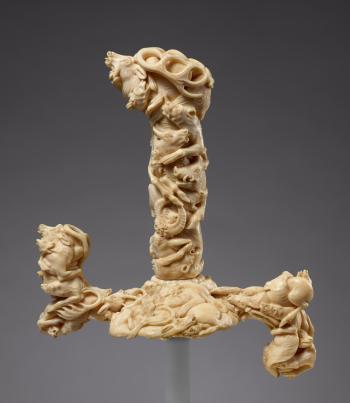
Sword Hilt, possibly by Johann Michael Maucher, ca. 1700, ivory, 16 × 16 × 6 cm (New York: The Frick, Gift of Alexis Gregory, 2021.18.01).
Carved ivory and rhinoceros horn objects also enter the collection for the first time. A fine hilt in ivory, possibly made by Johann Michael Maucher (1645–1701)—one of the most important ivory carvers and sculptors at that time—will shed more light on ivory carving and production in southern Germany during the seventeenth century.
A gilt bronze that represents Louis XIV is attributed to Domenico Cucci (ca. 1635–1704) and his workshop. Cucci was one of the most talented cabinetmakers of the eighteenth century, and this bronze is likely one of the few remaining remnants of a elaborate cabinet made for the king, around 1662–64. In 1883, the Musée du Louvre tried unsuccessfully to acquire the bronze, which mostly remained in private hands before being acquired by Gregory in 2007. Gilt bronzes and other objects designed by Cucci and produced in the Gobelins Manufactory (which made sumptuous furnishings and objects for French royal residences and as lavish diplomatic gifts) are mostly held in private hands. Besides The Frick, only a few collections, including the Château de Versailles, hold remnants of cabinets made by Cucci and his workshop.
Two clocks, one made by the British jeweler and goldsmith James Cox (ca. 1723–1800) and the second by Johann Heinrich Köhler (1669–1736), jeweler at the court of Dresden, diversify The Frick’s holdings of important clocks and watches and are key examples of their respective types. Both jewelers worked for powerful patrons: Köhler for Augustus II (‘the Strong’), Elector of Saxonyand King of Poland, and Cox for the Chinese Qianlong Emperor. Cox crafted automatons with musical movements, also called ‘sing-songs’, which were exported to China, India, Persia, and Russia. Examples of their work are still on view in the Grünes Gewölbe (Green Vault) in Dresden and the Forbidden City in Beijing.
Gregory’s bequest also brings to The Frick several works by women. An enameled medallion by Suzanne de Court (active ca. 1600), the only known female artist to lead a Limoges workshop during the sixteenth century, joins a notable pair of saltcellars signed by de Court already in The Frick’s collection. Two portraits by the celebrated Venetian pastel artist Rosalba Carriera (1673–1757), significantly enhance the museum’s holdings in this medium.
The exhibition Is generously funded by the Alexis Gregory Foundation.
Marie-Laure Buku Pongo, The Gregory Gift (London: Paul Holberton Publishing, 2023), 96 pages, ISBN: 978-1913645434, £25 / $30.
Catalogue cover image: James Cox, Musical Automaton Rhinoceros Clock, ca. 1765–72, gilt bronze, silver, enamel, paste jewels, white marble, and agate, 40 × 21 × 9 cm (The Frick Collection, Gift of Alexis Gregory, 2021.6.02; photo by Joseph Coscia Jr).
Exhibition | Nicolas Party and Rosalba Carriera
Opening in June at The Frick:
Nicolas Party and Rosalba Carriera
The Frick Madison, New York, 1 June 2023 — February 2024
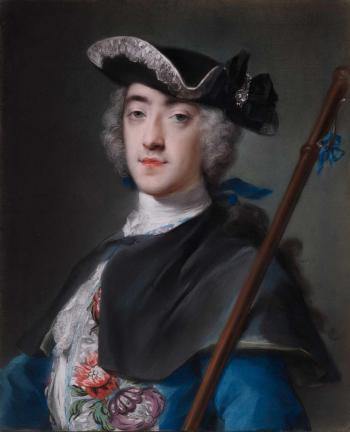
Rosalba Carriera, Portrait of a Man in Pilgrim’s Costume, ca. 1730. pastel on paper, glued to canvas, 59 × 48 cm (New York: The Frick Collection, Gift of Alexis Gregory, 2020.3.01).
This summer, The Frick Collection will debut a site-specific pastel mural by Swiss-born artist Nicolas Party (b. 1980), executed in the Italian Galleries at the museum’s temporary home, Frick Madison. The work will be created in response to Rosalba Carriera’s Portrait of a Man in Pilgrim’s Costume, a spectacular eighteenth-century pastel bequeathed to the Frick in 2020 by Alexis Gregory, the founder of Vendome Press. This is the second Frick installation to be inspired by a volume from The Frick’s popular Diptych series, each volume of which focuses on a single work from the collection, pairing an illuminating essay by a curator with a contribution from a contemporary cultural figure. Party’s mural will be the centerpiece of an upcoming Diptych, Rosalba Carriera’s Man in Pilgrim’s Costume, to be co-authored by Party and Xavier F. Salomon, the Frick’s Deputy Director and Peter Jay Sharp Chief Curator.
Funding for the installation is generously provided by The Christian Humann Foundation and the David L. Klein, Jr. Foundation.
Call for Papers | Dutch and Flemish Drawings 1500–1800
From ArtHist.net:
Making, Collecting, and Understanding Dutch and Flemish Drawings, 1500–1800
Amsterdam, 1–2 June 2023
Proposals due by 1 March 2023
This international symposium will celebrate Old Master drawings on the occasion of the exhibition The Art of Drawing: Master Drawings from the Age of Rembrandt in the Peck Collection at the Ackland Art Museum, on view at the Rembrandt House Museum (18 March – 11 June 2023).
Research in early modern Dutch and Flemish drawings touches on a wide variety of issues, including the study of materials and techniques; issues of attribution and oeuvre cataloging; and expanding our understanding of the provenance, collecting, and display of works on paper. This symposium aims to be wide ranging and inclusive of both art historians and conservation scientists. It offers scholars a chance to come together to present and discuss recent research in this specialized field, which now evolves to encompass new methodologies and concerns.
We invite scholars from all phases of their careers to submit proposals for papers. Subjects of interest include, but are not limited to: close studies of individual artists or drawings, connoisseurial concerns such as attributions of drawings to Rembrandt and his School, recent advances in technical research such as XRF imaging and watermark analysis, the study of early collections, and the sources and history of use of certain materials. We also welcome considerations that treat methodological concerns generally, or provide historiographic context for the field.
Lectures will be 20 minutes in length. To propose a topic, please send a short abstract (200 words) and a CV by 1 March 2023 to PeckDrawingsSymposium@rijksmuseum.nl. The organizers will respond by 15 March 2023.
Organizing Committee
• Dana Cowen, Ackland Art Museum, University of North Carolina at Chapel Hill
• Robert Fucci, University of Amsterdam
• Ilona van Tuinen, Rijksmuseum, Amsterdam
• David de Witt, The Rembrandt House Museum, Amsterdam
Current Archaeology Awards, 2023
From the magazine Current Archaeology (with awards announced February 25) . . .
Current Archaeology has announced nominees for its fifteenth annual awards. The 2023 awards celebrate the projects and publications that made the pages of the magazine over the past 12 months, and the people judged to have made outstanding contributions to archaeology. These awards are voted for entirely by the public—there are no panels of judges—so we encouraged you to get involved and choose the projects, publications, and people you wanted to win.
Nominees appeared in the following categories:
• Archaeologist of the Year
• Book of the Year
• Research Project of the Year
• Rescue Project of the Year
◊ ◊ ◊ ◊ ◊
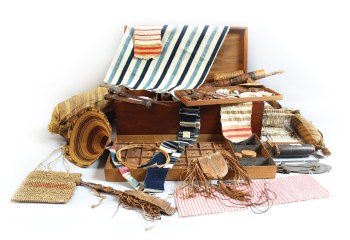
Campaign chest of abolitionist activist Thomas Clarkson, which included West African textiles and other objects that he used to argue against the slave trade. It was given to Wisbech & Fenland Museum in 1870 (Photo: Wisbech & Fenland Museum, Sarah Cousins).
Among the Nominees for Research Project of the Year:
From West Africa to Wisbech: Analysing 18th-Century Textiles in Thomas Clarkson’s Campaign Chest
Margarita Gleba (University of Padua), Malika Kraamer (University of Leicester), and Sarah Coleman (formerly Wisbech & Fenland Museum, now National Horseracing Museum), Current Archaeology, issue 383
Can the study of an abolitionist collection of West African textiles weave new threads into the story of cross-cultural contacts in the era of the Atlantic slave trade?
◊ ◊ ◊ ◊ ◊
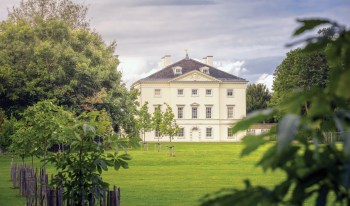
Roger Morris, Marble Hill House, Twickenham, 1724–29. As noted at Wikipedia, “the compact design soon became famous and furnished a standard model for the Georgian English villa and for plantation houses in the American colonies.” Having opened in May 2022 following the restoration, Marble Hill House is currently closed for the winter, with plans to reopen in April.
Among the Nominees for Rescue Project of the Year:
Restoring Marble Hill: How Archaeology Helped Revive a Georgian Gem
English Heritage, Current Archaeology, issue 388
Ongoing restoration work at Marble Hill in Twickenham and recent investigations of its grounds have revealed the fabric of the Georgian building alongside the story of its owner, Henrietta Howard.
HMS Invincible: Excavating a Georgian Time Capsule
Daniel Pascoe / Bournemouth University, Current Archaeology, issue 389
Investigations of the wreck of HMS Invincible, which sank off Portsmouth in 1758, have shed illuminating light on what life was like on board this 18th-century warship, and within the Georgian Royal Navy.
Lessons from Canterbury: Saving Heritage with New Approaches to Urban Development
SAVE Britain’s Heritage, Current Archaeology, issue 389
SAVE Britain’s Heritage have recommended a more historically sympathetic approach to urban development in response to the scale and height of new buildings proposed for Canterbury’s city centre.
Exhibition | Love Stories from the NPG
Now on view at The Baker Museum in Florida:
Love Stories from the National Portrait Gallery, London
Worcester Art Museum, 13 November 2021 — 13 March 2022
Amsterdam Museum in the Hermitage, 17 September 2022 — 8 January 2023
The Baker Museum, Naples, 4 February – 7 May 2023
Curated by Lucy Peltz
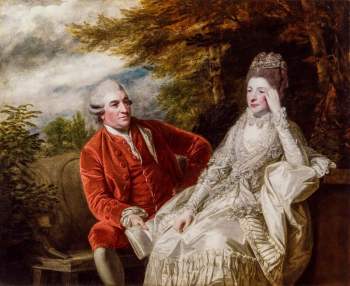
Joshua Reynolds, Portrait of David Garrick and Eva Maria Garrick, 1772–73, oil on canvas, 55 × 67 inches (London: National Portrait Gallery, purchased, 1981).
This groundbreaking exhibition presents masterpieces from the collection of the National Portrait Gallery, London, arguing that ideas of love and desire have been critical to the development of portraiture from the 16th century to the present day. Portraits provide visual records of relationships, are used to memorialize dead or absent lovers and have often been given as love tokens. Featured artists include Sir Joshua Reynolds, Angelica Kauffman, Man Ray, Lee Miller, David Hockney, and others. At the heart of this exhibition are a series of real-life love stories, from the English Renaissance to today, grouped thematically. Each of the love stories sheds light on a different aspect of romantic love and the role of portraits within it, from images that capture an artist’s obsession with their muse to those that record tragic love affairs or celebrate the triumph of love against the odds.
Love Stories from the National Portrait Gallery, London is organized by the National Portrait Gallery, London, and is curated by Dr. Lucy Peltz. The presentation of this exhibition at Artis—Naples, The Baker Museum is curated by Courtney McNeil, museum director and chief curator.
Lucy Peltz, ed., with contributions by Peter Funnell, Simon Callow, Marina Warner, Louise Stewart, and Kate Williams, Love Stories: Art, Passion & Tragedy (London: National Portrait Gallery, 2020), 231 pages, ISBN: 978-1855147034, $40.










 Enfilade
leave a comment