New Book | Thorvaldsen: Collector of Plaster Casts
From Aarhus UP:
Jan Zahle, Thorvaldsen: Collector of Plaster Casts from Antiquity and the Early Modern Period (Copenhagen: Thorvaldsens Museum and Aarhus University Press, 2020), 3 volumes, 828 pages, ISBN: 978-8771843590, $112.
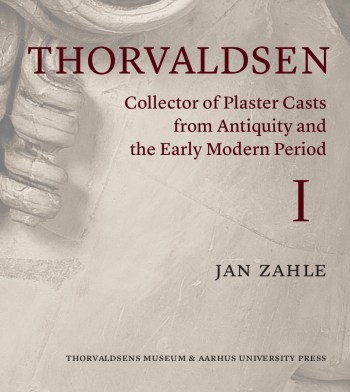 The Danish neoclassical sculptor Bertel Thorvaldsen (1770–1844), who lived most of his life in Rome, was not only one of Europe’s most sought-after artists; he was also a collector. In addition to his own works and drawings, he built extensive collections of paintings, prints, drawings, and books—and of ancient artefacts from Egyptian, Greek, and Roman antiquity: coins, lockets, containers, vases, lamps, fragments of sculpture, and more. He also acquired a large collection of plaster casts, primarily after ancient sculptures and reliefs, but also of works dating from the Renaissance and up until his own lifetime. Thanks to Thorvaldsen’s bequest to the city of Copenhagen, his birthplace, all of these collections are still largely intact and well preserved at his museum.
Home to a total of 657 plaster casts, the Thorvaldsen Museum’s cast collection is unique for several reasons: The collection offers us insight into the sculptor’s working methods and the development of his work because it served a clear function as an image bank of forms, motifs and subjects for Thorvaldsen’s own endeavours. Furthermore, the dual fact that the collection is so well preserved and was established over a relatively brief period of time makes it a valuable example illuminating the trade and distribution of plaster casts during the first half of the nineteenth century.
These areas of study form the central focal point of Volume I of this publication. Volume II contains a catalogue of the individual objects in the cast collection, while Volume III collects the overviews, inventories, concordances, and primary sources referred to in the first two volumes. Arising out of many years of study of Thorvaldsen’s cast collection conducted by their author, the classical archaeologist Jan Zahle, these books contain comprehensive source material from the period, much of it previously unknown.
The table of contents is available as a PDF file here»
New Book | Ten Kings’ Clothes: Royal Danish Dress, 1596–1863
Distributed by Yale UP:
Katia Johansen, Ten Kings’ Clothes: Royal Danish Dress, 1596–1863 (Denmark: Aarhus University Press, 2022), 496 pages, ISBN: 978-0300266764, $80.
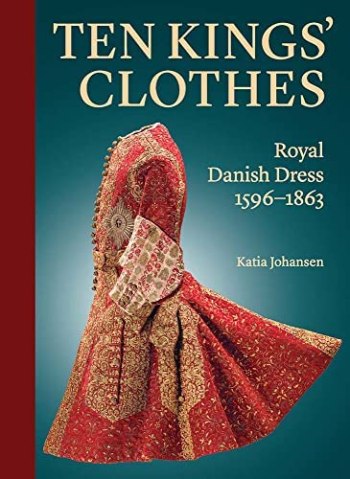 A richly illustrated glimpse into the magnificent collection of seventeenth-century men’s dress from the Danish kings’ wardrobes
Ten Kings’ Clothes: Royal Danish Dress, 1596–1863 presents the unparalleled collection of male dress belonging to the Danish kings from Christian IV to Frederik VII. The incomparable research showcases the collection of each monarch, put into context against the backdrop of pivotal moments in Danish history, the networks of supply, and the production and circulation of luxury goods. Richly illustrated with portraits, prints, and the stunning garments, extended entries and hand-drafted patterns allow a detailed and technical appreciation of each item. The historical garments tell the story not only of the kings’ coronations and weddings but also of everyday life at court, including the contributions of tailors, embroiderers, valets, portrait artists, castle stewards, and laundresses. The book includes a foreword written by Her Majesty Queen Margrethe II of Denmark.
Katia Johansen is a renowned author, lecturer, and teacher of textile conservation, exhibition techniques, and costume history. She is the former textile conservator and costume curator at The Royal Danish Collections at Rosenborg Castle, Denmark, where she worked for over 35 years.
Research Group | French Cultural Seminar, University of Warsaw

◊ ◊ ◊ ◊ ◊
From the University of Warsaw’s Centre de civilisation française (which includes the invitation in French) . . .
Dear Doctoral Students,
The French Cultural Center at the University of Warsaw invites you to participate in the Outils et méthodes de la recherche en sciences humaines doctoral seminar. This doctoral seminar aims to bring together young researchers dealing with aspects related to French culture. Representatives of all fields of the humanities are invited to cooperate. Our goal is to create a research group that will meet regularly and conduct joint cross-disciplinary research. The seminar is open to all members of the academic community.
The meetings will be held twice a month from February 2023 to June 2023 in the Center’s Library from 4.30 to 7.00pm. The seminar will be held in English or French. The topics of the meetings will vary depending on the needs and interests of the participants. Proposed topics include:
• Discussions of new scientific literature
• Discussions on new methodologies in French research
• Presentations prepared by seminar participants
• Short lectures by invited guests — discussions of publications, methodological lectures, lectures explaining the practical aspects of scientific research related to French culture (e.g. French archives, scientific databases, etc.)
The seminar will end with a round-table discussion summarizing the cycle and the publication of peer-reviewed texts presented by PhD students.
The first organizational meeting will take place on 10 February 2023 at 10.00am in the Library of the French Cultural Center or via Zoom. Willingness to participate in the seminar, along with any questions, should be sent to Emma Kołodziejek, e.kolodziejek@uw.edu.pl.
The Art Bulletin, December 2022
The eighteenth century in the latest issue of The Art Bulletin 104 (December 2022), along with the methodological ‘perspective’ conversation from Fricke and Flood:
A R T I C L E S
 • Beate Fricke and Finbarr Barry Flood, “Premodern Globalism in Art History: A Conversation,” pp. 6–19.
A conversation took place in 2021 between two art historians whose research focuses on different regions of the premodern world and who have recently collaborated on a project dealing with early histories of globalism. The discussion considers the potential archival value of ‘flotsam’—that is, extant artifacts and images lacking extensive textual metadata—for (re)constructing transcultural and transregional histories of circulation and reception. It addresses divergences in the nature of the available archival materials and the ethical and methodological challenges this poses. The discussants consider the need to move beyond earlier, largely celebratory narratives of the global to engage the ways in which transregional and transcultural networks intersected with more rooted or regional traditions of art making and material culture.
• Paris A. Spies-Gans, “Why Do We Think There Have Been No Great Women Artists? Revisiting Linda Nochlin and the Archive,” pp. 70–94.
In 1971 Linda Nochlin published her quickly canonical “Why Have There Been No Great Women Artists?” (ARTnews 69, no. 9). She offered a powerful narrative, claiming that Western institutional structures and a lack of access to vital educational opportunities had historically prevented women from becoming ‘great’ artists—indeed from even having the potential to achieve greatness. I suggest new visual and textual lenses through which we can update Nochlin’s narrative and reconsider women artists on their own societies’ terms, arguing that by returning to the archive, we can identify greatness and professionalism where they have eluded us before.
R E V I E W S
• Amy Knight Powell, Review of Aaron Hyman, Rubens in Repeat: The Logic of the Copy in Colonial Latin America (Getty Publications, 2021), pp. 120–23.
• Amanda Lahikainen, Review of Joseph Monteyne, Media Critique in the Age of Gillray: Scratches, Scraps, and Spectres (University of Toronto Press, 2022), pp. 123–26.
New Book | Media Critique in the Age of Gillray
From Toronto UP:
Joseph Monteyne, Media Critique in the Age of Gillray: Scratches, Scraps, and Spectres (Toronto: University of Toronto Press, 2022), 316 pages, ISBN: 978-1487527747, $75.
 In the late 1790s, British Prime Minister William Pitt created a crisis of representation when he pressured the British Parliament to relieve the Bank of England from its obligations to convert paper notes into coin. Paper quickly became associated with a form of limitless reproduction that threatened to dematerialize solid bodies and replace them with insubstantial shadows. Media Critique in the Age of Gillray centres on printed images and graphic satires which view paper as the foundation for the contemporary world. Through a focus on printed, visual imagery from practitioners such as James Gillray, William Blake, John Thomas Smith, and Henry Fuseli, the book addresses challenges posed by reproductive technologies to traditional concepts of subjective agency.
Joseph Monteyne shows that the late eighteenth-century paper age’s baseless fabric set the stage for contemporary digital media’s weightless production. Engagingly written and abundantly illustrated, Media Critique in the Age of Gillray highlights the fact that graphic culture has been overlooked as an important sphere for the production of critical and self-reflective discourses around media transformations and the visual turn in British culture.
Joseph Monteyne is an associate professor in the Department of Art History, Visual Art, and Theory at the University of British Columbia.
C O N T E N T S
List of Illustrations
Acknowledgments
Introduction: Making and Unmaking the Paper World
1 Dark Media and the Materiality of Nothing
Dark Media and Graphic Materiality
Smoked Images and Night Pieces: Touching Nothing
Form and Formlessness in Blake’s Embedded Media
2 Haunted Media
Conjuring Dead Painters
The Baseless Fabric of Print
Dematerializing Media
3 Good Copies, Bad Copies
Counterfeit Masks
Repetition with Difference
Pairs of Portraits
4 Social Detritus, Paper Detritus
Blind Beggars and Printed Images
Cobbling, Patching, Translating
The Gatherer of Scraps
Notes
Bibliography
Index
Cleveland Announces New Acquisitions
From the CMA press release (17 January 2023). . .
Recent acquisitions by the Cleveland Museum of Art (CMA) include a Korean abstract expressionist painting by Yun Hyong-keun 윤형근; a ten-panel folding screen by Kim Yoon-bo 김윤보; an early masterpiece by James Tissot from his English period; and a recently discovered full-length pastel portrait by Hugh Douglas Hamilton, the most celebrated Irish portraitist of the Grand Tour. . . .
Hugh Douglas Hamilton’s Portrait of George Clavering Cowper

Hugh Douglas Hamilton, Portrait of George Clavering Cowper, 3rd Earl Cowper, 1785, pastel on paper stretched on linen; sheet: 94 × 69 cm (The Cleveland Museum of Art, Leonard C. Hanna Jr. Fund).
Preserved in remarkable condition, this portrait has remained in the sitter’s family—and was discovered only recently in the collection of the descendants of its sitter, George Clavering Cowper, 3rd Earl Cowper (1738–1789), of Great Britain. The full-length pastel was a type developed during the 18th century that appealed to English tourists on the Grand Tour to Italy. The earl, a cultural paragon in Italy and a patron of artists and composers, sat for the most celebrated Irish portraitist of the Grand Tour, Hugh Douglas Hamilton, in Florence, where he made his home.
Cowper prominently wears the sash and star of the which he had received in March 1785. The Order of Saint Hubertus was founded in 1695, a knightly order of aristocratic hunters from throughout the Hapsburg empire, whose motto was “Honoring God by Honoring his Creatures.” Evoking the emotion of this motto, Hamilton featured Cowper’s hunting dog, who receives a tender pat on the head and wears a collar inscribed with Cowper’s name.
The portrait enhances the CMA’s collection of pastels, a strength of its drawings collection. The acquisition was made possible by the Leonard C. Hanna Jr. Fund.
More information on the portrait is available at Lowell Libson & Jonny Yarker.
The full press release describing the other three acquisitions is available here»
Exhibition | Sketching among the Ruins

Louise-Joséphine Sarazin de Belmont, The Roman Theater, Taormina, 1825, oil on paper, mounted on board, 42 × 58 cm
(New York: Thaw Collection, jointly owned by the Metropolitan Museum of Art and the Morgan Library & Museum, 2009.400:102)
◊ ◊ ◊ ◊ ◊
Now on view at The Morgan:
Sketching among the Ruins
The Morgan Library & Museum, New York, 25 October 2022 — 12 November 2023
By the mid-eighteenth century, the practice of sketching outdoors with oil paint had become popular among landscape artists. Furthermore, a study trip through Europe, often centered on a stay in Italy, had evolved as a customary part of artists’ training. Italy’s cities and countryside, filled with remnants of ancient monuments, offered artists stimulating subject matter, and the portability of oil sketching facilitated the firsthand study of ruins and their surroundings. While some painters carefully recorded these structures’ textures and colors, as well as how light fell upon them, others invented scenes by reimagining remains of the past or by envisioning the future deterioration of the present. Whether real or fictional, ruins and their surrounding landscape offered poignant juxtapositions—at once testimonies to the majesty of human achievement and to the inevitable triumph of time over our endeavors.
Sketching among the Ruins highlights oil sketches given jointly to the Morgan and the Metropolitan Museum of Art by Eugene V. Thaw, a trustee of both institutions.
◊ ◊ ◊ ◊ ◊
Thaw died in January of 2018 at the age 90. For an overview of his wide-ranging career as a dealer and collector, see Steven M. L. Aronson, “Celebrating Eugene Thaw’s Legacy,” Architectural Digest Pro (25 November 2018).
Exhibition | In and around Piranesi’s Rome

Charles-Louis Clérisseau, Travelers in the Interior of the ‘Temple of Mercury’ at Baiae, ca. 1761, opaque watercolor, 27 × 47 cm
(NY: The Morgan Library & Museum, 1985.62)
◊ ◊ ◊ ◊ ◊
Now on view at The Morgan:
In and around Piranesi’s Rome: Eighteenth-Century Views of Italy
The Morgan Library & Museum, New York, 10 January — 4 June 2023
By the mid-eighteenth century, the Grand Tour, a study trip through Europe with a period of residence in Italy, had become a fixture in the education of European aristocrats and the training of artists. These young travelers were eager to return home with reminders of their experience, which contributed to a demand for paintings, prints, and drawings of Italian views, or vedute. Rome and the vestiges of its ancient past were especially popular subjects, as is also reflected in the nearby display of oil sketches. The burgeoning genre spawned specialized artists (vedusti), particularly at the French Academy in Rome, a center of creative exchange for not only academy members but also other artists active across the city.
Artists took various approaches to vedute. Some adopted a documentary route, recording archeological and architectural sites, occasionally enlivened with figures. Others altered elements of an existing view or invented an entirely fictive scene, known as a capriccio. In both real and imagined modes, a powerful influence and creative force was the Italian Giovanni Battista Piranesi (1720–1778), who for some time maintained a workshop across the street from the French Academy and interacted with many of its artists.
Exhibition | Fortune and Folly in 1720

Installation view of Fortune and Folly in 1720
The New York Public Library, 2022
◊ ◊ ◊ ◊ ◊
At the NYPL (and on view during this year’s CAA conference) . . .
Fortune and Folly in 1720
New York Public Library, 23 September 2022 — 19 February 2023
Curated by Nina Dubin, Meredith Martin, and Madeleine Viljoen
In 1720, everyday citizens converged on the banking streets of Paris, London, and Amsterdam, speculating in New World trading companies and other maritime ventures. By the close of that year, an unprecedented bull market would culminate in the world’s first international financial crash. Orchestrated by the insolvent governments of France and England, and fueled by illusions of colonial wealth, these investment bonanzas—henceforth known as the Mississippi and South Sea Bubbles—have remained synonymous with the temptations of get-rich-quick schemes and the dangers of herd behavior. Three centuries and many booms and busts later, their imprint is indelible. Not only did the bubbles accelerate the growth of a financial system overflowing with stock shares, newly created banknotes, and other mysterious paper devices imbued with financial alchemy—they also illustrated the power of trust and dread, faith and fear, as drivers of market volatility.
The works on display draw from the collections of The New York Public Library and include a trove of caricatures from a Dutch volume known as The Great Mirror of Folly (Het groote tafereel der dwaasheid). Published as the crisis was unfolding, these prints portray the bewildering forces of modern economic life. Loaded with jokes, often of a scatological nature, The Great Mirror of Folly lifts the curtain on a farcical political theater whose stars include bankers and statesmen—and that’s just for starters. Offering tragicomic depictions of malevolent traders, hoodwinked investors, and villainous seductresses, the prints hold up a mirror to our own age, with its ever more complex monetary instruments and periodic meltdowns. They also reflect on the intersections between art and finance, reminding us that both are products of human imaginings.
Madeleine Viljoen, Nina Dubin and Meredith Martin, Meltdown! Picturing the World’s First Bubble Economy (Turnhout: Harvey Miller, 2020), 157 pages, ISBN: 978-1912554515, $65 / €50.
New Book | The Great New York Fire of 1776
From Yale UP:
Benjamin Carp, The Great New York Fire of 1776: A Lost Story of the American Revolution (New Haven: Yale University Press, 2023), 360 pages, ISBN: 978-0300246957, $30.
 Who set the mysterious fire that burned down much of New York City shortly after the British took the city during the Revolutionary War?
New York City, the strategic center of the Revolutionary War, was the most important place in North America in 1776. That summer, an unruly rebel army under George Washington repeatedly threatened to burn the city rather than let the British take it. Shortly after the Crown’s forces took New York City, much of it mysteriously burned to the ground. This is the first book to fully explore the Great Fire of 1776 and why its origins remained a mystery even after the British investigated it in 1776 and 1783. Uncovering stories of espionage, terror, and radicalism, Benjamin L. Carp paints a vivid picture of the chaos, passions, and unresolved tragedies that define a historical moment we usually associate with “life, liberty, and the pursuit of happiness.”
Benjamin L. Carp is professor of history at Brooklyn College and the CUNY Graduate Center. He is the author of Defiance of the Patriots: The Boston Tea Party and the Making of America and Rebels Rising: Cities and the American Revolution. He lives in New York City.










 Enfilade
leave a comment