Online Salon | Promenades on Paper: 18th-C. French Drawings
From AHNCA:
Virtual Salon on The Clark’s Exhibition of Eighteenth-Century French Drawings from the BnF
Online, Wednesday, 1 February 2023, 7pm ET
The Association of Historians of Nineteenth-Century Art and the Dahesh Museum join with the Clark Art Institute for a Virtual Salon on the Clark’s current exhibition Promenades on Paper: Eighteenth-Century French Drawings from the Bibliothèque nationale de France. Focusing on select drawings from the exhibition, curators Esther Bell, Anne Leonard, and Sarah Grandin will offer a varied and lively picture of artistic practices in the years leading up to and just after the French Revolution. This event is free and open to the public, but registration is required. Please register here.
Esther Bell is Deputy Director and Robert and Martha Berman Lipp Chief Curator at the Clark Art Institute. Prior to joining the Clark, Bell was the curator in charge of European paintings at the Fine Arts Museums of San Francisco. Bell has published essays and organized exhibitions on a range of subjects, from seventeenth-century genre painting to eighteenth-century theater to nineteenth-century millinery.
Anne Leonard is Manton Curator of Prints, Drawings, and Photographs at the Clark Art Institute. In addition to curating numerous exhibitions of works on paper, she is co-editor of The Routledge Companion to Music and Visual Culture (2014) and author/editor of Arabesque without End: Across Music and the Arts, from Faust to Shahrazad (2022).
Sarah Grandin is Clark-Getty Paper Project Curatorial Fellow at the Clark Art Institute. She specializes in French works on paper and the material culture of the ancien régime. She has published essays on typography, drawing, and Savonnerie carpets, and is preparing a monograph on issues of scale in the graphic and decorative arts under Louis XIV.
New Book | Décoration intérieure et plaisir des sens, 1700–1850
From Editoriale Artemide and GRHAM:
Noémi Duperron, Barbara Jouves-Hann, Maxime Georges Métraux, Marc-André Paulin, and Bérangère Poulain, eds., Décoration intérieure et plaisir des sens, 1700–1850 (Rome: Artemide edizioni, 2022), 168 pages, ISBN: 978-8875754204, €30. With contributions by Muriel Barbier, Élisabeth Caude, Christina Contandriopoulos, Aurélien Davrius, Joséphine Grimm, Johanna Ilmakunnas, Olivier Jandot, Desmond-Bryan Kraege, Ulrich Leben, Frédéric Leblanc, and Erika Wicky.
 Dès le début du XVIIIe siècle, l’idée de plaisir—comme recherche de sensations agréables—devient une composante essentielle et constante de la société. Selon l’historien Paul Hazard, la sensation permet alors à l’individu de prendre conscience de l’existence du monde qui l’entoure, et devient une préoccupation centrale pour les hommes de lettres et les artistes. Dans les espaces intérieurs, ce nouveau rapport de proximité entre l’homme sensible et les murs, le mobilier ou les objets du décor se ressent au travers des interrogations sur la place du plaisir sensoriel dans la distribution, l’ameublement et l’ornementation.
Ce paradigme est au cœur des articles présentés dans cet ouvrage. Focalisés sur la production européenne entre 1700 et 1850, leurs auteurs examinent les sensations sous l’angle de la culture matérielle, des normes sociales ou de l’usage des différentes pièces du logement, que celui-ci ait été édifié, théorisé ou simplement imaginé. En s’appuyant sur des méthodologies variées, les différentes études montrent le rôle central joué par le plaisir, le confort, la commodité ou encore l’agrément dans la conception des intérieurs à cette période. Affectant toutes les échelles de l’habitat, de la construction du bâtiment à la décoration de ses recoins les plus intimes, les sens du toucher, de l’odorat, de la vue ou de l’ouïe sont autant d’éléments auxquels les architectes, les artistes et les artisans devaient prêter attention pour satisfaire les exigences de leurs utilisateurs aux perceptions aiguisées.
Noémi Duperron est assistante diplômée à l’Université de Genève où elle enseigne l’histoire de l’art de la période moderne. Elle conduit une thèse de doctorat sur les représentations et les interprétations de l’Iliade d’Homère dans les arts français et britanniques au XVIIIe siècle sous la direction des Professeurs Jan Blanc et Christian Michel. Elle a conduit ses recherches portant essentiellement sur les échanges franco-britanniques, la peinture d’histoire et la réception de l’Antiquité grecque dans différentes institutions comme la Wallace Collection, la Biblioteca Herziana – Max Planck Institut für Kunstgeschichte ou encore le Warburg Institute.
Barbara Jouves-Hann est ingénieure de recherche, chargée du projet « Recherche et Restauration » pour le DIM PAMIR, Région Île-de-France. Elle est également responsable des études et de la recherche chez Madelénat Architecture et enseigne à l’Université Paris 1 Panthéon- Sorbonne ainsi qu’à l’Institut national du patrimoine. Sa thèse de doctorat, exécutée sous la direction du Professeur Thierry Lalot, a été soutenue à l’Université Paris 1 Panthéon-Sorbonne en 2019 sous le titre La conservation et la restauration des tableaux des collections privées à Paris entre 1789 et 1870 (à paraître aux Éditions de la Sorbonne).
Maxime Georges Métraux est historien de l’art, membre de l’équipe de la galerie Hubert Duchemin et chargé d’enseignement à l’Université Paris 1 Panthéon Sorbonne. Il a été commissaire scientifique de l’exposition Chic Emprise : Cultures, usages et sociabilités du tabac à l’époque moderne (2019, La Rochelle, musée du Nouveau Monde). Il a dernièrement publié dans le catalogue de l’exposition Les Animaux du Roi (2021, Versailles, château de Versailles) et Renoir, Monet, Gauguin. Images of a Floating World – The Kojiro Matsukata and Karl Ernst Osthaus collections (2022, Essen, Museum Folkwang).
Marc-André Paulin est restaurateur du patrimoine en ébénisterie et responsable de l’atelier de restauration mobilier au Centre de recherche et de restauration des Musées de France. Il prépare actuellement une thèse de doctorat à l’université de Lille sur l’ébéniste Jean-Henri Riesener.
Bérangère Poulain est maître-assistante en histoire de l’art de la période moderne à l’Université de Genève. Sa thèse de doctorat, exécutée sous la direction du Professeur Jan Blanc et la codirection du Professeur Christian Michel, a été soutenue à l’Université de Genève en 2020 sous le titre «Nouvelles couleurs, nouvelles jouissances». La polychromie des boiseries françaises au siècle des Lumières.
S O M M A I R E
Avant-Propos — Noémi Duperron, Barbara Jouves-Hann, Maxime Georges Métraux, Marc-André Paulin et Bérangère Poulain
I. En quête de sens : théorie et imaginaire
• Blondel et l’architecture dans le ‘goût moderne’ : la machine à habiter au service du plaisir des sens au XVIIIe siècle — Aurélien Davrius
• Fraicheur, senteurs et procédés rédactionnels : Le génie de l’architecture de Le Camus de Mézières à la lumière de la théorie des jardins — Desmond-Bryan Kraege
• La rhétorique des sens : la visite de Madame de Maisonneuve au Dôme des Invalides — Christina Contandriopoulos
II. Plaisir des sens : de l’objet à l’espace
• Formes, matérialité et usages du mobilier en France au XVIIIe siècle — Ulrich Leben
• Le cabinet particulier du roi Louis XIV à Versailles : secrets autour des transformations d’un bureau — Élisabeth Caude et Frédéric Leblanc
• « Une tente sous laquelle on dort » : l’alcôve et le lit d’alcôve dans la chambre au XVIIIe siècle — Muriel Barbier
• Construire le boudoir idéal : état de l’influence réciproque de la littérature sur les traités d’architecture au XVIIIe siècle — Joséphine Grimm
III. Les sens en éveil : pratiques et usages
• L’odeur des vernis ou la toxicité du confort au XVIIIe siècle — Erika Wicky
• Le confort thermique, l’ordre spatial et les objets dans les demeures suédoises au XVIIIe siècle — Johanna Ilmakunnas
• Le feu caché. Introduction du confort thermique et métamorphoses de l’économie des sens (France, 1700–1850) — Olivier Jandot
Résumés
Index
Exhibition | Looking Up: Studies for Ceilings, 1550–1800
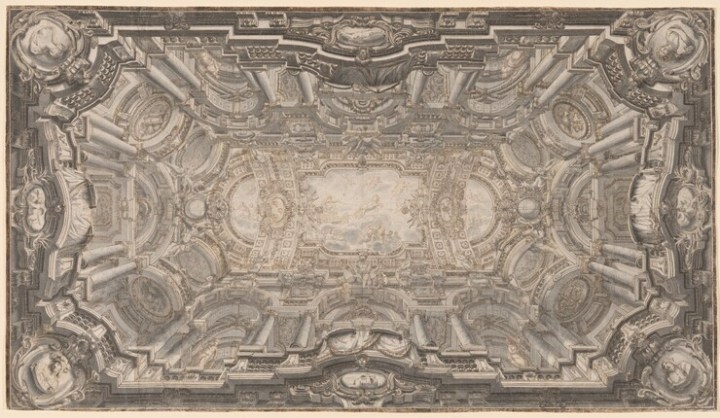
Ferdinando Galli Bibiena, A Grand Illusionistic Ceiling, 1720/1740, pen and brown ink with gray and brown washes over graphite on laid paper
(Washington, DC: National Gallery of Art, 1994.73.1)
◊ ◊ ◊ ◊ ◊
From the NGA:
Looking Up: Studies for Ceilings, 1550–1800
National Gallery of Art, Washington DC, 29 January — 9 July 2023
Curated by Jonathan Bober
In modern architecture and contemporary interior design, ceilings have lost much of their original, complex meaning, becoming neutral fields or featuring generic decoration. However, in the European tradition that spanned nearly four centuries, ceilings were where the most ambitious, compelling, and meaningful painted compositions appeared.
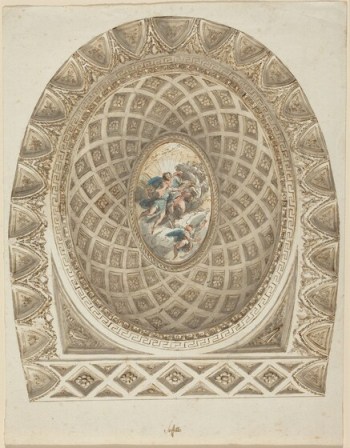
Felice Giani, A Coffered Dome with Apollo and Phaeton, ca. 1787, pen and brown ink with gray, blue, and pink washes over black chalk on wove paper (Washington, DC: National Gallery of Art, 1991.81.1).
Looking Up: Studies for Ceilings, 1550–1800 presents some 30 examples of the evolution of ceiling decoration. These works move from architectural frameworks housing conventional paintings to the illusion of a single, soaring space teeming with figures and dynamic movement during the baroque, and then on to the geometric organization and idealized form associated with neoclassism. Some of the drawings are vibrant preliminary studies; others are large-scale models that give a sense of the experience of the intended final composition. Studies of single motifs and individual figures reveal how these grand projects enticed viewers to pause and look up.
The exhibition is curated by Jonathan Bober, Andrew W. Mellon Senior Curator of Prints and Drawings, National Gallery of Art.
New Book | Schloss Hubertusburg

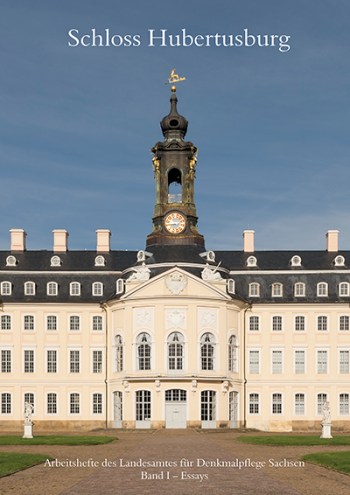
Johann Christoph von Naumann, Hubertusburg, begun in 1721 under Augustus the Strong, Elector of Saxony and King of Poland; it then served as the residence of his son Augustus III. The palace was site of the signing of the 1763 Treaty of Hubertusburg that ended the Seven Years’ War (Wikipedia entry; photo from Wikimedia Commons, May 2013).
◊ ◊ ◊ ◊ ◊
From Sax-Verlag and Sachsen.de:
Landesamt für Denkmalpflege Sachsen, ed., Schloss Hubertusburg / Band I: Essays / Band II: Katalog der Architekturzeichnungen, Reihe Arbeitshefte des Landesamtes für Denkmalpflege Sachsen, Band-Nr. 30 (Markkleeberg: Sax-Verlag, 2022), 1240 pages, ISBN 978-3867292825, €40.
Schloss und Garten von Hubertusburg in Wermsdorf gelten als größte barocke Residenzanlage in Sachsen und gehören zu den spektakulären Bau- und Kunstdenkmälern von internationaler Bekanntheit.
 Trotz des kontinuierlichen Bauunterhalts durch den Freistaat, vier großer Ausstellungen der Staatlichen Kunstsammlungen Dresden in den letzten Jahren, dem Wirken eines lokalen engagierten Fördervereins sowie zahlreicher Veranstaltungen fristet Schloß Hubertusburg sowohl in der Öffentlichkeit als auch im wissenschaftlichen Kontext immer noch ein randständiges Dasein.
Mit dem Arbeitsheft 30 liegen in dem ausführlichen Katalogband erstmals sämtliche, zum heutigen Zeitpunkt verfügbare Bau- und Gartenpläne aus dem 17. Jahrhundert bis zum Jahr 1945 zu Hubertusburg vor, aus bedeutenden sächsischen und europäischen Sammlungen, wissenschaftlich erschlossen und aufbereitet. Neben einer fotografischen Bestandsaufnahme werden neue Erkenntnisse zur Bau- und Gartengeschichte, zur ursprünglichen Raumausstattung wie der Königlichen Gemäldegalerie, Hof-Konditorei und Hofkellerei vorgestellt, gartenarchäologische Methoden sowie kunsthistorische Betrachtungen zur Schlosskapelle, aber auch restauratorische und denkmalpflegerische Fragen thematisiert. Die beiden zusammengehörigen Bände werden in einem Schutzschuber geliefert.
I N H A L T
Band I
Geleit- und Vorworte
• Louise Walleneit — Wände, die ausatmen
• Ingo Fischer — Zwei Schlösser in Einem
• Tim Tepper — Wandel und Spuren. Zur Geschichte von Hubertusburg und denkmalpflegerische Schlussfolgerungen für eine zukünftige Nutzung
• Hartmut Ritschel — Die Kapelle von Schloss Hubertusburg
• Michael Lange — Giovanni Battista Grone – das Deckenbild in der Kapelle von Schloss Hubertusburg
• Ralf Witthaus / Text: Barbara Rübartsch — Der Garten in mir – Ein Aktionskunstwerk im Sommer 2019
• Henrike Schwarz — Prachtgarten, Pachtland, Patientengarten und was bringt die Zukunft? Eine Würdigung des Schlossgartens Hubertusburg
• Hartmut Olbrich — Der Schlossgarten zu Hubertusburg. Archäologie zum Verständnis einer komplexen Anlage
• Eduard Wätjen — Das Kupferstichwerk zu Schloss Hubertusburg von Johann Christoph Naumann
• Thomas Liebsch — Die Gemäldegalerie König Augusts III. von Polen in der Jagdresidenz Hubertusburg
• Tobias Knobelsdorf — Die Plünderung von Schloss Hubertusburg im Frühjahr 1761 in zeitgenössischen Berichten
• Maureen Cassidy-Geiger — K. H. C. H.: The Königliche Hof-Conditorei Hubertusburg
• Johannes Wolff und Martin Kornek — Die Hofkellerei in Schloss Hubertusburg
Gernot Klatte, Die Büchsenkammer des Kurprinzen Friedrich August auf Schloss Hubertusburg
• Mike Huth — Quellenverzeichnis Schloss Hubertusburg
Bibliografie
Verwendete Dokumentationen
Abkürzungen
Abbildungsnachweis
Autoren
Band II
Vorwort
1 Altes Schloss Wermsdorf mit Fasanengarten
2 Weitere Gebäude in Wermsdorf
3 Jagdanlagen im Wermsdorfer Forst
4 Schloss Hubertusburg, 1. Bauphase 1721–1733: Vermessungspläne
5 Das Hubertusburger Jagdrevier 1723–1942
6 Schloss Hubertusburg, 1. Bauphase 1721–1733: Vorentwürfe zum Hauptpalais
7 Schloss Hubertusburg, 1. Bauphase 1721–1733: Grundrisse Hauptpalais
8 Schloss Hubertusburg, 1. Bauphase 1721–1733: Außenbau Hauptpalais
9 Schloss Hubertusburg, 1. Bauphase 1721–1733: Innenräume
10 Schloss Hubertusburg, 1. Bauphase 1721–1733: Nebengebäude
11 Schloss Hubertusburg, 1. Bauphase 1721–1733: Wachthäuser und Kasernen
12 Schloss Hubertusburg, 1. Bauphase 1721–1733: Lust- und Küchengarten
13 Schloss Hubertusburg, 1. Bauphase 1721–1733: Ziegelscheune
14 Schloss Hubertusburg, 2. Bauphase 1733–1763: Gesamtpläne
15 Schloss Hubertusburg, 2. Bauphase 1733–1763: Vorhof
16 Schloss Hubertusburg, 2. Bauphase 1733–1763: Kopfbauten im Vorhof
17 Schloss Hubertusburg, 2. Bauphase 1733–1763: Rundflügel
18 Schloss Hubertusburg, 2. Bauphase 1733–1763: Projekt zum Umbau des Stallhofs 1756
19 Schloss Hubertusburg, 2. Bauphase 1733–1763: Küchenhof
20 Schloss Hubertusburg, 2. Bauphase 1733–1763: Hundeställe und weitere Nebengebäude
21 Schloss Hubertusburg, 2. Bauphase 1733–1763: Gartenpläne
22 Schloss Hubertusburg, 2. Bauphase 1733–1763: Opernhaus 1741
23 Schloss Hubertusburg, 2. Bauphase 1733–1763: Wasserleitungen
24 Schloss Hubertusburg, 2. Bauphase 1733–1763: Vorentwürfe zum Umbau des Hauptpalais
25 Schloss Hubertusburg, 2. Bauphase 1733–1763: Grundrisse des Hauptpalais
26 Schloss Hubertusburg, 2. Bauphase 1733–1763: Ansichten des Hauptpalais
27 Schloss Hubertusburg, 2. Bauphase 1733–1763: Innenräume
28 Schloss Hubertusburg nach 1763: Hauptpalais
29 Schloss Hubertusburg nach 1763: Nebengebäude
30 Schloss Hubertusburg nach 1763: Lagepläne des 19. Jahrhunderts
31 Schloss Hubertusburg nach 1763: Lagepläne des 20. Jahrhunderts
32 Schloss Hubertusburg nach 1763: Vermessungskampagne Friedrich Carl Preßler 1830/31
33 Schloss Hubertusburg nach 1763: Umbauprojekt H. L. Otto 1835
34 Der Planschrank im Archiv des Fachkrankenhauses Hubertusburg
Anhang
Planmaterial zu Schloss und Garten Hubertusburg in historischen Planverzeichnissen
Gebäudebestandsplan und Gebäudenutzung in der Hubertusburger
Schloss- und Gartenanlage seit 1721
Abkürzungen
Abbildungsnachweis
Summer Course | The Age of Rubens
From ArtHist.net:
The Age of Rubens: 2023 Summer Course for the Study of the Arts in Flanders
Belgium, 18–28 June 2023
Applications due by 20 February 2023
Annually, the Summer Course brings a select group of 18 highly qualified young researchers to Flanders. They are offered an intensive 11-day programme of lectures, discussions, and visits related to a specific art historical period of Flemish art. The Summer Course provides the participants with a clear insight into the Flemish art collections from the period at hand, as well as into the current state of research on the topic. The 7th edition of the Summer Course will focus on ‘The Age of Rubens’. It will be held 18–28 June 2023. Excursions will be made to Antwerp, Mechelen, Leuven, Scherpenheuvel, Bruges, Ghent, Liège, and Brussels. The language of the Summer Course is English.
Who can apply?
Participants have a master’s degree or are PhD student, junior curator, or restorer, and they are specialised in art in the Age of Rubens. The master’s degree was earned maximum 10 years ago.
Participation fee
The participation fee of the Summer Course is fixed at €1280 (including VAT) per person. The fee includes the full 11-day programme, 10 overnight hotel stays in a single-occupancy room, all transportation within the programme, all entry tickets, 2 receptions, 5 lunches, and 5 dinners. Not included in the participation fee is the transport to and from Belgium.
How to apply?
All applicants should send a resume, a letter of motivation, and a letter of recommendation from a faculty member or a museum professional to an.seurinck@vlaamsekunstcollectie.be.
Grants
In addition to the regular applications materials, candidates applying for financial aid are asked also to send a statement explaining their financial need.
Partners
The Summer Course for the Study of the Arts in Flanders is a joint initiative of the KMSKA (Royal Museum of Fine Arts Antwerp), Musea Brugge, Museum of Fine Arts Ghent, M Leuven, Mu.ZEE Ostend, Ghent University, KU Leuven, the Flemish research centre for the arts in the Burgundian Netherlands, the Rubenianum, and the Flemish Art Collection. Structural content partners for this edition are the KBR (Royal Library of Belgium), The Royal Institute for Cultural Heritage (KIK-IRPA), and the Royal Museums of Fine Arts of Belgium. This edition is coordinated by Flemish Art Collection, KMSKA, and Rubenianum.
New Book | Images on a Mission in Early Modern Kongo and Angola
From Penn State UP:
Cécile Fromont, Images on a Mission in Early Modern Kongo and Angola (University Park: The Pennsylvania State University Press, 2022), 336 pages, ISBN: 978-0271092188, $110. Also available as an ebook.
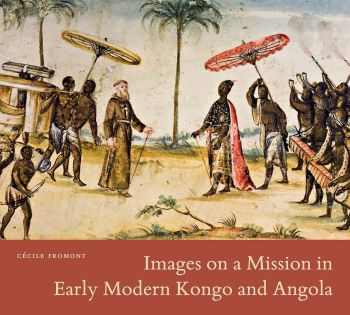 Early modern central Africa comes to life in an extraordinary atlas of vivid watercolors and drawings that Italian Capuchin Franciscans, veterans of Kongo and Angola missions, composed between 1650 and 1750 for the training of future missionaries. These ‘practical guides’ present the intricacies of the natural, social, and religious environment of seventeenth- and eighteenth-century west-central Africa and outline the primarily visual catechization methods the friars devised for the region. Images on a Mission in Early Modern Kongo and Angola brings this overlooked visual corpus to public and scholarly attention.
This beautifully illustrated book includes full-color reproductions of all the images in the atlas, in conjunction with rarely seen related material gathered from collections and archives around the world. Taking a bold new approach to the study of early modern global interactions, art historian Cecile Fromont demonstrates how visual creations such as the Capuchin vignettes, though European in form and crafstmanship, emerged not from a single perspective but rather from cross-cultural interaction. Fromont models a fresh way to think about images created across cultures, highlighting the formative role that cultural encounter itself played in their conception, execution, and modes of operation. Centering Africa and Africans, and with ramifications on four continents, Fromont’s decolonial history profoundly transforms our understanding of the early modern world. It will be of substantial interest to specialists in early modern studies, art history, and religion.
Cécile Fromont is Professor in the History of Art department at Yale University. She is the author of the award-winning book The Art of Conversion: Christian Visual Culture in the Kingdom of Kongo (2014) and the editor of Afro-Catholic Festivals in the Americas: Performance, Representation, and the Making of Black Atlantic Traditions (2019), the latter also published by Penn State University Press.
C O N T E N T S
List of Illustrations
List of Tables
Acknowledgements
Introduction
1 ‘Nonsense’: Capuchin Images of Kongo and Angola Against Italian Preconceptions
2 Practical Guides to the Mission: The Capuchin Central-African Corpus
3 Images and Devotion
4 Images as Method
5 Images against Idolatry
6 With ‘the Consent of the People, and the Secular Arm of the Prince’
7 Penned by Encounter: Capuchins, Central Africans, and the Making of a Cross-Cultural Discourse
Conclusion
Notes
Bibliography
Index
Call for Papers | Arts and Culture in the Capuchin Order
From ArtHist.net:
De habitudine Ordinis ad artem: Arts, Religion, and Culture in the Capuchin Order between the 16th and 18th Centuries
University of Teramo, 12–14 April 2023
Proposals due by 19 February 2023
Officially founded in 1528 with the bull Religionis Zelus by Pope Clement VII, the Order of the Friars Minor Capuchin lived the twenty years preceding the Council of Trent imitating St Francis and his first companions through preaching and the teaching of young people. Despite the escape to Switzerland of the famous Vicar and preacher Bernardino Ochino in 1542, the Order survived, and the Council of Trent (1547–63) gave great impetus to the Order’s spread, thanks partly to the participation of the Vicar General Bernardino da Asti as consultant. In 1574 Pope Gregory XIII allowed the Capuchins to found convents outside the Italian peninsula. Friars went to France, Spain, and the German-speaking regions; and new settlements were founded in Switzerland, Belgium, Austria, Bohemia, Bavaria, Westphalia, and Ireland. A century after their founding, the Capuchins had more than 40 provinces, 1200 friaries, and nearly 20,000 brothers. As missionaries, the Order was extremely active, evangelizing throughout the world; from Northern Europe to Brazil, from Congo to the Middle East, from North Africa to the West Indies, they were one of the main players, in close contact with sovereigns and the Holy See.
While many Capuchins had studied the visuals arts before entering the Order, especially in the years between 1618 and 1761, the Capuchin way of life was often antithetical to artistic practice. In fact, in the General Chapter of 1627, friars were forbidden to accept any painting or carving work requested by laymen. And yet, although the culture of the arts was not originally part of the Order’s activities and artistic practice was in many cases hindered, there were many who reached high levels in the cloister, especially in painting and wooden sculpture. During the 17th and 18th centuries, many Capuchins devoted themselves to painting, driven by different motivations: for pleasure and in response to commissions from nobles and benefactors. Sculpture was practised even more frequently, often for decorating the small churches that, according to the Constitutions, were not allowed to be sumptuous, but decorated only with poor and simple ornaments. The right combination of simplicity of material and preciousness of form was expressed in the works of the friar cabinet-makers (marangoni).
While numerous studies have addressed the relationship between the arts and the Capuchin Order, many questions remain under unexplored. This conference De habitudine Ordinis ad artem: Arts, Religion and Culture in the Capuchin Order between the 16th and 18th Centuries—organised by the University of Teramo with the patronage of the Seraphic Province of the Immaculate Conception of the Capuchin Friars Minor, the International Society of Franciscan Studies, and the Capuchin Historical Institute—will consider the difficult and elusive relationship between art, culture, religion, and the Capuchin Order on an international level, with particular attention paid to historical contexts and religious dimensions—a prerequisite for understanding Capuchin artists, the production of art objects, patronage, and Capuchin relations with the secular world globally. With the aim of fostering discussion and scientific debate, other topics relevant to the theme of the conference are also welcome. The most significant contributions will be considered for publication.
The conference will be divided into five sessions:
• the Capuchin Order in the context of the post-Tridentine Church
• artistic practice between norms, prohibitions, and customs
• cultural objects of the Capuchin world: use and circulation
• capuchin patronage
• images, knowledge, and preaching between devotion and catechesis
Each proposal must consist of two parts: the paper abstract (max 2000 characters including spaces) and a speaker profile (max 1500 characters including spaces) highlighting the curriculum vitae and professional position. The two parts must be combined in a single Word or PDF file. Interested parties must submit proposals by 19 February 2023, by uploading the documents here.
Scientific Committee
Massimo Carlo Giannini (University of Teramo) president
Raffaella Morselli (University of Teramo)
Alessandro Zuccari (Sapienza University of Rome)
Giorgio Fossaluzza (University of Verona)
Vincenzo Criscuolo (Capuchin Historical Institute)
Grado Giovanni Merlo (University of Milan)
Luigi Pellegrini (University of Chieti-Pescara)
Luca Siracusano (University of Teramo)
Cecilia Paolini (University of Teramo)
Organisation and scientific coordination
Pietro Costantini, pcostantini@unite.it
New Book | Material Cultures of the Global Eighteenth Century
From Bloomsbury:
Wendy Bellion and Kristel Smentek, eds., Material Cultures of the Global Eighteenth Century: Art, Mobility, and Change (London: Bloomsbury Visual Arts, 2023), 288 pages, ISBN: 978-1350259034, $115. Also available as an ebook.
 Things change. Broken and restored, reused and remade, objects transcend their earliest functions, locations, and appearances. While every era witnesses change, the eighteenth century experienced artistic, economic, and demographic transformations that exerted unique pressures on material cultures around the world. Locating material objects at the heart of such phenomena, Material Cultures of the Global Eighteenth Century expands beyond Eurocentric perspectives to discover the mobile, transcultural nature of eighteenth-century art worlds. From porcelain to betel leaves, Chumash hats to natural history cabinets, this book examines how objects embody imperialism, knowledge, and resistance in various ways.
By embracing things both elite and everyday, this volume investigates physical and technological manipulations of objects while attending to the human agents who shaped them in an era of accelerating global contact and conquest. Featuring ten essays, the volume foregrounds diverse scholarly approaches to chart new directions for art history and cultural history. Ranging from California to China, Bengal to Britain, Material Cultures of the Global Eighteenth Century illuminates the transformations within and between artistic media, follows natural and human-made things as they migrate across territories, and reveals how objects catalyzed change in the transoceanic worlds of the early modern period.
Material Cultures of the Global Eighteenth Century is part of the Material Culture of Art and Design series, edited by Michael Yonan.
Wendy Bellion is Sewell C. Biggs Chair in American Art History and Associate Dean for the Humanities at the University of Delaware. Her research focuses on North American art and the Atlantic World in the eighteenth and nineteenth centuries. She is the author of Citizen Spectator: Art, Illusion, and Visual Perception in Early National America (2011) and Iconoclasm in New York: Revolution to Reenactment (2019).
Kristel Smentek is Associate Professor of Art History in the Department of Architecture at the Massachusetts Institute of Technology. Her research engages eighteenth-century European graphic and decorative arts in their transcultural contexts. She is the author of Mariette and the Science of the Connoisseur in Eighteenth-Century Europe (2014), co-editor of Dare to Know: Prints and Drawings in the Age of Enlightenment (2022), and co-curator of the accompanying exhibition at the Harvard Art Museums.
C O N T E N T S
List of Illustrations
Notes on Contributors
Acknowledgements
Introduction, ‘Things Change’ — Wendy Bellion, University of Delaware and Kristel Smentek, MIT
1 ‘A Sort of Picture or Image of my Self’: Amoy Chinqua’s Almost Ancestral Portrait of Joseph Collet — Winnie Wong, University of California, Berkeley
2 Shooting for Freedom: Examining the Material World of Self-Emancipated Persons — Tiffany Momon, Sewanee: The University of the South
3 Something Old, Something New: Repurposing and the Production of Ephemeral Festival Architecture in Eighteenth-Century Paris — Matthew Gin, University of North Carolina at Charlotte
4 Botanical Fantasy in Silk: Transformations of a Rococo Floral Design from England to China — Mei Mei Rado, Los Angeles County Museum of Art
5 Making Marble Edible: Madame de Pompadour, Friendship, and the Multiple Lives of Porcelain — Susan M. Wager, University of New Hampshire, Durham
6 The Sovereign Betel in Eighteenth-Century Bengal and Bihar — Zirwat Chowdhury, University of California, Los Angeles
7 Isaiah Thomas’s Stamp Acts at the Halifax Gazette: Printers and Tacit Protest in Revolutionary America — Jennifer Y. Chuong, Humboldt-Universität zu Berlin
8 Between Art and Nature: The Dauphin’s Treasure at the Royal Cabinet of Natural History in Madrid — Tara Zanardi, Hunter College, CUNY
9 California Indian Basket Weavers, Spanish Imperialism, and Eighteenth-Century Global Networks — Yve Chavez, University of California, Santa Cruz
10 British Prints between Caricature and Ethnography — Douglas Fordham, University of Virginia
Index
At Christie’s | Interracial Double Portrait Purchased by Philip Mould
Press release via Art Daily (22 January 2023) . . .
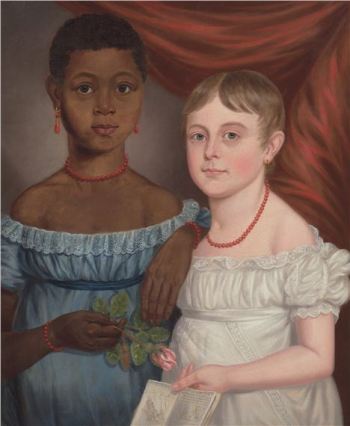
American School, A Portrait of Two Girls, ca. 1820, oil on canvas, 24 × 20 inches (Philip Mould & Co). Estimated to sell for $50–100K, the portrait sold at auction for nearly $1million.
An extraordinarily rare image of two children—one
White, one African American—was purchased by London art dealers Philip Mould & Company this evening (Friday, 20 January 2023) at Christie’s in New York for just under one million dollars.
Painted by an unknown artist in America in about 1820, and estimated at $50–100k, the double portrait attracted heated competition from collectors and museums on both sides of the Atlantic, eventually making ten times its top estimate with premium included.
Mould, who is also known as the art expert on BBC1’s Fake or Fortune, believes it to be unprecedented for this date in American portrait painting. “We are very excited to have bought it. I know of no painting of this date or earlier quite like it. The unselfconscious depiction of two racially distinct girls, who were clearly deeply attached, is extraordinarily rare for this period, as well as very affecting. The constraints and social protocol in painted portraiture of the period make such palpable depiction of interracial attachment almost without precedent.”
In their description of the painting Christie’s acknowledged its rarity, stating: “This double portrait presents its subjects as equals at a time of pervasive racial inequality. If anything, the pose and props cast the African American girl as the superior figure.” [Sale 21026, Lot 460]
The only painting that Mould knows which could be described as comparable is the portrait of Dido Belle and her cousin Elizabeth Murray painted around 1770 in England (on display as part of the collection at Scone Palace, Perth, Scotland)—a work that was the focus of an episode of Fake or Fortune in 2018. Dido was the daughter of a Black slave and White father. Mould identified the artist, after considerable research, as the Scottish portraitist, David Martin. “This however goes considerably further. Although, as yet, we don’t know the artist, nor the identity of the subjects, the relationship of equality is emphatically expressed” says Mould “The normal objectifications in the depiction of racial distinction have been set aside.”
A most unusual and revealing aspect of the painting is the book of the story of Cinderella held by the younger child. As the Christie’s cataloguer pointed out: “The inclusion of a reference to a well-known story with stepsister characters raises the possibility that in the absence of blood ties, the artist was nonetheless deliberately conveying sisterhood.” Mould muses “Or perhaps the reference to Cinderella is more obvious. As a female heroine who overcame the prejudices of her oppressors, Cinderella may well turn out to have more in common with the eldest child than initially thought.”
Future plans for the painting involve a period of research, after which Mould will be looking to place the work in a museum where its qualities and significance can be appreciated within a fuller context, and it can be enjoyed by the public.
◊ ◊ ◊ ◊ ◊
The painting was included in the Important Americana sale at Christie’s New York on 20 January 2023, Sale 21026, Lot 460. Also relevant is this early nineteenth-century miniature portrait of two girls with arms around each other.
Research Lunch | Dominic Bate on Pythagorean Visions
From the Mellon Centre:
Dominic Bate, Pythagorean Visions: Picturing Harmony in British Art, 1719–1753
Online only, Paul Mellon Centre for Studies in British Art, London, 10 February 2023, 1pm
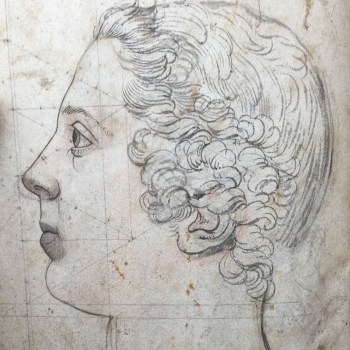 In the early eighteenth century, an eclectic group of artists and architects working primarily in London believed that they could improve the arts by placing their working practices on an unassailable mathematical footing. In this endeavour they were inspired by a concept of universal harmony, which held that the entire cosmos was organised by God according to the rules of arithmetic and geometry. This concept had ancient roots, being associated with the Greek philosopher Pythagoras, among others, but it assumed a new significance in Hanoverian Britain thanks to the work of antiquarians and natural philosophers such as Isaac Newton, whose scientific discoveries were hailed in terms of the recovery of lost knowledge.
The first part of this talk introduces some of the artistic initiatives that were inspired by the highly acclaimed work of Newton and his followers, and argues that these initiatives can be understood with reference to the early modern phenomenon of ‘projecting’, defined in this instance as the contrivance of speculative schemes that sought to marry public benefit and private profit by harnessing the power of mathematics and natural knowledge.
The second part of the talk deepens and complicates the first by focusing on the career of the talented draftsman Giles Hussey (1710–1788), who developed a mathematical approach to portraiture during the 1730s and 1740s. At the heart of Hussey’s method was the geometry of the equilateral triangle and the proportional relationships that it encompassed, including the ratios of musical consonances such as the octave (2:1), the perfect fourth (4:3), and the perfect fifth (3:2). Hussey’s work shows how the pursuit of mathematical approaches to artmaking could be productive while also entailing serious practical and theoretical difficulties, thereby shedding light on the role played by eighteenth-century artists (rather than ‘disinterested’ philosophers) as solvers of aesthetic problems.
Book tickets here»
Dominic Bate is a PhD candidate in the History of Art and Architecture at Brown University in Providence, Rhode Island, where he is writing a dissertation that examines the relationship between art and aesthetics, natural theology and practical mathematics in eighteenth-century Britain. Before coming to Brown, Dominic worked in the Department of Prints and Drawings at the British Museum, where he was involved in cataloguing the collection of portrait prints and British book illustrations. Dominic has BA and MA degrees in Art History from the Courtauld Institute of Art, and in the spring of 2022 he was a visiting student in the Department of History and Philosophy of Science at the University of Cambridge. His research has been supported by the Joukowsky Institute for Archaeology and the Ancient World at Brown and the Paul Mellon Center for Studies in British Art.










 Enfilade
leave a comment