Exhibition | Fashion and Music in Revolutionary France

Magasin des Modes Nouvelles, Troisième Année, Vingtième Cahier, 30 Mai 1788, 30, 1788, text with engraving
(Mia, The Minnich Collection The Ethel Morrison Van Derlip Fund, 1966, P.15,303-P.15,305)
◊ ◊ ◊ ◊ ◊
From the press release (22 August 2022) for the exhibition at Mia:
Revolution à la Mode: Fashion and Music in Revolutionary France
Minneapolis Institute of Art, 10 September 2022 — 5 March 2023
Curated by Nicole LaBouff
The Minneapolis Institute of Art presents an exhibition of 18th-century French periodicals documenting the French Revolution and the tumultuous years leading up to it. Revolution à la Mode: Fashion and Music in Revolutionary France features hand-colored fashion plates, illustrating how fashion, theater, and politics influenced one another as France constructed a new democracy. The exhibition, curated by Nicole LaBouff, Mia’s Associate Curator of Textiles, will be on view in the Cargill Gallery from 10 September 2022 until 5 March 2023. This exhibition marks the first time these items have been on view.
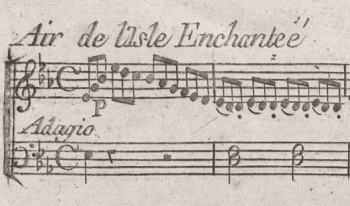 In a unique pairing, the exhibition showcases fashion plates and musical scores that were published side by side in periodicals for the entertainment and edification of the public. These publications were among the first modern fashion magazines, with the illustrations documenting the fashions that fluctuated with the changing political tides. More than 20 of these fashion plates will be on display, alongside paintings and sculpture that offer context.
In planning for this project, Mia partnered with violinist Peter Sheppard Skærved of London’s Royal Academy of Music and musicologist Rebecca Geoffroy-Schwinden of the University of North Texas to arrange new recordings of these songs long lost to history, which visitors will be able to hear in the gallery and on Mia’s website. Important but understudied contributions by women to the music of this period–uncovered through exhibition research–will be highlighted in the display. [Skærved performed the pieces live at Mia in a public program on October 18.]
“We learn more about the fashion plates and the musical scores by featuring them side-by-side in this exhibition,” said LaBouff. “Most of this music has never been recorded before and we are excited to bring it to life in this exhibition. Clothing and music shape politics from the ground up, and this show offers visitors the chance to understand the atmosphere of Revolutionary France through those lenses.”
The fashion plates and musical scores featured in this show were a gift from the collection of Dwight and Helen Minnich.
New Book | L’autre famille royale: Bâtards et maitresses
From Passés Composés:
Flavie Leroux, L’autre famille royale: Bâtards et maitresses d’henri IV à Louis XVI (Paris: Passés Composés, 2022), 272 pages, ISBN: 978-2379334801, €22.
 La faillite de l’absolutisme
Maîtresses et bâtards sont au cœur de l’histoire monarchique et tiennent, à l’avènement de ce qu’on appelle « l’absolutisme », un rôle de premier plan. Mais quel est-il ? Et surtout comment la famille royale peut-elle s’en accommoder alors que sur elle reposent la légitimité et la continuité du pouvoir ? C’est à cette question que Flavie Leroux répond en relisant les règnes des Bourbon, d’Henri IV à Louis XVI. Elle redonne leur place aux maîtresses successives et à leurs enfants, aussi bien dans l’idéologie monarchique que dans la réalité du pouvoir et de la vie de cour. D’abord famille de substitution sous Henri IV, avec Gabrielle d’Estrées et les Vendôme, ils s’imposent ensuite, avec Henriette d’Entragues, Louise de La Vallière ou Mme de Montespan, comme une famille parallèle que le roi garde auprès de lui et impose aux côtés de sa lignée légitime. Cette « contre famille » va concurrencer la « véritable » famille à un point tel que, sous Louis XV puis Louis XVI, c’est la crédibilité du pouvoir des Bourbon qui est mise en péril par cette nouvelle organisation. Entre famille, pouvoir et société, un livre inédit, brillant et décisif sur l’inexorable déclin de la monarchie française avant la Révolution française.
Docteur de l’École des Hautes Études en Sciences Sociales, chargée de recherche au Centre de recherche du château de Versailles, membre associée au Centre de recherches historiques, Flavie Leroux est spécialiste d’histoire de la cour et des femmes en France à l’époque moderne, en particulier des maîtresses royales, auxquelles elle a consacré sa thèse et un ouvrage, Les maîtresses du roi, de Henri IV à Louis XIV (2020).
Versailles Apartment of Mme du Barry Unveiled after Restoration
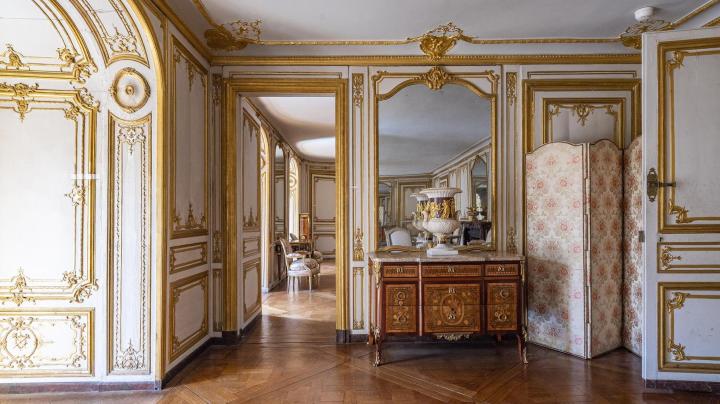
The suite of fourteen rooms was completed in 1770 under the direction of Ange-Jacques Gabriel. Madame du Barry lived there for five years (1770–1774).
◊ ◊ ◊ ◊ ◊
The newly restored private apartment of Jeanne Bécu, Comtesse du Barry (1743–1793) opened last month in connection with the exhibition Louis XV: Passions of a King. From The Art Newspaper:
Claudia Barbieri, “Louis XV’s Official Mistress Leaves the Shadows, as Restoration of her Versailles Apartment Reveals Secretive Life,” The Art Newspaper (19 October 2022). Madame du Barry, whose life is the subject of a new Netflix film, was born into poverty and sold trinkets on the streets of Paris before joining court circles in her 20s.
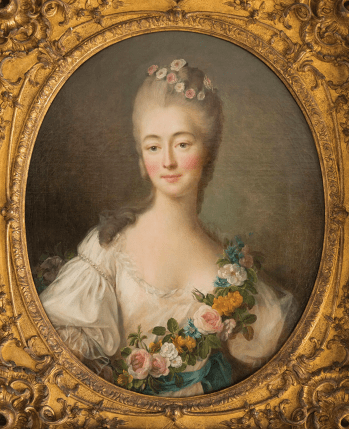
François-Hubert Drouais, Portrait of Madame Du Barry, 1769 (Château de Versailles).
In late October 1722, King Louis XV was crowned in Reims cathedral. This month, the Château de Versailles in Paris marks 300 years since the king’s coronation with an exhibition of 400 works and artefacts that reveal the private life of a monarch whose regal lifestyle paved the way for the French Revolution.
But the highlight of the exhibition is the restored chambers of the king’s last official mistress, Madame du Barry, which are fully open to the public for the first time.
Over the past 18 months, and at a cost of €5m, the Parisian restoration specialists Ateliers Gohard—known for restoring the Statue of Liberty’s torch—have painstakingly renovated the 18th-century decor of Du Barry’s home by gradually stripping away layer upon layer of paint to reveal the colours the king’s mistress chose. . . .
Du Barry was famed for her patronage of artists and craftsmen. But, after her death, her possessions were scattered through the Paris sale rooms. Most have never been recovered. An approximation of her chambers will soon be used in a Netflix-produced film adaptation of her life, with the US actor Johnny Depp playing King Louis XV and the French actor Maïwenn playing Du Barry [Maïwenn also directs the film]. Shooting is currently taking place at locations in and around Versailles.
The full article is available here»
Furniture History 2022
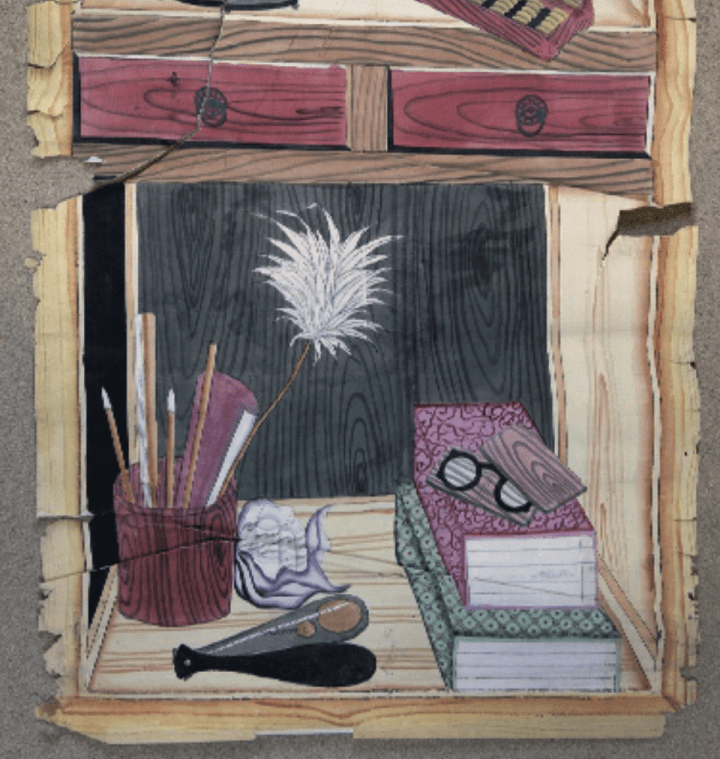
Wenfangtu, detail, ca. 1750, China, coloured woodblock print, 110 × 50 cm
(Stockholm: Nordiska Museet)
◊ ◊ ◊ ◊ ◊
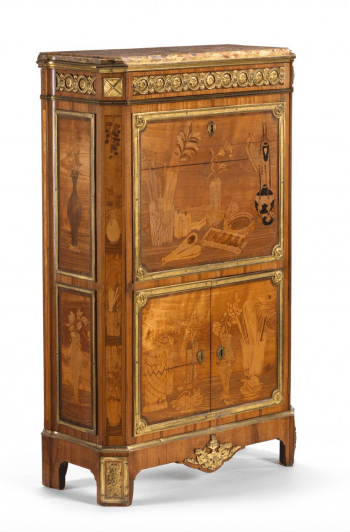
The long eighteenth century in the latest issue of Furniture History, from The Furniture History Society . . . I would particularly note the the article by Kee Il Choi, Jr, which identifies a category of Chinese woodblock prints (wenfangtu / 文房圖) as graphic source materials for marquetry panels of French furniture, especially pieces from the early 1770s—an alternative to the traditional assumption of carved Coromandel (kuancai) lacquer screens. In addition to being an ‘origins’ story, it’s fascinating material as the prints themselves raise myriad rich questions (wenfangtu are now known only from examples outside of China). –CH
 Furniture History 58 (2022)
A R T I C L E S
• Christopher Rowell, “The Carved Room at Petworth Revisited and Grinling Gibbons as an Auctioneer, Dealer, and Collector,” pp. 39–128.
• Kee Il Choi, Jr , “From Lieux to Meubles: Chinese Woodblock Prints and French Marquetry of the 1770s,” pp. 129–156.
• Irene Alessandra Meneghetti, “Transfer Printing on Wood: Research and Replication Based on Two Side Tables Attributed to Joseph Schneevogl,” pp. 157–174.
• Sarah Medlam, “Fit for a Prince: Seddon’s Cradle for Shiloh, the Prince of Peace, the Expected Child of Joanna Southcott, 1814,” pp. 175–198.
• Rufus Bird, “John Girdwood: A Modern Edinburgh Antiquary,” pp. 199–226.
A satinwood and marquetry secrétaire à abattant with gilt-bronze ormolu mounts, ca. 1775, France; stamped: René Dubois (maître, 1754–99), 137 × 84 cm (Melbourne: National Gallery of Victoria, 705.a-i-D4).
Panel Discussion | Revisiting Kubler’s The Shape of Time
From the BGC:
Reading The Shape of Time, 60 Years Later
Bard Graduate Center, New York, 30 November 2022, 6pm
Four perspectives on the seminal text by George Kubler from BGC faculty Meredith Linn, François Louis, Aaron Glass, and Drew Thompson, moderated by Joshua Massey and Jeffrey Collins.
 In 1962, Yale University art historian George Kubler published The Shape of Time: Remarks on the History of Things, a book that challenged traditional notions of style and period in art history. Now, 60 years later, we bring together a historian, an anthropologist, an archaeologist, and an art historian—all members of the BGC faculty—to explore The Shape of Time across geographical and disciplinary boundaries and to rediscover the prescient insights it offers for material culture and object-oriented scholarship.
$15 General | $12 Seniors | Free for people with a college or museum ID, people with disabilities and caregivers, and BGC members.
Meredith B. Linn is assistant professor of historical archaeology at Bard Graduate Center. She holds a PhD in anthropology from Columbia University, an MA in the social sciences from the University of Chicago, and a BA in art history from Swarthmore College. Her work focuses on nineteenth-century New York City, particularly upon the health-related experiences and strategies of Irish immigrants and upon Seneca Village, the predominantly African American community whose land was taken by the City of New York to construct Central Park. She has published articles about both projects and is currently working on a book about each.
François Louis is professor of Chinese art and material culture at Bard Graduate Center. From 2002 to 2008 he also served as editor-in-chief of the journal Artibus Asiae. He obtained his doctorate from the University of Zurich and has published widely on the visual and material culture of medieval China. Recent publications include Design by the Book: Chinese Ritual Objects and the Sanli Tu and the co-edited volumes Antiquarianism and Intellectual Life in Europe and China, 1500–1800 (2012) and Perspectives on the Liao (2013). He is currently working on a history of Liao-dynasty archaeological finds.
Aaron Glass is an associate professor of cultural anthropology at Bard Graduate Center. His research focuses on Indigenous visual art, material culture, media, and performance on the northwest coast of North America, as well as the history of anthropology, museums, and ethnographic representation. Glass’s books include The Totem Pole: An Intercultural History (2010); Objects of Exchange: Social and Material Transformation on the Late Nineteenth-Century Northwest Coast (2011); Return to the Land of the Head Hunters: Edward S. Curtis, the Kwakwaka’wakw, and the Making of Modern Cinema (2014); and Writing the Hamat’sa: Ethnography, Colonialism, and the Cannibal Dance (2021).
Drew Thompson is associate professor of Black studies and visual culture at Bard Graduate Center, where he researches and teaches in the areas of African and Black diaspora visual and material culture. Curating exhibitions is a fundamental part of his teaching and scholarship. He recently co-curated Benjamin Wigfall & Communications Village, the first posthumous survey of the Black American artist Benjamin Wigfall, which opened in September 2022 at the Dorsky Museum before traveling to the Virginia Museum of Fine Arts. He is also at work on an exhibition about African metalwork for the BGC Gallery, scheduled for fall 2023. He authored Filtering Histories: The Photographic Bureaucracy in Mozambique, 1960 to Recent Times (University of Michigan Press, 2021) and numerous publications about the history of photography and contemporary art in Southern Africa.
Joshua Massey is a student at Bard Graduate Center, where he studies American material culture and the ways in which objects are transformed into art through critical and creative interventions. His essay, “The World According to Aldwyth,” appears in the exhibition catalogue for This is Not! Aldwyth in Retrospect (2023–24), and he is the editor of Wordsmithing: The Spoken Art of Lonnie Holley, a forthcoming collection written in collaboration with Bernard Herman and Holley himself. In his spare time, Massey writes poetry, practices film photography, and shops for books he has no time to read.
Jeffrey L. Collins is professor of art history and material culture at Bard Graduate Center, where he specializes in seventeenth- and eighteenth-century Europe and its sphere of influence overseas. He is the author of Papacy and Politics in Eighteenth-Century Rome: Pius VI and the Arts (Cambridge, 2004) and a principal contributor to Pedro Friedeberg (Mexico City, 2009) and History of Design: Decorative Arts and Material Culture, 1400–2000 (New Haven and London, 2013). A fellow of the American Academy in Rome, he has published widely on architecture, urbanism, painting, sculpture, book illustration, museology, metalwork, furniture, and film.
New Book | Indigenous Continent: The Epic Contest for North America
From Norton:
Pekka Hämäläinen, Indigenous Continent: The Epic Contest for North America (New York: Liveright, 2022), 592 pages, ISBN: 978-163149698, $40.
 A prize-winning scholar rewrites 400 years of American history from Indigenous perspectives, overturning the dominant origin story of the United States.
There is an old, deeply rooted story about America that goes like this: Columbus ‘discovers’ a strange continent and brings back tales of untold riches. The European empires rush over, eager to stake out as much of this astonishing ‘New World’ as possible. Though Indigenous peoples fight back, they cannot stop the onslaught. White imperialists are destined to rule the continent, and history is an irreversible march toward Indigenous destruction.
Yet as with other long-accepted origin stories, this one, too, turns out to be based in myth and distortion. In Indigenous Continent, acclaimed historian Pekka Hämäläinen presents a sweeping counternarrative that shatters the most basic assumptions about American history. Shifting our perspective away from Jamestown, Plymouth Rock, the Revolution, and other well-trodden episodes on the conventional timeline, he depicts a sovereign world of Native nations whose members, far from helpless victims of colonial violence, dominated the continent for centuries after the first European arrivals. From the Iroquois in the Northeast to the Comanches on the Plains, and from the Pueblos in the Southwest to the Cherokees in the Southeast, Native nations frequently decimated white newcomers in battle. Even as the white population exploded and colonists’ land greed grew more extravagant, Indigenous peoples flourished due to sophisticated diplomacy and leadership structures.
By 1776, various colonial powers claimed nearly all of the continent, but Indigenous peoples still controlled it—as Hamalainen points out, the maps in modern textbooks that paint much of North America in neat, color-coded blocks confuse outlandish imperial boasts for actual holdings. In fact, Native power peaked in the late nineteenth century, with the Lakota victory in 1876 at Little Big Horn, which was not an American blunder, but an all-too-expected outcome.
Hämäläinen ultimately contends that the very notion of ‘colonial America’ is misleading, and that we should speak instead of an ‘Indigenous America’ that was only slowly and unevenly becoming colonial. The evidence of Indigenous defiance is apparent today in the hundreds of Native nations that still dot the United States and Canada. Necessary reading for anyone who cares about America’s past, present, and future, Indigenous Continent restores Native peoples to their rightful place at the very fulcrum of American history.
Pekka Hämäläinen is Rhodes Professor of American History at Oxford University and the author of The Comanche Empire, winner of the Bancroft Prize, and Lakota America: A New History of Indigenous Power. He lives in Oxford, England.
Decorative Arts Trust Internship Grant to Focus on John Ashley House

John Ashley House, Sheffield, Massachusetts (photo from Wikimedia Commons, July 2007). Built in 1735, the house is owned and operated by The Trustees of Reservations.
◊ ◊ ◊ ◊ ◊
As an anchor site of the Upper Housatonic Valley African American Heritage Trail, the Ashley House is important for its connection to Elizabeth Freeman (Mum Bett), who was enslaved there before suing for–and winning–her freedom in 1781 under Massachusetts’ newly ratified state constitution. Readers may recall that a statue of Freeman was unveiled in Sheffield just a few months ago.
From The Decorative Arts Trust press release:
The Decorative Arts Trust is pleased to announce that The Trustees of Reservations (The Trustees) of Boston, MA, will serve as our 2023–25 Curatorial Internship Grant partner.

Susan Ridley Sedgwick, Portrait of Elizabeth Freeman (Mum Bett), ca. 1812, watercolor on ivory (Boston: Massachusetts Historical Society).
The two-year internship will focus on the Colonel John Ashley House in Sheffield, MA. The house’s importance primarily derives from a connection with Mum Bett, an enslaved woman who sued Ashley for her freedom along with an enslaved man named Brom. The intern will lead an in-depth analysis of the objects contained within the Ashley House with the aim to create easy access to all records through the Trustees’ new online collections interface. The intern will also develop a furnishing plan for the Ashley House that synthesizes a refined understanding of the contents and the interiors in which they are displayed. Based in Stockbridge at the Trustees’ Mission House, the intern will work alongside the organization’s highly regarded curatorial staff, including Christie Jackson, Director of Collections, and Mark Wilson, Associate Curator.
The Decorative Arts Trust is a nonprofit organization that underwrites curatorial internships for recent Masters or PhD graduates in collaboration with museums and historical societies. These internships allow host organizations to hire a deserving professional who will learn about the responsibilities and duties common to the curatorial field while working alongside a talented mentor.
The Trustees is the oldest conservation and preservation nonprofit of its kind in the country and the largest in Massachusetts, where it has protected 123 diverse sites, spanning more than 27,000 acres, including 20 historic houses and more than 50,000 objects.
Online Talks | HECAA Emerging Scholars Showcase, Fall 2022
HECAA Emerging Scholars Showcase
Online (Zoom), 28 November 2022, 1.00–2.30pm (ET)
Please join us for the next HECAA Emerging Scholars Showcase on Monday, 28 November, from 1:00 to 2:30pm (ET). This showcase is scheduled for a weekday and at an earlier time to better accommodate colleagues in Europe, and in response to the stated preference for weekday events from members who participate in the survey last spring. Required registration is available here.
We hope you can join us for these six exciting presentations:
• Marie Isabell Wetcholowsky, (PhD student, Philipps-Universität Marburg), François Lemoyne and the Reinvention of History Painting under Louis XV
• Haoyang Zhao (PhD candidate, University of Glasgow), Revisiting Huangchao Liqi Tushi, an Art and Historical Analysis of Important Yet Neglected Imperial Albums Commissioned in the 18th-Century Qianlong Court
• Angela Göbel (PhD student, Université Lyon 3, Jean Moulin), The Role Model of the City of Versailles for European Residential Cities
• Grace Ford-Dirks (MA student, University of Delaware/Winterthur Museum), Many Hands, Many Marks, Many Stories: Reconsidering a ‘Louisiana’ Armoire
• Marie Giraud (PhD candidate, Queen Mary University of London), Jansenism and Print Culture in 18th-Century Paris (1709–1764)
• Elisa Cazzato (PhD, Marie Sklodowska-Curie Fellow, Università Cà Foscari – Venezia), The Lure of the Foreign Stage: Italian Art and Artistry Serving the French and European Spectacle
This event is open to everyone. Please email daniella.berman@nyu.edu with questions. We also are pleased to announce that, due to robust interest, there will be another Emerging Scholars Showcase in Spring 2023 (more information to follow in January).
Call for Papers | Unpacking the V&A Wedgwood Collection

The V&A Wedgwood Collection in Barlaston, Stoke-on-Trent, Staffordshire.
◊ ◊ ◊ ◊ ◊
From the Call for Papers from the V&A:
Unpacking the V&A Wedgwood Collection
Barlaston (Stoke-on-Trent) and London, 7–8 July 2023
Proposals due by 15 February 2023
The V&A Wedgwood Collection is one of the most important industrial collections in the world and a unique record of over 260 years of British ceramic production. Owned by the V&A following a successful fundraising campaign spearheaded by Art Fund in 2014, it is on display at Barlaston, Stoke-on-Trent, where an imaginative public programme celebrates the diversity, creativity and depth of the collection. The conference is organised in honour of Gaye Blake-Roberts MBE, former curator of the then Wedgwood Museum. After forty years of research and achievements, she retired from her position in early 2020, continuing her research as Honorary Senior Research Fellow at the V&A Research Institute.
Wedgwood was founded in 1759 by British potter and entrepreneur Josiah Wedgwood, who helped transform English pottery from a cottage craft into an art form and international industry. A museum has existed since 1906, first at the Etruria site and then from 1952 at Barlaston and a newly designed museum opened in 2008, winning the prestigious Art Fund Museum of the Year prize in 2009. It houses the finest collection of Wedgwood material, showcasing innovations in taste and fashion over three centuries and the UNESCO recognised Wedgwood Archives.
We are pleased to invite submissions from established scholars as well as emerging voices, and look forward to exploring new dialogues and disciplines which broaden our understanding of Wedgwood. Contributions are invited for four research themes:

Isaac Cook, curator of the first Wedgwood Museum at the Etruria factory, sorting trays of Josiah Wedgwood’s trials © Fiskars.
1 Beyond Josiah Wedgwood: Re-examining the Narrative
2 Global Wedgwood
3 Creativity, Technology, Economics, and Labour
4 Impressions of the Past: Contemporary Ceramic Making
Topics may include, but are not limited to:
• Transatlantic and continental trade
• Creativity, design, and artists
• Race
• Economics and labour
• Disability
• Workshop traditions
• Female contributions to the development and history of Wedgwood and ceramics
• Production and consumption of ceramics
• Empire and colonialism
• Technology
• Class
• Displaying and collecting of ceramics
• Social histories of ceramics
• Factory architecture and employee welfare
Please submit a 400-word abstract outlining a 20- to 30-minute presentation along with a short biography or curriculum vitae by 15 February 2023 to r.klarner@vam.ac.uk. These will be reviewed by the organising committee. Selected participants will be notified by 15 March 2023.
◊ ◊ ◊ ◊ ◊
Note (added 20 January 2023) — As initially announced here at Enfilade in November, the conference date was scheduled for 30 June — 1 July 2023; the posting has been updated with the new dates of 7–8 July.
New Book | Women, Collecting, and Cultures beyond Europe
From Routledge:
Arlene Leis, ed., Women, Collecting, and Cultures beyond Europe (New York: Routledge, 2022), 282 pages, ISBN: 978-1032135465, £130 / $150
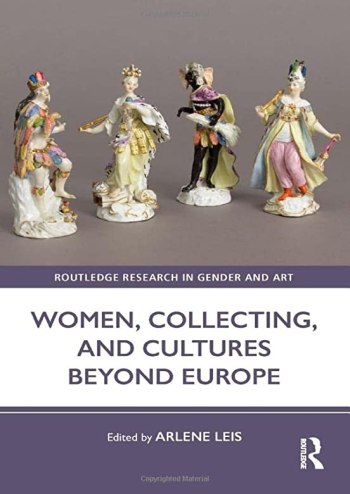 This edited volume builds on recent research and offers a wider lens through which to examine and challenge women’s collecting histories. Spanning from the seventeenth century to the twenty-first (although not organized chronologically) the research herein extends beyond European geographies and across time periods; it brings to light new research on how artificiallia and naturallia were collected, transported, exchanged, and/or displayed beyond Europe. Women, Collecting and Cultures beyond Europe considers collections as points of contact that forged transcultural connections and knowledge exchange. Some authors focus on collectors and what was collected, while others consider taxonomies, travel, patterns of consumption, migration, markets, and the after life of things. In its broad and interdisciplinary approach, this book amplifies women’s voices, and aims to position their collecting practices toward new transcultural directions, including women’s relation to distinct cultures, customs, and beliefs as well as exposing the challenges women faced when carving a place for themselves within global networks.
Arlene Leis is an independent art historian who received her PhD from University of York.
C O N T E N T S
Collecting to Collectingism: New Directions in Women’s Transcultural Practices — Arlene Leis
Part I: Points of Transcultural Exchange
1 Européenerie in Feminine Space: Qing Imperial Women and Collecting in China’s Long Eighteenth Century — Chih-En Chen
2 Coerced Contact: The Dzungar Court Costume of a Swedish Knitting Instructor — Lisa Hellman
3 Trading Places: The Japanese Art Collection of O’Tama Kiyohara Ragusa — Maria Antonietta Spadaro
4 Created to Gleam: Decorum, Taste, and Luxury of Four Dresses from Viceregal Mexico — Martha Sandoval-Villegas and Laura Garcia-Vedrenne
Part II: Natural History, Colonial Encounters, and Indigenous Histories
5 The Botanist Was a Woman: Classifying and Collecting on the First French Circumnavigation of the Globe — Glynis Ridley
6 Pineapple Lady: Expertise and Exoticism in Agnes Block’s Self-Representation as Flora Batava — Catherine Powell-Warren
7 A Memsahib’s ‘Natural World’: Lady Mary Impey’s Collection of Indian Natural History Paintings — Apurba Chatterjee
8 Women and Huipils: The Treasuring of an Indigenous Garment in New Spain — Martha Sandoval-Villegas
9 Colonial Pantomime: Queen Marie I of Portugal’s Human Cabinet of Curiosities — Agnieszka Anna Ficek
Part III: Settlers, Immigrants, and New Frontiers
10 Settler Botanists, Nature’s Gentlemen, and the Canadian Book of Nature: Catharine Parr Traill’s Canadian Wild Flowers — Cynthia Sugars
11 Collecting Indian Art in Santa Fe: The Bryn Mawrters and the Politics of Preservation — Nancy Owen Lewis
12 The Spectacle of Sponsoring an Ottoman Trousseau — Gwendolyn Collaço
13 Las Bexareñas and their Wills: Women’s Material Culture and Cataloguing Practices in Spanish San Fernando de Béxar — Amy M. Porter
Part IV: Recovery, Collaboration, and Repatriation
14 ‘He Surely Existed’: Women of the Early Folk Art Collecting Movement and Thomas W. Commeraw, Forgotten African-American Potter — Brandt Zipp
15 Adjacency in the Collection — Toby Upson
16 Collecting Fibre Arts in Arnhem Land — Louise Hamby
17 From Women’s Hands: Learning from Métis Women’s Collections — Angela Fey and Maureen Matthews










 Enfilade
leave a comment