Decorative Arts Trust Internship Grant to Focus on John Ashley House

John Ashley House, Sheffield, Massachusetts (photo from Wikimedia Commons, July 2007). Built in 1735, the house is owned and operated by The Trustees of Reservations.
◊ ◊ ◊ ◊ ◊
As an anchor site of the Upper Housatonic Valley African American Heritage Trail, the Ashley House is important for its connection to Elizabeth Freeman (Mum Bett), who was enslaved there before suing for–and winning–her freedom in 1781 under Massachusetts’ newly ratified state constitution. Readers may recall that a statue of Freeman was unveiled in Sheffield just a few months ago.
From The Decorative Arts Trust press release:
The Decorative Arts Trust is pleased to announce that The Trustees of Reservations (The Trustees) of Boston, MA, will serve as our 2023–25 Curatorial Internship Grant partner.

Susan Ridley Sedgwick, Portrait of Elizabeth Freeman (Mum Bett), ca. 1812, watercolor on ivory (Boston: Massachusetts Historical Society).
The two-year internship will focus on the Colonel John Ashley House in Sheffield, MA. The house’s importance primarily derives from a connection with Mum Bett, an enslaved woman who sued Ashley for her freedom along with an enslaved man named Brom. The intern will lead an in-depth analysis of the objects contained within the Ashley House with the aim to create easy access to all records through the Trustees’ new online collections interface. The intern will also develop a furnishing plan for the Ashley House that synthesizes a refined understanding of the contents and the interiors in which they are displayed. Based in Stockbridge at the Trustees’ Mission House, the intern will work alongside the organization’s highly regarded curatorial staff, including Christie Jackson, Director of Collections, and Mark Wilson, Associate Curator.
The Decorative Arts Trust is a nonprofit organization that underwrites curatorial internships for recent Masters or PhD graduates in collaboration with museums and historical societies. These internships allow host organizations to hire a deserving professional who will learn about the responsibilities and duties common to the curatorial field while working alongside a talented mentor.
The Trustees is the oldest conservation and preservation nonprofit of its kind in the country and the largest in Massachusetts, where it has protected 123 diverse sites, spanning more than 27,000 acres, including 20 historic houses and more than 50,000 objects.
Online Talks | HECAA Emerging Scholars Showcase, Fall 2022
HECAA Emerging Scholars Showcase
Online (Zoom), 28 November 2022, 1.00–2.30pm (ET)
Please join us for the next HECAA Emerging Scholars Showcase on Monday, 28 November, from 1:00 to 2:30pm (ET). This showcase is scheduled for a weekday and at an earlier time to better accommodate colleagues in Europe, and in response to the stated preference for weekday events from members who participate in the survey last spring. Required registration is available here.
We hope you can join us for these six exciting presentations:
• Marie Isabell Wetcholowsky, (PhD student, Philipps-Universität Marburg), François Lemoyne and the Reinvention of History Painting under Louis XV
• Haoyang Zhao (PhD candidate, University of Glasgow), Revisiting Huangchao Liqi Tushi, an Art and Historical Analysis of Important Yet Neglected Imperial Albums Commissioned in the 18th-Century Qianlong Court
• Angela Göbel (PhD student, Université Lyon 3, Jean Moulin), The Role Model of the City of Versailles for European Residential Cities
• Grace Ford-Dirks (MA student, University of Delaware/Winterthur Museum), Many Hands, Many Marks, Many Stories: Reconsidering a ‘Louisiana’ Armoire
• Marie Giraud (PhD candidate, Queen Mary University of London), Jansenism and Print Culture in 18th-Century Paris (1709–1764)
• Elisa Cazzato (PhD, Marie Sklodowska-Curie Fellow, Università Cà Foscari – Venezia), The Lure of the Foreign Stage: Italian Art and Artistry Serving the French and European Spectacle
This event is open to everyone. Please email daniella.berman@nyu.edu with questions. We also are pleased to announce that, due to robust interest, there will be another Emerging Scholars Showcase in Spring 2023 (more information to follow in January).
Call for Papers | Unpacking the V&A Wedgwood Collection

The V&A Wedgwood Collection in Barlaston, Stoke-on-Trent, Staffordshire.
◊ ◊ ◊ ◊ ◊
From the Call for Papers from the V&A:
Unpacking the V&A Wedgwood Collection
Barlaston (Stoke-on-Trent) and London, 7–8 July 2023
Proposals due by 15 February 2023
The V&A Wedgwood Collection is one of the most important industrial collections in the world and a unique record of over 260 years of British ceramic production. Owned by the V&A following a successful fundraising campaign spearheaded by Art Fund in 2014, it is on display at Barlaston, Stoke-on-Trent, where an imaginative public programme celebrates the diversity, creativity and depth of the collection. The conference is organised in honour of Gaye Blake-Roberts MBE, former curator of the then Wedgwood Museum. After forty years of research and achievements, she retired from her position in early 2020, continuing her research as Honorary Senior Research Fellow at the V&A Research Institute.
Wedgwood was founded in 1759 by British potter and entrepreneur Josiah Wedgwood, who helped transform English pottery from a cottage craft into an art form and international industry. A museum has existed since 1906, first at the Etruria site and then from 1952 at Barlaston and a newly designed museum opened in 2008, winning the prestigious Art Fund Museum of the Year prize in 2009. It houses the finest collection of Wedgwood material, showcasing innovations in taste and fashion over three centuries and the UNESCO recognised Wedgwood Archives.
We are pleased to invite submissions from established scholars as well as emerging voices, and look forward to exploring new dialogues and disciplines which broaden our understanding of Wedgwood. Contributions are invited for four research themes:

Isaac Cook, curator of the first Wedgwood Museum at the Etruria factory, sorting trays of Josiah Wedgwood’s trials © Fiskars.
1 Beyond Josiah Wedgwood: Re-examining the Narrative
2 Global Wedgwood
3 Creativity, Technology, Economics, and Labour
4 Impressions of the Past: Contemporary Ceramic Making
Topics may include, but are not limited to:
• Transatlantic and continental trade
• Creativity, design, and artists
• Race
• Economics and labour
• Disability
• Workshop traditions
• Female contributions to the development and history of Wedgwood and ceramics
• Production and consumption of ceramics
• Empire and colonialism
• Technology
• Class
• Displaying and collecting of ceramics
• Social histories of ceramics
• Factory architecture and employee welfare
Please submit a 400-word abstract outlining a 20- to 30-minute presentation along with a short biography or curriculum vitae by 15 February 2023 to r.klarner@vam.ac.uk. These will be reviewed by the organising committee. Selected participants will be notified by 15 March 2023.
◊ ◊ ◊ ◊ ◊
Note (added 20 January 2023) — As initially announced here at Enfilade in November, the conference date was scheduled for 30 June — 1 July 2023; the posting has been updated with the new dates of 7–8 July.
New Book | Women, Collecting, and Cultures beyond Europe
From Routledge:
Arlene Leis, ed., Women, Collecting, and Cultures beyond Europe (New York: Routledge, 2022), 282 pages, ISBN: 978-1032135465, £130 / $150
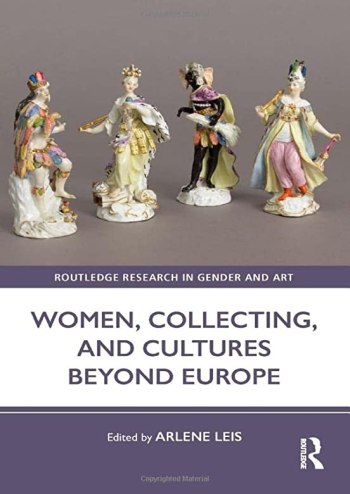 This edited volume builds on recent research and offers a wider lens through which to examine and challenge women’s collecting histories. Spanning from the seventeenth century to the twenty-first (although not organized chronologically) the research herein extends beyond European geographies and across time periods; it brings to light new research on how artificiallia and naturallia were collected, transported, exchanged, and/or displayed beyond Europe. Women, Collecting and Cultures beyond Europe considers collections as points of contact that forged transcultural connections and knowledge exchange. Some authors focus on collectors and what was collected, while others consider taxonomies, travel, patterns of consumption, migration, markets, and the after life of things. In its broad and interdisciplinary approach, this book amplifies women’s voices, and aims to position their collecting practices toward new transcultural directions, including women’s relation to distinct cultures, customs, and beliefs as well as exposing the challenges women faced when carving a place for themselves within global networks.
Arlene Leis is an independent art historian who received her PhD from University of York.
C O N T E N T S
Collecting to Collectingism: New Directions in Women’s Transcultural Practices — Arlene Leis
Part I: Points of Transcultural Exchange
1 Européenerie in Feminine Space: Qing Imperial Women and Collecting in China’s Long Eighteenth Century — Chih-En Chen
2 Coerced Contact: The Dzungar Court Costume of a Swedish Knitting Instructor — Lisa Hellman
3 Trading Places: The Japanese Art Collection of O’Tama Kiyohara Ragusa — Maria Antonietta Spadaro
4 Created to Gleam: Decorum, Taste, and Luxury of Four Dresses from Viceregal Mexico — Martha Sandoval-Villegas and Laura Garcia-Vedrenne
Part II: Natural History, Colonial Encounters, and Indigenous Histories
5 The Botanist Was a Woman: Classifying and Collecting on the First French Circumnavigation of the Globe — Glynis Ridley
6 Pineapple Lady: Expertise and Exoticism in Agnes Block’s Self-Representation as Flora Batava — Catherine Powell-Warren
7 A Memsahib’s ‘Natural World’: Lady Mary Impey’s Collection of Indian Natural History Paintings — Apurba Chatterjee
8 Women and Huipils: The Treasuring of an Indigenous Garment in New Spain — Martha Sandoval-Villegas
9 Colonial Pantomime: Queen Marie I of Portugal’s Human Cabinet of Curiosities — Agnieszka Anna Ficek
Part III: Settlers, Immigrants, and New Frontiers
10 Settler Botanists, Nature’s Gentlemen, and the Canadian Book of Nature: Catharine Parr Traill’s Canadian Wild Flowers — Cynthia Sugars
11 Collecting Indian Art in Santa Fe: The Bryn Mawrters and the Politics of Preservation — Nancy Owen Lewis
12 The Spectacle of Sponsoring an Ottoman Trousseau — Gwendolyn Collaço
13 Las Bexareñas and their Wills: Women’s Material Culture and Cataloguing Practices in Spanish San Fernando de Béxar — Amy M. Porter
Part IV: Recovery, Collaboration, and Repatriation
14 ‘He Surely Existed’: Women of the Early Folk Art Collecting Movement and Thomas W. Commeraw, Forgotten African-American Potter — Brandt Zipp
15 Adjacency in the Collection — Toby Upson
16 Collecting Fibre Arts in Arnhem Land — Louise Hamby
17 From Women’s Hands: Learning from Métis Women’s Collections — Angela Fey and Maureen Matthews
Exhibition | Clara the Rhinoceros

Jean-Baptiste Oudry, Clara, the Rhinoceros, 1749, oil on canvas, 306 × 453 cm
(Staatliches Museum Schwerin)
◊ ◊ ◊ ◊ ◊
From the press release (11 July 2022) for the exhibition:
Clara the Rhinoceros: Superstar of the 18th Century / Clara de Neushoorn: Superster van de 18e eeuw
Rijksmuseum, Amsterdam, 30 September 2022 — 15 January 2023
Curated by Gijs van der Ham
Clara was strange and new, huge and awe-inspiring—she was utterly unlike any other known animal. This fall, the Rijksmuseum presents Clara the Rhinoceros, an exhibition about an animal who travelled far from her native land of India and became the most famous rhinoceros in the world.

Saint-Germain, J.J., and F. Viger, Clock with Rhinoceros as Carrier, 1755 (Parnassia Collection).
The exhibition shows how new knowledge changed perceptions of the rhinoceros, and how art played its part in this process. The 60 objects on display include paintings, drawings, medals, statues, books, clocks, and a goblet. Very few of these artworks have been displayed before in the Netherlands, and never before have so many exceptional objects devoted to Clara the rhinoceros being presented together. They range from the first-ever European print depicting a rhinoceros—made in 1515 by Albrecht Dürer—to a life-size, full-length portrait of Clara by Jean-Baptiste Oudry dating from 1749. Clara the Rhinoceros runs from 30 September 2022 to 15 January 2023 in the Phillips Wing of the Rijksmuseum.
Clara may not have been the first rhinoceros to come to Europe, but she did become the most famous one. After her long voyage from India, in 1741 she arrived in Amsterdam. Her owner, Douwe Mout van der Meer, was soon showing her to anyone who would pay for the pleasure, whether at fairs, markets, carnivals, or royal courts. For the next 17 years she travelled around Europe in a custom-made cart, accompanied by her entourage. She travelled far and wide: to Vienna and Paris, and to Naples and Copenhagen. Upon her return to the Netherlands, she lived in a field in the North district of Amsterdam. Eventually, Clara died in London in 1758.
People touched, teased, admired, and studied Clara. She prompted this sensational level of interest because no one in Europe had ever been able to see a real live rhinoceros. She was a hyped up, must-see cultural phenomenon, and Mout used print advertising and medals to pump that hype to the max. Until Clara’s arrival, all that Europeans knew of her species was from a print made by Dürer in 1515. He based his drawing on a sketch of a rhinoceros that was briefly in Lisbon, though the sketch wasn’t entirely accurate: it depicted the rhinoceros with an extra horn on its back, for example, and skin that resembled a suit of armour.
 Clara’s appearance on the scene changed all this, leaing to a better understanding of the rhinoceros and to more accurate portrayals. Scholars studied her in minute detail, from head to tail, and artists became fascinated by every fold of her skin. A remarkable number of likenesses were made of Clara, in many forms and using many different materials. This exhibition presents an outstanding selection of these objects, including an impressive life-size portrait painted in Paris in 1749 by Oudry (on loan from Staatliches Museum Schwerin), a painting by Pietro Longhi showing Clara standing in front of her audience in Venice (from Ca’ Rezzonico, Venice), a large marble statue by the Flemish artist Pieter Anton Verschaffelt (from the Rothschild collection at Waddesdon Manor), and an exceptionally rare clock mounted on a Clara figure (from a private Dutch collection) made by the Parisian bronzier and clockmaker Jean-Joseph de Saint-Germain.
Clara was almost never free to walk or run. She depended on humans for her survival, and was rarely able to display natural behaviours—except for example the occasions when she needed to cross a river by swimming, and clearly enjoyed the water. In 1750 the Neurenberg biographer Christoph Gottlieb Richter published a conversation between a rhinoceros and a grasshopper, in which the rhinoceros bemoans the way people treat her and stare at her. This book presents a role-reversal, with the rhinoceros appraising and studying people rather than the other way around. And in her 2016 installation Clara, the contemporary artist Rossella Biscotti uses the rhinoceros’s story to interrogate the relationship between humans and animals. The installation, which is also part of the exhibition, shows that Clara’s story is also about colonialism, exoticism, and globalisation, as well as exploitation and power.
The exhibition design for Clara the Rhinoceros and Crawly Creatures is by stage designer Theun Mosk | Ruimtetijd. Graphic design for the exhibition is by Irma Boom.
Gijs van der Ham, Clara the Rhinoceros (Rotterdam: nai101, 2023), 208 pages, ISBN: 978-9462087477, $40.
Exhibition | Process: Design Drawings, 1500–1900

Design drawing for a patinated bronze vase, anonymous, ca. 1780
(Amsterdam: Rijksmuseum)
◊ ◊ ◊ ◊ ◊
From the museum:
Process: Design Drawings from the Rijksmuseum, 1500–1900
Créer: Dessiner pour les arts décoratifs, 1500–1900
Design Museum Den Bosch, Rijksmuseum, Amsterdam, 5 November 2022 — 12 February 2023
Fondation Custodia / Collection Frits Lugt, Paris, 25 February — 14 May 2023
Curated by Reinier Baarsen
This pioneering exhibition is an opportunity to discover a collection of extraordinary design drawings from the Rijksmuseum. The drawings, which date from the period 1500–1900, have been brought together for the first time and are arranged according to the successive stages of the design process.
 The focus here is not on big artistic names, but on the crucial role that drawings have played in design. We watch from close-by as the ideas for all sorts of items are formed and we also get to meet their inventors, makers, and patrons. Drawings of vases, chairs and clocks, stoves, sledges, and carriages are shown, from the first rough pencil sketches to beautifully worked-up and colourful presentations. The drawings in this exhibition were recently acquired by the Rijksmuseum in Amsterdam, where they belong to a special collection established by Senior Curator Reinier Baarsen. He offers us a unique insight here into the role that drawing has played in the design process, as well as the superb drawings it has produced.
Reinier Baarsen, Process: Design Drawings from the Rijksmuseum, 1500–1900 (Rotterdam: nai101, 2022), 464 pages, SBN 978-9462087354, €60 / $70.
◊ ◊ ◊ ◊ ◊
Note (added 28 February 2023) — The posting was updated to include the Fondation Custodia as a second venue.
Exhibition | Silver City: 500 Years of Portsmouth’s History
Now on view at the Portsmouth Museum and Art Gallery:
Silver City: 500 Years of Portsmouth’s History
Portsmouth Museum and Art Gallery, 28 May 2022 — 26 February 2023
Curated by James Daly and Susan Ward
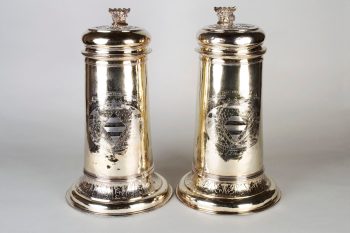
Portsmouth Flagons, made in 1683 by Wolfgang Howzer and presented to Portsmouth by Louise de Kéroualle, the Duchess of Portsmouth. She was one of Charles II’s mistresses and presented the Flagons to Portsmouth when she was made duchess, although there is no record of her having visited the town.
Silver City: 500 Years of Portsmouth’s History is a major exhibition at Portsmouth Museum and Art Gallery, telling the story of the city through amazing silver treasures. It showcases many precious objects that have never been on public display before. Most come from the city’s civic collection, but others have been loaned from the Royal Navy, the city’s Anglican cathedral, and the Goldsmiths’ Company Charity. Objects include a model of HMS Victory presented to the city when the Portsmouth Command of the Royal Navy was awarded the Freedom of the City in 1965. It is made from copper taken from the ship and plated in silver.
James Daly and Susan Ward, Silver City: 500 Years of Portsmouth’s History (Portsmouth: Tricorn Books, 2022), 161 pages, ISBN: 978-914615276, £27.
◊ ◊ ◊ ◊ ◊
Frances Parton’s review of the exhibition appeared in October issue of The Burlington Magazine, pp. 1015–17.
American Art, Fall 2022
The latest issue of American Art includes eight essays aimed at ‘Seeing the Survey Anew’. I was particularly intrigued with the piece by K. L. H. Wells on the Index of American Design, a WPA Federal Art Project (1936–1942) that produced thousands of illustrations documenting decorative arts before 1900; the article specifically addresses the “treatment of Shaker and Southwestern design as prime examples of how this government survey of American art helped codify White racial formation” (10). Katherine Fein’s essay is also fascinating, though now I’ve ventured into the dangerous shoals of recommendations. By all means, have a look at all of these thoughtful essays. –CH
 American Art 36.3 (Fall 2022)
Commentaries: Seeing the Survey Anew
• Kirsten Pai Buick, “Seeing the Survey Anew: Introduction,” pp. 2–4.
• Jessica L. Horton, “Seeing the National Museum of the American Indian Anew as a Diplomatic Assemblage,” pp. 5–9.
• K. L. H. Wells, “Indexing Whiteness to American Design,” pp. 10–14.
• Michael Lobel, “Reframing Illustration,” pp. 15–19.
• Katherine Fein, “Picturing White Skin on Elephant Tusk,” pp. 20–23.
• Zoë Colón, “Material Absence, Relational Presence: Courtney M. Leonard and the Shinnecock Whales,” 24–27.
• Alexis Monroe, “Whiteness and the West before the Transcontinental Railroad,” pp. 28–32.
• Tanya Sheehan, “Where to Begin: Marking Race in Surveys of American Art,” pp. 33–37.
New Book | Connected Mobilities
From Amsterdam UP:
Paul Nelles and Rosa Salzberg, eds., Connected Mobilities in the Early Modern World: The Practice and Experience of Movement (Amsterdam: Amsterdam University Press, 2022), 282 pages, ISBN: 978-9463729239, €122.
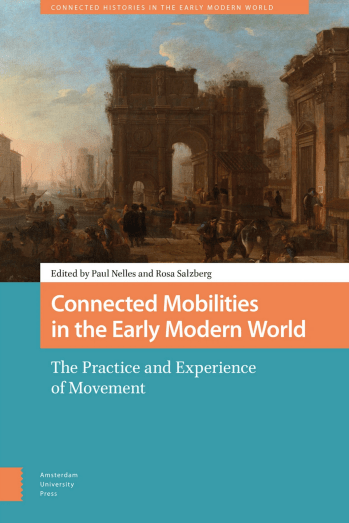 Connected Mobilities in the Early Modern World offers a panorama of movement, mobility, and exchange in the early modern world. While the pre-modern centuries have long been portrayed as static and self-contained, it is now acknowledged that Europe from the Middle Ages onwards saw increasing flows of people and goods. Movement also connected the continent more closely to other parts of the world. This book challenges dominant notions of the ‘fixed,’ immobile nature of pre-modern cultures through study of the inter-connected material, social, and cultural dimensions of mobility. The case studies presented here chart the technologies and practices that both facilitated and impeded movement in diverse spheres of social activity such as communication, transport, politics, religion, medicine, and architecture. The chapters underscore the importance of the movement of people and objects through space and across distance to the dynamic economic, political, and cultural life of the early modern period.
Paul Nelles is Associate Professor of early modern history at Carleton University. His research focuses on the history of books, writing, and religion in early modern Europe. His study of Jesuit communication, The Information Order: Writing, Mobility and Distance in the Making of the Society of Jesus (1540–1573), is forthcoming.
Rosa Salzberg is Associate Professor of Early Modern History, University of Trento. Her research focuses on communication, urban history and the history of migration and mobility in early modern Europe, with a focus on Venice. She is the author of Ephemeral City: Cheap Print and Urban Culture in Renaissance Venice (2014).
C O N T E N T S
Paul Nelles and Rosa Salzberg, Movement and Mobility in the Early Modern World: An Introduction
Moving Bodies
1 John Gallagher, Linguistic Encounter: Fynes Moryson and the Uses of Language
2 Gerrit Verhoeven, Wading through the Mire: Mobility on the Grand Tour, 1585–1750
3 Carolin Schmitz, Travelling for Health: Medicine and Rural Mobility in Early Modern Spain
Crossing Borders
4 Irene Fosi, Mobility and Danger on the Borders of the Papal States, 16th–17th Centuries
5 Paola Molino, News on the Road: The Mobility of Handwritten Newsletters in Early Modern Europe
6 Darka Bili., Quarantine, Mobility, and Trade: Commercial Lazzarettos in the Early Modern Adriatic
Global Networks
7 Paul Nelles, Devotion in Transit: Agnus Dei, Jesuit Missionaries, and Global Salvation in the Sixteenth Century
8 Felicita Tramontana, Getting to the Holy Land: Franciscan Journeys and Mediterranean Mobility
9 Sebouh Aslanian, From Mount Lebanon to the Little Mount in Madras: Mobility and Catholic-Armenian Alms-Collecting Networks during the 18th Century
Index
Conference | Boiseries: Decoration and Migration
From the conference website:
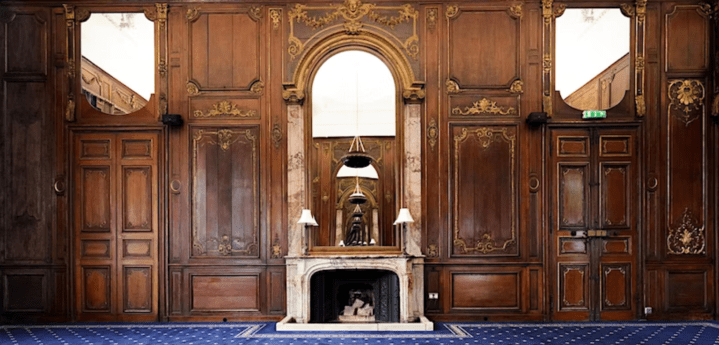
Boiseries: Decoration and Migration from the Eighteenth Century to the Present
Camden Place, Chislehurst (Kent), 12–13 January 2023
Organized by Lindsay Macnaughton and Laura Jenkins
This two-day conference investigates the cultural and commercial migrations of French eighteenth-century boiseries from their places of production in Paris and the Bâtiments du Roi to the drawing rooms of Britain and the United States. It will be the first major study of boiseries in the context of transatlantic cultural history and will build on the landmark studies of panelling as architectural salvage by Bruno Pons (1995, 2001) and the late John Harris (2007). The conference will bring together international experts and emerging scholars in the fields of art, architecture, history, and museums and heritage management and will form part of a programme of events marking the 150th anniversary of the death of Napoleon III at Camden Place.
Camden Place, where the conference will be held, is an English country house whose history and interiors have been shaped by the migration of people and decoration for over 300 years. Home to Chislehurst Golf Club, the Grade II* listed building features architectural elements by the British architects George Dance the Younger (1741–1825) and James ‘Athenian’ Stuart (1713–1788), and played host to the French Imperial court after the fall of the Empire in 1870. French chimney pieces, boiseries from the eighteenth-century Château de Bercy (demolished in 1862), and heavily carved oak panelling are among the elements that make up the house’s many layers, testifying both to the eclectic tastes of its nineteenth-century occupants and to the multifaceted, and multinational, histories of many English country houses.
Organised by Dr Lindsay Macnaughton (University of Buckingham) and Laura C. Jenkins (The Courtauld Institute of Art), with support from Chislehurst Golf Club, The Chislehurst Society, The University of Buckingham, and The Society for the Study of French History.
Tickets are available here. For enquiries, please contact lindsay.macnaughton@buckingham.ac.uk or laura.jenkins@courtauld.ac.uk.
T H U R S D A Y , 1 2 J A N U A R Y 2 0 2 3
10.00 Registration
10.30 Introduction by Lindsay Macnaughton
10.45 Session 1 | The Cultural Impact of French Émigrés in Britain
Moderated by Lindsay Macnaughton
• Camden Place as a Headquarters of Bonapartism, 1870–1879 — Thomas C. Jones (Senior Lecturer, The University of Buckingham)
• The French Imperial Family in Exile: The Display of Collections in Camden Place, 1870–1880 — Rebecca Walker (Independent Scholar)
• Lord Hertford’s Room from the Château de Bercy — Félix Zorzo (Curatorial Assistant, The Wallace Collection)
12.45 Lunch
1.45 Session 2 | Moving Rooms: Markets and Merchants
Moderated by Mark Westgarth
• The Valued Fragment: Georges Hoentschel as Dealer in Historic Interiors — Ulrich Leben (Independent Scholar)
• Decorating on a Grand Scale: British Professional Decorators of the Early 20th Century — Pat Wheaton (Independent Scholar)
• Saviours or Gravediggers of Panelling? Some Thoughts on the Role of Merchants — François Gilles (PhD Candidate, Université de Versailles St-Quentin-en-Yvelines)
3.45 Tea and Coffee Break
4.15 Keynote Lecture
• The Archaeology of Camden Place: An Architectural Conundrum — Lee Prosser (Curator of Historic Buildings, Historic Royal Palaces)
5.15 Closing Remarks
6.00 Drinks Reception
F R I D A Y , 1 3 J A N U A R Y 2 0 2 3
9.30 Tours of Camden Place (Registrants)
10.00 Registration
10.30 Opening Remarks by Laura Jenkins
10.45 Session 3 | Staging the Past: Boiseries and ‘Period Rooms’
Moderated by Laura Jenkins
• History of the Paneling of the State Bedroom of the Hôtel de Chevreuse et de Luynes in Paris, 1765–2014 — Frédéric Dassas (Senior Curator, Musée du Louvre)
• The ‘Roman’ Petit Salon of the Duc d’Aumont and the 18th-Century Origins of the Period Room — Gabriel Wick (Lecturer, NYU Paris)
• ‘Un Décor Authentique et Harmonieux’: Framing and Aestheticising the Cognacq-Jay Collection — Barbara Lasic (Lecturer, Sotheby’s Institute of Art)
12.45 Lunch
1.45 Session 4 | Franco-British Collectors of Boiseries
Moderated by Helen Jacobsen
• British Duc d’Aumale: The Boiseries of Orleans House, from Twickenham to Chantilly — Mathieu Deldicque (Director, Musée Condé, Château de Chantilly)
• Contextualising the Rothschild Collection of Panelling at Waddesdon Manor (provisional title) — Mia Jackson (Curator of Decorative Arts, Waddesdon Manor)
• Uncovering Identity and a Nationalist Narrative: The Imported Interiors at Harlaxton Manor — Carter Jackson (PhD Candidate, Boston University)
3.45 Tea and Coffee Break
4.15 Session 5 | Reuse and Reinterpretation
Moderated by Caroline McCaffrey-Howarth
• Past Lives: The Mona Von Bismarck House, 34 Avenue de New York, Paris — Melany Telleen (Independent Scholar)
• Boiserie Alternatives: Wallcoverings in Glass Beads, Straw, Lacquer, Porcelain, and Feathers — Maureen Cassidy-Geiger (Independent Scholar)
5.45 Closing Remarks
6.00 Tours of Camden Place (Registrants)










 Enfilade
leave a comment