Michelangelo as Pan?

Joseph Vernet, detail of a sketch showing the statue of Pan (with fig leaf), by the Aurelian Walls that bounded the Villa Ludovisi to the north, 1737. From D. Cordellier, P. Rosenberg, and P. Märker, Dessins français du musée de Darmstadt (2007), 459.
◊ ◊ ◊ ◊ ◊
I suspect many readers will find this series of postings about a Pan sculpture from Rome’s Villa Ludovisi of interest. Whatever the status of the attribution (itself intriguing), the statue clearly was linked with Michelangelo in the eighteenth century. –CH
Hatice Köroğlu Çam, “A New Self-Portrait of Michelangelo? The Statue of Pan at the Casino dell’Aurora in Rome,” 4 parts, Archivio Digitale Boncompagni Ludovisi (2022–23).
“Part 1: Correspondences” (20 March 2022).
“Part 2: Testimonia: Sketches and Earlier Inventories” (12 September 2022).
“Part 3: Reception” (5 November 2022).
“Part 4: Physical Condition and Conservation Mandates” (5 May 2023), a good place to start as it summarizes the earlier essays.
From Part 1, at the Archivio Digitale Boncompagni Ludovisi:

Pan, attributed to Michelangelo at the Casino dell’Aurora. Collection †HSH Prince Nicolò and HSH Princess Rita Boncompagni Ludovisi, Rome (Photo by T. Corey Brennan, October 2022).
A statue of Pan, for centuries located in the garden of Rome’s Villa Ludovisi, since 1901 has stood unprotected outside the southwest wing of the Casino dell’Aurora. Traditionally attributed to Michelangelo Buonarroti (1475–1564), and once deemed of great monetary value (4000 scudi in a 1749 Boncompagni Ludovisi inventory), it undoubtedly exhibits characteristic features of the master’s sculptural language.
Yet most surprisingly there is no detailed study focusing on this statue. The most recent treatment, that of Maria Elisa Micheli (Museo Nazionale Romane: Le Sculture I.6 I marmi Ludovisi dispersi [1986]), fills not quite a page and a half. Micheli dismisses seventeenth- and eighteenth-century attributions of the Pan to Michelangelo, considering it instead “a modern work of the late sixteenth century.”
The verdict strikes me as too hasty. After comparing the stylistic language of the Pan to that of Michelangelo in a wide range of his sculptures, paintings, and drawings, I have come to the conclusion that even if the sculpture is not by Michelangelo, it highlights many features of his style to a remarkable extent. And those attributes are recognizable even given the fact that the Pan today shows an unfortunate loss of details, especially the face—clear when comparing historic photos of the statue (from 1885) with its present state. . . .
The full posting is available here»
Hatice Köroğlu Çam studied journalism for three years with a double major in art history at Istanbul University in Turkey and then received her BA in art history at Rutgers University (2022), where she wrote her honors thesis on “Decoding Michelangelo’s Passion: Laocoön and Tityus.” She interned at the Archivio Digitale Boncompagni Ludovisi in the Spring and Summer of 2022, which made possible a visit to the Casino dell’Aurora, the home of Princess Rita Boncompagni Ludovisi, in July 2022. Hatice is currently on the staff of the museum store of the Princeton University Art Museum and plans to pursue her academic journey towards a PhD, including further research into the Pan project.
◊ ◊ ◊ ◊ ◊
More information about the Archivio Digitale Boncompagni Ludovisi—initiated by T. Corey Brennan (Rutgers University) while Andrew W. Mellon Professor in the American Academy in Rome (2009–12)—is available here.
◊ ◊ ◊ ◊ ◊
Note (added 5 May 2023) — The posting was updated to include a link to Part 4 of the series of essays.
Call for Papers | The Mutability of Collections
From ArtHist.net and the Seminar on Collecting and Display:
The Mutability of Collections: Transformation, Contextualisation, and Re-Interpretation
Seminar on Collecting and Display
Institute of Historical Research, University of London, 7–8 July 2023
Proposals due by 30 November 2022
We invite proposals for papers reflecting on the ways in which the contents of collections are not permanent but may be subject to numerous mutations. Objects in collections are added, exchanged or disposed of, translated and transformed. Items can be moved to new surroundings and different decorative settings, resulting in altered contexts of display, meaning, and significance. The history of collections is more than a history of objects brought together by acquisitive owners; it is also a history whereby collectors and owners may re-interpret an inherited or purchased collection and re-arrange and complete it in accordance to their taste.
As is well known, the Medici amassed a collection that grew, was looted, regained, distributed over palaces and villas, and finally bequeathed to Tuscany as part of Anna Maria Louisa’s family pact in 1737. Obviously, the Medici’s treasures were not the only collection with a fragmented biography and that of Rudolf II would provide another famous example.In the nineteenth century, William Beckford added new layers of interpretation as he amassed his collections from a variety of different sources. Further translations and reinterpretations ensued when the first collection was dispersed and Beckford created a new collecting environment in Bath.
This session aims to explore the various issues underlying the mutability of collections, including
• the ways in which intentionality, taste, and the periodically fluctuating finances of collectors influenced the composition and display of a collection, sometimes more than once within a collection’s biography
• the ways in which fashion may have directed a collector towards particular groups of objects, as well as their alteration according to the taste of the time
• the ways in which collections may be reinterpreted and take on new meanings according to the spaces in which they were displayed
• the different associations and meanings given to individual objects through their changing representations, displays, or associations
We invite paper proposals of no more than 250 words, investigating the mutability of early-modern collections during their creation, transfer to new locations, transformation, or re-interpretation. Please send your proposals, along with a short bio (no more than 200 words) to collecting_display@hotmail.com by 30 November 2022.
Colloquium | Historical Interiors and Digital Reconstructions
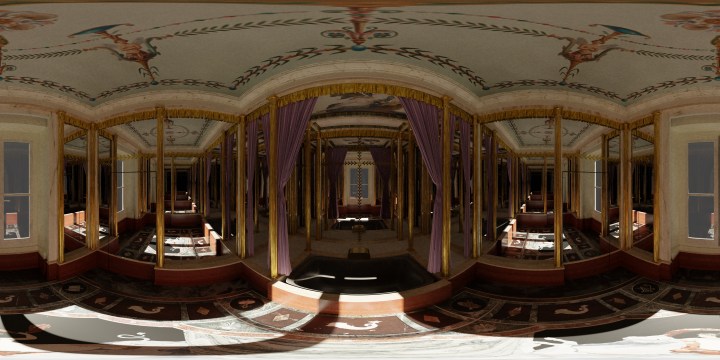
From the conference programme:
Historical Interiors and the Digital: The Possibilities and Limits of Virtual Reconstructions
Les intérieurs historiques et le numérique: possibilités et limites des reconstructions virtuelles pour la recherche
Online and in-person, Paris and Versailles, 17–18 November 2022
Colloque international organisé par Centre allemand d’histoire de l’art Paris, le Mobilier national et le Centre de recherche du château de Versailles
The virtual reconstruction of historical interiors—from architecture to wall decoration and furniture to textiles—has been a proven instrument of cultural mediation in recent years, particularly in museums, exhibitions and/or for the study of historical monuments (for instance in archaeology). Questions of spatial proportions and fundamental architectural units are today at the forefront, with emphasis often placed on the possibility of visiting these spaces virtually, either on a 2D screen or with an immersive headset.
However, when it comes to the recreation of the aesthetic characteristics of interiors, which are one of the key issues for their understanding, the possibilities of these new models seem limited. Depending largely on the harmonious interaction of different materials such as woods, metals, and textiles, as well as the structures of their respective surfaces, the nuances of colour or gold, or even the traces of artisanship, the existing solutions in rendering the materiality of an historic interior remain insufficient, both aesthetically and scientifically. The hope to swiftly overcome the excessively sanitized surfaces of digital models, expressed in 2013 (Kohle 2013, p. 166), has not yet come to fruition. Nevertheless, there is more to it than that, as the possibilities of using virtual reconstruction effectively for researching historical interiors—for example, through the virtual insertion of materials that are no longer ethically justifiable or prohibited today—are not fully exploited.
Focusing on the possibilities and limits of virtual reconstructions of historical interiors, of which questions of materiality are only one aspect, this conference highlights the fundamental issues that occupy current research. To attend in person or online on Wednesday, November 16 and Thursday, November 17, please email interieursetnumerique@dfk-paris.org. To attend the day on Friday, November 18 at Versailles (in person or online), registration is compulsory and free here.
W E D N E S D A Y , 1 6 N O V E M B E R 2 0 2 2
Centre allemand d’histoire de l’art Paris, salle Julius Meier-Graefe
18.30 Conférence inaugurale et discussion
Realism or Believability? The Production of Sensation in Animated Films – Bill Kinder, Boxcar Pictures, Berkeley/Paris
T H U R S D A Y , 1 7 N O V E M B E R 2 0 2 2
Centre allemand d’histoire de l’art Paris, salle Julius Meier-Graefe
9.30 Accueil par Peter Geimer, Directeur du Centre allemand d’histoire de l’art Paris
9.45 Présentation du colloque par les organisateurs
10.00 Études de cas et questions de recherche (1)
Modération : Muriel Barbier, Conservateur en chef du patrimoine, Mobilier national
• Digitally Recreating Lost Eighteenth-Century Irish Interiors: Challenges and Opportunities – Andrew Tierney, Department of the History of Art and Architecture, Trinity College Dublin
• De l’outil scientifique à l’« expérience de visite », le numérique à l’épreuve des enjeux de la restauration des appartements des ducs de Lorraine au château de Lunéville – Thierry Franz, Musée du château de Lunéville
• Restituer les palais impériaux napoléoniens : un défi technique et historique – Philippe Le Pareux, lycée de Valognes (Manche)
• ExploVision présente la première plateforme de consultation et d’échange autour du mobilier patrimonial – Philippe Dechenaux, Explovision
14.15 Galeries et artisanat
• La reconstitution 3D des galeries d’exposition du Garde-Meuble de la Couronne : enjeux, difficultés et compréhension d’un espace disparu – Gatien Wierez, CREHS Université d’Artois
• The Virtual Museum: Digital Reconstructions of the Kongl. Museum at the Royal Palace in Stockholm – Johan Eriksson, Department of Art History, Uppsala Universitet
• Réflexions autour de la galerie disparue de l’hôtel de Noailles à Saint-Germain-en-Laye – François Gilles, UVSQ/ENS Cachan, with Paul Feytis; Louis-Joseph Lamborot; Gabriel Wick
F R I D A Y , 1 8 N O V E M B E R 2 0 2 2
Centre de recherche du château de Versailles, Auditorium, aile Dufour
9.00 Accueil par Mathieu da Vinha, Directeur scientifique du G.I.P. Centre de recherche du château de Versailles
9.15 Autres approches et apports de la 3D
Modération : Benjamin Ringot, G.I.P. Centre de recherche du château de Versailles
• Augmented Reconstruction: On Introducing a Novel Reconstruction Method for Simulating Material and Materiality Using Mixed Realities – Clemens Brünenberg, TU Darmstadt, Department of Architecture, Institute of Classical Archaeology
• Au-delà de l’illustration. Quand des étudiants de licence apportent une contribution à la recherche – Nicolas Priniotakis, Cergy-Paris Université
11.00 Études de cas et questions de recherche (2)
Modération : Benjamin Ringot, G.I.P. Centre de recherche du château de Versailles puis Michel Jordan, laboratoire ETIS – CY Cergy Paris Université / ENSEA / CNRS
• Florence4D – Fabrizio Nevola, Chair of Art History and Visual Culture, University of Exeter
• Reconstitution 3D d’espaces intérieurs de trois domaines royaux : Versailles, Marly, Choisy – Hubert Naudeix, Aristeas
• Reconstitution d’un séjour d’Auguste le Fort à Moritzburg à l’hiver 1728 – Edouard Lussa, Histovery
15.15 Au-delà de la reconstitution 3D
Modération : Michel Jordan, laboratoire ETIS – CY Cergy Paris Université / ENSEA / CNRS
• Experimental Virtual Archaeological-Acoustics: Bringing together Physical, Computer, and Social Science Researchers – Brian Katz, Sorbonne Université, CNRS, UMR 7190
• Sacred Sound / Sacred Space: In Search of Lost Sound, Virtual Acoustic-Visual Reconstruction of Sacred Spaces of the Middle Ages – Stefan Morent, Department of the Institute of Musicology, University of Tübingen
• Reproduire l’histoire: Multi-Sensory Reconstructions of Historical Interiors for Virtual Reality – James Hutson and Trenton Olsen, Lindenwood University, Missouri
17.45 Conclusions
New Book | Architectural Type and Character
From Routledge:
Samir Younés and Carroll William Westfall, Architectural Type and Character: A Practical Guide to a History of Architecture (New York: Routledge, 2022), 272 pages, ISBN: 978-1138584037 (hardback), $128 / ISBN: 978-1138584051 (paperback), $36.
 Architectural Type and Character provides an alternative perspective to the current role given to history in architecture, reunifying architectural history and architectural design to reform architectural discourse and practice. Historians provide important material for appreciating buildings and guiding those who produce them. In current histories, a building is the product of a time, its form follows its function, irresistible influences produce it, and style, preferably novel, is its most important attribute. This book argues for an alternative. Through a two-part structure, the book first develops the theoretical foundations for this alternative history of architecture. The second part then provides drawings and interpretations of over one hundred sites from different times and places.
Samir Younes is Professor of Architecture at the University of Notre Dame where he was Director of Rome Studies and Director of Graduate Studies. He teaches architectural design and theory. His books include: The Imperfect City: On Architectural Judgement; Architects and Mimetic Rivalry; The Intellectual Life of the Architect; and Quatremère de Quincy’s Historical Dictionary of Architecture: The True, The Fictive, and The Real.
Carroll William Westfall’s PhD in the history of architecture from Columbia University was followed by five decades of teaching before retiring from the University of Notre Dame. His scholarly and general articles run from studies of Pompeii to critiques of current practice. His books are In This Most Perfect Paradise, a study of Rome in the 15th century; Architectural Principles in the Age of Historicism, a dialectic exchange with Robert Jan van Pelt; and Architecture, Liberty, and Civic Order: Architectural Theories from Vitruvius to Jefferson and Beyond, a review of architectural theory.
C O N T E N T S
List of Illustrations
Preamble
Introduction
Part I
1 The History of Architecture We Have
2 The Alternative: Type, Character, and Style
3 Urbanism
4 The Components and Types of Good Urban Form
Part II
5 The Tholos
6 The Temple
7 The Theatre
8 The Regia
9 The Dwelling
10 The Shop
11 The Hypostyle
Call for Articles | Race and Architecture in the Iberian World
From ArtHist.net:
Race and Architecture in the Iberian World, ca. 1500–1800s
Special Issue of Arts (2023), guest edited by Cody Barteet and Luis Gordo Peláez
Proposals due by 15 December 2022; finished articles due by 1 June 2023
In the field of art history, previous scholarship has addressed (and continues to address) the contribution of Indigenous, Black, Asian, and mixed-raced artists to the early modern visual culture in the Atlantic world. Frequently scholars are interested in documenting race and its enduring legacy through a variety of cultural artifacts such as paintings, sculptures, manuscripts, featherworks, metalwork, etc. However, much less attention has been given to architectural history, and particularly that of the early modern Iberian world.
Recently, Irene Cheng, Charles L. Davis II, and Mabel O. Wilson edited a ground-breaking volume titled Race and Modern Architecture (2020). Their publication provides an important collection of essays that discuss how the discipline of architectural history has been shaped by racial thought. Likewise, the Journal of the Society of Architectural Historians dedicated a short roundtable-style conversation on the subject of race and architecture in the 1400s through the 1800s (Carey, Dudley, Escobar, et. al. 2021). Each short paper considers the role of race in architecture and implores other scholars to investigate this understudied topic. This special issue of Arts is a response to this scholarly call to engagement. Specifically, we will explore the intersection of race, labor, and architectural history and their interconnectivity with the architecture and its accompanying artistic forms in the early modern Iberian world. We do so through considering how race and architecture are activated through construction projects, the building trades, the history of labor, and in plans, pictorial, and print representations, etc., in the vast territories (European, American, African, Asian) that comprised the Spanish and Portuguese empires.
We invite contributors to submit their research in English for consideration. Please note that there is a two-stage submission procedure. We will first collect a title and short abstract (maximum 250 words), five keywords, and a short bio (150 words), by 15 December 2022, via email to Dr. Cody Barteet (cbarteet@uwo.ca) and Dr. Luis Gordo Peláez (luisgordopelaez@csufresno.edu) or Dora Wang from Arts Editorial Office (dora.wang@mdpi.com). Selected abstracts will be invited to submit papers of 7000–9000 words for peer review by 1 June 2023. Journal publication is expected to occur from late spring through fall 2023, depending on the revision time needed after peer review. Each article will be published open access, on a rolling basis after successfully passing peer review.
Guest Editors
Cody Barteet, cbarteet@uwo.ca
Luis Gordo Peláez, luisgordopelaez@csufresno.edu
Special Issue Editor
Dora Wang, dora.wang@mdpi.com
Mark Hallett Departs the Mellon Centre to Lead the Courtauld
From the PMC announcement (11 November 2022) . . .
 The Paul Mellon Centre’s Director, Mark Hallett, will be stepping down after more than a decade in post to take up a new role next year as the Märit Rausing Director of the Courtauld Institute of Art.
During his time as Director, Hallett has overseen a major expansion and diversification of the London-based Centre, which is part of Yale University, and a partner of the Yale Center for British Art at New Haven. Under his leadership, the Centre has become celebrated for its support of world-class research on all periods and aspects of British art and architecture, understood in their broadest global contexts. Over the past ten years, the Centre has not only dramatically extended its scholarly reach, but also tripled in size. It has enthusiastically embraced the benefits of online publication and communication, and wholeheartedly committed itself to diversifying the field of British art studies. Over this same period, the Centre has also developed a highly ambitious series of research, teaching, learning, and networking initiatives, all of which have been designed to promote the very best scholarship on British art and architecture, to share knowledge and expertise, and to widen the Centre’s audiences.
Mark Hallett said: ‘’It has been a great honour to have led the Centre over the last decade. During that time, I have worked with a brilliant team of colleagues, both in London and in New Haven, to make the PMC a vital, vibrant, and expansive centre for the study of British art. Today, the Centre is in wonderful shape, and I know it will continue to thrive and develop. At the Courtauld, I look forward to building on the remarkable legacy of the current Märit Rausing Director, Professor Deborah Swallow, and to working with similarly world-class academics, curators, students, and supporters in helping the Courtauld write a new and exciting chapter in its history.’’
Susan Gibbons, Vice Provost for Collections and Scholarly Communication, Yale University, and ex-officio Chief Executive of the Paul Mellon Centre, said: ‘’The transformation of the Centre under Mark’s leadership has been remarkable. He has opened the doors of the Centre wide, not only to London, but to the world, while carefully sustaining the high quality research and scholarship that has been the hallmark of the organization. From the launch of British Art Studies and the British Art in Motion undergraduate film competition, to the formation of networks for researchers and practitioners, to broadening fellowship and grant opportunities, Mark has truly championed new ways to understand and engage with British art history.”
At Bonhams | Fine Clocks

The Old Rectory, in the village of Chilton Foliat, a Queen Anne style home, most of which dates to the mid eighteenth century. It’s located at the West Berkshire/Wiltshire border, two miles north of Hungerford. In May it was, as noted by Country Life, listed for £5.95 million.
◊ ◊ ◊ ◊ ◊
Press release from Bonhams:
Fine Clocks Sale
Bonhams, London, 30 November 2022
The Old Rectory, Chilton Foliat Sale
Bonhams, London, 6 December 2022
Two exquisite timepieces by the father of English clockmaking, Thomas Tompion (1639–1713) from the Elliot Collection of fine English clocks feature in Bonhams Fine Clocks Sale in London on Wednesday, 30 November 2022. The collection also includes an important late 17th-century ebony veneered longcase clock of three-month duration by another great clockmaker of the golden age, Joseph Knibb (1640–1711). In addition to these masterpieces of timekeeping, Old Master pictures, 19th-century paintings, and classic English decorative arts from Alan and Tara Elliot’s historic country home are to be offered in a separate sale—The Old Rectory, Chilton Foliat—at Bonhams on Tuesday, 6 December.

Thomas Tompion and Edward Banger, Type 3 Burr Walnut Longcase Clock, London, no. 463, ca. 1707
Tompion’s ebony table clock numbered 198, was made in around 1692, and embodies all that Tompion owners cherish (estimate: £200,000–300,000). The tall rectangular dial with its twin subsidiaries allows the crucial functions (time, winding, date, strike or silent) to be controlled from the front of the clock—an example of perfect industrial design. The exquisitely engraved backplate was created by the craftsman known today only as ‘Engraver 155’. 155’s confident and free engraving is of the highest order. He was responsible for the backplate of the year-going ‘Mostyn Tompion’ in the British Museum and decorated the miniature clock supplied to Queen Mary in 1693, which sold at Bonhams in 2019 for a record price of £1.6 million.
Knibb’s ebony veneered longcase clock of three-month duration with Roman-striking and one-and-a-quarter second pendulum is perhaps the most beguiling clock in the collection (estimate: £120,000–180,000). Knibb had an irrepressibly inquisitive brain and was obsessed by saving power in his clocks’ movements. An ordinary longcase clock hammer strikes its bell 156 times a day; Knibb realised that this was a massive drain on the power of the mechanism and sought different ways to sound the hours. His pièce de résistance was the development of the Roman striking system—as exemplified by this clock—whereby a deep bell represents the numeral 5, while a higher pitched bell represents 1. While one o’clock is marked by a single high hammer blow, five o’clock is a single low blow. Six o’clock, therefore, is one low blow followed by one high blow. This ingenious system saves 96 hammer strikes a day. Over the three months that the Elliot clock runs, 9,216 hammer blows are saved. Although inspired, the system never met with popularity, and it is rare to find a Roman striking clock today. They can always be spotted from a distance however, as the numeral 4 is denoted as IV instead of IIII.
The sale also includes an early 20th-century mahogany two-day marine chronometer by Victor Kullberg used by Ernest Shackleton in 1921, likely as part of the Quest expedition to Antarctica in 1921–22 (estimate: £1,500–2,500). Originally conceived as an Arctic voyage to travel north of Alaska, a last-minute loss of funding meant that the expedition could not go ahead. The entire cost of a replacement voyage was offered by John Quiller Rowett, who had agreed to partially fund the Arctic voyage, on condition that it be south bound to the Antarctic. The chronometer was collected by Shackleton from Greenwich on 21 July 1921, and the voyage began on 17 September of that year. Shackleton was unwell on board the Quest, and unfortunately, by the time the ship reached South Georgia, he was quite ill. He died of a heart attack shortly after arriving on 5 January 1922.
 James Stratton, Bonhams Director of Clocks, said: “To own a clock by Thomas Tompion is every clock collector’s dream. Alan Elliot, who put together the wonderful collection we are offering in this sale, was fortunate enough to have two in his stewardship, as well as an important longcase clock by Joseph Knibb. Other Elliot clocks include a lantern clock from 1685 and a table clock by Langley Bradley, the man who made the first clock for St Paul’s Cathedral. Elsewhere in the sale, the marine chronometer taken by Sir Ernest Shackleton to the Antarctic on the Quest expedition is a timely reminder of a true British hero, the centenary of whose death we are marking this year.”
Other highlights include:
• A fine and rare early 18th-century walnut longcase clock by Thomas Tompion and Edward Banger, London, no. 463. This second of Alan Elliot’s Tompion clocks is particularly interesting as it was made when Tompion was in a brief partnership with his niece’s husband, Edward Banger. Estimate: £100,000–200,000.
• An 18th-century walnut striking longcase clock of one month duration by George Graham, London no. 590. Estimate: £30,000–50,000.
• A late 17th-century ebony veneered quarter-repeating timepiece by Langley Bradley, London. It is likely that this clock was used in a bedroom as it doesn’t strike the hours every hour. Anyone waking up in the night and wanting to know the time could pull a cord on the side to sound the hour and the quarters past the hour. This would have been invaluable before the advent of electricity or matches to light a candle. Estimate: £5,000–8,000.
New Book | Small Things in the Eighteenth Century
From Cambridge UP:
Chloe Wigston Smith and Beth Fowkes Tobin, eds., Small Things in the Eighteenth Century: The Political and Personal Value of the Miniature (Cambridge: Cambridge University Press, 2022), 280 pages, ISBN: 978-1108834452, $99.
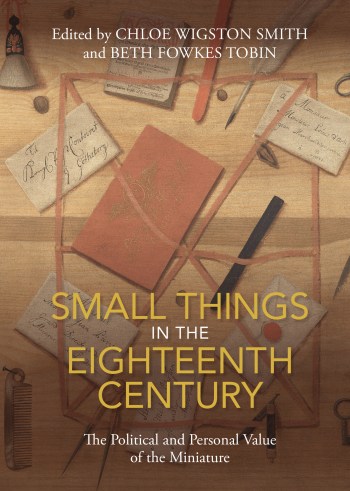 Offering an intimate history of how small things were used, handled, and worn, this collection shows how objects such as mugs and handkerchiefs were entangled with quotidian practices and rituals of bodily care. Small things, from tiny books to ceramic trinkets and toothpick cases, could delight and entertain, generating tactile pleasures for users while at the same time signalling the limits of the body’s adeptness or the hand’s dexterity. Simultaneously, the volume explores the striking mobility of small things: how fans, coins, rings, and pottery could, for instance, carry political, philosophical, and cultural concepts into circumscribed spaces. From the decorative and playful to the useful and performative, such small things as tea caddies, wampum beads, and drawings of ants negotiated larger political, cultural, and scientific shifts as they transported aesthetic and cultural practices across borders, via nationalist imagery, gift exchange, and the movement of global goods.
Chloe Wigston Smith is the author of Women, Work, and Clothes in the Eighteenth-Century Novel (2013) and co-editor, with Serena Dyer, of Material Literacy in Eighteenth-Century Britain: A Nation of Makers (2020). Her current research, supported by a British Academy fellowship, centers on material culture and the Atlantic world.
Beth Fowkes Tobin, a recipient of NEH and NSF fellowships, is the author of The Duchess’s Shells: Natural History Collecting in the Age of Cook’s Voyages (2014), Colonizing Nature: The Tropics in British Arts and Letters, 1760–1830 (2005), and Picturing Imperial Power: Colonial Subjects in Eighteenth-Century British Painting (1999).
C O N T E N T S
Figures
Notes on Contributors
Acknowledgments
Introduction: The Scale and Sense of Small Things — Chloe Wigston Smith and Beth Fowkes Tobin
Part I: Reading Small Things
1 ‘The Sum of All in All’: The Miniature Book and the Nature of Legibility — Abigail Williams
2 Nuts, Flies, Thimbles, and Thumbs: Eighteenth-Century Children’s Literature and Scale — Katherine Wakely-Mulroney
3 Gothic Syntax — Cynthia Wall
4 Small, Familiar Things on Trial and on Stage — Chloe Wigston Smith
Part II: Small Things in Time and Space
5 On the Smallness of Numismatic Objects — Crystal B. Lake
6 Crinoidal Limestone and Staffordshire Teapots: Material and Temporal Scales in Eighteenth-Century Britain — Kate Smith
7 ‘Joineriana’: The Small Fragments and Parts of Eighteenth-Century Assemblages — Freya Gowrley
8 ‘Pray What a Pox Are Those Damned Strings of Wampum?’ — Robbie Richardson
Part III: Small Things at Hand
9 ‘We Bought a Guillotine Neatly Done in Bone’: Illicit Industries on Board British Prison Hulks, 1775–1815 — Anna McKay
10 ‘What Number?’: Reform, Authority, and Identity in Late Eighteenth-Century Military Buttons — Matthew Keagle
11 Two Men’s Leather Letter Cases: Mercantile Pride and Hierarchies of Display — Pauline Rushton
12 The Aesthetic of Smallness: Chelsea Porcelain Seal Trinkets and Britain’s Global Gaze, 1750–1775 — Patricia F. Ferguson
13 ‘Small Gifts Foster Friendship’: Hortense de Beauharnais, Amateur Art, and the Politics of Exchange in Post-Revolutionary France — Marina Kliger
Part IV: Small Things on the Move
14 Hooke’s Ant — Tita Chico
15 Portable Patriotism: Britannia and Material Nationhood in Miniature — Serena Dyer
16 Revolutionary Histories in Small Things: Louis XVI and Marie Antoinette on Printed Ceramics, c. 1793–1796 — Caroline McCaffrey-Howarth
17 A Box of Tea and the British Empire — Romita Ray
Afterword: A Thing’s Perspective — Hanneke Grootenboer
Select Bibliography
Index
Sydney’s Powerhouse Announces Gift of Schofield Jewellery

French demi-parure consisting of necklace (shown) and a pair of earrings (not pictured), gold and onyx cameos, 1820
(Sydney: Powerhouse, gift of Anne Schofield; photograph by Marinco Kajdanovski)
◊ ◊ ◊ ◊ ◊
Press release (3 November 2022) from Sydney’s Powerhouse:
Powerhouse today announced an unprecedented gift from Australia’s leading antique jewellery dealer, 100 rare pieces of historical gemstone jewellery, this acquisition is one of the most significant donations in the museum’s history.

Ring, gold, chrysoprase, and rose diamonds, ca 1780 (Sydney: Powerhouse, gift of Anne Schofield; photograph by Ryan Hernandez).
Anne Schofield’s personal jewellery collection includes works created between the 17th and early 20th centuries featuring an astonishing range of gemstones and techniques. Highlights from the Anne Schofield Collection include exquisitely crafted archaeological jewellery, 18th-century hardstone intaglios, Carlo Giuliano earrings, an Egyptian-style lapis lazuli demi-parure, Art Nouveau dragonfly and wasp pedants, Cartier and Georg Jensen pieces, and a French demi-parure with onyx cameos from 1820.
Internationally renowned for her knowledge and passion for fine jewellery, Ms Schofield established her legendary boutique Anne Schofield Antiques in Woollahra in 1970. It was the first successful business in Australia to specialise in antique jewellery. A long-standing donor and supporter of the Powerhouse as Life Fellow and honorary adviser for jewellery, in 2014 she generously lent 70 significant objects from her personal collection to the award-winning exhibition, A Fine Possession: Jewellery and Identity. [See The Culture Concept Circle for coverage of that show.]
The Anne Schofield Collection will be photographed and made available on the Powerhouse website and will be on display at Powerhouse Ultimo next year.
“Over the past 30 years I have made many individual donations of antique and costume jewellery to the Powerhouse, to enhance the museum’s existing holdings. Many famous collections throughout the world have grown in importance as a result of private donations and bequests. I strongly believe that collectors who have enjoyed success should consider giving back to their city or country as generously as Australia has given to them,” Anne Schofield said.
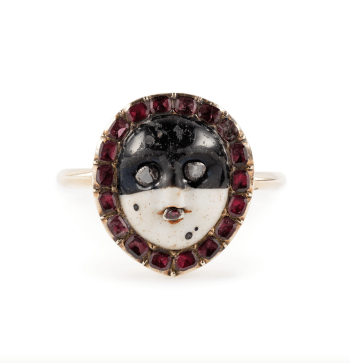
Ring (Italy), gold, enamel, garnets, and rose diamonds, ca 1760 (Sydney: Powerhouse, gift of Anne Schofield; photograph by Ryan Hernandez).
“Anne Schofield has extraordinary knowledge and expertise in fine jewellery. Over many years she has generously shared her knowledge with our museum and shared her collections with our audiences and communities. This transformative gift to the people of Sydney and NSW will have an impact for many generations to come,” Powerhouse Trust President Peter Collins AM KC said.
“Across her incredible career, Anne Schofield has continually sought out ways to share her remarkable collections with the public. This generosity of spirit could not be clearer than in this extraordinary donation that will transform the Powerhouse collection. Jewellery is not only powerful decorative art, but a form of social history and it is our privilege to be able to share this with the community. I pass on my deep gratitude and thanks to Anne for this gift and her ongoing commitment to the Powerhouse Museum,” Powerhouse Chief Executive Lisa Havilah said.
During her formative years in London in the early 1960s, Anne became passionate about the decorative arts with a focus on costume and, eventually, antique jewellery. In 1970 she established Anne Schofield Antiques on Queen Street Woollahra. In 2003 Anne was appointed a Member of the General Division of the Order of Australia AM for her services to the performing arts and to the decorative arts, particularly antiques, as an author and consultant. Anne is a member of the international Society of Jewellery Historians (SJH), a Life Fellow of the Powerhouse museum, a member of the Australian Art and Antique Dealers Association (AAADA), and co-author with Kevin Fahy of the seminal book Australian Jewellery: 19th and Early 20th Century.
Powerhouse sits at the intersection of arts, design, science, and technology and plays a critical role in engaging communities with contemporary ideas and issues. We are undertaking a landmark $1.4 billion infrastructure renewal program, spearheaded by the creation of the flagship museum, Powerhouse Parramatta; expanded research and public facilities at Powerhouse Castle Hill; the renewal of the iconic Powerhouse Ultimo; and the ongoing operation of Sydney Observatory. The museum is custodian to over half a million objects of national and international significance and is considered one of the finest and most diverse collections in Australia. We are also undertaking an expansive digitisation project that will provide new levels of access to Powerhouse collections.
Art Market | Fine Arts Paris & La Biennale, November 2022

Designed by Pierre-Antoine Mongin and produced by Joseph Dufour (1754–1827), Jardins de Bagatelle/Jardins Anglais, ca. 1802, imprimé à la planche en papiers raboutés, 51 × 380 cm. Offered by Carolle Thibaut-Pomerantz.
◊ ◊ ◊ ◊ ◊
From the July press release, via Art Daily:
Fine Arts Paris & La Biennale
Carrousel du Louvre, Paris, 9–13 November 2022
In February 2022, two leading French art fairs—the venerable Biennale, one of the world’s oldest art fairs (formerly known as La Biennale des Antiquaires) and the fast-growing Fine Arts Paris—announced that they had merged to create a new annual flagship event in Paris celebrating art from the Antiquity to present day. Now, Fine Arts Paris & La Biennale unveils details of its inaugural edition, which will take place at the prestigious Carrousel du Louvre, from 9 to 13 November, before moving to the Grand Palais Ephémère in November 2023 and then to the renovated Grand Palais in November 2024.
 86 internationally renowned galleries and talented young dealers will participate in what promises to be a major event in the global art market calendar. A showcase of art, culture, savoir-faire, and heritage, Fine Arts Paris & La Biennale will present carefully selected artworks spanning no fewer than fourteen categories, including Antiquities, Old Masters, Antique Furniture, Modern and Contemporary Art, Tapestries, Ceramics, and Jewellery, as well as Tribal Art, Asian Art, Islamic Art, and Books and Manuscripts.
Louis de Bayser, President of Fine Arts Paris & La Biennale said: “Fine Arts Paris & La Biennale is Paris’s only fair dedicated to Fine Arts, tracing the entire history of art across time and continents. In the next three years, as we move from the Carrousel du Louvre to the Grand Palais Ephémère and ultimately the Grand Palais, our objective will be to expand the fair’s global reputation and growth, as well as to contribute to reinforce Paris’s status and importance on the international art market”.

Rosalba Carriera, Portrait of a Gentleman in Blue Coat, 18th century, pastel, 55 × 40 cm. Offered by Galerie de Bayser.
Following on the footsteps of its illustrious predecessors, the new fair will bring together prominent Old Master galleries, led by a strong contingent of renowned French specialists (De Bayser, Didier Aaron, Baulme, Perrin, Giovanni Sarti, Coatalem, Mendes, Terrades, Leegenhoek, Talabardon & Gautier) and young art dealers (Edouard Ambroselli, Chaptal). They will be joined by London gallerist and pre-eminent scholar of 18th-century Venetian view painting Charles Beddington; Artur Ramon, one of Spain’s most important specialists in the field; Costermans, Brussels’ oldest art gallery, and the Geneva-based Dutch and Flemish painting specialist de Jonckheere who will present a 16th-century panoramic view by Hans Bol, among other masterpieces.
Antique Furniture and Decorative Arts
France’s long and glorious tradition of furniture-making and decorative arts will be reflected in the extraordinary selection showcased by Parisian galleries Steinitz, Léage and Oscar Graf. Belgium silver specialist Janssens van der Maelen will also participate alongside London dealer Brun who will unveil a terracotta bust of Napoleon.
Furthermore, the fair will welcome passionate gallerists with an unusual profile, including Portuguese neurologist turned collector and art dealer Mário Roque and 36-year-old Maxime Carron who, following a sporting education, created Royal Provenance, a gallery in Paris specialising in European heirlooms. Having recently sold a chair that once belonged to Queen Marie-Antoinette’s bedroom, he will unveil many more fascinating treasures, including a rare early 19th-century Morocco case containing the keys of Paris parks, possibly given by King Louis Philippe to his eldest son, Ferdinand-Philippe d’Orléans, Duke of Orléans (1810–1842) on the occasion of his coronation in 1830.
The fair will also welcome Carolle Thibaut-Pomerantz, one of very few specialists in historic wallpapers in the world. The New York/Paris-based gallerist, whose greatest finds are now part of the major museums including New York’s Metropolitan Museum of Art, will present a selection of wallpapers dating from the 18th century to the 1950s, including three large panels known as Jardins de Bagatelle / Jardins Anglais, designed by Pierre-Antoine Mongin and produced ca. 1800–04 by the French wallpaper and fabrics manufacture, Joseph Dufour in Macon.
Sculpture
Sculpture will feature strongly, with some of the most discerning specialists in the discipline vying to present rare pieces. The Parisian gallery Sismann, which focuses on Old Master sculpture, will present a Virgin and Child in limestone, made in Toul (France), ca. 1330–1340. Trebosc + van Lelyveld, Chiale and Ratton-Ladrière will show an ensemble of works from the Renaissance to the early 20th century. Michel Poletti and Alain Richarme from Univers du Bronze will celebrate the Golden Age of French sculpture (1830s–1930s) with works by Antoine-Louis Barye, Emmanuel Fremiet, Henri Laurens, and a life-size bronze nude representing David Victorious over Goliath, ca. 1894–1910, which was once in the collection of Auguste Lumière, the inventor of the cinematograph. The bronze is one of only two known similar works by the artist, the other being in the collection of the Musée d’Orsay.
Renowned for his early 20th-century animal sculptures, Xavier Eeckhout will exhibit an exquisite bronze lion cub made in 1935 by Louis de Monard. Galerie Malaquais will celebrate French figurative sculpture with Assia, a 1936 monumental sculpture by Charles Despiau, dedicated to and from the collection of the eminent French art dealer, editor and historian Georges Wildenstein (1892–1963).
Modern and Contemporary Art
Modern and Contemporary Art will also take centre stage in this inaugural edition of the fair. In a nod to history, Marianne Rosenberg, the granddaughter of Paul Rosenberg, perhaps the most important Modern Art dealer of the first half of the 20th century (who, for a time, worked with Wildenstein) will be present at the fair. Her New York gallery, Rosenberg & Co will exhibit a very rare oil on board by Henry Rousseau, La Citadelle, ca. 1893. Specialising in drawings for four generations, the Galerie de Bayser will unveil a magnificent charcoal drawing of a woman wiping her neck by Edgar Degas and a pastel depiction of a monkey by Simon Bussy.
Other leading modern and contemporary art galleries will include Jill Newhouse (New York), Lancz, La Béraudière (Brussels), and reputed French dealers, such as Applicat-Prazan, Berès, Brame & Lorenceau, Laurentin, Seine 55, Ary Jan, La Présidence, and Opera Gallery, which will showcase a roll call of modern and contemporary artists, from Fernand Léger and Marc Chagall, to Pierre Soulages and Fernando Botero. They will be joined by two Paris-based contemporary art galleries, RX and Christophe Gaillard.
Antiquities and Non-Western Arts
Tracing a complete world art history, Fine Arts Paris & La Biennale will bring together specialists in Antiquities, Tribal Art, Asian Art, and Islamic Art. A Roman marble Head of Aphrodite from the 2nd century AD will be one of the highlights presented by Kevorkian, a third-generation Parisian dealer specialising in Islamic Art.
They will be joined by Kent Antiques, a prominent London gallery dealing in Islamic and Indian art, Orientalist paintings, and courtly objects which will present an important Iznik blue and white pottery tile decorated with Saz leaves and khatai blossoms made in the Ottoman Empire, ca. 1545–50.
Asian Art will be represented by two highly regarded gallerists: Tamio Ikeda whose Parisian gallery Tanakaya will feature original Japanese prints, Ukiyo-e and Shin-Hanga, paintings, bronzes, ceramics, and lacquers; and Christophe Hioco, who will showcase a bronze head of Buddha from Thailand, Sukhothai, made in the late 14th–early 15th century.
In addition, the fair will be distinguished by a roster of Tribal Art galleries, led by Belgian African art expert Didier Claes and Oceanic art specialist Anthony Meyer. Visitors will be able to admire a 19th-century Dogon mask from Mali in the booth of Barcelona dealer Montagut, while the Parisian galleries Monbrison, Flak, and Belgian art dealers Mestdagh will impress with a display of artifacts from Oceania, Indonesia, Africa, India, and Japan.
Rare Books and Prints
A great drawing or painting is not always found in a frame, as demonstrated by the selection of rare books, manuscripts, and prints in the fair. The fourth-generation Parisian print dealer Prouté will present a 16th-century woodcut by Albrecht Dürer depicting the Christ in Limbo. They will be joined by H. H. Rumbler, Frankfurt specialists in Old Master prints; London dealer Daniel Crouch, a world authority in the field of rare atlases and maps; and an outstanding group of book specialists whose expertise spans the 15th through the 20th centuries. These include young gallerist Camille Sourget, fourth-generation book specialist Stéphane Clavreuil, and Parisian expert Jean-Baptiste de Proyart.
Jewellery
Finally, breaking the boundaries between fine and decorative arts, the new fair will also celebrate jewellery as a form of art. Renowned dealers in antique jewellery (Bernard Bouisset, Orpheo Genève, Martin du Daffoy, Larengregor) will be joined by contemporary artist-jewellers Walid Akkad, Frédérique Mattei, and Chinese designer Feng J. One year after one of her creations entered the collections of the Musée des Arts Décoratifs in Paris, Feng J will uncover spectacular new designs especially made for the fair. These include a masterpiece of jewellery craftmanship inspired by the artist’s passion for the Impressionist period: a diamond tiara whose various pastel tones are reminiscent of a Monet painting.










 Enfilade
leave a comment