Research Seminar | Greg Smith on Girtin and the Artist Catalogue
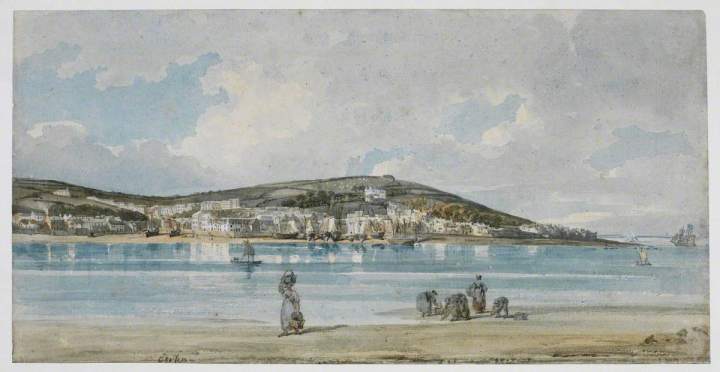
Thomas Girtin, Appledore, from Instow Sands, ca. 1800, graphite and watercolour on laid paper, 25 × 47 cm
(London: The Courtauld, D.1952.RW.846)
◊ ◊ ◊ ◊ ◊
From PMC:
Greg Smith | Rethinking the Artist Catalogue for the Online Age: Thomas Girtin (1775–1802)
Paul Mellon Centre, London, 5 October 2022, 6pm
This lecture relates to the publication Thomas Girtin (1775–1802): An Online Catalogue, Archive, and Introduction to the Artist, due to be released on 4 October.
I will begin by outlining the scope of the project and my thinking behind the site’s tri-partite structure and title: An Online Catalogue, Archive, and Introduction to the Artist. Particular attention will be paid to two challenges: how to make a free-to-access site straightforward to use for a non-specialist audience; and then, how best to ensure the future of the site as an academic resource that can develop through the incorporation of new material and research. I will then move on to consider the different sections of the site, beginning with the approximately 1550 catalogue entries that form its core. Emphasis will be placed on the features that distinguish the site from a conventionally published catalogue and why it is that I have studiously avoided using the term catalogue raisonné. I will then look at each of the sections of the Archive, focusing first on the challenge of relating the material to the rest of the site, and then summarising their current status in relation to my ambition to produce a comprehensive if not definitive record of sales, exhibitions and publications, together with extensive transcriptions of all the early biographical accounts and related manuscript material. I will conclude my introduction to the site by looking at some of its inevitable limitations, not least as a challenge to my audience to use it as a resource for the investigation of themes beyond the project’s scope. Book tickets»
Greg Smith is an independent art historian, who has published extensively on the history of British watercolours and watercolourists, as well as landscape artists working in Italy. He has also worked as a curator at the Whitworth Art Gallery, Manchester, the Design Museum, London, and the Barber Institute of Fine Art, Birmingham, and has organised exhibitions on the work of Thomas Girtin (Tate Britain), Thomas Jones (National Gallery of Wales), and Thomas Fearnley (Barber Institute of Fine Art). As Senior Research Fellow at the Paul Mellon Centre for Studies in British Art, Greg Smith is developing a major online project: Thomas Girtin (1775–1802): An Online Catalogue, Archive and Introduction to the Artist.
New Book | Dinner with Joseph Johnson
Marking Banned Books Week (18–24 September 2022), with an 18th-century reminder of publishing’s power. From Princeton UP (the British cover is, I think, more exciting –CH).
Daisy Hay, Dinner with Joseph Johnson: Books and Friendship in a Revolutionary Age (Princeton: Princeton University Press, 2022), 536 pages, ISBN: 978-0691243962, $40.
 Once a week, in late eighteenth-century London, writers of contrasting politics and personalities gathered around a dining table. The veal and boiled vegetables may have been unappetising, but the company was convivial and the conversation brilliant and unpredictable. The host was Joseph Johnson, publisher and bookseller: a man at the heart of literary life. In this book, Daisy Hay paints a remarkable portrait of a revolutionary age through the connected stories of the men and women who wrote it into being, and whose ideas still influence us today.
Johnson’s years as a publisher, 1760 to 1809, witnessed profound political, social, cultural, and religious changes—from the American and French revolutions to birth of the Romantic age—and many of his dinner guests and authors were at the center of events. The shifting constellation of extraordinary people at Johnson’s table included William Blake, William Wordsworth, Samuel Taylor Coleridge, Benjamin Franklin, the scientist Joseph Priestly, and the Swiss artist Henry Fuseli, as well as a group of extraordinary women—Mary Wollstonecraft, the novelist Maria Edgeworth, and the poet Anna Barbauld. These figures pioneered revolutions in science and medicine, proclaimed the rights of women and children, and charted the evolution of Britain’s relationship with America and Europe. As external forces conspired to silence their voices, Johnson made them heard by continuing to publish them, just as his table gave them refuge.
A rich work of biography and cultural history, Dinner with Joseph Johnson is an entertaining and enlightening story of a group of people who left an indelible mark on the modern age.
Daisy Hay is an award-winning biographer whose previous books include Young Romantics: The Shelleys, Byron, and Other Tangled Lives and Mr. and Mrs. Disraeli: A Strange Romance. She is associate professor of English literature and life writing at the University of Exeter.
Symposium | Close Encounters: The Low Countries and Britain
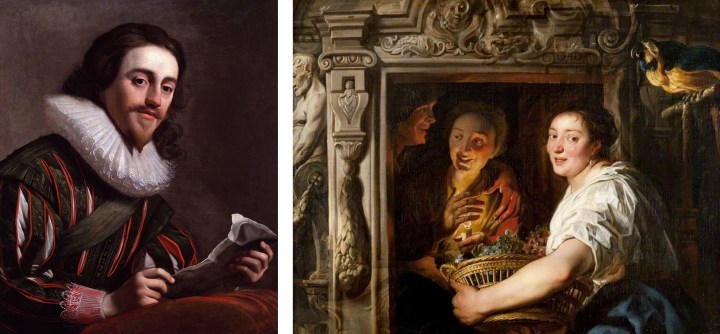
Left: Gerrit van Honthorst, King Charles I, 1628 (London: National Portrait Gallery). Right: Jacob Jordaens, A Maidservant with a Basket of Fruit and Two Lovers, 1629–35 (Glasgow: Kelvingrove Art Gallery and Museum).
◊ ◊ ◊ ◊ ◊
From CODART:
Close Encounters: Cross-Cultural Exchange between the Low Countries and Britain, 1500–1800
RKD – Netherlands Institute for Art History, The Hague, 22–23 September 2022
On 22 and 23 September 2022, a symposium will be held at the RKD – Netherlands Institute for Art History on the occasion of the launch of the richly annotated and illustrated digital English version of Horst Gerson’s chapter on Britain from his Ausbreitung und Nachwirkung der holländischen Malerei des 17. Jahrhunderts of 1942 (Dispersal and Legacy of Dutch Painting of the 17th Century). The event is jointly organized by the RKD and the embassy of the UK in the Netherlands, University of Amsterdam and Courtauld Institute of Art.
Before 1942, the study of Dutch art and artists in Britain was largely uncharted territory. In the last thirty years, research on early modern artists migration and cultural exchange between the Low Countries and Great Britain has progressed rapidly and in various directions. In particular, the Dutch and Flemish artists community in London and the careers of individual artists at the English and Scottish courts have received attention. The same goes for the collection history of Netherlandish art in the UK. The launch of the annotated and translated version of Gerson’s text marks the perfect occasion to rethink, discuss, and contextualize his original findings with current knowledge.
At the symposium Close Encounters, international experts from the UK, the United States, Germany, and The Netherlands will present a range of papers that will draw attention to different aspects of this cultural exchange: artists’ and dealers’ travels and routes, artist’s education, networks, patronage, as well as styles and its implications for connoisseurship. Tickets are available through the RKD website: €30 (€15 students).
Program Committee
• Rieke van Leeuwen (RKD)
• Angela Jager (RKD)
• Karen Hearn (Honorary Professor, University College London)
• Sander Karst (University of Amsterdam)
• David Taylor (Independent, previously National Trust and National Galleries Schotland)
• Joanna Woodall (Courtauld Institute of Art)
T H U R S D A Y , 2 2 S E P T E M B E R 2 0 2 2
9.45 Registration and Coffee
10.30 Welcome and Introduction
• Chris Stolwijk (General Director RKD) — Welcome
• Lucy Ferguson (Deputy Ambassador of the UK in the Netherlands) — Welcome
• Rieke van Leeuwen — Introduction to the Program
11.00 Session 1: Cross-Cultural Networks and Collaboration
Chairs: Sander Karst and David Taylor
• Adam White — Nicholas Stone the Elder (c. 1587–1647) and His Circle: Anglo-Netherlandish Inter-Action in Sculpture, Architecture, and Painting
• Imogen Tedbury — The Van de Velde Studio at the Queen’s House
• Ada De Wit — Woodcarvers and Their Anglo-Netherlandish Network: Grinling Gibbons and Laurens van der Meulen
12.30 Lunch Break
13.30 Session 2: Thinking Differently about Cross-Cultural Exchange
Chairs: Karen Hearn and Joanna Woodall
• Gary Alabone — Leatherwork and Kwab: Influences between English and Netherlandish Picture Frames
• Flash Talk: Eleanor Stephenson — Copying the Cartouche: Cross-Cultural Exchanges in Dutch and English Cartography, 1658–1675
• Amy Lim — John van Collema: A Dutch India Merchant in London
• Ulrike Kern — Dutch Art Terminology in the British Workshop
15.15 Coffee and Tea Break
15.45 Session 3: 17th-Century Netherlandish Painters and Their Relations to British Patrons
Chairs: Angela Jager and Joanna Woodall
• Michele Fredericksen — Between Two Courts: Gerrit van Honthorst and Stuart Patrons in London and The Hague
• Flash Talk: Rebekka Hoummady — A Kings Daughter in Exile: Diplomatic and Artistical Mediation between the Courts of Elizabeth Stuart and Charles I by Gerrit van Honthorst
• John Loughman — Samuel van Hoogstraten’s English Patrons
Launch of Gerson Digital: Britain
• Karen Hearn and Rieke van Leeuwen — Gerson Digital: UK, the Project
Panel Discussion
F R I D A Y , 2 3 S E P T E M B E R 2 0 2 2
9.30 Registration and Coffee
10.00 Session 4: Collecting and Art Trade
Chairs: Angela Jager and David Taylor
• Ellinoor Bergvelt and Helen Hillyard — Dutch Paintings for Everyone! A Study of the Cartwright Collection at Dulwich Picture Gallery
• Sander Karst — Migration and Adaptation: Netherlandish Artists and the Art Market in Late 17th-Century Britain
• Tico Seiffert — Collecting Rembrandt’s Art in Britain before 1700
• Kate Heard — George IV (1762–1830) as a Collector of Dutch and Flemish Prints and Drawings
• Quentin Buvelot — British Connections in the Collection of the Mauritshuis
12.30 Lunch Break Opportunity to visit the Mauritshuis
14.30 Session 5: Legacy of the Dutch Golden Age
Chairs: Karen Hearn and Rieke van Leeuwen
• Remmelt Daalder — ‘Whom no Age has equalll’d in Ship-painting’, Willem van de Velde: World Famous in 18th-Century England
• Rica Jones — Untangling the Tangled Evidence of Jan Griffier the Elder’s Descendants and a Note on Their Legacy in British Painting
• Rebecca Welkens — Thomas Worlidge, His Approach to Rembrandt’s Prints, and the Construction of Concepts of Fame in England in the 18th Century
• Flash Talk: Quirine van de Meer Mohr — In the Wake of the Old Masters: The Migration of Dutch Modern Artists in Early 19th-Century Britain
16.30 Drinks Reception
Exhibition | Horace Walpole and Philanthropy
Now on view at The Walpole Library, with a rich and engaging online component:
‘Knight Errant of the Distressed’: Horace Walpole and Philanthropy in Eighteenth-Century London
The Lewis Walpole Library, Farmington, CT, 11 May — 22 December 2022
Curated by Andrew Rudd
 ‘Knight Errant of the Distressed’: Horace Walpole and Philanthropy in Eighteenth-Century London uses images, manuscripts, artefacts, and extracts from publications and correspondence to situate Walpole within the burgeoning philanthropic culture of his age. It reveals Walpole’s secret giving to prisoners and other good causes and examine the principles which underlay his philanthropy. A main aim of the exhibition is to stimulate discussion about philanthropy today.
Horace Walpole (1717–1797) lived in an age that prided itself on the extent of its philanthropy. His friend Hannah More described the era as the “age of benevolence.” Yet while Walpole was familiar with many leading philanthropists, he is not known as a supporter of good causes himself; indeed, after his death, he was accused of being uncharitable and even blamed for the suicide of the young poet Thomas Chatterton, who had sought Walpole’s financial assistance in vain.
This exhibition seeks to situate Walpole in the context of eighteenth-century British philanthropy. An array of philanthropic organizations, fundraising initiatives, and ad hoc giving formed part of everyday life in Britain under the reigns of George II and III. The rich were expected to support the poor and needy in order to supplement the overstretched parish-based welfare system. Walpole frequently dispatched anonymous donations to victims of misfortune he read about in his daily newspaper.
Walpole was drawn personally toward outlandish cases, and this exhibition portrays his active involvement in several high-profile campaigns, including the ill-fated encounter with Chatterton. Walpole could be disparaging in his remarks about philanthropy, but visitors are encouraged to weigh his private generosity. Walpole regarded philanthropy as a means to cultivate the curious and eccentric, a discernibly queer philanthropic vision in which he himself played the role of “knight errant of the distressed.”
Andrew Rudd, of the University of Exeter, researches and teaches British literature of the eighteenth century and Romantic period. His monograph, Sympathy and India in British Literature 1770–1830 (Palgrave Macmillan), was published in 2011, and he is currently writing a cultural history of charity in the eighteenth century. He has held numerous fellowships (most recently at Yale’s Lewis Walpole Library and the School of Advanced Studies in English, University of Jadavpur) and speaks regularly at conferences, seminars, and public events. Since 2015, he has been a member of the Arts and Humanities Research Council’s Peer Review College.
In addition to the online exhibition, a 24-page exhibition brochure by Dr. Rudd is available for download.
◊ ◊ ◊ ◊ ◊
Andrew Rudd | Horace Walpole and Philanthropy in Eighteenth-Century England
Lewis Walpole Library, Farmington, Tuesday, 20 September 2022, 7.00pm
In partnership with the Farmington Libraries, Dr. Rudd will explore the rich and exciting world of philanthropy in eighteenth-century England. The talk will focus on the collector and man of letters Horace Walpole (1717–1797), who was a generous, if sometimes eccentric, supporter of the era’s good causes. Walpole’s giving habits illuminate a thriving culture of charitable relief which still finds echoes in philanthropy today.
Registration is available here»
◊ ◊ ◊ ◊ ◊
The Charitable Impulse: Philanthropic Values from the Eighteenth Century to Today
Dwight Hall at Yale, Wednesday, 21 September 2022, 4.00–6.00pm
A conversation jointly organized by The Lewis Walpole Library, Yale University and Dwight Hall at Yale: Center for Public Service and Social Justice
In the eighteenth century, charitable acts and societies in England and the American colonies were motivated by an understanding of moral and ethical obligations of the ‘better off’ to do good works on behalf of the ‘needy’. Philanthropic organizations from this time reveal historical attitudes toward the benefit to the individual and the public of charitable activities. This panel will explore how views on privilege, agency, status, and the responsibilities of members of society to others have evolved over time, and the ways in which certain implicit understandings of why and how people should care for others remain unchanged.
Online Seminar | What Does It Mean to Curate a Historic House?

Kingston Lacy, Dorset, designed by Sir Roger Pratt, ca. 1663–65.
◊ ◊ ◊ ◊ ◊
From Eventbrite:
What Does It Mean to Curate a Historic House?
Online, Monday, 26 September 2022, 11.00–12.00 BST
This session will combine a short film and panel discussion based on a British Academy-funded research project led by Dr Tarnya Cooper and Dr Oliver Cox, which explores the contemporary issues and challenges with curating a historic house owned by a heritage organisation. The short film, shot at Kingston Lacy in the summer of 2022, explores the role of the curator in a publicly-accessible historic house, discussing how to prioritise sharing what is significant rather than what is left. Following the film, Cox and Cooper will convene a panel discussion featuring leading specialists from across Europe to discuss the future for historic house curation and interpretation.
Chairs
• Oliver Cox (Head of Academic Partnerships, V&A)
• Tarnya Cooper (Curatorial and Collections Director, National Trust)
Panellists
• Sarah McLeod (Chief Executive, Wentworth Woodhouse Preservation Trust)
• Jeffrey Haworth (Historian and former National Trust Curator)
• Alice Loxton (History Hit)
• John Orna-Ornstein (Director of Curation and Experience, National Trust)
This event is delivered by The National Trust as part of the Art History Festival (20–26 September 2022), presented by the Association for Art History. The full Festival programme is available here»
Print Quarterly, September 2022
The long eighteenth century in the latest issue of Print Quarterly:
Print Quarterly 39.3 (September 2022)

Anonymous artist after Sébastien Leclerc, View of the Hall of Mirrors, ca. 1684, pen and brown ink, brown wash on paper, 13.6 × 9.1 cm (Musée National des Châteaux du Versailles, INV.DESS 1247).
Tomáš Valeš, “Franz Anton Maulbertsch, Jakob Matthias Schmutzer and the Allegory on the Edict of Toleration, 1785”
This article discusses new insights into the painter Franz Anton Maulbertsch (1724–1796) and the creation of his print, the Allegory on the Edict of Toleration (1785). It adduces two letters from the engraver Jakob Mattias Schmutzer (1733–1811), his collaborator since the 1750s and later his father-in-law. The article discusses the strategies used for the print’s distribution and also presents an analysis of the print’s preparatory drawing and three proof impressions.
Antoine Gallay, “Sébastien Leclerc’s Preparatory Drawing for the View of the Hall of Mirrors (1684): A Reassessment”
This short article re-examines the status of a drawing acquired by the Musée National des Châteaux de Versailles et de Trianon in 2008, traditionally attributed to Sébastien Leclerc and thought to have been made in preparation for his famous print of the View of the Hall of Mirror (1684). The author also presents a second little known drawing which was most certainly made by Leclerc himself in preparation for the print. Comparison between this drawing and the print offers new insight on the early appearance of the Hall of Mirrors and on Leclerc’s artistic conception and practices.
The issue also includes these relevant notes and reviews:
 Battle Engravings for the Emperors of China
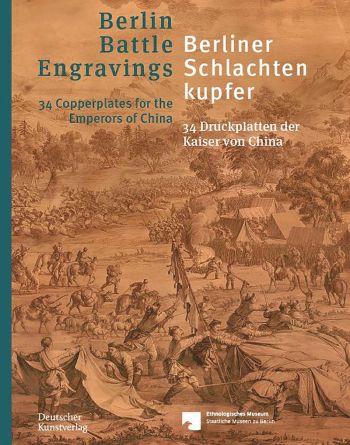
Jean Michel Massing, Review of Henriette Lavaulx-Vrécourt, Niklas Leverenz and Alexey Pastukhov, Berlin Battle Engravings: 34 Copperplates for the Emperors of China / Berliner Schlachtenkupfer: 34 Druckplatten der Kaiser von China (Berlin: Staatliche Museen zu Berlin and Deutscher Kunstverlag, 2021), p. 305.
Thomas Gainsborough in London
Anne Lyles, Review of Susan Sloman, Gainsborough in London (London: Modern Art Press, 2021), p. 307.
Utamaro and the Spectacle of Beauty
Adam Haliburton, Review of Julie Nelson Davis, Utamaro and the Spectacle of Beauty (London: Reaktion Books, 2021), p. 308.
The Waterloo Map of Pierre-Jacques Goetghebuer
Inge Misschaert has contributed a brief analysis of the much-copied Map of the Battle of Waterloo (1815) by Belgian architect and engraver Pierre-Jacques Goetghebuer. The article elaborates on the production history of Goetghebuer’s map and its context alongside other adventurous competitors seeking to illustrate the famous battle in its immediate aftermath.
The Reception of Raphael
Carlo Schmid, Review of Andres Stolzenburg and David Klemm, eds., Raffael: Wirkung eines Genies (Petersberg: Hamburger Kunsthalle and Michael Imhof Verlag, 2021), p. 315.
The review focuses on the cult of Raphael which took off at the beginning of the nineteenth century.
The Fruitful Encounter Between Engraving and Photography
Francesca Maria Bonetti, Review of Nicolas Devigne and Virginie Caudron, eds., Contacts – Photographie – Gravure: Jeux et Enjeux (Aire-sur-la-Lys: ateliergaleriéditions and éditions Musée de Gravelines, 2020), p. 318.
Bonetti discusses the different photomechanical processes based on proto-photographic experiments carried out between 1824 and 1827 and known as heliography.
Exhibition | Threads of Power
 Opening this week at BGC:
Threads of Power: Lace from the Textilmuseum St. Gallen
Bard Graduate Center, New York, 16 September 2022 — 1 January 2023
Curated by Emma Cormack, Ilona Kos, and Michele Majer
“I love lace for evening dresses … for a cocktail frock … or for a blouse… . When a fabric is fancy in itself it needs simplicity of design to show it to its best advantage.” —Christian Dior
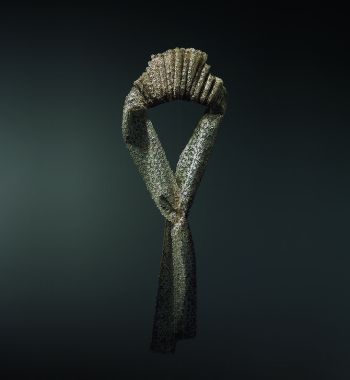
Point de France needle-lace frelange with lappets, Orne, France, ca. 1695, linen (Textilmuseum St. Gallen, acquisition from the John Jacoby Collection, 1954,01246; photo by Michael Rast).
Lace—delicate, sumptuous, enigmatic—takes over the Bard Graduate Center Gallery this fall. Trace the development of European lace from its sixteenth-century origins to the present day. See more than 150 examples of lace from the renowned collection of Switzerland’s Textilmuseum St. Gallen, including some of the world’s finest examples of handmade needle and bobbin lace that were favored by the wealthy and powerful of Bourbon France and Habsburg Spain. Learn about the women who crafted this sought-after status symbol by hand and about the evolution of Swiss chemical lace, known as guipure lace, made on embroidery machines. Explore new innovations in lace production, like laser-cut and 3D-printed lace, used in contemporary haute couture.
Curated by Emma Cormack, associate curator, Bard Graduate Center; Ilona Kos, curator, Textilmuseum St. Gallen; and Michele Majer, assistant professor, Bard Graduate Center. Threads of Power: Lace from the Textilmuseum St. Gallen is organized by Bard Graduate Center and the Textilmuseum St. Gallen. The exhibition will open at Bard Graduate Center Gallery in New York in September 2022 and will be available to tour after closing in January 2023.
◊ ◊ ◊ ◊ ◊
Emma Cormack and Michele Majer, eds., Threads of Power: Lace from the Textilmuseum St. Gallen (New York: Bard Graduate Center, 2022), 432 pages, ISBN: 978-0300263497, $75.
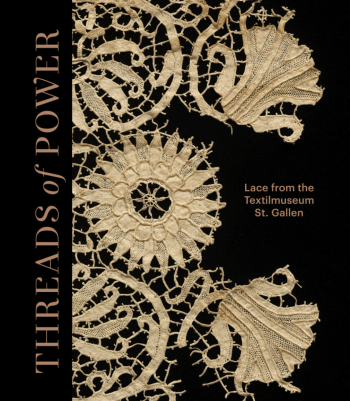 Tracing the history of lace in fashion from its sixteenth-century origins to the present, Threads of Power: Lace from the Textilmuseum St. Gallen offers a look at one of the world’s finest collections of historical lace. The book explores the longstanding connections between lace and status, addressing styles in lace worn at royal courts, including Habsburg Spain and Bourbon France, as well as lace worn by the elite ruling classes and Indigenous peoples in the Spanish Americas. Featuring new research, the publication covers a range of topics related to lace production, lace in fashion and portraiture, lace revivals, the mechanization of the lace industries in the nineteenth and twentieth centuries, and contemporary innovations in lace. With a focus on lace techniques, women lace makers, and lace as a signifier of wealth and power, this richly illustrated book includes wide-ranging contributions by curators and experts from major museums and academic institutions.
C O N T E N T S
Director’s Foreword, Susan Weber
Editor’s Note
Introduction, Emma Cormack and Michele Majer
The Emergence of Lace in Early Modern Europe
1 Barbara Karl — Lace and Status: Luxury, Power, and Control in Early Modernity
2 Femke Speelberg — Putting a Name to Lace: Fashion, Fame, and the Production of Printed Textile Pattern Books
3 Paula Hohti Erichsen — ‘Monstrous’ Ruffs and Elegant Trimmings: Lace and Lacemaking in Early Modern Italy
4 Frieda Sorber — Antwerp, A Center of Lace Making and Lace Dealing, 1550–1750
Lace in Spain and the Americas, 1500–1800
5 Amalia Descalzo Lorenzo — The Triumph of Lace: Spanish Portraiture of the Sixteenth and Seventeenth Centuries
6 Mariselle Méléndez — ‘A desire of being distinguished by an elegant dress is universal’: Clothing, Status and Convenience in Eighteenth-Century Spanish America
7 James Middleton — A Prodigious Excess: Lace in New Spain and Peru, ca. 1600–1800
8 Laura Beltrán-Rubio — ‘Covered in much fine lace’: Dress in the Viceroyalty of New Granada
The Dominance of France, 1660–1790
9 Denis Bruna — Lace and Economy under Louis XIV
10 Lesley Miller — Lace à la Mode, ca. 1690–1790
Mechanization and Revivalism: The Nineteenth Century Lace Industries
11 Emma Cormack and Michele Majer — Fashion and the Lace Industries in France, Belgium, and England, 1800–1900
12 Annabel Bonnin Talbot — Ahead of the Curve: A. Blackbourne & Co. and the Late-Nineteenth Century British Lace Industry
13 Emily Zilber — Italy to New York: Making Historic Textiles Modern at the Scoula d’Industrie Italiane
14 Anne Wanner-JeanRichard and Ilona Kos — Imitation and Inspiration: The Leopold Iklé Collection in St. Gallen
Innovations in Lace, 1900 to Today
15 Catherine Örmen — Fashion and Lace since 1900
16 Annina Dosch, Interview with Tobias Forster, Hans Schreiber, and Martin Leuthold — Lace in St. Gallen Today: Tradition and Innovation at Forster Rohner and Jakob Schlaepfer
Illustrated Checklist of the Exhibition
Glossary, compiled by Kenna Libes
Bibliography
Contributors
Index
Lecture | Charles Kang on Antoine Benoist’s Portraits of Louis XIV
From BGC:
Charles Kang | From Wax to Paper: Antoine Benoist’s Portraits of Louis XIV
A Françoise and Georges Selz Lecture on Eighteenth- and Nineteenth-Century French Decorative Arts and Culture
Bard Graduate Center, New York, 28 September 2022, 6.00pm
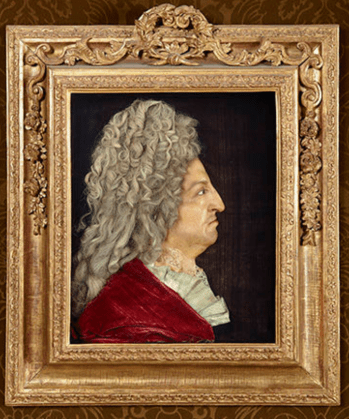
Antoine Benoist (1632–1717), Portrait of Louis XIV, ca. 1705, colored wax with a natural wig. 52 × 42 cm (Musée national des châteaux de Versailles et de Trianon).
Painter and sculptor Antoine Benoist is best known for a profile relief portrait of Louis XIV in polychrome wax. The striking verisimilitude of this work and his other wax creations readily evoke the popular wax statues at Madame Tussauds. In this lecture, Charles Kang explores the outer limits of royal portraiture at the time of Louis XIV, beyond oil paintings, marble busts, bronze statues, and medals. Kang also looks at two other works that Benoist produced towards the end of his career: a group of grisaille miniature portraits in elaborate gilt bronze frames and a manuscript biography of Louis XIV decorated with similar miniatures in gouache. Through these works, Benoist attempted to reposition himself as a chronicler of royal likeness rather than as a wax portraitist.
Charles Kang is Curator of Eighteenth- and Nineteenth-Century Drawings at the Rijksmuseum Amsterdam. Responsible for the museum’s collection of Dutch and European drawings, he is currently working on several projects, including one on the rise of private drawing societies in the Netherlands and another on the relationship between artistic drawing and early ethnography. He trained in eighteenth-century French art and visual culture and holds a PhD from Columbia University and an MA from Williams College in the history of art.
The Burlington Magazine, August 2022
The August issue of The Burlington is rich for the eighteenth century, including Karin Wolfe’s obituary for Christopher Johns (details for his memorial service, on 17 September, are emerging here).
The Burlington Magazine 164 (August 2022)
 A R T I C L E S
• Gauvin Alexander Bailey, “A Borromini-Inspired Church Plan in Eighteenth-Century Lima,” pp. 740–51.
Built in 1758–66, the Church of Los Huérfanos, Lima, is unique in Spanish South America for its oval plan. Its designer is her identified as a master builder, Cristóbal de Vergas, who was inspired by prints of Francesco Borromini’s S. Carlo alle Quattro Fontane, Rome, exemplifying the revival of interest during the Rococo perios in Roman Baroque precedents.
• Adam Bowett, “The Floral Marquetry Floor at Burghley House,” pp. 752–59.
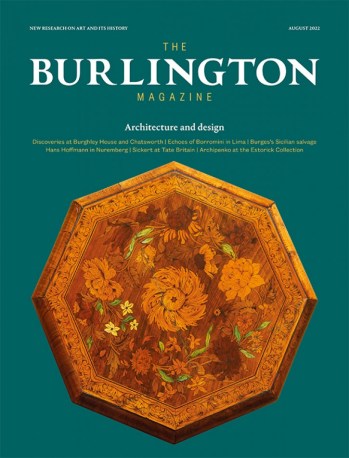
The possibility that five pieces of eighteenth-century furniture at Burghley House, Stamford, incorporate maquetry made for a floor in the house c.1685 is here confirmed by references in inventories. The marquetry can be linked to furniture in the Royal Collection, raising the possibility that the floor was mdade by Gerrit Jensen incorporating marquetry supplied by Jasper Braems.
• François Marandet, “A Modello by Louis Laguerre and the Programme of the Painted Hall at Chatsworth,” pp. 760–67.
With the help of a recently discovered modello, the subject of Louis Laguerre’s monumental painting on the east wall of the Painted Hall, Chatsworth, is here identified as Augustus Ordering the Closing of the Doors of the Temple of Janus. This allows the political allegory of the room’s decoration, completed in 1694, to be fully understood for the first time.
R E V I E W S
• Neil Jeffares, “Pastels in the Pandemic,” pp. 780–87.
The notoriously fragile medium of pastel has not been out of the public eye during the difficult circumstances of the past two years. Exhibition in San Francisco and Munich and a biography of Rosalba Carriera invite comparisons between the major pastellists of the eighteenth century: Joseph Vivien, Maurice-Quentin de La Tour, and Jean-Étienne Liotard, as well as Carriera.
• Reinier Baarsen, Review of Calin Demetrescu, Les ébénistes de la Couronne sous le règne de Louis XIV (La Bibliothèque des Arts, 2021), pp. 818–19.
• Daniel Fulco, Review of Andreas Schumacher, ed., Venezianische Malerei: Staatsgalerie in der Residenz Würzburg (Schnell & Steiner, 2021), pp. 819–21.
• Howard Coutts, Review of Patricia Ferguson, ed., Pots, Prints, and Politics: Ceramics with an Agenda, from the 14th to the 20th Century (British Museum Press, 2021), pp. 821–22.
• Sophie Rhodes, Review of Tessa Murdoch, Europe Divided: Huguenot Refugee Art and Culture (V&A Museum, 2021), pp. 827–28.
• Patrick Bade, Review of Charles Dellheim, Belonging and Betrayal: How Jews Made the Art World Modern (Brandeis University Press, 2021), p. 828.
O B I T U A R I E S
• Karin Wolfe, Obituary for Christopher M.S. Johns (1955–2022), pp. 829–31.
Professor of History of Art at Vanderbilt University, Nashville, since 2003, Christopher M.S. Johns published widely on Italian art of the seventeenth and eighteenth centuries. His determination to demonstrate the falsity of the belief that the settecento was a period of cultural decline had a substantial influence on both scholarship and academic curricula.
Material and Visual Culture Seminar Series, Fall 2022
From ArtHist.net:
Material and Visual Culture Seminar Series, 17th and 18th Centuries
Online, University of Edinburgh, 28 September — 7 December 2022
Each session we’ll hear from two speakers, sharing their research on, and approaches to, the study of 17th- and 18th-century material and visual culture. From reassessing how the work of female artists is read, to European visualisation of Latin America, and the exchange of objects, this year’s programme covers a broad range of topics. We aim to make a space in which these rich histories can be explored from varied disciplines to enhance our research practices. We’ll be meeting on Wednesdays, 5–6pm GMT, online using Zoom. See Eventbrite to register, view speaker abstracts, receive the joining link and reminders. Registration closes 40 minutes before seminar start time. Please contact materialcultureresearcheca@ed.ac.uk with any queries.
28 September | Approaching Identities
Chair: Georgia Vullinghs
• Emma Pearce
• Ailsa Maxwell
12 October | Patronage and Person under the Stuarts
Chair: Catriona Murray
• Sarah Hutcheson
• Megan Shaw
26 October | Baroque Devotional Visual Culture
Chair: Carol Richardson
• Lucía Jalón Oyarzun
• Sandra Costa Saldanha
9 November | Pasteboard and Printing Plates: Elusive Objects
Chair: Molly Ingham
• Chiara Betti
• Lucy Razzall
23 November | The Social Life of … Tea
Chair: Caroline McCaffrey-Howarth
• Anna Myers
• Lucy Powell
7 December | The Materiality of Making
Chair: Viccy Coltman
• Kerry Love
• Alejandro Octavio Nodarse










 Enfilade
leave a comment