New Book | English Garden Eccentrics
From Yale UP:
Todd Longstaffe-Gowan, English Garden Eccentrics: Three Hundred Years of Extraordinary Groves, Burrowings, Mountains, and Menageries (London: Pual Mellon Centre, 2022), 400 pages, ISBN: 978-1913107260, $40.
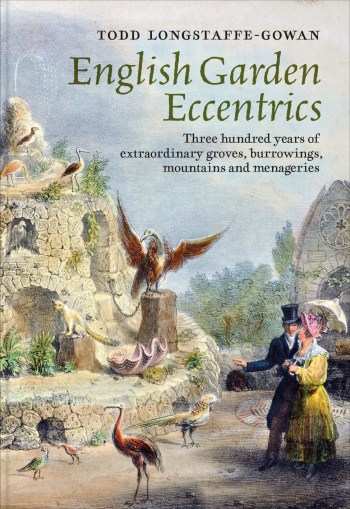 In his new book, English Garden Eccentrics, renowned landscape architect and historian Todd Longstaffe-Gowan reveals a series of obscure and eccentric English garden-makers who, between the early seventeenth and the early twentieth centuries, created intensely personal and idiosyncratic gardens. They include such fascinating characters as the superstitious antiquary William Stukeley and the animal- and bird-loving Lady Read, as well as the celebrated master of Vauxhall Gardens, Jonathan Tyers, who created at his home at Denbies one of the gloomiest and most perverse anti-pleasure gardens in Georgian England. Others built miniature mountains, shaped topiaries, displayed exotic animals, excavated caves, and assembled architectural fragments and fossils to realise their gardens in a way that was often thought to be excessive.
With quirky and compelling illustrations and chapters including “Lady Broughton’s ‘Miniature Copy of the Swiss Glaciers’,” “Topiary on a Gargantuan Scale: The Clipped ‘Yew-trees’ at Four Ancient London Churchyards,” and “The Burrowing Duke at Harcourt House,” English Garden Eccentrics brings together garden and landscape history with cultural history and biography. The book engagingly reveals what it is about the gardener and his or her creation that can be seen as eccentric and focuses on an area of garden history that has scarcely been previously explored: gardens seen as expressions of the singular character of their makers, and therefore functioning, in effect, as a form of autobiography. This lively and accessible book calls on gardeners today to learn from example and dare to be eccentric.
Todd Longstaffe-Gowan is a landscape architect with an international practice based in London. He is gardens adviser to Historic Royal Palaces, lecturer at New York University (London), president of the London Gardens Trust, editor of The London Gardener, and author of several books including The London Town Garden (Yale, 2001) and The London Square (Yale, 2012).
Online Courses from the V&A, Autumn 2022
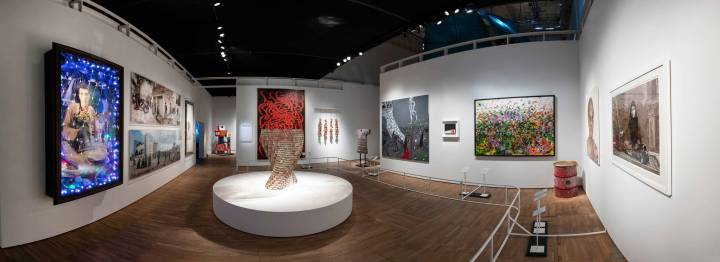
Installation view of the exhibition Epic Iran (London: V&A, 29 May 2021 — 12 September 2021).
◊ ◊ ◊ ◊ ◊
A selection of upcoming online courses from the V&A:
Principles of Exhibition Making
V&A Academy Online, Tuesdays, 13.00–16.30, 13 September — 18 October 2022
Working with the V&A’s expert staff and industry professionals, you will study the process and driving ideas behind V&A exhibition-making: from concept to build and design, you will get a 360-degree insight into the major considerations when putting on a show. Focusing on six key themes—mission, audience, research, experience design, project management, and collaboration—this course will give you the skills and knowledge you need to feel more confident about putting on an exhibition of your own.
The course is intended primarily for people who are early- or mid-career in the museum/heritage sector or people interested in working in exhibitions. It will be delivered online and will be made up of live presentations, tutorials, panel discussions, exclusive interviews, and small-group workshop sessions, designed to create an engaging and interactive experience whichever time zone you are joining from. Course fee: £365. More information»
Course director Matilda Pye is an independent curator, educator, and a V&A Research Institute, Paul Mellon, Public Engagement Fellow. Since 2004 she has worked with museums and galleries in the UK and internationally including Tate, the National Portrait Gallery, Royal Museums Greenwich, and the Baltic Centre for Contemporary Art.

François Boucher, Portrait of Madame de Pompadour, detail, 1758, oil on canvas, 29 × 22 inches (London: V&A, 487-1882).
◊ ◊ ◊ ◊ ◊
The Age of Revolutions: Art in 18th-Century Europe
V&A Academy Online, Thursdays, 10.30–16.30, 22 September — 8 December 2022
From Rococo to Romanticism, explore a remarkable period in the history of art. Expert lecturers will bring to life themes such as taste, patronage, and the art market, while you discover how artists and designers responded to an age of enlightenment and revolution.
The 18th-century art world was remarkable in its stylistic diversity, from the austere British Palladian style to the exuberance of continental Rococo. By the early nineteenth century, two leading cultural movements, Neo-classicism and Romanticism, co-existed to dynamic effect in the fields of art, design, and architecture. Throughout Europe, increasing wealth, together with better opportunities for travel, widened the market for both the fine and decorative arts. Drawing on the V&A’s collections, expert lecturers will trace stylistic developments within a wider political and cultural context, and in relation to themes such as taste, patronage and the art market. Course fee: £395. More information»
Course director Kathy McLauchlan is an art historian specialising in French painting and lecturer with the Arts Society, Morley College, and Oxford University. Guest lecturers include Justine Hopkins, specialist in 19th- and 20th-century art and design; Angela Cox, specialist in British painting; and Jacqueline Cockburn, Director of Art and Culture Andalucía and lecturer for the V&A and the Arts Society.
22 September | Introductions
• Introduction to the Course — Kathy McLauchlan
• Historical Background — Angela Cox
• Patrons and Markets — Kathy McLauchlan
• Introduction to the Museum: The Ceramic Staircase — Justine Hopkins
29 September | Institutions and Ideals
• Academies — Kathy McLauchlan
• Language of Architecture — Caroline Knight
• How to Look at a Painting — Angela Cox
• Meet and Greet
6 October | French Style
• Inventing the fête champêtre — Jeremy Howard
• Madame de Pompadour as Patron — Barbara Lasic
• Interiors — Barbara Lasic
• Spotlight Session: 18th-Century Bronzes — Kira d’Alburquerque
13 October | Fantasy and Imagination
• ‘All Spirit and Fire’: The Art of Giambattista Tiepolo — Catherine Parry-Wingfield
• Meissen and Sèvres — Susan Bracken
• Catholic Magnificence: Architecture of Germany and Central Europe — Clare Ford-Wille
• Spotlight Session: A Virtual Menagerie in Dresden 1732 — Susan Bracken
20 October | Capturing Life
• Hogarth’s Narratives — Justine Hopkins
• Painting with Feeling: The Art of Chardin — Clare Ford-Wille and Kathy McLauchlan
• French Sculptors from Pigalle to Houdon — Catherine Parry-Wingfield
27 October | Lure of Italy
• Grand Tour — Clare Ford-Wille
• Rome, Art Capital of the World — Kathy McLauchlan
• England’s Country Houses — Caroline Knight
• Spotlight Session. Palladio’s Quattro Libri — Caroline Knight
3 November | Business of Art
• Carriera, La Tour, Liotard: Masters of the Pastel Portrait — Clare Ford-Wille
• Images for All: London and the Print Market — Angela Cox
• Reynolds, Gainsborough, and the Business of Portraiture — Angela Cox
• Spotlight Session: Design for the Enlightenment — Caroline McCaffrey-Howarth
10 November | Town and Country
• The British Watercolour, from Cozens to Cotman — Angela Cox
• From Garden Architecture to Landscape Architecture: William Kent to Capability Brown — TBC
• London Entertainment and the Arts — Catherine Parry-Wingfield
• Spotlight Session: Canova’s Theseus — Justine Hopkins
17 November | Revolution
• Boullée, Visionary Architect — Barbara Lasic
• Jacques-Louis David: Revolution to Empire — Kathy McLauchlan
• Blake, Palmer, and Revolution — Justine Hopkins
24 November | Age of Napoleon
• Empire Style — Clare Ford-Wille
• Canova and the New Sculpture — Justine Hopkins
• Goya — Justine Hopkins
• Spotlight Session: Behind the Scenes at the Royal Collection, The Waterloo Chamber — Richard Williams
1 December | Romantics
• Pugin, Landseer, and the Revival of the Middle Ages — Justine Hopkins
• The Victorian Dream of Chivalry: Spectacle, Pageantry, and Bad Weather — Tobias Capwell
• The New Houses of Parliament — Justine Hopkins
• Spotlight Session: Behind the Scenes at the Wallace Collection — Tobias Capwell
8 December | Lure of the Past
• Friedrich and the Spirit of Longing — Justine Hopkins
• Géricault and Delacroix: Romantics at the Salon — Kathy McLauchlan
• Constable and Turner — Angela Cox

The Age of Glass, 1650 to Now
V&A Academy Online, Wednesdays, 14.00–16.30, 2 November — 7 December 2022
In celebration of the United Nations 2022 International Year of Glass, museum curators, historians, and artists will explore the global history of glass from 1650 to the present. This 6-week course follows a chronological structure, from the early modern methods of glassmaking in Venice, to experiments at 17th-century London glasshouses, and the celebrated Crystal Palace at the Great Exhibition of 1851. Bringing in historic and contemporary approaches to the study of glass, it shines a light on techniques, materials, makers, and markets and aims to celebrate the significant role played by glass in wider social, cultural, and historical contexts. Each week we will cover a range of themes, including materials and techniques, dining, industry, empire, historic recreation, women glass artists, and the role of gender in a largely male-dominated world. Course fee: £120. More information»
Course leader Dr Caroline McCaffrey-Howarth specialises in the histories of collecting and displaying European decorative arts, 1650–1900. She was previously V&A Curator, Ceramics and Glass, 1600–1800 and is now Lecturer in 18th- and 19th-Century Visual and Material Culture in the History of Art Department at the University of Edinburgh.
2 November | Materials, Makers, and Markets
• Introduction — Caroline McCaffrey Howarth
• Selling and Making Glass in 17th- and 18th-Century London — Caroline McCaffrey-Howarth
• Recorded Tour of V&A Glass Galleries, with live Q&A session — Reino Liefkes, Senior Curator, Ceramics and Glass
9 November | Glass Techniques
• Historic Recreation — TBC
• Live Studio Demonstration with Q&A — Bethany Wood, Glass Artist and Founder of Blowfish Gallery
16 November | The Global Story of Glass
• Transparency and Enlightenment, Race and Glass — Kerry Sinanan, University of Texas and Rakow Researcher, Corning Museum of Glass
• Artist Spotlight Session — Chris Day, Glass and Ceramics Artist
23 November | A Glassy Society
• Breaking the Ice with Glass, Canons, Blue Balls, Fountains, and Fantasy Animals in the National Glassmuseum in Leerdam — Kitty Laméris, Dutch Glass Expert
• Dining in Style in the 18th Century: The Age of Glass — Kit Maxwell, Curator of Applied Arts, Art Institute Chicago; curated the 2020–22 exhibition In Sparkling Company, Corning Museum of Glass
30 November | Glass and Industry
• Antonio Salviati and the 19th-Century Revival of Venetian Glass — Reino Liefkes, Senior Curator, Ceramics and Glass
• The New Stourbridge Glass Museum (opened April 2022) and the Growth of the British Glass Industry — Harrison Davies, Curator, Stourbirdge Glass Museum
7 December | Breaking the Glass Ceiling: Women and Glass
• Pioneer Women in 20th-Century Glass — Diane Wright, Curator of Glass, Toledo Art Museum
• Artist in Focus: Maria Bang-Espersen (Watch: Maria Bang Espersen WSKG Arts & Culture short)
Exhibition | Beauty and Ritual: Judaica from The Jewish Museum, NY
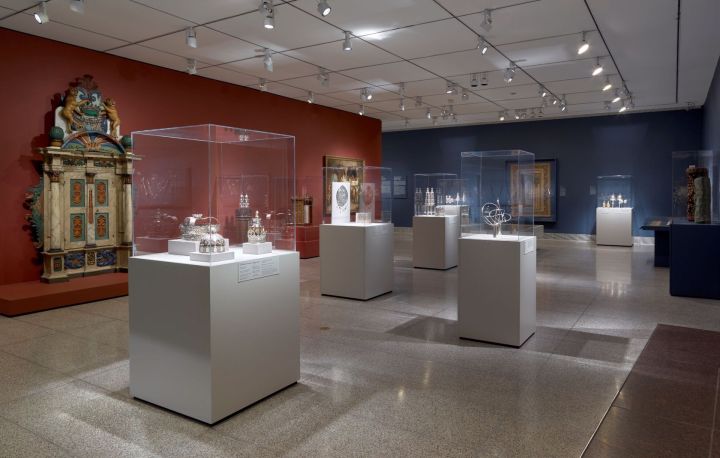
Now on view at the MFAH:
Beauty and Ritual: Judaica from The Jewish Museum, New York
Museum of Fine Arts, Houston, 10 July — 18 September 2022
Examining Jewish ceremonial objects from antiquity to the present, Beauty and Ritual: Judaica from the Jewish Museum, New York marks the first in a series of presentations from the world-renowned collection of the Jewish Museum in New York City. The new, ongoing partnership between the MFAH and the Jewish Museum brings exceptional objects to Houston over a period of years.

Torah Ark, 18th century, pinewood: carved and painted; fabric: embroidered with metallic thread (The Jewish Museum, New York, gift of Arthur Heiman; photograph by John Parnell).
Beauty and Ritual explores the artistic, ritualistic, and cultural significance of more than 140 works. The objects on view derive from Jewish communities throughout the world, spanning Central Asia to North Africa and Western Europe. The exhibition also explores how artists—from different backgrounds—and Jewish communities have creatively adapted traditional forms of Judaica by utilizing a rich array of styles, materials, and techniques, and drawing on broader cultures. The exhibition comprises three thematic galleries: “The Art of the Synagogue: Adorning the Torah,” “A Day of Rest: The Radiance of the Sabbath,” and “Beyond the Synagogue and the Home: The Light of the Hanukkah Menorah.”
In early 2023, the Albert and Ethel Herzstein Gallery for Judaica opens at the MFAH for the ongoing presentation of objects on loan from the Jewish Museum.
From the press release (8 June 2022) from The Jewish Museum:
The Museum of Fine Arts, Houston, and The Jewish Museum, New York today announced a partnership to establish an ongoing presence for Judaica at the MFAH: In July 2022, the MFAH will open the exhibition Beauty and Ritual: Judaica from The Jewish Museum, New York, the first step in the ongoing partnership, which will bring exceptional objects from the Jewish Museum to Houston over a period of years. In early 2023, ongoing presentations centered on objects on loan from the Jewish Museum will begin when The Albert and Ethel Herzstein Gallery for Judaica opens at the MFAH. The Herzstein Gallery is a centerpiece of the World Faiths Initiative at the MFAH, a program of interfaith projects based on the museum’s collections and exhibitions and funded by the Lilly Endowment Inc.
Commented Gary Tinterow, Director, Margaret Alkek Williams Chair, of the MFAH: “The first significant piece of Judaica to enter the Museum’s collection was the Montefiore Mainz Mahzor, in 2018. Calligraphed and illustrated around 1310 in Mainz, some 150 years before Gutenberg would print his Bible in that same medieval town, the Mahzor is one of the earliest surviving illuminated Jewish prayer books from Central Europe. Now, with this significant partnership with The Jewish Museum, New York, and access to their extraordinary collections, we are able to amplify the cultural and artistic history of Judaism, first with this summer’s exhibition, Beauty and Ritual, and, beginning early next year, with presentations in the newly endowed, permanent Judaica gallery. I am enormously grateful to the Jewish Museum, New York, for their partnership, and to The Albert and Ethel Herzstein Foundation, in making possible this permanent presence for Judaica and historic Jewish traditions at the MFAH.”
“After two years of discussion and planning, I am delighted that the Museum of Fine Arts, Houston will be offering its audiences a chance to see highlights from the Jewish Museum’s renowned collection of Judaica,” commented Claudia Gould, the Helen Goldsmith Menschel Director of The Jewish Museum, New York. “There are very few general fine-arts museums in the nation that have a dedicated space for Judaica, and this exciting collaboration will have significant impact on the field. As head of the Jewish Museum in New York, which maintains a unique collection of nearly 30,000 works of art, ceremonial objects, and media including one of the world’s major Judaica collections, I am looking forward to working with the MFAH on this important initiative.”
About Beauty and Ritual: Judaica from The Jewish Museum, New York
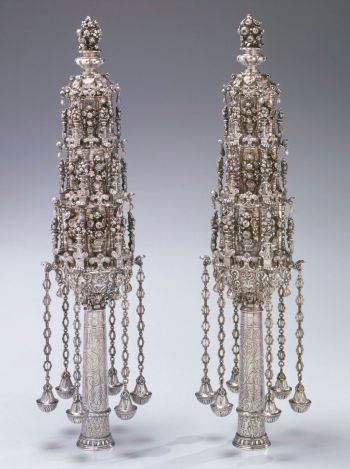
Torah Finials, early 18th century, silver: cast repousse, and engraved (The Jewish Museum, New York)
The exhibition Beauty and Ritual: Judaica from The Jewish Museum, New York is the first of a series of presentations at the MFAH from the collection of The Jewish Museum, New York. The exhibition will feature over 140 objects from the Jewish Museum’s world-renowned collection, examining Jewish ceremonial objects from antiquity to the present and exploring their artistic, ritualistic, and cultural significance.
The objects presented derive from Jewish communities throughout the world, ranging from Central Asia to North Africa and Western Europe. The exhibition also explores how artists— from different backgrounds—and Jewish communities have creatively adapted traditional forms of Judaica by utilizing a rich array of styles, materials, and techniques, and drawing on broader cultures. Three thematic galleries explore the ceremonial objects used for Jewish practice in the synagogue, in the home and beyond.
“The Art of the Synagogue: Adorning the Torah” features ceremonial objects used within the synagogue for the purpose of beautifying and protecting the Torah, the central ritual text of Judaism. One Torah ark, intended for housing the Torah, is a monumental 18th-century pinewood enclosure from Bavaria. The ark echoes the colorful, painted decorations of houses of that region, resembling an entrance to a home, and, at 10 feet in height, nearly at the same scale.
“A Day of Rest: The Radiance of the Sabbath” presents Judaica traditionally used for the Sabbath, the weekly day of rest. At the center of the gallery will be a 2012 commission for the Jewish Museum by artist Beth Lipman. In this ethereal work, Beth Lipman drew inspiration from traditional Jewish ceremonial objects in the museum’s collection, including those used for the Sabbath. The piece is a table set with an abundance of glass objects, evocative of the Baroque still life tradition of the vanitas painting in which worldly objects are shown together with symbols of mortality to prompt reflection on the inherent transience of beauty and life. The work conveys the household table as a place where festivity, family, history, and the fragile passing of time converge.
“Beyond the Synagogue and the Home: The Light of the Hanukkah Menorah,” examines the menorah, traditionally the lamp used to celebrate the holiday of Hanukkah, the eight-day festival of lights. This final gallery of the exhibition showcases the menorah’s history and visual presence as a symbol of Jewish culture to the world—from the earliest times with a fired-clay lamp from the third to the fifth century CE, to elaborate 18th- and 19th-century Italian and German metalwork, and to 20th-century depictions by modern artists Marc Chagall and Ben Shahn.
About the World Faiths Initiative at the MFAH
Funded by a grant from the Lilly Endowment Inc., the Museum of Fine Arts, Houston’s World Faiths Initiative seeks to activate themes of religion, faith and spirituality in the Museum’s encyclopedic collections through innovative programming and reimagined displays. The focus on the many expressions of faith in the collections of the MFAH seeks to honor the diverse communities of Houston and inspire connections across cultures and beliefs. The World Faiths Initiative is centered on both The Albert and Ethel Herzstein Gallery for Judaica and cross-cultural installations and public programming exploring faith and spirituality, activities that serve the Museum’s long-term goals of representing world religions within the permanent collection. The project team is being led by Aimée Froom, MFAH curator, Art of the Islamic Worlds, and Caroline Goeser, W.T. and Louise J. Moran Chair of Learning and Interpretation. The initiative is supported with grant funds from the Lilly Endowment Inc.
Display | Exploring Lines: The Drawings of Sir James Thornhill
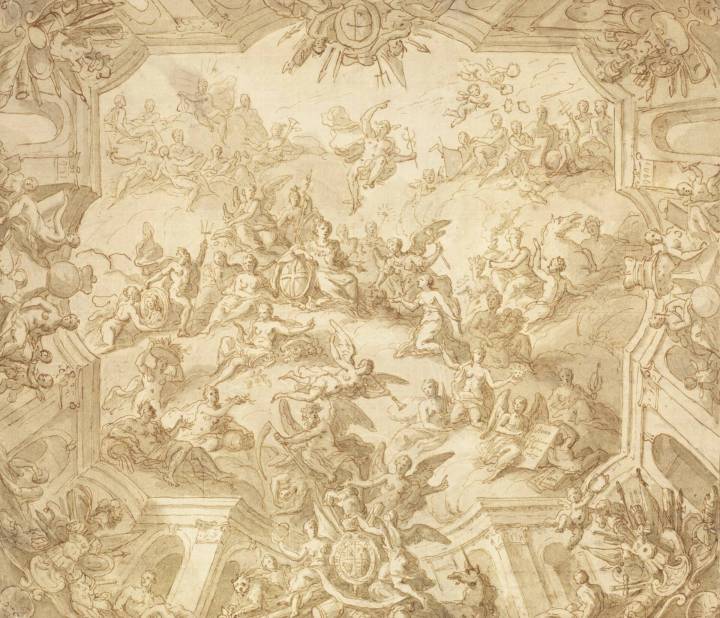
James Thornhill, Preliminary Design for the Ceiling of the Upper Hall at Greenwich, ca.1707, pen and ink with wash over pencil, squared in pencil, 34 × 38 cm (London: V&A, E.5199-1919). The drawing depicts Queen Anne at the centre, surrounded by allegorical figures representing Providence,the Virtues, the Arts and Sciences, and other emblems of Empire.
◊ ◊ ◊ ◊ ◊
Now on view at the V&A:
Exploring Lines: The Drawings of Sir James Thornhill
Victoria and Albert Museum, London, 1 July — 13 August 2022
A display illustrating the work of Sir James Thornhill, and his process of developing and drawing intricate designs for his mural paintings.
Sir James Thornhill (1675 or 1676–1734) was one of the most renowned artists of early 18th-century Britain whose mural paintings adorned the walls and ceilings of prestigious buildings throughout the country. Focusing on the role that drawing played in Thornhill’s practice, this display explores how he used sketches and more considered worked up designs to develop his creative ideas.
Call for Papers | Wastework
From ArtHist.net:
Wastework
Bibliotheca Hertziana – Max Planck Institute for Art History, Rome, 15–17 March 2023
Proposals due by 15 September 2022
Art students today know the rules: no solvents in the trash, no clay down the drain, and don’t forget to cure that resin before you toss it! Early modern craftsmen had their own rituals of disposal, too—albeit ones driven more by economies of thrift than by environmental regulation or fire safety. This international, interdisciplinary conference invites papers on the materiality, spatiality, and processing of waste in the early modern workshop, broadly conceived. It proposes to examine acts of disposal, displacement, removal, and abeyance—in short, the getting rid of unwanted things—and the consequences these carry for the study of early modern material culture.
Marble dust, scrap metal, broken glass, dried oil… How did the apparent formlessness of this discarded matter—the residues, the shavings, the piles—generate new ideas for forms or find new life through changes in state engendered by slaking, burning, distilling or casting? Who were the actors trading in workshop waste, and how can we map their networks, both local and global? How were materials stored and recycled between artistic acts? What disposal flows led household waste—egg shells, stale bread, stove ash—to enter the space of the studio as artistic material or cleaning product? How did the presence, accumulation and containment of waste—its conduits and repositories—condition the environment and location of the workshop? In research today, how can waste pits be used as sources for both the footprints and layouts of workshops and for the information they provide on technological and stylistic change? More broadly, how is waste archived, and are all archives just waste heaps of history?
We welcome papers that respond to these questions with historical case studies, wider-reaching theorisations, or methodological reflections. While our focus is on practices and spaces of art-making, we also seek contributions from beyond the history of art. Building on the home-economics framework of Simon Werrett’s Thrifty Science (2019); the emerging field of Discard Studies; and histories of pre-industrial recycling by Reinhold Reith and of medieval waste by Susan S. Morrison, this conference will serve as a forum for generating new narratives of waste, thrift, and re-use in the early modern arts that go beyond the well-researched category of spoliation. We foreground waste as the material expression of practices of ordering and classification by which people adjudicated between collection and disposal, wanted and unwanted, salvation and loss. In reimagining the discarded past we intend to test the usefulness of contemporary formulations—secondary product cycles, material fatigue, metabolic flows, sustainability, recycling—while also proposing new typologies and categories. A series of pre-conference visits to local workshops and heritage collections will launch the event. Travel and accommodation costs will be covered for speakers.
This conference is organized by Dr. Ruth Ezra and Dr. Francesca Borgo within the framework of the Lise Meitner Research Group Decay, Loss, and Conservation in Art History at the Bibliotheca Hertziana – Max Planck Institute for Art History. For more information see our webpage. Please send your CV (including current position and affiliation), a 250-word abstract, and paper title to john.rattray@biblhertz.it by 15 September 2022. Proposals will be considered for inclusion in a planned special journal issue on waste in the early modern workshop.
Call for Papers | Portraiture and the Construction of Identity
From ArtHist.net, which includes the German version:
Portraiture and the Construction of Identity / Identitätskonstruktion im Porträt
Rheinische Friedrich-Wilhelms-Universität Bonn, Kunsthistorisches Institut, 30 March — 1 April 2023
Organized by Helen Boeßenecker
Proposals due by 15 August 2022
Since the 1990s, cultural scholars and theoreticians of postcolonial studies such as Stuart Hall and Homi K. Bhabha have increasingly shaped an understanding of cultural identity that no longer sees identity primarily as something existent and stable, but rather, especially in diasporic contexts, as the (fluid) production of negotiation processes. Processuality, transformation, hybridity thus come into view as important factors of identity formation. As is well known, the cultural construction character of identity has also been emphasized, albeit under different premises, by gender studies. Thus, approaches of feminist theory or gender studies argued that gender identity and gender difference should not be understood as something ‘naturally’ given, but rather emphasized their social construction and performative production—a perspective that was also reflected by gender studies in art history and discussed with regard to the productivity of images.
The planned conference takes the concept of construction in the context of identity as a starting point to newly engage in portraiture and its historical and situational contexts. Although identity has always been an important question in art historical portrait research, the extent to which portraits contribute to the identity constitution of the self and to which identity is not only reproduced but constructed in and through portrait practices has not been sufficiently illuminated so far. More often, the focus has been on questions of individuality, identification, likeness (similitudo), or liveliness, and thus on the relationship of the image to the model and strategies of vivid representation. Following on from more recent contributions, which increasingly ask about the use of portraits within social and cultural practices or are dedicated to strategies of self-fashioning in (self-)portraits, the conference will focus on the question of the construction of cultural and gender identities in portraiture and would like to adopt a decidedly transcultural and transdisciplinary perspective.
The tension between the ‘self’ and the ‘other’ will be investigated on the basis of portraits and the question will be pursued as to what role the confrontation with the foreign other plays for one’s own identity construction: Which pictorial means, and staging strategies are used in portraits to show cultural origin and roots, but also cultural difference? How is the relationship between the image of the self and the image of the other expressed in portraits, and what strategies of self-assertion and -staging can be identified? When and where, on the other hand, do assimilations, cultural appropriations, transcultural encounters, spaces in between and hybrid portrait cultures reveal themselves? The question of the construction of cultural identities and the aesthetic means, visual ‘codes’, subversive transformation processes as well as imaginations and projections used in this context will be examined. In addition to body discourses (including the semantics of skin color, tattoos, makeup) and the identity-forming significance of material culture (e.g., textiles, jewelry, armor, weapons), the artistic materials, media, and techniques used also prove relevant, as well as the attributions and practices associated with them, for example with regard to ‘exotic’ materials or the adaptation of ‘foreign’ artistic techniques or styles.
In addition, by exploring portraits and their historical, political, and performative contexts as well as practices of collection and display we want to gain insights into the structures and dynamics of identity formation and -construction: What consciousness do portraits reflect in terms of individuality, collective identities and national affiliations? Do identification and community formation with ‘compatriots’ take place primarily through the nation, region or even city? Are these homogeneous entities, or can plural notions of identity and competing groups rather be identified? What is the relationship between religious confession and identity and to what extent do the dynamics of European identities shift in a global context? Does the mobility of individuals and associated experiences of foreignness or assimilation processes, for example in relation to artists’ journeys, migration and exile experiences, pilgrimage, global expansion, and mission, find expression in portrait practices, so that—to speak with Paul Gilroy—not only roots but routes are inscribed in the portrait?
Furthermore, gender perspectives are to be included in these questions. To what extent do portrait practices produce, stabilize, or undermine gender roles and attributions? In what way can portraits and portrait series express different facets of female, male or queer identities and thus the mutability of gender identities? The conference would like to encourage us not to discuss these questions in isolation, but to link them to questions of cultural identity and ethnicity, taking up perspectives from gender and postcolonial studies. Thus, following on from previous profound research contributions on portraiture from the perspective of gender studies, the interplay of race, class and gender in portraiture will be examined to an even greater extent in order to question power relations and heteronormative, Eurocentric views.
The conference would like to shed light on these research questions across time periods and cultures and thus to adopt a cross-epochal, transcultural or comparative cultural perspective, whereby portraits in all artistic genres and media (painting, sculpture, prints, photography, digital image cultures) can be considered on the basis of case studies. Also, with the aim of promoting methodological reflection, the conference seeks to stimulate an exchange between different disciplines (especially art history, archaeology, African, Asian, and Islamic studies, ethnology).
Please send your abstract (maximum of 800 words) for a 25-minute presentation in German or English together with a short CV to Helen Boeßenecker (h.boessenecker@uni-bonn.de) by 15 August 2022.
New Book | The Invention of the Colonial Americas
From The Getty:
Byron Ellsworth Hamann, The Invention of the Colonial Americas: Data, Architecture, and the Archive of the Indies, 1781–1844 (Los Angeles, Getty Research Institute, 2022), 328 pages, ISBN: 978-1606067734, $60.
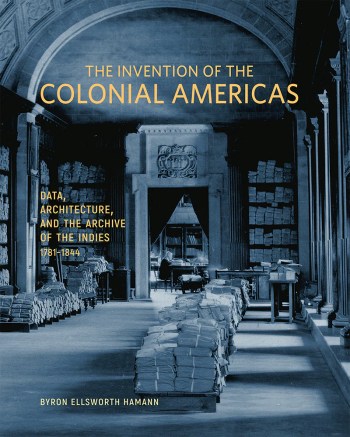 The story of Seville’s Archive of the Indies reveals how current views of the sixteenth and seventeenth centuries are based on radical historical revisionism in Spain in the late 1700s.
The Invention of the Colonial Americas is an architectural history and media-archaeological study of changing theories and practices of government archives in Enlightenment Spain. It centers on an archive created in Seville for storing Spain’s pre-1760 documents about the New World. To fill this new archive, older archives elsewhere in Spain—spaces in which records about American history were stored together with records about European history—were dismembered. The Archive of the Indies thus constructed a scholarly apparatus that made it easier to imagine the history of the Americas as independent from the history of Europe, and vice versa.
In this meticulously researched book, Byron Ellsworth Hamann explores how building layouts, systems of storage, and the arrangement of documents were designed to foster the creation of new knowledge. He draws on a rich collection of eighteenth-century architectural plans, descriptions, models, document catalogs, and surviving buildings to present a literal, materially precise account of archives as assemblages of spaces, humans, and data—assemblages that were understood circa 1800 as capable of actively generating scholarly innovation.
Byron Ellsworth Hamann is an associate professor of art history at Ohio State University. His research is focused on the art and writing of pre-Hispanic Mesoamerica, as well as on the connections linking the Americas and Europe in the early modern Mediterratlantic world.
Exhibition | The Ceramics of Tonalá, Mexico
Now on view at SAMA:
A Legacy in Clay: The Ceramics of Tonalá, Mexico
San Antonio Museum of Art, 18 March 2022 — 19 March 2023

Earthenware Jar from Tonalá, mid-18th–late-18th century, burnished and painted earthenware, 33 inches tall (San Antonio Museum of Art, 2021.21).
The town of Tonalá, Mexico, has a long history with clay, dating back to the pre-Hispanic period and enduring to the present day. Tonalá’s contemporary dedication to ceramic arts was spurred by early modern Europeans’ obsession with the quality of the region’s clay beginning in the early sixteenth century. This exhibition highlights a selection of SAMA’s collection of Tonalá ceramics, which span from an important recent acquisition of an eighteenth-century monumental Tonalá vessel, to a variety of works from the twentieth century that demonstrate the trajectory of style in Tonala pottery. This focus exhibition offers visitors a glimpse into an important genre of SAMA’s Latin American art collection while demonstrating the breadth in styles achieved by some of Tonalá’s expert ceramicists.
New Book | New World Objects of Knowledge
Distributed by The University of Chicago Press:
Mark Thurner and Juan Pimentel, eds., New World Objects of Knowledge: A Cabinet of Curiosities (London: University of London Press, 2021), 350 pages, ISBN: 978-1908857828, $75.

From the late fifteenth century to the present day, countless explorers, conquerors, and other agents of empire have laid siege to the New World, plundering and pilfering its most precious artifacts and treasures. Today, these natural and cultural products—which are key to conceptualizing a history of Latin America—are scattered in museums around the world. With contributions from a renowned set of scholars, New World Objects of Knowledge delves into the hidden histories of forty of the New World’s most iconic artifacts, from the Inca mummy to Darwin’s hummingbirds. This volume is richly illustrated with photos and sketches from the archives and museums hosting these objects. Each artifact is accompanied by a comprehensive essay covering its dynamic, often global, history and itinerary. This volume will be an indispensable catalog of New World objects and how they have helped shape our modern world.
Mark Thurner is professor of Latin American studies at the University of London. His books include The First Wave of Decolonization and History’s Peru: The Poetics of Colonial and Postcolonial Historiography. Juan Pimentel is research professor in the history of science at the Centro de Ciencias Humanas y Sociales, CSIC, Madrid. He is the author of many books, including The Rhinoceros and the Megatherium: An Essay in Natural History.
C O N T E N T S
Introduction by Mark Thurner and Juan Pimentel
Part 1: Artificialia
1 Codex Mendoza by Daniela Bleichmar
2 Macuilxochitl by Juan Pimentel
3 Potosi by Kris Lane
4 Piece of Eight by Alejandra Irigoin and Bridget Millmore
5 Pieza de Indias by Pablo Gomez
6 Rubber by Heloisa Maria Bertol Domingues and Emilie Ana Carreón Blaine
7 Silver Basin by Mariana Francozo
8 Feathered Shield by Linda Baez
9 Black by Adrian Masters
10 Cards by Jorge Canizares Esguerra
11 Mary’s Armadillo by Peter Mason
12 Mexican Portrait by Andrés Gutiérrez Usillos
13 Clay Vessel by Jorge Canizares-Esguerra
14 Singing Violin by Jorge Canizares Esguerra
15 Creole Cabinet by Juan Pimentel and Mark Thurner
16 Modern Quipu by Sabine and William Hyland
17 Memory Palaces by Jorge Canizares-Esguerra
18 Inca Mummy by Christopher Heaney
19 Xilonen by Miruna Achim
20 Machu Picchu by Amy Cox-Hall
Part 2: Naturalia
21 Amazon by Roberto Chauca
22 Bird of Paradise by Jose Ramon Marcaida
23 Emeralds by Kris Lane
24 Pearls by Jorge Canizares Esguerra
25 Cochineal by Miruna Achim
26 Opossum by Jose Ramon Marcaida
27 Guinea Pig by Helen Cowie
28 Bezoar by Jose Pardo-Tomas
29 Cacao by Peter Mason
30 Strawberry by Elisa and Ana Sevilla
31 Volcano by Sophie Brockmann
32 Andes by Mark Thurner and Jorge Canizares-Esguerra
33 Anteater by Helen Cowie
34 Megatherium by Juan Pimentel
35 Tapir by Irina Podgorny
36 Cinchona by Matthew Crawford
37 Potato by Rebecca Earle
38 Guano by Gregory Cushman
39 Tortoise by Elizabeth Hennessey
40 Darwin’s Hummingbird by Iris Montero
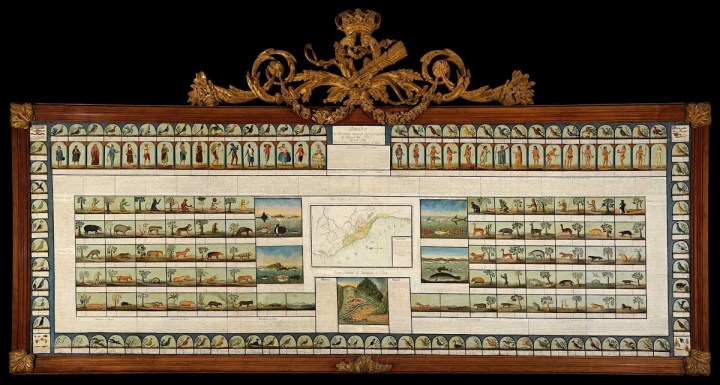
José Ignacio de Lequanda and Louis Thiébaut, Quadro de Historia Natural, Civil y Geográfica del Reyno del Perú, 1799, 331 × 119 cm (Madrid: Museo Nacional de Ciencias Naturales). This exceptional work presents 195 scenes and 381 figures describing the physical geography, the history, the ethnography, the fauna, and flora of the Peruvian Viceroyalty, via Google Arts & Culture.
Online Talk | Felicity Myrone on Prints and Drawings at the BL

King’s Concordance, C.23.e.4. f.34r (London: The British Library).
◊ ◊ ◊ ◊ ◊
Felicity Myrone | Prints and Drawings at the British Library: Revealing Hidden Collections
Wallace Collection Seminars on the History of Collections and Collectin
Online, Monday, 25 July 2022, 17.30 (BST)
It is our pleasure to invite you to the next Wallace Collection Seminar in the History of Collecting. Viewing options are provided below.
The British Library’s collections contain extensive visual materials, much originating from its foundation as part of the British Museum. While the collections that remained at the Department of Prints and Drawings at the British Museum have now been fully catalogued, there is currently no index or catalogue to the British Library’s far more extensive holdings of prints and drawings. Valuable and diverse collections and materials are usually unlisted and undescribed, found in collective records and in items categorised as other formats.
A project to make more of the Library’s collections accessible is now underway. With the support of a Getty Paper Project grant and building on a Paul Mellon Mid-Career Fellowship, this involves writing the first handbook to the prints and drawings collections. What do we hold and why? How are our prints and drawings currently described, or more commonly, not? How can archival research into the collections—including historic acquisitions and Library/Museum duplication and transfers—help us to question the long-held assumption that art found its natural place at the Print Room? This paper explores how the perceived purpose and status of prints and drawings has varied and developed in the context of library collections in the 18th and 19th centuries, using case studies drawn from the history of the British Museum and Library.
Felicity Myrone is Lead Curator of Western Prints and Drawings at the British Library in London.










 Enfilade
leave a comment