Conference | Architecture and the Literary Imagination, 1350–1750
From ArtHist.net and the American University of Rome:
Architecture and the Literary Imagination, 1350–1750
American University of Rome, 6–8 November 2025
Organized by Fabio Barry and Paul Gwynne
 Architecture & the Literary Imagination broadens the repertoire of period voices for understanding pre-modern architecture, beyond the usual theoretical tracts, to foster dialogue between scholars across disciplines, and encourage intermedial perspectives on architecture and literature.
t h u r s d a y , 6 n o v e m b e r
19.00 Introductions
19.15 Keynote
• Luis Javier Cuesta Hernández (Universidad Complutense de Madrid) — ‘Ephesians will no longer be proud of the Great Temple that Herostratus burned’: Imagined Architecture in Mexico in the 17th Century
f r i d a y , 7 n o v e m b e r
9.30 Medieval
• Elizabeth Pastan (Emory University) — ‘Let stond the wyndow glasid’: Writings about Windows
• Sara Ronzoni (Università di Padova) — ‘La closture et la muraille’: la costruzione della città utopica tra ‘La Cité des dames’ e ‘La città del sole’
• Hannele Hellerstedt (Lincoln College, Oxford) — Divine Inspiration: Imagining Construction in ‘La Cité des dames’
11.00 Coffee break
11.30 Interiors
• Klaus Tragbar (Zentralinstitut für Kunstgeschichte München) — Gli ambienti di Franco Sacchetti
• Caterina Cardamone (Vrije Universiteit, Brussels) — Diplomatic Reports as Sources for the Florentine Imagery of Northern Architectural Culture
• Christian Frost (London Metropolitan University) — Dante and Boccaccio and the Emergence of the Civic Palazzo in Late Medieval Florence
13.00 Lunch
14.30 Vitruvius, Pliny, and Others
• Mikel Marini (Università di Bologna) — ‘Erger cantando machina sublime’: Un’analisi vitruviana dell’architettura ecfrastica in poesia
• Fabio Colonnese (La Sapienza, Roma) — Between Text and Imagination: Reconstructions of the Tomb of Lars Porsenna
15.30 Coffee break
16.00 Gardens
• Luke Morgan (Monash University, Melbourne) — ‘Bodies without Souls’: Avatars of Circe in the Early Modern Garden
• Nicholas Temple (London Metropolitan University) — Virgil’s Eclogues and Early 18th-Century Pastoralism on the Janiculum in Rome
17.00 Break
18.00 Keynote
• Níall McLaughlin (Níall McLaughlin Architects, London) — My Portfolio in Poems
Venue: Università Roma Tre, Aula Magna Adalberto Libera, Largo G. B. Marzi 10
s a t u r d a y , 8 n o v e m b e r
9.30 Ruins and Humanists
• Theodoris Koutsogiannis (Art Gallery, Parliament, Athens) — Atene immaginaria cartacea e la tradizione letteraria nella prima età moderna
• Elisa Bacchi (Università di Pisa) — Parola come monumentum, parola al monumentum: leggere e scrivere le rovine dell’Antico nell’Umanesimo italiano
• Susanna de Beer (Royal Dutch Institute, Rome) — The Literary Imagination of Ruins and the Rebuilding of Rome(s)
11.00 Coffee break
11.30 Counter Reform
• Nathaniel Hess (Warburg Institute, University of London) — The Church between Two Temples: Poetry and Images in the Works of Marco Girolamo Vida
• Stefano Canciosi (Corpus Christi College, Oxford) — Angelo Rocca’s Approach to Classical Sources in his ‘Bibliotheca Apostolica Vaticana’
12.30 Lunch
14.00 17th and 18th Centuries
• Giovanni Santucci (Università di Pisa) — Real and Imagined Architecture in Daniel Defoe’s ‘Tour thro’ the Whole Island of Great Britain’: National Ornament and the Design of Political Ideals
• Daniela Roberts (Julius-Maximilians-Universität Würzburg) — The Perception of Medieval Architecture in the Journals and Letters of English Travelers, 1720–1750
• Maicol Cutrì (Università Cattolica del Sacro Cuore, Milan) — «quanti poetici concetti potrebbero scaturire da quelle metaforiche pietre?» Spazi architettonici e invenzioni poetiche in Emanuele Tesauro
15.30 Coffee break
16.00 Ephemera
• Micaela Antonucci (Università di Bologna) — ‘La storia è il più durevole monumento’: Le architetture effimere nelle cronache delle cerimonie pubbliche a Roma nel primo Cinquecento
• Laura García Sánchez (Universitat de Barcelona) — ‘Apparato funebre dell’anniversario à Gregorio XV celebrato in Bologna à XXIV di luglio M. DC. XXIV dall’ illustrissimo & reverendiss. sig. Cardinal Ludovisi’: Una fonte letteraria al servizio di una architettura effimera
17.00 Break
18.00 Keynote
• Shirine Hamadeh (Koç University, Istanbul) — Poetry, Epigraphy, and the Sensory World of Ottoman Architecture
Conference | Vico, Antiquity, and the Visual Arts
Starting today, from ArtHist.net and the conference programme:
Vico, l’Antiquité et les Arts Visuels
Online and in-person, Besançon, MSHE Ledoux, 3–4 November 2025
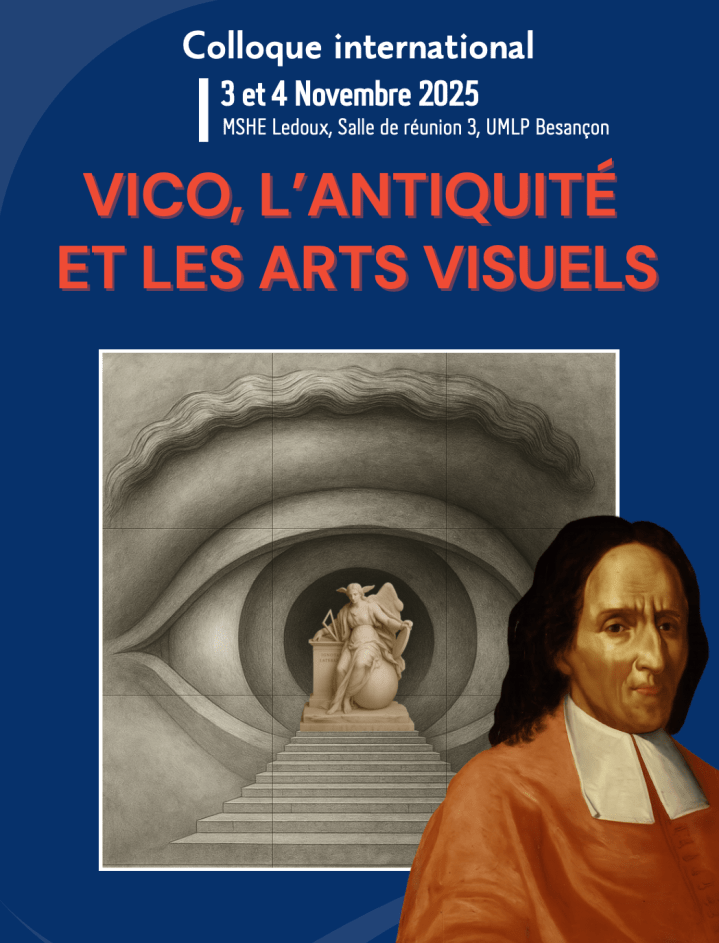 On the occasion of the tricentenary of the first edition of La Scienza Nuova (Naples, 1725), this international conference aims to analyze, in an innovative and interdisciplinary way, a central aspect of Giambattista Vico’s work: the importance he attributes to images and visual signs, which he considers the original language, historically prior to the development of spoken language. Although he rarely mentions the arts, Vico’s thought allows us to understand the visual artifact of ancient civilizations as an image-object (factum) that embodies the way in which humans perceive, experience, and interpret the world, thus constituting their reality (the historical verum).
The corpus of his ancient visual sources, as well as the influence of his thought on Antiquity and on the creative imagination of the first “universals of imagination” and “ornamental metaphors” within the disciplines of Visual Studies, have never been studied as such by specialists. The exploration of these themes raises numerous methodological challenges and requires a multidisciplinary approach. The three sessions will address theories and histories of art and collecting, literary theory, iconology, mythology, heraldry and emblem studies, the history and comparative study of law, architecture, archaeology, palaeography, anthropology, museology, semiotics, the geography of perception, as well as the psychology and sociology of art, extending to design and the pedagogy of the imagination. The symposium will be broadcast live.
Contact: anna_eleanor.signorini@umlp.fr
m o n d a y , 3 n o v e m b e r
Zoom link: https://us06web.zoom.us/j/85036141522?pwd=LJ4sv9sRfCIsrxMoSxTA1L9Oqlf2mG.1
9.00 Ouverture du colloque – Présentation par Anna E. Signorini
9.10 Session 1 | The Construction of Visual Knowledge from Antiquity to the Age of Vico
• Marcus Jan Bajema (Leyde) — Vico and the Longue Durée of Aegean Art (Vico et la longue durée de l’art égéen)
• Maurizio Harari (Université de Pavie) — Sul potente regno de’ toscani in Italia: architettura più antica, religione più tragica, arte militare più sapiente
• Italo Iasiello (Université de Naples Federico II) — Il contesto antiquario di Giambattista Vico: Napoli e l’Antichità nel primo Settecento
• Daniel Orrells (King’s College) — Vico and the Visual World of 18th-Century Antiquarianism
12.00 Déjeuner
14.30 Session 1 | The Construction of Visual Knowledge from Antiquity to the Age of Vico, continued
• Loredana Lorizzo (Université G. D’Annunzio de Chieti-Pescara) — Nella biblioteca di Giuseppe Valletta: Vico e la letteratura artistica
14.50 Session 2 | Semiotics, Law, Pedagogy, Design: Vico’s Iconic Thought
• Davide Luglio (Sorbonne) — La Scienza Nuova et la sémiotique figurale de G.B. Vico
• Osvaldo Sacchi (Université de la Campanie Luigi Vanvitelli) — Gli ‘universali fantastici’ di Vico e la ‘grande bellezza’ del diritto romano
• Donald Kunze (Pennsylvania State University) — Representing Nothing: Vico’s Induction and Inversion
• Marco Dallari (Bologne) — Disegno infantile e rappresentazione del mondo e di sè alla luce della théorie vichiana
• Oliver Reichenstein (Information Architects, Zurich) — (Inter)facing the Truth: Maker’s Knowledge in Human Centered Design
t u e s d a y , 4 n o v e m b e r
Zoom link: https://us06web.zoom.us/j/89987641547?pwd=r3qY5x1duD4qhYqIU77eMJCctqv2a3.1
9.00 Dora d’Auria (UMLP Besançon, ISTA) — La connaissance des antiquités du Cilento à l’époque de Vico
9.20 Session 3 | Modern and Contemporary Receptions of Vico in the Visual Arts and Visual Studies
• Silvia Davoli (Oxford et Strawberry Hill House, Londres) — Vico and Antiquarian Collecting in Milan during the 19th Century
• Paolo Heritier (Université de Turin) — Vico, les emblèmes et les Legal Visual Studies
• Frances S. Connelly (Université du Missouri-Kansas City) — Reimagining Culture: Vico’s Poetic Monsters in Contemporary Art
• Isabela Gaglianone (Université de São Paulo) — Vico et le regard philologique d’Aby Warburg
• Anna Eleanor Signorini (UMLP Besançon, ISTA) — Vico vu par les critiques d’art du XXe siècle
Exhibition | Franz Xaver Messerschmidt

Installation view of the exhibition Franz Xaver Messerschmidt: More Than Character Heads
(Wien: Lower Belvedere; photo by Johannes Stoll).
◊ ◊ ◊ ◊ ◊
From the press release for the exhibition:
Franz Xaver Messerschmidt: More Than Character Heads
Lower Belvedere, Vienna, 31 October 2025 — 6 April 2026
Curated by Katharina Lovecky and Georg Lechner, with Kati Renner
Franz Xaver Messerschmidt (1736–1783) is presented as an artist at a cultural and political turning point in history. His portraits of members of the court and the aristocracy, scholars, scientists, and writers offer an insight into the social structures of his day. Furthermore, his now iconic ‘Character Heads’, which he started working on in 1770, are also interpreted as a phenomenon of their time. The exhibition compares Messerschmidt’s sculptures to the work of other artists with whom he has often been associated with the aim of critically questioning possible parallels and influences.
General Director Stella Rollig: “No other artist from the Belvedere’s collection holds equal fascination for both the public and artists in the same way as Messerschmidt. Was he a genius or an outsider? Many identities have been attributed to him through history, some of which are pure fiction. This exhibition considers these various interpretations from today’s perspective and shows the full scope of his work in a way that has not been seen for a long time.”
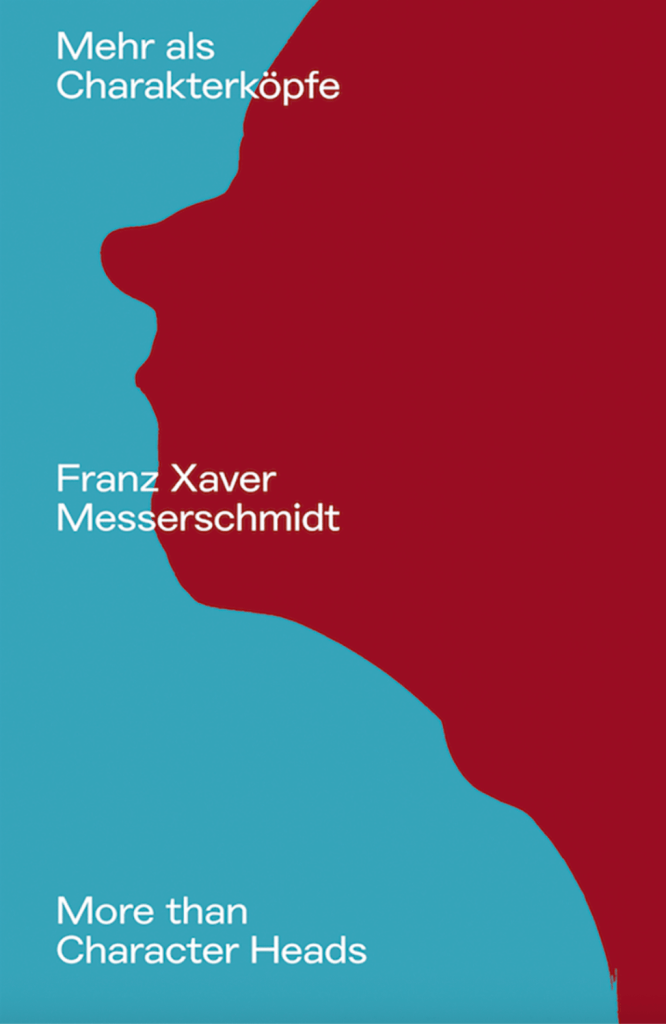 Franz Xaver Messerschmidt is one of the pivotal artists in the Belvedere’s collection. The museum holds the world’s largest selection of works by this sculptor and has showcased these in its permanent displays for over a century. From around 1769 Messerschmidt’s portraits reflected a new image of humanity, permeated with the ideas of the Enlightenment, with emphasis moving away from Baroque pomp to place a greater focus on the individual. Moreover, the patrons and personalities he portrayed—such as Maria Theresia Felicitas von Savoy-Carignan, physicians Gerard van Swieten and Franz Anton Mesmer, and art writer Franz Christoph von Scheyb—shed light on the cultural, political, and intellectual world of the eighteenth century.
Although Messerschmidt’s ‘Character Heads’ are now famous, they remain a puzzle to this day. The psychopathological interpretation—extremely popular since the twentieth century—is a narrow lens through which to view these objects and ignores the fact that the sculptor was responding to the profound social and intellectual changes of the eighteenth century in his work. The exhibition aims to situate Messerschmidt’s ‘Character Heads’ in the context of that period’s preoccupation with facial expressions and to read them as a phenomenon of their time. Comparisons with works by artists such as Joseph Ducreux, William Hogarth, and Jakob Matthias Schmutzer confirm that the fascination with the face (and its aberrations) was by no means unique in this age.
“Despite the fact that Messerschmidt’s intentions remain unclear, we can identify key intellectual trends from the eighteenth century in his ‘Character Heads’—even now they still inspire direct responses from viewers. Their frontality and expressive power are classic examples of the departure from academic neoclassicism,” said curator Katharina Lovecky.
Curator Georg Lechner added: “Messerschmidt’s ‘Character Heads’ have had an eventful exhibition history reflecting their varied reception—from amusing curiosity to important works of art history. After the Baroque Museum was opened in the Lower Belvedere, Messerschmidt’s sculptures became established museum pieces and were permanently incorporated into art-historical debate.”
Georg Lechner, Katharina Lovecky, and Stella Rollig, eds., Franz Xaver Messerschmidt: Mehr als Charakterköpfe / More than Character Heads (Cologne: Verlag der Buchhandlung Walther und Franz König, 2025), 208 pages, ISBN: 978-3753309064, €35. Bilingual catalogue.
Call for Articles | Markers, Journal for Gravestone Studies
From the Association for Gravestone Studies:
Markers: Annual Journal of the Association for Gravestone Studies, 2027 Issue
Submissions due by 1 January 2026
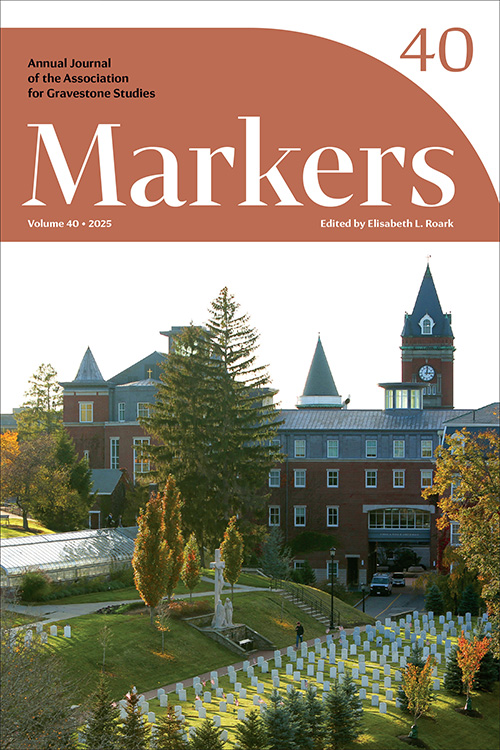 We are currently seeking article submissions for the 2027 issue of Markers, the scholarly journal of the Association for Gravestone Studies. The subject matter of Markers is defined as the analytical study of gravemarkers, monuments, tombs, and cemeteries of all types and encompassing all historical periods and geographical regions. Markers is of interest to scholars in anthropology, historical archaeology, art and architectural history, ethnic studies, material culture studies, American studies, folklore and popular culture studies, linguistics, literature, rhetoric, local and regional history, cultural geography, sociology, and related fields. Articles submitted for publication in Markers should be scholarly, analytical, and interpretive, not merely descriptive or entertaining, and should be written in a style appropriate to both a wide academic audience and an audience of interested non-academics.
Authors are encouraged to consult the “Notes for Contributors to Markers and Markers Style Guide.” Submissions for 2027 should be sent to Editor Elisabeth Roark, Professor of Art History and Museum Studies at Chatham University, at roark@chatham.edu, before 1 January 2026.
Exhibition | Mécaniques d’art Présentation
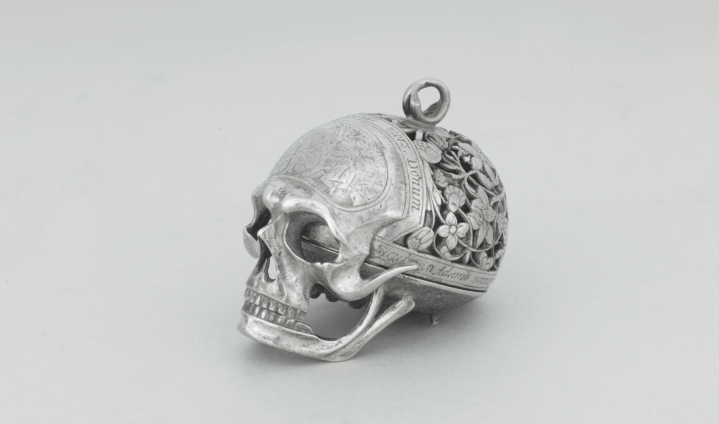
Jean Rousseau, Skull-shaped Watch, Geneva, mid-17th century, silver and gilt brass (Paris: Musée du Louvre). The engraved decoration depicts Adam and Eve and the Resurrection of Christ, with text from St. Paul.
◊ ◊ ◊ ◊ ◊
From the press release for the exhibition:
Mécaniques d’art Présentation
Musée du Louvre, Paris, 17 September — 12 November 2025
The Louvre has opened an exhibition that shines a spotlight on one of its most fascinating yet lesser-known treasures: the mechanical arts. With works spanning more than two millennia—from ancient Egyptian water clocks to contemporary horological masterpieces—the exhibition reveals humanity’s enduring desire to capture, measure, and even control time. Visitors enter a world where science, craftsmanship, and artistry intersect.
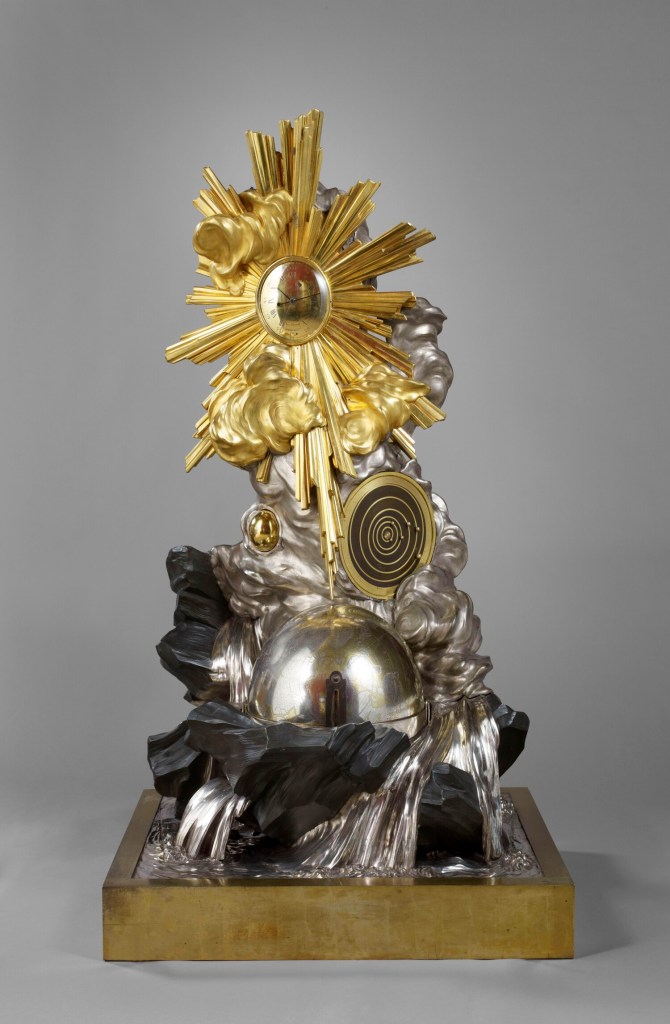
Claude Siméon Passemant, Jean-Baptiste Lepaute, and Jean-Joseph Lepaute, Clock known as The Creation of the World (La Création du Monde), 1754, wood, iron, patinated copper alloy, silver-plated and gilded copper, and glass.
Among the earliest pieces is a fragment of an Egyptian clepsydra, a water clock from the Ptolemaic period, which once measured the hours of the night by dripping water drop by drop. Fast forward to 10th-century Córdoba, and a magnificent fragment of a peacock automaton—possibly designed to dazzle with moving parts—demonstrates the ingenuity of Islamic artisans. The journey continues through Renaissance and Baroque Europe. A spherical watch signed by Jacques de La Garde in 1551, the oldest known signed French watch, showcases the refinement of early horology. Visitors can also admire a skull-shaped ‘memento mori’ watch from Geneva, a striking reminder of time’s fleeting nature. And in the grandeur of 18th-century Paris, the celebrated Creation of the World clock, presented to Louis XV in 1754, takes center stage, complete with rotating Earth, lunar phases, and a miniature planetarium.
This celebration of historic craftsmanship is paired with an exceptional loan from Swiss maison Vacheron Constantin. Their creation La Quête du Temps (The Quest for Time), unveiled for the house’s 270th anniversary, is a clock-automaton that brings the tradition of horology into the 21st century. With 23 complications—including an automaton astronomer performing 144 gestures—it unites Renaissance humanism with modern precision engineering. Beyond telling the hour, the piece offers a poetic vision of cosmic and astronomical phenomena.
The dialogue between centuries underscores how the fascination with time has always inspired technical brilliance and artistic imagination. Whether through polyhedral dials of the 17th century, armillary spheres perched on the shoulders of Atlas, or contemporary automata, the exhibition shows that the quest to master time is as much about beauty as it is about function.
More information is available here»
Exhibition | Wright of Derby: From the Shadows
Detail from Joseph Wright, An Experiment on a Bird in the Air Pump, 1768
(London: The National Gallery)
◊ ◊ ◊ ◊ ◊
From the press release for the exhibition:
Wright of Derby: From the Shadows
National Gallery, London, 7 November 2025 — 10 May 2026
Derby Museums, 2026
In the autumn of 2025, the National Gallery will present Wright of Derby: From the Shadows, the first exhibition dedicated to Joseph Wright ‘of Derby’ (1734–1797) at the National Gallery, and the first exhibition to focus on his ‘candlelight’ series. The exhibition is organised in partnership with Derby Museums where it will travel in 2026.
Following on from recent exhibitions such as Turner on Tour (2022) and Discover Constable & The Hay Wain (2024), this exhibition will put the spotlight on a well-known British artist in the National Gallery Collection whose work has come to symbolise an era. Traditionally, Wright of Derby has been viewed as a figurehead of the Enlightenment, a period of scientific, philosophical and artistic development in the 17th and 18th century. Challenging this conventional view, the exhibition contributes to the ongoing re-evaluation of the artist, portraying him not merely as a ‘painter of light’ but as one who deliberately explores the night-time to engage with deeper and more sombre themes, including death, melancholy, morality, scepticism, and the sublime.
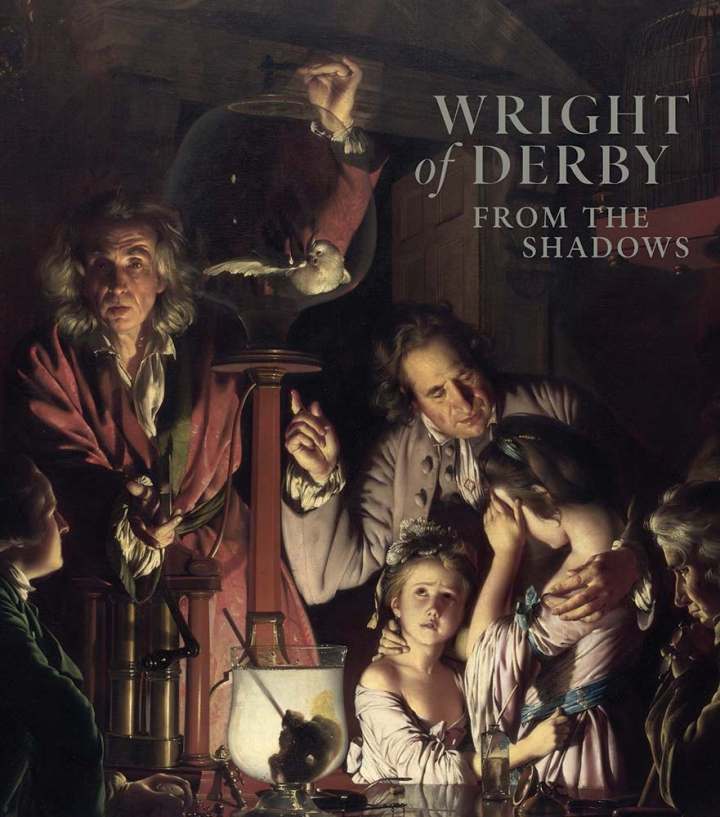 This exhibition will focus on Joseph Wright’s career between 1765 and 1773, during which time he made a series of candlelit scenes. We will show a number of masterpieces from this period including Three Persons Viewing the Gladiator by Candlelight (1765, private collection), A Philosopher giving that Lecture on the Orrery in which a lamp is put in place of the Sun (1766, Derby Museum and Art Gallery), and the National Gallery’s An Experiment on a Bird in the Air Pump (1768). This marks the first time in 35 years that all these works will be brought together. In these ‘candlelight’ paintings, Wright of Derby shows thrilling moments, not just of discovery but of shared learning. His dramatic depictions of natural and artificial light link his work back to the artistic traditions of the Renaissance and artists such as Caravaggio, whose strong light and deep shadows were rarely employed in British art before the mid-18th century.
Yet Wright of Derby also engaged with very contemporary questions around the act of observation, spectacle and education raised by philosophers of the Enlightenment. In his masterpiece An Experiment on a Bird in the Air Pump, a travelling lecturer shows a well-established experiment to a family audience whose reactions range from wonder to horror. In The Orrery, the first of his paintings on a ‘scientific’ subject, a philosopher presents a lecture on astronomy using a clockwork model of the solar system as the centrepiece, the sun replaced by an oil lamp. In Three Persons Viewing the Gladiator by Candlelight, one artist holds up a drawing of the central sculpture for critical assessment. These works explore moral ambiguity in acts of looking, as well as the intellectual influence of ‘high’ art.
Wright ‘of Derby’ was working at a turning point for art viewing in the 18th century, when the public display of art and the instigation of annual contemporary art exhibitions were being promoted. The Air Pump was completed the same year as the creation of the Royal Academy and was intended to be accessible to a broad public (though it was displayed at the Society of Artists). Mezzotint prints of Wright’s works, which played a key role in establishing his international reputation, will also be on display. These luxury prints highlight how the artist took full advantage of popular reproduction techniques of his time to expand his reputation both at home and abroad.
Wright of Derby: From the Shadows will show over twenty works, including other paintings, works on paper, and objects that explore both Wright of Derby’s artistic practice and the historic context of scientific and artistic development in which they were made. Seventeen artworks will be coming from Derby Museums, who hold the world’s largest collection of Wright’s work. In 2026, Wright of Derby: From the Shadows, will travel to Derby Museum and Art Gallery, bringing two of Wright’s most famous works, The Air Pump and The Orrery, back to his hometown for the first time in 80 years.
Christine Riding and Jon King, Wright of Derby: From the Shadows (London, National Gallery London, 2025), 96 pages, ISBN: 978-1857097467, £20.
New Book | The People of Print: Eighteenth-Century England
From Cambridge UP, with an online book launch, together with a speed-pitching workshop, scheduled for Monday (see below) . . .
Adam James Smith, Rachel Stenner, and Kaley Kramer, eds., The People of Print: Eighteenth-Century England (Cambridge: Cambridge University Press, 2025), 124 pages, ISBN: 978-1009629454, $18.
 This collection profiles understudied figures in the book and print trades of the eighteenth century. With an explicit focus on intervening in the critical history of the trades, this volume profiles seven women and three men, emphasising the broad range of material, cultural, and ideological work these people undertook. It offers a biographical introduction to each figure, placing them in their social, professional, and institutional settings. The collection considers varied print trade roles including that of the printer, publisher, business-owner, and bookseller, as well as several specific trade networks and numerous textual forms. The biographies draw on extensive new archival research, with details of key sources for further study on each figure. Chronologically organised, this Element offers a primer both on individual figures and on the tribulations and innovations of the print trade in the century of national and print expansion.
c o n t e n t s
Preface
1 Introduction — Adam James Smith, Rachel Stenner, and Kaley Kramer
2 Elizabeth Nutt: Print Trade Matriarch (1666–1746) — Helen Williams
3 John Nicholson and the Auctioning of Copyright (d.1717) — Jacob Baxter
4 Catherine Sanger: Publisher in Bartholomew Close (1687–1716) — Kate Ozment
5 John White Junior: Printer in the North (1689–1769) — Sarah Griffin
6 Selling the Enlightenment: Mary Cooper and Print Culture (1707–1761) — Lisa Maruca
7 The ‘Indefatigable’ Ann Ward: Printer in York (1715/6–1789) — Kaley Kramer
8 Anne Fisher (1719–1778): Not Simply a Printer’s Wife — Barbara Crosbie
9 Sold at the Vestry: John Rippon (1751–1836) and the Hymnbook Trade — Dominic Bridge
10 Diversity in the Book Trades: Ann Ireland (1751–1843) of Leicester — John Hinks
11 ‘Laugh when you must, be candid when you can’: The Concealed Resistance of the Radical Printer Winifred Gales (1761–1839) — Adam James Smith
◊ ◊ ◊ ◊ ◊
From Eventbrite:
The People of Print: Eighteenth-Century England
Book Launch and Early Career Researcher Speed-pitching Workshop
Online, Monday, 3 November, 6.30pm GMT
All welcome! Please register by 2 November.
Join the Centre for Print Culture at the University of Sussex to celebrate the publication of this volume, the follow-on to The People of Print: Seventeenth-Century England, with an evening of lively talks and discussion. The People of Print: Eighteenth-Century England profiles understudied figures in the book and print trades, featuring new research and critical perspectives on this fascinating and rich cultural field. We will be joined by Dr Barbara Crosbie (Durham University), Dr Jacob Baxter (St Andrews), and Dr Lisa Maruca (Wayne State, Professor Emerita), who will discuss their research for the latest collection.
Following the launch, there will be a Speed-pitching workshop (7.30–8.15pm GMT) for early career researchers studying topics in the histories of the book, print, and publishing trades. Come with an idea you can explain in 3 minutes, and we will pair you with one of our publishing panel of journal, series, and book editors for feedback:
• Dr Helen Williams, The Printing Historical Society
• Dr Kaley Kramer and Dr Adam James Smith, editors The People of Print
• Professor Samantha Rayner, Commissioning Editor of Cambridge Elements, Publishing and Book Culture
• Dr Rachel Stenner, editor of Publishing History journal and The People of Print series
Call for Papers | Hospitals and Confraternities, 13th–18th Centuries
From ArtHist.net:
Hospitals and Confraternities in Europe, 13th–18th Centuries
Naples, 8–11 April 2026
Organized by Gemma Colesanti, Toni Conejo, Salvatore Marino, and Stefano D’Ovidio
Proposals due by 30 November 2025
The 15th edition of the Abrils de l’Hospital, a series of annual conferences promoted by the University of Barcelona since 2103, will be held in Naples in April 2026. This edition will focus on the role of charitable confraternities and craft guilds in the foundation, administration, reform, and expansion of hospitals and other welfare institutions. The conference will place particular emphasis on both the tangible and intangible heritage of these organizations, examined through interdisciplinary and gender-aware approaches. The broad chronological scope will encourage innovative research adopting a longue durée perspective on the ongoing processes of reform, refoundation, and restructuring that characterized confraternities, hospitals, and charitable institutions of the ancien régime. Special attention will be devoted to large and medium-sized urban contexts, in order to promote comparative discussions across the diverse political, economic, social, and cultural landscapes of Christian Europe.
The sessions will be organized around three main research strands:
1. The agency of confraternities, craft guilds, associations of foreigners, and charitable movements in the foundation, management, and administrative reform of hospitals.
2. The involvement of members of ruling families and the urban patriciate, merchants, artisans, and farmers in confraternities and associations responsible for hospitals and other charitable institutions (orphanages, leprosaria, lazarettos, and almsgiving organizations).
3. The written records produced by confraternities and guilds engaged in the management of pious institutions, along with the architectural and artistic heritage commissioned by lay and religious groups for the enlargement, embellishment, and ritual use of hospital spaces and their attached religious buildings.
Alongside academic sessions and discussions, the program will include poster presentations, as well as guided visits to archives and to the main hospitals and confraternal buildings in the city of Naples.
The Call for Papers is open until 30th November 2025. Proposals should be submitted to the conference organizers at abrils.hospital@ub.edu and must include the following information in a single PDF or Word file: full name, academic affiliation, paper title, abstract (150–200 words), and a short CV (maximum 200 words). Presentations may be delivered in Catalan, French, English, Italian, Portuguese, or Spanish. Accepted proposals will be notified by 31st January 2026.
Organizers: Gemma T. Colesanti (ISP-CNR, Napoli), Toni Conejo and Salvatore Marino (Universitat de Barcelona), Stefano D’Ovidio (Università di Napoli Federico II)
Call for Papers | Art and the Aesthetics of Pregnancy and Birth
From ArtHist.net and SSPRB::
Beauty and the Sublime in Gestation and Coming into Being:
Art and the Aesthetics of Pregnancy and Birth
Online, 4–5 June 2026
Keynote Speakers: Lauren Bice and Sheila Lintott
Proposals due by 1 December 2025
The Society for the Study of Pregnancy and Birth (SSPRB) is pleased to announce the Call for Papers for its second international virtual symposium, Beauty and the Sublime in Gestation and Coming into Being: Art and the Aesthetics of Pregnancy and Birth, a virtual event that will take place online across two half-day sessions on June 4–5, 2026 (to facilitate participation across time zones).
In her work on experiences of a feminist sublime in gestation and birth, American philosopher Sheila Lintott has described these experiences as, “dangerous internal experiences that prompt both introspective and extrospective exploration and recognition.” This international virtual symposium explores and recognizes these experiences, seeking to highlight scholarship and ideas on art about birth and pregnancy, as well as philosophical approaches to aesthetic properties, values, and qualities related to beauty and the sublime in gestation and coming into being.
Some areas of interest include
• How have artists represented pregnancy and birth, both historically and in our contemporary world, and what do these images convey to their viewers about the experiences they represent?
• How do aesthetic qualities emerge through our experiences of pregnancy, birth, and coming into being?
• How do birth professionals inform us about birth, neonatal life and the aesthetics of the birth environment through their work?
• Where do we see the aesthetics of pregnancy and birth within the field of philosophy?
• What are some of the ways in which different cultures celebrate or influence the art, beauty, and/or the aesthetics of pregnancy and birth?
• What are the internal and external aesthetic experiences of parents who adopt or foster children?
• How does phenomenology intersect with the aesthetics of pregnancy and birth?
• How are art and the aesthetics of pregnancy and birth part of the Birthing Justice Movement or other movements?
We are interested in philosophical, interdisciplinary, and/or artistic approaches to art and the aesthetics of pregnancy and birth, and welcome papers in fields across the arts, humanities, social sciences and psychology. We also welcome the work of birth professionals whose backgrounds inform their understanding of aesthetics in spaces of birth.
We invite abstracts for short papers (15–20 minutes) from any discipline to be submitted by Monday, 1 December 2025. Please email abstracts (with titles) of no more than 250 words and a short biography (75 words) to the Society for the Study of Pregnancy and Birth (SSPRB) at ssprbpapers@gmail.com. Full panel submissions are also welcome and should include the same information for each presenter on the panel (abstract and biography). Panels should include 3–4 presenters. Please note that presenters on a 4-person panel will have less time to present their work. The event will be recorded and accessible on request for those not able to attend.
You can contact us at ssprbsociety@gmail.com. Sign up for the SSPRB Newsletter here: ssprb.substack.com. To learn more about the Society for the Study of Pregnancy and Birth, visit our website.
Exhibition | Miniature Worlds: Little Landscapes
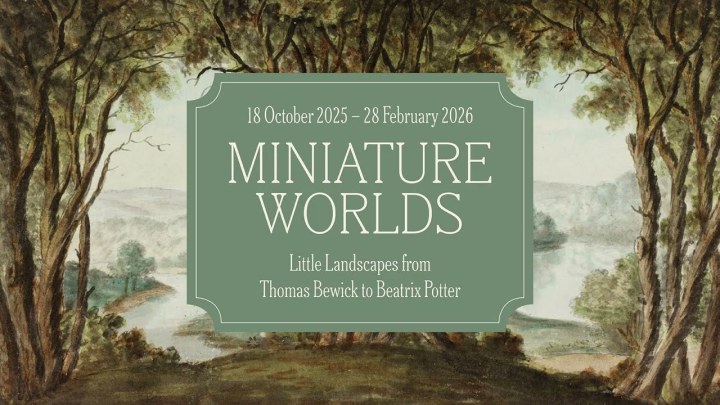
William Beilby, River Landscape Seen through Trees, 1774
(Newcastle: Laing Art Gallery)
◊ ◊ ◊ ◊ ◊
Now on view in Newcastle, as noted by the Art History News blog:
Miniature Worlds: Little Landscapes from Thomas Bewick to Beatrix Potter
Laing Art Gallery, Newcastle, 18 October 2025 — 28 February 2026
Curated by Lizzie Jacklin
Miniature Worlds: Little Landscapes from Thomas Bewick to Beatrix Potter explores the intricate beauty of small-scale landscapes across three centuries of British art. The exhibition focuses on vignette format illustrations and the changing relationship between text, illustration, and publishing. Highlights include seven highly detailed watercolors by J.M.W. Turner, whose 250th birthday is being celebrated this year; a dramatic and diminutive drawing by John Martin; and nine intricate watercolours by Beatrix Potter. The exhibition features over 130 objects, 90 of which are loans from other UK collections.
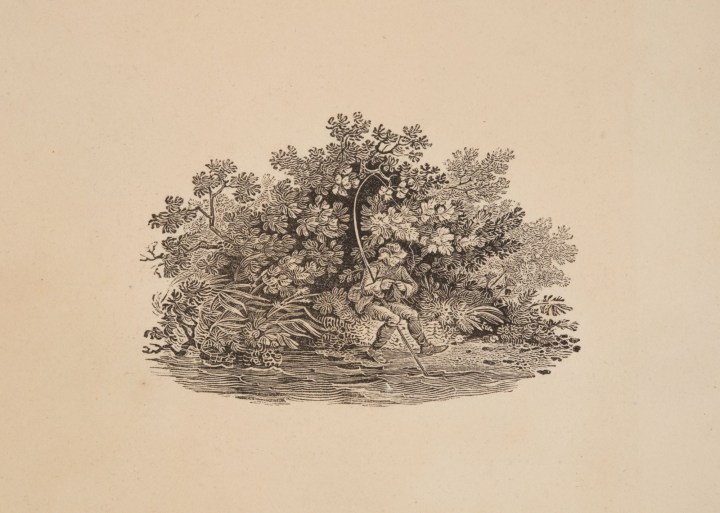
Thomas Bewick, Angler on a Riverbank, Tailpiece Illustration from A History of British Birds, volume 2, p. 50, wood engraving (Newcastle: 1804 / Ashmolean Museum).
The exhibition opens with works by Newcastle artist and wood engraver Thomas Bewick (1753–1828), who reinvented both the wood engraving technique and the small borderless ‘vignette’ illustration. A section dedicated to ‘Poetic Landscapes’ explores small scale works made during the Romantic Era, which saw artists emphasise emotion, imagination, and engagement with the natural world. The exhibition then explores the world of Victorian and Edwardian children’s books, which were often produced in small, child-friendly formats. Highlights include three of John Tenniel’s iconic illustrations for Lewis Carroll’s Alice’s Adventures in Wonderland and original works by Beatrix Potter for The Tale of Peter Rabbit, The Tale of Flopsy Bunnies, and The Tale of Mrs Tittlemouse. The exhibition closes with 20th- and 21st-century works that reference and develop histories of the small-scale landscape in new ways.
Miniature Worlds: Little Landscapes features paintings and prints by artists including J.M.W. Turner, Beatrix Potter, Thomas Bewick, William Blake, Agnes Miller Parker, Eric Ravilious, Joanna Whittle, and more. Loans from Tate, the V&A, the British Museum, the Ashmolean Museum, National Galleries of Scotland, Newcastle University, Newcastle City Libraries, the Natural History Society of Northumbria, and the artists Paul Coldwell and Joanna Whittle complement the strengths of North East Museums’ collections.
r e l a t e d t a l k s
Wednesday, 19 November 2025, 1pm
Lizzie Jacklin | Watercolour Worlds: The Vignettes of J.M.W. Turner and Beatrix Potter
Wednesday, 28 January 2026, 1pm
Lizzie Jacklin | Curator Talk: Miniature Worlds
Wednesday, 4 February 2026, 1pm
Jenny Uglow | Bewick and Lear: Oddities of Daily Life










 Enfilade
leave a comment