At Auction | Chardin’s Basket of Wild Strawberries
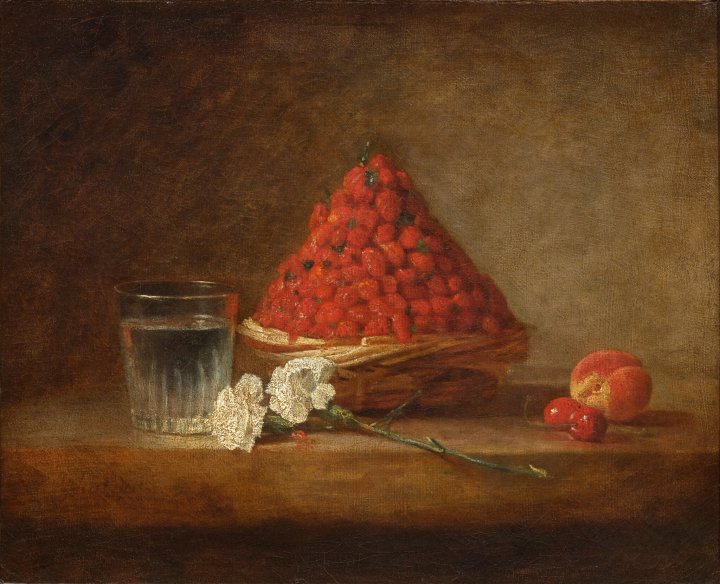
Jean-Siméon Chardin, The Basket of Wild Strawberries, shown at the Salon of 1761, oil on canvas, 38 × 46cm. The painting sold for €24,381,400 on 23 March 2022 at Artcurial in Paris. More information is available here.
◊ ◊ ◊ ◊ ◊
From The New York Times and Art Daily:
Laura Zornosa, “Louvre Bids to Keep a Chardin Bought by U.S. Museum in France,” The New York Times (4 May 2022). The Kimbell Art Museum in Texas is revealed to be the buyer of “Basket of Wild Strawberries,” at auction. The Louvre has been working to name it a national treasure.
On a computer screen, the still life Basket of Wild Strawberries by the 18th-century French painter Jean Siméon Chardin is quiet and unassuming. His talent in capturing the reflection of light off the rim of a water glass is muted in that setting. In person, though, it casts a spell.
“It’s deceptively simple, and it’s absolutely captivating and it’s magical,” said Eric Lee, the director of the Kimbell Art Museum, which bought the work at auction in France in March for more than $22 million. “The painting completely mesmerized me, and it mesmerizes almost anyone who sees it.”
But now the Kimbell, whose successful bid for the work was first reported by the Art Newspaper of France, has to wait to see whether it can actually export the picture, which it purchased at the auction house Artcurial in Paris.
The Louvre has requested that the artwork be classified as “a national treasure” and is looking for sponsorship to purchase it. Under French law, the export can be frozen for 30 months, or 2 1/2 years.
“We are fully mobilized to bring it into the national collection,” Laurence des Cars, president and director of the Louvre, told Le Figaro in March. . . .
The full article is available here»
Exhibition | La Chine
Closing this weekend in Dresden at the Kupferstich-Kabinett:
La Chine: The 18th-Century China Collection in the Dresden Kupferstich-Kabinett
Residenzschloss, Staatliche Kunstsammlungen Dresden, 19 November 2021 — 8 May 2022
 In the early eighteenth century, when the legendary art collection of August the Strong (1670–1733), came into being, Asia was viewed with excited fascination in Europe.
In addition to today‘s world-famous porcelain wares, more than 1100 Chinese drawings and watercolour paintings on paper and silk, as well as woodcuts and coloured prints, were brought to Dresden. This important collection, along with 850 chinoiserie prints, is preserve in the Kupferstich-Kabinett of the Staatliche Kunstsammlungen Dresden. In the first inventory of the Kupferstich-Kabinett, drawn up in 1738, the objects were listed under the categories ‘La Chine’ and ‘La Chine européenne’.
An outstanding feature is the large collection of Chinese popular prints. In China itself, such New Year pictures, congratulatory leaflets, and theatre scenes were considered mere commodities, so that hardly any have been preserved. The prints were cheap to buy. With their wideranging symbolism, usually promising good fortune and prosperity, these sheets were hung up in homes for the New Year or passed on as a blessing, for example, and usually were not preserved. In Europe, Chinese folk art was seen as documenting the costumes and customs of distant lands. In the courtly sphere, the sheets were used as wall decorations, for example. They also served as models for chinoiserie prints. These provided motifs for decorations on buildings and furniture, as well as for porcelain painting.
Ines Beyer, Transformation
The first copperplate prints created in China were made by Matteo Ripa in collaboration with artists from the court painting workshops, on commission to the Kangxi Emperor, after woodcuts illustrating the Emperor’s own poems. The work by Ines Beyer entitled Transformation, based on the eighth view in the series, creates a link to the present day.
Cordula Bischoff and Petra Kuhlmann-Hodick, La Chine: Die China-Sammlung Des 18. Jahrhunderts Im Dresdner Kupferstich-Kabinett (Dresden: Sandstein Verlag, 2021), 256 pages, ISBN: 978-3954986286, €38.
New Book | British Dandies
Distributed by The University of Chicago Press:
Dominic Janes, British Dandies: Engendering Scandal and Fashioning a Nation (Oxford: Bodleian Library Publishing, 2022), 248 pages, ISBN: 978-1851245598, £30 / $45.
 Reveals how the scandalous history of fashionable men and their clothes is a reflection of changing attitudes to style, gender, and sexuality.
Well-dressed men have played a distinctive part in the cultural and political life of Britain over several centuries. But unlike the twenty-first-century hipster, the British dandies provoked intense degrees of fascination and horror in their homeland and played an important role in British society from the seventeenth to the twentieth century. This book explores that social and cultural history through a focus on three figures: the macaroni, the dandy, and the aesthete. The first was noted for his flamboyance, the second for his austere perfectionism, and the third for his perversity. All were highly controversial in their time, pioneering new ways of displaying and performing gender, as demonstrated by the impact of key figures such as Lord Hervey, George ‘Beau’ Brummell, and Oscar Wilde. Illustrated with contemporary prints, portraits, and caricatures, this groundbreaking study tells the fascinating—and scandalous—story of fashionable men and their clothes.
Dominic Janes is professor of modern history at Keele University.
C O N T E N T S
List of Illustrations
1 British Dandies
2 Dressing the Sexes in the Seventeenth and Eighteenth Centuries
3 A Georgian Taste for Macaroni
4 Fine and Dandy in the Regency
5 Victorians and the Aesthetic Pose
6 Fashion and Scandal in the Twentieth Century
Notes
Bibliography
Picture Credits
Index
Call for Articles | Thresholds 51: Heat
From Thresholds:
Thresholds 51: Heat
Edited by Hampton Smith and Zachariah DeGiulio
Submissions are due by 1 June 2022
 Thresholds is the annual peer-reviewed journal produced by the MIT Department of Architecture, held in over 150 university art & architecture libraries around the world. Content features leading scholars and practitioners from the fields of architecture, art, and culture.
Heat is elusive: always on the move, always fugitive. Though we have many signs of its presence—sweating, ‘hot’ and ‘cool’ media, sitting under the shade, catching fire—heat itself largely evades conventional forms of representation. As the transference of energy from one system to another, heat radiates and penetrates. Immanent and intense, heat binds and nourishes as much as it reshapes or destroys. While helping us navigate the material world as tool, medium, and affect, heat forces us to come to terms with the fragility of the systems in which we take part. And though temperature is regularly mapped across graphs and thermometers, the feeling of heat is often so localized and so personal that it evades historic perception altogether. Even if we know things are hotter now than they were yesterday, where is heat within art and architecture practice?
Thresholds 51: Heat takes enthalpy—the thermodynamic property that comprises heat, pressure, and volume to effect chemical state change—as its guiding principle. We seek scholarly writing, artistic interventions, and criticism from art, architecture, and related fields to apply pressure within the volume to effect disciplinary state change. We aim to discover the ways art and architecture have historically navigated, wielded, and avoided heat.
Courtyard buildings across the Islamic world produce thermal delight; Mande blacksmiths carefully wield heat to make iron tools for repairing and nourishing communities; museum conservators curate temperature-controlled environments for artworks; Yurok practices of fire stewardship regulate natural rhythms of growth and decay. And though thermodynamic flux underlies such practices of making and maintenance, heat just as frequently effaces or prevents knowledge production—think of the conflagration of the University of Cape Town’s special collections or mold consuming boxes of archival material.
Recognizing that heat has never been evenly felt, from the violently racialized fictions of the ‘torrid zone’ to the lack of adequate shade in urban communities, we are particularly invested in alternative architectural or aesthetic mobilizations of heat—in the contestation of thermal violence, in the activation of ritual, or in the warmth of community, desire, and lust. A critical account of heat within art and architecture must attend to its use as a medium and structure of violence, while nevertheless exploring how ‘feeling the heat’ productively links scales of being, practices, and types of labor.
Please send all submissions to the editors via email at thresh@mit.edu with the subject heading THAT’S HOT. Essay submissions should be in English, approximately 3000 words, and formatted in accordance with the Chicago Manual of Style. Submission should include a brief cover letter, contact information, and bio of 50–75 words for each author. Text should be submitted in MS Word. Images should be submitted at 72 dpi as uncompressed TIFF files. Other creative proposals, including, but certainly not limited to, performances, poetry, and film are not limited in size or medium. All scholarly submissions are subject to peer review.
Call for Papers | Shipwrecks in Art, History, and Archaeology
From ArtHist.net:
Resurfacing: Shipwrecks in Art, History, and Archaeology
The Warburg Institute, The Royal Museums Greenwich, London, 11–12 November 2022
Proposals due by 27 May 2022
Organized by Caspar Pearson, Johannes von Müller, Andrew Choong Han Lin, and Imogen Tedbury
Every sea voyage entails the possibility of disaster. This makes the motif of the shipwreck a highly significant symbol, to which its popularity as an artistic subject in the early modern period attests. Today, the potential symbolism of a shipwreck and its contents remains key to marine archaeology. Since Plato, the ship can act as a metaphor for a state and consequently a state can also invest itself into its ships—and its shipwrecks. Examples like the Mary Rose (1545) or the Titanic (1912) demonstrate how these structures can, in the public imagination, become era-defining symbols of certain technological or social achievements. Archaeology can reveal wondrous relics of a wreck’s active life, a snapshot of the past frozen in the moment of the vessel’s abrupt end.
The shipwreck, already a versatile metaphor, can therefore also serve as a figure for history itself. In his architectural treatise, Alberti, who dabbled in nautical archaeology when he attempted to raise an ancient ship from the bed Lake Nemi, discusses Vitruvius as one of the few survivors of a shipwrecked antiquity. In turn, Winckelmann likens the ruins of classical artworks to the fragments of a ship that can never be seen in its entirety. In these two key moments in the history of art history, the figure of the ship signifies the suspension of time, and the shipwreck, in consequence, marks the end of an era. Perhaps it is for this reason that Jacob Burckhardt would eventually conceive of the scholar drifting upon vast seas of past and present turmoil.
As the horizons of art history have expanded beyond their former Eurocentric focus, increasing interest in processes of exchange, trade and migration have also led to the discovery of sunken treasures that are now claimed as objects of study. In this context, the shipwreck may eventually reveal itself as a guiding principle for art history written on the fragmented grounds of surviving data. This conviction, however, demands to take into account the systemic suppression of marginalised histories, gradually resurfacing and challenging scholars to review their standpoint.
Considerations like these spark a variety of questions. What meaning does the figure of the shipwreck hold for art history, archaeology and related disciplines? Are the vessels lost at sea merely shattered cabinets of forgotten wonders that are now resurfacing? Or does the interest in them which art historians and archaeologists share with maritime historians, literary scholars and artists hold the potential to recalibrate an understanding of the knowledge produced in confrontation with material objects of both past and diverse aesthetics? And how do questions such as these resonate in a moment in which the dangers of the voyage by sea are very real and not metaphorical at all for hundreds of thousands who desperately try to cross the bodies of water separating the Global South from the Global North?
This two-day conference, held on 11 and 12 November 2022 in London at the Warburg Institute and the Royal Museums Greenwich, invites scholars from a variety of fields—art history, archaeology, history of ideas, literary studies, and others—in order to discuss the following topics and more:
a) material and epistemic cultures of shipwrecks
b) the shipwreck as a subject in the arts of the past and the present alike
c) the shipwreck as a metaphor as which it runs through histories of both literature and scholarship
d) the shipwreck as a potential paradigm for an expansion of subject areas in art history, archaeology and related fields.
Please send a proposal of 300 words max. together with a short CV to caspar.pearson@warburg.sas.ac.uk by 27 May 2022.
Organisers
Dr Caspar Pearson (The Warburg Institute), Dr Johannes von Müller (Christian-Albrechts-Universität Kiel), Andrew Choong Han Lin, and Dr Imogen Tedbury (The Royal Museums Greenwich)
New Book | Jean-Baptiste Greuze et ses têtes d’expression
Published by the Comité des travaux historiques et scientifiques and the Institut national d’histoire de l’art:
Yuriko Jackall, Jean-Baptiste Greuze et ses têtes d’expression: La fortune d’un genre (Paris: CTHS / INHA, 2022), 320 pages, ISBN: 978-2735509393, €38.
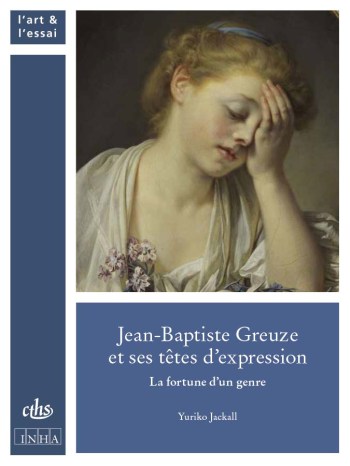 La représentation de têtes dites d’expression a été initiée par Charles Le Brun au xviie siècle et s’inscrit dans la tradition académique. Les figures de Jean-Baptiste Greuze, principalement féminines, sont
d’abord le vecteur narratif des œuvres au sein desquelles elles ont vocation à s’intégrer. Toutefois, les émotions vont peu à peu constituer l’unique élément fictionnel des productions de l’artiste. L’autrice montre comment les têtes «greuziennes » — parfois jugées décadentes en raison de leur lascivité et leur volupté affichées — acquièrent finalement un statut autonome et deviennent un genre artistique à part entière entretenu par les collectionneurs et perpétué par une nouvelle génération d’artistes.
Spécialiste de la peinture française du xviiie siècle, Yuriko Jackall est conservatrice en chef de la Wallace Collection (London). Auparavant conservatrice à la National Gallery of Art (Washington, DC), elle a participé à l’exposition Hubert Robert (1733–1808) (musée du Louvre / National Gallery of Art, 2016), puis a été commissaire des expositions America Collects Eighteenth-Century French Painting et Fragonard: The Fantasy Figures (National Gallery of Art, 2017).
Table des matières
Liste des abréviations
Remerciements
Préface
Avertissement
Introduction
• Greuze peintre
• Deux approches de Greuze peintre
• Un nouveau regard sur les têtes de Greuze
• Greuze éclipsé ?
• Greuze et Diderot
• Le sens du dessin de Denon
I. Un lexique pour la tête isolée
• Une tête d’après nature
• Tête et tête d’après nature
• Tête de fantaisie
• Tête de caractère
• Tête d’expression
• Tête d’étude
• Transformations de la tête isolée
II. Les identités académiques de Greuze
• Greuze et l’Académie
• Greuze selon Gougenot
• Peintre d’expression
• Peintre de nature
• Nature et expression
• Greuze entre nature et expression
III. La tête autonome : découper, isoler, extraire, remplacer
• Corrège, Coypel et le recadrage
• Mettre le tableau en morceaux
• Couper les têtes
• L’image du sentiment
• Le visage métonymique
• Greuze et le comte de Caylus
• Caylus et Watteau : dess(e)ins et jeux de fonds
• Caylus et Vien : sculpter la tête
IV. Morceler Greuze
• La question de matérialité
• Greuze, dessinateur
• Surfaces
• Greuze, peintre
• Du dessin à la peinture
• D’un tableau à l’autre
• Faire de la tête un condensé de l’oeuvre
V. Exprimer le désir et l’admiration
• De l’allégorie
• La Tête d’une jeune fille, exprimant l’admiration et le désir
• Abondance
• Interchangeabilité
• Expressions symboliques
• La part du spectateur : une lecture libertine
• La part du spectateur : un choix féminin
Conclusion: De l’expression au caractère
• La place de Greuze
• Évolutions lexicales
Bibliographie
Index
Crédits photographiques
New Book | Capitalism and the Emergence of Civic Equality
From The University of Chicago Press:
William Sewell, Capitalism and the Emergence of Civic Equality in Eighteenth-Century France (Chicago: The University of Chicago Press, 2021), 416 pages, ISBN: 9780226770321 (cloth), $105 / ISBN: 9780226770468 (paper), $35.
 There is little doubt that the French Revolution of 1789 changed the course of Western history. But why did the idea of civic equality—a distinctive signature of that revolution—find such fertile ground in France? How might changing economic and social realities have affected political opinions? William H. Sewell Jr. argues that the flourishing of commercial capitalism in eighteenth-century France introduced a new independence, flexibility, and anonymity to French social life. By entering the interstices of this otherwise rigidly hierarchical society, expanded commodity exchange colored everyday experience in ways that made civic equality thinkable, possible, even desirable, when the crisis of the French Revolution arrived. Sewell ties together masterful analyses of a multitude of interrelated topics: the rise of commerce, the emergence of urban publics, the careers of the philosophes, commercial publishing, patronage, political economy, trade, and state finance. Capitalism and the Emergence of Civic Equality in Eighteenth-Century France offers an original interpretation of one of history’s pivotal moments.
William H. Sewell Jr. is the Frank P. Hixon Distinguished Service Professor Emeritus in Political Science and History at the University of Chicago. He is the author of several books, including, most recently, Logics of History: Social Theory and Social Transformation, published by the University of Chicago Press.
C O N T E N T S
Introduction: The French Revolution and the Shock of Civic Equality
1 Old Regime State and Society
2 The Eighteenth-Century Economy: Commerce and Capitalism
I. The Emergence of an Urban Public
3 The Commercial Public Sphere
4 The Empire of Fashion
5 The Parisian Promenade
II. The Philosophes and the Career Open to Talent
6 The Philosophe Career and the Impossible Example of Voltaire
7 Denis Diderot: Living by the Pen
8 The Abbé Morellet: Between Publishing and Patronage
9 Jean-Jacques Rousseau: Self-Deceived Clientage
III. Royal Administration and the Promise of Political Economy
10 Tocqueville’s Challenge: Royal Administration and the Rise of Civic Equality
11 Warfare, Taxes, and Administrative Centralization: The Double Bind of Royal Finance
12 Political Economy: A Solution to the Double Bind?
13 Navigating the Double Bind: Efforts at Reform
Conclusion: The Revolution and the Advent of Civic Equality
Epilogue: Civic Equality and the Continuing History of Capitalism
Acknowledgments
References
Index
Call for Papers | The Science of Taste in the 18th Century
From Fabula.org (which also includes the accompanying bibliography) . . .
La Science du Goût au XVIIIe Siècle
Special issue of Revue Internationale d’étude du dix-huitième siècle (RIEDS), edited by Guilhem Armand and Emmanuelle Sempère
Proposals due by 1 June 2022; completed essays due by 1 November 2022
« Ce sens, ce don de discerner nos aliments, a produit dans toutes les langues connues, la métaphore qui exprime par le mot goût, le sentiment des beautés et des défauts dans tous les arts »
–Voltaire, « Goût (Gramm. Litterat. & Philos.) », Encyclopédie, vol. VII (1757).
« Une espèce de toucher plus fin, plus subtil »
–Jaucourt, « Goût (Physiolog.) », Ibid.
Ce siècle, qui est celui de l’Encyclopédie, qui, en quelque sorte, s’ouvre avec l’ennoblissement de la science par Fontenelle qui parvient dans le même temps à en faire un objet de plaisir, et se clôt avec La Physiologie du goût, n’est-il pas celui où tente de s’élaborer une véritable science du goût ?
Le 18e siècle – ou, plus largement, le grand âge classique – est en effet la grande période de théorisation du goût, mais la labilité du terme rend en même temps la notion rétive à toute tentative de définition stricte. Pourquoi désigner de l’un des cinq sens ce qui flatte l’oreille (un air), charme la vue (un tableau), plaît à l’esprit ou au cœur ? Pourquoi même désigner d’un sens corporel ce qui stimule l’esprit ou heurte les règles sociales ? Enfin, pourquoi parmi ces cinq sens choisir l’un des moins « nobles », et peut-être le moins attendu (et non pas l’odorat, l’expression « avoir le nez fin » étant attestée depuis au moins 1694) ? Car il convient de noter que les choses de la table et tout ce qui s’y rapporte relèvent du péché de gourmandise dont, rappellent médecins et théologiens de l’époque, on est puni par l’indisposition ou la maladie. Or, il n’est peut-être pas indifférent que cette association entre un sens et un jugement se cristallise à une époque où la gourmandise commence à être réhabilitée, où la gastronomie naît et acquiert progressivement ses lettres de noblesse, tandis que les belles lettres deviennent littérature. Au même moment, un domaine du savoir se dégage au croisement des disciplines artistiques et de la philosophie : l’esthétique. Le goût, ce serait donc ce terme qui permet d’évoquer à la fois une sensation, une émotion et un jugement, une intuition et une théorie.
Durant cette même période, ce que l’on appelle le goût français se répand dans toute l’Europe et même au-delà, pour devenir durablement synonyme du bon goût. La notion revient sans cesse, pour définir une convenance sociale dans les apparences, caractériser une posture, un langage, une réussite ou un échec littéraire, théâtral, artistique, mais aussi tout simplement pour désigner la saveur d’un mets. Le goût cristallise aussi des enjeux politiques et entretient des liens forts avec les notions d’esprit des nations et de génie : c’est peut-être ce qui explique l’intérêt grandissant des Lumières pour ce concept difficile, cousin du je-ne-sais-quoi, et la multiplication des tentatives de définition qu’il suscite, voire des querelles, au moment même où s’élabore la science esthétique, où le mot et l’idée d’original changent de statut, où la notion d’expérience humaine s’individualise. La question du goût se pose de façon d’autant plus intéressante que la littérature fait une place de plus en plus grande à une vie psychique clairement ancrée dans la vie physique. Cette science du goût qui s’élabore se situe ainsi au cœur du partage des savoirs qui caractérise le 18e siècle : au confluent de différents domaines, elle s’en enrichit, non sans éviter le risque d’une certaine confusion.
La question du goût au 18e siècle a fait principalement l’objet de deux types d’approche, résonnant avec l’analogie étudiée dans l’article du même nom dans l’Encyclopédie de Diderot et D’Alembert : le goût comme sens physique, renvoyant à la gourmandise, et le goût en lien avec l’esthétique au moment où cette science émerge. Les travaux de Jean-Claude Bonnet – du numéro 15 de DHS à son ouvrage La Gourmandise et la faim, 2015 – ainsi que ceux de Béatrice Fink, et d’historiens comme Philippe Meyzie (Lumières n° 11 « La Gourmandise entre péché et plaisir ») ont enrichi et affiné notre connaissance de la réhabilitation du péché de gourmandise, de la transformation des arts culinaires en ce qui s’appellera bientôt la gastronomie (1801), des débats techniques, médicaux et philosophiques. Si quelques travaux comme ceux de Frédéric Charbonneau (L’École de la gourmandise, 2008) font le lien entre esthétique – et en particulier littérature – et gourmandise, les deux domaines restent le plus souvent distincts. Cependant, les positions et postures des auteurs du 18e siècle en matière de morale et d’esthétique sont de plus en plus interrogées aujourd’hui sous l’angle d’une sensibilité concrète, voire d’une physiologie. Depuis les travaux d’Alain Corbin, les « cultures sensibles » sont devenues un objet historique et plus généralement l’anthropologie sensorielle très active outre-Atlantique depuis les travaux de Howes et de Classen trouve un assez large écho dans l’ensemble des sciences humaines. Ces approches sont d’autant plus pertinentes pour le goût qu’il engage une sensorialité dite « basse » en dépit des opérations de symbolisation dont il fait l’objet – l’homologie avec le jugement de valeur en est une. Force est en effet de constater que si le goût participe, tout comme la vue, des deux ordres de la sensibilité que constituent la morale et la sensation, il conduit bien davantage, ou plus directement, dans les ressacs de la sensation et de ses ressorts physiologiques. Serait-ce à dire que le « goût » le plus « sublime » relèverait de ce qu’il y a de plus matériel en nous[1] ? On pourrait en prendre pour preuve les coups de boutoir dont le Neveu attaque l’édifice du bon goût et qui bouleversent l’ordre moral et esthétique du Philosophe de la Satire seconde. Lequel confesse une forme de dégoût : « Je commençais à supporter avec peine la présence d’un homme qui discutait une action horrible, un exécrable forfait, comme un connaisseur en peinture ou en poésie examine les beautés d’un ouvrage de goût[2] ». Celui qui mange mal (ou peu, ou trop) et celui qui mange bien (à satiété, en bonne compagnie, avec mesure et choix) dessinent ainsi les contours de goûts concurrents, qui questionnent et mettent à mal les idéaux de sociabilité et d’universalité.
Le goût s’envisage avec profit par son envers, ou son dessous, qu’il s’agisse du “mauvais goût” ou du “dégoût”. Le premier a été envisagé par Jennifer Tsien relativement à l’esthétique du 18ème siècle (Le Mauvais goût des autres, 2017) et par Carine Barbafieri et Jean-Christophe Abramovici sous un angle résolument transversal (L’Invention du mauvais goût à l’âge classique, 2013). Le second a fait l’objet d’une journée d’étude en mai 2019 à l’Université d’Aix Marseille (« Le Dégoût : vécu, perception, représentations et histoire »).
C’est à la fois dans la lignée de ces travaux récents ou plus anciens, et dans une perspective renouvelée, que se situe cet appel. La richesse et la diversification des travaux sur le goût dans ces dernières décennies montrent à quel point les enjeux du goût débordent les questions purement esthétiques ou idéologiques. Cet appel à communication voudrait donc envisager la catégorie du goût non plus seulement dans ses fonctions normatives ou axiologiques, ou dans ses dimensions sociologiques ou esthétiques, mais aussi en tant que catégorie épistémique et scientifique. Il s’agira d’interroger la notion de “goût” au 18e dans le champ des savoirs, pour mieux comprendre les enjeux heuristiques et méthodologiques que les philosophes, écrivains, artistes, savants et amateurs ont voulu lui prêter.
Ce dossier de RIEDS s’intéressera donc au goût sous toutes les formes et dans tous les sens que lui donne le XVIIIe siècle, mais en mettant en particulier l’accent sur le lien entre les deux termes de la métaphore, les deux sens du goût, et en postulant que ce lien n’est pas seulement de l’ordre de l’histoire esthétique ou des mentalités. La labilité des notions de bon et de mauvais goût, l’empirisme qui préside au choix du terme goût pour parler de préférence esthétique et, parallèlement, l’ambiguïté qui caractérise la gastronomie encore naissante et pas encore ainsi nommée doivent avoir partie liée. C’est pourquoi nous envisageons l’angle de la science du goût, qui permet de s’intéresser au lien qu’opère cette notion entre l’intuitif et le rationnel : le goût apparaît en effet comme un point de jonction important entre une appréhension concrète – induite par le sens premier – et une signification plus abstraite, en quelque sorte à l’image de ce lien permanent entre arts et théories, fiction et savoir, qui est au cœur des écrits des Lumières. Le goût, devenu objet d’un discours savant, cristallise en effet les différends philosophiques de toute farine. Prise entre les feux du rationalisme et de la subjectivité, de la physiologie et de la morale, la science du goût ne risque-t-elle pas la contradiction ? Et ne cristalliserait-elle pas ainsi une « révolution morale » (au sens de K.A. Appiah[3]) ?
Si Kant ou Burke ont tenté de revisiter l’idée que l’esthétique pourrait se passer d’un rapport direct et sensitif, voire sensuel, aux objets, n’est-ce pas qu’il y avait bien, chez tant d’autres théoriciens, notamment les Encyclopédistes (Diderot et Jaucourt, en particulier), en partant de la physiologie, un matérialisme sourd travaillant cet ennoblissement du sens ? Mais le point de départ physiologiste n’est pas nécessairement matérialiste et peut abonder d’autres théories, comme celles du médecin et écrivain Tiphaigne de La Roche, qui tenta une solution hybride (sinon incertaine, voire confuse) de matérialisme spiritualiste.
En forçant le trait, un hiatus se dessine entre une conception subjectiviste du goût, sur lequel elle fait peser un risque d’obscurité, d’illégitimité, de solipsisme, et une conception sensitive et physiologique qui voudrait gommer la labilité du jugement de goût dans une perspective positive et scientifique. À cette aune doublement complexe, les goûts et les dégoûts des savants, des artistes et des écrivains de la période, ne nous parlent plus seulement de leur sensibilité, mais peuvent informer une histoire émotionnelle des mentalités, qui pourra s’appuyer sur les travaux de Françoise Waquet[4]. Aussi, l’examen de l’hypothèse d’une science du goût en construction au fil du siècle pourra-t-il se doubler d’une réflexion sur le savoir que nous construisons nous-mêmes sur le goût que les hommes et les femmes des Lumières ont manifesté, sans le théoriser, mais en l’expérimentant sans relâche et de multiples façons, pour une science mêlée, dont on rappellera qu’elle ne s’inféode pas à l’objectivité moderne.
Les contributions (en histoire des idées, histoire et théories de l’art, littérature, histoire culturelle) pourront aborder les axes suivants :
Les savoirs sur le goût: la critique a déjà défriché toute cette littérature autour de la gourmandise et du goût au sens physiologique, ainsi que les nombreux textes théoriques tels que les préfaces de manuels culinaires (J.-C. Bonnet, B. Fink), les ouvrages de médecine, les traités savants sur l’agronomie (on pense évidemment à Parmentier), et les correspondances d’auteurs qui révèlent goûts et dégoûts, excès et régimes. Si on prolonge l’enquête, ces textes peuvent-ils se lire comme le lieu où se pense le passage du sens matériel à sa symbolisation, où s’interroge le lien entre la perception subjective du goût et le défi théorique tendant à une forme d’universalisme ? Que nous disent, par exemple, les plaisirs d’Émilie du Châtelet ou les raffinements libertins du rapport entre l’individuel et le politique ?
Matérialité du goût et sensualisme. Comment s’articulent les théories du goût (dans tous les sens) et le sensualisme des Lumières ? Qu’impliquent les bouleversements épistémiques touchant la sensation sur la définition du jugement de goût ? Le goût peut-il relever de la pure matière ? Un savoir abstrait peut-il se passer d’un rapport direct, sensitif, voire sensuel aux objets ? Du côté de l’esthétique, il s’agira de s’intéresser à ce glissement du je-ne-sais-quoi à l’originalité, à ce moment où le goût déborde les règles de la Technè. On pourra s’intéresser aux arts d’agrément, aux querelles esthétiques, à la question de la permanence ou de l’universalité du grand goût par rapport aux théories relativistes, ainsi qu’aux questionnements sur la postérité.
Les goûteurs et les dégoûtants : sociologie et anthropologie du goût. À cette époque où se redéfinit le sublime, où l’association du beau et du bien se trouve remise en question, où les frontières du bon et du mauvais goût semblent mouvantes, c’est aussi fondamentalement le rapport du goût à la morale qui se trouve questionné, dans un siècle qui désire certes détacher la science et la philosophie d’un certain nombre de préoccupations théologiques, mais pour y fonder une éthique. Comment redéfinir le goût dans la perspective éthique des Lumières, qui s’affronte aux valeurs humanistes, aux aspirations de l’individualité et de l’harmonie sociale, à l’idée du génie des nations, aux acquis du relativisme et de l’universalisme ?
Modalités de soumission
Les propositions d’article sont à envoyer avant le 1er juin 2022, sous la forme d’un résumé ne dépassant pas 500 mots, en français ou en anglais, accompagné d’une brève notice bio-bibliographique, aux deux adresses suivantes : guilhem.armand@univ-reunion.fr et sempere@unistra.fr. Après accord du comité scientifique, les propositions retenues seront attendues pour le 1er novembre 2022. Les articles feront entre 30.000 et 45.000 caractères espaces comprises et pourront conformément aux normes de la revue être rédigés en français ou en anglais ; ils seront accompagnés d’un résumé en 500 caractères maximum, espaces comprises, et d’une biobibliographie des auteurs en 300 caractères espaces comprises.
Exhibition | Bestowing Beauty

Inkwell, Pakistan, Sindh, eighteenth century, steel, overlaid with gold (koftgari) (Houston: Hossein Afshar Collection at the MFAH). This inkwell is dedicated to Mir Fateh ‘Ali Sarkar-i Khan Talpur (r. 1783–1801/2), chief of the Talpurs, a tribe that conquered and ruled Sindh, in present-day Pakistan, from 1783 until 1843. The slit in the inkwell’s base, which makes it possible for a belt to pass through, suggests its portability and importance as part of courtly attire. The gold overlay, delicate decoration, and dedicatory inscription emphasize the power and prestige of the written word.
◊ ◊ ◊ ◊ ◊
From the Toledo Museum of Art’s press release for the exhibition:
Bestowing Beauty: Masterpieces from Persian Lands
The Museum of Fine Arts, Houston, 19 November 2017 — 11 February 2018
High Museum of Art, Atlanta, 12 December 2020 — 18 April 2021
Toledo Museum of Art, 23 April — 17 July 2022
Curated by Aimée Froom
This spring and summer the Toledo Museum of Art offers a spectacular exhibition of more than 100 objects drawn from one of the most significant private collections of Persian art. Bestowing Beauty: Masterpieces from Persian Lands showcases the artistic inventiveness of Persian culture across different media, featuring a broad array of textiles, ceramics, metalwork, lacquer, paintings, jewelry, and manuscripts from the Hossein Afshar Collection. Historically Persian lands—a wide swath of territory that at various times spanned from Cairo to Delhi, with its heart in what is now modern-day Iran—saw centuries of conquest and globalization. The art that resulted both reinforced Persian culture and assimilated these cross-cultural exchanges.
 Woven throughout the stories of these extraordinary objects are experiences, ideas, and emotions shared by cultures across the globe. By evoking universal themes of love, loss, conflict, and spirituality the exhibition brings to life the rich heritage and enduring beauty of Persian art.
“Celebrating the cultural heritage of Iran at the Toledo Museum of Art with Bestowing Beauty represents a rare opportunity for our audiences to experience the grandeur and beauty of these objects in person,” said Diane Wright, the Museum’s senior curator of glass and contemporary craft. “An important area of trade and migration, Persian lands served as critical centers of artistic production and influence for centuries, which the exhibition brilliantly highlights through these extraordinary works of art.”
The visual and literary arts have held a privileged place in Iranian civilization for centuries. The Hossein Afshar Collection, which embraces a diverse range of treasures from the eve of Islam’s arrival in the seventh century to the end of the 19th century, was assembled to preserve and share Persian art and culture today and for future generations. The exceptional objects in Bestowing Beauty embody the history of trade and migration found in Persian art, as well as map the legacy of artistic and technological advancements across the region.
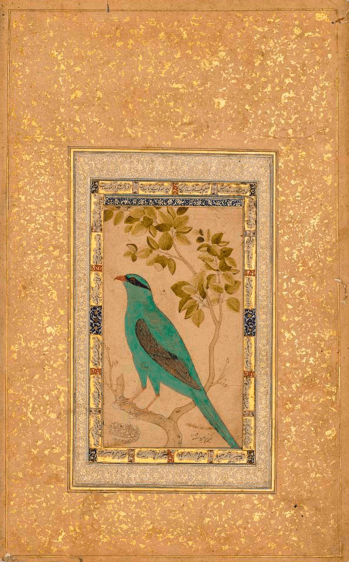
Signed ‘Ali-Quli’, Common Green Magpie, 1746–47, ink, opaque watercolor, and gold on paper (Hossein Afshar Collection at the MFAH).
The exhibition is divided into six sections:
Banquets and Battles features the exuberance of palace feasting and fighting, quintessential aspects of Persian kingship and perennially popular subjects in Persian art and literature. Feasts are portrayed across media, such as a 19th-century painting of a female juggler accompanied by a cat, and the exhibition also includes lavishly decorated serving vessels and utensils fashioned from metals and ceramic.
Faith and Piety explores how, after the advent of Islam, words from the Qur’an became paramount as a mode of expression. Exquisitely penned and sumptuously illuminated Qur’an manuscripts were produced across the Islamic world. Calligraphers also copied a variety of texts in addition to the Qur’an, such as sayings from the Hadith, Shi‘a invocations, literary manuscripts and poetry, all of which are included in the exhibition.
Art of the Word, the third section, delves into the different developments, styles and uses of calligraphy, enhancing the aesthetic form and rhythmic beauty of calligraphy. Words were woven into textiles, engraved onto metalwork, painted on ceramic objects and enamels, and carved into wood.
In Persian literature, love finds expression as a profound human connection and metaphor for a yearning for unity with the divine. Love and Longing traces how calligraphers and painters brought to life the rich corpus of Persian literature, from the exquisite miniature paintings from the Shahnama (Book of Kings), the Persian national epic, to couplets of lyric poetry and a pair of tightly embracing lovers on a slim lacquer pen case.
Kingship and Authority explores the kingly ideal, which figures prominently in Persian visual and literary culture. In addition to the Shahnama—the masterpiece that reflects the legends and virtues of Persian dynasties—court painters in the 19th century captured portraits of royalty and the ruling elite. This section also incorporates monumental silk carpets of the 16th and 17th centuries and an exquisite 19th-century pendant of gold, pearls, and gemstones.
The concluding section, Earth and Nature, examines the manifestations of flora and fauna that abound in the art of Iran. Its people were among the earliest civilizations to cultivate gardens. The garden’s symbolism—of paradise, of the promise of spring, of renewal—permeated Persian culture and can be seen in the exhibition through glorious depictions of lions, falcons, nightingales, roses, and fruit.
“The significance of Persian lands geographically, culturally and politically cannot be overstated,” said Sophie Ong, Hirsch curatorial fellow at the Toledo Museum of Art. “Bestowing Beauty draws attention to the splendor and complexity of Persian art, continuing TMA’s enrichment of the medieval world and beyond.”
Bestowing Beauty: Masterpieces from Persian Lands is organized by the Museum of Fine Arts, Houston.
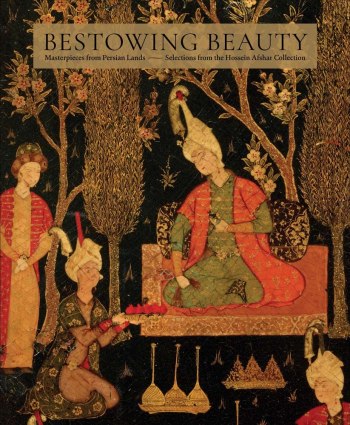
Aimée Froom, ed., Bestowing Beauty: Masterpieces from Persian Lands—Selections from the Hossein Afshar Collection (New Haven: Yale University Press, with The Museum of Fine Arts, Houston, 2021), 304 pages, ISBN: 978-0300247022, $85. With contributions by Walter Denny, Melanie Gibson, David Roxburgh, Robert Hillenbrand, Mary McWilliams, Janet O’Brien, Marianna Shreve Simpson, Eleanor Sims, Margaret Squires, and Julie Timte.
Abbot Hall Receives Screen Painted by George Romney
From the press release (7 April 2022). . .
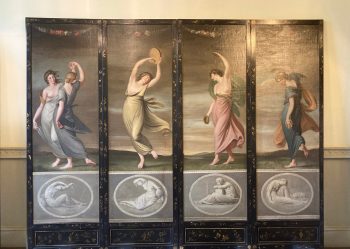
George Romney, Painted Screen, ca. 1760s (Kendal: Abbot Hall Art Gallery and Museum).
Lakeland Arts has received a four-paneled painted screen created by English portrait painter George Romney (1734–1802). The work has been allocated to Lakeland Arts for the nation through HM Government Acceptance in Lieu of Inheritance Tax Scheme by the Estate of Patricia Jaffé, administered by Arts Council England. The painted screen now enters the Abbot Hall Collection permanently, alongside several other Romney pieces acquired by Lakeland Arts throughout its 65-year history.
Dated by Alex Kidson as belonging to the early stages of the painter’s career, the screen is believed to have been painted during Romney’s early years in London, from 1762 onwards. The work takes its inspiration from the publication of engravings of wall paintings discovered in Pompeii in 1749 and circulated throughout Europe in Le Antichità di Ercolano Esposte (Antiquities of Herculaneum Exposed), first published in 1757. Romney has reworked the antique figures into poses of his own devising which echo their classical source. In doing so, the screen anticipates his later preoccupation with classical subject matter.

George Romeny, The Gower Family, The Children of Granville, 2nd Earl Gower, 1776–77, oil on canvas, 203 × 235 cm (Kendal: Abbot Hall Art Gallery and Museum).
Abbot Hall is home to one of the finest collections of Romney paintings in Britain, including the 1759–60 portrait of Captain Robert Banks, the 1796 group portrait The Four Friends, a pastel portrait of the Romantic poet Charlotte Smith, and several sketchbooks. Most significantly, the Collection holds claim to Romney’s masterpiece, the 1776–77 depiction of The Gower Family, the Children of Granville Leveson-Gower, 2nd Earl Gower. A direct line can be drawn between the dancer bearing a tambourine in the second leaf of the painted screen and Lady Anne’s posture in The Gower Family.
Romney was one of the most fashionable and sought-after artists of his time and is known for his engagement with classical themes. The son of a cabinet-maker, Romney was born in Dalton-in-Furness in Lancashire (now Cumbria) and received informal artistic training in his youth. His career began in earnest when he moved to Kendal aged 21 to begin an apprenticeship under the Cumbrian portraitist Christopher Steele and later established his own studio in the town. Romney married the daughter of his landlady, who remained in Kendal with their family when he moved to London to pursue his ambitions. Although he returned sporadically to Cumbria, he moved back permanently towards the end of his working career and was nursed by his wife through two years of ill health before passing away in 1802.
The permanent allocation of the screen will provide an unrivalled opportunity for Abbot Hall visitors to see the development of this important aspect of Romney’s art throughout his working life. The screen may be the earliest surviving piece to illustrate Romney’s exploration of antique themes, and The Gower Family is considered his finest example of this genre, in any UK public collection. It is therefore fitting for both works to be in the care of Lakeland Arts.
Rhian Harris, Chief Executive at Lakeland Arts, said: “We are absolutely delighted the Romney screen has been acquired by Lakeland Arts on a permanent basis. Our thanks go to Arts Council England, the Acceptance in Lieu panel and the Trustees of the Patricia Jaffé Estate for recognising the important connection between George Romney and Kendal in allocating this important piece to Abbot Hall.”
Edward Harley OBE, Chairman of the Acceptance in Lieu Panel said: “I am delighted that this remarkable piece dating from the early stages of George Romney’s career has been allocated to Lakeland Arts for Abbot Hall in Kendal. It is fitting that it returns to the town in which the artist spent the early years of his career. It will allow the work to be compared alongside his masterpiece The Gower Children.”
The screen was accepted in lieu of inheritance tax in the 2020–21 financial year but permanently allocated to Lakeland Arts for Abbot Hall in March 2022. In 2020–21, £54 million worth of objects—paintings, archives, and items of cultural importance—were accepted for the nation through the Acceptance in Lieu and Cultural Gifts Schemes and allocated to museums across the UK.










 Enfilade
leave a comment