Exhibition | Secret Maps
Opening today at the British Library:
Secret Maps
British Library, London, 24 October 2025 — 18 January 2026
Curated by Tom Harper, Nick Dykes, and Magdalena Peszko

Paul Sandby and William Roy, Great Map of Scotland, ca. 1755 (London: British Library, Maps CC.5.a.441).
Step into the shadows at Secret Maps, a major new exhibition revealing the stories hidden in some of history’s most mysterious maps. Maps have always been more than just tools for navigation—in the hand of governments, groups, and individuals, maps create and control knowledge. In Secret Maps, we trace the levels of power, coercion, and secrecy that lie behind maps from the 14th century to the present day, and uncover the invisible forces that draw and distort the world around us. Some of the maps on display reveal hidden landscapes, offering insight into places long forgotten or erased from official histories. Others are purposefully deceptive, designed to protect treasures, mask strategic locations, or reshape the way we see the world. This exhibition uncovers each of their individual secrets, revealing their hidden purposes and power.
Tom Harper, Nick Dykes, and Magdalena Peszko, Secret Maps: How They Conceal and Reveal the World (London: British Library Publishing, 2025), 256 pages, ISBN: 978-0712355643, £40.
Journée d’études | Sculpture in Franche-Comté, 15th–20th Centuries
From ArtHist.net:
Actualité de la sculpture en Franche-Comté:
Circulations, Pratiques et Conservation, XVe–XXe siècle
Online and in-person, Université Marie et Louis Pasteur, Besançon, 4 November 2025
Organized by Hélène Zanin
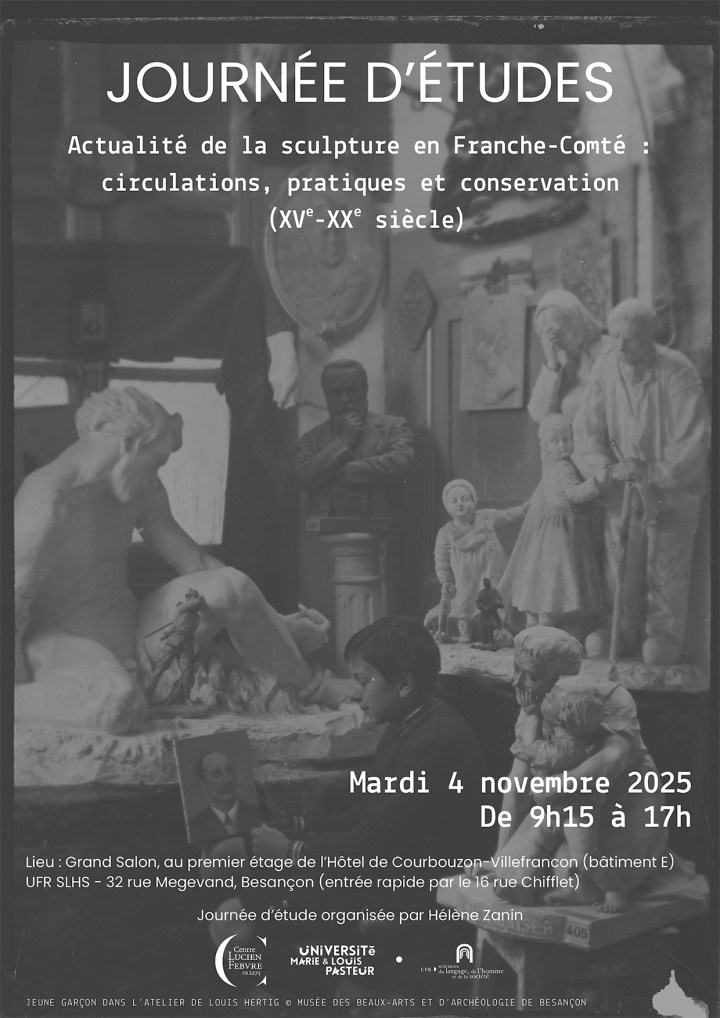 Inscription et lien de visioconférence disponible sur demande: helene.zanin@umlp.fr
9.15 Introduction, Hélène Zanin (Université Marie et Louis Pasteur / Centre Lucien Febvre)
9.30 Actualité de la sculpture des XVe et XVIe siècles
Modération: Sandra Bazin-Henry (Université Marie et Louis Pasteur / Centre Lucien Febvre)
• Matthieu Fantoni (musée Fabre), en visioconférence — Retour d’expérience sur la restauration de La Pietà de Conrad Meit à la cathédrale de Besançon, 2019–23
• Thomas Flum (Université Marie et Louis Pasteur / Centre Lucien Febvre) — La Pietà de Conrad Meit et l’originalité du choix iconographique
• Lola Fondbertasse (musées de Dijon) — Quelques réflexions sur la sculpture bourguignonne du XVe siècle: Le projet d’exposition du musée des Beaux-Arts de Dijon
11.00 Pause
11.15 Sculptures et monuments des XIXe et XXe siècles: études et protection
Modération: Sara Vitacca (Université Marie et Louis Pasteur / Centre Lucien Febvre)
• Justine Vigneres (DRAC Bourgogne-Franche-Comté) et Michaël Vottero (DRAC Bourgogne-Franche-Comté), en visioconférence — Découvertes et protections récentes au titre des monuments historiques de sculptures du XIXe siècle en Bourgogne-Franche-Comté
• Charlotte Leblanc (DRAC Occitanie), en visioconférence — La protection des statuaires monumentales de Belfort: étude du groupe Quand Même d’Antonin Mercié
12.45 Pause déjeuner
14.15 Sociabilités, circulation et carrière des artistes
Modération: Claire Maingon (université Bourgogne-Europe / LIR3S)
• Virginie Guffroy (musée du Louvre) — Les réseaux de sociabilités d’un sculpteur bisontin, l’exemple de Luc Breton (1731–1800)
• Grégoire Extermann (Haute école spécialisée de la Suisse Italienne – SUPSI / Fonds National Suisse pour la recherche scientifique) — Nul n’est prophète en son pays: James Pradier et la sculpture à Genève au XIXe siècle
15.20 Pause
15.30 Œuvres multiples et leurs usages
Modération: Hélène Zanin (Université Marie et Louis Pasteur / Centre Lucien Febvre)
• Emy Faivre (Université Marie et Louis Pasteur / ISTA) — Modèles pour apprendre: Circulation et réception des plâtres dans les écoles d’art de Franche-Comté, XIXe–XXIe siècles
• Virginie Frelin-Cartigny (Musée des Beaux-Arts et d’Archéologie de Besançon) — Louis Hertig: Découverte de l’œuvre d’un sculpteur à travers la photographie
Fin de la journée vers 17h
Kit Maxwell to Lead Applied Arts of Europe at the Art Institute of Chicago
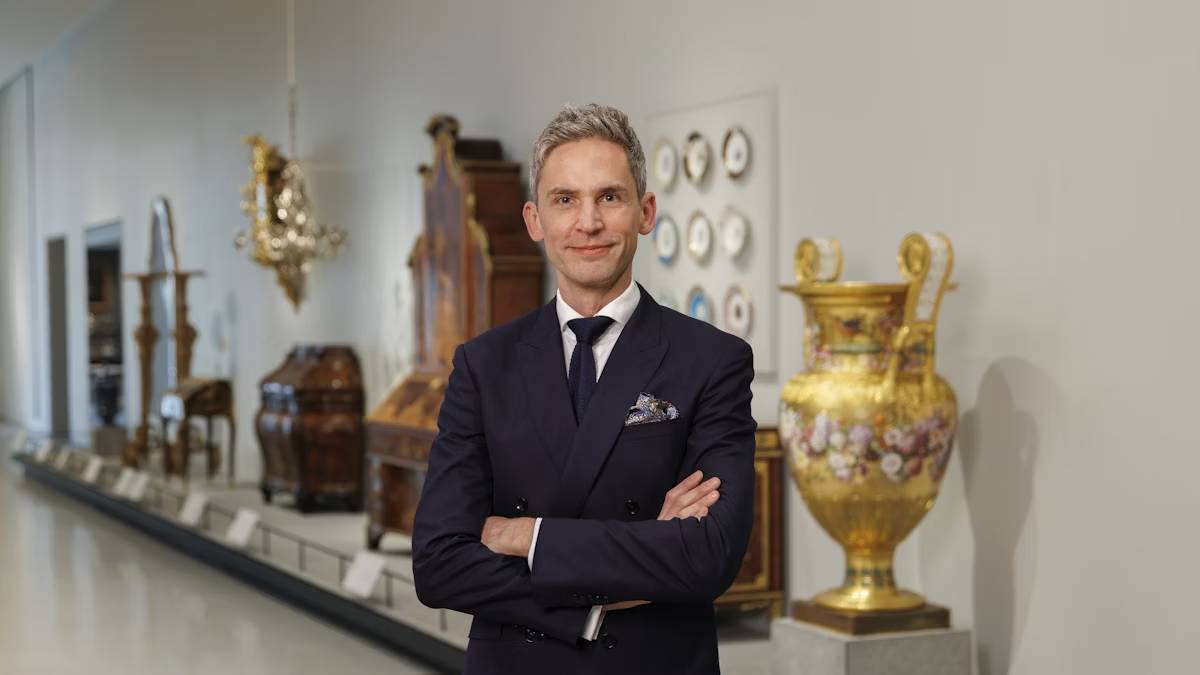
Kit Maxwell is the new Chair and Eloise W. Martin Curator of Applied Arts of Europe at the Art Institute of Chicago.
◊ ◊ ◊ ◊ ◊
From the AIC press release (13 October 2025) . . .
The Art Institute of Chicago is pleased to announce the appointment of Dr. Christopher (Kit) Maxwell to the position of Chair and Eloise W. Martin Curator of Applied Arts of Europe. In his role, Kit will lead the Applied Arts of Europe Department through continued gallery enhancements, strategic acquisitions, and dynamic gallery rotations. He has taken on this role upon Ellenor Alcorn’s retirement from the position.
Kit joined the museum in 2022 as the Samuel and M. Patricia Grober Curator of the department. He brought expertise in European ceramics and glass with a special interest in the impacts of global trade and colonial expansion on the development of European design. Through his work, Kit has contributed to the growth and development of the Applied Arts of Europe department, expanding the stories we tell through acquisitions and collection research.
“In just a few years, Kit has had a significant impact on the museum and the department,” said James Rondeau, President and Eloise W. Martin Director at the Art Institute of Chicago. “His work and collaboration played an essential role in the spectacular redesign of the recently opened Eloise W. Martin Galleries. We look forward to how his vision, expertise, and dedication will continue to build on the momentum of the department.”
The new Applied Arts of Europe galleries opened in July after a multi-year redesign project. The galleries present more than 300 objects from the Art Institute’s outstanding collection of furniture, silver, ceramics, and glass made between 1600 and 1900 and feature a new design vocabulary with cutting-edge casework and lighting. Working closely with Ellenor Alcorn, renowned Barcelona-based architectural firm Barozzi Veiga, and other colleagues, Kit co-curated this elegant installation to showcase the creativity and innovation that defined European design during an era of extraordinary transformation.
“I feel honored to have had the opportunity to work with Ellenor during her time at the museum and benefitted enormously from her incredible experience and generous collegiality,” said Kit Maxwell. “This department has so much to offer visitors—from the Thorne Miniature Rooms to the newly designed ceramics gallery—and I’m thrilled to have the opportunity to engage with our audiences in new and exciting ways.”
Prior to the Art Institute, Kit served as curator of early modern glass at the Corning Museum of Glass where he was responsible for collections from about 1250 to 1820, and researched innovations of 18th-century British glass and its relationship to global trade and colonial expansion. His 2021 exhibition at Corning, In Sparkling Company: Glass and the Costs of Social Life in Britain during the 1700s shed new light on the significance of glass in domestic, court, commercial, and scientific settings. Before the Corning Museum of Glass, Kit worked in several different capacities at the Royal Collection Trust, and from 2005 through 2010 he held the position of assistant curator in the Ceramics and Glass Section at the Victoria and Albert Museum.
Kit received his BA in the History of Art from University of Cambridge, his MA in Decorative Arts from University of London, and his PhD from University of Glasgow. His recent post-doctoral work includes a research degree in Nazi-era Provenance at the University of Glasgow, and another in Caribbean Studies at the University of Warwick.
Expanded V&A Gilbert Galleries to Open in March 2026
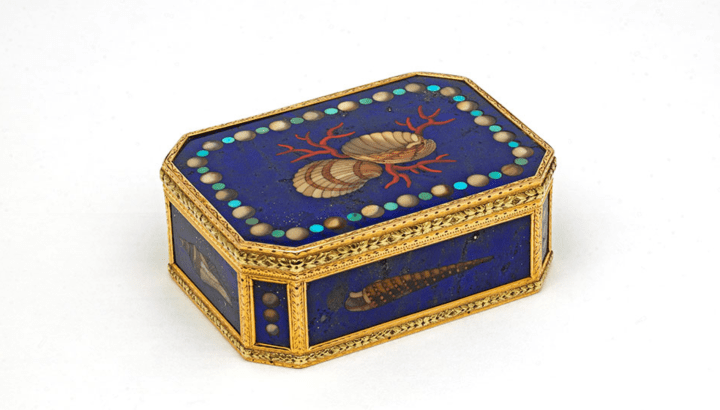
Rectangular, gold-mounted commessi di pietre dure (stone mosaics) snuffbox depicting shells and coral, Florence, Grand Ducal workshops, ca.1800
(The Rosalinde and Arthur Gilbert Collection on loan to the V&A)
◊ ◊ ◊ ◊ ◊
From the press release:
The Victoria and Albert Museum will double the size of its Gilbert Galleries in March 2026, unveiling seven newly transformed rooms dedicated to one of the world’s most dazzling collections of decorative arts. The free galleries will showcase masterpieces of silver, enamel, gold boxes, stone and glass micromosaics—including a monumental table-top made by Michelangelo Barberi for Tsar Nicholas I of Russia, newly revealed after pioneering laser cleaning by V&A conservators.
The transformation of the original gallery space will create the museum’s first double aspect gallery, overlooking both the John Madejski Garden and the Exhibition Road Quarter. The new gallery spaces have been achieved by incorporating adjacent former offices, re-opening historic brick archways and embracing natural sustainability through the reinstatement of original Victorian solar shading. As the only permanent V&A galleries devoted to a private collection the Gilbert Galleries offer a rare insight into the art of collecting and its role in shaping museums.
The new Gilbert Galleries have been designed by Citizens Design Bureau, the award-winning practice founded by Katy Marks, in their first collaboration with the V&A. The reopening marks the latest milestone in FuturePlan, the V&A’s ambitious programme of development at the South Kensington site which has transformed over 85% of the Museum’s public spaces in the past 15 years. FuturePlan combines world-class design with the restoration of the original building, creating inspiring new settings for the collections and ensuring greater access for all.
The galleries will showcase one of the world’s largest collections of glass micromosaics, now with a dedicated space allowing the majority of the objects in the Gilbert Collection to be seen together for the first time. Going on display for the very first time at the V&A are two large scale views of Rome by the master, Domenico Moglia. The large-scale format plaques, first shown in the UK at the Great Exhibition of 1851, depict views of the ruined Colosseum and the Roman Forum, intricately made with tiny pieces of coloured glass, some of only a few millimetres square. The glass micromosaic technique was developed in the 18th century in the Vatican Mosaic Workshop, which is still active today.
Over 200 gold boxes will take centre stage in a new room, displayed in the round to showcase their exquisite three-dimensional craftsmanship. Highlights include diamond-set snuffboxes commissioned by Frederick ‘the Great’ II of Prussia, including a mother-of-pearl box selected for the collection by Rosalinde Gilbert herself—offering a new lens on her role as collector and her career as a couture designer in London. Across the galleries, multisensory experiences will bring the collection to life—from touchable samples of rare stones to custom-blended scents—with extensive consultation ensuring inclusive design for neurodiverse visitors and those living with dementia. The galleries will also spotlight important new research into provenance. A dedicated room explores Nazi and Soviet looting, including the redisplay of two pairs of silver-gilt gates once taken from Kyiv-Pechersk Lavra monastery—the only examples of their kind outside the Orthodox world.
Tristram Hunt, Director of the V&A, said: “The Gilbert Galleries honour the transformative philanthropy of Rosalinde and Arthur Gilbert, celebrate some of the most exquisite works of art ever made, and now also explore the fascinating and sometimes complex histories behind them. As part of our FuturePlan transformation, this project combines cutting-edge design, pioneering conservation and the restoration of V&A South Kensington’s historic spaces to inspire creativity in every visitor.”
Alice Minter, Senior Curator of the Rosalinde & Arthur Gilbert Collection, said: “The Gilbert Collection is a feast for the eyes—from dazzling stone and glass mosaics and jewelled gold boxes to masterpieces of silver and enamel. With these new galleries, we can share the artistry of these extraordinary objects in more depth than ever before, while also asking important questions about their histories and journeys. It’s a chance for visitors to get closer to beauty, brilliance and craftsmanship on an intimate scale, but also to discover the personal stories of Rosalinde and Arthur Gilbert as collectors.”
Sir Arthur Gilbert (1913–2001, knighted in 2001) and his first wife Rosalinde (1913–1995) began their careers as fashion entrepreneurs in wartime London, showing at the V&A’s Britain Can Make It! exhibition in 1946 before moving to Los Angeles in 1949, where Arthur became a successful property developer. Their Beverly Hills home inspired a passion for historic objects, and from the 1960s they built an extraordinary collection of silver, gold boxes, enamel portrait miniatures and stone and glass mosaics, many once owned by figures such as Queen Charlotte, Tsarina/ Empress Catherine II of Russia, Frederick ‘the Great’ II of Prussia, Napoleon Bonaparte, Sir Robert and Horace Walpole, the Churchill and the Rothschild families. The collection was transferred to Great Britain in 1996 and has been in the care of the V&A since 2008.
New Book | Americana Insights, Pennsylvania German Redware
From Penn Press:
Lisa Minardi, ed., Americana Insights 2025 (Philadelphia: University of Pennsylvania Press, 2025), 300 pages, ISBN: 979-8988533122, $65. With contributions by Johanna Brown, Laini Farrare, R. Erich Hess, Christopher Malone, Lisa Minardi, Karl Pass, Candace Perry, Jeffrey Pressman, Jean Renshaw, Justin Thomas, and Adam Zayas.
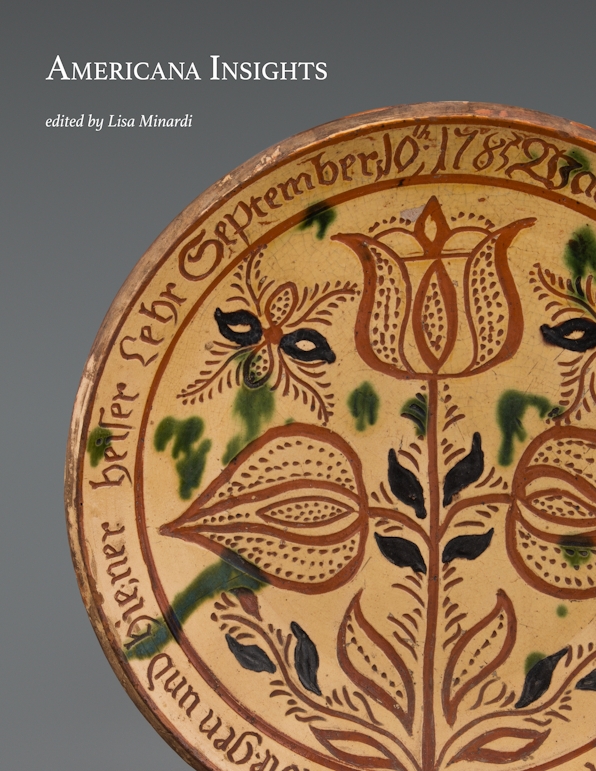 A comprehensive study of Pennsylvania German redware and a celebration of this vibrant folk art tradition
Americana Insights 2025 is the third volume in an annual series that presents the latest research and discoveries on traditional Americana, folk art, and material culture. In this volume the authors explore a beloved aspect of American folk art—Pennsylvania German redware. Focusing on redware’s production, use, and collecting in southeastern Pennsylvania from the mid-eighteenth to early twentieth century, the authors provide fresh insights into renowned potters such as Georg Hubener and Samuel Troxel as well as lesser-known figures. Other essays delve into the work of twentieth-century potters like Jacob Medinger, considered the last of the traditional Pennsylvania German potters, and Mildred Keyser, a pioneering revivalist potter. The authors also explore broader themes, including the use of political imagery and hunting iconography, and redware’s role in cultural exchange between Anglo-Americans and Pennsylvania Germans. A celebration of this vibrant folk art tradition and a vital scholarly contribution, Americana Insights 2025 represents the most comprehensive study of Pennsylvania German redware in more than a century.
Lisa Minardi is a curator and scholar of Pennsylvania German art and culture. She has organized numerous exhibitions and published extensively and was assistant curator at Winterthur Museum from 2006 to 2016. Minardi currently serves as executive director of Historic Trappe and the Center for Pennsylvania German Studies. She is a PhD candidate in the History of American Civilization Program at the University of Delaware, where she is researching the German-speaking community of early Philadelphia for her dissertation. She holds an MA from the Winterthur Program in Early American Culture and a BA in history and museum studies from Ursinus College.
Turner’s ‘Battle of Trafalgar’ Back on Display at Greenwich
◊ ◊ ◊ ◊ ◊
From the press release (via Art Daily) . . .
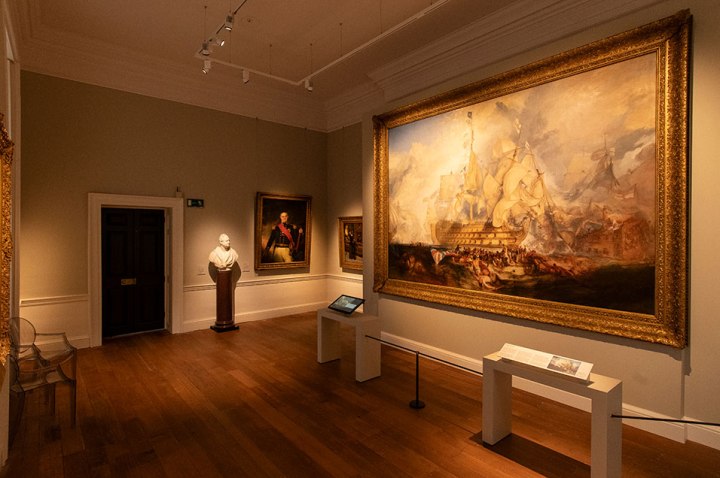
2025 marks the 250th anniversary of the birth of Joseph Mallord William Turner (1775–1851), one of Britain’s most admired Romantic painters. To commemorate this landmark anniversary, the National Maritime Museum is returning one of Turner’s most important masterpieces to display in the Queen’s House. The Battle of Trafalgar will be on public display from 21 October 2025, 220 years to the day since the Battle of Trafalgar.
Measuring more than three metres across, The Battle of Trafalgar is the largest painting that Turner ever completed. It commemorates the most decisive naval action of the Napoleonic Wars, the victory of the British Royal Navy over a combined French and Spanish fleet off Cape Trafalgar on 21 October 1805. The painting was made for King George IV in 1824—Turner’s only royal commission. It initially attracted criticism from naval officials, who complained about factual inaccuracies, but it was later acclaimed as a highlight of the Naval Gallery—a popular public art gallery set within the grounds of the Royal Hospital for Seamen at Greenwich.
In The Battle of Trafalgar, Turner captures the human drama of the action, from the struggles of the ordinary sailors to the fatal wounding of their commander, Vice-Admiral Horatio Nelson. The finished composition is a symbolic amalgamation of different moments in the battle. Nelson’s flagship, Victory, is depicted on an exaggerated scale, an artistic decision intended to emphasise the might of British naval power. The ship’s falling foremast, bearing the vice-admiral’s flag, symbolises Nelson’s demise. The signal flags spell the final three letters of ‘duty’, referencing both Nelson’s famous order, “England expects every man to do his duty,” and some of his dying words, “Thank God I have done my duty.”
The French ship Redoubtable, from which the fatal shot came, foundered in a storm after the battle but is depicted sinking in the thick of the action. In compressing the timeline, Turner emphasised the defeat of the Franco-Spanish fleet. However, while celebrating Britain’s triumph, Turner did not shy away from the brutal realities of naval warfare and encouraged respect and sympathy for sailors manning the ships on both sides of the conflict. In the centre of the image, at what would have been eye level when the painting was first displayed in St James’s Palace, the lifeless eyes of a dead seafarer gaze out. The Latin word ‘ferat’ appears in the water beside him, recalling Nelson’s motto, Palam qui meruit ferat (‘Let him who has earned it bear the Palm’). The palm referenced in the motto was a traditional symbol of victory, but the sailor’s suffering undermines this noble ideal of glory.
 In 1829, George IV had Turner’s The Battle of Trafalgar transferred from St James’s Palace to the Naval Gallery. Greenwich Hospital, where the gallery was situated, provided accommodation for elderly and disabled naval veterans, many of whom had served at Trafalgar. This made it a fitting home for Turner’s painting, given its emphasis on the labour and suffering of common sailors.
The painting was taken off display in March 2024 to protect it during a capital project at the National Maritime Museum. Its new home places it within the heart of the Museum’s fine art collection in the Queen’s House art gallery. It will be displayed alongside artworks from the Museum’s collection that tell the story of its journey from St James’s Palace to the Naval Gallery at Greenwich.
A new book has also been published celebrating this exceptional artwork. J.M.W. Turner’s The Battle of Trafalgar: Commemoration and Controversy is part of Royal Museums Greenwich’s new Spotlight series. Curator Katherine Gazzard considers the challenges that Turner faced during the creation of the painting, the public response to it and the fascinating history that led to its place at the centre of a national art collection.
Katherine Gazzard, J.M.W. The Battle of Trafalgar: Commemoration and Controversy (Greenwich: Royal Museums Greenwich, 2025), 96 pages, ISBN: 978-1068765995, £13.
Prado Acquires Pendant Paintings by François Boucher
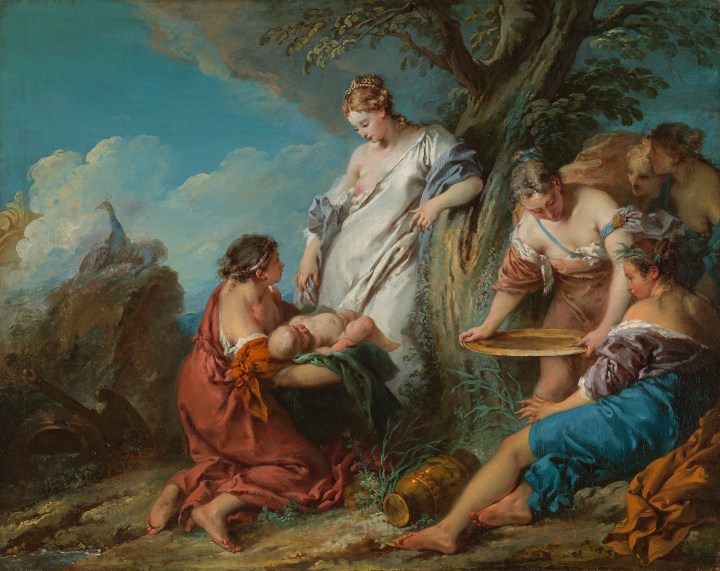
François Boucher, The Birth of Adonis, early 1730s, oil on canvas
(Prado: Museo Nacional del Prado)
◊ ◊ ◊ ◊ ◊
From the press release, via Art Daily:
The lavish, sensual world of French Rococo just got brighter in Madrid. The Museo Nacional del Prado has announced a major acquisition that cements its standing as a premier destination for 18th-century art: two exceptional mythological paintings by François Boucher, the undisputed star of the era. The newly acquired works, The Birth of Adonis and The Death of Adonis, offer a crucial glimpse into the early genius of Boucher (1703–1770), who would later become the court decorator par excellence for Louis XV and the favorite painter of Madame de Pompadour.
The two canvases, which cost €2.2 million, were purchased using funds generated by the generous bequest of Juan José Luna Fernández, a beloved former Prado curator and a pivotal scholar of French painting who passed away in 2020. His legacy—a Madrid home auctioned for €3.2 million—now beautifully bridges a research past with the museum’s artistic future.
Boucher’s interpretation of the Adonis myth—which blends love, tragedy, and eroticism in delicate pastoral settings—was perfectly suited to the refined taste of the Rococo. With the acquisition, the Prado can now tell a richer, more complete story of the artist. In The Birth of Adonis, Boucher captures the myth’s genesis, showing the sorrowful transformation of Myrrha into a tree, from which Adonis is born. The Death of Adonis, conversely, develops the tragic farewell scene between the goddess Venus and her lover after he is fatally wounded by a wild boar.
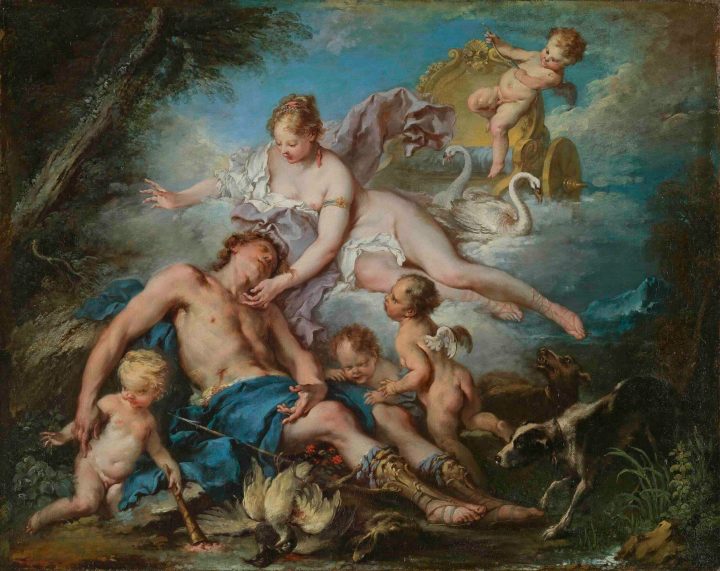
François Boucher, The Death of Adonis, early 1730s, oil on canvas
(Prado: Museo Nacional del Prado)
◊ ◊ ◊ ◊ ◊
These pieces were painted on the same bolt of canvas early in Boucher’s career, shortly after his return from Italy in 1731. They display a technical fluidity influenced by his predecessors Antoine Watteau and Sebastiano Ricci. The recent restoration not only brightened the luminous colors characteristic of Boucher but also revealed visible changes and the artist’s signature, confirming the works’ authenticity and offering a window into his creative process. The new paintings join another important Boucher work in the collection, Pan and Syrinx, which Luna was instrumental in acquiring in 1985. The newest additions powerfully expand the Prado’s representation of the Rococo master, complementing his mature style with a view of his formative years.
While Boucher’s glamorous, optimistic style—characterized by graceful lines and light color—was the height of courtly fashion across Europe, his works are comparatively scarce in Spanish collections. Historically, the Spanish Bourbon court favored Italian art or the stricter Neoclassicism championed by artists like Mengs. Boucher’s focus on gallant and mythological themes simply contrasted with the predominantly religious and historical tastes of the Spanish monarchy, meaning his major works largely remained tied to French aristocratic commissions. This acquisition, therefore, is not just a triumph of taste but an important historical correction. It gives the Spanish public access to the visual language of the 18th century’s great narrator and pays a final, fitting tribute to the curator who tirelessly championed his work.
To mark the occasion, Françoise Joulie, the world’s leading specialist on Boucher, will deliver a conference on November 12th at the Prado auditorium, inviting the public to delve deeper into the seductive genius of the artist who truly defined the spirit of the Ancien Régime.
Society of Antiquaries of London Launches Fundraising Series
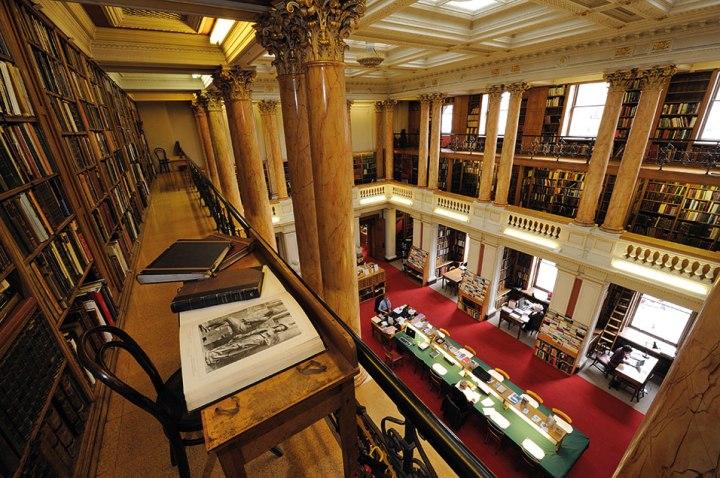
Library of the Society of Antiquaries of London, Burlington House.
◊ ◊ ◊ ◊ ◊
From the press release, via Art Daily:
The Society of Antiquaries has launched a series of fundraising events Past Matters: Shaping Our Future at Burlington House in support of the Society’s bold vision to transform its historic home into a world-leading centre for the study of heritage. The talks series will take place from 28 October to 19 November 2025 with tickets now available to buy online. These autumn events will enable the Society to commission architectural plans to shape the Society’s future at Burlington House and increase access to the vast collections, expand the Society’s research and education programmes, and create dynamic new spaces for exhibitions, seminars, and events. This will ensure that Burlington House remains a place of inspiration, scholarship, and discovery for generations to come.

George Vertue, Lady Jane Grey, 1748, engraving.
Alongside the talks, Abbott & Holder (30 Museum Street, opposite the British Museum) will sell some early engravings by George Vertue for the Society of Antiquaries from 21 October until December 2025. Seven prints of the 18th-century engravings made from plates by the Society’s first official engraver, George Vertue (1684–1756), all duplicates with copies still part of the Society’s Collection, will be for sale with 65% of the sale price going to the Society. The enterprising Vertue combined his work for the Society with illustrious private commissions and the production of independent engravings, which he sold from his shop in Drury Lane. His ‘tablatures’ of historical royal portraits were ‘collected, drawn, and engraved from ancient original pictures’.
Natasha McEnroe FSA, General Secretary and CEO of the Society of Antiquaries of London, says: “Thanks to our kind sponsors so far we have raised £1.3 million (27%) of the £4.8m cost of the Society’s 999-Year Lease. We invite supporters to sponsor our home in square feet:£500 cover a square foot of Burlington House, while ‘Foundation 1707 Sponsors’ will sponsor four square feet of Burlington House with £2,000 (costs can be spread with monthly Direct Debits). Our supporters will all get a special ‘Bond of Support’ designed by British artist Adam Dant.”
All events cost £30 per person, with tickets available on the Society’s website. Geoffrey Munn’s Halloween talk can also be followed online at a cost of £6. The Society is collaborating with the St. James’s Hotel & Club for the Past Matters season and supporters are able to enjoy a special three-course lunch offer of £30 including a glass of bubbly and event attendees can exclusively enjoy a 20% discount on the exquisite art-inspired afternoon tea by showing their ticket confirmation. The hotel is just across the road in St James’s; pre-booking is essential and the offers are available until 30 November; they can be booked here.
Sale of Early Engravings of the Society of Antiquaries at Abbot & Holder
October — December
From 21 October we are offering seven prints of engravings made from plates by the Society’s first official engraver, George Vertue (1684–1756) for sale with the gallery Abbott & Holder.
Royal Patrons and Collectors in the 20th Century, from King Edward VII to Queen Elizabeth II
Tuesday, 28 October, 6pm
Join Tim Knox FSA, Director of the Royal Collection, for a lively exploration of royal taste and patronage from Edward VII to Queen Elizabeth II.
Myth and Magic: A 16th-Century Charmstone and Its Links to the Society of Antiquaries
Friday, 31 October, 6pm
On Halloween night, join Geoffrey Munn OBE FSA, as he unveils the extraordinary tale of a mysterious 16th-century rock crystal charmstone.
Drawn to Discovery at the Antiquaries
Thursday, 6 November, 5pm
An evening reception with Abbott & Holder at the Antiquaries for a curated selection of highlights from the Society’s remarkable collection of over 55,000 prints and drawings from the 17th to 20th centuries.
Hats off to Tradition: Tales from The Cocked Hat Club
Wednesday, 19 November, 6pm
Roll up! Roll up! Join us for a unique evening that lifts the lid on one of the most curious—and least known—aspects of the ‘Old Lady’, as the Society of Antiquaries is affectionately known.
Call for Articles | Queerness in 18th- and 19th-C. European Art
From ArtHist.net and Arts:
Queerness in 18th- and 19th-Century European Art and Visual Culture, 2nd Edition
Special issue of the journal Arts, guest edited by Andrew Shelton
Abstracts due by 15 January 2025; final manuscripts will be due by 1 July 2026
Essays regarding a wide variety of topics that subvert or disrupt heteronormative interpretations of the art and visual culture of this period are welcome, including the works of art produced by or under the auspices of personages who can plausibly be identified as attracted to members of the same sex; works or creative situations that can be construed as expressing or eliciting same-sex sexual desire or attraction; works or creative situations in which the heteronormative polarity of the processes of identification and desire can be perceived as having been collapsed or scrambled; works or creative situations that involve gender-bending or gender fluidity; works or creative situations that either deepen or complicate our understanding of sexuality and/or sexual identity during the 18th and 19th centuries; and works that eroticize individuals or situations that are normally regarded as lying outside the realm of the erotic.
Arts is an international, peer-reviewed, open access journal promoting significant research on all aspects of the visual and performing arts, published bimonthly online by MDPI.
Submission Planning
• Abstracts due by 15 January 2025, submission link for abstracts.
• Final manuscripts due by 1 July 2026, submission link for full articles.
Submission Criteria
• Abstract and a short biography should be sent to Andrew Shelton (shelton.85@osu.edu) and Sylvia Hao (sylvia.hao@mdpi.com).
• Final articles, in English only, should be at least 4000 words long; a 150-word abstract and 5 keywords should also be submitted.
• Authors can include image files (tables, maps, graphs, photographs …) in ..jpg; they should ensure that images are free of rights (or that rights have been obtained).
• Each article will be peer-reviewed by at least two anonymous referees.
For inquiries, please contact: Sylvia Hao (sylvia.hao@mdpi.com) and Editorial Office of Arts (arts@mdpi.com).
Symposium | Vanbrugh from Stage to Stone
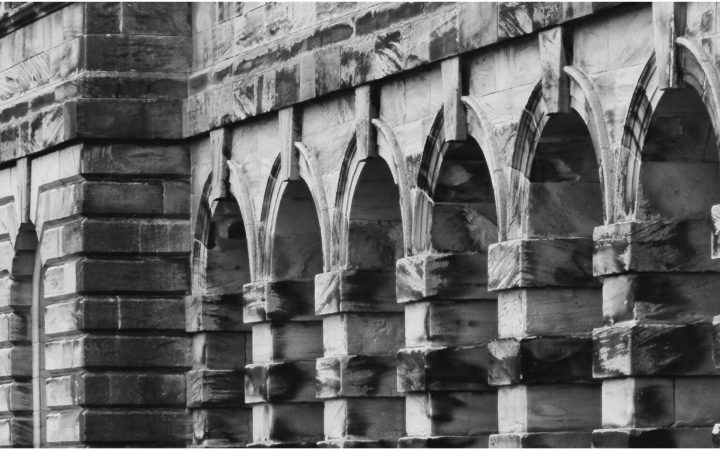
Sir John Vanbrugh, Seaton Delaval Hall, Northumberland, near Newcastle, 1718–28. Ravaged by fire in 1822, it is now owned by the National Trust.
◊ ◊ ◊ ◊ ◊
Next spring at the University of Cambridge:
Vanbrugh from Stage to Stone
Howard Theatre, Downing College, Cambridge, 27 March 2026
This international academic conference will explore the impact and legacy of Sir John Vanbrugh. The event marks the tercentenary of Vanbrugh’s death in March 1726 and forms part of the Vanbrugh300 festival for 2026, organised by The Georgian Group, the conservation organisation founded in 1937 to protect and promote Georgian buildings.
For those requiring hotel accommodations, there are two options nearby: the Regency Guesthouse, an independent boutique hotel, and the University Arms, a luxury hotel located directly across Regent Street from Downing College.
This conference is organised by the Ax:son Johnson Centre for the Study of Classical Architecture (CSCA) at the University of Cambridge in partnership with The Georgian Group.
Registration is now open via The Georgian Group website.
p r o g r a m m e
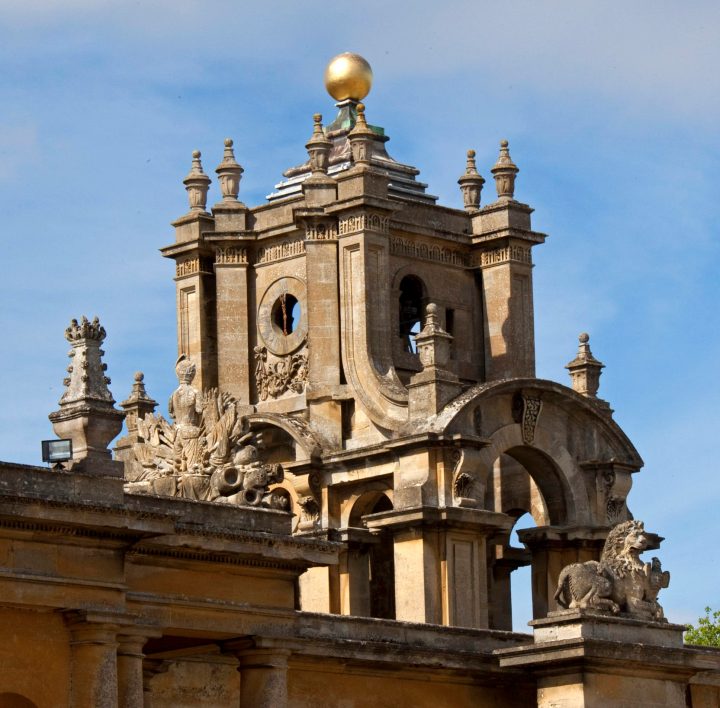
Detail of Blenheim Palace (Photo by Tony Hisgett CC BY-SA 2.0).
9.00 Registration breakfast with tea and coffee
9.45 Introductory Remarks — Frank Salmon (CSCA) and Anya Lucas (The Georgian Group)
10.00 Session 1 | Vanbrugh: The Writer and Herald
Chair: Charles Saumarez Smith
• Christopher Ridgway — Sir John Vanbrugh: The Letters of a ‘Great and Versatile Character’
• Annette Rubery — ‘I confess I have not at all stuck to the original’: John Vanbrugh as Translator and Adaptor
• David Roberts — The Playwright in Print
• James Peill — Vanbrugh as Herald
11.15 Coffee and tea
11.45 Session 2 | Vanbrugh: The Architect and Politician
Chair: Charlotte Davis
• Matthew Wood — Weighing Scales of Power? The State Apartments at Castle Howard
• Susie West — Vanbrugh and the Country House Plan
• Rory Fraser — John Vanbrugh: The Politician behind the Polymath
13.00 Lunch
14.00 Session 3 | Vanbrugh’s Network
Chair: Elizabeth Deans
• Melanie Hayes and Andrew Tierney — Building Relations: Collaboration, Achievement, and Artisanal Agency in Vanbrugh’s Architectural Practice
• Helen Lawrence-Beaton — Parallel Careers and Building Neighbours: The Relationship between Vanbrugh and Thomas Archer
• James Legard — Vanbrugh/Hawksmoor: The Graphic Anatomy of an Architectural Partnership
15.00 Tea and cake
15.30 Session 4 | Vanbrugh at Stowe
Chair: Frank Salmon
• Tom Nancollas — Vanbrugh’s Sleeping Parlour: Anatomy of a Lost Folly
• Michael Bevington — Vanbrugh’s Innovative Architectural Reconstructions at Stowe
• Francis Terry — Vanbrugh’s Design for Stowe
16.30 Break
16.45 Panel Discussion | Vanbrugh’s Influence
Chair: Matthew Walker
• Jeremy Musson, Frances Sands, and Owen Hopkins
17.30 Champagne reception










 Enfilade
leave a comment