New Book | Conchophilia
From Princeton UP:
Marisa Anne Bass, Anne Goldgar, Hanneke Grootenboer, and Claudia Swan, with contributions by Stephanie Dickey, Anna Grasskamp, and Róisín Watson, Conchophilia: Shells, Art, and Curiosity in Early Modern Europe (Princeton: Princeton University Press, 2021), 224 pages, ISBN: 978-0691215761, £40 / $50.
 Among nature’s most artful creations, shells have long inspired the curiosity and passion of artisans, artists, collectors, and thinkers. Conchophilia delves into the intimate relationship between shells and people, offering an unprecedented account of the early modern era, when the influx of exotic shells to Europe fueled their study and representation as never before. From elaborate nautilus cups and shell-encrusted grottoes to delicate miniatures, this richly illustrated book reveals how the love of shells intersected not only with the rise of natural history and global trade but also with philosophical inquiry, issues of race and gender, and the ascent of art-historical connoisseurship.
Shells circulated at the nexus of commerce and intellectual pursuit, suggesting new ways of thinking about relationships between Europe and the rest of the world. The authors focus on northern Europe, where the interest and trade in shells had its greatest impact on the visual arts. They consider how shells were perceived as exotic objects, the role of shells in courtly collections, their place in still-life tableaus, and the connections between their forms and those of the human body. They examine how artists gilded, carved, etched, and inked shells to evoke the permeable boundary between art and nature. These interactions with shells shaped the ways that early modern individuals perceived their relation to the natural world, and their endeavors in art and the acquisition of knowledge. Spanning painting and print to architecture and the decorative arts, Conchophilia uncovers the fascinating ways that shells were circulated, depicted, collected, and valued during a time of remarkable global change.
Marisa Anne Bass is Professor of Northern European Art, 1400–1700 at Yale University. Her books include Insect Artifice and Jan Gossart and the Invention of Netherlandish Antiquity. Anne Goldgar is the Garrett and Anne Van Hunnick Professor of European History at the University of Southern California. Her books include Tulipmania and Impolite Learning. Hanneke Grootenboer is Professor of the History of Art and Chair of the department at Radboud University Nijmegen. Her books include Treasuring the Gaze and The Pensive Image. Claudia Swan is the Mark S. Weil Professor of Art History and Archaeology at Washington University in St. Louis. Her books include Art, Science, and Witchcraft in Early Modern Holland and Rarities of These Lands.
C O N T E N T S
Anne Goldgar — Introduction: For the Love of Shells
Part I: Surface Matters
1 Claudia Swan — The Nature of Exotic Shells
2 Anna Grasskamp — Shells, Bodies, and the Collector’s Cabinet
Part II: Microworlds of Thought
3 Marisa Anne Bass — Shell Life, or the Unstill Life of Shells
4 Hanneke Grootenboer — Thinking with Shells in Petronella Oortman’s Dollhouse
Part III: The Multiple Experienced
5 Róisín Watson — Shells and Grottoes in Early Modern Germany
6 Stephanie S. Dickey — Shells, Prints, and the Discerning Eye
Acknowledgments
Notes
Bibliography
Contributors
Index
Illustration Credits
Print Market | Mad about Mezzotint at the Court of George III
From Isaac and Ede:
Mad about Mezzotint at the Court of George III
Reindeer Antiques, London, 6 October — 5 November 2021
 This exhibition organized by David Isaac of Isaac and Ede celebrates the bicentenary of the 60-year reign of King George III (1738–1820) through one mezzotint portrait for each year of his reign. Meet the movers and shakers, the courtiers and courtesans, the duchesses and dandies of the period. Each mezzotint was printed in the year it represents, so there are 61 prints to cover the years 1760–1820 with a couple of extras thrown in for good measure. Royalty and aristocracy dominate throughout the opening decades, but as the country finds itself increasingly at war with America, France, Spain (and practically everyone else), we see a predominance of naval and military heroes taking centre stage. Towards the end of our period, we begin to see the emergence of the self-made man, and the entrepreneurial spirit of that would come to symbolize the Victorian era. To be held at Reindeer Antiques, 81, Kensington Church Street, London W8 4BG.
Printed catalogues are available: UK £30 including P&P / USA £47 including P&P. View a PDF of the catalogue on Issuu. The catalogue is also distributed by Paul Holberton Publishing:
David Isaac, Mad about Mezzotint at the Court of George III (London: Isaac and Ede, 2022), 148 pages, ISBN 978-1913645359, £30.
◊ ◊ ◊ ◊ ◊
Note (added 6 July 2022) — The original posting did not include catalogue details from PHP.
Exhibition | Aquatint: From Its Origins to Goya
From the NGA:
Aquatint: From Its Origins to Goya
National Gallery of Art, Washington, D.C., 24 October 2021 — 21 February 2022
Curated by Rena Hoisington
 A new printmaking technique—aquatint—swept through 18th-century Europe, yielding an extraordinary range of works, from images of erupting volcanoes, amorous couples, and mysterious tombs, to Russian exotica, biting caricatures, and moonlit vistas. The first American exhibition to survey the medium’s development in France, England, Italy, Germany, the Netherlands, and Spain, Aquatint: From Its Origins to Goya presents some 100 early and exceptional impressions, many of which have recently been acquired by the National Gallery of Art. By supplementing the line work of etching, aquatint offered an exciting method for multiplying ink-and-wash drawings that render tone in subtle ways.
Aquatint flourished outside the official circles of European art academies in the hands of three kinds of artists—professional printmakers, amateurs (art lovers), and peintre-graveurs (painter-printmakers). Each played a distinctive and significant role in publicizing, disseminating, and advancing the aquatint medium. Professional printmakers combined it with other intaglio printmaking techniques to reproduce highly prized drawings by old master and contemporary artists. Amateurs, an elite group of like-minded collectors, embraced drawing, etching, and aquatint to not only expand their art-historical and connoisseurial knowledge, but also cultivate relationships with artists. Peintre-graveurs revisited, re-created, and circulated their designs through aquatint to build their reputations and broaden their audiences, dramatically expanding the formal vocabulary and expressive potential of the medium.
Rena Hoisington, Aquatint: From Its Origins to Goya (Princeton: Princeton University Press, 2021), 288 pages, ISBN: 978-0691229799, $60.
Supported by the Eugene V. and Clare E. Thaw Charitable Trust and written by Rena M. Hoisington, curator and head of old master prints at the National Gallery of Art, a book illustrated with rare works from the National Gallery’s collection of early aquatints accompanies the exhibition. It provides an engaging narrative about the medium’s flourishing as a cross-cultural and cosmopolitan phenomenon that contributed to the rise of art publishing, connoisseurship, leisure travel, and drawing instruction as well as the spread of neoclassicism.
Exhibition | Goya

Francisco de Goya, Still Life with Golden Bream (Besugos), 1808–12, oil on canvas, 45 × 63 cm
(The Museum of Fine Arts, Houston, 94.245)
◊ ◊ ◊ ◊ ◊
Press release (via Art Daily) for the exhibition:
Goya
Fondation Beyeler, Basel, 10 October 2021 — 23 January 2022
Curated by Martin Schwander and developed by Isabela Mora and Sam Keller
275 years after his birth, the Fondation Beyeler presents one of the most significant exhibitions ever devoted to Francisco de Goya—one of modern art’s major trailblazers. For the first time, rarely displayed paintings from Spanish private collections will be shown alongside key works from distinguished European and American museums and private collections. The exhibition brings together around 70 paintings and more than 100 masterful drawings and prints. Today, as during the artist’s lifetime, Goya’s works present viewers with a unique sensory and intellectual experience. For the past two centuries, his complex and ambiguous oeuvre has acted as a beacon and a landmark for many artists. The exhibition is organised by the Fondation Beyeler in collaboration with the Museo Nacional del Prado in Madrid.
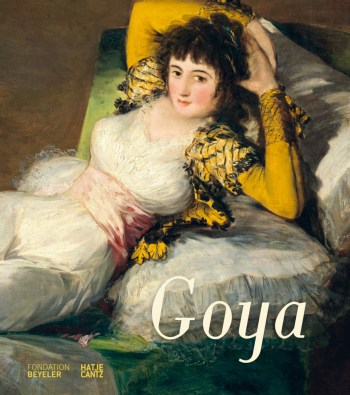 Francisco de Goya y Lucientes (1746–1828) occupies a paradoxical position in European art history as one of the last great court painters and a forerunner of the figure of the modern artist. In order to convey the uniqueness of Goya’s work, which spans a period ranging from Late Rococo to Romanticism, and do justice to the formal and thematic wealth of his painted, drawn, and printed oeuvre, the exhibition presents the full spectrum of genres and recurring motifs. Arranged chronologically, it features large-scale stately paintings as well as sketchbook pages, focussing on Goya’s late work.
The exhibition at the Fondation Beyeler presents both the established court painter and the inventor of enigmatic and disturbing pictorial worlds, his religious and his secular images, his depictions of Christ and of witches, portraits and history paintings, still lifes and genre scenes. Next to paintings commissioned by the royal family, the aristocracy and the bourgeoisie, the show features works created by Goya within a self-conquered space of artistic freedom, among them cabinet paintings often intended only for highly private display. With rebellious resolve, Goya was one of the first artists in the history of European art to push back against the rules and dogmas that constrained artistic creation, instead making a stand for artists’ impulse and inventiveness (‘capricho’ and ‘invención’). Highlights of the exhibition include the portrait of the Duchess of Alba (1795) and the iconic Clothed Maja (La maja vestida, 1800–07), as well as the rarely displayed Maja and Celestina on a Balcony and Majas on a Balcony (1808–12), the latter two on loan from European private collections.

Francisco Goya y Lucientes, María Amalia de Aguirre y Acedo, marquesa de Montehermoso, 1810, oil on canvas, 170 × 103 cm (Private Collection).
The exhibition will further feature small-format genre scenes, held for the most part in Spanish private collections and hitherto only rarely shown outside Spain. In these paintings—as in his drawings and prints—Goya gave free rein to his innermost inspiration. For the first time since their only display to date at the Museo Nacional del Prado, the Fondation Beyeler will thus show the full series of eight remaining history and genre pictures from the Madrid collection of the Marqués de la Romana. They will be joined by the four celebrated, rarely loaned panels with genre scenes from the Real Academia de Bellas Artes de San Fernando in Madrid.
In his genre scenes and history paintings, Goya depicts events from everyday life in Spain around 1800—socially, politically, and religiously troubled times. Recurring settings include markets and bullrings, prisons and ecclesiastical institutions, lunatic asylums, and the courts of the Inquisition. Depictions of witches are another key motif, used by Goya to expose the superstition of his time. Next to a group of etchings from The Disasters of War (Los desastres de la guerra, 1811–14), the exhibition will also feature a selection of prints from the 1799 Caprichos series, among them the celebrated plate no. 43, programmatically titled The Sleep of Reason Produces Monsters, which displays Goya’s resigned and melancholy realisation that neither reason nor irony and sarcasm can fight off irrationality. Goya’s enigmatic and unfathomable pictorial worlds have been held in high regard ever since the age of early 19th-century French Romanticism. Among modern artists, Pablo Picasso and Joan Miró, Francis Bacon and the Surrealists viewed Goya as a kindred spirit. And he remains a major reference for many contemporary artists, among them Marlene Dumas and Philippe Parreno.
Commissioned by the Fondation Beyeler, renowned French artist Philippe Parreno (b. 1964) has created a film based on Goya’s iconic Black Paintings series (Pinturas negras, 1819–24), which will premiere at the exhibition. The 14 murals were originally painted in Goya’s residence on the outskirts of Madrid and were most likely not intended for public viewing. Now in the collection of the Museo Nacional del Prado in Madrid, the paintings are so fragile that they cannot leave the museum.
For the first time, seldom seen paintings from Spanish private collections, some of which have not changed hands since the artist’s lifetime, are shown alongside key works from the most prestigious European and American museums and private collections. Works will be on loan from major museums such as the Museo Nacional del Prado, the Museo Thyssen-Bornemisza, the Fundación Lázaro Galdiano and the Fundación Casa de Alba, all in Madrid, the Musée du Louvre in Paris, the Metropolitan Museum of Art in New York, the National Gallery in London, the Gallerie degli Uffizi in Florence, the National Gallery of Ireland in Dublin, the Sammlung Oskar Reinhart ‘Am Römerholz’ in Winterthur, the Minneapolis Institute of Art, and the Museum of Fine Arts in Houston.
Martin Schwander, ed., with text by Andreas Beyer, Helmut C. Jacobs, Ioana Jimborean, José Manuel Matilla, Gudrun Maurer, Manuela B. Mena Marqués, Colm Tóibín, Bodo Vischer, Francisco de Goya (Stuttgart: Hatje Cantz, 2021), 288 pages, ISBN: 978-3775746571 (English edition), $90. Also available in German.
New Book | Quakers and Their Meeting Houses
Distributed by Oxford UP:
Chris Skidmore, Quakers and Their Meeting Houses (Liverpool: Liverpool University Press, 2021), 240 pages, ISBN: 978-1800857209, £40 / $75.
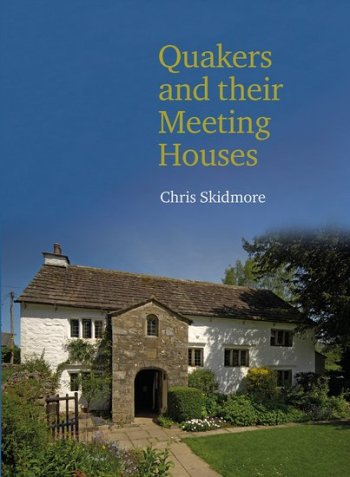 This book provides a fascinating account of the architecture and historical development of the Quaker meeting house from the foundation of the movement to the twenty-first century. The Quaker meeting house is a distinctive building type used as a place of worship by members of the Society of Friends (Quakers). Starting with buildings of the late-seventeenth century, the book maps how the changing beliefs and practices of Quakers over the last 350 years have affected the architecture of the meeting house. The buildings considered are illustrated, predominantly in colour, and are from England, Scotland, and Wales, with some consideration of colonial American examples. The book commences with an introduction that provides an accessible account of the early history of Quakerism, and it concludes with a consideration of whether there is a Quaker architectural style and of what it might consist.
Call for Papers | Grinling Gibbons and the Story of Carving
From ArtHist.net (5 October 2021) . . .
Grinling Gibbons and the Story of Carving
Victoria and Albert Museum, London, 24–25 June 2022
Organized by Jenny Saunt, Kira d’Alburquerque, and Ada de Wit
Proposals due by 10 January 2022
Grinling Gibbons (1648–1721) is the most celebrated carver in British history. His closely observed depictions of full-bodied natural forms, executed in hyperreal detail, captivated audiences of his own time as much as they captivate us today. But how much is really known about this man, his work, and its implications in terms of the way we think about carving now? As part of the year-long Gibbons tercentenary celebrations of 2021/22, this conference explores the story of Gibbons but also investigates broader themes around the subject of carving in a European context from 1600 to 1800.
On day one, an invited panel of speakers will present the latest research on Grinling Gibbons and his work. For the second day, we invite papers that explore all aspects of the processes of production and design in the story of carving in early modern Britain and in terms of international exchanges. Topics of interest are wide ranging and include design, sources, materials, methods, training, tools, techniques, business and workshop structures, branding, professional networks, and nineteenth- and twentieth century engagement with and reinterpretation of the carved work produced in this period. Intersections and interactions are of particular interest. In what ways did the lives and careers of practitioners contemporary to Grinling Gibbons and the careers of his assistants and apprentices relate to each other and how did this impact the work produced? What were the exchanges between carving and other related disciplines of the time, such as ship building, furniture production and frame making? Using examples of early modern practice, how can we expand our understanding of the meaning of design sources and processes, be that through print or other material or social cultures of the time; how did these interplay and how can they be questioned and quantified? How can we develop methodologies to investigate these makers and their understanding of their own working processes, their relationships with materials and tools, and what new insights can be gained from this type of exploration? How did such factors work together to create the type of physical forms that are so recognisable as the product of Gibbons’ world?
Papers should be 20 minutes in length and include a PowerPoint. Please send an abstract of 250–300 words, with name, title, institution, and short bio (100 words max) to grinling.gibbons@vam.ac.uk. The deadline for paper proposals is 10th January 2022. Notification for acceptance will be sent by 7th February 2022.
Exhibition | Native New York
From the Smithsonian National Museum of the American Indian:
Native New York
National Museum of the American Indian, New York, opening 25 October 2021
 Native New York journeys through city and state to explore the question “What makes New York a Native place?” The exhibition encompasses twelve places in present-day New York, introducing visitors to the Native nations that call the region home. Stretching from Long Island through New York City and on toward Niagara Falls, it covers pre–Revolutionary War exchanges through contemporary events. From Haudenosaunee (Iroquois) ironworkers who helped build Manhattan’s iconic skyscrapers to Lenape (Delaware) teens visiting their ancestral home, stories of Native New Yorkers provide an expanded understanding of the region’s history and reveal that New York is—and always has been—a Native place.
New Book | Follies in America
From Cornell UP:
Kerry Dean Carso, Follies in America: A History of Garden and Park Architecture (Ithaca: Cornell University Press, 2021), 216 pages, ISBN: 978-1501755934, $30.
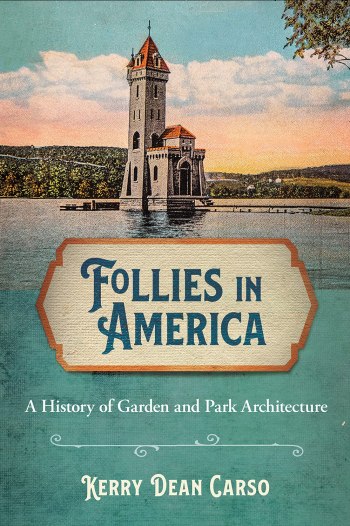 Follies in America examines historicized garden buildings, known as ‘follies’, from the nation’s founding through the American centennial celebration in 1876. In a period of increasing nationalism, follies—such as temples, summerhouses, towers, and ruins—brought a range of European architectural styles to the United States. By imprinting the land with symbols of European culture, landscape gardeners brought their idea of civilization to the American wilderness.
Kerry Dean Carso’s interdisciplinary approach in Follies in America examines both buildings and their counterparts in literature and art, demonstrating that follies provide a window into major themes in nineteenth-century American culture, including tensions between Jeffersonian agrarianism and urban life, the ascendancy of middle-class tourism, and gentility and social class aspirations.
Kerry Dean Carso is Professor of Art History at the State University of New York at New Paltz. She is the author of American Gothic Art and Architecture in the Age of Romantic Literature.
C O N T E N T S
List of Illustrations
Acknowledgments
Introduction
1 The English Landscape Garden in America
2 Temples
3 Summerhouses
4 Towers
5 Ruins
Conclusion
Notes
Bibliography
Index
The Georgian Group Architectural Awards 2021
From The Georgian Group:
The Georgian Group Architectural Awards
Presented 5 October 2021
The annual Georgian Group Architectural Awards, generously sponsored by Savills, took place at the RIBA on 5 October this year. The awards, now in their seventeenth year, recognise exemplary conservation and restoration projects in the UK and reward those who have shown the vision and commitment to restore Georgian buildings and landscapes. The awards ceremony was presented by Dr John Goodall, chair of the judging panel and Architectural Editor at Country Life, with certificates handed out by the Georgian Group’s President, the Duchess of Argyll. The winning schemes were chosen from over thirty entries, with shortlisted projects encompassing a broad range of building types.
Re-use of a Georgian Building
Winner: Cobham Dairy, Kent
Client: The Landmark Trust
Architect: Purcell
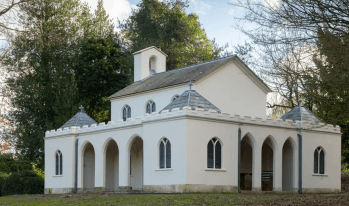 The Dairy on the Cobham estate, Kent, was designed by James Wyatt in 1794 for the 4th Earl and Countess of Darnley. It served both as an ornamental eye-catcher in Humphry Repton’s parkland and as a working building, complete with accommodation for the dairymaid. Abandoned for more than a century, it was rescued from collapse in the 1980s by the SPAB. The Landmark Trust has since taken a 99-year lease of the dairy and restored it as a self-catering holiday cottage for two. Work has included the restoration of the external slate cladding and the re-instatement of the vaulted ceilings.
Highly Commended: The Old Church, Lowick, Northumberland
Client: Dean Keyworth, Armstrong Keyworthy Interior Design
Architect: Paul Hales, Robert J. Hales Ltd
One of only two Church of Scotland churches built in England, the building was deconsecrated in 1821 and has lain empty for much of the time since. The present owners have converted in sympathetically, making ingenious use of the spaces below and above the Victorian gallery, and adding rooms in the roof space, so preserving the volume of the double-height interior—a space too often subdivided in church and chapel conversions—which successfully serves as the principal reception room. This approach has left an uninterrupted view of the stained glass windows, which were restored as part of the project.
Restoration of a Georgian Garden or Landscape
Winner: Gunton Park, Norfolk
Client: Ivor Braka, Kit and Sally Martin, Lady Suffield
Landscape Architects: John Phibbs, Debois Landscape Survey Group (Phase 1); Patrick James, The Landscape Agency (Phase 2)
The 1,200 acre park and garden that surrounds Gunton Hall—itself designed in the 1740s by Matthew Brettingham and later altered by Samuel Wyatt—evolved under the ownership of several generations of the Harbord family and with the involvement of successive landscape architects: Charles Bridgeman, Humphry Repton and William Sawrey Gilpin. By the 1970s, following decades of decline, much of the estate had been sold and ploughed-up for arable cultivation, while hundreds of mature parkland trees and those in its woodland belts had been felled. The restoration of the park has taken nearly thirty years and has seen acres of new woodland planted, avenues, carriageways, clumps and individual parkland trees re-instated, and the establishment of a herd of deer.
Restoration of a Georgian Building in an Urban Setting
Winner: Buxton Crescent Hotel and Thermal Spa, Buxton Crescent, Derbyshire
Client: Buxton Crescent Ltd.
Architect: Curious Architecture and Interior Design
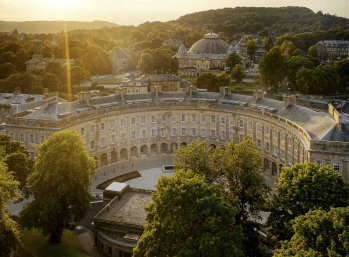 The Crescent, designed by John Carr of York for the 5th Duke of Devonshire and built between 1780 and 1789, was with the adjoining Natural Baths and Pump Room, the centrepiece of the planned Georgian spa town. Since the 1990s it has lain empty and in an increasing state of disrepair. This major project initiated by the Borough and County Councils, and supported by the National Lottery Heritage Fund and Historic England, set out to return all three buildings to use and to help in the economic regeneration of Buxton as a spa. This heroic and transformative project has taken more than two decades to come to realisation and combines conservation and new work.
Highly Commended: Private townhouse in Kennington
Client: Fabian Richter
Architect: Robert Birbeck
Master Builder: Stephen Bull
This project has seen the painstaking, comprehensive conservation, over a seven year period of a run-down terraced townhouse of 1792. The works have involved, re-roofing and repointing, the replacement of gypsum plasterboard with lime plasters on lath, the repair of Georgian joinery and the restoration of the servant’s bell system, as well as full re-servicing. Externally, York slabs have replaced cement steps and new iron railings have been installed. The work has been underpinned by thorough historical research and reflects a conservation ethos that is more commonly the preserve of large public or charitable bodies that private houses.
Highly Commended: Frogmore House, Watford
Client: St William Homes LLP, Berkeley Group
Architects: Giles Quarme Architects
A merchant’s house built in 1716 to the south of Watford high street, the building had been on Historic England’s Buildings At Risk Register for some years. Divided into flats in the 1950s, it fell into gradual dereliction from the 1970s and suffered extensive vandalism. As part of the redevelopment of the wider site the building has been restored and structural failure, water ingress and dry rot have all been tackled. Historic joinery—windows, doors, staircase balusters and panelling—has been repaired or where necessary re-instated, and the doorcase, stolen in 2009, recovered and put back. The building is now in use as an office.
Restoration of a Georgian Structure or Interior
Winner: The Bath Stone Bridge, Halswell Park, Somerset
Client: Edward Strachan
Architect: Architecton
The Bath Stone Bridge is thought to have been designed by Thomas Wright and was a key element of the water gardens known as Mill Wood, laid out by Sir Charles Kemeys Tynte in the second half of the eighteenth century, as part of the Halswell Hall landscape. Since 2014 the owner has begun the on-going task of reconstituting and restoring the park. The current project has involved the full restoration of the bridge, which has been on the local authority’s ‘at risk’ list since 2005, and the repair of the associated dam and leaking pond. Many missing parts of the structure were fished out of the water, where they had fallen, but some lost elements had to be recut, as in the case of a missing herm. The new ornamental carving playfully includes some twentieth-century details in evidence of its date.
Highly Commended: The State Drawing Room, Stowe, Buckinghamshire
Client: Stowe House Preservation Trust
Architect: Purcell
The State Drawing Room at Stowe was created in 1778, and balances the State Music Room to the other side of the central Marble Saloon. Both interiors were designed by Vincenzo Valdrè. Following rigorous research, the decision was taken to return the room to its decorative appearance in c.1800. New orange hangings, based on a guidebook description, were commissioned in a durable fabric, while paint research revealed that the ceiling had been painted in three shades of pink with both gold and silver gilding to its plaster enrichments. This striking scheme has been reinstated following cleaning and repair. In addition, a painted, timber copy of the marble Piranesian chimneypiece sold from the room in the 1920s has been made from a scan of the original and a new oak floor was laid to the pattern of the historic boards.
Restoration of a Georgian Country House
Winner: Radbourne Hall, Derbyshire
Client: Trustees of the Radbourne Settlement
Architect: Peregrine Bryant Architects
Radbourne Hall was designed in 1739 by William Smith of Warwick for German Pole. From 2017 to 2020 the house has been subject to far-reaching repair and conservation work. This has included slate and lead repairs to the roof, which have now also been fitted with firebreaks and breathable wood fibre insulation. Internally, damage done by a 1950s structural steel has also been remedied and out-dated electrical and mechanical services have been replaced, while the enfilade on the piano nobile has been re-instated and a John Fowler decorative scheme of the 1950s retained and conserved. A striking new set of cantilevered steps, structurally independent from the house, have been constructed to the rear.
Highly Commended: Sheringham Hall, Norfolk
Client: Paul Doyle and Gergely Battha-Pajor
Architect: John Simpson Architects
Sheringham Hall was designed for Abbot and Charlotte Upcher by Humphry Repton and his son John Adey Repton between 1813 and 1819. Having bought a 99-year lease of the house and garden from the National Trust, Paul Doyle and Gergely Pattha-Pajor have undertaken various works to restore the building’s intended plan and room functions thereby sympathetically and brilliantly recreating the Regency elegance of the interiors. The original dining room has been re-instated, while appropriate neo-classical statuary once more fills the staircase niches. Associated works in the garden include the restoration of glass houses and the erection of an openwork pavilion designed by John Simpson.
Restoration of a Georgian Church or Chapel
Winner: All Saints Church, Newcastle
Client: All Saints Presbyterian Church
Architect: Doonan Architects
All Saints Church was completed in 1796 to the design of David Stephenson, the first Newcastle architect to study in London; it is unique in being the only church in England with an elliptical nave. Although one of the finest buildings in the city, it has long been on the Georgian Group’s casework radar due to its poor condition and it has been listed on Historic England’s Heritage-at-Risk register since 2011. Under new guardianship, a project of restoration began in 2019 which saw repairs to the roof, gutters, windows and walls. Internally, redecoration has been undertaken in an appropriate Georgian palette. A new marble pavement, allowing for an efficient under-floor heating system, has been laid, unifying the concrete floors in the entrance hall and ‘school gym’ floor in the nave. Additional facilities—including a kitchen, WCs and an office—have been sensitively incorporated within the space. The church has now been removed from the At Risk Register.
Highly Commended: St Alfege Church, Greenwich
Client: St Alfege Church PCC
Architect: Richard Griffiths Architects
St Alfege Church, designed by Nicholas Hawksmoor, was built between 1712 and 1714, with the upper part of the steeple added by John James in 1730. This project, which built upon previous restoration work, was designed to extend to the south and north elevations, repair the leaking roof and make the church fully accessible and welcoming to a wider public. A long wooden ramp has been installed at the north entrance, historic paving has been repaired and an ironwork arch designed by Albert Richardson has been rediscovered and re-instated over the high-street entrance to the churchyard. Internally changes include additional WCs in the wells of the staircases, while water ingress issues have been resolved allowing for the full internal redecoration of the church. In addition, the crypt has been opened to hard hat tours.
Giles Worsley Award for New Work in the Spirit of the Georgian Era
Winner: Nithurst Farm, West Sussex
Client: Adam and Jessica Richards
Architect: Adam Richards Architects
Built in open fields, on the site of a farmworker’s cottage in the South Downs National Park, Nithurst Farm is conceived as a Roman ruin wrapped around a modern concrete house. The building rises in steps from a single-storey entrance on the north side to a three-storey tower at the south, inspired by Vanbrugh’s belvedere at Claremont. The house is symmetrical in plan, tapering out along its axis to the large light-filled south-facing sitting room, and its main ground floor space is inspired by the sala found in those of Palladio’s villa designs, such the Villa Barbaro, which incorporate box-like secondary rooms against the exterior walls.
New Building in a Georgian Context
Winner: Wolverton Hall Folly, Worcestershire
Client: Nicholas Coleridge CBE
Architect: Quinlan Terry Architects
 The inspiration for the design of Wolverton Hall Folly was taken from the Picturesque tradition with its many variations of follies in a controlled landscape. Among a number of possible small garden buildings, the Banqueting House at Long Melford, built in 1550 with sash windows added in the 1730s, became a source of inspiration. The design was prepared with the proportions adapted considerably to provide a large study on the first floor with the addition of ogee arches to the stone window surrounds terminating in stone acanthus leaf finials and a central cupola to assist the requirement for a staircase and chimney. The result is a building that can express in classical terms the different moods of time and place with an underlying seriousness and humour.
Highly Commended: The University Arms Hotel, Cambridge
Client: CUA Property Ltd
Architect: John Simpson Architects
The University Arms Hotel, Cambridge, was established in the 1820s and is the oldest hotel in the city. The present building, however, was substantially constructed in 1903 and extended in the 1920s. Its 1833 west entrance facing onto Regent Street was demolished in 1965 to make way for a Modernist block by Feilden and Mawson. John Simpson Architects were commissioned to transform the hotel, adding 60 rooms to it, a terrace overlooking Parker’s Piece, and a new entrance façade. The latter comprises a Doric porte cochère of Ketton stone, wittily referencing Ledoux’s Parisian Barrières of the 1770s as heralds of the city beyond. Meanwhile, the western section of the south front was remodelled by adding a three-storeyed bow, and to the east a four-bay verandah on the first floor.
Diaphoros Prize
Winner: The Cons Club, Framlingham, Suffolk
Client: Paperhouse Properties Ltd
Architect: Hoare Ridge and Morris Architects
Built c.1810, Church House, as it was originally known, was a prominent townhouse owned by the Edwards family of bankers and doctors. In 1910 it became the Framlingham Constitutional Club and later renamed the Framlingham Conservative Club. The club closed at the end of 2018; threatened with being carved up as flats, it was purchased by the architects Mark Hoare and Ted Ridge the following year with the hope of turning it into a public space. The new vision includes a café, gallery space, studios, youth club and meeting rooms for public hire, with the creation of separate offices for Framlingham Town Council in a semi-independent part of the building. Re-activating the street frontage was key and the café can now be accessed by the Georgian front door which had previously been blocked.
Call for Papers | The 17th and 18th Centuries at the Accademia

Giovanni Battista Tiepolo, The Scourge of the Serpents (detail), 1732–35, oil on canvas
(Venice: Gallerie dell’Accademia)
◊ ◊ ◊ ◊ ◊
From ArtHist.net and the Accademia:
The Seventeenth and Eighteenth Centuries at the Gallerie dell’Accademia: New Studies
Gallerie dell’Accademia, Venice, 22–23 February 2022
Organized by Giulio Manieri Elia and Michele Nicolaci
Proposals due by 10 December 2021
The inauguration of the new Seicento and Settecento rooms at the Gallerie dell’Accademia represents a fundamental part of the re-installation of the museum’s collections that has finally been completed with the ground floor organized around 13 rooms, with a chronological arc from the seventeenth to the ninenteenth centuries. Among the 62 works now visible to the public—including absolute highlights of the period’s artistic production—many are included in the museum itinerary for the first time, and many have returned to view after significant restoration campaigns. The long gestation of this moment has enabled scrupulous examination of the works, stimulating new research and unexpected discoveries, and a rich dialogue between the museum and both the Italian and international scholarly communities.
The reopening of these spaces, which singularly represent the art of painting over these two centuries, should be considered a cue for new departures, a field of investigation for new research. Plenty of the works remain little known, and many diverse and fascinating themes merit further research: from authorship to dating, from patronage to provenance, from iconographic questions to those linked to the materials and techniques of painting and restoration history. To further this endeavour, the Gallerie will organize a workshop intended as an opportunity to share inquiries and to enrich our knowledge about the museum’s patrimony with the aim of attracting the most innovative and cutting-edge studies on the Seicento and Settecento works in the Gallerie dell’Accademia. The conference will foreground not only artworks hanging in the new rooms 5 and 6, but also the rest of the display, as well as the many works in the museum’s stores and those visible in other institutions in Venice and the Veneto (external stores). It is further hoped that the meeting will constitute a preliminary contribution to complex effort of updating the catalogue raisonné of the collections.
The workshop will be held in the Gallerie dell’Accademia over two days, one dedicated to the Seicento and one to the Settecento, with individual talks lasting 30 minutes. A portion of the conference will address restoration conducted in the museum, providing the opportunity to share conservation discoveries, doubts, and decisions with the workshop participants. The conference will take place in person, with a limited number of places available respecting the rules in place with regards to the containment of the diffusion of Covid 19 (distancing, masks, and other measures required by relevant safety protocols). Plans are also in progress for the transmission of the talks via the YouTube channel of the museum.
Candidates who wish to present should send an abstract of no more than two pages and a brief CV, in Italian or English. Research concentrating on one or more works in the museum will be privileged along with talks that significantly and concretely advance the current state of knowledge, or which offer a novel approach to understanding the works, their original context, creation, or material history. Participants may expect the costs of travel and stay in Venice to be partially or totally covered. Publication of the conference proceedings is foreseen. Proposals should be sent to michele.nicolaci@beniculturali.it by the 10th of December 2021.










 Enfilade
leave a comment