Talk | Christine Stevenson on Vanbrugh and His Clients
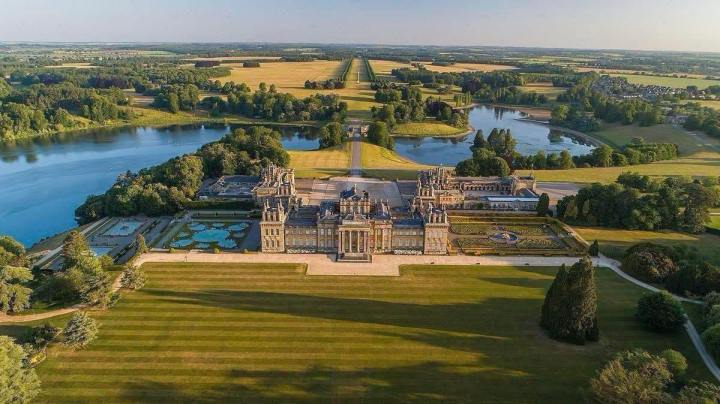
Sir John Vanbrugh, Blenheim Palace, Oxfordshire, 1705–22. Seat of the Dukes of Marlborough.
◊ ◊ ◊ ◊ ◊
From The Georgian Group, in anticipation of Vanbrugh300 in 2026:
Christine Stevenson | John Vanbrugh and the Art of Client Management
The Georgian Group, 6 Fitzroy Square, London, 21 October 2025, 6.30pm
The early eighteenth-country houses designed by John Vanbrugh (1664–1726), including Blenheim in Oxfordshire and the now-lost Claremont in Surrey and Eastbury in Dorset are, or were, remarkable for their bold forms and unorthodox ornament. Yet in one respect Sir John’s work was supremely delicate: the ways in which he persuaded clients that boldness and unorthodoxy were the most economical routes to displays appropriate to their status. His arguments are gossipy, funny, and often suspect. They present the architect less as a designer than as a hedge against financial and reputational risk. At the same time, they offer us a fascinating insight into the sometimes-fraught social and familial relationships in play when it came to spending money on a house. Georgian Group members, £15 / non-members, £18; tickets include a glass of wine.
Booking is available here»
Exhibition | Vanbrugh: The Drama of Architecture
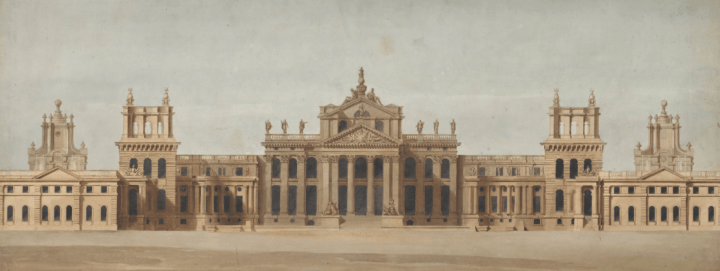
Soane office, Royal Academy Lecture Drawings of the work of Sir John Vanbrugh, Blenheim Palace, elevation
(London: Sir John Soane’s Museum, SM 74/4/8)
◊ ◊ ◊ ◊ ◊
The exhibition opens in the spring; the book launches this fall:
Vanbrugh: The Drama of Architecture
Sir John Soane’s Museum, London, 4 March — 28 June 2026
Curated by Charles Saumarez Smith
300 years after his death, a major new exhibition exploring one of the UK’s greatest architects—Sir John Vanbrugh (1664–1726)—will open in the spring at Sir John Soane’s Museum. Some of the UK’s most admired and loved country houses like Blenheim Palace and Castle Howard were the result of Vanbrugh’s genius, becoming cornerstones of English Baroque. Soane cited him as one of his great influences, saying Vanbrugh had “all the fire and power of Michelangelo and Bernini.”
Curated by Sir Charles Saumarez Smith CBE and architect Roz Barr, the exhibition will feature never-before-exhibited drawings from the collections of the V&A, the Royal Institute of British Architects, the National Portrait Gallery, and Sir John Soane’s Museum, including many in Vanbrugh’s own hand. Perhaps overshadowed by contemporaries Nicholas Hawksmoor and Sir Christopher Wren, the emotional impact and imagination of Vanbrugh has continued to be admired, particularly by architects, in the centuries since. The exhibition will highlight Vanbrugh’s enduring architectural ideas and influence, including on two of the most influential architects of the 20th century, Robert Venturi (1925–2018) and Denise Scott Brown (b.1931). A new short film by filmmaker Jim Venturi, their son, will explore this connection and will be shown on loop in the Museum’s Foyle Space. Vanbrugh: The Drama of Architecture will introduce new audiences to the work of an English Baroque architect, adventurer, playwright, and spy 300 years after his death.
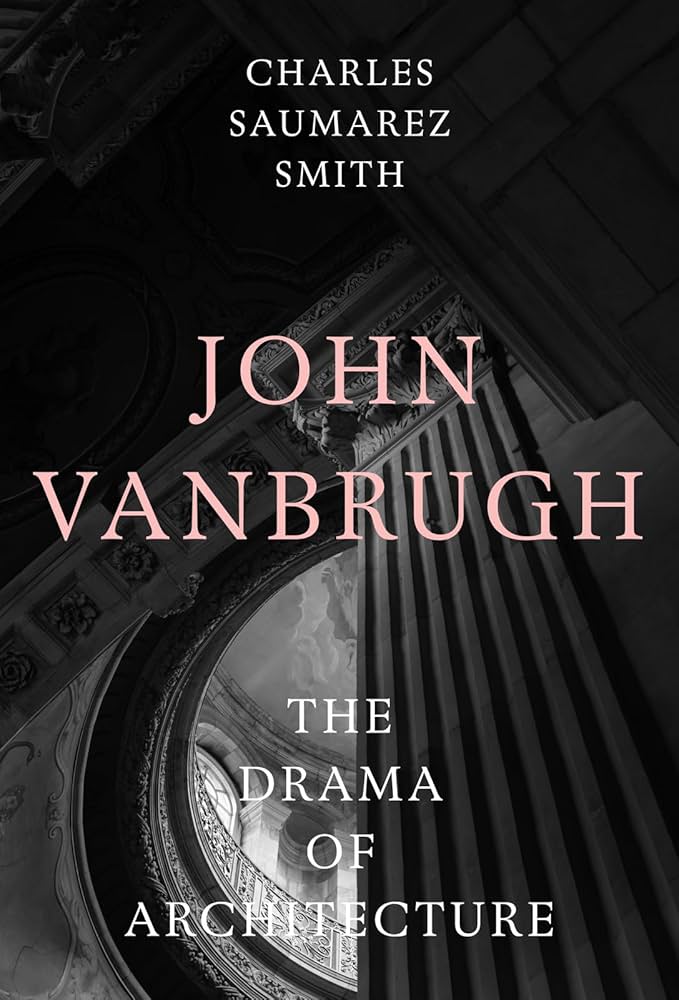
Charles Saumarez Smith, John Vanbrugh: The Drama of Architecture (London: Lund Humphries, 2025), 272 pages, ISBN: 978-1848227316, £30.
◊ ◊ ◊ ◊ ◊
Book tickets at Wigmore Hall:
Book launch | John Vanbrugh: The Drama of Architecture
The Wigmore Hall, London, 20 November 2025, 12.30pm
 Charles Saumarez Smith will give a lunchtime talk on Vanbrugh’s extraordinary life: his upbringing; why he spent so much time in a French gaol; the writing of The Relapse and The Provoked Wife; and how he came to design Castle Howard with no previous experience of architecture. Saumarez Smith will give particular attention to Vanbrugh’s work as a theatrical impresario and the designer of the Queen’s Theatre, Haymarket, so disastrous as a venue for plays, but where all of Handel’s early operas were performed. He will then describe Vanbrugh’s quarrel with the Duchess of Marlborough and his later work as an architect, at King’s Weston, Claremont, Grimsthorpe, Seaton Delaval, and Stowe. In recent years, Vanbrugh’s reputation as an architect has been eclipsed by his subordinate, Nicholas Hawksmoor. This talk and the accompanying book will explain Vanbrugh’s originality and influence on later architects from Robert Adam to Robert Venturi and Denise Scott Brown.
Exhibition | Egypt: Influencing British Design, 1775–2025

George Dance, Front Elevation of a Library Chimney-piece for the 1st Marquess of Lansdowne, Lansdowne House, Berkeley Square, Westminster, ca. 1788–94; pen, sepia, raw umber, and crimson washes, shaded on laid paper laid down on (old) board with double-ruled border (London: Sir John Soane’s Museum, SM D3/3/3).
◊ ◊ ◊ ◊ ◊
Now on view at The Soane:
Egypt: Influencing British Design, 1775–2025
Sir John Soane’s Museum, London, 8 October 2025 — 18 January 2026
The mystery, romance, and aesthetic appeal of ancient Egypt has informed richly decorated Regency homes, Victorian factories and cemeteries, Art Deco cinemas, and twentieth-century houses, shops, and offices. This exhibition explores the British fascination with all things Egyptian through evocative drawings and books owned by Soane. Decorative objects including Wedgwood ceramics, Liberty Fabrics, and an Egyptian-style Singer sewing machine demonstrate the range of ways people have brought Egypt into their homes from Soane’s time to today.
This exhibition is accompanied by new work by Cairo-born artist Sara Sallam. As part of this exhibition, Sallam has produced A Tourist Handbook for Egypt outside of Egypt, Vol. II, London. Displayed in the Foyle Space in large scale, Sallam’s collages juxtapose photographs of London’s commemorative statues and imperial architecture with nineteenth-century paintings of correlating events in Egypt. Copies are available for purchase from the museum shop. Sallam’s second work, Eyes that Weep, Eyes that Pierce, is an audio tour, available exclusively on Bloomberg Connects, inspired by the sarcophagus of Seti I. Sallam invites you to listen closely to the Egyptian sky goddess Nut (seen inside the sarcophagus), her voice tracing the many eyes that have peered into Seti I’s sarcophagus across time.
Exhibition | Mary Linwood: Art, Stitch and Life
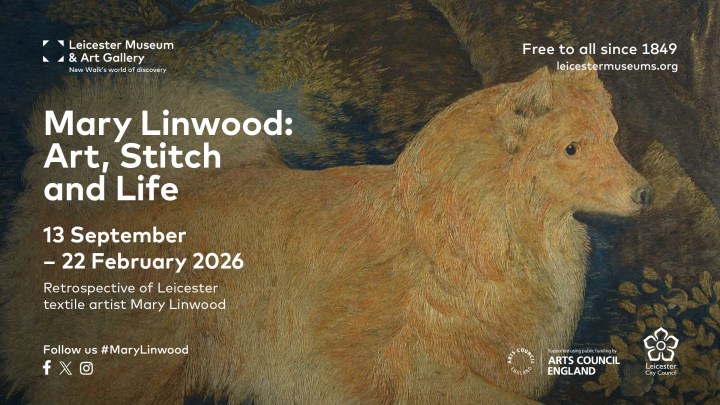
Mary Linwood, Pomeranian Dog, detail, needlework, 68 × 86 cm
(Leicester Museum & Art Gallery)
◊ ◊ ◊ ◊ ◊
Now on view, as noted by Adam Busiakiewicz for the Art History News blog:
Mary Linwood: Art, Stitch, and Life
Leicester Museum & Art Gallery, 13 September 2025 — 22 February 2026
A retrospective of the Leicester textile artist Mary Linwood (1755–1845)
Leicester’s Mary Linwood was a celebrity artist in the early 1800s but has since been largely forgotten. She created detailed embroidered versions of famous British paintings using a technique known as needle painting. Linwood was not only a talented artist but also an innovator and entrepreneur. Alongside running a successful school for young ladies in Leicester, she exhibited her embroidered works in touring exhibitions and established the first gallery in London to be run by a woman. In her lifetime, Linwood was supported by the wealthy and powerful, and was widely respected and well known. Since her death, however, she has been overlooked and undervalued. This exhibition is the first retrospective of Mary Linwood’s work since 1945, featuring 14 embroidered works from the Leicester Museums collections. Alongside these historic pieces are new textile artworks by Ruth Singer, reflecting on Linwood’s life and legacy.
Ruth Singer, Lost Threads: Mary Linwood’s Legacy (2025), 60 pages, £15. Available for purchase here.
◊ ◊ ◊ ◊ ◊
It’s also a fine opportunity to remind readers of Heidi Strobel’s recent book, The Art of Mary Linwood: Embroidery, Installation, and Entrepreneurship in Britain, 1787–1845. –CH
Call for Papers | The Art of the Syllabus
From ArtHist.net:
The Art of the Syllabus
Centre for Research in Visual Culture, University of Nottingham, January — June 2026
Proposals due by 17 November 2025
Every year the Centre for Research in Visual Culture organises its seminar programme around a given theme. This year’s theme is The Art of the Syllabus, and for the first time we are inviting scholars to propose papers to present as part of our research programme from January to June 2026.
In histories of the teaching of art, photography, and art history, the syllabus is often sidelined. Teachers, students, institutions, even government policy: these are the threads usually pulled upon to tell this history. There is a logic to this marginalisation. Without a teacher, students, or an institution, a syllabus is redundant—a dormant document awaiting activation. Moreover, even though archives are filled with records of syllabi that have been activated, anyone who has been in a classroom knows that the syllabus itself is a poor record of what was discussed. At the same time, the syllabus captures a kind of pre-history of the classroom. It is a record of the best intentions of the teacher before the reality of the students (and the institution) intervenes. By using the syllabus as the starting point for our discussions, we are hoping we might capture the histories of teaching that never came to pass as well as those that did.
If our theme relates to your current research, we would like to hear from you. We are especially interested in hearing from scholars working on pre-twentieth century histories of art, photography, and art history pedagogy, although scholars of the twentieth- and twenty-first centuries are of course welcome as well. We are less interested in hearing about completed research projects. Conversely, if you are at the beginning of a project that resonates with our call, please do consider working through your early ideas at the CRVC. Please send a short (250 word) blurb and (50 word) bio to chloe.julius@nottingham.ac.uk by 17 November. All of our seminars take place in person on Wednesdays at 4pm. Talks should be planned to run for 45 minutes to an hour, and will be followed by a lively discussion. Travel will be reimbursed up to £150.
Conference | The Image of the Black Archive: Past, Present and Future
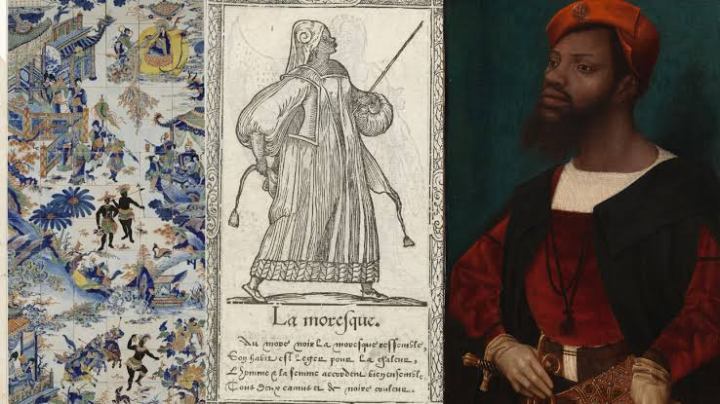
Anonymous (Delft), Tile panel with a Chinese landscape, ca. 1700; François Desprez, Illustration from Recueil de la diversité des habits‘, 1562; Jan Jansz Mostaert, Portrait of an African Man (Christophle le More?), 1525–30 (Rijksmuseum, Amsterdam).
◊ ◊ ◊ ◊ ◊
From The Warburg Institute:
The Image of the Black Archive: Past, Present, and Future
Online and in-person, The Warburg Institute, University of London, 7–8 November 2025
Organized by Hannah Lee and Maria Golovteeva
In 1960, Franco-American art collectors and philanthropists Jean and Dominique de Ménil initiated the Image of the Black archive. Originally begun in Paris and then expanded with an office in Houston, the research project was a response to the 1960s Civil Rights movement in the US. This two-day international conference brings together scholars who have contributed to the project over its history and those producing new research on the historic representation of African people in European and American art and culture. Attendance (online or in-person) is free with advance booking, though places are limited.
Keynote Speaker
Dr Adrienne L. Childs is an independent scholar, art historian, and curator. She is Senior Consulting Curator at The Phillips Collection. Her current book is an exploration of Black figures in European decorative arts entitled Ornamental Blackness: The Black Figure in European Decorative Arts, published by Yale University Press in 2025.
This conference is organised with the generous support of the Henry Moore Foundation, the Society for Renaissance Studies, and the Association for Art History.
f r i d a y , 7 n o v e m b e r
9.00 Registration
9.30 Opening Remarks
9.45 Panel 1
• Joaneath Spicer (Walters Art Museum), Balthazar, One of the Three Kings > Portrait: Prince Aniaba of Assinie as Balthazar, 1700
• Adam Sammut (University of York), Painted Black: Rubens’s ‘Mulay Ahmad’ after Jan Cornelisz. Vermeyen
• Edward Town (Yale Center for British Art), Framing the Black Presence in British Art: Research, Curation, and the Limits of the Archive
11.05 Tea and coffee break
11.30 Panel 2
• Najee Olya (William & Mary), The Contradictions of the Anthropological Gallery: Frank M. Snowden, Jr.’s Ethiopians and the Image of the Black in Western Art
• Jaqueline Lombard (University of New Hampshire), Coins on the Cutting Room Floor: Twelfth-Century Images of Saint Maurice in the Image of the Black Archives
• Paul Kaplan (Purchase College, SUNY), First Fruits
12.50 Lunch break
13.50 Panel 3
• Michael I. Ohajuru (Institute of Commonwealth Studies), The John Blanke Project: Artists and Historians Reimagine the Black Trumpeter to Henry VII and Henry VIII
• Sarah Thomas (Birkbeck), Facing the Inventory: WY Ottley and the Archive of Enslavement
• Nanfuka Joan Kizito (Makerere University), Decolonising the Archive: An Africanised Reflection on the History of the ‘Image of the Black in Western Art’ Project
15.10 Panel 4
• Isabel Raabe (Talking Objects) and Doreen Mende (Staatliche Kunstsammlung Dresden), Plural Histories of Networked Knowledge: Cross-Collections Research at the Staatliche Kunstsammlungen Dresden
• Sarah Okpokam (National Portrait Gallery), TBC
16.10 Tea and coffee break
16.30 David Bindman: In Memoriam
Drinks Reception
s a t u r d a y , 8 n o v e m b e r
9.30 Registration
10.00 Keynote
• Adrienne L. Childs, The Ornamentality of Blackness
11.00 Tea and coffee break
11.30 Panel 5
• Jacopo Gnisci (UCL), European Perceptions of Ethiopia’s Material Past in the Renaissance
• Patricia Simons (University of Michigan Ann Arbor \ University of Melbourne), Heat and Wind: Renaissance Representations of Black Men in Material Culture
• Riccardo Tonin (Ca’ Foscari University of Venice), Musi da porton: The Image of the Black on the Doors of Venice
12:50 Lunch break
13:50 Panel 6
• Amber Burbidge (European University Institute), Blackness and Bathing: The ‘Black Venus’ in the Image of the Black Archive
• Denva Gallant (Rice University), Afterlives of the Black Body: Dismemberment and the Black body in Matteo di Pacino’s Miracle of the Leg
• Nancy Ba (Sorbonne Université), Ethnographic Sculpture as Visual Archive? The Politics of Flesh, Complexion, and Scientific Image-Making in the Colonial Context, 1859-1931
15.10 Panel 7
• Borja Franco Llopis (Universidad Nacional de Educación a Distancia), Misconceptions and Silences: Black Representation and Slavery in Iberian Art
• Ekaterini Kepetzis (Rheinland-Pfälzische Technische Universität, Landau), ‘Only a lodger, and hardly that’: The Representation of Blacks on Eighteenth-Century English Trade Cards
• C.C. McKee (Bryn Mawr), Forms of Blackness from Fireburn to Sale: Painting Labor, Race, and the Environment in the Post-Emancipation Danish West Indies
16.30 Closing Remarks
Online Talks | Finding Moses Williams
Upcoming from The Library Company of Philadelphia:
Finding Moses Williams
Online, Wednesday, 19 November 2025, 1.00–3.30
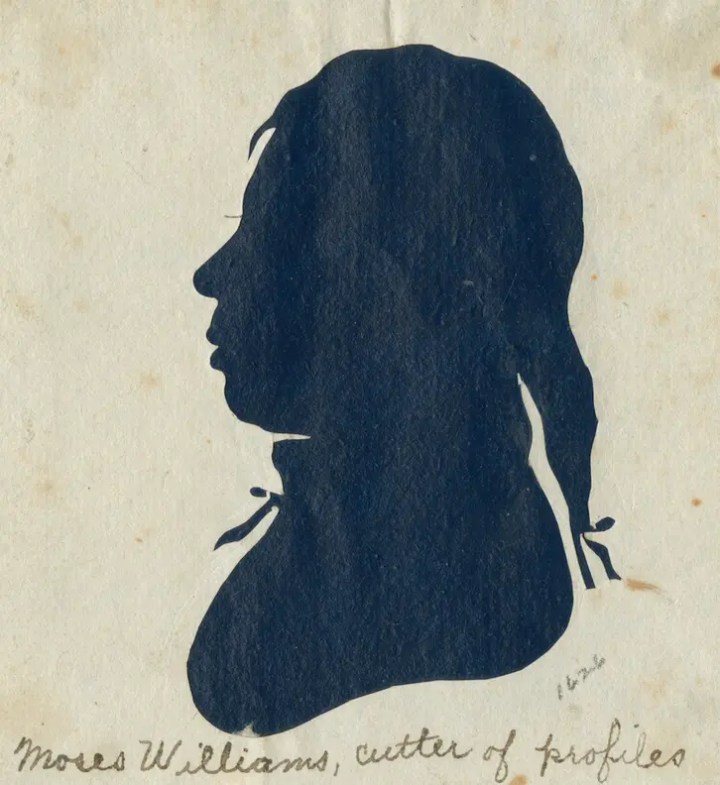
Silhouette of Moses Williams, perhaps by Raphaelle Peale or by Williams himself, after 1802, 9 × 8 cm (Library Company of Philadelphia).
This program of illustrated talks by five speakers will focus on the identification of the exceptional hollow-cut paper profiles created by Moses Williams (1776–1830) at Peale’s Philadelphia Museum and on presenting new historically accurate information about Williams’s life and family. Moses’s parents were manumitted by Peale in 1786 and Moses, who was born enslaved, was then indentured to Peale by his parents until age twenty-eight
Raised within the Peale family, Moses was literate and trained in skills for creating and installing the Museum’s displays of art and natural science. After the installation of a physiognotrace device for creating hollow-cut paper profiles in 1802, Moses was freed and given the concession to operate this new attraction. The popularity of this inexpensive form of portraiture and the highly accurate and elegant profiles Moses cut, made him financially independent.
Recent research into Moses’s life provides us with a clearer understanding of his artistry and other activities, as well as his death date and the identity of his descendants. And, the story of Williams’s birth family illuminates how the practice of indenture used by Free Black families, like the Williams family, was a strategy for seeking financial stability.
A small selection of Moses Williams’s profiles will be on display at the Library Company during November and December and in the Peale Gallery at the Philadelphia Museum of Art. The program is sponsored by the Library Company of Philadelphia’s Program in African American History and the Center for American Art at the Philadelphia Museum of Art.
Registration for this free virtual event is available here»
p r e s e n t a t i o n s
1.00 Welcome — Sarah Weatherwax (Senior Curator of Graphic Arts, The Library Company of Philadelphia)
1.05 Introduction to LCP’s Program in African American History — Wynn Eakins (Reference Librarian and African American History Subject Specialist, The Library Company of Philadelphia)
1.10 Finding Moses in the Peale-Sellers Family Album — Carol Soltis (Project Associate Curator, Philadelphia Museum of Art)
1.35 Presenting Moses at The Peale, Baltimore’s Community Museum — Nancy Proctor (Re-founding Director of The Peale)
2.00 ‘Not Yet Completely Free,’ Moses and His Family in the Context of the Gradual Manumission Act — Ellen Fernandez Sacco (Genealogist and Independent Scholar)
2.25 Locating Moses William in Philadelphia: New Information about Moses Williams’s Life and Death Based on a Re-examination of Philadelphia’s Primary Sources — Dean Krimmel (Creative Museum Services, Research Consultant to The Peale)
2.50 Moses Williams, A Technical View — Lauren Muney (Silhouette Artist and Researcher)
3.15 Final Q&A
At Frieze Masters London | Neoclassical Bust of Emperor Nero as a Child
This neoclassical bust from Elliot Davies Fine Art offers a good chance to highlight Frieze London and Frieze Masters:
Frieze Masters London
The Regent’s Park, London, 15–19 October 2025
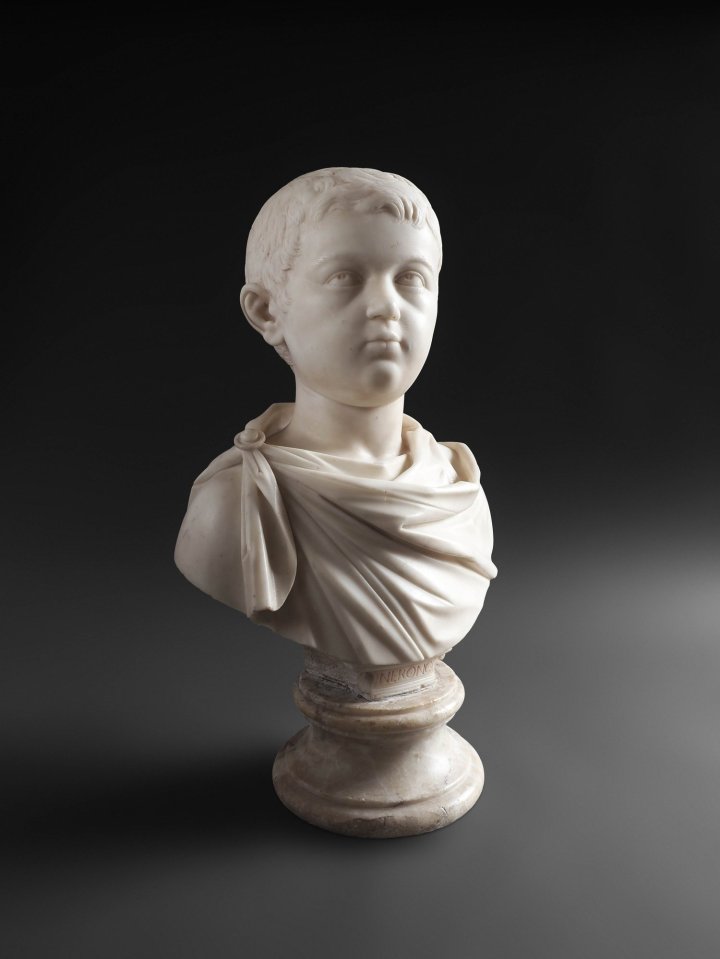
Attributed to Bartolomeo Cavaceppi, Bust of the Young Emperor Nero, after 1734, white carrara marble, 53 cm high (Offered by Elliot Davies Fine Art).
Elliot Davies Fine Art makes its debut at Frieze Masters London with a newly discovered bust of the young Emperor Nero, attributed to Bartolomeo Cavaceppi (ca.1716–1799). Rome’s leading 18th-century restorer and sculptor, Cavaceppi worked closely with Cardinal Alessandro Albani at the Villa Albani, where he restored and made fine copies of the classical antiquities in his collection. The bust is a version of an ancient work in the Albani collection and corresponds to entries in Cavaceppi’s posthumous studio inventories of 1799 and 1802, which record busts of a young Nero in both marble and plaster.
The work will be presented in the fair’s Reflections section, as part of a display inspired by the Sir John Soane Collection in Lincoln’s Inn Fields and curated by Abby Bangser, founder and creative director of Object & Thing. Alongside the Cavaceppi bust, Elliot Davies Fine Art will show a group of Roman, medieval, and Renaissance architectural fragments, as well as paintings and drawings ‘inspired by the antique’—evoking Soane’s eclectic interiors and reflecting Frieze Masters’ ethos of bringing six millennia of art history together under one roof.
More information on the bust is available here»
A leading international dealer and advisor in the fields of European sculpture and antiquities, Elliot also regularly sources British pictures, works of art, and antique furniture for clients and enjoys combining these aesthetics at exhibitions and art fairs. As a writer and researcher, Elliot has published work on important European sculpture, particularly renaissance bronzes and has made numerous major discoveries in these fields. Recently, he has authored the catalogue for the Ömer Koç collection of British art—one of the greatest private collections assembled in recent times. Elliot is available by appointment in York or London.
From the general press release:
Frieze announces the highlights of the 23rd edition of Frieze London and the 13th edition of Frieze Masters, returning to The Regent’s Park from 15–19 October 2025. At Frieze London, audiences will encounter must-see solo projects, artist-led initiatives, and curated sections that bring new perspectives to contemporary practice. Frieze Masters brings together 137 galleries spanning 27 countries, staging rediscoveries, rare masterpieces, and curated sections that open dialogues across centuries. Together, the two fairs will once again transform London into a meeting point for global perspectives and cultural exchange.
Alongside the fairs, Frieze Week will animate the city with a dynamic programme of exhibitions, performances, and events across London’s leading institutions and galleries, reaffirming the capital’s position as a major centre of the international art calendar. . . .
Call for Papers | ‘Civilizing’ the World, 1780–1945
From ArtHist.net and The Warburg Institute:
‘Civilizing’ the World: Classicism, Neo-Classical Sculpture, and Plaster Casts
in the Service of Imperial Powers and Post-Colonial Elites, 1780–1945
The Warburg Institute, School of Advanced Study, University of London, 22–23 October 2026
Proposals due by 1 December 2025
We invite proposals for 20-minute papers for a two-day conference to be held at the Warburg Institute (School of Advanced Study, University of London) in co-organization with the Institute of Classical Studies (SAS, UoL) and the Department of the Classics (University of Reading).

Algiers, La Mosquée Djemaa-Djedid, La Statue du Duc d’Orléans.
Throughout the nineteenth and early twentieth centuries, European imperial and colonial powers used both Greco-Roman and neo-classical sculpture, as well as architecture and other art forms, to express and consolidate their authority, at home and in colonial settings, through the assertion of Eurocentric notions of ‘civilization’ and inherited supremacy. The establishment of museums and art academies, on a European model, remained a feature of nation-building by elites in many former colonies after independence.
This conference aims to bring together and foster new research into the roles that classical and neoclassical art (broadly defined) fulfilled for European colonial powers and post-colonial elites globally, seeking critical exploration and assessment of the ways classical visual culture has been reused, redefined and also contested. The conference seeks to investigate classical visual culture in the service of self-presentation among competing nations and as a means to ‘civilize’ and / or dominate indigenous, subaltern and settler populations. We encourage examination of the social, political and racial implications of engagement with the European classical tradition in both colonial and post-colonial contexts worldwide. We invite contributions on works including neo-classical sculpture, plaster casts after the antique, and works such as ethnographic life-casts, the creation and use of which amplified and illuminated concepts of race and evolution that underpinned notions of Greco-Roman cultural supremacy. While the principal focus of the conference is on sculptural works, proposals on other arts and/or the interaction of the visual and literary are also welcome.
We invite scholars at all stages of their career, including PhD students and early-career researchers, to submit proposals (300 words maximum) for 20-minute presentations. The preferred mode of attendance will be in person, and the organizers are aiming to raise funding in support of travel expenses for speakers who cannot obtain funding from elsewhere. In the light of the international scope of the topic and call for papers, please indicate whether you may be able to access travel subsidies from your own institution or other sources, and / or whether you would be prepared to attend and present online if necessary. Proposals and the accompanying statement should be sent to Eckart.Marchand@sas.ac.uk by 1 December 2025.
Organizers
Eckart Marchand (Warburg Institute), eckart.marchand@sas.ac.uk
Katherine Harloe (Institute of Classical Studies), katherine.harloe@sas.ac.uk
Amy Smith (University of Reading), a.c.smith@reading.ac.uk
Conference | 18th-C. Painting between Italy and the Hapsburg Empire
From the Department of Art History at the Universität Wien:
Settecento Malerei: Cultural Transfer between Italy and the Habsburg Territories
Online and in-person, Department of Art History of the University of Vienna, 23–24 October 2025
Organized by Eleonora Gaudieri and Erika Meneghini
Registration due by 19 October 2025
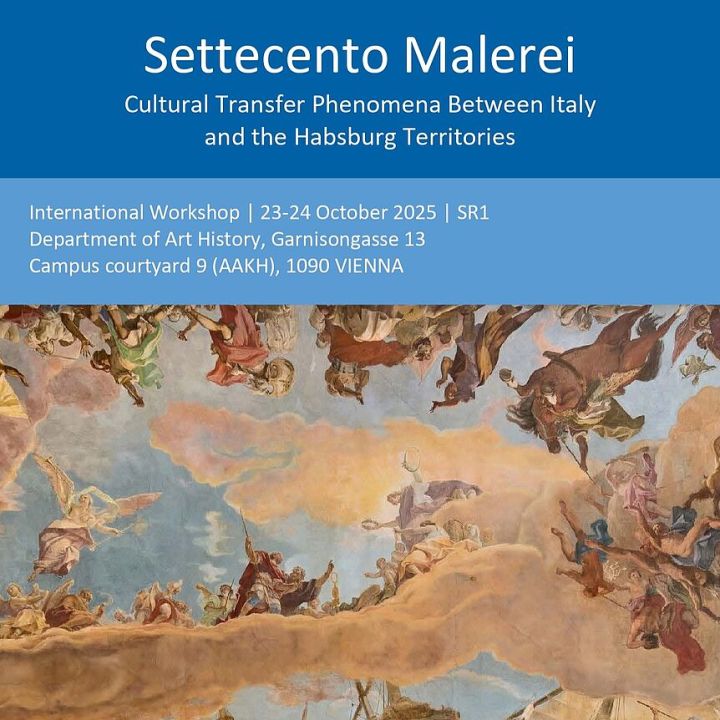 The beginning of the Settecento was characterised by a considerable expansion of the transalpine art market, driven by a strong interest in collecting Italian artworks. This phenomenon attracted numerous Italian artists, including many painters, to Vienna and its allies, the courts of the German prince-electors of Schönborn, Wittelsbach and others. At the same time, a number of Austrian painters were encouraged to further their training in Italy, where they were profoundly influenced by the local visual language. The high quality and renowned tradition of Italian painting, fostered by a dense network of international connections, enabled numerous artists of Italian origin, as well as Italians by adoption, to pursue successful careers at the Habsburg imperial court in Vienna. This phenomenon must be understood within the broader context of the diplomatic and artistic networks that connected Vienna with key centres on the Italian peninsula, such as Venice, Bologna, Rome, and Naples.
The two-day workshop will provide a wide-ranging exploration of 18th-century Italian painting as a focal point for transfer phenomena between the Italian peninsula and the domains of the Habsburg Empire, with a special focus on Vienna as the imperial capital. The proceedings will open with the keynote speech by Cecilia Mazzetti di Pietralata. The subsequent sixteen presentations have been organised into four sections, reflecting the variety of perspectives through which these historical and artistic phenomena can be approached: Collecting Italian Painting in the Habsburg Empire; Artworks and Material Objects as Vehicles of Cultural Transfer; Artists as Transregional Agents Between Italy and the Habsburg Regions; and The Role of Academies and Museums in the Transfer of Knowledge. The objective of this study day is on one hand to examine the meanings and functions of Italian painting within the socio-political and cultural context of the Habsburg imperial court in Vienna and its allied courts; and on the other hand, to explore the various dynamics that fostered the transfer of Italian painting and Italian artistic knowledge to Vienna and the territories of the then Habsburg Empire.
The conference languages are English, German, and Italian. A livestream of the event will be available. Please confirm your attendance in-person or online via email to settecentomalerei@gmail.com by 19 October. If you have any questions, please contact the organisers: Eleonora Gaudieri and Erika Meneghini.
Dr. Eleonora Gaudieri, eleonora.gaudieri@univie.ac.at
Postdoctoral Researcher (APART-GSK funding programme, ÖAW)
Department of Art History, University of Vienna
Erika Meneghini MA, erika.meneghini@univie.ac.at
PhD Candidate
Department of Art History, University of Vienna
The workshop is supported by the Department of Art History and the Vienna Center for the History of Collecting at the University of Vienna. Funding is provided by the Faculty of Historical and Cultural Studies at the University of Vienna, the City of Vienna, and the Austrian Academy of Sciences.
t h u r s d a y , 2 3 o c t o b e r
9.00 Welcome
9.30 Keynote
• Cecilia Mazzetti di Pietralata (University of Cassino and Southern Lazio) — Vienna italiana: Forme e attori dello scambio culturale tra Sei e Settecento, tra immigrazione artistica e vocazione internazionale dell’aristocrazia europea
10.30 Coffee Break
10.50 Section 1 | Collecting Italian Painting in the Habsburg Empire
Moderator: Silvia Tammaro
• Stefan Albl (Schloss Eggenberg & Alte Galerie, Graz) — Il dilemma della scelta: L’arrotino di Giacomo Francesco Cipper
• Ilaria Telesca (University of Naples ‘Federico II’) — Arte e potere: La committenza artistica dei viceré austriaci di Napoli
• Jiří Štefaňák (Masaryk University, Brno) — Non multa, sed multum: Italian Painting in the Collections of the Moravian Aristocracy at the End of the 18th Century
12.30 Lunch Break
14.00 Section 2 | Artworks and Materials Objects as Vehicles of Culture Transfer
Moderator: Eleonora Gaudieri
• Ada Berktay (Sakıp Sabancı Museum, Istanbul) — Lepanto as Material Allegory: Naval Triumph and the Politics of Display in Italian and Habsburg Visual Culture
• Tomáš Kowalski (Monuments Board of the Slovak Republic, Bratislava) — Baroque Illusion: Italian Settecento Frescoes in Slovakia
• Beatrice Bolandrini (Università e-Campus; Accademia del Lusso, Milan) — Anton Giorgio Clerici ed Annibale Visconti, ‘consiglieri intimi’ di Carlo VI e Maria Teresa, committenti di Giambattista Tiepolo e Mattia Bortoloni
• Tomáš Valeš (Masaryk University, Brno) — Shared, ‘Recycled’, Reinvented: Art of Venetian Settecento in the Hands of ‘Viennese’ 18th-Century Painters
• Erika Meneghini (University of Vienna) — From Naples to Vienna and the Habsburg Lands: The Artistic Reception of Francesco Solimena’s Oeuvre beyond the Alps
19.00 Conference Dinner
f r i d a y , 2 4 o c t o b e r
9.00 Section 3 | Artists and Transregional Agents between Italy and the Habsburg Regions
Moderator: Erika Meneghini
• Francesco Ceretti (University of Pavia) — Pietro Bellotti: Da Venezia alle corti mitteleuropee
• Eleonora Gaudieri (University of Vienna) — Daniele Antonio Bertoli: Traces of his Activity at the Habsburg Court in Vienna
• Enrico Lucchese (University of Campania ‘Luigi Vanvitelli’) — I soggiorni viennesi e nei territori asburgici di Antonio Pellegrini (1675–1741)
• Sanja Cvetnić (University of Zagreb) — Federico Bencovich as Transregional Artist
• Laura Facchin (University of Insubria, Varese) — Angelica Kauffmann: Painter of the Habsburg Court from Milan to Vienna
12.00 Lunch Break
13.30 Section 4 | The Role of Academies and Museums in the Transfer of Knowledge
Moderator: Stefan Albl
• Susanne Müller-Bechtel (University of Würzburg) — Figur–Pose–Wissen: Das akademische Aktstudium als epistemische Kunstpraxis in Rom, Wien und Mailand
• Lorenzo Giammattei (Sapienza University of Rome) — The Antique in the Drawings of Austrian Artists in Rome in the Second Half of the 18th Century
• Paolo Pastres (Independent Researcher, Udine) — Vienna e Firenze nel Settecento: Due modelli museali a confronto
15.00 Coffee Break
15.20 Final Discussion
16.45 Optional visit to the Schönbrunn Chapel and the Blue Staircase










 Enfilade
leave a comment