Exhibition | Canvas & Silk: Historic Fashion
From the press release (10 June 2021) for the exhibition:
Canvas & Silk: Historic Fashion from Madrid’s Museo del Traje
The Meadows Museum, SMU, Dallas, 19 September 2021 — 9 January 2022
Curated by Amanda Dotseth and Elvira González
The Meadows Museum, SMU, has announced a major exhibition of Spanish dress and fashion that will pair paintings from the Meadows’s collection with historic dress and accessories from the Museo del Traje, Centro de Investigación del Patrimonio Etnológico in Madrid. Canvas & Silk: Historic Fashion from Madrid’s Museo del Traje marks the first major collaboration between this important Spanish institution and an American museum and will include approximately 40 works from the Meadows alongside examples of dress and accessories from the Museo del Traje (Spanish National Museum for Fashion). Displayed together, the works in the exhibition not only tell the story of how fashion trends in Spain changed over four hundred years, but also reveal how elements of a country’s history—such as its involvement with global trade or the formation of a national identity—are reflected in its dress.
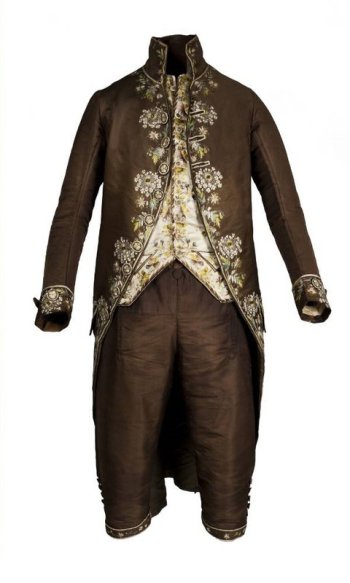
Traje a ‘la francesca’ (calzón, chupa, casaca) / French Costume (Breeches, Vest, Dress Coat), ca. 1795–1800; silk, linen, and cotton (Madrid: Museo del Traje, Centro de Investigación del Patrimonio Etnológico; Calzón, CE000663; chupa, CE000664; casaca, CE000665; photo by Gonzalo Cases Ortega).
Canvas & Silk will be on view at the Meadows from 19 September 2021 until 9 January 2022. Concurrently, the Meadows will also present Image & Identity: Mexican Fashion in the Modern Period, an investigation into Mexican dress spanning from Mexican Independence to modern times through photographs and prints from the collections of the Meadows Museum and SMU’s DeGolyer Library.
“We are thrilled to have the opportunity to gain further insight into the Meadows’s collection of Spanish art through its exhibition with loans from Spain’s premier collection of historic dress,” said Amanda W. Dotseth, curator at the Meadows Museum and co-curator of the exhibition in collaboration with Elvira González of the Museo del Traje. “This exhibition makes it possible to tell a more nuanced story about Spanish society through the presentation of historic paintings with contemporaneous examples of the garments depicted therein. We are as never before able to explore the complex relationships between representation and reality, between image and artifact. Spanish fashion has long been a point of interest for the Meadows Museum, whether in the form of past exhibitions—such Balenciaga and His Legacy: Haute Couture from the Texas Fashion Collection in 2007—or as portrayed in the collection’s prints, paintings, and sculptures. We look forward to continuing our study and display of Spanish fashion with this unprecedented collaboration with the Museo del Traje.”
Canvas & Silk will be divided into themes that elucidate various trends in the history of European fashion in general and Spanish dress in particular over the past five hundred years. These include ‘Precious Things’, featuring accessories like jewelry and combs made from precious metals and other rare materials such as coral; ‘Traditional Dress’ with examples of garments and ensembles that are typically identified with Spain, such as a traje de luces (the suit typically worn by bullfighters) and mantón de Manila (traditional embroidered silk shawls historically traded through Manila); and ‘Stepping Out’ demonstrating the importance of what one wore when presenting themselves in public. Highlights of pairings combining paintings from the Meadows’s collection and historic dress from the Museo del Traje include Ignacio Zuloaga’s The Bullfighter ‘El Segovianito’ (1912) accompanied by a traje de luces of the same color; Zuloaga’s Portrait of the Duchess of Arión, Marchioness of Bay (1918) displayed alongside a mantón de Manila similar to the one the duchess is holding; and Joan Miró’s Queen Louise of Prussia (1929) paired with a vibrantly hand-painted dress and shoes by twentieth-century fashion designer Manuel Piña.
“By pairing the Museo del Traje’s collection with that of the Meadows’s, we are bringing the dress, accessories, and other material objects to life, enabling viewers to see the contexts in which such articles were worn,” said Elvira González, curator of the historic apparel collection at the Museo del Traje. “Viewed together, the clothing allows for a deeper understanding of the painting; for example, the presence of the mantón de Manila (embroidered Manila silk shawl) in Ignacio Zuloaga y Zabaleta’s painting Portrait of the Duchess of Arión, Marchioness of Bay (1918) speaks to the social position of the woman depicted. Not only will our collection be seen by audiences in the U.S. for the first time, but it will also be displayed in a completely new light. We’re excited to see what kind of scholarship and new ideas might be generated by presenting these works in a new environment and alongside these paintings and drawings.”
The accompanying exhibition catalogue will contain an essay co-authored by Dotseth and González that illuminates themes linking the garments, accessories, and corresponding works in the Meadows collection. The publication will feature new photography of key objects by Jesús Madriñán.
Canvas & Silk will be accompanied by a focused exhibition in the museum’s first-floor galleries titled Image & Identity: Mexican Fashion in the Modern Period, curated by Akemi Luisa Herráez Vossbrink, the Center for Spain in America (CSA) Curatorial Fellow at the Meadows Museum. Featuring photographs, prints, books, and gouaches from the 19th and 20th centuries, this exhibition will explore Mexican fashion through images of everyday scenes, festivities, regional types, and occupations. Building on a theme developed in Canvas & Silk, Image & Identity will also show how national identity formation is reflected in fashion and is often accompanied by a resurgence in the popularity of indigenous dress. Works in Image & Identity are drawn from the collections of the Meadows Museum and SMU’s DeGolyer Library, named after Everette L. DeGolyer, Sr. who, with his son, collected maps, books, manuscripts, and photographs related to Mexican exploration and history. Artists featured in the exhibition include Alfred Briquet, Carlos Mérida, Diego Rivera, José Clemente Orozco, Jerry Bywaters, Paul Strand, and Manuel Álvarez Bravo.
Workshop | 18th-C Persianate Albums Made in India

Musical and dance performance in the harem, from an Indo-Persianate album of Antoine Louis Polier, I 4594, fol. 19, Delhi or Faizabad before 1777
(Staatliche Museen zu Berlin, Museum für Islamische Kunst / Johannes Kramer)
◊ ◊ ◊ ◊ ◊
From ArtHist.net (11 September 2021) . . .
18th-Century Persianate Albums Made in India: Audiences – Artists – Patrons and Collectors
Online and In-Person, Museum of Asian Art and Museum of Islamic Art, Berlin, 15–17 September 2021
Organized by Friederike Weis
This workshop will address the role of Indo-Persianate albums (muraqqaʿs) that were assembled for or collected by the Mughal governors of Awadh (Uttar Pradesh): Shujaʿ al-Daula (r. 1754–75) and his successor Asaf al-Daula (r. 1775–97), as well as other local elites in Bengal and Bihar. Europeans also participated in the creation and consumption of albums, as patrons and collectors. In 1882, the Prussian State acquired a group of twenty albums from the twelfth Duke of Hamilton. So far, these artworks have received little study. Eight of them belonged to the Scottish surgeon and interpreter Archibald Swinton (1731–1804) and ten to the Franco-Swiss engineer-architect Antoine Louis Henri Polier (1741–1795)—both were Company officers deeply acquainted with Indo-Persian aristocratic culture. Many more albums are linked to well-known European figures, such as the Governor-General of Bengal Warren Hastings (1732–1818) and the French Company officer (and special agent to Shujaʿ al-Daula in Faizabad) Jean-Baptiste-Joseph Gentil (1726–1799). Numerous interrelated questions arise from the study of this material, concerning audiences, artists, patrons, collectors, and their wish to produce and preserve knowledge.
The workshop will be held as a blended format with a mix of online and on-site presentations at the Museum of Asian Art and the Museum of Islamic Art in Berlin. You are cordially invited to join all presentations via webex (free of charge). We anticipate that the event will be recorded. If you wish to attend the workshop in person, please note that the number of seats at both venues is limited. Advance registration for on-site attendance is essential: f.weis@smb.spk-berlin.de.
Times are listed according to CEST (Central European Summer Time)
W E D N E S D A Y , 1 5 S E P T E M B E R 2 0 2 1
Museum für Asiatische Kunst, 3.00–6.20pm | Link
3.00 Raffael Gadebusch (Berlin) — Welcome
3.15 Friederike Weis (Berlin) — Introduction
3.50 Session 1. Polier’s Albums and Manuscripts: Contents and Contexts
Chair: Friederike Weis
• Susan Stronge (London) — Collecting the Mughal Past
• Malini Roy (London) — Blurred Lines: Looking at the Paintings by the Artist Mihr Chand and Determining the Boundaries between Innovation, Imitation, or Intentional ‘Duplication’
• Firuza Abdullaeva-Melville (Cambridge) — Three Highlights of Polier’s Collection from Cambridge: Treasures or Leftovers
T H U R S D A Y , 1 6 S E P T E M B E R 2 0 2 1
Museum für Asiatische Kunst, 9.30am–4.30pm | Link
9.30 Session 2. Patrons, Collectors, and Compilation Strategies
Chair: Susan Stronge
• Emily Hannam (Windsor) — Fit for a King? Two Late Mughal Albums in the Royal Library at Windsor Castle
• Axel Langer (Zurich) — Obvious or Hidden Narratives in the Large Clive Album
• J.P. Losty (Sussex) — Archibald Swinton’s Indian Paintings and Albums: An Analysis
12.00 Lunch Break
1.20 Session 3. Recurrent Themes and Tropes in Indo-Persianate Albums
Chair: Laura Parodi
• Katherine Butler Schofield (London) — Performing Women in the Polier and Plowden Albums: Pursuing Khanum Jan
• Molly Aitken (New York) — Intoxicating Friendships: Figuring Classical Indian Aesthetic Regimes in Mughal Album Painting
• Yuthika Sharma (Edinburgh) — Topography as Mughal Utopia? Polier’s ‘Garden Series’ and Artistic Exchange in 18th-Century Periphery-Centre Imagination
• Anastassiia Botchkareva (New York) — Tropes and Outliers: Tracing Patterns of Iconography in the Polier Albums
F R I D A Y , 1 7 S E P T E M B E R 2 0 2 1
Archäologisches Zentrum (Offices of the Museum für Islamische Kunst), 9.45am–3.30pm | Link
9.45 Stefan Weber and Deniz Erduman-Çalış (Berlin) — Welcome
10.00 Session 4. Calligraphy in the Berlin Albums: Historicism and Contemporary Mughal Masters
Chair: Axel Langer
• Claus-Peter Haase (Berlin) — The Calligraphies of the 16th-17th Centuries in the Berlin Albums: Reflections on their Origins and Purpose in a Muraqqaʿ
• Will Kwiatkowski (Berlin) — Expanding the Canon: Mir Muhammad Husayn ʿAta Khan and the Polier Albums
11.50 Session 5. Indian Muraqqaʿs Collected by Europeans: Networks and Relationships
Chair: Deniz Erduman-Çalış
• Laura Parodi (Genova) — Allegory and Verisimilitude in Later Indian Albums
• Isabelle Imbert (Manchester) — Like a Garden Bedecked: Floral Margins in 18th-Century Awadhi Albums Produced for European Patrons
1.10 Lunch Break
2.20 Session 5: Indian Muraqqaʿs Collected by Europeans: Networks and Relationships, continued
• Yael Rice (Amherst, MA) — The London Market for South Asian Muraqqaʿs and the Hastings Albums
3.00 Final Discussion
Huntington Commissions Wiley to Paint New, ‘Blue-Boy’ Inspired Work

Thomas Kehinde Wiley, A Portrait of a Young Gentleman, 2021, oil on linen, 71 × 49 inches, © Kehinde Wiley (San Marino: Collection of The Huntington Library, Art Museum, and Botanical Gardens, commissioned through Roberts Projects, Los Angeles). Installation photo by Joshua White.
◊ ◊ ◊ ◊ ◊
Press release (9 September 2021) from The Huntington:
Kehinde Wiley, A Portrait of a Young Gentleman
San Marino, The Huntington Library, Art Museum, and Botanical Gardens, 2 October 2021 — 3 January 2022
The Huntington Library, Art Museum, and Botanical Gardens announced today that it has commissioned the renowned artist Kehinde Wiley to create a new work inspired by Thomas Gainsborough’s The Blue Boy (ca. 1770). Wiley’s A Portrait of a Young Gentleman (also the original title of the Gainsborough painting) will be a large-scale portrait in the Grand Manner style that will be added to The Huntington’s permanent collection. The new painting will be on view from 2 October 2021 through 3 January 2022, in The Huntington’s Thornton Portrait Gallery, opposite the institution’s iconic and recently restored Blue Boy. The acquisition of the Wiley portrait celebrates the 100th anniversary of the purchase of the Gainsborough painting by Henry and Arabella Huntington, the founders of the institution.
 “Just as scholars come to The Huntington to study and reinterpret our significant collections, with this commission we are delighted that Kehinde Wiley will reenvision our iconic work, The Blue Boy, and Grand Manner portraiture in a powerful way,” said Huntington President Karen R. Lawrence. “Across the breadth of our library, art, and botanical collections, we are inviting perspectives that alter the way we see tradition itself.”
Wiley has long talked about the role The Huntington played in his formative years as an artist growing up in Los Angeles. When he was young, his mother enrolled him in art classes at The Huntington, where he encountered a formidable collection of Grand Manner portraits—large-scale depictions of England’s 18th- and 19th-century noble class. The portraits made such an impression on Wiley that he would later incorporate their stylistic representations of wealth, glory, and power into his own artistic practice, focusing on the Black and brown bodies missing from the museums he visited.
“I loved The Huntington’s galleries; the paintings by Joshua Reynolds, Thomas Gainsborough, and John Constable were some of my favorites,” Wiley said. “I was taken by their imagery, their sheer spectacle, and, of course, their beauty. When I started painting, I started looking at their technical proficiency—the manipulation of paint, color, and composition. These portraits are hyperreal, with the detail on the face finely crafted, and the brushwork, the clothing, and the landscape fluid and playful. Since I felt somewhat removed from the imagery—personally and culturally—I took a scientific approach and had an aesthetic fascination with these paintings. That distance gave me a removed freedom. Later, I started thinking about issues of desire, objectification, and fantasy in portraiture and, of course, colonialism.”
For A Portrait of a Young Gentleman, Wiley has been painting in Senegal, where he has been living during the COVID-19 pandemic and where Black Rock Senegal, his artist-in-residence program, is headquartered.
Wiley, who earned a bachelor’s in fine arts from the San Francisco Art Institute in 1999 and a master’s in fine arts from Yale University in 2001, became famous for full-length depictions of everyday Black men and women in street clothes. The subjects are painted in classical poses against vibrant, patterned backgrounds, reminiscent of West African fabrics as well as wallpaper and textile designs by William Morris and Co. Wiley’s portraits have come to include depictions of a number of public figures, the most well known of which is the presidential portrait of Barack Obama, which coincidentally will be on view just a few miles from The Huntington at the Los Angeles County Museum of Art (LACMA) this fall, as part of a national tour.
“By adding a work by Kehinde Wiley to our collection, and offering it on view in our most lauded gallery of historic art, we are examining our shared history and beginning to curate our future,” said Christina Nielsen, Hannah and Russel Kully Director of the Art Museum at The Huntington. “I fully expect that Wiley’s portrait will speak to 21st-century audiences just as Thomas Gainsborough’s Blue Boy did to its original audience when it was first unveiled in 1770. We can’t wait to share this experience with visitors.”
In conjunction with the commission, The Huntington is developing plans for a related book.
In January 2022, The Blue Boy will travel to London for an exhibition at the National Gallery, opening 100 years to the day it departed from England for its new home in California.
◊ ◊ ◊ ◊ ◊
Note (added 2 October 2021) — The painting was unveiled on 2 October 2021. The posting has been updated to include the images.
World’s Oldest Jeans as Inspiration

From Industry.Fashion.com (with coverage also at HypeBeast). . .
Tom Shearsmith, “Diesel to Reproduce World’s Oldest Known Jeans Fabric,” The Industry.Fashion (3 September 2021).
Diesel has announced it is to honour Genoa, the birthplace of Jeans, and celebrates Made in Italy by presenting a reproduction of the oldest jeans fabric ever documented in history.
 Dating back to 1760, local townspeople and labourers in Genoa were first seen wearing jeans as part of their daily wardrobes. Colours ranged from standard indigo to brown to white. A nativity figurine by Pasquale Navone shows a man with denim trousers (woven diagonally, 2 to 1, in a blue cotton weft and white linen warp) that appear remarkably similar to iterations from the modern era. This sculpture represents the oldest historical instance of jeans.
Diesel has replicated the original fabric and garment as they existed three hundred years ago using handmade Italian textiles and workmanship. The re-creation is exhibited at Genova Jeans fair in Genoa, Italy through September 6, where Diesel was invited to celebrate the heritage of Made in Italy jeans.
◊ ◊ ◊ ◊ ◊
The nativity figure by Pasquale Navone (1746–1791) is now housed at the Galleria Nazionale di Palazzo Spinola in Genova, a building begun in 1594 and updated substantially in the eighteenth century. As noted at Wikipedia:
In the 18th century it [the palazzo] again passed through marriage to become the property of the House of Spinola, when Maddalena Doria married to Niccolò Spinola. Maddalena directed the Rococo refurbishment in the mid-18th century, and engaged Lorenzo De Ferrari, Giovanni Battista Natali and Sebastiano Galeotti to paint the quadratura and decoration. She also commissioned the Gallery of Mirrors. Her grandson, Paolo Francesco Spinola, however was forced during the Napoleonic occupation to sell many works of art; his portrait (1794) by Angelica Kauffman is on display in the palace.
◊ ◊ ◊ ◊ ◊
Note (added 9 September 2021) — The title of the original posting misleadingly used the word denim.
Exhibition | The Jewish Past of Strawberry Hill
From the exhibition press release, via Art Daily,
The Unexpected Jewish Past of Strawberry Hill House
Online, starting in 2021
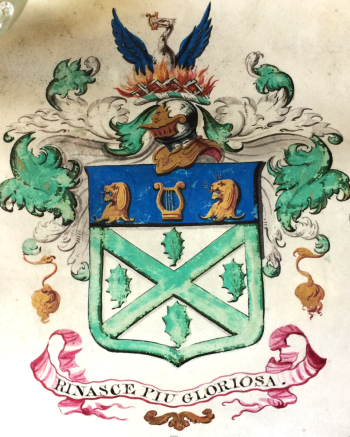
Grant of Arms to John Braham, detail, 1817, “Rinasce piu gloriosa” (It rises again more glorious).
As part of the events and activities celebrating the European Jewish Days of Culture festival, Strawberry Hill House has a free online exhibition exploring the lives of two of the historic west London villa’s former owners: Frances, Countess Waldegrave (1821–1879) and Herbert Stern, 1st Baron Michelham (1851–1919).
For many, Strawberry Hill House is synonymous with Horace Walpole, who built the neo-Gothic villa (1749–76), and filled it with his collections. However, following his death in 1797, the house was passed to a succession of owners, including the formidable Frances, Lady Waldegrave, the daughter of the internationally famous Jewish opera singer, John Braham, and later to Herbert Stern, the scion of a Jewish banking dynasty. As visitors will discover in Strawberry Hill’s comprehensive online exhibition, the House’s Jewish owners brought it back to the centre of the social and artistic milieu of their respective eras.
Through a variety of images and objects, online visitors can explore the aspects of Jewish culture and sociability that characterised the lives of Lady Waldegrave and the Stern Family. With themes including family ties, cosmopolitanism, art patronage, social status, religious identity, anti-Semitism, and different forms of philanthropy, the exhibition shines a spotlight onto the lives and activities of two very different chatelaines, whose time at Strawberry Hill has often been overshadowed by the presence of Walpole.
Visitors to Strawberry Hill House will be able to explore two objects on loan that complement the online exhibition: the Grant of Arms to John Braham (1817) and the Louis William Desanges painting Strawberry Hill: The Drawing Room (1865). Lady Waldegrave was very proud of the coat of arms granted to her father in 1817—a symbol of his success, and his patronage by important figures such as the Duke of Sussex. Appropriately enough for a poor orphan from the East End, who had sold pencils on the street as a young boy, he chose a phoenix rising from the ashes as his crest. The phoenix holds a lyre in its beak—a suitable symbol for a musician (the lyre was the crest of the Worshipful Company of Musicians), and the Grant is inscribed ‘Rinasce piu gloriosa’ (it rises again more glorious). One of the stained-glass windows in the Round Drawing Room at Strawberry Hill shows Braham’s Grant of Arms, and it can also be seen above the entrance gate. Lady Waldegrave became known as one of the foremost political hostesses of Victorian Britain. She, along with her last husband Chichester Fortescue, managed a wide circle of political friendships, both nationally and internationally. Whilst she was deeply involved with the fortunes of the Liberal Party, for which Fortescue was an MP and cabinet minister, the parties she hosted at Strawberry Hill were deliberately bipartisan. Lord Russell, Gladstone and Disraeli were all regular visitors to Strawberry Hill. The Desanges painting Strawberry Hill: The Drawing Room shows such a glittering gathering.
To coincide with the online exhibition, author and curator Nino Strachey will share her personal reflections on the life of her ancestor, Frances Waldegrave, with a talk on 29 September. Drawing on her research into the Braham family, Nino will share new insights from the papers recently acquired by the British Library.
Strawberry Hill House Curator, Silvia Davoli, says: “Our collaboration with the Jewish Country Houses Project has led me to develop a more in-depth documentary research on Lady Waldegrave and the Sterns. With this exhibition my hope is to engage our visitors with a new exciting dimension of the history of the house, a story full of surprises and yet to be told!”
Derek Purnell, Director, Strawberry Hill House & Garden, says: “I am delighted that by displaying these items we are able to begin to share some of the lesser-known stories of Strawberry Hill House’s illustrious history, and we are grateful to Nino Strachey for her contribution to making this project possible.”
Since 2018 Strawberry Hill House has collaborated with the Jewish Country Houses Project, a 4-year research project funded by the Arts and Humanities Research Council, you can find more information about the project and the ongoing initiatives here.
This exhibition is curated by Silvia Davoli (Curator, Strawberry Hill), in collaboration with Nino Strachey (Writer and former Head of Research for the National Trust), Tom Stammers (Associate Professor in Modern European Cultural History, University of Durham), Michele Klein (Independent Researcher), Chris Jones (Curator, Salomons Museum), Bethan Wood (Marketing and Communication Manager, Strawberry Hill), and Carole Tucker (Hon Librarian at Strawberry Hill).
230th Anniversary of Robert Carter’s ‘Deed of Gift’
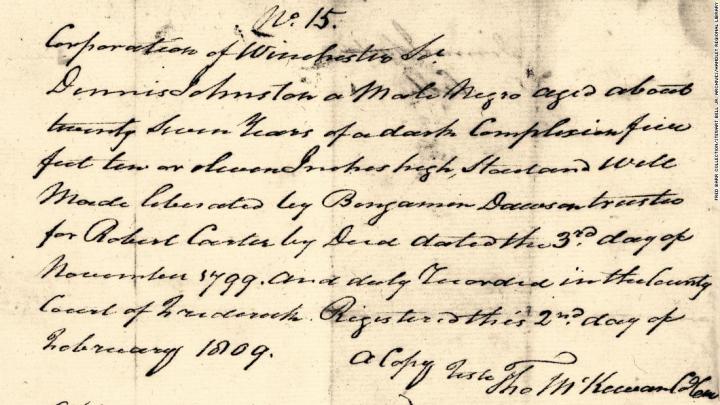
Staggered over time, the manumission took decades to complete. A certificate of freedom for one of the freedmen reads, “Dennis Johnston, a Male Negro aged about twenty seven years of dark Complexion five feet ten or eleven inches, stout and well made liberated By Benjamen (sic) Dawson, trustee for Robert Carter by Deed dated the 3rd day of November 1799, and duly recorded in the County Court of Frederick. Registered this 2nd day of February 1809.” (Winchester, Virginia: Stewart Bell Jr. Archives, Handley Regional Library).
◊ ◊ ◊ ◊ ◊
As reported by Eliott McLaughlin for CNN, yesterday was the 230th anniversary of the start of the largest liberation of enslaved people in the United States prior to 1863.
Eliott C. McLaughlin, “Like Washington and Jefferson, He Championed Liberty. Unlike the Founders, He Freed His Slaves,” CNN (5 September 2021).
It was 230 years ago Sunday that Robert Carter III [1728–1804], the patriarch of one of the wealthiest families in Virginia, quietly walked into a Northumberland County courthouse and delivered an airtight legal document announcing his intention to free, or manumit, more than 500 slaves. He titled it the “deed of gift.” It was, by far, experts say, the largest liberation of Black people before the Emancipation Proclamation more than seven decades later.
On September 5, 1791, when Carter delivered his deed, slavery was an institution, a key engine of the new country’s economy. But many slaveholders—including founding fathers George Washington, Thomas Jefferson and James Madison, who knew Carter—had begun to voice doubts. That was the extent of their umbrage. . . .
Today, descendants of both Carter and the men and women he freed say more must be done to propel the largely uncelebrated deed of gift into the national conscience.
Meriwether Gilmore, who grew up in Westmoreland County, where Carter’s Nomini Hall estate once spanned 2,000 acres, is related to Carter on her mother’s side. Her sister is named after his mother and oldest daughter, Priscilla. Her father worked with Black churches in the area to commemorate the deed of gift’s bicentennial in 1991.
“I think the story of Robert Carter III is incredibly important,” she said, “and not just to glorify another rich, White man, but to show how personal convictions can be stronger than the status quo, that doing the right thing is often hard but important and that people matter—that people are more important than the work that they perform.” . . .
A religious wanderer drawn later in life to integrated churches, Carter III was not the first to free his slaves. Others, middle-class Quakers and Baptists among them, had released a few slaves here, a few there, but none rivaled Carter’s deed, which established a schedule to free 511 slaves, starting with the oldest and later their children.
Carter also allowed the freedmen to choose their last names so they could keep families together and pass down wealth. He ensured they had salable skills, arranged for them to buy or lease land, and bought their wares. He also spent a great deal on transporting them from his plantations to the Northumberland courthouse, and on lawyers to guarantee his heirs—some none too happy he was paring their inheritance—didn’t undo his wishes. . . .
The full article is available here»
◊ ◊ ◊ ◊ ◊
As noted in the article, the Nomini Hall Slave Legacy Project works to chronicle the descendants of the enslaved Africans who were freed by Robert Carter III from his Nomini Hall estate.
For Carter’s biography, see Andrew Levy, The First Emancipator: The Forgotten Story of Robert Carter, the Founding Father Who Freed His Slaves (New York: Random House, 2005).
Frick Announces Its Most Significant Gift of Drawings and Pastels
Press release (30 August 2021) from The Frick:

Elisabeth Vigée Le Brun, Head of a Woman, 1784, pastel on paper, 12 x 10 inches (New York: Frick Collection, promised gift from the Collection of Elizabeth and Jean-Marie Eveillard; photo by Joseph Coscia Jr.).
The Frick Collection announces the largest and most significant gift of drawings and pastels in its history, thanks to the generosity of Elizabeth ‘Betty’ and Jean-Marie Eveillard. Over the past forty-five years, the Eveillards have assembled an outstanding collection of European works on paper, ranging in date from the end of the fifteenth century to the twentieth century and representing artists working in France, Britain, Italy, Spain, and the Netherlands. The Eveillards have made a promised gift to the Frick of twenty-six of these works—eighteen drawings, five pastels, two prints, and one oil sketch—among them some of their finest acquisitions. Along with preparatory figurative sketches and independent studies and portraits are two vivid landscape scenes. Fittingly for the Frick, artists represented include François Boucher, Edgar Degas, Jean-Honoré Fragonard, Francisco José de Goya y Lucientes, Thomas Lawrence, and Jean-François Millet. The group also introduces to the Frick’s holdings works by artists not yet represented in its primary collecting areas, including Gustave Caillebotte, Maurice Quentin de La Tour, Jan Lievens, John Singer Sargent, and Elisabeth Vigée Le Brun. In the fall of 2022, at its temporary Frick Madison location, the museum will present an exhibition of these extraordinary works, to be accompanied by a catalogue and public programs.
François Boucher, Reclining Shepherdess (La bergère au Coeur), ca. 1753; black, red, and white chalk and blue, light blue, red, pink, and yellow pastel with touches of grey watercolor washes and possibly some traces of graphite on paper; 16 × 19 inches (New York: Frick Collection, promised gift from the Collection of Elizabeth and Jean-Marie Eveillard; Photo by Joseph Coscia Jr.).
Comments Xavier F. Salomon, the Frick’s Deputy Director and Peter Jay Sharp Chief Curator, “It has been a pleasure studying and selecting from this remarkable collection of two longtime supporters of the Frick, assembled just as our own holdings have been, according to criteria of beauty, quality, and condition. Each of the twenty-six works either appreciably deepens our holdings of a familiar artist or brings to us the work of one who is not—but should be—represented within our core areas of European Old Master art. In adding five pastels and an oil sketch, the gift also strengthens our examples of these media. We very much look forward to sharing these works with the public next year.” Betty and Jean-Marie Eveillard have been deeply involved with the Frick for many years, both having served as Trustees. Betty is currently the Board’s Chair.
The Eveillards acquired their first important work in 1975, John Singer Sargent’s Virginie Amélie Avegno, Mme. Gautreau (Mme. X), and have been active collectors ever since. This drawing is the most modern work in the promised gift to the Frick and is a particularly satisfying addition to the museum’s holdings: It is known from archival correspondence that Henry Clay Frick desired a portrait by Sargent but did not succeed in securing a sitting with the artist. Dated to about 1884, Sargent’s Mme. Gautreau is one of some dozen studies produced for the famous painted portrait Madame X, a highlight of the collection of The Metropolitan Museum of Art. This sheet shows the artist working out the figure’s pose, representing her lithe figure kneeling on a sofa and looking out a window. Sargent was captivated by Gautreau and strived in studies like this and in the final painting to capture her “unpaintable beauty and hopeless laziness.”
Other later nineteenth-century drawings coming to the Frick are by Degas and Caillebotte, selected to complement the collection’s Impressionist paintings. While the institution owns a quintessential Degas canvas of dancers, the Eveillards’ early drawing of Adelchi Morbilli, created in Naples in 1857, will be the first work on paper by the artist in the Frick’s collection. It is one of—and arguably the best of—his series of drawings of his cousin. When it was drawn, Degas was particularly interested in the work of Jean-Auguste-Dominique Ingres, and the portrait reflects this affinity. Gustave Caillebotte is best known and perhaps most celebrated for his 1877 painting at Chicago’s Art Institute, Paris Street, Rainy Day. A man of wealth, Caillebotte was also a patron and supporter of fellow Impressionist colleagues. His works only rarely appear on the market, most still being in the possession of his descendants. The promised gift includes a preparatory drawing for the iconic Paris street scene.

François Boucher, Reclining Shepherdess (La bergère au Coeur), ca. 1753; black, red, and white chalk and blue, light blue, red, pink, and yellow pastel with touches of grey watercolor washes and possibly some traces of graphite on paper; 16 × 19 inches (New York: Frick Collection, promised gift from the Collection of Elizabeth and Jean-Marie Eveillard; photo by Joseph Coscia Jr.).
Eighteenth-century French art is one of the Frick’s strengths, with holdings by Boucher, Fragonard, Greuze, and Watteau. The gift brings to the museum works in chalk and pastel on paper by these four artists, media in which none of them is currently represented. Among these is a pastel drawing lauded by the influential writers Edmond and Jules Goncourt as one of the most beautiful by Boucher. The image of a reclining woman is associated with a pastoral painting now at the Louvre. Young Woman (La Coquette) by Fragonard is one of a series of spectacular drawings of female models standing outdoors. These were made in the early 1770s, contemporaneous with his creation of the four original canvases of The Progress of Love that today are a highlight of the Frick. The most renowned—and arguably the best—pastelist in eighteenth-century France was the eccentric Maurice Quentin de La Tour. The Eveillards have the finest pastel by him in private hands in the United States, the portrait of Madame Rouillé. It too comes to the Frick along with a sheet by De La Tour’s near contemporary Nicolas Lancret, neither of whom is currently represented at the museum in any medium. Widely traveled and celebrated during her life, Elisabeth Vigée Le Brun was a highly accomplished portraitist and writer. Her work also enters the collection with Head of a Woman, a sketch signed and dated 1784 and likely made in preparation for a history painting that was never executed. The scope of the institution’s French works is broadened further with sheets by Pierre-Paul Prud’hon and Jean-Baptiste Wicar.
Painter Eugène Delacroix was among those artists to herald French Romanticism. In 2010, former Frick Director Charles Ryskamp left to the Frick the artist’s Moroccan Interior, a delicate and personal drawing from one of the sketchbooks Delacroix made in 1832 during a visit to North Africa. The Eveillard gift includes a pastel by the artist depicting two North African figures in a landscape, based on sketches made two decades later. Of the twenty known Delacroix pastels of such subjects, only a dozen can be located today; the Eveillard sheet is the only one in private hands, making this acquisition a particularly rare occurrence.
The Frick is also celebrated for Spanish art, including five works by Goya: four paintings and one drawing, The Anglers. The Eveillards’ Tambourine Player will deepen the institution’s holdings by the artist. This depiction of a dancing Spanish man comes from the same album as the aforementioned drawing and likewise exemplifies the artist’s use of everyday people as subjects, as is also the case with the Frick’s large Goya painting of laborers, The Forge.
Other works in the gift enrich the Frick’s celebrated collection of Italian works, with sheets ranging from a rare anonymous fifteenth-century Venetian drawing to Italian Renaissance and Baroque sheets by Federico Barocci, Guido Reni, and Salvator Rosa and eighteenth-century works by Giovanni Battista Piazzetta and Giovanni Domenico Tiepolo. The group includes two remarkable portraits by Jan Lievens, the Dutch contemporary of Rembrandt, and by Sir Thomas Lawrence, the leading British portraitist of his age. As a young collector, Henry Clay Frick was particularly interested in the Barbizon school, and a drawing by Jean-François Millet, one of the movement’s founding members, will also enter the collection through this generous gift. The landscape joins a genre scene by Millet already in the collection. Crowning this remarkable group of works is an oil sketch by John Constable, made in preparation for the last of the artist’s famous series of ‘six-footer’ paintings, of which The White Horse at the Frick was the first.
Exhibition | Virginia Lee Montgomery: Sword in the Sphinx

Virginia Lee Montgomery (VLM), Sword in the Sphinx, 2018, resin, steel, rust, concrete, enamel. As installed at Socrates Sculpture Park, Queens, New York in 2018.
◊ ◊ ◊ ◊ ◊
Opening this month at Meijer Gardens and Sculpture Park:
Virginia Lee Montgomery: Sword in the Sphinx
Frederik Meijer Gardens & Sculpture Park, Grand Rapids, Michigan, 16 September — 31 October 2021
The figure of the sphinx originated as an ancient Egyptian and Greek mythological monster. The sphinx with a female head and upper body and with lion’s legs became a popular garden statue in 18th-century Europe. Its features resembled that of Madame Pompadour, the French patron of the arts and chief mistress of King Louis XV. In Sword in the Sphinx, VLM adopts the Pompadour-style sphinx with a shocking twist: her back is pierced with a steel sword. Known for combining surrealism and feminism, VLM asks provocative questions about the representation of female power in art, adding another layer of meaning to a mythical figure with a complex history. Sword in the Sphinx is VLM’s official entry in the 2021 ArtPrize competition.
Marble Ponytails, the smoothly carved and polished marble ponytails, installed in the Courtyard Level, are named after ancient deities, among them Aurora, Andromeda, and Medusa. VLM asks us to dissociate these forms from masculine phallocentric readings, shifting perspective toward what she calls “feminist metaphysics.” VLM carved these sculptures by hand at the historic West Rutland Marble Quarry, on a fellowship through The Vermont Carving Studio and Sculpture Center.
Two of VLM’s short films are also being screened in the O-A-K Theater.
◊ ◊ ◊ ◊ ◊
Virginia Lee Montgomery (VLM), CUT COPY SPHINX, 2018, digital video, 3minutes 30seconds. “A surreal, sculptural short art-film about metaphysics, myth, and destruction. A feminist twist on the classical myth of Oedipus and the Sphinx, CUT COPY SPHINX recasts the sphinx as the uncanny hero who endures ‘cuts’ across time. Shot en plein aire on a miniature prop-set with a Dewalt drill and a gallon of honey, CUT COPY SPHINX syncs philosophy, feminism, and image theory. The film is directed, edited, scored, and performed by the artist, VLM” (description from Vimeo).
◊ ◊ ◊ ◊ ◊
Responding to a 2018 installation of Sword in the Sphinx at Socrates Sculpture Park in Queens, New York, Wendy Vogel describes the video CUT COPY SPHINX:
“A video for the park’s website dramatizes how an eighteenth-century sculpture of Madame de Pompadour as a sphinx, the authorship of which is disputed, has been copied for centuries in decor and knickknacks. A response to the #MeToo movement, Montgomery’s work upends the masculine bravado of the tales of King Arthur and Oedipus. ‘In the myth, Oedipus kills the sphinx’, Montgomery says, ‘but in my version she just keeps replicating’.”
–Wendy Vogel, “First Look: Virginia Lee Montgomery,” Art in America (October 2018).
Symposium | Everyday Rococo: Madame de Pompadour and the Arts
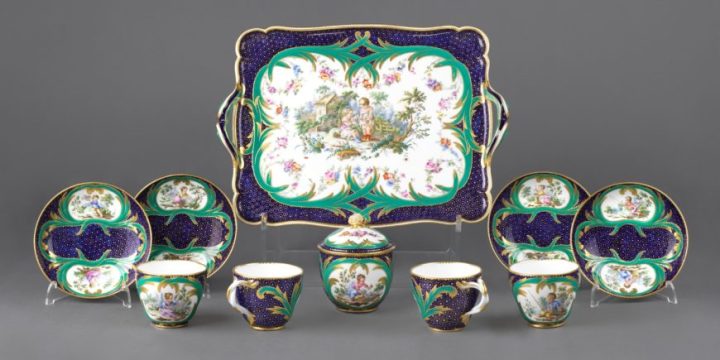
Tray and Tea Service (déjeuner ‘Courteille’, four gobelets ‘Hébert’ et soucoupes, pot à sucre ‘Bouret’), Manufacture de Sèvres, soft-paste porcelain, painted and gilded, lapis and green ground painted with children in landscapes by André-Vincent Vielliard, date letter F for 1759; probably bought by Mme de Pompadour in December 1759 (London: The Wallace Collection, C401-06).
◊ ◊ ◊ ◊ ◊
From The French Porcelain Society:
Everyday Rococo: Madame de Pompadour and the Arts
The Wallace Collection, London, 3–4 December 2021; rescheduled for 1–2 July 2022
The French Porcelain Society is pleased to announce its forthcoming symposium Everyday Rococo: Madame de Pompadour and the Arts to be held at the Wallace Collection, London, on 3–4 December 2021. With two days of papers, which we hope will also be available online, this will be the first reassessment of Jeanne-Antoinette Poisson’s artistic patronage since the landmark exhibition Madame de Pompadour et les Arts of 2002.
Commemorating the tercentenary of her birth, and marking the publication of Rosalind Savill’s book Everyday Rococo: Madame Pompadour and Sèvres Porcelain, this conference will welcome international experts discussing her interests in the fine and decorative arts from pets to porcelain and from prints to religious paintings. Further details will follow in the autumn, but please save the dates: Friday 3rd and Saturday 4th December.
New Book | Everyday Rococo
Scheduled for publication in October:
Rosalind Savill, Everyday Rococo: Madame de Pompadour and Sèvres Porcelain (London: Unicorn Press, 2021), 704 pages, ISBN: 978-1916495715, £200.
 Jeanne Antoinette Poisson (1721–1764), Marquise de Pompadour, the 300th anniversary of whose birth will be celebrated on 29 December 2021, became the official mistress of Louis XV of France in 1745, and for the rest of her life their patronage of Vincennes/Sèvres helped to make it one of the greatest porcelain factories in history. Everyday Rococo: Madame de Pompadour and Sèvres Porcelain is a year-on-year richly-illustrated chronology of her daily life and purchases. Although also partly a social history revealing Madame de Pompadour as a major player in the art and politics of eighteenth-century France, Rosalind Savill’s diligent research has concentrated on the everyday details of Madame de Pompadour’s life for which Vincennes/Sèvres catered so perfectly.
Rosalind Savill, DBE, FBA, FSA, was Director of the Wallace Collection in London from 1992 until 2011, and is a specialist in French decorative arts, especially Sèvres porcelain. Her major publication, The Wallace Collection: Catalogue of Sèvres Porcelain, 3 vols, 1988, was awarded the National Art-Collection Fund prize for Scholarship in 1990. She was appointed CBE for Services to the Study of Ceramics in 2000, won the European Woman of Achievement Award (Arts and Media) in 2005, was appointed DBE for Services to the Arts in 2009, and was appointed an Ocier dans L’Ordre des Arts et des Lettres, France, in 2014. She co-curated the exhibition The Art of Love: Madame de Pompadour at the Wallace Collection in 2002.










 Enfilade
leave a comment