Student Funding | Research Related to Castletown House, County Kildare
From the application form:
Kevin B. Nowlan Castletown Bursary
Applications due by 13 November 2021
The Kevin B. Nowlan Castletown Bursary was established in 2017 in honour of the late Professor Nowlan, who chaired the Castletown Foundation for more than three decades. The scholarship, advertised biannually, aims to further research on the history, architecture, collections, and estate of Castletown House in County Kildare. Applicants must be registered students and engaged in research which focuses on or relates to Castletown. The award of €2,000 may be used for research-related expenses or University fees. The selection committee will be composed of members of the Castletown Foundation and one external specialist. The scholarship need not be awarded in any one year, and the decision of the assessors is final.
Applicants must complete this form and submit it by email to Professor Christine Casey, caseych@tcd.ie, and Dr. Alison FitzGerald, alison.fitzgerald@mu.ie, by 5pm, Friday, 13 November 2021, with the subject line ‘Kevin B. Nowlan Castletown Bursary’. A confidential reference supporting the application must arrive separately, before the closing date.
Exhibition | Discovering Viceregal Latin American Treasures
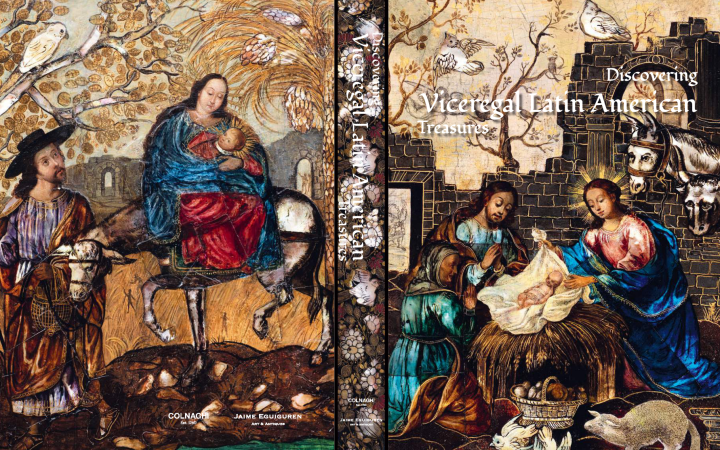
From Jaime Eguiguren Art & Antiques:
Discovering Viceregal Latin American Treasures
Colnaghi, New York and London, 2 July — 10 September 2021
Jaime Eguiguren Art & Antiques, Montevideo, Uruguay, 2 July — 10 December 2021
Jaime Eguiguren Art & Antiques and Colnaghi gallery are delighted to announce Discovering Viceregal Latin American Treasures, a survey exhibition that brings together more than a hundred works of art from the Viceregal period. The presentation takes place virtually and is supported by the publication of a printed exhibition catalogue, which will be the most in-depth publication on Viceregal art ever printed. The Old Master works in the exhibition date from the 16th to 18th century and include paintings, sculptures, silver, barniz de pasto (lacquer-like resin), ceramics, and furniture.
Discovering Viceregal Latin American Treasures, with essays by Pablo F. Amador Marrero, Alejandro Antuñano, Gonzalo Eguiguren Pazzi, Jaime Eguiguren, Cristina Esteras Martín, Sofía Fernández Lázaro, Concha García Sáiz, Jorge González Matarraz, Nuria Lázaro Milla, Yaiza A. Pérez Carracedo, Héctor San José, Dorie Reent (London: Colnaghi, 2021), 344 pages, ISBN: 978-8409304752.
New Book | Belonging and Betrayal
Distributed by The University of Chicago Press:
Charles Dellheim, Belonging and Betrayal: How Jews Made the Art World Modern (Waltham, MA: Brandeis University Press, 2021), 672 pages, ISBN: 978-1684580569, $40.
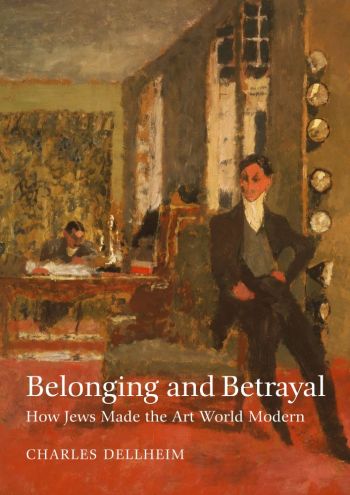 The story of dealers of Old Masters, champions of modern art, and victims of Nazi plunder.
Since the late-1990s, the fate of Nazi stolen art has become a cause célèbre. In Belonging and Betrayal, Charles Dellheim turns this story on its head by revealing how certain Jewish outsiders came to acquire so many old and modern masterpieces in the first place—and what this reveals about Jews, art, and modernity. This book tells the epic story of the fortunes and misfortunes of a small number of eminent art dealers and collectors who, against the odds, played a pivotal role in the migration of works of art from Europe to the United States and in the triumph of modern art. Beautifully written and compellingly told, this story takes place on both sides of the Atlantic from the late nineteenth century to the present. It is set against the backdrop of critical transformations, among them the gradual opening of European high culture, the ambiguities of Jewish acculturation, the massive sell-off of aristocratic family art collections, the emergence of different schools of modern art, the cultural impact of World War I, and the Nazi war against the Jews.
Charles Dellheim is professor of history at Boston University. He is the author of The Face of the Past: The Preservation of the Medieval Inheritance in Victorian England and The Disenchanted Isle: Mrs. Thatcher’s Capitalist Revolution.
C O N T E N T S
Acknowledgments
Prologue: Reframing the Picture
Part I. The Old Masters’ New Masters
1 Horse Dealer to Art Dealer
2 Treasure Island
3 Assimilating Art
4 Acquiring Eyes
5 Metropolitan Man
Part II. Was Modernism Jewish?
6 Madman and Sons
7 Was Modernism Jewish?
8 First Impressionists
9 Berlin Calling
10 Between Bohemian and Bourgeois
11 The Right Banker
Part III. In The Middle
12 The Wheel of War
13 Brothers-in-Arms
14 Custody Battles
15 In the Market of Love
16 Brothers-in-Law
17 Gentlemen and Players
Part IV. To Have and Have Not
18 Artful Jews
19 Artless Jews
20 Next Year in Paris?
21 After the Fall
22 The Dispossessed
23 The Exiles and the Kingdom
Epilogue: A Crack in Everything
New Book | Art Markets, Agents, and Collectors
From Bloomsbury:
Adriana Turpin and Susan Bracken, eds., Art Markets, Agents, and Collectors: Collecting Strategies in Europe and the United States, 1550–1950 (London: Bloomsbury Visual Arts, 2021), 400 pages, ISBN: 978-1501348877, $160.
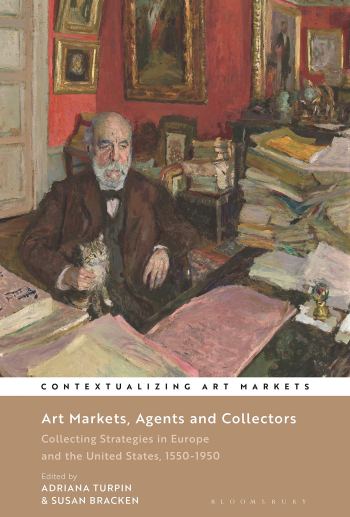 Art Markets, Agents and Collectors brings together a wide variety of case studies, based on letters and detailed archival research, which nuance the history of the art market and the role of the collector within it. Using diaries, account books, and other archival sources, the contributions to this volume show how agents set up networks and acquired works of art, often developing the taste and knowledge of the collectors for whom they were working. They are therefore seen as important actors in the market, having a specific role that separates them from auctioneers, dealers, museum curators, or amateurs, while at the same time acknowledging and analyzing the dual positions that many held. Each chronological period is introduced by a contextual essay, written by a leading expert in the field, which sets out the art market in the period concerned and the ways in which agents functioned. This book is an invaluable tool for those needing a broader introduction to the intricate workings of the art market.
Adriana Turpin is Academic Director and Head of Research, Institut d’Etudes Supérieures des Arts, Paris.
Susan Bracken is Associate Lecturer, Department of History of Art, Birkbeck University of London.
C O N T E N T S
List of Plates
List of Figures
Series Editor’s Introduction
Acknowledgements
Introduction — Jan Dirk Baetens, Susan Bracken, and Adriana Turpin
Part I: Agents in the Market, 1550–1720
I Introduction: Agents in the Art Market, 1550–1720 — Sandra van Ginhoven
1 Hans Albrecht von Sprinzenstein: An Austrian Art Agent in the Service of Archduke Ferdinand II of Tyrol — Adriana Concin
2 Marco Boschini and the Artists of His Time — Linda Borean
3 International Art Dealers, Local Agents, and Their Clients in Seventeenth-Century Habsburg Inner Austria — Tina Košak
4 James Thornhill as an Agent-Collector in Early-Eighteenth-Century Paris — Tamsin Lee-Woolfe
Part II: Agents in the Long Eighteenth Century
II Introduction: Hidden Figures – Agents in the Long Eighteenth Century — Bénédicte Miyamoto
5 Scottish Agents in Rome in the Eighteenth Century: The Case of Peter Grant — Maria Celeste Cola
6 ‘An Oracle for Collectors’: Philipp von Stosch and Collecting and Dealing in Art and Antiquities in Early-Eighteenth-Century Rome and Florence — Ulf R. Hansson
7 Shaping the Taste of British Diplomats in Eighteenth-Century Venice — Laura-Maria Popoviciu
8 Establishing Honest Trading Relationships: Academic Painters in the Art Market of Eighteenth-Century France — Christine Godfroy-Gallardo
9 The German Art Market in the Eighteenth Century — Renata Schellenberg
10 Playing the Market: Lord Yarmouth, the Prince Regent, and the Role of the Royal Agent, 1806–19 — Rebecca Lyons
Part III: The Agent in the Modern European Art Market, 1820–1950
III Introduction: The Art Market in Europe, 1820–1950 — Anne Helmreich
11 Edward Solly, Felice Cartoni, and Their Purchases of Paintings: A ‘Milord’ and His ‘Commissioner’ Anticipating a Transnational Network of Dealers, c. 1820 — Robert Skwirblies
12 ‘To see once again the glorious picture by Moretto before it is forever lost for Rome’: How an Artist’s Position in the Canon of Taste Was Enhanced in the Nineteenth Century — Corina Meyer
13 ‘It is not my fault if in all the private collections, the Dutch paintings surpass all’: Thoré-Bürger’s Promotion of Dutch Art in the Parisian Art Market of the 1860s — Frances Suzman Jowell
14 The Beurdeleys: A Dynasty of Curiosity Dealers and Their Networks — Camille Mestdagh
15 Collaboration and Resistance: The National Gallery, London, and the Italian Art Market at the End of the Nineteenth Century — Elena J. Greer
16 ‘I shall set at once about the work’: Some Agents in China — Nick Pearce
17 Promoting Themselves: Agents and Strategies in early Surrealism’s Art Market — Alice Ensabella
Part IV: Agents in the Market for American Collectors
IV Introduction: Collecting Alliances in the United States during the Long Nineteenth century — Inge Reist
18 Can a Leopard Change Its Spots? René Gimpel, Art Dealer — Diana J. Kostyrko
19 Samuel P. Avery’s Early Career: The Emergence of a Successful Art Agent, Art Dealer, and Art Expert — Madeleine Fidell-Beaufort
20 Dealing with Allegories of the Four Parts of the World: James Hazen Hyde (1876–1959) and His Network — Louise Arizzoli
21 Laying the Foundation: Harold Woodbury Parsons and the Making of an American Museum — MacKenzie Mallon
22 Convergences: Art History, Museums, and Scholar-Agent Martin Birnbaum’s Transatlantic Art for the Public — Julie Codell
Bibliography
Contributors
Index
New Book | Time, Media, and Visuality in Post-Revolutionary France
From Bloomsbury:
Iris Moon and Richard Taws, eds., Time, Media, and Visuality in Post-Revolutionary France (London: Bloomsbury Visual Arts, 2021), 280 pages, ISBN: 978-1501348396 (hardback), £85 / $115. Digital formats also available.
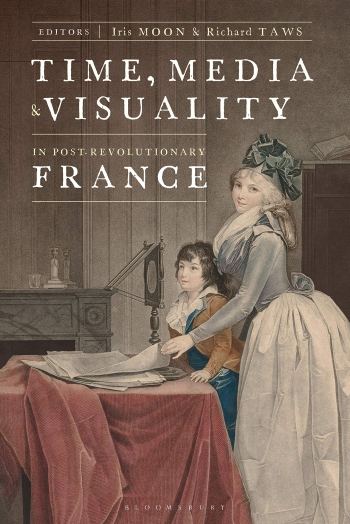 The radical break with the past heralded by the French Revolution in 1789 has become one of the mythic narratives of our time. Yet in the drawn-out afterlife of the Revolution, and through subsequent periods of Empire, Restoration, and Republic, the question of what such a temporal transformation might involve found complex, often unresolved expression in visual and material culture.
This diverse collection of essays draws attention to the eclectic objects and forms of visuality that emerged in France from the beginning of the French Revolution through to the end of the July Monarchy in 1848. It offers a new account of the story of French art’s modernity by exploring the work of genre painters and miniaturists, sign-painters and animal artists, landscapists, architects, and printmakers, as they worked out what it meant to be ‘post-revolutionary’.
Iris Moon is Assistant Curator in the Department of European Sculpture and Decorative Arts at the Metropolitan Museum of Art, New York. She was awarded her PhD in 2013 from the Massachusetts Institute of Technology, and was previously Pre-Doctoral Fellow at the Getty Research Institute, Mellon Postdoctoral Fellow and Assistant Director for Mellon Initiatives at the Sterling and Francine Clark Art Institute, Jane and Morgan Whitney Fellow in the Department of European Sculpture and Decorative Arts at the Metropolitan Museum of Art, and Visiting Assistant Professor at the Pratt Institute, New York. She is author of The Architecture of Percier and Fontaine and the Struggle for Sovereignty in Revolutionary France (2016).
Richard Taws is Reader in the History of Art at University College London. He has been the recipient of fellowships from the Getty Foundation, Institute for Advanced Study, Princeton, and the Bard Graduate Center, New York, and he was awarded a Philip Leverhulme Prize in 2012. He is author of The Politics of the Provisional: Art and Ephemera in Revolutionary France (2013), and co-editor, with Genevieve Warwick, of Art and Technology in Early Modern Europe (2016). With a collective of scholars in various disciplines, he recently co-authored Interacting with Print: Elements of Reading in the Era of Print Saturation, 1700–1900 (2018).
C O N T E N T S
List of Plates
List of Figures
Notes on Contributors
Acknowledgments
Iris Moon and Richard Taws, Introduction
1 Jann Matlock — Miniature Style, 1789–1815
2 Iris Moon — Rupture, Interrupted: Rococo Recursions and Political Futures in Percier and Fontaine’s Napoleon Fan
3 Stephen Bann — A Draughtsman’s Contract: Court and Country in the work of Louis Lafitte
4 Katie Hornstein — Jean-Baptiste Huet’s Lions and the Look of the Captive in Post-Revolutionary France
5 Steven Adams — First as Farce, then as Tragedy: Art, Vaudeville, and Modern Painting after the French Revolution
6 Kathryn Desplanque — Monsieur Crouton, The Shop Sign Painter: The Unexceptional Artist in Early Nineteenth-Century Satirical Print
7 Daniel Harkett — Medium as Museum: Marie-Victoire Jaquotot’s Porcelain Painting and Post-Revolutionary Fantasies of Preservation
8 Susan L. Siegfried — The Cultural Politics of Fashion and the French Revolution of 1830
9 Richard Taws — A Storm is Coming: Georges Michel in the Wind
Index
New Book | The Last Embassy: The Dutch Mission of 1795
From Princeton UP:
Tonio Andrade, The Last Embassy: The Dutch Mission of 1795 and the Forgotten History of Western Encounters with China (Princeton: Princeton University Press, 2021), 424 pages, ISBN: 978-0691177113, $35 / £28.
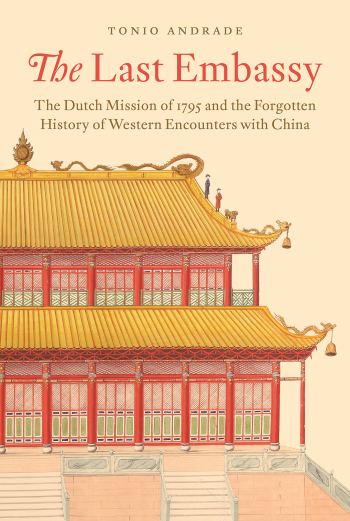 From the acclaimed author of The Gunpowder Age, a book that casts new light on the history of China and the West at the turn of the nineteenth century.
George Macartney’s disastrous 1793 mission to China plays a central role in the prevailing narrative of modern Sino-European relations. Summarily dismissed by the Qing court, Macartney failed in nearly all of his objectives, perhaps setting the stage for the Opium Wars of the nineteenth century and the mistrust that still marks the relationship today. But not all European encounters with China were disastrous. The Last Embassy tells the story of the Dutch mission of 1795, bringing to light a dramatic but little-known episode that transforms our understanding of the history of China and the West.
Drawing on a wealth of archival material, Tonio Andrade paints a panoramic and multifaceted portrait of an age marked by intrigues and war. China was on the brink of rebellion. In Europe, French armies were invading Holland. Enduring a harrowing voyage, the Dutch mission was to be the last European diplomatic delegation ever received in the traditional Chinese court. Andrade shows how, in contrast to the British emissaries, the Dutch were men with deep knowledge of Asia who respected regional diplomatic norms and were committed to understanding China on its own terms. Beautifully illustrated with sketches and paintings by Chinese and European artists, The Last Embassy suggests that the Qing court, often mischaracterized as arrogant and narrow-minded, was in fact open, flexible, curious, and cosmopolitan.
Tonio Andrade is professor of Chinese and global history at Emory University. His books include The Gunpowder Age: China, Military Innovation, and the Rise of the West in World History (Princeton), Lost Colony: The Untold Story of China’s First Great Victory over the West (Princeton), and How Taiwan Became Chinese: Dutch, Spanish, and Han Colonization in the Seventeenth Century. He lives in Decatur, Georgia.
Exhibition | Weaving Splendor: Treasures of Asian Textiles

One Hundred Cranes Imperial Robe (detail), Chinese, late 17th–early 18th century, Qing Dynasty (1644–1911), embroidered damask, 58 × 91 inches
(Kansas City: The Nelson-Atkins Museum of Art, William Rockhill Nelson Trust, 35-275)
◊ ◊ ◊ ◊ ◊
Opening next month at The Nelson-Atkins:
Weaving Splendor: Treasures of Asian Textiles
The Nelson-Atkins Museum of Art, Kansas City, 25 September 2021 — 6 March 2022
Frist Art Museum, Nashville, 7 October — 31 December 2022
For the first time in decades, The Nelson-Atkins Museum of Art will display rarely seen Chinese, Indian, Japanese, and Persian costumes and textiles. Made with fine materials, exemplary techniques, and artistry, Asian luxury textiles were central to global trade. The sumptuous textiles in this exhibition conveyed the identities, status, and taste of both local and international patrons and consumers.
The exhibition traces the journeys of key works of art and the people who owned them and carried them across the world. Luxurious costumes of the court performed power, while striking theater robes brought stage characters to life. Sturdy wall hangings and furniture covers transformed palaces, temples, and homes, while shimmering tapestry-woven carpets were created as diplomatic gifts for foreign rulers. Artists borrowed techniques from near and far to appeal to the latest fashions in the developing global market. The extraordinary stories of these treasures of the collection take visitors on an irreducible journey across continents, from the 1500s to today.
◊ ◊ ◊ ◊ ◊
Note (added 6 October 2022) — The posting was updated to include Nashville as a venue. More information is available here»
Exhibition | Chintz: Cotton in Bloom
Now on view at the Fashion and Textile Museum in London:
Chintz: Cotton in Bloom / Sits: katoen in bloei
Museum of Friesland, Leeuwarden, 11 March — 10 September 2017
Fashion and Textile Museum, Newham College, London, 18 May – 12 September 2021

Girl’s jacket with millefleur pattern, below a hand-painted girl’s chintz petticoat; cotton, painted and dyed using the chintz technique; India, 1725–75; jacket about 1760 (Fries Museum Leeuwarden; photo Studio Noorderblik).
Chintz: Cotton in Bloom is a collection with an extraordinary story, spanning hundreds of years and thousands of miles. The complicated technical craftsmanship required to fix bright dyes to cotton, devised across centuries and using complex chemical formulae, meant that for many years chintz was a closely guarded secret, or preserve of the elite. However, by the 18th century, chintz had become more widely accessible. The lightweight, washable, gaily coloured, and boldly patterned cottons eventually became a sensation throughout England and across Europe. These developments resulted in the intricate, colourful flowers of chintz fabric being cherished and preserved by generations.
Chintz: Cotton in Bloom showcases some 150 examples of this treasured textile, originating from all around the world—from mittens to wall hangings, from extravagant 18th-century sun hats to stylish mourning dresses.
The exhibition was organised by the Fries Museum, Leeuwarden (The Netherlands)—where the show, curated by Gieneke Arnolli, first appeared in 2017.
Exhibition | Paintings on Stone
Looking ahead to next year at SLAM (the catalogue is available now) . . .
Paintings on Stone: Science and the Sacred, 1530–1800
Saint Louis Art Museum, 20 February — 15 May 2022
Curated by Judith Mann
 In 2000 the Saint Louis Art Museum purchased Cavaliere d’Arpino’s Perseus Rescuing Andromeda (ca. 1593–94), an exceptional painting on lapis lazuli. The acquisition of the small, stunning work of art spurred extensive research that culminates in Paintings on Stone: Science and the Sacred 1530–1800, the first systematic examination of the pan-European practice of this unusual and little-studied artistic tradition.
By 1530 Italian artists had begun to paint portraits and sacred images on stone. At first artists used slate and marble. By the last decades of the sixteenth century, the repertoire expanded, eventually including alabaster, lapis lazuli, onyx, jasper, agate, and amethyst. In addition to demonstrating the beauty of these works, Paintings on Stone explains why artists began using stone supports and the role that stone played in the meaning of these endeavors. Bringing together more than 90 examples by 58 artists, the exhibition represents major centers of stone painting and features 34 different stones, nearly the full range that were used. The exhibition is curated by Judith W. Mann, curator of European art to 1800.
Judith W. Mann, ed., Paintings on Stone: Science and the Sacred, 1530–1800 (Munich: Hirmer Publishers, 2021), 320 pages, ISBN: 978-3777435565, $50.
Paintings on Stone examines a fascinating tradition long overlooked by art historians—stone surfaces used to create stunning portraits, mythological scenes, and sacred images. Written by an international team of scholars, the catalogue reveals the significance of these paintings, their complex meanings, and their technical virtuosity. Using a technique perfected by Sebastiano del Piombo (1485–1547), sixteenth-century Italian artists created compositions using stone surfaces in place of panel or canvas. The practice of using stone supports continued to engage European artists and patrons well into the eighteenth century. This volume reveals the beauty of these works and examines the complexity of using materials such as slate, marble, alabaster, lapis lazuli, and amethyst. Illustrated with more than one hundred examples, and with essays on topics ranging from importing stone to its relationship to alchemy, Paintings on Stone will become the essential reference on this little-studied practice.
Exhibition | Goya: Drawings from the Prado
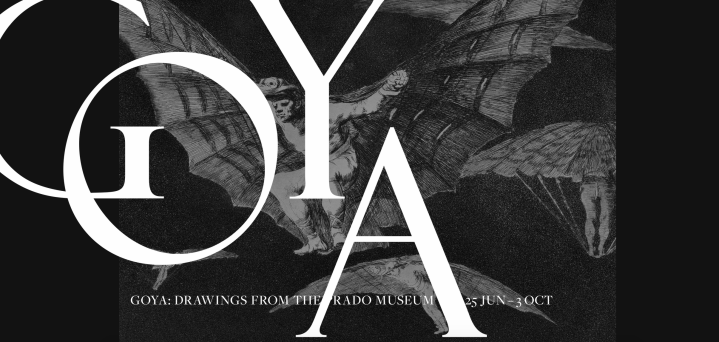
From the press release (18 May 2021) for the exhibition now on view at the NGV (with lots of interesting online features) . . .
Goya: Drawings from the Prado Museum
National Gallery of Victoria, Melbourne, 24 June — 3 October 2021
The world-exclusive exhibition Goya: Drawings from the Prado Museum features more than 160 works on paper by Francisco Goya (1746–1828), celebrating the artist’s extraordinary draughtsmanship and imagination. Considered to be one of the first truly modern artists, Goya produced humorous and critical images of Spanish society that comment on gender relationships, social inequality, and violence, as well as visions of fantastic creatures.
Goya: Drawings from the Prado Museum is the first major presentation of Goya’s work at the NGV in more than 20 years and features 44 drawings on loan from the Prado Museum, the largest group of Goya’s drawings ever seen in Australia. Ranging from bold ink drawings to delicate red chalk sketches, the drawings on display have been selected by the Prado especially for this NGV presentation. Highlights include examples from the artist’s earliest albums of social satires, preparatory drawings for his iconic print series, through to pages from the late albums, which contain some of Goya’s most complex and surreal images. This rich and diverse selection of drawings showcases the breadth of Goya’s drawing practice, as well as offering a rare insight into the artist’s image-making process.

Francisco Goya, This is how useful men usually end up, 1814–23, wash, brush, bistre on laid paper (Madrid: Prado).
Following a near-fatal illness in 1792, which left him profoundly deaf, Goya turned to drawing to record his private thoughts, visions, and dreams and continued this practice until the end of his life. In eight private albums, as well as in single sheet drawings, he gave expression to a vision of humanity that had no equivalent in the art of his day. Highlight works include This is how useful men usually end up (1814–23), a moving commentary on the consequences of poverty and war, and Literate animal (1824–28), a satirical image of an educated animal, which Goya drew in the last years of his life.
The works drawn from the Prado collection have been complemented by more than 120 etchings from Goya’s renowned print series: the Caprichos (1797–98), which satirised vices and follies in Spanish society; The Disasters of War (1810–15), based on the atrocities of the war and famine that followed the Napoleonic invasion of Spain in 1808; Tauromaquia (1815–16) on the subject of bullfighting; and the enigmatic Disparates (c. 1815–19), made during the reign of Ferdinand VII, whose suppression of civil liberties affected the lives of many intellectuals and reformers, including Goya and his friends. The prints are drawn from the NGV Collection with fifteen works on loan from the Art Gallery of South Australia. Goya’s most famous etching, The sleep of reason produces monsters, a striking composition of the sleeping artist haunted by monstrous apparitions, is also featured in the exhibition.
The exhibition is structured chronologically and thematically around recurring themes in Goya’s art, many of which are as relevant today as they were in Goya’s time: the relationship between men and women; the condemnation of ignorance and religious zeal; the exploration of violence and its consequences; and the device of the nightmare or dream to critique social and political realities.
Tony Ellwood AM, Director of the National Gallery of Victoria, said: “All aspects of society came under Goya’s critical eye—from education and marriage, to social justice and power relationships. Audiences to this exhibition will be astonished by the contemporary relevance of this exhibition and the universal themes that underpin the works of this celebrated Spanish artist.”
“The NGV has a longstanding relationship with the Prado Museum in Madrid, a cultural partnership which has resulted in the Melbourne Winter Masterpieces exhibition Italian Masterpieces from Spain’s Royal Court, as well as the NGV’s commitment to sharing its significant collection of William Blake watercolours with Spanish audiences in the near future. We are indebted to the Prado Museum for generously lending these important Goya drawings. Without their continued support and commitment to this cultural exchange between Europe and Australia, a presentation of this significance would not be possible,” said Ellwood.
Francisco de Goya y Lucientes was the most celebrated artist of his time in Spain. He was court painter to four monarchs and lived through the turbulent events of the French occupation, the subsequent Peninsular War, and the Inquisition. He moved in elite circles and painted portraits of statesmen, aristocrats, influential writers, and intellectuals. His friendships with liberals sharpened Goya’s political awareness and social conscience, which was particularly evident in his drawings and prints.
Goya: Drawings from the Prado Museum (Melbourne: National Gallery of Victoria, 2021), 360 pages, ISBN: 978-1925432862, $70 (AUD). With contributions by José Manuel Matilla, Manuela Mena Marqués, Mark McDonald, Phillip Adams, Eric Campbell, Michael Christoforidis, Gideon Haigh, Adrian Martin, Richard Read, and Colm Tóibín, as well as NGV curators.










 Enfilade
leave a comment