Call for Articles | Fall 2022 Issue of J18: Silver
From the Call for Papers:
Journal18, Issue #14 (Fall 2022) — Silver
Issue edited by Agnieszka Anna Ficek and Tara Zanardi
Proposals due by 1 September 2021; finished articles will be due by 1 March 2022
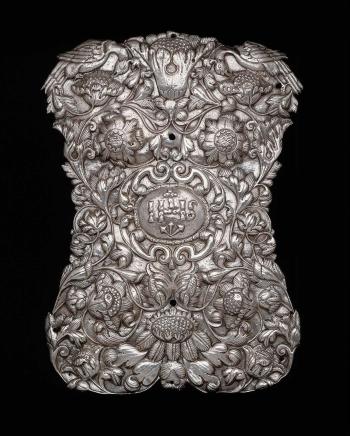
Ornamental plaque (mariola or maya), one of a pair, 1725–50, Moxos or Chiquitos missions, Alto Peru (present-day Bolivia), silver, 42 × 31 × 3 cm (Museum of Fine Arts Boston, Gift of Landon T. Clay, 1992.346).
Silver has held an illustrious place within early modern decorative arts as well as histories of empire, slavery, and colonialism. From cutlery and serving dishes to liturgical goods and medals, silver graced the collections of rulers and churches. During the eighteenth century, silver’s mutability lent itself well to the rococo’s penchant for metamorphosis. Highly regarded for its pliability, sheen, and virtuosity, silver was also esteemed for its inherent value. Silver’s capacity for transformation—from raw material into objects of beauty or currency—made it a valuable medium for artists, a tool for global expansion, and income for rebuilding state treasuries. As a currency standard in the eighteenth century, silver did not share the same vacillations as paper money, but it was subject to the fluctuation of quantities available in quarries, such as Zacatecas or Potosí, since its mining production could directly impact the consumption of goods for which it was traded.
In addition, silver’s mineralogical value became a source of appreciation so that silver, in its raw form, was placed in natural history cabinets. Complementing developments in the natural sciences, including geology and mineralogy, as they became more specialized, silver invited close scrutiny by artists, natural historians, and collectors. Silver’s discovery in quarries sparked the development of silversmithing sites, terrestrial exploration, and mining activities, including novel processes for extraction and the growth of enslaved labor and human trafficking. This intermingling of silver’s multifaceted roles—silver as a source of artistry, revenue, curiosity, and subjugation—positions it directly within the complexities of the eighteenth-century global world.
We welcome proposals for contributions that examine silver from diverse perspectives—metallurgical, artistic, imperial, and financial—and within a wide range of geographical locales. By situating silver within the context of geopolitics, economics, diplomacy, newly specialized sciences, and art, we aim to offer a broad analysis of silver’s vital roles in scientific, economic, and artistic circles across the eighteenth-century world.
Issue Editors
• Agnieszka Anna Ficek, The Graduate Center, City University of New York
• Tara Zanardi, Hunter College, City University of New York
Proposals for issue #14 Silver are now being accepted. Deadline for proposals: 1 September 2021.
To submit a proposal, send an abstract (250 words) and brief biography to editor@journal18.org and taramzanardi@gmail.com. Articles should not exceed 6000 words (including footnotes) and will be due by 1 March 2022. For further details on submission and Journal18 house style, see Information for Authors.
Online Workshop | Imperial Material: Napoleon’s Legacy
From Eventbrite:
Imperial Material: Napoleon’s Legacy in Culture, Art, and Heritage, 1821–2021
Online, 3 September 2021
Organized by Matilda Greig and Nicole Cochrane
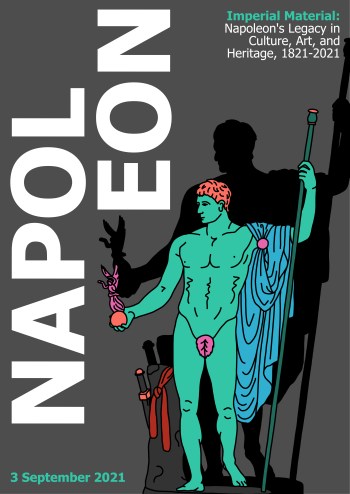 Two hundred years after Napoleon Bonaparte’s death, this online workshop confronts his vast material, visual, and cultural legacy.
Napoleon Bonaparte died exactly two hundred years ago on a small island in the middle of the Atlantic Ocean. He had spent the last six years of his life in exile on St Helena, removed from political and military power, in the unusual situation of being able to try to shape and preserve his own posthumous legacy. He was, in a way, phenomenally successful. Napoleon is an instantly recognisable name to this day, and despite growing efforts in recent years to critically revise his reputation and highlight his role in issues such as the reinstatement of slavery, he has largely managed to escape the same level of historical censure as other infamous military dictators. This is perhaps partly because his name has become such an adaptable brand, standing for an entire era of people, places, and events, as well as a full two centuries’ worth of art, craft, and consumer commodities. While other events marking the bicentenary of Napoleon’s death have weighed his contributions to legislative, political, and military reform, less work has been done to confront his vast material, visual, and cultural legacy. This workshop therefore brings together researchers and museum and heritage professionals to reflect on the enduring material and visual legacy of Napoleon, what our interpretation and use of it means for the future, as well as how it affects our understanding of the past. The workshop is free to attend; registration information is available here.
F R I D A Y , 3 S E P T E M B E R 2 0 2 1
All times are in BST
10.00 Opening Remarks
10.15 Keynote
• Napoleon: A Life Told in Gardens and Shadows, In Discussion — Ruth Scurr (University of Cambridge)
11.10 Break
11.30 Panel 1: National Responses
• Vive L’Empereur!: Napoleon’s Material Legacy in Australia — Emma Gleadhill (Macquarie University) and Ekaterina Heath (University of Sydney)
• Napoléon alla turca: The Ultimate European — Fezanur Karaağaçlıoğlu (Boğaziçi University)
12.15 Panel 2: Politics of Iconography
• Victory Shall Be Mine: The Form, Fate, and Fortune of the Vittoria di Fossombrone and Napoleon as Mars the Peacemaker — Melissa Gustin (University of York)
• Napoleon’s Iconography: Politics of Images and an ‘Imperial Corporate Design’? — Andrea Völker (Leuphana Universität Lüneburg)
13.00 Lunch Break
14.00 Panel 3: Napoleon in the Museum
• The Mysteries of Napoleon’s Toothbrush — Harriet Wheelock (Royal College of Physicians of Ireland and TU Dublin)
• Absence and Ubiquity in the Louvre’s Commemoration of Napoleonic Art Pillage — Nancy Karrels (University of Illinois Urbana-Champaign)
14.45 Panel 4: Representations on Stage and Screen
• I, Napoleon: Blurred Boundaries in Napoleonic Performance — Laura O’Brien (Northumbria University)
• The Emperor’s New Close-Up: Napoleon’s Enduring Impact on Contemporary Film as an Iconic Historical Brand — Aidan Moir (York University)
15.30 Break
16.00 Panel 5: Objects from the Sacred to the Mundane
• From Mania to Relics: The Artefacts of the 1890 Waterloo Panorama — Luke Reynolds (University of Connecticut)
• The Relics of Napoleon and Modern Memory — David O’Brien (University of Illinois Urbana-Champaign)
16.45 Panel 6: Urban and Cultural Legacies
• Perpetual Erasure: Napoleonian Politics and the Cemetery — Kaylee P. Alexander (Guilford College)
• The Legacy of the Napoleonic Era on Hairstyle and Hairdressing — Hervé Boudon (Independent scholar)
17.30 Closing Remarks
New Book | No Wood, No Kingdom
From Penn Press:
Keith Pluymers, No Wood, No Kingdom: Political Ecology in the English Atlantic (Philadelphia: University of Pennsylvania Press, 2021), 296 pages, ISBN 978-0812253078, $50 / £40.
 In early modern England, wood scarcity was a widespread concern. Royal officials, artisans, and common people expressed their fears in laws, petitions, and pamphlets, in which they debated the severity of the problem, speculated on its origins, and proposed solutions to it. No Wood, No Kingdom explores these conflicting attempts to understand the problem of scarcity and demonstrates how these ideas shaped land use, forestry, and the economic vision of England’s earliest colonies.
Popular accounts have often suggested that deforestation served as a ‘push’ for English colonial expansion. Keith Pluymers shows that wood scarcity in England, rather than a problem of absolute supply and demand, resulted from social conflict over the right to define and regulate resources, difficulties obtaining accurate information, and competing visions for trade, forestry, and the English landscape. Domestic scarcity claims did encourage schemes to develop wood-dependent enterprises in the colonies, but in practice colonies competed with domestic enterprises rather than supplanting them. Moreover, close studies of colonial governments and the actions of individual landholders in Ireland, Virginia, Bermuda, and Barbados demonstrate that colonists experimented with different, often competing approaches to colonial woods and trees, including efforts to manage them as long-term resources, albeit ones that nonetheless brought significant transformations to the land.
No Wood, No Kingdom explores the efforts to knot together woods around the Atlantic basin as resources for an English empire and the deep underlying conflicts and confusion that largely frustrated those plans. It speaks to historians of early modern Europe, early America, and the Atlantic World but also offers key insights on early modern resource politics, forest management, and political ecology of interest to readers in the environmental humanities and social sciences as well as those interested in colonialism or economic history.
Keith Pluymers is Assistant Professor of History at Illinois State University.
C O N T E N T S
Note on Spelling and Dates
Introduction: A Wooden World
1 Scarcity, Conflict, and Regulation in England’s Royal Forests
2 Creating Scarcity in Ireland’s Woods
3 The Political Ecology of Woods in Virginia
4 Conservation and Commercialization in Bermuda
5 Deforestation and Preservation in Early Barbados
6 Toward an Atlantic or Imperial Political Ecology?
Archives Consulted
Notes
Index
Acknowledgments
New Book | The Age of Wood
From Simon & Schuster:
Roland Ennos, The Age of Wood: Our Most Useful Material and the Construction of Civilization (New York: Scribner, 2020), 336 pages, ISBN: 978-1982114732, $28.
 As the dominant species on Earth, humans have made astonishing progress since our ancestors came down from the trees. But how did the descendants of small primates manage to walk upright, become top predators, and populate the world? How were humans able to develop civilizations and produce a globalized economy? Now, in The Age of Wood, Roland Ennos shows for the first time that the key to our success has been our relationship with wood.
Brilliantly synthesizing recent research with existing knowledge in fields as wide-ranging as primatology, anthropology, archaeology, history, architecture, engineering, and carpentry, Ennos reinterprets human history and shows how our ability to exploit wood’s unique properties has profoundly shaped our bodies and minds, societies, and lives. He takes us on a sweeping ten-million-year journey from Southeast Asia and West Africa where great apes swing among the trees, build nests, and fashion tools; to East Africa where hunter gatherers collected their food; to the structural design of wooden temples in China and Japan; and to Northern England, where archaeologists trace how coal enabled humans to build an industrial world. Addressing the effects of industrialization—including the use of fossil fuels and other energy-intensive materials to replace timber—The Age of Wood not only shows the essential role that trees play in the history and evolution of human existence, but also argues that for the benefit of our planet we must return to more traditional ways of growing, using, and understanding trees.
A winning blend of history and science, this is a fascinating and authoritative work for anyone interested in nature, the environment, and the making of the world as we know it.
Roland Ennos is a visiting professor of biological sciences at the University of Hull. He is the author of successful textbooks on plants, biomechanics, and statistics, and his popular book Trees, published by the Natural History Museum, is now in its second edition. He lives in England.
New Book | Féau & Cie: The Art of Wood Paneling
From Rizzoli:
Olivier Gabet and Axelle Corty, with a foreword by Michael S. Smith and photographs by Robert Polidori, Féau & Cie: The Art of Wood Paneling, Boiseries from the 17th Century to Today (New York: Rizzoli, 2020), 288 pages, ISBN: 978-0847868506, $65.
 The French woodwork purveyor Féau & Cie has supplied architects, designers, and museums with period paneling since 1875. Featuring documents, drawings, plaster models, panels, and antique boiserie rooms, its archive of 25,000 pieces—many from the eighteenth century and Art Deco era—is an unrivaled source of inspiration for re-creating heirloom spaces as well as for constructing spectacular contemporary pieces. Though the house remains best known for its magical historic rooms, it has collaborated with architects and decorators on original projects since its beginnings, and today’s design greats—including Michael S. Smith, Brian J. McCarthy, and Robert Couturier, among others—regularly call upon the firm for elaborate projects.
In this first book of the firm’s work, Feau & Cie reveals a selection of its most exceptional projects, from magnificent historical abodes to daring modern creations, including a palace in Tuscany and residences in Paris, London, New York, Malibu, and Atlanta. Dazzling images of finished interiors are accompanied by details of panels, doors, and decor, while exclusive photographs by Robert Polidori explore the house’s Parisian atelier. The unique savoir faire of joiners, sculptors, gilders, and painter-decorators shines through in this visual celebration of decorative masterpieces, which is bound to delight design masters and art lovers alike.
Founded in 1875, Féau & Cie is a Paris-based firm specializing in antique wood paneling and reproductions. Olivier Gabet is the director of the Musée des Arts Décoratifs in Paris. Robert Polidori is one of the world’s most acclaimed photographers of architecture and interiors.
Display | Silk & Swan Feathers: A Luxurious 18th-Century Armchair

Armchair (Bergère), ca. 1770/1772 or early 1780s, Georges Jacob, walnut, painted and varnished, and beech; silk, linen, hemp, and horsehair upholstery with swan- and goose-down feather stuffing; silk trim; iron tacks and gilt-brass nails, 39 × 37 × 30 inches (Los Angeles: The J. Paul Getty Museum, 88.DA.123).
◊ ◊ ◊ ◊ ◊
From the press release (12 May) for the exhibition:
Silk & Swan Feathers: A Luxurious 18th-Century Armchair
The Getty Center Museum, Los Angeles, 25 May 2021 — 31 July 2022
Curated by Charissa Bremer-David
An extraordinary 18th-century Parisian armchair that has survived nearly unaltered for over 200 years, with its original painted-wood surface and silk upholstery, will be highlighted at the Getty Center Museum starting May 25. Getty curators and conservators conducted extensive analysis of its history and construction, and they reveal their findings alongside the elegant chair in the year-long exhibition Silk & Swan Feathers: A Luxurious 18th-Century Armchair.
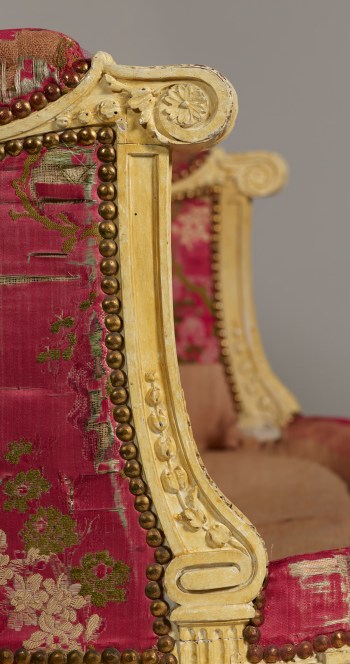 “Remarkably, this armchair still looks very much as it did when delivered to its first owner in the late 1700s,” says Charissa Bremer-David, curator of the exhibition. “Though the varnish on the wood has yellowed and the worn textile cover has gently faded, the finish and materials have endured without refurbishment or reupholstering. This armchair, therefore, is an important source of information about how late 18th-century French seat furniture was produced.”
Made in Paris in the early 1770s or early 1780s for an elite patron, the chair’s sumptuous appearance is striking, from its deep seat cushion stuffed with swan- and goose-down feathers to the vibrant crimson color of the silk fabric and the squares of gold leaf on its brass upholstery nails. Multiple craftsmen, including a joiner (woodworker) and an upholsterer, contributed to each facet of its construction.
It was created in the form known as bergère, the French term for a type of softly padded armchair with a lofty cushion that seemed to invite sitters to linger, rest, read, or chat. Its form developed in response to clothing fashion and notions of comfort. The receding curve of the arms could accommodate the voluminous drapery of women’s dresses and the extensive fabric of men’s knee-length coats, while the well-stuffed back and oval seat enveloped the occupants in luxury.
Marks on the armchair indicate it originally belonged to the château de Chanteloup, an important country house situated on an extensive estate in central France. It was part of a set that comprised five large armchairs, four long settees, and six smaller chairs. The group was dispersed in 1794, and the other surviving pieces no longer preserve their original appearance.
Getty conservators and scientists investigated the hidden joinery of the armchair frame and the layering of its painted surface and upholstery. This was accomplished through analysis of microscopic samples and by using imaging methods that did not disturb the original structure. An X-ray of the chairback reveals layers of upholstery materials that correspond to illustrated technical manuals of the period. Other images revealed the frame, made mostly of walnut, was put together using the traditional mortise-and-tenon joint, a method of interlocking two elements at right angles.
Also highlighted in the exhibition are four 18th-century illustrated books from the Getty Research Institute that detail the work of joiners and upholsterers, helping to put the bergère within the broader context of labor, craft, taste, and the market for furniture in France during the 1700s.

Student Funding | Research Related to Castletown House, County Kildare
From the application form:
Kevin B. Nowlan Castletown Bursary
Applications due by 13 November 2021
The Kevin B. Nowlan Castletown Bursary was established in 2017 in honour of the late Professor Nowlan, who chaired the Castletown Foundation for more than three decades. The scholarship, advertised biannually, aims to further research on the history, architecture, collections, and estate of Castletown House in County Kildare. Applicants must be registered students and engaged in research which focuses on or relates to Castletown. The award of €2,000 may be used for research-related expenses or University fees. The selection committee will be composed of members of the Castletown Foundation and one external specialist. The scholarship need not be awarded in any one year, and the decision of the assessors is final.
Applicants must complete this form and submit it by email to Professor Christine Casey, caseych@tcd.ie, and Dr. Alison FitzGerald, alison.fitzgerald@mu.ie, by 5pm, Friday, 13 November 2021, with the subject line ‘Kevin B. Nowlan Castletown Bursary’. A confidential reference supporting the application must arrive separately, before the closing date.
Exhibition | Discovering Viceregal Latin American Treasures
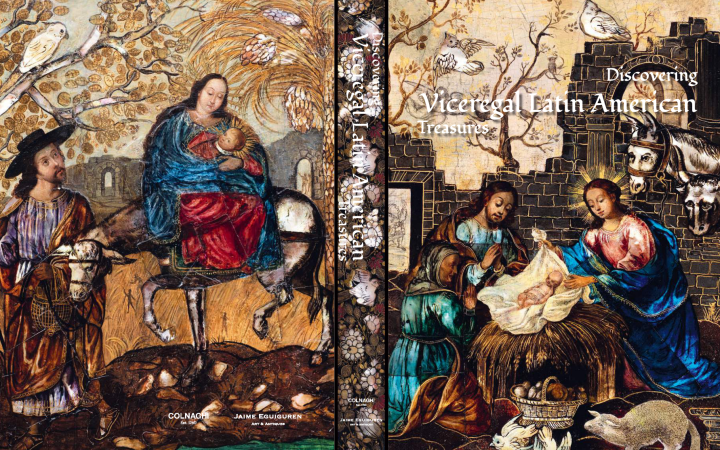
From Jaime Eguiguren Art & Antiques:
Discovering Viceregal Latin American Treasures
Colnaghi, New York and London, 2 July — 10 September 2021
Jaime Eguiguren Art & Antiques, Montevideo, Uruguay, 2 July — 10 December 2021
Jaime Eguiguren Art & Antiques and Colnaghi gallery are delighted to announce Discovering Viceregal Latin American Treasures, a survey exhibition that brings together more than a hundred works of art from the Viceregal period. The presentation takes place virtually and is supported by the publication of a printed exhibition catalogue, which will be the most in-depth publication on Viceregal art ever printed. The Old Master works in the exhibition date from the 16th to 18th century and include paintings, sculptures, silver, barniz de pasto (lacquer-like resin), ceramics, and furniture.
Discovering Viceregal Latin American Treasures, with essays by Pablo F. Amador Marrero, Alejandro Antuñano, Gonzalo Eguiguren Pazzi, Jaime Eguiguren, Cristina Esteras Martín, Sofía Fernández Lázaro, Concha García Sáiz, Jorge González Matarraz, Nuria Lázaro Milla, Yaiza A. Pérez Carracedo, Héctor San José, Dorie Reent (London: Colnaghi, 2021), 344 pages, ISBN: 978-8409304752.
New Book | Belonging and Betrayal
Distributed by The University of Chicago Press:
Charles Dellheim, Belonging and Betrayal: How Jews Made the Art World Modern (Waltham, MA: Brandeis University Press, 2021), 672 pages, ISBN: 978-1684580569, $40.
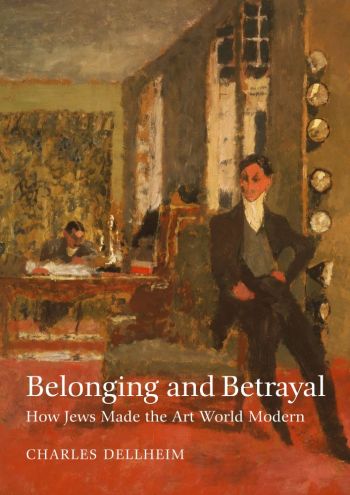 The story of dealers of Old Masters, champions of modern art, and victims of Nazi plunder.
Since the late-1990s, the fate of Nazi stolen art has become a cause célèbre. In Belonging and Betrayal, Charles Dellheim turns this story on its head by revealing how certain Jewish outsiders came to acquire so many old and modern masterpieces in the first place—and what this reveals about Jews, art, and modernity. This book tells the epic story of the fortunes and misfortunes of a small number of eminent art dealers and collectors who, against the odds, played a pivotal role in the migration of works of art from Europe to the United States and in the triumph of modern art. Beautifully written and compellingly told, this story takes place on both sides of the Atlantic from the late nineteenth century to the present. It is set against the backdrop of critical transformations, among them the gradual opening of European high culture, the ambiguities of Jewish acculturation, the massive sell-off of aristocratic family art collections, the emergence of different schools of modern art, the cultural impact of World War I, and the Nazi war against the Jews.
Charles Dellheim is professor of history at Boston University. He is the author of The Face of the Past: The Preservation of the Medieval Inheritance in Victorian England and The Disenchanted Isle: Mrs. Thatcher’s Capitalist Revolution.
C O N T E N T S
Acknowledgments
Prologue: Reframing the Picture
Part I. The Old Masters’ New Masters
1 Horse Dealer to Art Dealer
2 Treasure Island
3 Assimilating Art
4 Acquiring Eyes
5 Metropolitan Man
Part II. Was Modernism Jewish?
6 Madman and Sons
7 Was Modernism Jewish?
8 First Impressionists
9 Berlin Calling
10 Between Bohemian and Bourgeois
11 The Right Banker
Part III. In The Middle
12 The Wheel of War
13 Brothers-in-Arms
14 Custody Battles
15 In the Market of Love
16 Brothers-in-Law
17 Gentlemen and Players
Part IV. To Have and Have Not
18 Artful Jews
19 Artless Jews
20 Next Year in Paris?
21 After the Fall
22 The Dispossessed
23 The Exiles and the Kingdom
Epilogue: A Crack in Everything
New Book | Art Markets, Agents, and Collectors
From Bloomsbury:
Adriana Turpin and Susan Bracken, eds., Art Markets, Agents, and Collectors: Collecting Strategies in Europe and the United States, 1550–1950 (London: Bloomsbury Visual Arts, 2021), 400 pages, ISBN: 978-1501348877, $160.
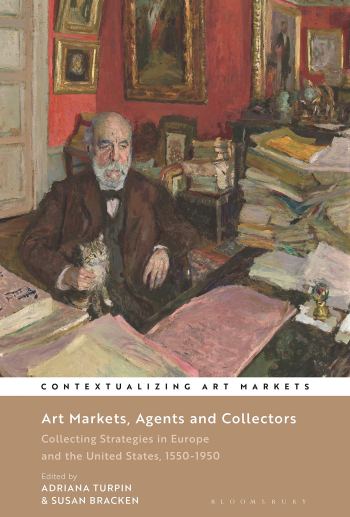 Art Markets, Agents and Collectors brings together a wide variety of case studies, based on letters and detailed archival research, which nuance the history of the art market and the role of the collector within it. Using diaries, account books, and other archival sources, the contributions to this volume show how agents set up networks and acquired works of art, often developing the taste and knowledge of the collectors for whom they were working. They are therefore seen as important actors in the market, having a specific role that separates them from auctioneers, dealers, museum curators, or amateurs, while at the same time acknowledging and analyzing the dual positions that many held. Each chronological period is introduced by a contextual essay, written by a leading expert in the field, which sets out the art market in the period concerned and the ways in which agents functioned. This book is an invaluable tool for those needing a broader introduction to the intricate workings of the art market.
Adriana Turpin is Academic Director and Head of Research, Institut d’Etudes Supérieures des Arts, Paris.
Susan Bracken is Associate Lecturer, Department of History of Art, Birkbeck University of London.
C O N T E N T S
List of Plates
List of Figures
Series Editor’s Introduction
Acknowledgements
Introduction — Jan Dirk Baetens, Susan Bracken, and Adriana Turpin
Part I: Agents in the Market, 1550–1720
I Introduction: Agents in the Art Market, 1550–1720 — Sandra van Ginhoven
1 Hans Albrecht von Sprinzenstein: An Austrian Art Agent in the Service of Archduke Ferdinand II of Tyrol — Adriana Concin
2 Marco Boschini and the Artists of His Time — Linda Borean
3 International Art Dealers, Local Agents, and Their Clients in Seventeenth-Century Habsburg Inner Austria — Tina Košak
4 James Thornhill as an Agent-Collector in Early-Eighteenth-Century Paris — Tamsin Lee-Woolfe
Part II: Agents in the Long Eighteenth Century
II Introduction: Hidden Figures – Agents in the Long Eighteenth Century — Bénédicte Miyamoto
5 Scottish Agents in Rome in the Eighteenth Century: The Case of Peter Grant — Maria Celeste Cola
6 ‘An Oracle for Collectors’: Philipp von Stosch and Collecting and Dealing in Art and Antiquities in Early-Eighteenth-Century Rome and Florence — Ulf R. Hansson
7 Shaping the Taste of British Diplomats in Eighteenth-Century Venice — Laura-Maria Popoviciu
8 Establishing Honest Trading Relationships: Academic Painters in the Art Market of Eighteenth-Century France — Christine Godfroy-Gallardo
9 The German Art Market in the Eighteenth Century — Renata Schellenberg
10 Playing the Market: Lord Yarmouth, the Prince Regent, and the Role of the Royal Agent, 1806–19 — Rebecca Lyons
Part III: The Agent in the Modern European Art Market, 1820–1950
III Introduction: The Art Market in Europe, 1820–1950 — Anne Helmreich
11 Edward Solly, Felice Cartoni, and Their Purchases of Paintings: A ‘Milord’ and His ‘Commissioner’ Anticipating a Transnational Network of Dealers, c. 1820 — Robert Skwirblies
12 ‘To see once again the glorious picture by Moretto before it is forever lost for Rome’: How an Artist’s Position in the Canon of Taste Was Enhanced in the Nineteenth Century — Corina Meyer
13 ‘It is not my fault if in all the private collections, the Dutch paintings surpass all’: Thoré-Bürger’s Promotion of Dutch Art in the Parisian Art Market of the 1860s — Frances Suzman Jowell
14 The Beurdeleys: A Dynasty of Curiosity Dealers and Their Networks — Camille Mestdagh
15 Collaboration and Resistance: The National Gallery, London, and the Italian Art Market at the End of the Nineteenth Century — Elena J. Greer
16 ‘I shall set at once about the work’: Some Agents in China — Nick Pearce
17 Promoting Themselves: Agents and Strategies in early Surrealism’s Art Market — Alice Ensabella
Part IV: Agents in the Market for American Collectors
IV Introduction: Collecting Alliances in the United States during the Long Nineteenth century — Inge Reist
18 Can a Leopard Change Its Spots? René Gimpel, Art Dealer — Diana J. Kostyrko
19 Samuel P. Avery’s Early Career: The Emergence of a Successful Art Agent, Art Dealer, and Art Expert — Madeleine Fidell-Beaufort
20 Dealing with Allegories of the Four Parts of the World: James Hazen Hyde (1876–1959) and His Network — Louise Arizzoli
21 Laying the Foundation: Harold Woodbury Parsons and the Making of an American Museum — MacKenzie Mallon
22 Convergences: Art History, Museums, and Scholar-Agent Martin Birnbaum’s Transatlantic Art for the Public — Julie Codell
Bibliography
Contributors
Index










 Enfilade
leave a comment