Call for Papers | Wood: Between Natural Affordance and Cultural Values
From ArtHist.net:
Wood: Between Natural Affordance and Cultural Values in Eurasia
Ludwig Maximilian University of Munich (and online), 31 March — 2 April 2022
Organised by Aleksandra Lipińska and Ilse Sturkenboom
Proposals due by 30 September 2021
In “The Theory of Affordances” of 1977, the American psychologist James J. Gibson coined the term affordance to denote that which environment offers an animal [or a human for that matter] for good or ill. This concept resonated broadly within humanities and, more recently, especially within material culture studies. Wood can be understood as a natural affordance that is one of the most universally available materials in a vast area of the world. Wood comes with its natural and physical characteristics that determine its workability. The use of various kinds of wood is, however, not only determined by the availability and applicability of the material itself but also by cultural values and specific requirements within a society.
This conference aims at bringing together scholars from diverse fields within humanities and science to discuss similarities and differences, continuities and discontinuities in the notions surrounding wood in various cultural contexts within Eurasia until the ‘material revolution’ that followed after 1900. We would like to address the question of the relationships or tensions between the naturally determined affordances of timber and their cultural coding.
Questions addressed may include, but need not be limited to:
• The relation between the substance and the produced object as a result of the tension between natural affordances and cultural practices
• Religious, philosophical, and historical notions of wood in various cultural contexts within Eurasia and their impact on the application of wood in artefacts
• Relationships of wood with other materials within material hierarchies, as a combination in objects/architecture, or as a carrier of designs that may also occur in other materials
• The mobility of wooden objects and their impact in diverse cultural contexts
• The use of wood as a tool or medium, e.g. imprint
• The specificity of working in wood and resulting identities of woodworkers and their works
• Scientific/ dendrochronological analyses of wood and their impact on the interpretation of cultural meaning of wooden objects
The conference is planned to take place as an in-person event, but online attendance will also be made available in a hybrid format. As far as attendants cannot be reimbursed by their home institutions, travel and accommodation costs will be reimbursed by the conveners.
The conference is organised by Aleksandra Lipińska (Professor for Art of the Early Modern Period, Institute for Art History, LMU Munich) and Ilse Sturkenboom (Professor for Islamic Art History, Institute for Art History, LMU Munich).
We kindly ask interested participants to submit, by 30 September 2021, a working title, a maximum 250-word abstract, and a short CV to Ilse.Sturkenboom@LMU.de and aleksandra.lipinska@kunstgeschichte.uni-muenchen.de.
Conference | Secrets of the Bedroom and Boudoir
From Haughton International:
Secrets of the Bedroom and the Boudoir
Haughton International Seminar
The British Academy, Carlton House Terrace, London, 14–15 October 2021

Perfume burner and egg steamer, Sèvres soft-paste porcelain, 1759 (London: The Wallace Collection).
The 2021 Haughton International Seminar provides an international tour of royal bedrooms and boudoirs over the centuries. Amongst the many and varied topics to be discussed will include intimate dining, activities, design, textiles, paintings, lighting, and items used for the toilette, hygiene, and health. They were more than bedrooms; they were the heart of the kingdom.
Cost of the two day seminar: £110 (inc VAT). Cost of the two day seminar including champagne reception and dinner at The Athenaeum (Thursday, 14th October): £190 (inc VAT). Student tickets for two-day seminar (on production of ID): £60 (inc VAT). Booking in advance through the website is essential due to limited numbers. Below is a preliminary programme (subject to change).
T H U R S D A Y , 1 4 O C T O B E R 2 0 2 1
8.45 Registration
9.15 Morning Session
• Annabel Westman
• Timothy Schroder
• Rosalind Savill
• Lisa White
12.40 Lunch Break
2.00 Afternoon Session
• Meredith Chilton
• Simon Thurley
4.30 Q&A Session
6.30 Drinks Reception (for dinner guests only) at The Athenaeum Club, 107 Pall Mall
7.15 Dinner (club dress code: smart, with ties for gentlemen, no denim and no training shoes)
F R I D A Y , 1 5 O C T O B E R 2 0 2 1
9.00 Arrival
9.30 Morning Session
• Bertrand Rondot
• Katharina Hantschmann
• Christiane Ernek-van der Goes
• Rose Kerr
12.55 Lunch Break
2.10 Afternoon Session
• Ivan Day
• Robin Emmerson
• Joanna Marschner
4.30 Q&A Session
Call for Papers | 2022 Wallace Seminars in the History of Collecting
From the Call for Papers:
Seminars in the History of Collecting, 2022
The Wallace Collection, London, last Monday of the Month (possibly online)
Proposals due by 17 September 2021
The seminar series was established as part of the Wallace Collection’s commitment to the research and study of the history of collections and collecting, especially in the eighteenth and nineteenth centuries in Paris and London. We are keen to encourage contributions covering all aspects of the history of collecting, including:
• Formation and dispersal of collections
• Dealers, auctioneers, and the art market
• Collectors
• Museums
• Inventory work
• Research resources
The seminars—normally held on the last Monday of every month during the calendar year, excluding August and December—act as a forum for the presentation and discussion of new research into the history of collecting. Seminars are open to curators, academics, historians, archivists, and all those with an interest in the subject. Papers should generally be about 45–60 minutes long. Seminars take place between 5.30 and 7pm. While we hope that the seminars can resume in situ at the Wallace Collection at some stage during 2022, the Collection will follow government guidelines about best practice as it evolves in the light of the COVID-19 pandemic, and it is quite possible that the seminars will continue to take place on Zoom throughout the year.
If interested, please send a short text (500–750 words), a brief CV, and indicate any months when you would not be available to speak, by Friday 17 September 2021. For more information and to submit a proposal, please contact: collection@wallacecollection.org.
Please note that if seminars take place at the Wallace Collection we are able to contribute up to the following sums towards speakers’ travelling expenses on submission of receipts:
• Speakers within the UK – £80
• Speakers from Continental Europe – £160
• Speakers from outside Europe – £250
Online Lecture | Gem Impressions in the Portuguese Royal Collections
From the registration page:
Ana Mónica da Silva Rolo and Noé Conejo Delgado, A Dactyliothec from Pietro Bracci in the Portuguese Royal Family’s Collections
Wallace Collection Seminars on the History of Collections and Collecting
Online, Monday, 26 July 2021, 17.30
 During the eighteenth and nineteenth centuries, in Europe, the versatile education of erudite elites was indispensable to and synonymous with social distinction. In this cultural frame, travels through Europe, in the style of the Grand Tour, became especially appreciated among European aristocratic youth. At the same time, interest in Classical antiquity and collecting antiques was enhanced, giving rise to a flourishing activity of replica production and trade, especially in Italy.
The dactyliothec by the Italian artist Pietro Bracci (1700–1773) in the collections of the Museum-Library of the House of Bragança (Vila Viçosa, Portugal) illustrates eighteenth- and nineteenth-century taste, shared by the last generations of the Portuguese Royal House. The set presented is composed of 2,350 plaster moulds of gems and cameos, organized in three thematic series. The first and largest series is dedicated to emblematic pieces of ancient art and the Italian Renaissance. The second series is composed of a selection of reproductions of the best carvings originally made by eighteenth-century craftsmen, like Giovanni or Luigi Pichler and Natal Marchant. The third and last series brings together a total of 180 cameos dedicated to Emperors of Europe. Dated between the end of the eighteenth century and the first quarter of the nineteenth century, this dactyliothec reflects the importance that such casts assumed as souvenirs of Classical art and history for collectors and travellers, as well as their use as an educational resource in the academic training of young aristocrats.
You can register to view this talk via Zoom here, or plan to watch via The Wallace Collection’s YouTube channel.
Ana Mónica da Silva Rolo and Noé Conejo Delgado are both based at the Archaeology Centre UNIARQ of Lisbon University.
Tulane Post-Doctoral Fellowship in Africana Studies, 2021–22
Tulane Post-Doctoral Fellowship in Africana Studies, 2021–22
Applications due by 26 July 2021
The Africana Studies Program at Tulane University is pleased to announce a Post-Doctoral Fellowship in Africana Studies for AY2021–22 (with possible renewal through 2024). Applications will be accepted now through 26 July 2021. This Interfolio link contains a description of the position and mechanism to apply.
Tulane University invites applications for a one-year Africana Studies postdoctoral scholar for 2021–2022 (possible renewal through 2024). Centering the interdisciplinary and global study of Africa and its diasporas, Tulane’s vibrant Africana Studies Program is comprised of both joint and affiliate faculty drawn from across the university’s academic programs and departments. The Program has recently secured a major internal grant that, in addition to funding this post-doctoral fellowship, will also underwrite three new initiatives over the next three years.
In addition to contributing to and participating in the Black Studies intellectual community on campus and pursuing their own research agenda, the fellow will play a primary role in coordinating one of these new initiatives, “Black Studies Book Club,” with the guidance of Africana Studies Program faculty. Each semester, Black Studies Book Club will focus on a recently published text that has shifted the conversation in Africana Studies as a discipline. The author will be invited to Tulane to give a free and open public lecture in addition to facilitating a smaller, more intimate, ‘book club’ style conversation engineered to bring together some of the diverse constituencies of the program, including Tulane Africana Studies students and faculty as well as students and faculty from our high school and HBCU Black Studies Book Club partners.
Faculty in the Africana Studies Program will provide mentorship to the fellow via professional development advice, access to their own scholarly networks, and opportunities for the fellow to share and receive feedback about work-in-progress. The fellowship also includes a $2,500 research fund.
Given the inherently interdisciplinary nature of Africana Studies, we welcome applicants from any discipline whose primary research concerns center Africa and/or any part of its global diasporas. Tulane University is an equal employment opportunity/affirmative action/persons with disabilities/veterans employer committed to excellence through diversity. Tulane will not discriminate against individuals with disabilities or veterans. All eligible candidates are encouraged to apply.
Duties will include
• Participating in and contributing the Africana Studies scholarly community on campus
• Teaching one intro-level undergraduate course in Spring 2022 which will feature the Book Club text
• Providing support for the Fall 2021 Black Studies Book Club which will already have been organized
• Organizing and promoting the Black Studies Book Club (planning public lectures and book club meetings, coordinating with our high school and HBCU partners) for spring 2022 and starting the planning for fall 2022
• Engaging with Black Studies Book Club scholars and participants
• Working on their own scholarly research and writing
Qualifications
• Ph.D. in any discipline but with evidence of a research agenda that centers the concerns of Africa and/or any part of its global diasporas. Those with graduate level training specifically in African Studies, African American Studies, African Diaspora Studies, or Black Studies are especially encouraged to apply.
• Excellent writing and analytical skills; experience in writing for different purposes and a diversity of audiences, including but not limited to scholarly audiences
• Flexibility, nimbleness, and creativity, with the ability to work both collaboratively and independently
• Experience in project management and/or in organizing lectures and events
• Enthusiasm for working collaboratively with our high school and HBCU partners
Review of applications will begin July 12. Complete application must be received by July 26 to be considered. Applications must be submitted via Interfolio (https://apply.interfolio.com/90018) and include the following:
• Completed application form
• Cover letter
• Curriculum Vitae – Your most recently updated C.V.
• Research Statement (no more than 750 words)
• Writing sample (no more than 8,000 words)
• List of six scholars you would consider inviting for the Black Studies Book Club, with a few sentences of explanation about each detailing how you think their recent publication(s) have informed conversations about Black Studies as a discipline
• Names and contact information for two references
Online Exhibition | Making History: Shakespeare and the Royal Family
The exhibition is available here:
Making History: Shakespeare and the Royal Family
Online Exhibition, launching 15 July 2021

John Boyne, ‘Falstaff and his Prince’, 1783, etching showing Charles Fox as Falstaff to George’s Prince Hal.
The Shakespeare in the Royal Collection (ShaRC) project is delighted to announce a new digital exhibition, exploring the entwined stories of Shakespeare and the royal family across the centuries, launching on Thursday, 15 July 2021. Making History: Shakespeare and the Royal Family reveals how influential this relationship has been in shaping British culture.
Drawing on new archival research, the exhibition (in eight sections) explores the curious, political, and sometimes tragic connections between Shakespeare and the royal family through access to key objects in the Royal Collection and Royal Archives. A Shakespeare Folio contains handwritten annotations made by Charles I shortly before his 1649 execution. A painting by Thomas Gainsborough marks the short-lived affair of the actress and poet Mary ‘Perdita’ Robinson with George IV when Prince of Wales, casting him in the role of a dashing Prince Florizel. Digital visualisations put viewers in the audience of performances watched by Queen Victoria, bringing historical Shakespearean performances in the State Apartments at Windsor Castle vividly to life for the first time.
A wider online database, allowing users to search over 1,000 Shakespeare-related objects from the Royal Collection and Royal Archives, will also shortly be launched, and can be explored here: https://sharc.kcl.ac.uk/
Shakespeare in the Royal Collection is a three-year AHRC-funded research project led by King’s College London, in collaboration with Birkbeck University of London and The Royal Collection Trust. It investigates the Shakespeare-related holdings in the Royal Collection and Royal Archives, 1714–1945, and provides new information about a broad range of objects created, collected and displayed by generations of members of the royal family.
New Book | Men on Horseback
From Macmillan:
David A. Bell, Men on Horseback: The Power of Charisma in the Age of Revolution (New York: Farrar, Straus and Giroux, 2020), 352 pages, ISBN: 978-0374207922, $30.
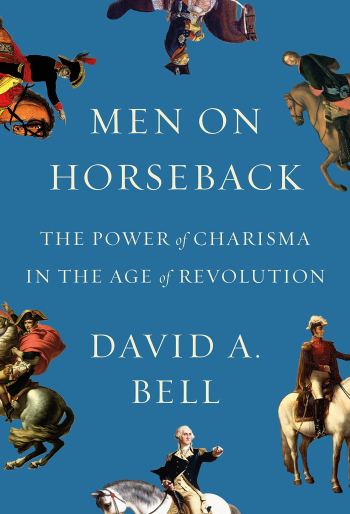 An immersive examination of why the age of democratic revolutions was also a time of hero worship and strongmen
In Men on Horseback, the Princeton University historian David A. Bell offers a dramatic new interpretation of modern politics, arguing that the history of democracy is inextricable from the history of charisma, its shadow self.
Bell begins with Corsica’s Pasquale Paoli, an icon of republican virtue whose exploits were once renowned throughout the Atlantic World. Paoli would become a signal influence in both George Washington’s America and Napoleon Bonaparte’s France. In turn, Bonaparte would exalt Washington even as he fashioned an entirely different form of leadership. In the same period, Toussaint Louverture sought to make French Revolutionary ideals of freedom and equality a reality for the formerly enslaved people of what would become Haiti, only to be betrayed by Napoleon himself. Simon Bolivar witnessed the coronation of Napoleon and later sought refuge in newly independent Haiti as he fought to liberate Latin America from Spanish rule. Tracing these stories and their interconnections, Bell weaves a spellbinding tale of power and its ability to mesmerize.
Ultimately, Bell tells the crucial and neglected story of how political leadership was reinvented for a revolutionary world that wanted to do without kings and queens. If leaders no longer rule by divine right, what underlies their authority? Military valor? The consent of the people? Their own Godlike qualities? Bell’s subjects all struggled with this question, learning from each other’s example as they did so. They were men on horseback who sought to be men of the people―as Bell shows, modern democracy, militarism, and the cult of the strongman all emerged together.
Today, with democracy’s appeal and durability under threat around the world, Bell’s account of its dark twin is timely and revelatory. For all its dangers, charisma cannot be dispensed with; in the end, Bell offers a stirring injunction to reimagine it as an animating force for good in the politics of our time.
David A. Bell is the Sidney and Ruth Lapidus Professor in the Era of North Atlantic Revolutions at Princeton University and the author of several previous books, among them The First Total War and Shadows of Revolution.
New Book | Letters to Camondo
From Macmillan:
Edmund de Waal, Letters to Camondo (New York: Farrar, Straus and Giroux, 2021), 192 pages, ISBN: 978-0374603489, $28.
 A tragic family history told in a collection of imaginary letters to a famed collector, Moise de Camondo
Letters to Camondo is a collection of imaginary letters from Edmund de Waal to Moise de Camondo (1860–1935), the banker and art collector who created a spectacular house in Paris, now the Musée Nissim de Camondo, and filled it with the greatest private collection of French eighteenth-century art.
The Camondos were a Jewish family from Constantinople, ‘the Rothschilds of the East’, who made their home in Paris in the 1870s and became philanthropists, art collectors, and fixtures of Belle Époque high society, as well as being targets of antisemitism—much like de Waal’s relations, the Ephrussi family, to whom they were connected. Moise de Camondo created a spectacular house and filled it with art for his son, Nissim; after Nissim was killed in the First World War, the house was bequeathed to the French state. Eventually, the Camondos were murdered by the Nazis.
After de Waal, one of the world’s great ceramic artists, was invited to make an exhibition in the Camondo house, he began to write letters to Moise de Camondo. These fifty letters are deeply personal reflections on assimilation, melancholy, family, art, the vicissitudes of history, and the value of memory.
Edmund de Waal is an artist who has exhibited in museums and galleries around the world. His bestselling memoir, The Hare with Amber Eyes, has won many prizes and has been translated into twenty-nine languages. The White Road, a journey into the history of porcelain, was published in 2015. He lives in London with his family.
New Book | The House of Fragile Things
From Yale UP:
James McAuley, The House of Fragile Things: Jewish Art Collectors and the Fall of France (New Haven: Yale University Press, 2021), 320 pages, ISBN: 978-0300233377, $30.
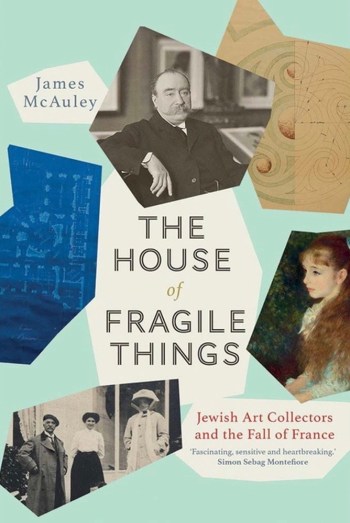 In the dramatic years between 1870 and the end of World War II, a number of prominent French Jews—pillars of an embattled community—invested their fortunes in France’s cultural artifacts, sacrificed their sons to the country’s army, and were ultimately rewarded by seeing their collections plundered and their families deported to Nazi concentration camps.
In this rich, evocative account, James McAuley explores the central role that art and material culture played in the assimilation and identity of French Jews in the fin-de-siècle. Weaving together narratives of various figures, some familiar from the works of Marcel Proust and the diaries of Jules and Edmond Goncourt—the Camondos, the Rothschilds, the Ephrussis, the Cahens d’Anvers—McAuley shows how Jewish art collectors contended with a powerful strain of anti-Semitism: they were often accused of ‘invading’ France’s cultural patrimony. The collections these families left behind—many ultimately donated to the French state—were their response, tragic attempts to celebrate a nation that later betrayed them.
James McAuley is the Paris correspondent for The Washington Post and a contributor to The New York Review of Books. He recently received his doctorate in French history at Oxford.
Call for Papers | Rethinking Race and Representation in the Francosphere
From ArtHist.net (10 July 2021) . . .
Rethinking Race and Representation in Art History and Material Culture of the Eighteenth- and Nineteenth-Century Francosphere
H-France Salon
Abstracts due by 15 August 2021, with accepted papers due by 1 February 2022
H-France Salon invites contributions for a Salon series addressing the theme of “Rethinking Race and Representation in Art History and Material Culture of the Eighteenth- and Nineteenth-Century Francosphere.” This Salon builds on the H-France Salons Series entitled “Race, Racism, and the Study of France and the Francophone World Today” [H-France Salon 11.2 (2019)] and seeks to offer new ways and tools for thinking specifically about constructions of race in history, art history, and material culture in the eighteenth and nineteenth centuries.
The editors are open to many directions, but possible angles may include:
• What overlooked artists or artwork should we include to shift our understanding–or what well-known works should we reconsider in the light of new narratives and questions? We welcome essays that focus either on one artist or representation, or on a set.
• What approaches are particularly thought-provoking or effective pedagogically?
• What methods can help us recover the agency of the people who modeled for, or were depicted in, artworks?
• How can we use objects or aspects of material culture?
• How do choices for representing eighteenth and nineteenth century works, i.e. museum displays and curation, renaming or questioning the titles of artworks, decisions about where and how art is displayed in urban and national settings, etc, shape our understanding of those works?
• How do modern ways of representing the eighteenth and nineteenth centuries (from graphic histories to public murals to video ) affect our understanding of the past?
• How do we engage contemporary debates, like French debates around race as an ‘American’ category?
Interested contributors should e-mail an abstract (max.1000 words) and CV to the editors Jennifer Heuer (heuer@history.umass.edu), Gülru Çakmak (gcakmak@umass.edu), and Robin Mitchell (robin.mitchell@csuci.edu) by August 15, 2021. Papers (2500–4000 words) will be submitted by February 1, 2022.
As H-France Salon supports multi-media resources, we welcome possibilities that take advantage of the platform. Please contact us with any questions or ideas!










 Enfilade
leave a comment