New Book | The Thing about Religion
From The University of North Carolina Press:
David Morgan, The Thing about Religion: An Introduction to the Material Study of Religions (Chapel Hill: The University of North Carolina Press, 2021), 268 pages, ISBN: 978-1469662824, $95 / ISBN: 978-1469662831 (paperback), $25.
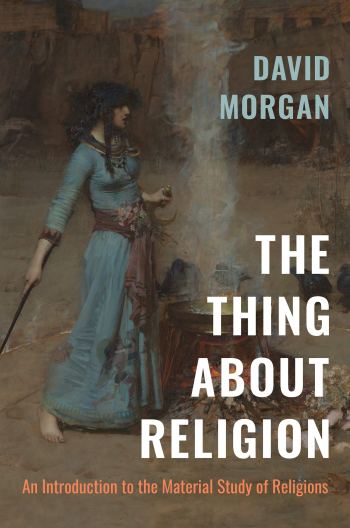 Common views of religion typically focus on the beliefs and meanings derived from revealed scriptures, ideas, and doctrines. David Morgan has led the way in broadening that framework to encompass the understanding that religions are fundamentally embodied, material forms of practice. This concise primer shows readers how to study what has come to be termed material religion—the ways religious meaning is enacted in the material world. Material religion includes the things people wear, eat, sing, touch, look at, create, and avoid. It also encompasses the places where religion and the social realities of everyday life, including gender, class, and race, intersect in physical ways. This interdisciplinary approach brings religious studies into conversation with art history, anthropology, and other fields. In the book, Morgan lays out a range of theories, terms, and concepts and shows how they work together to center materiality in the study of religion. Integrating visual evidence, he then applies these ideas and methods to case studies across a variety of religious traditions, modeling step-by-step analysis and emphasizing the importance of historical context.
David Morgan is professor of religious studies and art, art history, and visual studies at Duke University. His most recent book is Images at Work: The Material Culture of Enchantment.
C O N T E N T S
Acknowledgments
Introduction: How Materiality Matters to the Study of Religion
Part I. Theories and Definitions
1 How Some Theories of Religion Dematerialize It
2 What Is the Material Study of Religion?
3 How Religions Happen Materially
Part II. Studying Material Religion
4 The Power of Things: A History of Magic Wands
5 Notre-Dame de Paris: Religion and Time
6 Words and Things
Conclusion: Things, Networks, and Agents
Resources for Classroom Use
Primary Texts, Key Terms, and Online Resources
Writing Guide
Bibliography to Support Student Research
Notes
Index
New Book | A Companion to Viceregal Mexico City, 1519–1821
From Brill:
John López, ed., A Companion to Viceregal Mexico City, 1519–1821 (Leiden: Brill, 2021), 470 pages, ISBN: 978-9004335561, €233 / $280. Volume 3 in Brill’s Companions to the Americas series.
 This book presents a historical overview of colonial Mexico City and the important role it played in the creation of the early modern Hispanic world. Organized into five sections, an interdisciplinary and international team of twenty scholars scrutinize the nature and character of Mexico City through the study of its history and society, religious practices, institutions, arts, and scientific, cartographic, and environmental endeavors.
The Companion ultimately shows how viceregal Mexico City had a deep sense of history, drawing from all that the ancient Americas, Europe, Asia, and Africa offered but where history, culture, and identity twisted and turned in extraordinary fashion to forge a new society.
John F. López (Ph.D., Massachusetts Institute of Technology, 2013) is Assistant Professor of Early Modern European and Latin American art and architecture at the University of California, Davis. López has authored numerous articles and has edited special issues for Ethnohistory, Latin American Geography, and Monumentos históricos.
C O N T E N T S
List of Figures and Tables
Archival and Image Repositories
Notes on Contributors
Acknowledgements
John F. López — Introduction: Viceregal Mexico City, Colonial Cosmopolitanism, and the Hispanic World
Part 1. History and Society
1 Matthew Restall — Fear, Wonder, and Absence: Our Distorted View of Moctezuma’s Tenochtitlan
2 Luis Fernando Granados — The Weirdest of All? Indigenous Peoples and Polities of Colonial Mexico City
3 Joan C. Bristol — Blackness and Blurred Boundaries in Mexico City
4 Sonya Lipsett-Rivera — Of Pleasures and Proscriptions: Or How Residents of Mexico City Negotiated Gender and Family Norms
5 Frances L. Ramos — War, Legitimacy, and Ceremony in 18th-Century Mexico City: The Annual Funerary Honors for Fallen Soldiers
Part 2. Religious Life
6 Antonio Rubial García — City of Friars, City of Archbishops: The Church in Mexico City in the Age of the Hapsburgs
7 Alejandro Cañeque — The Cabildo of Mexico City, Patron Saints, and the Making of Local and Imperial Identities
8 Cristina Cruz González — Visualizing Corporate Piety: The Art of Religious Brotherhoods
Part 3. Institutions
9 Iván Escamilla González — Permanence and Change in Mexico City’s Viceregal Court, 1535–1821
10 María del Pilar and Martínez López-Cano — Finance and Credit in Viceregal Mexico City
11 Enrique González González — Uneven Chances: Education in Colonial Mexico City
12 Paula S. De Vos — Medicine and Municipal Rights in Viceregal Mexico City
Part 4. Special Themes
13 Barbara E. Mundy — The Urban Plans of Mexico City, 1520–1810
14 John F. Lopez — The Desagüe’s Watermark: Cartography and Environmental Crisis at Viceregal Mexico City
15 Miruna Achim — Urban Science in 18th-Century Mexico City
Part 5. The Arts
16 Kelly Donahue-Wallace — A Culture of Print in Viceregal Mexico City
17 Martha Lilia Tenorio — Novohispanic Baroque Poetry: A Lyric Chronicle of Mexico City
18 Jesús A. Ramos-Kittrell — Music and Literature in New Spain: The Politics of Buen Gusto in 18th-Century Mexico City
19 Amy C. Hamman and Stacie G. Widdifield — The Royal Academy of San Carlos, 1781–1800
Index
Call for Papers | CAA 2022, Chicago and Online
Listed below is a selection of panels relevant (or potentially relevant) to the eighteenth century. Please pay particular attention to two items: the HECAA-affiliate session on “Eighteenth-Century Women Artists in Context,” chaired by Melissa Hyde and Paris Amanda Spies-Gans; and the ASECS-affiliate session on “Eighteenth-Century Dictionaries and Encyclopedias,” chaired by myself and Jennifer Germann. The full listing is available here (bear in mind that since some sessions have already been formed, this Call for Papers provides only a partial guide for what to expect in February and March). –Craig Hanson
110th Annual Conference of the College Art Association
In-Person, Hilton Chicago, 16–19 February 2022
Online, via Zoom, 3–5 March 202
Proposal due by 16 September 2021
CAA will deliver the 110th Annual Conference with in-person and virtual, live sessions in two components. In-person sessions will be held at the Hilton Chicago, February 16–19, and virtual, live sessions will be held on Zoom, March 3–5. All sessions will be 90 minutes long, organized at the discretion of each session chair. To submit a proposal, send a completed proposal form and a two-page CV to the chair(s) by 16 September 2021.
◊ ◊ ◊ ◊ ◊
Abolitionist Aesthetics (Virtual)
Chair: Eva McGraw, mcgraw.eva@gmail.com
The late eighteenth century witnessed the emergence of a burgeoning abolitionist visual culture as anti-slavery activists on both sides of the Atlantic seized upon images as a powerful weapon in their crusade against human bondage. With Britain’s withdrawal from the international slave trade in 1807 and the abolition of slavery in the British Empire in 1833, abolitionist images increasingly focused on domestic American slavery. Utilizing various media, black and white activists employed images as potent tools for moral suasion, illustrating the essential humanity of enslaved people and exposing the cruelty of the peculiar institution. While the most iconic abolitionist images—including that of the slave ship Brookes and the illustrations for Harriet Beecher Stowe’s Uncle Tom’s Cabin—have been frequently considered, scholars have yet to examine the full range of abolitionist imagery. This panel seeks new approaches to the study of anti-slavery imagery across national contexts from the eighteenth century to the present day. Submissions may address but are not limited to the following questions: What visual strategies did abolitionists use to further their cause, and how did the particularities of media impact their productions? How did abolitionist image-makers combat censorship? What sorts of patronage networks existed for the creation and dissemination of abolitionist art? How did the contributions of black abolitionists impact anti-slavery imagery? Finally, does the history of abolitionist aesthetics inform present-day efforts to memorialize abolitionists and/or resonate with renewed efforts to achieve racial justice in America, including Black Lives Matter and the Prison-abolition Movement?
◊ ◊ ◊ ◊ ◊
Appraising Your Research as Data: Managing, Visualizing, and Preserving Your Scholarship
Art Libraries Society of North America (In-Person)
Chair: Jill E. Luedke (Temple University), jluedke@temple.edu
The scholarship used and produced by art historians and visual artists is no longer limited to journal articles, research notes, and works of art. Today, new approaches to art historical research and visual arts practice utilize media-rich and technology-robust sources of data such as GIS coordinates, 3D scans and prints, video games, Twitter feeds, Instagram images, and virtual and augmented reality tools. Research data management, data visualization, and data preservation play increasingly important roles in the evolving landscape of scholarly endeavors; and, academic libraries are expanding their services, creating new spaces, and developing frameworks to support new fields of inquiry by art history practitioners. Moreover, academic administrations are establishing institutional repository standards for all disciplines, and grant-funding agencies are requiring data management plans. Innovative faculty and students partner with librarians and library specialists for guidance on the discovery, use, and maintenance of diverse data formats. This panel will address useful research management practices, skills and methods to visually represent research, and processes and tools to archive and preserve data in all phases of the research lifecycle.
◊ ◊ ◊ ◊ ◊
Archive, Object, Image: Reading Against the Grain in the Dutch and Spanish ‘Golden Ages’
Historians of Netherlandish Art (In-Person)
Chairs: Carrie J. Anderson (Middlebury College), carriea@middlebury.edu; and Marsely L. Kehoe, marselykehoe@gmail.com
The artistic flourishing of the so-called Dutch and Spanish ‘Golden Ages’ was built upon the labor and suffering of people across global empires, which extended from Europe to Asia, Africa, and the Americas. Not just vestiges of the past, these issues are indeed quite urgent, as they underpin contemporary dialogues around race, violence, and representation. As scholars of the early modern period, we have an opportunity and an obligation to center long-suppressed voices, redress historical imbalances, and challenge racist narratives that persist to this day. But how can we present a more balanced version of the past when we are dependent upon archives, texts, objects, and images that are both byproducts of and mechanisms for systemic oppression?
This panel seeks methodologically innovative projects that challenge or disrupt the narratives that attach to early modern Dutch, Hispano-Flemish, and Spanish archives, texts, objects, and images. Proposals may include, but are not limited to, the following: studies that prioritize voices and identities that are absent—or purposefully excluded—from the textual, archival, or pictorial record; research that recontextualizes and/or localizes the commodities of global trade; data-driven projects that challenge the semantic structures of the early modern archive; studies that decenter imperial narratives or examine productive failures in research, scholarship, and teaching.
◊ ◊ ◊ ◊ ◊
Constructing Art History in and through Eighteenth-Century Dictionaries and Encyclopedias
American Society for Eighteenth-Century Studies (In-Person)
Chairs: Jennifer Germann (Ithaca College), jgermann@ithaca.edu; and Craig Hanson (Calvin University), chanson@calvin.edu
Notwithstanding an impressive body of scholarship addressing eighteenth-century encyclopedias generally—particularly Ephraim Chambers’s Cyclopedia and the Encyclopédie of Diderot and d’Alembert—art history as a discipline has yet to produce anything like a comprehensive account of how various artistic discourses of the period were shaped by such reference works—either by ambitious universal dictionaries or by more focused, specialized volumes. In fact, however, the long eighteenth century saw the publication and often significant distribution of a wide range of art and architectural dictionaries, books like Filippo Baldinucci’s Vocabolario toscano dell’arte del disegno (1681), Neve’s The City and Country Purchaser’s and Builder’s Dictionary (1703), John Barrow’s Dictionarium Polygraphicum (1735), François Marie de Marsy’s Dictionnaire abrégé de peinture et d’architecture (1746), Joachim Christoph Gottsched’s Handlexicon, oder, kurzgefasstes Wörterbuch der schönen Wissenschaften und freyen Künste (1760), and Diego Antonio Rejon de Silva’s Diccionario de las nobles artes para instrucción de los aficionados, y uso de los profesores (1788).
This panel invites papers that explore how dictionaries and encyclopedias (broadly defined) mediated and shaped the emerging field of art history for both artistically sophisticated readers and a wider general audience. How were these texts used in the past (and by whom) and how might art historians engage them productively today? And what to make of how these texts have worked to legitimate some objects of art historical inquiry, even as the omissions have also profoundly shaped the field?
For all our twenty-first-century hopes of advancing a comprehensive, global scope, how effectively might any reference work, dependent upon existing scholarship, break from the biases and narratives that have dominated art history as an academic discipline? Should such works continue to be produced and, crucially, in what form? Narrowly focused papers are welcome so long as they also position their subjects within a larger framework. Contributions that reconsider well-known eighteenth-century publications (including universal dictionaries) as well as essays addressing underexplored reference books are encouraged.
◊ ◊ ◊ ◊ ◊
Britain in (and out of) Europe: Unity, Separation, and the Arts of Leave-Taking
Historians of British Art (Virtual)
Chairs: Marcia Pointon, m.r.pointon@manchester.ac.uk; and Keren Hammerschlag, Keren.Hammerschlag@anu.edu.au
The 2016 referendum and eventual withdrawal of Britain from the European Union in 2020 has brought about a protracted and painful repositioning of Britain in relation to the rest of Europe. As existing partnerships are dissolved and new partnerships sought, Brexit has also revived interest in the British Commonwealth, Britain’s alliance with America, and its role as a global middle-power. This panel will consider artistic and cultural responses to Brexit and the political, economic and social rupture it represents. It also seeks more generally to re-examine historical and contemporary artistic and material reflections on the relationship of Britain to Europe. For many, Brexit was experienced as an enforced separation—a one-sided divorce. From maritime subjects and migration imagery to genre paintings and deathbed scenes, Britain has long-standing pictorial traditions representing leave-taking of a variety of sorts. The arts of leave-taking, divorce and separation speak to the movement of people, goods and capital, and reflect on the passage of time and nature of death. This panel will consider all media from any period that grapples with these themes in British art, visual and material culture. (British art here includes art produced in and about the former British Empire.) Examinations of the visual cultures of mourning, migration, deportation and resistance to enforced separations, especially in the context of Brexit and other recent political crises, are encouraged. We welcome proposals that are broad and creative in their interpretation of the theme.
◊ ◊ ◊ ◊ ◊
Centering the Caribbean: The Long Eighteenth Century, Hemispheric Perspectives, and ‘American Art’ (In-Person)
Chairs: Marie-Stephanie M. Delamaire (Winterthur Museum, Garden & Library), sdelam@winterthur.org; and Katelyn D. Crawford (Birmingham Museum of Art), kcrawford@artsbma.org
How different does early American art look when viewed from the Caribbean? Histories of colonial and vice-royal American art, tend to privilege art produced in continental spaces as they came to be organized as nation states, overlooking the interrelatedness of early Caribbean and continental colonies. This interconnectedness had a profound impact on artistic creation in the early Americas. Artists like José Campeche, Peter Bentzon, John Greenwood, Josef Francisco Xavier de Salazar y Mendoza, and Agostino Brunias, worked outside and across borders; between social classes and races; and beyond sovereignties which historical narratives have organized for the eighteenth century.
This panel centers the Caribbean region—hub of colonial, revolutionary, and hemispheric activity—a pivot for eighteenth-century visual culture that offers avenues to address art making beyond national paradigms and the continental weight of North American and Latin American art histories. At a time when a synthetic view of ‘American’ art history seems no longer feasible nor desirable, the Caribbean region opens onto the importance of art making between American spaces. We seek papers that focus on works of art, artists, networks of exchange, patronage, collecting or destruction that emerged from or were driven by the Caribbean region. We welcome papers that address specific artists and works of art even if the visual record is missing or destroyed (such as José Antonio Aponte’s “libro de pinturas”), mis-catalogued (for instance the portrait formerly identified as Hercules Posey, the cook who George Washington enslaved), or displaced (such as John Smibert’s Bermuda Group).
◊ ◊ ◊ ◊ ◊
Dismantling the Patriarchal Canon: Foregrounding Women Artists and Patrons through Digital Art History
Digital Art History Society (Virtual)
Chairs: Tracy Chapman Hamilton, tracychamilton21@gmail.com; Dana Hogan (Duke University), dana.hogan@duke.edu; and Mariah Proctor-Tiffany (California State University, Long Beach), mariah.proctor@csulb.edu
As premodern feminist art historians we have found that the digital allows, inspires, and even requires us to reassess women’s contributions to history and, in so doing, challenge and disrupt the male-centered canon. Through examples like Gealt and Falcone’s A Space of Their Own, Barker and The Medici Archive Project’s Jane Fortune Research Program on Women Artists, and the Clara database, launched in 2008 by the National Museum of Women in the Arts, we have witnessed the impact digital tools—made even richer because of their collaborative nature—have had in the last decades on our ability to conduct research on women’s roles in advancing visual arts and culture globally. Digital Art History methods, such as data analysis, virtual and augmented reality, digital mapping and networking, and dynamic archive databases, have allowed us to dig deeply into the record; raise ethical questions of privilege, bias, accessibility, and audience; reckon with the limitations of representation to reveal the often unseen in our histories; and find new inspiring ways to visually interact with and contextualize people, place, and material. We aim to expand even further upon the work that has been done by soliciting papers on digital projects—or those holding theoretical or historical perspectives—that offer new methodological applications in the study of women as integral to the full breadth of our chronological and geographical past and present. Each project should refute the concept of a single patriarchal canon and illustrate how the digital makes this essential reassessment possible and unavoidable.
◊ ◊ ◊ ◊ ◊
Eighteenth-Century Women Artists in Context: Not Apart, but a Part
Historians of Eighteenth-Century Art and Architecture (In-Person)
Chairs: Melissa L. Hyde (University of Florida), mhyde@arts.ufl.edu; and Paris Amanda Spies-Gans (Harvard University Society of Fellows), pspiesgans@fas.harvard.edu
The history of women artists does not stand outside or even on the periphery of art history, but is integral to a full understanding of the history of art. That conviction is the starting point for this ASECS/CAA session. We invite papers that make a substantive case for women’s presence in aesthetic culture during the long eighteenth century, that consider the training and practices of women artists in dynamic interaction with the men who were their colleagues, collaborators, teachers, students, patrons and collectors, and sometimes also their fathers, brothers, and husbands. Thus, special consideration will be given to papers that trace the complex circumstances that conditioned women’s making of art, their careers and their lives. Papers might take up questions of how women artists appropriated, changed, or even subverted the dominant trends in art making, and how and why they affiliated themselves with certain traditions and not with others. Other topics to be addressed might include: in addition to women who worked as painters, those who practiced printmaking, or natural history illustration; interrogations of the categories of professional and non-professional (or ‘amateur’); ways in which women used the visual arts to claim agency and be recognized as individuals at a time when they had few sociopolitical rights; and women who traveled. In sum, we seek papers that advance knowledge about the significant role that women artists played in the overall production of visual culture during the eighteenth and early-nineteenth centuries.
◊ ◊ ◊ ◊ ◊
Imagined Geographies: (Trans)regional Visual Practices in South and Southeast Asia (Virtual)
Chairs: Katherine Bruhn, katiebruhn@gmail.com; and Shivani Sud (UC Berkeley), shivanisud05@gmail.com
How do artists in Indonesia claim the formation of a Nusantara Islamic identity through the transferral of linguistic and cultural constructs such as alam (universe), an Arabic term that can also be found in Mughal manuscripts? Or, how do regional court painters in India construct an imagined vision of firangistan (the west) in local visual practices? With a desire to rethink the ways in which geographies are constructed, studied, and defined in the context of South and Southeast Asia, we invite proposals that explore artistic practices which disrupt prescriptive geopolitical boundaries like the nation-state and region. From colonial histories to post-War regional categorizations, the regions of South and Southeast Asia have been defined and reinvented in accordance with geopolitical interests and cultural usages. In contrast, recent scholarship has demonstrated that vernacular social and cultural practices contributed to the formation of imagined geographies, shared communities, and coeval artistic practices beyond the political borders and territorial boundaries of these regions (Tajudeen, 2017). From the eighteenth century to the present, we aim to foreground the power and agency of artists and art in constructing new visions of the world in and across these regions. Our objective is to move beyond current geopolitically bounded framings of South and Southeast Asian art history to instead examine the ways in which the transregional circulation of people, ideas, and objects shaped notions of identity and belonging. In doing so, we hope to offer fresh possibilities for the study of non-Western art practices in and beyond these regions.
◊ ◊ ◊ ◊ ◊
New Age of Teaching the Art of the Islamic World
Museum Committee (In-Person)
Chair: Xenia Gazi (School of the Art Institute of Chicago), agazio@saic.edu
Scholars and museum educators interpreting and teaching the art of the Islamic world (MENASA’s art*) have an indisputably challenging role: they need to re-interpret the history of the region from textbooks steeped in colonial discourses while sheltering the art they study from negative portrayals by many Western media. The purpose of this panel is to ask museum educators to explain strategies and tactics they use to mitigate stereotypes about MENASA’s art and its context while also engaging the public. We especially welcome female educators and/or papers that explain how educators address stereotypes about the art of the Islamic world. We aim to spotlight innovative case studies that portray this groundbreaking work, revealing how art history and museum education can help bridge understanding and revitalize the discourse on MENASA’s art in museums and classrooms alike.
*Middle East-North Africa-South Asia
◊ ◊ ◊ ◊ ◊
Sacred Images in a Secular Age: Religious Art in 19th-Century Europe (In-Person)
Chairs: Aaron Wile (National Gallery of Art), aaron.m.wile@gmail.com; and Mary Morton (National Gallery of Art), m-morton@nga.gov
According to the standard accounts of nineteenth-century European art, modernity did away with the viability of sacred subjects. In an industrialized, urban society defined by science and progress, religion slid into obsolescence. In response, artists abandoned religious themes to focus on the social realities of modern life or the material possibilities and limitations of their medium.
In recent years, this narrative has come under strain. Religious art, art historians are recognizing, flourished in nearly every medium and movement in the nineteenth century—but not on the same terms it did during the Renaissance and Baroque. If religion did not necessarily decline in the nineteenth century, as the first theorists of secularization, such as Comte, Marx, and Durkheim, believed it would, its status changed. Scholars increasingly conceive of secularization as a reordering of the relationship between God and creation. In modernity, it became possible to understand nature, society, and the self without reference to a transcendent reality. Faith persisted, but in its own sphere.
This panel explores how artists navigated the shifting terrain of the sacred in modernity. To what extent was it possible to access the divine in a disenchanted age? How should sacred subjects be represented in a society that defined itself without religious referents? How did artists seek to reconcile religion with science, individualism, nationalism, urbanization, imperialism, and advanced capitalism? And how did religious painting and sculpture respond to the unprecedented proliferation of mass-media and other developments in visual culture in the period?
◊ ◊ ◊ ◊ ◊
The Interstices of Print
Association of Print Scholars (In-Person)
Chairs: Sarah Bane (University of California, Santa Barbara), sbane@umail.ucsb.edu; and Michelle Donnelly (Yale University), michelle.donnelly@yale.edu
This session will interrogate the interstices of printmaking across geographies and time periods. David Landau and Peter Parshall’s foundational text, The Renaissance Print, 1470–1550, suggests that “printmaking developed early on as a trade capable of eluding conventional practices and consequently attracting artisans with the initiative to work in the shadowy interstices that lay between the guilds and local governments” (12: 1994). From this early history of the medium to the present, printmaking has had an ability to produce and thrive within interstitial spaces both for working artists and in the art historical canon. Interstices are also essential to printmaking’s technical processes. For example, in aquatint, the interstices between resin grains that the acid etches into create the print’s design. Yet, scholars and collectors have tended to overlook interstitial objects that fall between the categorical boundaries of intaglio, relief, planographic, and stencil printing.
This session invites papers that examine printmaking and its interstices across a wide range of visual and material cultural practices. Examples of welcome topics include but are not limited to the following: gaps in canonical art historical narratives; liminal spaces of making, such as Mabel Dwight’s movement between her home and studio while creating lithographs; physical intervals between printed marks, such as cross-hatching used to depict the Black body in Phillis Wheatley’s engraved frontispiece to Poems on Various Subjects, Religious and Moral (1773); and hybrid works that push against conventional print taxonomies such as Giovanni Benedetto Castiglione’s seventeenth-century monotypes and Pati Hill’s xerographs from the 1970s–80s.
New Book | Green Unpleasant Land
From Peepal Tree Press:
Corinne Fowler, Green Unpleasant Land: Creative Responses to Rural England’s Colonial Connections (Leeds: Peepal Tree Press, 2021), 324 pages, ISBN: 978-1845234829, £20 / $30.
 Green Unpleasant Land explores the countryside’s repressed colonial past and demonstrates its importance as a source of ideas about Englishness. The book presents historical evidence to show that rural England was a place of conflict and global expansion. It also examines four centuries of literary response to explore how race, class, and gender have both created and deconstructed England’s pastoral mythologies. In particular, the book argues that Black and British Asian writers have challenged narrow, nostalgic views of rural England but also expressed attachment to English landscapes and the natural world.
The book questions the countryside’s reputation as a retreat from urban life. It interrogates the idea that country houses are models for civilised living or that moorlands are places of freedom. It presents new perspectives on the ‘English’ flora and fauna that feature in literature, parks, allotments, and suburban gardens. The book reconsiders a range of rural locations through the lens of British colonial involvement, including East India Company activity and the slavery business. The book connects England’s outward-reaching histories to what was happening in the countryside: the enclosure of common land, the beginnings of industrial mass farming, and the reshaping of landownership through imperial profits. In bringing together histories usually separated by the Atlantic, Green Unpleasant Land makes connections, for instance, between the rebellion of enslaved people for their freedom in Jamaica in 1831, and the struggles of English agricultural workers in the Captain Swing uprising of the same year.
But Green Unpleasant Land is more than an academic study—accessibly written as it is—because it contains a section of Corinne Fowler’s own stories and poems written in response to the research she has undertaken and the material objects she has encountered. It is a personal story, too, of her own family relationship to transatlantic enslavement.
Green Unpleasant Land should make uncomfortable reading for anyone who wants to uphold nostalgic views of rural England. The heatedness of the recent media response to such work shows just what is at stake: a selective vision of nation that underplays the impact of four colonial centuries, or a vision that embraces, as Paul Gilroy expresses it, a post-imperial “convivial culture.”
Corinne Fowler is a research expert at the University of Leicester, and is Director of Colonial Countryside: National Trust Houses Reinterpreted. Professor Fowler is an expert in the legacies of colonialism and postcolonialism to literature, heritage, and representations of British history. She co-founded and led the Centre for New Writing for six years, where she bought together writers and researchers to commission over 100 creative works.
C O N T E N T S
Acknowledgments
Preface
Part I. Empire, Literature, and Rural England
1 Nation at the Crossroads
2 Green Unpleasant Land
3 Pastoral
4 Country Houses
5 Moorlands
6 Plants, Gardens, and Empire
Part II. Creative Responses: The Colonial Countryside
Fields Strawberries
Gardens Azaleas
Graveyards Myrtilla
Hills Cotswolds
Maypoles Green and Pleasant Land
Moorlands Heathcliff
Parks Kings Heath Park
Pastoral A New Chronology
Pubs Public Houses of Britain
Seeds William Blathwayt of Dyrham Park
Woodlands An Escaped Slave from Yorkshire, 1789
Epilogue
Further Reading
Index
Addressing Colonialism and Historic Slavery at the National Trust
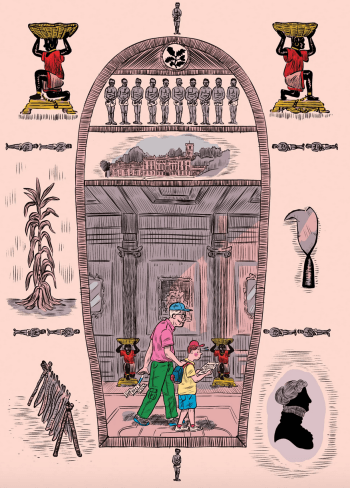
Illustration by Michael Kennedy for Sam Knight’s article in The New Yorker (23 August 2021), p. 31
The National Trust released its Interim Report on the Connections between Colonialism and Properties Now in the Care of the National Trust, Including Links with Historic Slavery in September 2020. Sam Knight’s recent article, “Britain’s Idyllic Country Houses Reveal a Darker History” from The New Yorker (23 August 2021), pp. 30–41, explores the wider context of the report along with its British reception.*
The article is, to my thinking, immensely instructive, usefully framing the scale of the problem (historically) and the magnitude of work now to be done (both professionally and societally). As Knight writes, “The National Trust, more than any other institution, helped to create the idealized version of the English country house. Almost every historian I spoke to supported the charity’s decision to reinterpret its properties, but many also observed that it did not have a choice. . . . Given Britain’s changing demographics and the weight of recent decades of colonial history, the elisions of the past were no longer tenable. The National Trust has been forced to explode a myth of its own making. But many English people preferred the myth as it was” (34).
As for the report itself, much of the attention has been directed to its listing of National Trust properties. In fact, taken as a whole, it provides an excellent guide to crucial historic institutions—with essays ranging from compensation for slave-ownership to the East India Company—along with relevant bibliographies (I can imagine lots of useful teaching applications). –CH
* In the same issue of The New Yorker, Adam Gopnik writes of ‘What the French Make of Lafayette,” pp. 66–70, observations occasioned by two recent biographies Mike Duncan’s Hero of Two Worlds: The Marquis de Lafayette in the Age of Revolution (Public Affairs, 2021) and Laurent Zecchini’s Lafayette: héraut de la liberté (Fayard, 2019).
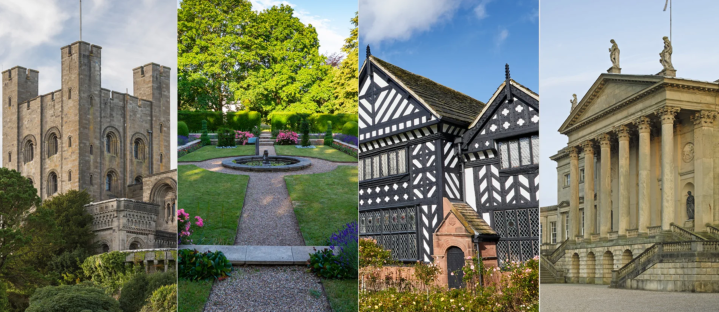
Penrhyn Castle in Wales, Clandon Park Gardens in Surrey, Speke Hall in Liverpool, and Kedleston Hall in Derbyshire (National Trust); all four properties are included in the report’s “Gazetteer.”
◊ ◊ ◊ ◊ ◊
From the NT:
The National Trust cares for places and collections on behalf of the nation, and many have direct and indirect links to colonialism and historic slavery. We’ve released a report examining these connections as part of our broader commitment to ensure that these links are properly represented, shared and interpreted.
The buildings in our care reflect many different periods and a range of British and global histories—social, industrial, political and cultural. As a heritage charity, it’s our responsibility to make sure we are historically accurate and academically robust when we communicate about the places and collections in our care.
The Interim Report on the Connections between Colonialism and Properties Now in the Care of the National Trust, Including Links with Historic Slavery details the connections 93 historic places in our care have with colonialism and historic slavery. This includes the global slave trades, goods and products of enslaved labour, abolition and protest, and the East India Company.
It draws on recent evidence including the Legacies of British Slave-ownership project and the Trust’s own sources. It also documents the way that significant Trust buildings are linked to the abolition of slavery and campaigns against colonial oppression.
It has been edited by Dr Sally-Anne Huxtable (National Trust Head Curator), Professor Corinne Fowler (University of Leicester), Dr Christo Kefalas (National Trust World Cultures Curator), and Emma Slocombe (National Trust Textiles Curator), with contributions from other National Trust curators and researchers around the country. Some of the research has already been used to update our digital content and supports visitor information and interpretation at relevant places.
Sally-Anne Huxtable, Corinne Fowler, Christo Kefalas, and Emma Slocombe, eds., Interim Report on the Connections between Colonialism and Properties Now in the Care of the National Trust, Including Links with Historic Slavery (Swindon: National Trust, 2020).
C O N T E N T S
Authorship and Acknowledgements
Foreword, Gus Casely-Hayford
Introduction — Sally-Anne Huxtable, Tarnya Cooper, and John Orna-Ornstein
1. Wealth, Power, and the Global Country House — Sally-Anne Huxtable
2 Trade in Enslaved People — Jane Gallagher
3 Abolition, Resistance and Protest — Christo Kefalas
4 Compensation for Slave-ownership — Elizabeth Green, Christo Kefalas, and Emma Slocombe
5 Merchant Companies — Rupert Goulding
6 The East India Company — Lucy Porten
7 Banking and Bankers — Frances Bailey
8 The British Raj in India after 1857 — Rachel Conroy
9 Industrialisation and the Import of Cotton — Emma Slocombe
10 Research — Sophie Chessum
Gazetteer of National Trust Properties
Appendix: Next Steps
Bibliography
Further Reading
New Book | Bravura
From Princeton UP:
Nicola Suthor, Bravura: Virtuosity and Ambition in Early Modern European Painting (Princeton: Princeton University Press, 2021), 304 pages, ISBN: 978-0691204581, $65 / £50.
 The painterly style known as bravura emerged in sixteenth-century Venice and spread throughout Europe during the seventeenth century. While earlier artistic movements presented a polished image of the artist by downplaying the creative process, bravura celebrated a painter’s distinct materials, virtuosic execution, and theatrical showmanship. This resulted in the further development of innovative techniques and a popular understanding of the artist as a weapon-wielding acrobat, impetuous wunderkind, and daring rebel. In Bravura, Nicola Suthor offers the first in-depth consideration of bravura as an artistic and cultural phenomenon. Through history, etymology, and in-depth analysis of works by such important painters as Franҫois Boucher, Caravaggio, Francisco Goya, Frans Hals, Peter Paul Rubens, Tintoretto, and Diego Velázquez, Suthor explores the key elements defining bravura’s richness and power.
Suthor delves into how bravura’s unique and groundbreaking methods—visible brushstrokes, sharp chiaroscuro, severe foreshortening of the body, and other forms of visual emphasis—cause viewers to feel intensely the artist’s touch. Examining bravura’s etymological history, she traces the term’s associations with courage, boldness, spontaneity, imperiousness, and arrogance, as well as its links to fencing, swordsmanship, henchmen, mercenaries, and street thugs. Suthor discusses the personality cult of the transgressive, self-taught, antisocial genius, and the ways in which bravura artists, through their stunning displays of skill, sought applause and admiration. Filled with captivating images by painters testing the traditional boundaries of aesthetic excellence, Bravura raises important questions about artistic performance and what it means to create art.
Nicola Suthor is professor of art history at Yale University. She is the author of Rembrandt’s Roughness (Princeton University Press).
C O N T E N T S *
Introduction
1 Celebrations of Violence
2 The Figural Tour de Force
3 The Spatial Tour de Force
4 Bravura as Painterly Style
5 Communicating Artifice
6 Economies of Practice
7 Arte-Factum: The Feminizing Bravura
8 Endangering the Youth
9 The Academic Response
10 Reenactments and Echoes
Notes
Bibliography
Index
Photo Credits
* A more detailed table of contents is available via Amazon; Alexander Marr recently reviewed the book for Apollo Magazine (17 August 2021).
.
Call for Papers | ASECS 2022, Baltimore
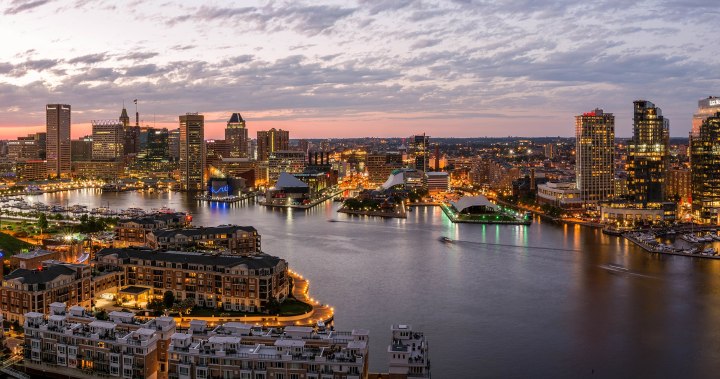
Baltimore’s Inner Harbor
(Photo by Patrick Gillespie, September 2016; Wikimedia Commons)
◊ ◊ ◊ ◊ ◊
2022 American Society for Eighteenth-Century Studies Conference
Hilton Baltimore Inner Harbor, 31 March — 2 April 2022
Proposals due by 8 October 2021 (extended from the original date of 17 September)
Proposals for papers to be presented at the annual meeting of the American Society for Eighteenth-Century Studies, in Baltimore, are now being accepted. Proposals should be sent directly to the session chairs no later than 17 September 2021. Along with our annual business meeting, HECAA will be represented with the Anne Schroder New Scholars Session, chaired by Dipti Khera and Aaron Wile (see #173). A selection of additional sessions that might be relevant for HECAA members is included below. A full list of panels is available as a PDF file here.
◊ ◊ ◊ ◊ ◊
1 Presidential Session | Venice, Real and Imagined
Irene Zanini-Cordi (Florida State University), izaninicordi@fsu.edu
Venice, hovering above its lagoon waters, was dismissed by Chateaubriand as a “city against nature” after his first visit, but defended by the Venetian salonnière Renier Michiel as “a city above nature.” This difference in perceptions, speaks to the fascinating protean quality of the city. Its beauty, traditions, architecture, culture and diversity have mesmerized and puzzled grand tourists, and have attracted artists, writers, singers, and actors from all over the world. This session welcomes papers focusing on any aspect of eighteenth-century Venice, both real and imagined.
2 Presidential Session | New Horizons in Enlightenment Studies (Roundtable) Meghan Roberts (Bowdoin College), mroberts@bowdoin.edu; and Daniel Watkins (Baylor University), daniel_watkins@baylor.edu
Twenty years after Keith Baker and Peter Hanns Reill published What’s Left of Enlightenment?, the Enlightenment is in the news. Voltaire’s Treatise on Tolerance became a bestseller in the wake of the 2015 attacks in Paris. David Hume’s racist statements in Essays, Moral and Political drew widespread notice and condemnation, resulting in Edinburgh University renaming David Hume Tower in 2020. In 2021, conservative talking heads claimed that Benjamin Franklin fought against “cancel culture.” The heritage of the Enlightenment is up for grabs. As Christy Pichichero has convincingly argued, it is necessary to complicate pristine notions of the Enlightenment and “make transparent the aspirations and the drastic omissions in Enlightenment ‘philosophie.’” We propose a roundtable that addresses the complicated and contested status of the Enlightenment in our current historical moment and contemplates new paths forward for Enlightenment teaching and scholarship. Among many possible questions, what is new for Enlightenment studies, and why does it matter? What does it mean to speak of Enlightenment in global and colonial contexts? Has studying race, gender, and Enlightenment changed in our moment of #MeToo and #BlackLivesMatter? We hope to represent a wide array of perspectives and particularly encourage graduate students and early career researchers to apply. Panelists working on any facet of the Enlightenment, broadly defined, are welcome.
3 Presidential Session | Undergraduate Research (Roundtable)
Rachael King (University of California, Santa Barbara), rking@english.ucsb.edu
This roundtable invites considerations of the role that undergraduates play in research into the eighteenth century. As major requirements and undergraduate interest are changing at many universities, many ASECS members are not teaching primarily, or at all, in the field of eighteenth-century studies. But at the same time, cross-rank research groups in fields such as the digital humanities, book history, and critical making are increasingly common, a trend that can attract undergraduates to the field. How is the move toward undergraduate research initiatives affecting our work? How can we encourage more undergraduate research? Presentations by or including undergraduate researchers are particularly welcomed.
4 Innovative Course Design
asecsoffice@gmail.com
ASECS invites proposals for a new course on eighteenth-century studies or a new unit (1–4 weeks of instruction) within a course. Proposals may address a specific theme, compare related works from different fields (music and history, art and theology), take an interdisciplinary approach to a social or historical event, or suggest new uses for instructional technology. The unit/course should either have never been taught or have been taught recently for the first time. Applicants should submit a 750–1500 word proposal that focuses sharply on the leading ideas distinguishing the unit/course. The proposal should indicate why particular texts and topics were selected and (if possible) how they worked; ideally, a syllabus will be provided. The competition is open to current members of ASECS. Up to three proposals will be selected for presentation during the Innovative Course Design session at the Annual Meeting; a $500 award will be presented to each of the participants, who also will be asked to submit an account of the unit/course, a syllabus, and supplementary materials for publication on the ASECS website.
5 Wikipedia Edit-A-Thon (Workshop) [Digital Humanities Caucus]
Collin Jennings (Miami University), jenninc@miamioh.edu
The ASECS Digital Humanities Caucus invites proposals for supporting a Wiki Edit-A-Thon focused on creating and expanding Wikipedia entries for marginalized figures and groups of the eighteenth century. Proposals may come from either scholars with experience editing Wikipedia entries or from scholars with plans for expanding particular entries. Speakers will prepare brief presentations (~5 minutes) on best practices or plans for editing Wikipedia entries, and the majority of the session will consist of attendees contributing to eighteenth-century entries. Although the Edit-A-Thon during the session will be relatively short, we will also set a goal for the number of entries to be created or expanded over the course of the entire conference.
6 Centering Marginalized Voices in Digital Humanities Projects (Roundtable) [Digital Humanities Caucus]
Mattie Burkert (University of Oregon), mburkert@uoregon.edu
How can scholars use digital tools, ranging from databases, to digitization, to visualization, to center marginalized voices of the eighteenth century? To what extent can new methods produce new perspectives on the figures and groups of the period? We seek proposals describing DH projects that have foregrounded marginalized voices of the eighteenth century. The projects can be at any stage of development, from planning to completion, but the speakers should be able to share concrete steps they took for centering underrepresented groups in their projects. These might include using digital research techniques for discovering under-researched figures, or they might entail using publication and exhibition platforms for representing projects designed around such figures.
7 Disability Performances [Disability Studies Caucus]
Annika Mann (Arizona State University) Annika.Mann@asu.edu; and Emily Stanback (University of Southern Mississipi), Emily.Stanback@usm.edu
This panel seeks to investigate disabilities, bodyminds, and performances in the long eighteenth century. How do we recover an archive of disability performance, broadly speaking? How might disability performance render new insights about the formation of disability as a socially constituted and contested identity? What insights can eighteenth-century archives offer about the performativity of the everyday when thinking through diverse bodyminds?
By “performance” we hope to signal not just theatre, the playhouse, and the repertoire, but also larger moments that feel “performative.” As Tracy C. Davis, Willmar Sauter, and Judith Butler theorize, performance time, performance events, and performative self-making raise concerns about layered temporalities, polychronicity, repetition, hiccups, ruptures, and revisions. Tobin Siebers calls attention to the multiple offstage performances like passing, masquerading, and other ways to navigate the social. How can eighteenth-century performances extend, complicate, or reshape our understanding of disability performance? We invite 250-word abstracts about these or related topics on disability performance in the long eighteenth century.
17 Transformation, Idealization, Animation: Contemporary Perspectives on the Pygmalion Myth [New Lights Forum]
Jennifer Vanderheyden (Marquette University), jennifer.vanderheyden@marquette.edu
The Walters Art Museum in Baltimore holds Falconet’s renowned sculpture Pygmalion and Galatea. According to the museum’s website, “This statue is very likely the one exhibited by the artist at the Salon of 1763 (in Paris). Pygmalion is depicted in rapturous amazement at the feet of his love object, a nude sculpture, just at the moment when it is given life by Venus, the goddess of love.” This panel invites interdisciplinary proposals that consider the enduring influence of the Pygmalion myth from a contemporary perspective. In all disciplines one encounters love and its idealization, disappointment of imperfections, animation of the inanimate, transformations of the allegory, the aesthetics of mimesis… to name only a few. For example, in his Salon of 1763, Denis Diderot praises Falconet for his animation of Pygmalion, but continues with a critique and proposal of another version of the statue that would be even more lifelike. Diderot’s theories of this animation (including his proposal that one can consume marble by pulverizing it, mixing the powder with soil and compost, then sowing vegetables that will be consumed) continue to engage dialogue, as do other reworkings of the Pygmalion story.
19 Teaching the Eighteenth Century (Poster Session) [Pedagogy Caucus]
Linda Troost (Washington & Jefferson College), ltroost@washjeff.edu
How do we continue to engage students with the eighteenth century in innovative ways? All aspects of pedagogy are welcome for poster presentations that cover an entire course or focus on a particular element of a course. Brief presentations (5 minutes) will be followed by time for conversation. Participants in panels or roundtables are also welcome to participate in the poster session. Posters will remain on display throughout the conference and then be placed online.
20 Aiding the Anxious: How Non-Specialists Can Navigate Teaching about Race and Empire (Roundtable) [Race and Empire Caucus]
Kimberly Takahata (Villanova University), kimberly.takahata@villanova.edu
Building on the series of Presidential Sessions including Concepts in Race and Pedagogy for 18th-Century Studies (2021), Teaching Race in the 18th Century in the 21st-Century Classroom (2019), and Addressing Structural Racism in the 18th-Century Curriculum” (2018), this session invites facilitators for a discussion and workshop for non-specialists of critical race and anticolonial studies on integrating matters of race and empire into the 18th-century classroom. Pushing past strategies of syllabus “inclusivity,” this session asks: how can we center race and empire as critical paradigms across a variety of courses in eighteenth-century literature, culture, and history? What strategies can expand and deepen our engagement with race and empire in the classroom? In particular, this conversation will be interested in techniques that are helpful for early career, sessional, and adjunct instructors.
21 Eighteenth-Century Studies in Dialogue with the Work of Dionne Brand, Saidiya Hartman, and Christina Sharpe (Roundtable) [Race and Empire Caucus]
Eugenia Zuroski (McMaster University), zuroski@mcmaster.ca
At this moment of intensified calls across “traditional” academic fields for more sustained engagement with antiracist frameworks, decolonizing movements, and Black life and liberatory thought, how might eighteenth-century studies of race and empire better think with and learn from work in Black and African/African Diasporic studies? This roundtable invites participants to focus on the writing and scholarship of Dionne Brand, Saidiya Hartman, and Christina Sharpe—three thinkers whose work on ontologies, geographies, and narratives of Black life since the eighteenth century seems more crucial than ever to any scholarly approach to the long eighteenth century. Papers may focus on one, two, or all three writers, and should call attention to how a specific text, figure, concept, or method from these scholars’ work generates possibilities for future approaches to the study of race and empire.
48 Crafted Lives
Chloe Wigston Smith (University of York), chloe.wigstonsmith@york.ac.uk; and Jennie Batchelor (University of Kent), J.E.Batchelor@kent.ac.uk
We invite proposals that address the teaching and making of needlework by women and girls in the transatlantic eighteenth century. In recent years, the “material turn” has generated new approaches to material culture and maker’s knowledge in eighteenth-century studies. Yet skills such as needlework and embroidery often remain underestimated, falling under the collection of “female accomplishments” perceived, then and now, as symptomatic of the undereducation and oppression of women and girls. “Crafted Lives” seeks to reorient attention to the transfer of knowledge, aesthetics and techniques that circulated back and forth across the Atlantic. We’re especially keen on proposals that make visible the politics of needlework and the complexities of women’s handicrafts and their experiences of learning, making and teaching needlework over the lifecycle. How did material literacy intersect with or diverge from textual literacy? How did needlework forms articulate their makers’ emotions and their cultural, religious and political beliefs? How did some of these material contributions engage debates about abolition, empire and women’s rights? How did eighteenth-century craft knowledge circulate within/between classes, households and institutions, the provinces and the metropole, and within colonial spaces? We welcome abstracts from across the disciplines represented by ASECS members, as well as abstracts that draw on a range of archives.
54 Arts of the Table in Global Perspective
Sarah R. Cohen (University at Albany, SUNY), scohen@albany.edu
For elite and middle-class consumers in the eighteenth century, dining entailed a variety of forms of artistry: in addition to food preparation itself, elaborate attention was often paid to tableware, rituals of consumptive performance, as well as written texts that alternately prescribed, described and imagined the process of consuming food and drink as physical and material enactment. All of these arts were moreover often global in scope, whether one took the perspective of diners in Europe or of those in other parts of the world; through international commerce, colonization, travel, and curiosity food and its consumptive arts manifested multiple points of intersection, exploitation and even hybridization among countries and cultures. This panel seeks papers that address any aspect of the arts of dining, viewed through the lens of an increasingly globalized eighteenth-century world.
55 Transplanted Lives and Foreign Presence: The Visual Culture of Immigrants in Eighteenth-Century Europe
Marina Kliger (Metropolitan Museum of Art); and Thea Goldring (Harvard University), Marina.Kliger@metmuseum.org
During the long eighteenth century, established commercial networks, expanding empires, political conflicts, and economies of slave labor contributed to the growing presence of foreign individuals and communities within Europe and the British Isles. These voluntary and forced transplants from the East and West Indies, the shores of the Mediterreanean, and from across Europe itself became part of the urban fabric of increasingly cosmopolitan cities like London, Paris, Marseilles, Venice, and Amsterdam. Building on the work of Denise Murrell and Ian Coller on France and Beth Fowkes Tobin, Rozina Visram, and Jennifer Germann on Britain, this panel considers the visual representation of these immigrant groups in Europe, as well as their own artistic practices within their host societies. Following recent scholarship that foregrounds the negotiation of difference within and the global character of Enlightenment culture, we ask: How did images of eighteenth-century Europe’s foreign residents contribute to constructions of cultural difference and competing notions of cosmopolitan and national identity? How did these portrayals shape such communities’ lived experiences? Conversely, how did foreign individuals exert agency through visual representation and negotiate their new societies through artistic practice? Finally, considering both the gaps and biases of the visual archive, what are the limits and dangers of using images as evidence of the historical presence of these groups in Europe? We particularly welcome papers that seek to recover the identities and lived experiences of persons represented in exoticizing studies, unidentified portraits, cosmopolitan city views, artist sketches, and the like.
61 How ‘Byzantine’ Was the Eighteenth Century? New Insights on the Christian Orthodox Art and Architecture of the Late Ottoman Empire
Nikolaos Magouliotis (PhD Candidate ETH Zurich/gta); Demetra Vogiatzaki (PhD Candidate Harvard University), vogiatzaki@g.harvard.edu
The most common term used to describe Christian Orthodox art and architecture produced in Ottoman territories during the early modern period is “post-byzantine.” While Byzantine elements did persist long after the Fall of Constantinople, the referentiality of the term falls short of the increasing aesthetic variation of architectural monuments, decorative objects and artworks produced by the Christian communities of the Empire. As recent scholarship has highlighted, particularly from the eighteenth century onwards, the eastbound expeditions of missionaries, merchants, diplomats and antiquarians, the establishment of Ottoman embassies in the West, and the privileges granted to the Christian millet had a significant influence on the local culture; from Jerusalem to Istanbul and from Anatolia to the Balkans, regional idioms merged with metropolitan Istanbulite fashions and Western influences.
This session seeks papers that investigate the evolution of the artistic and architectural expression of Eastern Orthodoxy in the long eighteenth century. How cohesive was the aesthetic production of the Christian millet? How did it mirror the contemporaneous intra-confessional collision and coalescence within the Empire? What was the influence of European travelers and Ottoman cosmopolitan elites? We encourage close studies of situated artifacts (ie. buildings, artworks and devotional objects), itinerant people (such as pilgrims and craftsmen) and objects (from holy relics, to print media) that illustrate or complicate the deviation from the Byzantine tradition. Contributions that seek to challenge or revise the terminology used to describe Christian Orthodox art and architecture in the eighteenth century are particularly welcome.
64 Seeing Empire Near and Far
Daniel O’Quinn (University of Guelph), doquinn@uoguelph.ca
This panel aims to explore how formal hybridization allowed metropolitan and colonial subjects to conceptualize empire across a wide range of visual media in Britain and its colonies including panoramas, phantasmagoria, theatrical scenography, raree shows, wonder cabinets, collections of ephemera, and embroidery samplers. The extreme differentiation in scale and purpose of these cultural artefacts is important to the overall argument of this panel for it contends that similar formal procedures could be adapted to the most public visualizations of empire and to the most private acts of colonial resistance. The desire here is not to suggest that everyone sees empire in a similar fashion, but rather that the changing structure of the world could be addressed in the formal spaces where disparate cultures meet. Using familiar visual tropes and strategies—i.e. that which was close at hand–the makers of these objects were able to broach unfamiliar social scenarios that encompass the vast global networks that were transforming the flows of populations and commodities in the long eighteenth century.
74 Skin & Bone: Animal Substrates in the Eighteenth Century
Sarah Grandin (The Clark Art Institute), sgrandin@clarkart.edu
Eighteenth-century Europe saw technological improvements in the manufacture of a variety of smooth materials, from paper to porcelain. And yet alongside the use of these highly processed substances, those of animal origin continued to be deployed for their unique receptivity to marks and incisions. Artists and artisans continued to prize animal supports the world over, from Paris, to Manila, to Dakar, to the Labrador peninsula, using ivory in portrait miniatures, vellum for botanical illustrations, teeth for scrimshaw trophies, tusks as religious figurines, and caribou skins for coats. As studies in technical art history have articulated, such surfaces were valued for their physical properties, from their capacity to retain or repel ink, to the glow imparted by collagen, to the organic translucence of polished bone. The import of maritime, missionary, colonial, indigenous, and local economies from which these substances emerged in the eighteenth century has only recently begun to be explored.
This panel invites speakers to consider the observable qualities of animal substrates in relation to their origins. How did practitioners and viewers think about the copresence of liveliness and death caught up in these materials, which were extracted from animal bodies, and often at great cost to the humans who hunted them, slaughtered them, prepared them, and were even exchanged against them? Did working on tissue illicit moments of sympathy, repulsion, or identification? Through a focus on animal substrates, this panel encourages participants to investigate how materials’ geographic and anatomical sources were understood, overlooked, and elided in the eighteenth century.
90 Materials of Global Trade: Networks, Mobility, and Transformation
Jennifer Germann (Ithaca College), jgermann@ithaca.edu
This panel will explore the abundance and variety of materials that travelled the globe during the long and wide eighteenth century and the different modes of transformation and appropriation they experienced when they reached their destinations. Such materials include natural resources (e.g., silver, cacao, and minerals) and botanical and zoological specimens, among others. This panel is interested in how such materials could be modified or transformed to create novel types of material goods or be the inspiration for creating new objects. Some questions to consider include: how were materials adapted and transformed? In what ways were artistic traditions shaped by these contacts with a diverse range of material goods and things? How were these materials and products beneficial in promoting innovation and experimentation? How did they facilitate the creation of new customs and in what ways did they combine with (or hinder) pre- existing ones? What meanings were generated in different cosmopolitan centers around the world, especially port cities that played an essential role in the dissemination of goods on a global scale? Topics that explore regions outside of Europe and North America and interdisciplinary approaches are encouraged, as are graduate students and early career scholars.
114 Hispanists Here to Help! Integrating Spain and Latin America into Your Eighteenth-Century Courses (Roundtable)
Adela Ramos (Pacific Lutheran University), ramosam@plu.edu
This roundtable continues the call to build “Everybody’s ASECS” and “to stimulate interdisciplinary and cross-cultural conversations” by helping to create classroom spaces where the many languages and literatures that constitute the Enlightenment come together. Proposed in response to the enthusiastic support the session received at ASECS 2021 and offered in connection to Plan Your Survey Course: Workshop on Backwards Design, it has a twofold goal: we aim to continue providing dieciochistas from all corners of the globe with ideas for how to integrate the literatures of Spain and Latin America to their courses, and with opportunities to reflect on, discuss, and even revise our pedagogical frameworks. We invite proposals from scholars that offer innovative ideas for including the Hispanic world—perhaps a separate unit or in a comparative framework—in courses on the eighteenth century and/or the Enlightenment offered by departments of English, French, American Studies, Women and Gender Studies, History, Art History, and Music. We also welcome proposals that consider the broader implications of rethinking the traditional pedagogical parameters that have tended to marginalize the Hispanic eighteenth century for our understanding of issues such as empire, race, slavery, science, and commerce.
122 Redesigning Eighteenth-Century Britain
Mike Goode (Syracuse University), mgoode@syr.edu
This session asks participants to attend to the conceptual frameworks through which eighteenth- century British artists, craftspeople, gardeners, engineers, philosophers, and/or politicians talked about medial, ecological, structural, formal, or aesthetic design, with an especial emphasis on how they thought about *redesigning* as an activity, process, and mode. Papers might ideologically critique specific eighteenth-century languages of, or material instances of, redesign to unpack the work they accomplish (the example comes to mind of how debates over “revolution” and “reform” sometimes played out as conversations over how best to “renovate” or “remodel” the state). But the impetus for the session comes just as much from current interest in so-called “post-critical” approaches to eighteenth-century Britain, like new materialism, new formalism, and actor-network theory. Such approaches often encourage thinking about objects and forms both as designs and as designing agents, and they also sometimes leverage conceptual vocabularies imported from design theory (affordances, capabilities, allowances, etc.). To what extent are any of these new approaches drawing upon or redesigning eighteenth-century terms or conceptual lenses? Might any eighteenth-century intellectual frameworks or terms for thinking about design generally, or about specific designs or instances of redesign, be used to enrich or critique new scholarly approaches that rely upon design concepts and vocabularies? The goal of the session is to promote a richer understanding of the intellectual history of eighteenth-century British design while also reflecting on the theoretical possibilities and limitations that various design concepts might hold for studying eighteenth-century texts and cultures.
125 Visualizing Urban Spaces (Roundtable)
Molly Nebiolo (Northeastern University), nebiolo.m@northeastern.edu
How can we see the spaces of the past? How did cities fit into early American landscapes? In what ways do digital tools and the digital humanities inform our understanding of space and place in eighteenth-century early America? These are just a few questions that can be addressed, pondered, and answered in this panel. Images of the period, from colonial maps to city plans, give us one way to imagine early American cities. Narratives around place, or the travelogues of those moving between cities and colonies, provide us with another avenue for “seeing” the past. With digital tools and programs, we can move closer to a more comprehensive narrative of early urban spaces. GIS mapping, 3D modelling, VR, and other digital platforms create a larger, interdisciplinary narrative around eighteenth century spatial history and the way different populations moved, belonged, and occupied urban spaces. We welcome a variety of interpretations of urban space, place, and ways of understanding both, digitally or otherwise. The session investigates the ways in which humanists are able to visualize the past, and it exemplifies the significance of urban space to the eighteenth century.
129 Let’s Get Small: Micro-Art Histories
Melissa Hyde (University of Florida), mlhyde@ymail.com
A by now thoroughly established trend in art history and in accounts of eighteenth century culture has oriented us towards questions of sweeping global scope and ambition, and the charting of vast and complex international networks and Empires in art and culture. This history, rich in insights, is nevertheless sometimes gigantesque in its claims for art as well as in its scope. This session takes a different tack, and proposes instead to explore little histories, micro- histories, local histories and microscopic histories of art, understood either as histories of small or marginal things or as ‘little histories’, geographically confined, fleeting, circumscribed, particular, even anecdotal. What can intense scrutiny of local specifics, concentration on seemingly small-scale or unnoticed events works or networks of art tell us? And what are the pleasures, as well as the profits, of paddling the backwaters and trawling the pond for all that is teeming, singular, vibrant but hard to see? I welcome papers from “microscopists” of eighteenth- century art history on any aspect of the period that ask big questions about small things.
131 Spreading the Image: European Print Culture
Susanne Anderson-Riedel (University of New Mexico), ariedel@unm.edu
This session invites new scholarship on the publishing, commerce, and distribution of prints to investigate the close net of international collaborations within the European print market in the long eighteenth century. Market interactions highlight the role of prints in facilitating aesthetic, intellectual, and cultural dialogues of the Enlightenment.
133 Spectacle behind the Curtain: Décor, Machines, and Special Effects
Elisa Cazzato (Università Cà Foscari, post-doc and NYU, visiting research fellow), elisa.cazzato@gmail.com
This panel promotes a discussion on artistic practices behind the creation of spectacle in eighteenth-century Europe. The worlds of stage design, machinery, and popular attractions are inherently transient and contingent and often leave few traces. During this period, moreover, a host of stage decorators, machinists, fireworks technicians, circus performers, and foreign entertainers circulated across Europe, spreading ideas and practices that were frequently appropriated and standardized while their origins or creators went unacknowledged. These influential artists and performers, often lacking strong institutional affiliation, have not been given the same critical attention paid to visual artists, musicians, or dramatists. This panel encourages a behind-the-scenes look at such artistic practices that can expand our view and understanding of eighteenth-century spectacle and its varied constituents. For example, how did artists involved in ephemeral or peripheral activities exert their individual personalities? In what ways did certain attractions like wax statues and dioramas, cabinets d’optique, and Wunderkammer inform and overlap with science and technology? How might we account for the status of the marvelous within an era of so-called “Enlightenment” rationality? How can we appreciate décor and other special effects not only as artistic products, but also as autonomous cultural phenomena?
The session seeks to foster interdisciplinary dialogue on performance creation, stage-settings, and the circulation of artists and ideas. It welcomes submissions from scholars at any career stage, as well as from arts professionals in or outside academia. Contributions informed by the experience of staging (or planning to stage) an eighteenth-century work are especially encouraged.
136 Media, Techniques, and Practices from the Mezzotint to the Daguerreotype
Megan Baker (University of Delaware); and Joseph Litts (Princeton University), mebaker@udel.edu
Numerous novel artistic techniques were developed over the long eighteenth century. Following recent process-driven art history, including research by Ewa Lajer-Burcharth or Matthew Hunter, we are interested in interrogating the politics and possibilities within artistic media, techniques, and practices. Artists, regardless of their culturo-geographic positioning, faced choices and material limits; beyond simple lack of access, they innovated and deliberately blurred the lines between different media. How did they navigate these choices and what are the non-iconographic visual ramifications? Can materials have a politics? Is there a materiality of settler colonialism? Is there a materiality of resistance to settler colonialism?
We especially encourage submissions from scholars at all stages who are looking at materials beyond traditional oil painting or sculpture, particularly including: drawings, pastels, watercolors, reproductive prints, miniatures, photographic processes before the daguerreotype, period techniques for ageing and/or conserving works of art, wax, relationships between makeup and theatrical productions, decoupage, souvenirs, or silhouettes. We are interested in approaches that consider inter-media and inter-material approaches to the history of art, as well as process- driven research centering innovative artistic techniques and new materials in the eighteenth century.
138 Conversations across the Arts: Adaptations in the Long Eighteenth Century
Daniella Berman (New York University), daniella.berman@nyu.edu; and Ashley Bender (Texas Woman’s University), abender@twu.edu
When we talk about the eighteenth-century and adaptation, we frequently talk about adaptations of eighteenth-century literature and art, often into film. Yet adaptation was a common practice during the eighteenth century as well. From Nahum Tate’s 1681 adaptation of Shakespeare’s King Lear to William Hogarth’s 1731 representation of a scene from John Gay’s Beggar’s Opera (1728); from Henry Fuseli’s images inspired by, and William Blake’s illustrations for, Dante’s Divine Comedy to the numerous adaptations of Samuel Richardson’s Pamela, or Virtue Rewarded (1740), eighteenth-century artists, writers, and composers regularly adapted works of their contemporaries and predecessors into new genres (e.g., novel to opera) and across media (e.g., novel to oil painting), creating what Giuseppe Mazzotta has called a “conversation among the arts.” Drawing on the distinctions Julie Sanders makes between adaptation and appropriation (Adaptation and Appropriation, 2006), we invite papers that explore these phenomenona across the long eighteenth century. We welcome papers on any kind of adaptation in the period, with a particular interest in adaptations across the arts.
141 Portraiture in the Americas
Emily K. Thames (Florida State University), ekt13@my.fsu.edu
This panel calls for papers that examine portraits created during the long eighteenth century from any geographic, political, or cultural context in the Americas (North America, Central America, South America, and the Caribbean), and it endeavors to generate scholarly discussion about the trends and themes that emerged in the practice of portraiture across the hemisphere during this time. The topic of portraiture has received much attention in recent decades in eighteenth-century art historical studies—how can we ‘rethink’ portraiture, specifically in the Americas, to consider new methods of inquiry or interpretation? What unique meaning or use do such portraits possess within their local milieus? What roles do portraits play in the creation and/or reification of colonial or imperial narratives? With the expansion of colonial networks and the shifting of imperial boundaries throughout the century, what cross-cultural exchanges can be addressed through portraiture? This panel particularly encourages papers that consider portraits or portraiture traditions from understudied regions in the Americas or portrait artists from underrepresented communities.
144 Representing Slavery in French Enlightenment and Revolutionary Cultures
Masano Yamashita (University of Colorado Boulder), masano.yamashita@colorado.edu; and Scott M. Sanders (Dartmouth College), scott.m.sanders@dartmouth.edu
This panel explores the visual and rhetorical tropes deployed in representations of enslavement in the French-speaking world. From Voltaire’s Candide to Bernardin de Saint-Pierre’s Paul et Virginie, many canonical French texts describe encounters with enslaved people in vivid tableaux. In addition to narrative depictions, colonial newspapers documented the marks of torture that transformed enslaved bodies into visual histories of brutality. While in novels, these encounters are often moralized as moments of pity and indignation, in historical documents, they objectify the enslaved as property. We seek proposals that explore the tableaux representations of novelists, playwrights, travel writers, memoirists, artists, and illustrators, who faced the task of confronting French and/or colonial audiences to the shock of slavery. Of particular interest to our panel are papers that recover the voices and agency of the enslaved, analyze the circulation and translation of ideas regarding slavery from one medium to another, take up questions of gender and slavery, or assess the social taxonomies of slavery and servitude. This panel additionally aims to include various voices of French diasporas across the globe.
147 The Unproductive
Amit Yahav (University of Minnesota, Twin Cities), ayahav@umn.edu
This panel seeks papers that draw on eighteenth-century examples to consider the capacity of the arts not so much to please as they teach, but to afford breaks from an overbearing regime of productivity and growth. While the eighteenth century has been implicated in instrumentality of all sorts, it also promoted idlers, ramblers, airy fictions—emblems of inefficiency and uselessness. How might we conceive of ephemerality, vacuity, or inaction as in and of themselves worthy conditions? How might we make the case for the value of reading materials, musical pieces, or decorative arts that leave little enduring marks on mind or heart? And how might instances of eighteenth-century embracing of futility help us craft defenses of current humanistic studies, defenses that do not rely on the humanities’ serviceability to a social machinery which privileges productivity, efficiency, utility, and growth? Proposals examining arts and literatures of all languages, media, and genres are welcome.
151 Objects and the Making of Enlightenment Selves
Joelle Del Rose (College for Creative Studies, Detroit); and Mary Peace (Sheffield Hallam University), m.v.peace@shu.ac.uk
This panel will ask how the acquisition and accumulation of material objects in the eighteenth century brokered modern ideas of the self and new cultural forms. Novel commodities flooded the mental and physical worlds of eighteenth-century men and women, changing their perception of self and others. Now in the twenty-first century as we are forced to confront limits of the material world and the sustainability of material acquisition, it’s timely to return to the origins of this material accumulation. The panel solicits papers which to ask how the arrival and manufacture of new commodities—furniture, sugar, coffee, tea, fabrics, and architectural spaces, etc. choreographed ideas of the self and new cultural forms such as the conversation piece and the novel. The panel is interested also in soliciting papers which consider how the symbolic meanings of these material objects are forged and contested in contemporary representation. We solicit papers of 15 minutes duration to be circulated in advance to facilitate an extended discussion period.
152 Forging Forgeries: Material Imitations
J. Cabelle Ahn (Harvard University), cabelle.ahn@gmail.com
This panel invites papers that examine visual technologies of material mimesis. There has been recent scholarly attention on “fakes” or imitation materials in early modern Europe such as Pamela Smith’s Making and Knowing Project’s recreation of a recipe for imitation coral, as well as studies on the roles of artists, collectors, and amateurs and how their intentional forgeries advanced the development of connoisseurship. The eighteenth century continued the Renaissance interest in material substitutions sometimes in order to meet market demands and to cut production costs—this in turn gave rise to original materials or methods of production. The panel hopes to unearth understudied examples of imitation and how these technologies contributed to the evolving discourse on connoisseurship, metamorphosis, and artisanal intelligence in this period. Examples include James Tassie’s glass paste that imitated antique cameos, Piet Sauvage’s paintings that imitated marble bas-reliefs (which he frequently exhibited in the Salon), manuals on how to forge gemstones by coloring glass and crystals, the vogue for “japanning” which imitated east Asian lacquer work, wooden furniture and architectural interiors painted to resemble porcelain or marble, as well as various printmaking technologies that not only reproduced different drawing media but also modes of printmaking. Submissions may thus consider specific case studies of artworks, manuals, objects, or sites, and the panel invites papers on all geographies across the long eighteenth-century, particularly submissions outside of the Eurocentric context.
157 Deconstructing, Dismantling, Decolonizing: Current Scholarship on the Arts of the Colonial Americas (Roundtable)
Caroline Culp (Stanford University); and Philippe Halbert (Yale University), philippe.halbert@yale.edu
We invite proposals for a roundtable discussion on current and future directions in scholarly approaches to the arts of the colonial Americas, including North, Central, and South America and the Caribbean. What trends have emerged in recent years that prompt new ways of interpreting hemispheric circulations of art, ideas, and materials? How have methodological and theoretical innovations shaped more inclusive perspectives on “American” art and identity? In the wake of ongoing calls for decolonization, what role can art historians working in this area play in nuancing larger historical narratives? Short talks offering insight into postcolonial, queer, and gender- and race-related topics are especially welcome as we come together to consider the state of the field.
158 Embodied Rhetorics (Roundtable)
Miriam Wallace (New College of Florida), mwallace@ncf.edu
Where and why do we find examples of “embodied rhetoric” in the eighteenth century? We might think of Defoe’s description of Friday’s gesture placing his head beneath Robinson Crusoe’s foot signifying voluntary servitude and its relation to the supplicating figure of “Am I not a Man and a Brother” emblem, memoralized by Wedgewood. Or we might consider Trim’s gesture with his hat in Tristram Shandy describing how we pass from life to death, and onwards to Gilbert Austin’s Chironomia as a handbook for speaking gesture (building upon Bulwer’s Chirologia) as figures for something like “embodied rhetoric” or an emphasis on gesture and persuasive or signifying postures. How do we think about literary descriptions, elocutionary training, satirical prints, theatrical portraits, or historical paintings as exemplifying and figuring rhetorical delivery and effective speaking? How was ‘rhetoric’ in the sense of performed speech or persuasive writing divorced from or dependent upon embodiment? Which bodies were ‘speaking bodies’ and under what conditions? Presentations that engage literary works, visual images, or ekphrastic moments are invited to help us think about the relation of embodiment to persuasion and effective representation.
159 Clothing and Empire: Dress and Power
Kristin O’Rourke (Dartmouth College), kristin.orourke@dartmouth.edu
This session hopes to explore the knotty connections between fashion and power in the long eighteenth century, particularly in relationship to the military, financial and racial politics of empire. Over the past several years, art history, fashion studies, and material history have made clear the importance of examining the details of dress, accessories, cosmetics, furnishings, and behaviors in visual imagery in order to understand social status and power relations over time and across geographical and national boundaries. From Napoleonic history paintings to elite portraiture to graphic satire throughout Europe and in relation with European colonization, we can read dress as a curated self-representational device as well as an unconscious sign of power or powerlessness. This panel would welcome individual case studies as well as broader theoretical or historical discussions surrounding both the stuff of dress and its political effect.
173 Anne Schroder New Scholars Session [Historians of Eighteenth-Century Art and Architecture]
Dipti Khera (New York University), dipti.khera@nyu.edu; and Aaron Wile (National Gallery of Art), A-Wile@nga.gov
This is an open session for advanced graduate students and early career scholars in the art and architectural history of the long eighteenth century around the globe. We especially encourage submissions from underrepresented scholars; those who work in universities, museums, and para-academic institutions outside of North America and/or in adjunct employment positions; and those who define their stakes, topics, and temporal frames for the eighteenth century through visual/material/spatial analyses in relation to histories of enslavement, colonization, and the racialization and discrimination of bodies, knowledge, places, and objects.
185 Seen Here Making a Masterpiece: Rendering Artists, Musicians, and Authors in Painting, Poetry, Sculpture, and Prose [South-Central Society for Eighteenth-Century Studies]
Kevin L. Cope (Louisiana State University), encope@lsu.edu
Whether Edmund Waller’s address to a painter or Frances Burney’s account of the imaginary poet Macartney or Largilliere’s portrait of Voltaire or the Derby Porcelain Manufactory’s figurine of a poet, the long eighteenth century abounds with representations of artists and writers that were executed in media or genres other than those in which the depicted subjects specialized. Essayists write about artists, novelists tell tales concerning songsters, and sculptors portray architects at work. These media-crossing renderings often involve a significant change in tone. Engravers satirize elegists; composers change the tune of would-be lyric poets. This panel will feature papers exploring the presentation of artists dedicated to one medium or genre in another medium or genre. It will refresh acquaintance with the easily overlooked and frequently forgotten imagining of artists and artistry. The panel will raise questions about the purpose of such boundary-crossing representations while also probing Enlightenment ideas about the mutual affiliation of the arts and about the character, value, and social roles of modern cultural professionals. It will give new life to a puzzling genre, the representation of those who represent, that both perplexes and peps up the neoclassical distinctions between art and nature, original and copy, and life and its artful immortalizations.
Exhibition | Imperfect History
From the press release (20 August 2021) . . .
Imperfect History: Curating the Graphics Arts Collection at Benjamin Franklin’s Public Library
The Library Company of Philadelphia, 20 September 2021 — 8 April 2022
Curated by Erika Piola and Sarah Weatherwax
 New exhibition reveals visual cues of bigotry and inequality over hundreds of years in America.
At a time when Americans are constantly bombarded with graphics, some with hidden meanings, our ability to interpret visuals has taken on new urgency. Imperfect History: Curating the Graphics Arts Collection at Benjamin Franklin’s Public Library is a new exhibit designed to help us read between the lines of popular graphics. Drawing from a collection of extraordinary breadth spanning 300 years, Imperfect History showcases hidden and rare items, the unseen stories of everyday people, and the prejudices and preconceptions of different time periods. It’s a visual time machine of the good, the bad, and the ugly of American culture.
“The point is not to take things at face value,” said Michael Barsanti, the Edwin Wolf 2nd Director of the Library Company. “Inequalities and prejudices have existed in plain view for centuries. We just need to look for the clues in visual materials. Our hope is that this exhibition will help teach the public to understand racist, sexist, and other biased imagery in popular culture today and throughout history, in an effort to mitigate bigotry.”
Items glorifying white men, stereotyping African Americans, satirizing feminism, and representing economic disparities will be on display. So too will ‘imperfect’ works that would never see the light of day in a fine arts exhibit, but that offer important lessons in how people lived, what they cared about and what they really thought.
“We want to help patrons understand American history through graphic materials,” notes co-curator Erika Piola, Director of the Visual Culture Program. “These are images created and seen by everyday people. They were collected by the son of a Library Company librarian, hung on the walls of American homes, were saved in scrapbooks, and mailed to the dwellings of average citizens.”
Included in the exhibition are an ink blotter with female nudes on lettuce, a promotional item never seen before publicly. There are rare items such as a print of an enslaved teen with vitiligo who was exploited as a sideshow curiosity and a lithograph of living and dead all-white male Masons described as the “wise and good among mankind.”
Among the exhibition’s five areas is the ‘Imperfection Section’ with items that have been altered, suffered age deterioration, damage, have artistic errors, or inscriptions. “We want people to appreciate that just because items like photographs, prints and sketches might be damaged, it doesn’t make them any less important to future generations,” says Piola.
Co-curator Sarah Weatherwax, Senior Curator of Graphic Arts notes, “Benjamin Franklin founded the Library Company to prepare colonists for citizenship by giving them access to books. But today, being an engaged citizen requires us to look beyond text and also focus on visuals, to understand nuance and context.”
The Imperfect History project includes an exhibition, publication, digital catalog, a visual literacy workshop, a one-day symposium, and a curatorial fellowship. It is in commemoration of the Fiftieth Anniversary of the Graphic Arts Department.
Digital Catalog
The digital catalog creatively demonstrates multiple viewpoints through descriptions of the same visual material written by four guest catalogers from different fields. The exhibition publication is an illustrated catalog providing an overview of the history of graphics collecting at the Library Company as well as narratives and a case study of the relationships between American art history, visual culture and literacy, race, gender, and Philadelphia imagery and image makers.
Visual Literacy Workshop: Urban In-sights
A select group of historians, curators, and other professionals from around the U.S. gathered virtually at the end of June for a workshop designed to enhance participants’ ability to ‘read’ and analyze graphic materials. In addition to historical context, they learned about different graphic processes, and how to conduct primary and secondary research using graphic materials.
Symposium: Collecting, Curating, and Consuming American Popular Graphic Arts Yesterday and Today
The one-day symposium scheduled for 25 March 2022 will examine the changing and innovative trends in how popular graphics are curated, interpreted, used and understood by those who produced, viewed, and consumed them.
Curatorial Fellowship
Imperfect History included a 20-month fellowship providing an aspiring graphics curator with practical career training.
Support for Imperfect History is provided by the Henry Luce Foundation, Walter J. Miller Trust, Center for American Art, Philadelphia Museum of Art, Jay Robert Stiefel, and Terra Foundation for American Art.
◊ ◊ ◊ ◊ ◊
About the Library Company of Philadelphia
Established in 1731 by Benjamin Franklin, the Library Company of Philadelphia was founded as the first public library with the mission of putting books in the hands of ‘ordinary citizens’. It is the oldest cultural institution in America, the Nation’s first Library of Congress, and the largest lending library through the Civil War.
Today, the Library Company is an independent research library and educational institution specializing in American and global history from the 17th through the early 20th centuries. With one of the world’s largest holdings of early Americana, the Library Company also has close to one million pieces in their collections that relate to African American history, economic and women’s history, the history of medicine, and visual culture. The Library Company promotes access to these collections through fellowships, exhibitions, programs, and online resources.
The holdings of over 100,000 items in the Graphic Arts Collection comprise one of the few public collections in the United States specializing in historical American popular graphics from the 17th century through the early 20th century. The works represent the multiple perspectives and aesthetic senses of their creators, while they also serve as material documents of the culture, politics, and economics in which they were produced and consumed.
Exhibition | Seeing Coal

James Hutton, Theory of the Earth, with Proofs and Illustrations
(Edinburgh, 1795)
◊ ◊ ◊ ◊ ◊
Though focused on the nineteenth and twentieth centuries, the online component of the LCP exhibition begins with James Hutton’s Theory of the Earth, with Proofs and Illustrations (Edinburgh, 1795). For the much wider arguments of coal’s significance for the industrial revolution—with important stakes for the history of science, economic history, and various forms of material culture, particularly textiles—see Margaret Jacob, The First Knowledge Economy: Human Capital and the European Economy, 1750–1850 (Cambridge UP, 2014); for one economic historian’s response to the book, see Cormac Ó Gráda, “Did Science Cause the Industrial Revolution?,” Journal of Economic Literature 54.1 (March 2016): 224–39. More recently, for the topic generally, see Ralph Crane, Coal: Nature and Culture (London: Reaktion Books, 2021). –CH
Seeing Coal: Time, Material, Scale
The Library Company of Philadelphia, 3 May — 28 August 2021
Curated by Andrea Krupp
Printed materials from the 19th and early 20th century attest to coal’s ubiquity. Today, coal has practically disappeared from Philadelphia’s visual and cultural landscape, though it is still extracted, traded, and consumed worldwide. Seeing Coal looks at Pennsylvania anthracite coal, and raises questions about the significance of its visible and invisible presence in our world. Through historic images, material specimens, poetry and visual art, coal is presented as a material that can help us re-think our relationship with Nature and Time.
It is 300-million-year-old life matter transformed into carbon. It performs a vital function—storing carbon underground. It is rich with meaning and portent, and it deserves our attention. Human lives are ephemeral, yet our actions in the here-and-now shape an unseen future. Through its dynamic materiality, coal connects us to Deep Time and Nature. It reminds us of our own Earth origins and helps us re-vision how to live on a fragile and finite planet.
The exhibition was curated by Andrea Krupp, Library Company Conservator and visual artist.
New Book | Strata
Published by Thames & Hudson and The University of Chicago Press:
Edited by the Oxford University Museum of Natural History, with an introduction by Douglas Palmer and a foreword by Robert Macfarlane, Strata: William Smith’s Geological Maps (Chicago: The University of Chicago Press, 2020), 256 pages, ISBN: 978-0226754888, $65.
 Lavishly illustrated with full-color geological maps, tables of strata, geological cross-sections, photographs, and fossil illustrations from the archives of the Oxford University Museum of Natural History, the Geological Society, the London Natural History Museum, and others, Strata provides the first complete presentation of the revolutionary work of nineteenth-century geologist William Smith, the so-called father of English geology. It illustrates the story of his career, from apprentice to surveyor for hire and fossil collector, from his 1799 geological map of Bath and table of strata to his groundbreaking 1815 geological strata map, and from his imprisonment for debt to his detailed stratigraphical county maps.
This sumptuous volume begins with an introduction by Douglas Palmer that places Smith’s work in the context of earlier, concurrent, and subsequent ideas regarding the structure and natural processes of the earth, geographical mapping, and biostratigraphical theories. The book is then organized into four parts, each beginning with four sheets from Smith’s hand-colored, 1815 strata map, accompanied by related geological cross-sections and county maps, and followed by fossil illustrations by Smith contemporary James Sowerby, all organized by strata. Essays between each section explore the aims of Smith’s work and its application in the fields of mining, agriculture, cartography and hydrology. Strata concludes with reflections on Smith’s later years as an itinerant geologist and surveyor, plagiarism by a rival, receipt of the first Wollaston Medal in recognition of his achievements, and the influence of his geological mapping and biostratigraphical theories on the sciences—all of which culminated in the establishment of the modern geological timescale.
C O N T E N T S
Foreword — Robert Macfarlane
Introduction — Douglas Palmer
1 Borders and the North
Fossils: London Clay to Greensand
i Apprentice — Peter Wigley
2 Wales and Central England
Fossils: Brickearth to Clunch Clay and Shale
ii Mineral Prospector — Peter Wigley
iii Field Work — Dave Williams
3 East Anglia and the South East
Fossils: Kelloways Stone to Fuller’s Earth Rock
iv Cartographer — Tom Sharpe
v Fossil Collector — Jill Darrell and Diana Clements
4 The West
Fossils: Blue Marl to Redland Limestone
vi Well Sinker — John Mather
vii Mentor — John Henry
Table Detailing William Smith’s Fossils Featured as Photographic Plates in This Book
Bibliography and Sources of Illustrations
Index and Acknowledgments










leave a comment