New Book | The New Art Museum Library
Happy National Library Week! From Rowman & Littlefield:
Amelia Nelson and Traci Timmons, eds., The New Art Museum Library (New York: Rowman & Littlefield Publishers, 2021), 224 pages, ISBN: 978-1538135709 (eBook) $52 / ISBN: 978-1538135693 (hardback) $55.
 The New Art Museum Library addresses the issues facing today’s art museum libraries through a series of scholarly essays written by top librarians in the field. In 2007, the publication, Art Museum Libraries and Librarianship, edited by Joan Benedetti, was the first to solely focus on the field of art museum librarianship. In the decade since then, many changes have occurred in the field—both technological and ideological—prompting the need for a follow-up publication. In addition to representing current thinking and practice, this new publication also addresses the need to clearly articulate and define the art museum library’s value within its institution. It documents the broad changes in the environment that art museum libraries now function within and to celebrate the many innovative initiatives that are flourishing in this new landscape.
Librarians working in art museum face unique challenges as museums redefine what object-based, visitor-centric learning looks like in the 21st century. These unique challenges mean that art museum libraries are developing new strategies and initiatives so that they can continue to thrive in this environment. The unique nature of these initiatives mean that they will be useful to librarians working in a wide range of special libraries, as well as more broadly in academic and public libraries. The New Art Museum Library is uniquely positioned to present new strategies and initiatives including digital art history initiatives, the new norms in art museum library staffing, and the public programing priorities that are core to many art museum libraries today.
Amelia Nelson is the head of library and archives at the Spencer Art Reference Library in The Nelson-Atkins Museum of Art. With a background in public services, information literacy, and digital initiatives she has published and presented on innovative topics like using VTS in information literacy classes and local artists’ files in contemporary art classes. In her own professional practice she believes in creating innovative projects that can be replicated and adapted to fit the needs of art libraries across the country. She is inspired by the innovative work that art libraries and archives have done to share unique resources in this rich information landscape and happy that these projects and initiatives can be shared with practitioners and those considering a career in art librarianship.
Traci E. Timmons is senior librarian at the Seattle Art Museum. In this role she manages all aspects of running two research libraries and a satellite library for the largest art museum in the Pacific Northwest: personnel management, acquisitions, cataloging, reference, research, digital collection development, maintaining and processing archives, artist files management, collection development, and grant writing. She has published on such diverse topics as early-printed books, special collections, artists’ books, classification theory, and user experience. She is passionate about the field of art librarianship, and specifically about its application in museums.
C O N T E N T S
Preface — Amelia Nelson (The Nelson-Atkins Museum of Art) and Traci Timmons (Seattle Art Museum)
Introduction: The Art of Transformation — Kristen Regina (Philadelphia Museum of Art)
Part I. Developing, Managing, and Caring for Collections
1 Shelved Out of Sight: Library Spaces and Archives Storage in Art Museums — Jenna Stout (Saint Louis Art Museum)
2 Cultivating Wisely: Strategies to Keep the Collection Alive and Evergreen — Doug Litts (Art Institute of Chicago)
3 Blood on the Walls, Blood on the Shelves: Decolonizing the Art Museum Library — Courtney Becks (University of Illinois at Urbana-Champaign)
4 Haptic Aesthetics: Artists’ Books in Art Museum Libraries — Anne Evenhaugen (Smithsonian Institution, American Art & Portrait Gallery Library) and Tony White (Thomas J. Watson Library, The Metropolitan Museum of Art)
5 Ephemeral Survival: Managing Physical and Digital Artist File Collections — Alexandra Reigle (Smithsonian Institution, American Art & Portrait Gallery Library) and Simon Underschultz (National Gallery of Australia)
6 Building Web Archive Collections in Art Museum Libraries — Sumitra Duncan (The Frick Collection/ New York Art Resources Consortium)
7 Preservation and Conservation for Art Museum Library Collections: Progressive Approaches and Evolving Concepts — Beth Morris (Independent Librarian, Preservation Specialist, Book Conservator, and Scholar)
Part II. Access, Outreach, and Collaboration
8 Prioritizing Special Collections in the Art Museum Library — Lee Ceperich (Virginia Museum of Fine Arts)
9 The Life of the (Third-) Party (System): Integrated Library Systems and Discovery Layers — Dan Lipcan (Peabody Essex Museum)
10 Reconsidering the Reference Collection: Using Print Art Reference Materials as Training Tools — Gwen Mayhew (Canadian Centre for Architecture) and Annalise Welte (Getty Research Institute)
11 The State and Vision of Exhibitions in Art Museum Libraries — Carol Ng-He (San Jose State University)
12 Evolution & Revolution: New Approaches to Art Museum Library Programming — Janice Lea Lurie (Minneapolis Institute of Art)
13 Local Consortia and Museum Libraries: Partnering for the Future — Alba Fernandez-Keys (Indianapolis Museum of Art at Newfields)
Part III. Personnel in the Art Museum Library
14 Entering the Field: Resources for Aspiring Museum Librarians — Lauren Gottlieb-Miller (The Menil Collection)
15 Demonstrating the Value of the Art Museum Library through Strategic Volunteer and Intern Management — Traci E. Timmons (Seattle Art Museum)
Part IV. Digital Landscapes in the New Art Museum Library
16 Digital Art History and the Art Museum Library — Stephen J. Bury (The Frick Collection)
17 The Changing Ecologies of Museum Metadata Systems — Jonathan Lill (Museum of Modern Art)
18 Digitization and Contributions to Digital Repositories — Bryan Ricupero (University of Wyoming) and Sophie Jo Miller (University of Wyoming)
19 The Wikimedia Movement in the GLAM Sector — Sarah Osborne Bender (National Gallery of Art) and Carissa Pfeiffer (Black Mountain College Museum + Arts Center)
20 Getting a Seat at the Table: Art Museum Libraries as Open Access Stakeholders — Heather Saunders (The Cleveland Museum of Art)
About the Editors and the Contributors
Index
Exhibition | Bound for Versailles
Opening this summer at The Morgan:
Bound for Versailles: The Jayne Wrightsman Bookbindings Collection
The Morgan Library & Museum, New York, 25 June — 26 September 2021
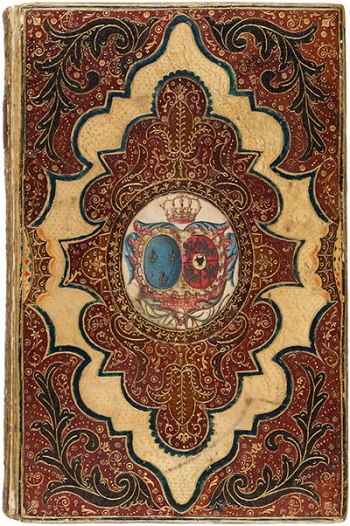
Binding by Jacques-Antoine Derome for Marie Leczinska, with the queen’s arms under mica. Le Pseautier de David, traduit en francois, avec des notes courtes, tirées de S. Augustin, & des autres Peres. Nouvelle edition, Paris: Chez Louis Josse et Charles Robustel, 1725. W 1028.
In the spring of 2019 Jayne Wrightsman bequeathed to the Morgan an exceptional collection of books bound for the highest echelons of 18th-century French society. Owned by kings, queens, dukes, and duchesses, the books are monuments of fine printing, elegant engraved illustration, and artistic binding by the most renowned craftspeople. Elaborately decorated bookbindings provided a canvas for an individual to signal their wealth and taste through bookbinders who reflected the trends and developments in contemporary artistic styles.
The books on display showcase the important role women—such as Madame Adélaïde (daughter of King Louis XV) and Queen Marie-Antoinette—had as book owners and collectors. Book illustrations by François Boucher, Jean-Baptiste Oudry, and Charles-Nicolas Cochin capture the visual ethos of the 18th century, while the artisan binders (male and female) at the workshops of Luc-Antoine Boyet, Antoine-Michel Padeloup, Nicolas-Denis Derome, and others produced bindings worthy of the shelves at Versailles. This exhibition honors Mrs. Wrightsman’s gift and her collecting acumen in recognizing the important role bookbinding played in the decorative arts and the cultural life of the Ancien Régime.
Bound for Versailles: The Jayne Wrightsman Bookbindings Collection is made possible with support from the Jamie and Maisie Houghton Fund and the Parker Gilbert Fund, and with assistance from the Malcolm Hewitt Wiener Foundation.
Exhibition | Bibiena Drawings from the Jules Fisher Collection
Opening in May at The Morgan:
Architecture, Theater, and Fantasy: Bibiena Drawings from the Jules Fisher Collection
The Morgan Library & Museum, New York, 28 May — 12 September 2021
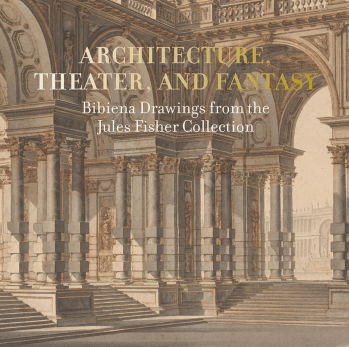 For nearly a century, members of three generations of the Bibiena family were the most highly sought theater designers in Europe. Their elaborate stage designs were used for operas, festivals, and courtly performances across Europe: from their native Italy to cites as far afield as Vienna, Prague, Stockholm, St. Petersburg, and Lisbon. Beyond these performances, the distinctive Bibiena style survives through their remarkable drawings. This exhibition is the first in the United States in over thirty years to celebrate these talented draftsmen and marks the promised gift to the Morgan of a group of Bibiena drawings from the collection of Jules Fisher, the Tony-winning lighting designer. These drawings demonstrate the range of the Bibienas’ output, from energetic sketches to highly finished watercolors. With representations of imagined palace interiors and lavish illusionistic architecture, this group of drawings will highlight the visual splendor of the baroque stage.
Arnold Aronson, Diane Kelder, John Marciari, and Laurel Peterson, Architecture, Theater, and Fantasy: Bibiena Drawings from the Jules Fisher Collection (London: Paul Holberton, 2021), 96 pages, ISBN: 978-1913645045, £17 / $25.
Arnold Aronson is professor of theatre in the MFA Theatre Program at the Columbia University School of the Arts. Diane Kelder is professor emerita of art history at the Graduate Center, CUNY, and consulting curator of the Fisher collection. John Marciari is the Charles W. Engelhard Curator of Drawings and Prints and curatorial chair at the Morgan Library & Museum. Laurel Peterson, formerly the Moore Curatorial Fellow at the Morgan Library & Museum, is an independent scholar.
Online Seminar | Robert Pogue Harrison and Susan Stewart
Coming up from BGC:
Seminar in Epistemologies of Material Culture with Robert Pogue Harrison and Susan Stewart
Online, Bard Graduate Center, Wednesday, 14 April 2021, 6–7.30pm
Robert Pogue Harrison and Susan Stewart will present at the Seminar in Epistemologies of Material Culture. They will each speak briefly on their publications The Dominion of the Dead and The Ruin Lesson, respectively, followed by a conversation moderated by Peter N. Miller and a Q&A session. Held via Zoom, this event will be live with automatic captions. A link will be circulated to registrants by 3pm on the day of the event. Register here.
◊ ◊ ◊ ◊ ◊
Robert Pogue Harrison, The Dominion of the Dead
 How do the living maintain relations to the dead? Why do we bury people when they die? And what is at stake when we do? In The Dominion of the Dead, Robert Pogue Harrison considers the supreme importance of these questions to Western civilization, exploring the many places where the dead cohabit the world of the living—the graves, images, literature, architecture, and monuments that house the dead in their afterlife among us.
This elegantly conceived work devotes particular attention to the practice of burial. Harrison contends that we bury our dead to humanize the lands where we build our present and imagine our future. As long as the dead are interred in graves and tombs, they never truly depart from this world, but remain, if only symbolically, among the living. Spanning a broad range of examples, from the graves of our first human ancestors to the empty tomb of the Gospels to the Vietnam Veterans Memorial, Harrison also considers the authority of predecessors in both modern and premodern societies. Through inspired readings of major writers and thinkers such as Vico, Virgil, Dante, Pater, Nietzsche, Heidegger, and Rilke, he argues that the buried dead form an essential foundation where future generations can retrieve their past, while burial grounds provide an important bedrock where past generations can preserve their legacy for the unborn.
The Dominion of the Dead is a profound meditation on how the thought of death shapes the communion of the living. A work of enormous scope, intellect, and imagination, this book will speak to all who have suffered grief and loss.
Robert Pogue Harrison is the Rosina Pierotti Professor in Italian Literature and chairs the Department of French and Italian at Stanford University. He is the author of The Body of Beatrice, Forests: The Shadow of Civilization, The Dominion of the Dead, Gardens: An Essay on the Human Condition, and Juvenescence: A Cultural History of Our Age, the latter three published by the University of Chicago Press. He is a member of the American Academy of Arts and Sciences. He is also host of the radio program Entitled Opinions on Stanford’s station KZSU 90.1.
◊ ◊ ◊ ◊ ◊
Susan Stewart, The Ruins Lesson: Meaning and Material in Western Culture
 How have ruins become so valued in Western culture and so central to our art and literature? Covering a vast chronological and geographical range, from ancient Egyptian inscriptions to twentieth-century memorials, Susan Stewart seeks to answer this question as she traces the appeal of ruins and ruins images, and the lessons that writers and artists have drawn from their haunting forms.
Stewart takes us on a sweeping journey through founding legends of broken covenants and original sin, the Christian appropriation of the classical past, and images of decay in early modern allegory. Stewart looks in depth at the works of Goethe, Piranesi, Blake, and Wordsworth, each of whom found in ruins a means of reinventing his art. Lively and engaging, The Ruins Lesson ultimately asks what can resist ruination—and finds in the self-transforming, ever-fleeting practices of language and thought a clue to what might truly endure.
Susan Stewart, the Avalon Foundation University Professor in the Humanities at Princeton University, is a poet, critic, and translator. A former MacArthur Fellow and Chancellor of the Academy of American poets, she is the author of six books of poems, including Columbarium, which won the National Book Critics Circle Award, and, most recently, Cinder: New and Selected Poems. Her many prose works include On Longing, Poetry and the Fate of the Senses, The Open Studio: Essays in Art and Aesthetics, and The Poet’s Freedom.
New Book | Craft: An American History
From Bloomsbury:
Glenn Adamson, Craft: An American History (London: Bloomsbury Publishing: 2021), 400 pages, ISBN: 978-1635574586, $30.
 A groundbreaking and endlessly surprising history of how artisans created America, from the nation’s origins to the present day.
At the center of the United States’ economic and social development, according to conventional wisdom, are industry and technology-while craftspeople and handmade objects are relegated to a bygone past. Renowned historian Glenn Adamson turns that narrative on its head in this innovative account, revealing makers’ central role in shaping America’s identity. Examine any phase of the nation’s struggle to define itself, and artisans are there—from the silversmith Paul Revere and the revolutionary carpenters and blacksmiths who hurled tea into Boston Harbor, to today’s ‘maker movement’, from Mother Jones to Rosie the Riveter, from Betsy Ross to Rosa Parks, from suffrage banners to the AIDS Quilt.
Adamson shows that craft has long been implicated in debates around equality, education, and class. Artisanship has often been a site of resistance for oppressed people, such as enslaved African-Americans whose skilled labor might confer hard-won agency under bondage, or the Native American makers who adapted traditional arts into statements of modernity. Theirs are among the array of memorable portraits of Americans both celebrated and unfamiliar in this richly peopled book. As Adamson argues, these artisans’ stories speak to our collective striving toward a more perfect union. From the beginning, America had to be-and still remains to be-crafted.
Glenn Adamson’s books include Fewer, Better Things, The Invention of Craft, and The Craft Reader. His writings have also been published in museum catalogues and in Art in America, Antiques, Frieze, and other periodicals. He was previously director of the Museum of Arts and Design, New York, and has held appointments as Senior Scholar at the Yale Center for British Art, and as Head of Research at the Victoria and Albert Museum, London. He lives in the Hudson Valley, New York.
C O N T E N T S
Introduction
1 The Artisan Republic
2 A Self-Made Nation
3 Learn Trades or Die
4 A More Perfect Union
5 American
6 Making War
7 Declarations of Independence
8 Cut and Paste
9 Can Craft Save America?
Acknowledgments
Notes
Index
Louvre Collection Online
As reported by the Agence France-Presse (26 March 2021), via Art Daily:
The Louvre museum in Paris said Friday it has put nearly half a million items from its collection online for the public to visit free of charge. As part of a major revamp of its online presence, the world’s most-visited museum has created a new database of 482,000 items at collections.louvre.fr with more than three-quarters already labelled with information and pictures.
It comes after a year of pandemic-related shutdowns that has seen an explosion in visits to its main website, louvre.fr, which has also been given a major makeover. . .
The full AFP story is available here»

New Book | Prose of the World: Denis Diderot
From Stanford UP:
Hans Ulrich Gumbrecht, Prose of the World: Denis Diderot and the Periphery of Enlightenment (Stanford: Stanford University Press, 2021), 280 pages, ISBN: 978-1503615250, $35.
 Philosopher, translator, novelist, art critic, and editor of the Encyclopédie, Denis Diderot was one of the liveliest figures of the Enlightenment. But how might we delineate the contours of his diverse oeuvre, which, unlike the works of his contemporaries, Voltaire, Rousseau, Schiller, Kant, or Hume, is clearly characterized by a centrifugal dynamic? Taking Hegel’s fascinated irritation with Diderot’s work as a starting point, Hans Ulrich Gumbrecht explores the question of this extraordinary intellectual’s place in the legacy of the eighteenth century. While Diderot shared most of the concerns typically attributed to his time, the ways in which he coped with them do not fully correspond to what we consider Enlightenment thought. Conjuring scenes from Diderot’s by turns turbulent and quiet life, offering close readings of several key books, and probing the motif of a tension between physical perception and conceptual experience, Gumbrecht demonstrates how Diderot belonged to a vivid intellectual periphery that included protagonists such as Lichtenberg, Goya, and Mozart. With this provocative and elegant work, he elaborates the existential preoccupations of this periphery, revealing the way they speak to us today.
Hans Ulrich Gumbrecht is the Albert Guérard Professor in Literature Emeritus at Stanford University. His books written in English include In 1926 (1998), Production of Presence (Stanford, 2004), In Praise of Athletic Beauty (2006), Atmosphere, Mood, Stimmung (Stanford, 2012), After 1945 (Stanford, 2013), and Our Broad Present (2014).
New Book | Speculative Enterprise
From the University of Virginia Press:
Mattie Burkert, Speculative Enterprise: Public Theaters and Financial Markets in London, 1688–1763 (Charlottesville: University of Virginia Press, 2021), 296 pages, ISBN 978-0813945958 (cloth), $95 / ISBN 978-0813945972 (ebook), $30 / ISBN 978-0813945965 (paper), $40.
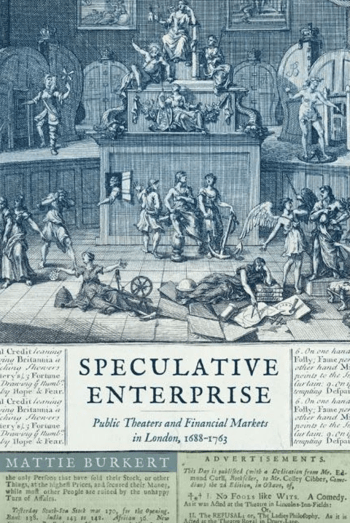 In the wake of the 1688 revolution, England’s transition to financial capitalism accelerated dramatically. Londoners witnessed the rise of credit-based currencies, securities markets, speculative bubbles, insurance schemes, and lotteries. Many understood these phenomena in terms shaped by their experience with another risky venture at the heart of London life: the public theater. Speculative Enterprise traces the links these observers drew between the operations of Drury Lane and Exchange Alley, including their hypercommercialism, dependence on collective opinion, and accessibility to people of different classes and genders.
Mattie Burkert identifies a discursive ‘theater-finance nexus’ at work in plays by Colley Cibber, Richard Steele, and Susanna Centlivre as well as in the vibrant eighteenth-century media landscape. As Burkert demonstrates, the stock market and the entertainment industry were recognized as deeply interconnected institutions that, when considered together, illuminated the nature of the public more broadly and gave rise to new modes of publicity and resistance. In telling this story, Speculative Enterprise combines methods from literary studies, theater and performance history, media theory, and work on print and material culture to provide a fresh understanding of the centrality of theater to public life in eighteenth-century London.
Mattie Burkert is Assistant Professor of English at the University of Oregon.
New Book | Wanstead House: East London’s Lost Palace
It’s not schedule to be published until next spring, but pre-order sales will help fund production costs; and if you use the code WANSTEAD40 at checkout, you’ll receive a 40% discount. So, order now! From Historic England and Liverpool University Press:
Hannah Armstrong, Wanstead House: East London’s Lost Palace (Liverpool: Liverpool University Press, 2022), 224 pages, ISBN: 978-1800856097, £45.
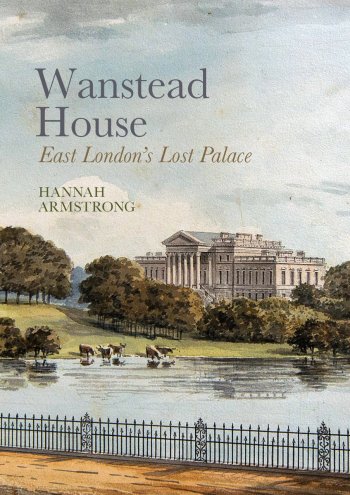 In c.1713, Sir Richard Child, heir to a mercantile fortune, commissioned Colen Campbell, to build Wanstead House, “one of the noblest houses, not only in England, but in Europe.” Campbell’s innovative classical façade was widely influential and sowed the seeds for English Palladianism. Its opulent interior by William Kent was equal to Kensington Palace and its extensive gardens were attributed to leading landscape designers George London and Humphry Repton. Wanstead’s glory days came to an end in 1822, when a major sale of its contents was arranged to pay off financial debts. Two years later the house was demolished, its building fabric dispersed far and wide. A large crater on an east London golf course is all that remains of this once ‘princely mansion’.
Wanstead House: East London’s Lost Palace provides the first illustrated history of the lost Georgian estate, charting the meteoric rise and fall of the Child dynasty. By restoring Wanstead’s reputation amongst the leading houses of the era, this book demonstrates that those lost in actuality, should by no means be lost to history.
Hannah Armstrong completed her PhD at Birkbeck College, University of London, having previously studied at the University of Glasgow, where she graduated with a Masters with Distinction in Decorative Arts and Design History. In 2012, Hannah Armstrong was awarded the Anne Christopherson Fellowship at the British Museum’s Prints and Drawings department. She lives in South West London.
◊ ◊ ◊ ◊ ◊
Note (added 25 March 2021) — The original posting did not include the discount code.
Exhibition | Taming the Tongue in the Heyday of English Grammar
From the press release for the exhibition:
Taming the Tongue in the Heyday of English Grammar, 1711–1851
The Grolier Club, New York, 4 March — 15 May 2021
 The exhibition Taming the Tongue in the Heyday of English Grammar (1711–1851), is on display March 4 through May 15, 2021, at the Grolier Club. It offers a revelatory glimpse into a time when English grammar was taught and studied with a grim fervor unthinkable to us now. Sales of books on grammar were second only to those of the Bible. The subject was so serious that grammar books, when illustrated, often showed pictures of children being caned or whipped, perhaps for sins such as dangling their participles.
Some grammarians offered beautiful tributes to the language; others came for battle, armed with claims of invincibility against allegedly incompetent rivals. This exhibition tells the colorful story of these books and the extraordinary characters who wrote them. Highlights from the English-grammar collection of Bryan A. Garner, a grammarian, lexicographer, law professor, and Grolier member, are on view in the second-floor gallery.
The exhibition also explores issues central to our literary history. For instance, it sheds new light on the rivalry between Noah Webster, the “father of the American dictionary,” and Lindley Murray, the “father of English grammar.” One previously unknown document connects the two men in a failed business transaction in New York—a real-estate contract that Webster breached. It helps explain how the two men came to detest each other.
There’s more:
• Elizabeth Elstob, who in 1715 wrote the first Old English grammar despite being raised by an uncle who disapproved of female education. The book is an amazing feat.
• William Cobbett, a populist politician who became a grave-robber, digging up Thomas Paine’s bones in hopes of rallying the English around political reform. Passionate about linguistic correctness, he would have gone to prison (where he often found himself), had the need arisen, in defense of his grammatical views.
• Samuel Kirkham, the best-selling grammarian who inspired Abraham Lincoln. Kirkham was also a phrenologist who bequeathed his own skull to his widow, and then to his son. His obituary began with its precise measurements.
One of the grammars, by John Comly (1808), contains the first-known (now widely repudiated) prohibition of the split infinitive. Another, by Ann Fisher (1762), first laid down the still-controversial ‘rule’ that the masculine pronoun includes the feminine.
The catalogue tells some extraordinary stories, such as the member of Congress—a Pennsylvania Whig—who in 1847 wrote a grammar filled with racial animus; the Ohio gubernatorial contender who in 1835 wrote a grammar rife with plagiarism, which helped get him booted from his church; and a cult leader who, once excommunicated, decided in 1826 to write a grammar “to liberate this important branch of science from long-received errours [sic].” Then there’s the best-selling grammar with the big-print typo on the title page: “ENGISH GRAMMAR.”
This is not your father’s grammar—nor your mother’s. It’s your great-great-great-great grandparents’ grammar. And it’s all on display at the Grolier Club, accompanied by a richly illustrated catalogue from Oak Knoll Press.
Bryan Garner, Taming the Tongue in the Heyday of English Grammar, 1711–1851 (New York: The Grolier Club, 2021), 301 pages, ISBN: 978-1605830926, $45.
An online version is available here»










 Enfilade
leave a comment