New Book | Prose of the World: Denis Diderot
From Stanford UP:
Hans Ulrich Gumbrecht, Prose of the World: Denis Diderot and the Periphery of Enlightenment (Stanford: Stanford University Press, 2021), 280 pages, ISBN: 978-1503615250, $35.
 Philosopher, translator, novelist, art critic, and editor of the Encyclopédie, Denis Diderot was one of the liveliest figures of the Enlightenment. But how might we delineate the contours of his diverse oeuvre, which, unlike the works of his contemporaries, Voltaire, Rousseau, Schiller, Kant, or Hume, is clearly characterized by a centrifugal dynamic? Taking Hegel’s fascinated irritation with Diderot’s work as a starting point, Hans Ulrich Gumbrecht explores the question of this extraordinary intellectual’s place in the legacy of the eighteenth century. While Diderot shared most of the concerns typically attributed to his time, the ways in which he coped with them do not fully correspond to what we consider Enlightenment thought. Conjuring scenes from Diderot’s by turns turbulent and quiet life, offering close readings of several key books, and probing the motif of a tension between physical perception and conceptual experience, Gumbrecht demonstrates how Diderot belonged to a vivid intellectual periphery that included protagonists such as Lichtenberg, Goya, and Mozart. With this provocative and elegant work, he elaborates the existential preoccupations of this periphery, revealing the way they speak to us today.
Hans Ulrich Gumbrecht is the Albert Guérard Professor in Literature Emeritus at Stanford University. His books written in English include In 1926 (1998), Production of Presence (Stanford, 2004), In Praise of Athletic Beauty (2006), Atmosphere, Mood, Stimmung (Stanford, 2012), After 1945 (Stanford, 2013), and Our Broad Present (2014).
New Book | Speculative Enterprise
From the University of Virginia Press:
Mattie Burkert, Speculative Enterprise: Public Theaters and Financial Markets in London, 1688–1763 (Charlottesville: University of Virginia Press, 2021), 296 pages, ISBN 978-0813945958 (cloth), $95 / ISBN 978-0813945972 (ebook), $30 / ISBN 978-0813945965 (paper), $40.
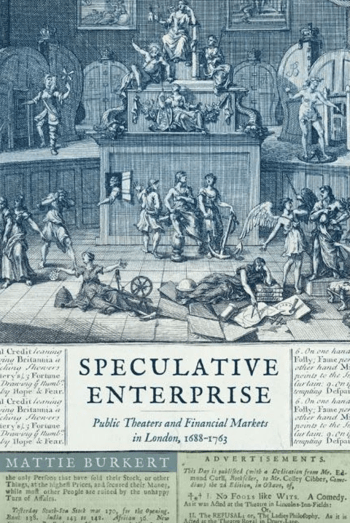 In the wake of the 1688 revolution, England’s transition to financial capitalism accelerated dramatically. Londoners witnessed the rise of credit-based currencies, securities markets, speculative bubbles, insurance schemes, and lotteries. Many understood these phenomena in terms shaped by their experience with another risky venture at the heart of London life: the public theater. Speculative Enterprise traces the links these observers drew between the operations of Drury Lane and Exchange Alley, including their hypercommercialism, dependence on collective opinion, and accessibility to people of different classes and genders.
Mattie Burkert identifies a discursive ‘theater-finance nexus’ at work in plays by Colley Cibber, Richard Steele, and Susanna Centlivre as well as in the vibrant eighteenth-century media landscape. As Burkert demonstrates, the stock market and the entertainment industry were recognized as deeply interconnected institutions that, when considered together, illuminated the nature of the public more broadly and gave rise to new modes of publicity and resistance. In telling this story, Speculative Enterprise combines methods from literary studies, theater and performance history, media theory, and work on print and material culture to provide a fresh understanding of the centrality of theater to public life in eighteenth-century London.
Mattie Burkert is Assistant Professor of English at the University of Oregon.
New Book | Wanstead House: East London’s Lost Palace
It’s not schedule to be published until next spring, but pre-order sales will help fund production costs; and if you use the code WANSTEAD40 at checkout, you’ll receive a 40% discount. So, order now! From Historic England and Liverpool University Press:
Hannah Armstrong, Wanstead House: East London’s Lost Palace (Liverpool: Liverpool University Press, 2022), 224 pages, ISBN: 978-1800856097, £45.
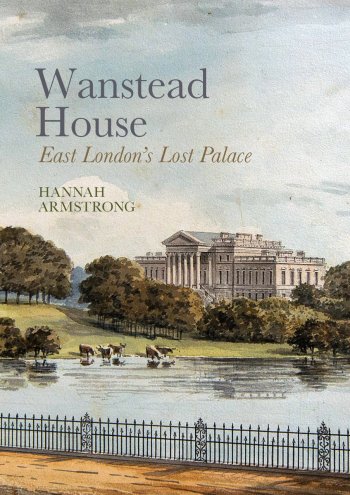 In c.1713, Sir Richard Child, heir to a mercantile fortune, commissioned Colen Campbell, to build Wanstead House, “one of the noblest houses, not only in England, but in Europe.” Campbell’s innovative classical façade was widely influential and sowed the seeds for English Palladianism. Its opulent interior by William Kent was equal to Kensington Palace and its extensive gardens were attributed to leading landscape designers George London and Humphry Repton. Wanstead’s glory days came to an end in 1822, when a major sale of its contents was arranged to pay off financial debts. Two years later the house was demolished, its building fabric dispersed far and wide. A large crater on an east London golf course is all that remains of this once ‘princely mansion’.
Wanstead House: East London’s Lost Palace provides the first illustrated history of the lost Georgian estate, charting the meteoric rise and fall of the Child dynasty. By restoring Wanstead’s reputation amongst the leading houses of the era, this book demonstrates that those lost in actuality, should by no means be lost to history.
Hannah Armstrong completed her PhD at Birkbeck College, University of London, having previously studied at the University of Glasgow, where she graduated with a Masters with Distinction in Decorative Arts and Design History. In 2012, Hannah Armstrong was awarded the Anne Christopherson Fellowship at the British Museum’s Prints and Drawings department. She lives in South West London.
◊ ◊ ◊ ◊ ◊
Note (added 25 March 2021) — The original posting did not include the discount code.
Exhibition | Taming the Tongue in the Heyday of English Grammar
From the press release for the exhibition:
Taming the Tongue in the Heyday of English Grammar, 1711–1851
The Grolier Club, New York, 4 March — 15 May 2021
 The exhibition Taming the Tongue in the Heyday of English Grammar (1711–1851), is on display March 4 through May 15, 2021, at the Grolier Club. It offers a revelatory glimpse into a time when English grammar was taught and studied with a grim fervor unthinkable to us now. Sales of books on grammar were second only to those of the Bible. The subject was so serious that grammar books, when illustrated, often showed pictures of children being caned or whipped, perhaps for sins such as dangling their participles.
Some grammarians offered beautiful tributes to the language; others came for battle, armed with claims of invincibility against allegedly incompetent rivals. This exhibition tells the colorful story of these books and the extraordinary characters who wrote them. Highlights from the English-grammar collection of Bryan A. Garner, a grammarian, lexicographer, law professor, and Grolier member, are on view in the second-floor gallery.
The exhibition also explores issues central to our literary history. For instance, it sheds new light on the rivalry between Noah Webster, the “father of the American dictionary,” and Lindley Murray, the “father of English grammar.” One previously unknown document connects the two men in a failed business transaction in New York—a real-estate contract that Webster breached. It helps explain how the two men came to detest each other.
There’s more:
• Elizabeth Elstob, who in 1715 wrote the first Old English grammar despite being raised by an uncle who disapproved of female education. The book is an amazing feat.
• William Cobbett, a populist politician who became a grave-robber, digging up Thomas Paine’s bones in hopes of rallying the English around political reform. Passionate about linguistic correctness, he would have gone to prison (where he often found himself), had the need arisen, in defense of his grammatical views.
• Samuel Kirkham, the best-selling grammarian who inspired Abraham Lincoln. Kirkham was also a phrenologist who bequeathed his own skull to his widow, and then to his son. His obituary began with its precise measurements.
One of the grammars, by John Comly (1808), contains the first-known (now widely repudiated) prohibition of the split infinitive. Another, by Ann Fisher (1762), first laid down the still-controversial ‘rule’ that the masculine pronoun includes the feminine.
The catalogue tells some extraordinary stories, such as the member of Congress—a Pennsylvania Whig—who in 1847 wrote a grammar filled with racial animus; the Ohio gubernatorial contender who in 1835 wrote a grammar rife with plagiarism, which helped get him booted from his church; and a cult leader who, once excommunicated, decided in 1826 to write a grammar “to liberate this important branch of science from long-received errours [sic].” Then there’s the best-selling grammar with the big-print typo on the title page: “ENGISH GRAMMAR.”
This is not your father’s grammar—nor your mother’s. It’s your great-great-great-great grandparents’ grammar. And it’s all on display at the Grolier Club, accompanied by a richly illustrated catalogue from Oak Knoll Press.
Bryan Garner, Taming the Tongue in the Heyday of English Grammar, 1711–1851 (New York: The Grolier Club, 2021), 301 pages, ISBN: 978-1605830926, $45.
An online version is available here»
Online Seminar | The John Evan Bedford Library of Furniture History
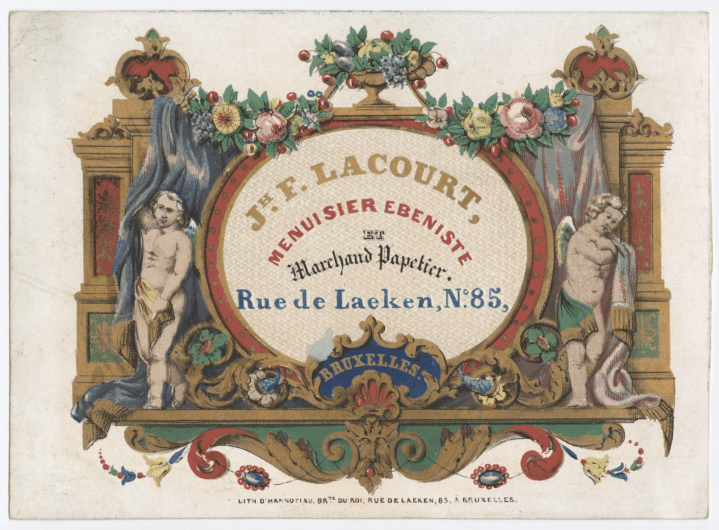
Trade Card of J. F. Lacourt (Leeds University Library, MS 2241 John Evan Bedford Library of Furniture History).
◊ ◊ ◊ ◊ ◊
From The Furniture History Society:
‘Pattern Books, Early Trade Catalogues, and Many Other Rarities’: The John Evan Bedford Library of Furniture History
The Furniture History Society Online Lecture, Wednesday, 24 March 2021, 18.00 (GMT)
Members of the Bedford project team from Special Collections at the University of Leeds will highlight some of the rare books and ephemera in the John Evan Bedford Library of Furniture History and explain more about the ambitions of the cataloguing project. Chaired by Mark Westgarth, the presentations will be followed by a discussion with the Bedford team and an opportunity to ask questions about the project.
When the art and antique dealer John Bedford died in February 2019 he gifted a remarkable collection of rare books, manuscripts, artworks, and objects to the University of Leeds. Assembled over almost half a century, the John Evan Bedford Library of Furniture History is an exceptional resource covering all aspects of the English home, from interiors and furnishings to lighting and metalwork, drapery and upholstery to architectural and garden design. Comprising over 3,000 printed items, many of them extremely rare, and in some cases unique, the collection includes furniture pattern books, designs for ornament, and inventories of country houses. The books, which also touch on household life and management, date from the seventeenth century onwards. The archive is also rich in rare ephemera including trade cards, labels, and pamphlets, many of which are unknown outside this collection. The John Victor Bedford Will Trust, with great generosity and vision, is funding a cataloguing project based in Special Collections at the University of Leeds to make the collection fully searchable and accessible.
This event is free for FHS members and £5 for non-members. If you are a non-member and would like to attend, please click here. Contact events@furniturehistorysociety.org to register interest.
Mark Westgarth is Associate Professor in Art History and Museum Studies at the University of Leeds and also Director of the Centre for the Study of the Art & Antiques Market. He has been instrumental in developing antique dealer collections at Leeds; Mark is a Council Member of the FHS.
Rhiannon Lawrence-Francis, Collections and Engagement Manager, has operational oversight of the project to catalogue the John Evan Bedford Library of Furniture History. She visited John at his Guernsey home a few weeks before he died, and planned and managed the transfer of his collection to Leeds. A medievalist by background she is responsible for the rare book collections in the University Library and has a special interest in incunabula, early modern printing, provenance, and bookbindings.
Rachel Eckersley, Rare Book Specialist, is responsible for cataloguing the pre-1851 books, researching provenance, and promoting the collection. Previously, she was a postdoctoral researcher at The Centre for the Comparative History of Print (also at Leeds), a library digitisation assistant at the Wren Library, Trinity College, Cambridge, and a research fellow in book history at Queen Mary University of London.
Rosie Dyson, Collections Officer, is currently researching trade cards and ephemera. She is undertaking work to catalogue, digitise, and repackage John’s collection of trade cards and associated ephemera and has written several articles on her findings so far. Her background is in photography and digitisation.

Illustration from Jean-Baptiste Pillement, The Ladies Amusement: Or, the Whole Art of Japanning Made Easy, second enlarged edition, ca. 1762 (Leeds University Library, MS 2241 John Evan Bedford Library of Furniture History). This is the only known complete and coloured copy.
Location of 1634 St Mary’s Fort Discovered
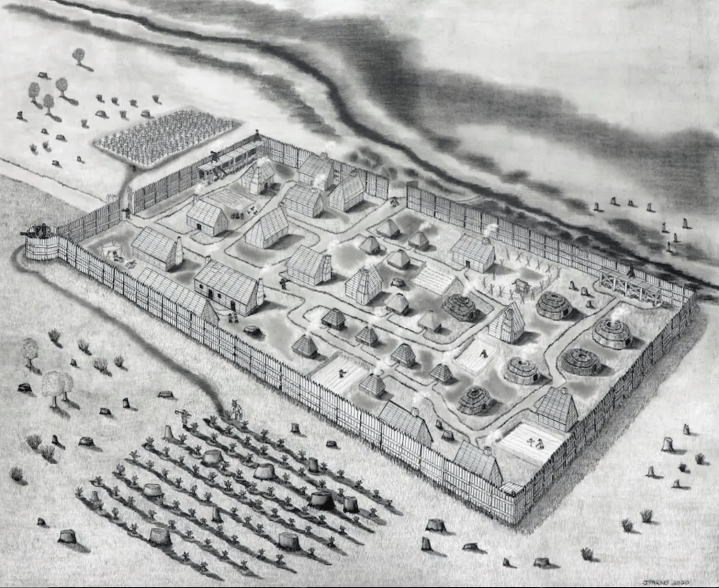
Conjectural drawing of the 1634 fort at the St. Mary’s settlement in Maryland (Jeffrey R. Parno/Historic St. Mary’s City). Interestingly, the outline of the fort does not match a 1634 description of it made by the governor, Philip Calvert.
◊ ◊ ◊ ◊ ◊
St. Mary’s City served as the capital of the Providence of Maryland until 1694, when the capital of the royal colony was moved to Annapolis. For more information on the discovery of the site of St. Mary’s Fort, see Michael Ruane’s reporting for The Washington Post. From the HSMC press release (22 March 2021). . .
In honor of Maryland Day (25 March 2021), Historic St. Mary’s City announces today that Dr. Travis Parno, Director of Research and Collections for Historic St. Mary’s City, and his team have located the site of the original St. Mary’s Fort, the 1634 palisaded fort erected by the first wave of European settlers who founded Maryland. The site, which spans an area approximately the size of a football field, is located in Historic St. Mary’s City (HSMC) in Southern Maryland.
“Finding the location of Maryland’s original settlement is truly exciting news for our state and will give us an opportunity to reconnect with our pre-colonial and early colonial years,” said Governor Larry Hogan. “The state has been proud to support the study of St. Mary’s Fort and looks forward to further excavation of the area as we approach our state’s 400th anniversary,” Governor Hogan added.
St. Mary’s Fort was the first major foothold of European settlement in the state and the fourth English colony in the country after Jamestown (1607), Plymouth (1620), and Massachusetts Bay (1630). In March of 1634, approximately 150 Maryland colonists arrived on two ships, Ark and Dove, in an area that was home to the Yaocomaco, a tribe loosely allied with the Piscataway paramount chiefdom. What little is known about this period is drawn from English colonial records. The archaeological study of St. Mary’s Fort has the potential to unearth new information about Maryland’s pre-colonial and early colonial past.
Members of the HSMC Department of Research and Collections have been conducting fieldwork within the St. Mary’s City National Historic Landmark area since 1971, but definitive traces of St. Mary’s Fort remained elusive until a 2018 grant from the Maryland Historical Trust allowed Parno to hire geophysicist Dr. Timothy J. Horsley to survey two suspected locations using magnetic susceptibility, magnetometry, and ground-penetrating radar. The results, which were verified via a brief archaeological dig, confirmed the fort’s exact location.
The study of St. Mary’s Fort is part of a larger initiative titled People to People: Exploring Native-Colonial Interactions in Early Maryland, scheduled to begin in 2021. Created as a collaborative effort between Historic St. Mary’s City and Piscataway tribal participants, the project will include archaeological excavations at St. Mary’s Fort and indigenous sites near the fort, interpretation and exhibits of native and colonial culture, and public programming about life in the region in the years prior to and during the early seventeenth century.
Parno is currently consulting with Piscataway tribal participants and other stakeholders, and excavations of St. Mary’s Fort are ongoing thanks to the support of private donors and funds provided by Governor Hogan’s office. With the support of the State, St. Mary’s Fort will be integrated into Historic St. Mary’s City’s living history program in time for the state’s 400th anniversary in 2034. In the meantime, the excavation site is open during public visitation hours.
A formal online announcement will premiere 25 March 2021, at 7pm (EST) on the HSMC Maryland Day event page. No registration needed; the premiere will be free and open to the public.
New Book | Utamaro and the Spectacle of Beauty
This new, expanded paperback edition is distributed in North and South America by The U. of Chicago Press:
Julie Nelson Davis, Utamaro and the Spectacle of Beauty (London: Reaktion Books, 2021), 296 pages, ISBN: 978-1789142358, $40.
 Japanese artist Kitagawa Utamaro (1753–1806) was one of the most influential artists working in the genre of ukiyo-e, ‘pictures of the floating world’, in late eighteenth-century Japan, and was widely appreciated for his prints of beautiful women. In 1804, at the height of his success, Utamaro published a set of prints related to a banned historical novel. The prints, titled Hideyoshi and his Five Concubines, depicted the military ruler Toyotomi Hideyoshi’s wife and concubines, and consequently, he was accused of insulting Hideyoshi’s dignity. Utamaro was sentenced to be handcuffed for fifty days and is thought to have been briefly imprisoned. According to some sources, the experience crushed him emotionally and ended his career as an artist.
In this new expanded edition, Julie Nelson Davis draws on a wide range of period sources, makes a close study of selected print sets, and reinterprets Utamaro in the context of his times. Reconstructing the place of the ukiyo-e artist within the commercial print market, she demonstrates how Utamaro’s images participated in a larger spectacle of beauty in the city of Edo (present-day Tokyo).
Julie Nelson Davis is associate professor of East Asian art in the Department of Art History at the University of Pennsylvania. She is the author of Dramatic Impressions: Japanese Theater Prints from the Gilbert Luber Collection.
C O N T E N T S
Introduction: Utamaro, Ukiyo-e, and the City of Prints
1 Constructing the Artist Known as Utamaro
2 ‘Pictures of Beauties’ and Other Social Physiognomies
3 Behind the Brocade and Other Yoshiwara Illusions
4 Utamaro and the Feminine Spectacle
5 Making History into the Pageant of the Floating World
References
Works Cited
Acknowledgements
List of Illustrations
Index
Exhibition | Yinka Shonibare CBE: End of Empire

Yinka Shonibare CBE, End of Empire, 2016; fiberglass mannequins, Dutch wax printed cotton textile, metal, wood, motor, globes, and leather; 116 × 201 × 39 inches.
◊ ◊ ◊ ◊ ◊
Opening this spring at the Museum der Moderne:
Yinka Shonibare CBE: End of Empire
Museum der Moderne, Salzburg, 22 May — 12 September 2021
Curated by Thorsten Sadowsky and Marijana Schneider
One of the most prominent and versatile artists working in the UK today, Yinka Shonibare CBE (b. London, 1962) makes work that scrutinizes the legacy of Western colonialism and its lingering traces. The British-Nigerian artist rose to renown with installations featuring headless life-sized figures in historic costumes tailored out of colorful batik-dyed fabrics. A self-described ‘postcolonial hybrid’, Shonibare zooms in on episodes from art and history, primarily from eighteenth- and nineteenth-century Europe, employing subversive creative strategies to visualize them in tragicomic scenes of human activity. Shonibare’s multimedia oeuvre probes constructions of race, class, and national and cultural identities through a sustained study of the historic interdependencies between Africa and Europe. The retrospective gathers ca. sixty works from the past thirty years.
The catalogue is distributed in North American by The University of Chicago Press:
Thorsten Sadowsky, ed., Yinka Shonibare CBE: End of Empire (Munich: Hirmer Publishers, 2021), 256 pages, ISBN: 978-3777435893, $45.
 Since the 1990s, the British-Nigerian artist Yinka Shonibare CBE has developed opulently executed sculptures and installations, colorful collages, and theatrically staged photographs and films. The signature material in Yinka Shonibare’s multimedia artworks, so-called African fabric, is a cipher. Originally produced in Manchester and intended for sale in Indonesia, the brightly colored fabric gained its name after British imperialists shifted their focus to colonial Africa. Featuring this product of both colonization and self-identification, Shonibare’s sculptures and installations revisit the conflicted legacy of many historical artifacts in order to explore the complex hybridity of postcolonial life with unique irony. Illustrated by two hundred full-color reproductions of his work, Yinka Shonibare CBE: End of Empire offers an up-close encounter with the tensions and history that motivate this singular artist, tracing colonialism and its consequences for leaders, worldviews, and body images in his oeuvre.
Thorsten Sadowsky is director of the Museum der Moderne in Salzburg, Austria.
Online | Art Museums and the Legacies of the Dutch Slave Trade
Presented by the Center for Netherlandish Art at the Museum of Fine Arts, Boston, the Harvard Art Museums, and Harvard University’s Department of History of Art and Architecture:
Art Museums and the Legacies of the Dutch Slave Trade: Curating Histories, Envisioning Futures
Online conference in four parts: 9–23 April 2021
Organized by Sarah Mallory, Kéla Jackson, and Rachel Burke, together with Joanna Sheers Seidenstein
Registration is now open for the conference Art Museums and the Legacies of the Dutch Slave Trade: Curating Histories, Envisioning Futures, presented by the Center for Netherlandish Art at the Museum of Fine Arts, Boston, the Harvard Art Museums, and Harvard University’s Department of History of Art and Architecture. This four-partprogram explores efforts by art museums to deploy their spaces and their collections—which are often enmeshed with colonialism and exploitation—to present more complete narratives of and perspectives on slavery and its legacies. This conference is organized by Sarah Mallory, Kéla Jackson, and Rachel Burke, all doctoral students in Harvard University’s Department of History of Art and Architecture, and Joanna Sheers Seidenstein, the Stanley H. Durwood Foundation Curatorial Fellow in the Division of European and American Art, at the Harvard Art Museums. We hope you will attend!
◊ ◊ ◊ ◊ ◊
Part 1 | Exhibiting Slavery and Representing Black Lives
Friday, 9 April 2021, 1–3pm EST
Curators will discuss their work on groundbreaking projects in the Netherlands and the United States, namely the Rijksmuseum’s current Slavery exhibition, the Rembrandthuis Museum’s exhibition Here: Black in Rembrandt’s Time, the Los Angeles County Museum of Art’s reinstallation of its permanent collection, and the Museums Are Not Neutral initiative. They will reflect on the broader call for museums to recognize the relationship of their collections to slavery and to present-day racial injustice. Speakers include Maria Holtrop (Curator of History, Rijksmuseum), Stephanie Archangel (Junior Curator, History Department, Rijksmuseum), Diva Zumaya (Assistant Curator, European Painting and Sculpture, Los Angeles County Museum of Art), and La Tanya S. Autry (cultural organizer, co-producer of Museums Are Not Neutral, founder of the Black Liberation Center, and independent curator).
For more information and to register, please click here»
◊ ◊ ◊ ◊ ◊
Part 2 | De-centering/Re-centering: Forging New Museological and Historical Narratives
Friday, 16 April 2021, 1–3 pm EST
This session brings together historians and art historians whose work has, on the one hand, been grounded in art museum collections and, on the other, challenged traditional museological narratives of slavery’s legacies in the Netherlands and the Americas. Speakers include Vincent Brown (Charles Warren Professor of American History, Professor of African and African American Studies, and Founding Director of the History Design Studio, Harvard University), Pepijn Brandon (Assistant Professor of Economic and Social History, Vrije Universiteit Amsterdam, and Senior Researcher, International Institute of Social History), Elmer Kolfin (Assistant Professor, University of Amsterdam), and Claudia Swan (Mark Steinberg Weil Professor of Art History & Archaeology, Washington University in St. Louis).
For more information and to register, please click here»
◊ ◊ ◊ ◊ ◊
Part 3 | History, Memory, and Legacy: Jamaica Kincaid, Rosana Paulino, and Cheryl Finley in Conversation
Friday, 23 April 2021, 11am–noon EST
Renowned writer Jamaica Kincaid and groundbreaking visual artist Rosana Paulino will discuss their explorations of the legacies of slavery in their work. They will be joined in conversation by eminent art historian Cheryl Finley.
For more information and to register, please click here»
◊ ◊ ◊ ◊ ◊
Part 4 | The Work of Objects: Interpretation within and beyond Museum Walls
Friday, 23 April 2021, 1– 2:30pm EST
This session includes brief talks, followed by a roundtable discussion, by academics and museum professionals who focus on Dutch and American art and history. Speakers will discuss specific objects—ranging from the 17th to the 21st century—that have posed interpretive and museological challenges. They will also present new possibilities for considering the relationship between slavery’s past and present-day racial injustice. Speakers include Justin Brown (Ph.D. candidate, Department of the History of Art, Yale University), Ana Lucia Araujo (Full Professor and Associate Chair, Department of History, Howard University), Makeda Best (Richard L. Menschel Curator of Photography, Harvard Art Museums), Nancy Jouwe (Chairwoman, BAK [basis voor actuele kunst] Supervisory Board, Utrecht; co-founder, Framer Framed; and co-founder, Mapping Slavery), Imara Limon (Curator, Amsterdam Museum), Adam Tessier (Barbara and Theodore Alfond Director of Interpretation, Museum of Fine Arts, Boston), and Lea van der Vinde (Curator, Royal Picture Gallery Mauritshuis).
For more information and to register, please click here»
Online Conference | Relics and the Arts between Europe and America
From ArtHist.net:
Relics and the Arts between Europe and America: Debating Shared Histories
Reliquias y arte entre Europa y América: historias compartidas a debatir
Online, Universidad de los Andes UNIANDES, Bogotá, Colombia, 12–14 April 2021
Registration due by 8 April 2021
 This international conference is the first to address relics from a transatlantic perspective. It aims to explore art historical issues regarding relics and reliquaries in the early modern period in the Iberian world. By bringing together papers that deal both with the Iberian Peninsula and Latin America, we also wish to provide a forum for wider discussion and debate regarding the presumed ‘shared histories’ of these territories as far as concerns relics and reliquaries, objects which are as peculiar as they are inextricably tied to the Catholic societies of this age. Papers will be in English and Spanish.
This free conference is open to academics and professionals. Please register at the conference website. Note that the times are for Columbia (5 hours behind GMT).
Organización
• Luisa Elena Alcalá (Universidad Autónoma de Madrid, España)
• Juan Luis González García (Universidad Autónoma de Madrid, España)
• Patricia Zalamea Fajardo (Universidad de los Andes, Colombia)
Comité científico
• María Berbara (Universidade do Estado do Rio de Janeiro, Brasil)
• Carmen Fernández-Salvador Ayala (Universidad San Francisco de Quito, Ecuador)
• Escardiel González Estévez (Universidad de Sevilla, España)
• Cécile Vincent-Cassy, (Université Sorbonne Paris Nord, Francia)
L U N E S , 1 2 A B R I L 2 0 2 1
8:30 Inauguración y bienvenida. Patricia Zalamea (Decana), Universidad de los Andes
Presentación del Proyecto “Spolia Sancta,” a cargo de Luisa Elena Alcalá (UAM) y Juan Luis González García (UAM)
8.40 Primera sesión: Reliquias e imágenes-reliquia
Moderan: Juan Luis González García y Luisa Elena Alcalá
• Imagen-reliquia o imágenes y reliquias en la Nueva España: funciones y funcionamientos propios y compartidos — Patricia Díaz Cayeros, Universidad Nacional Autónoma de México
• Divine Fragments: Image-Relics in Spanish America — Cristina Cruz González, Oklahoma State University (EEUU)
• El poder de la mirada. El caso de la Virgen del Lledó y otras imágenes-reliquia — María Elvira Mocholí Martínez, Universitat de València (España)
• Francisco de Holanda: reliquia, icono, retrato — José Riello, Universidad Autónoma de Madrid (España)
• Relics and Miraculous Images in Early Modern Spain and Latin America: Religious Responses to the Plague of Locusts — Milena Viceconte, Università degli Studi di Napoli ‘Federico II’ (Italia)
11.30 Segunda sesión. Mapas de circulación
Modera: Cécile Vincent-Cassy
• Presencia y amplificación del lignum crucis en el Virreinato del Perú: elaboraciones visuales y escritas para la construcción de lo sagrado — Agustina Rodríguez Romero, UNTREF-CONICET, Buenos Aires (Argentina)
• Auge y desaparición de las reliquias en Tunja. El altar relicario de la Soledad en la iglesia de los Jesuitas, 1655–1854 — Abel Fernando Martínez Martín (Universidad Pedagógica y Tecnológica de Colombia, Tunja) y Andrés Ricardo Otálora Cascante (Universidad Nacional de Colombia, Bogotá)
• Presencia de corpi santi en México: análisis del proceso de circulación y materialidad de un relicario. Siglos XVIII–XIX — Gabriela Sánchez Reyes, Coordinación Nacional de Monumentos Históricos-INAH (México). Doctoranda en El Colegio de Michoacán. (México)
M A R T E S , 1 3 A B R I L 2 0 2 1
8.30 Tercera sesión. Reliquias e identidad local: éxitos y fracasos
Modera: Patricia Zalamea Fajardo
• Reliquias e identidades en el virreinato del Perú (siglos XVI–XVII) — María Cruz de Carlos Varona, Universidad Autónoma de Madrid (España)
• Tras las huellas de los mártires, santos y hombres insignes. Bosquejo sobre las reliquias de la iglesia catedral metropolitana de Lima (siglos XVI–XIX) — Jesús Alfaro Cruz, Universidad Nacional Autónoma de México
• La memoria perdida de los Santos Mártires de Cardeña en San Juan de Puerto Rico (1664–presente) — María Judith Feliciano, Independent Scholar, Nueva York (EEUU)
10.15 Cuarta sesión. Relicarios y lenguajes artísticos
Modera: Escardiel González Estévez
• A Paper Journey into a Sacred World: The Transmission of Manual Manifestations of Devotion in New World Convents — Yessica Porras, University of California, Berkeley (EEUU)
• Los relicarios de la Iglesia de San Ignacio en Bogotá — María Constanza Villalobos, Investigadora Independiente, Bogotá
• Capilla, oratorio, tesoro: algunas reflexiones en torno al relicario como espacio de íntima oración — Elsaris Nuñez Méndez, IIE, Universidad Nacional Autónoma de México
• Envolviendo la (in)tangible sacralidad: el retablo de la Virgen del Pilar de Quito — Carmen Fernández-Salvador Ayala, Universidad San Francisco de Quito (Ecuador)
M I É R C O L E S , 1 4 A B R I L 2 0 2 1
8.30 Quinta sesión. Reliquias y sus controversias: ortodoxia / heterodoxia
Moderan: Maria Berbara y Carmen Fernández-Salvador
• Reliquias del cielo: Las cuentas de Estefanía de la Encarnación y el problema de la ortodoxia — Tanya J. Tiffany, University of Wisconsin-Milwaukee (EEUU)
• Reliquiae maioris y reliquiae minoris. Circulación, uso y censura de reliquias en el Nuevo Reino de Granada, siglos XVI–XVIII — María Cristina Pérez Pérez, Universidad Externado de Colombia, Bogotá
• Reliquia, conversión y sometimiento. Apuntes sobre la reliquia de Pedro Claver y su función como objeto de evangelización e identidad — Darío Velandia, Uniandes, Bogotá
• Heads to Adore, Heads to Horrify — Jens Baumgarten, Universidade Federal de São Paulo (Brasil)
• Reliquaries as Nodal Objects in Transcultural Negotiation Processes — Urte Krass, Institute for Art History, Universität Bern (Suiza)
11:30 Visita virtual al Museo Colonial, Bogotá
13:00 Conclusiones y cierre










 Enfilade
leave a comment