New Book | She Being Dead Yet Speaketh
Distributed by The University of Chicago Press:
Mary Franklin and Hannah Burton, She Being Dead Yet Speaketh: The Franklin Family Papers, edited by Vera Camden (Toronto: Iter Press, 2020), 349 pages, ISBN: 978-0866986236, $60.
 On Black Bartholomew’s Day—August 24, 1662—nearly two thousand ministers denied the authority of the Church of England and were subsequently removed from their posts. Mary Franklin was the wife of Presbyterian minister Robert Franklin, one of the dissenting ministers ejected from their pulpits and their livings on that day. She recorded the experience of her persecution in the unused pages of her husband’s sermon notebook. In 1782—some hundred years after the composition of her grandmother’s narrative— Mary’s granddaughter, Hannah Burton, took up this same notebook to chronicle her experience as an impoverished widow, barely surviving the economic revolutions of eighteenth-century London. Collected for the first time, this volume of the Franklin Family Papers offers rare insight into the personal lives of three generations of dissenting women.
The Other Voice in Early Modern Europe: The Toronto Series, 71
Mary Franklin (d. 1711) was the wife of an English Presbyterian minister.
Hannah Burton (1723–1786) was the granddaughter of Mary and Robert Franklin and the wife of a London goldsmith.
Vera J. Camden is professor of English at Kent State University, training and supervising analyst at the Cleveland Psychoanalytic Center, and assistant clinical professor of psychiatry at Case Western Reserve University. She is associate editor of American Imago and American editor of the Journal of Graphic Novels and Comics.
C O N T E N T S
Acknowledgments
Illustrations
Abbreviations
Introduction
Mary Franklin (d. 1711)
The Notebook of Mary Franklin (ca. 1685)
The Experience of Mary Franklin (ca. 1689–90)
The Prison Correspondence of Mary and Robert Franklin (1670)
The Last Will and Testament of Mary Franklin (1709, probated 1711)
Hannah Burton (1723–1786)
The Diary of Hannah Burton (1782)
Appendix 1: The Funeral Sermon for Mary Franklin
• The Dissolution of the Earthly House of this Tabernacle (1713)
Appendix 2: Letters
• The Letters of Ralph Snow (1691)
• The Letter of William Bailey to Joshua Wilson (1817)
Appendix 3: Probated Wills
• The Last Will and Testament of Walter Boddington (1734, probated 1736)
• The Last Will and Testament of William Burton (1777, probated 1781)
Bibliography
Index
Call for Papers | Figures of Widows

Jean-Baptiste Greuze, The Widow Receiving Her Priest Surrounded by Her Children , 1784, oil on canvas, 50 × 63 inches
(Saint Petersburg: Hermitage Museum)
◊ ◊ ◊ ◊ ◊
The Call for Papers for this GRHAM Study Day, via ArtHist.net, where the French version is also available:
Widows in the 17th and 18th Centuries: Images of Social Status—Accepted, Hidden, Claimed?
Figures de veuves à l’époque moderne (XVIIe et XVIIIe siècles): Images d’un statut social accepté, caché, revendiqué?
INHA (Institut National d’Histoire de l’Art), Galerie Colbert, Paris, 15 June 2021
Proposals due by 15 March 2021
Woman and widow under the Ancien Régime? The images defining a woman abound, should they describe a seductive woman, an influential or a common one. However, the images that could characterize the widow remain vague. As a matter of fact, the widow is defined essentially in negative terms; a widow is ‘the one who has lost her husband’ [1]. The social status imposed by widowhood is considered less favorable than that of a married woman, the Dictionnaire de Trévoux specifying that ‘a widow mourns her husband, not so much for her loss, but mostly because she is deprived of the rank she held and the consideration she benefited from’ [2]. This could lead her to condemnable behaviors: ‘The widow often subtracts and conceals her husband’s most beautiful furniture’ [3]. Opposite to this unattractive vision, however, widowhood seems then to offer to women a freedom that neither daughters nor wives experienced [4].
Several images arise from this contrasting portrait. The first one to appear is the widow seen through a state policy point of view such as Marie de Medici as Regent by Frans Pourbus (1613), Anne of Austria in Mourning Clothes with her Children by Philippe de Champaigne (1643) or Marie-Antoinette in the Conciergerie Prison by Alexandre Kucharski (1793). These portraits evoke in turn the woman in position of power, the patron, the arts and letters’ amateur, but also the grieving, lonely, old and fallen woman.
The widow can be portrayed in many other ways. Like Madame Godefroid, Keeper of the King’s Paintings by Jean Valade (1755), she could hold a position by succession to her late husband. She could also be the spokesperson for various passions highlighted by bourgeois drama: the sadness of Greuze’s Inconsolable Widow (1762), the melancholy of Reynolds’s Countess of Lincoln (1781), or the moral probity of Greuze’s Widow Receiving her Priest Surrounded by her Children (1782). These different aspects of widowhood revealed by the artists enable to question all the statutory references that define the widow: her mourning clothes, her attributes such as the faithful dog and her psychological characteristics which give great importance to sentimentality. The absence of some of these visual codes allows to question other widow figures for the young widow rarely remains inconsolable, as La Fontaine’s fable reminds us [5]. Under Choderlos de Laclos’ pen, the Marquise de Merteuil became even a manipulative libertine, taking full advantage of the financial autonomy and independence of mind that the widowhood offered her.
This brief panorama would be incomplete without mentioning the widow in religious paintings such as The Raising of the Son of the Widow of Naim, The Raising of Lazarus, or Agrippina Landing at Brindisi with the Ashes of Germanicus. The image of the widow is also endowed with a strong allegorical power that makes her one of the first figures in war memorials, such as the Monument for the Heart of Victor Thérèse Charpentier, Count of Ennery (1777–81).
This study day aims to question the identity of these widows—famous or unknown—in order to better understand their intellectual, political, and social influence, by finding out whether their widowhood proved to be an asset or a weakness. How did the image of the widowed woman develop during the 17th and 18th centuries? And how did it deal with the particular 18th-century rising value shaped by Rousseau’s representation of a woman as a mother dedicated to both her home and the education of her children?
This study day proposes several topics in order to better define and understand the image of the widow in the arts, not only in France but also in Europe:
• The image of the widow through her various portraits, emphasizing her political, economic, intellectual, and moral power. Were such portraits reserved only for influential women or for those who had famous husbands? Or, could they also depict women belonging to different social classes?
• The representation of the widow in history and genre painting: is she the main figure in these paintings or secondary one? In these paintings, which psychological characteristics are most often solicited? Do these descriptions reflect a widow’s specific identity?
• The destination of the image of the widow in the arts of the Ancien Régime. Are these representations kept within family confines or are they disseminated in a wider environment? If so, which are the reasons behind?
• Beyond the specific matter of representation, particular attention will be paid to widows who are also artists as well as artists’ widows. What is their place in society? What role do they play in the preservation of their husband’s artistic heritage?
• Finally, considering also the material culture, do external signs of mourning worn by widows—clothes and accessories—act as a testimony of constant imposed codes or, conversely, bear witness of an evolution, not only in fashion, but also in the way in which widows are represented?
We welcome proposals in French or English, of about 500 words, for papers addressing either broader analyses or specific case studies. Candidates are invited to attach a curriculum vitae. Submission and contact: asso.grham@gmail.com.
This study day is organized by GRHAM with the support of the Doctoral School of Art History of the University Paris 1 Panthéon-Sorbonne (ED 441) and the HiCSA (EA 4100).
[1] Antoine FURETIÈRE, Dictionnaire universel contenant généralement tous les mots françois tant vieux que modernes, & les Termes des Sciences & des Arts (La Haye, Rotterdam, Arnoud & Reinier Leers, 1701), III, See «Veuf, Veuve».
[2] Dictionnaire universel François et latin, vulgairement appelé Dictionnaire de Trévoux (Paris, Delaune, 1743), VI, See «Veuf, Veuve».
[3] FURETIÈRE, Dictionnaire, op. cit., See ‘Soustraire’.
[4] Françoise FORTUNET, «Veuves de guerre à l’époque révolutionnaire», PELLEGRIN, Nicole, WINN, Colette H. (dir.), Veufs, veuves et veuvage dans la France d’Ancien Régime (Paris, Champion, 2004), 138–39: ‘It has long been noted that widowhood was the most favorable status that a woman could have had in our old society, for it gave her a freedom ignored by daughters and wives. In theory it was known, but living examples are stronger proof’ (translated from French).
[5] Jean de LA FONTAINE, Fables choisies mises en vers (Lyon, Sarrazin, 1696, 1668), 140, CXXIV: «La perte d’un époux ne va point sans soupirs//On fait beaucoup de bruit, et puis on se console».
Call for Paper by GRHAM (Research Group in Modern art History) / Appel diffusé par les membres du bureau du GRHAM (Groupe de Recherche en Histoire de l’Art Moderne):
• Florence Fesneau (Université Paris 1 Panthéon-Sorbonne)
• Barbara Jouves-Hann (Université Paris 1 Panthéon-Sorbonne/ENS Paris-Saclay)
• Maxime Georges Métraux (Université Paris-Sorbonne)
• Alice Ottazzi (Université Franche-Comté)
• Marine Roberton (Université Paris 1 Panthéon-Sorbonne)
• Maël Tauziède-Espariat (Université de Bourgogne)
• Marianne Volle (Université Paris 1 Panthéon-Sorbonne et York University)
New Book | A Catalogue of the Sculpture Collection at Wilton House
From Oxbow Books:
Peter Stewart, ed., A Catalogue of the Sculpture Collection at Wilton House, with photographs by Guido Petruccioli (Oxford: Archaeopress Archaeology, 2021), 438 pages, ISBN: 978-1789696554, $160.
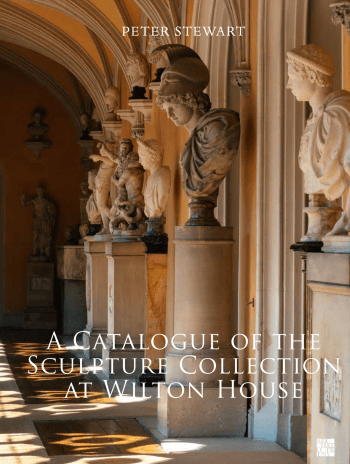 The Wilton House sculptures constituted one of the largest and most celebrated collections of ancient art in Europe. Originally comprising some 340 works, the collection was formed around the late 1710s and 1720s by Thomas Herbert, the eccentric 8th Earl of Pembroke, who stubbornly ‘re-baptized’ his busts and statues with names of his own choosing. His sources included the famous collection of Cardinal Mazarin, assembled in Paris in the 1640s and 1650s, and recent discoveries on the Via Appia outside Rome. Earl Thomas regarded the sculptures as ancient—some of them among the oldest works of art in existence—but in fact much of the collection is modern and represents the neglected talents of sixteenth-and seventeenth-century artists, restorers and copyists who were inspired by Greek and Roman sculpture.
About half of the original collection remains intact today, adorning the Gothic Cloisters that were built for it two centuries ago. After a long decline, accelerated by the impact of the Second World War, the sculptures have been rehabilitated in recent years. They include masterpieces of Roman and early modern art, which cast fresh light on Graeco-Roman antiquity, the classical tradition, and the history of collecting.
Illustrated with specially commissioned photographs, this catalogue offers the first comprehensive publication of the 8th Earl’s collection, including an inventory of works dispersed from Wilton. It re-presents his personal vision of the collection recorded in contemporary manuscripts. At the same time, it dismantles some of the myths about it which originated with the earl himself, and provides an authoritative archaeological and art-historical analysis of the artefacts.
Peter Stewart is Director of the Classical Art Research Centre and Associate Professor of Classical Art and Archaeology at the University of Oxford. He has worked widely in the field of ancient sculpture. His publications include Statues in Roman Society: Representation and Response (2003) and The Social History of Roman Art (2008). Much of his research concerns the relationship between Gandhāran art and Roman sculpture.
Guido Petruccioli is an Oxford University-trained classical archaeologist and professional photographer with specialist interests in Roman imperial portraiture and the documentation of ancient sculpture.
C O N T E N T S
Preface
Image Credits
Introduction
Catalogue
Statues, Statuettes, and Herms
Busts and Heads
Reliefs and Miscellaneous Objects
Architectural Elements
Plates
Appendix 1 Works Formerly in the Collection
Appendix 2 Concordance to Michaelis
Index of Names and Places
London to Re-Site Statues of Two Politicians Tied to Slave Trade

Left: Replica of a statue by Louis-François Roubiliac of Sir John Cass (1661–1718), original from 1751. As noted in the Wikipedia entry on the statue, the original bronze sculpture “stood for many years on Aldgate High Street, before being relocated to the John Cass Institute in Jewry Street in 1869. The statue was finally relocated to the Guildhall in 1980.” Right: John Francis Moore, Statue of William Beckford (1709–1770), 1772 (London: Guildhall).
◊ ◊ ◊ ◊ ◊
As widely reported, including in this piece by Tessa Solomon for ARTnews (22 January 2021). . .
The City of London Corporation, which manages London’s historic center and financial hub, has voted to remove two monuments to British politicians linked to the transatlantic slave trade. The statue of William Beckford, a two-time mayor of London who made his fortune in plantations in Jamaica in the late 1700s, will reportedly be re-sited and replaced with a new work. The monument to Sir John Cass, a 17th-century member of Parliament, philanthropist, and merchant who profited from the Royal African Company, a major force in the slave economy, will be returned to the Sir John Cass Foundation. His name has already been stripped from the City University of London’s business school. . . .
◊ ◊ ◊ ◊ ◊
For the decision in light of a forthcoming UK government policy aimed at safeguarding historic monuments, see Gareth Harris’s article for The Art Newspaper (22 January 2021). Pushed by Boris Johnson, the new policy goes in to effect in March.
Both statues were discussed over thirteen years ago in this essay by Madge Dresser, “Set in Stone? Statues and Slavery in London,” History Workshop Journal 64.1 (Autumn 2007): 162–99, the abstract of which opens as follows: “This article examines public monuments in London and their relationship to slavery and abolition, a topic that has attracted remarkably little empirical research.”
Exhibition | Goya’s Graphic Imagination

Francisco de Goya y Lucientes, Giant Seated in a Landscape (detail), by 1818, burnished aquatint with scraping and strokes of ‘lavis’ added along the top of the landscape and within the landscape; plate: 28.4 × 20.8 cm (New York: The Metropolitan Museum of Art, 35.42).
◊ ◊ ◊ ◊ ◊
Opening next month at The Met:
Goya’s Graphic Imagination
The Metropolitan Museum of Art, New York, 12 February — 2 May 2021
Regarded as one of the most remarkable artists from the late eighteenth and early nineteenth centuries, Francisco Goya (1746–1828) is renowned for his prolific activity as a draftsman and printmaker, producing about nine hundred drawings and three hundred prints during his long career. Through his drawings and prints, he expressed his political liberalism, criticism of superstition, and distaste for intellectual oppression in unique and compelling ways. This exhibition will explore Goya’s graphic imagination and how his drawings and prints allowed him to share his complex ideas and respond to the turbulent social and political changes occurring in the world around him. The broadly chronological presentation will follow Goya’s evolution and different phases as a graphic artist as well as his approaches to his subjects. Around one hundred works on display will come mainly from The Met collection—one of the most outstanding collections of Goya’s drawings and prints outside Spain—with other works coming from New York, Boston, and Madrid’s Museo Nacional del Prado and the Biblioteca Nacional.
The catalogue is distributed by Yale University Press:
Mark McDonald, with contributions by Mercedes Ceron-Pena, Francisco J. R. Chaparro, and Jesusa Vega, Goya’s Graphic Imagination (New York: The Metropolitan Museum of Art , 2021), 320 pages, ISBN: 978-1588397140, $50.
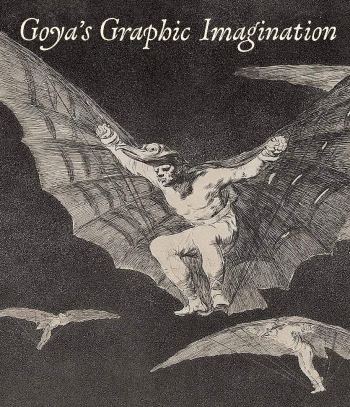 This book presents the first focused investigation of Francisco Goya’s (1746–1828) graphic output. Spanning six decades, Goya’s works on paper reflect the transformation and turmoil of the Enlightenment, the Inquisition, and Spain’s years of constitutional government. Two essays, a detailed chronology, and more than 100 featured artworks illuminate the remarkable breadth and power of Goya’s drawings and prints, situating the artist within his historical moment. The selected pieces document the various phases and qualities of Goya’s graphic work—from his early etchings after Velázquez through print series such as the Caprichos and The Disasters of War to his late lithographs, The Bulls of Bordeaux, and including albums of drawings that reveal the artist’s nightmares, dreams, and visions.
Mark McDonald is curator in the Department of Drawings and Prints at The Metropolitan Museum of Art.
New Book | Meltdown!
◊ ◊ ◊ ◊ ◊
Accompanying the exhibition Fortune and Folly in 1720 (scheduled to open at the New York Public Library in September), the related publication is now available from Brepols:
Madeleine Viljoen, Nina Dubin and Meredith Martin, Meltdown! Picturing the World’s First Bubble Economy (Turnhout: Harvey Miller, 2020), 157 pages, ISBN: 978-1912554515, $65 / €50.
Meltdown! focuses on the depiction of the first international financial crisis following the 1720 collapse of stock market bubbles in England, France and the Netherlands.
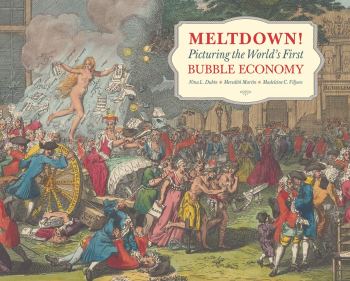 This book tells two parallel stories: one of the spectacular rise and fall of the world’s first bubble economy, and another of the enterprising art industry that chronicled its collapse. The Mississippi and South Sea Bubbles, spawning the invention of French banknotes as well as joint-stock companies built on fantasies of New World trade, imposed on everyday Europeans a crash course in new financial products. In turn, a bubbling print market relentlessly caricatured the meltdown of 1720, offering viewers an entertaining primer on the otherwise bewildering realities of modern economic life. Such satirical works—most notably a Dutch compendium titled The Great Mirror of Folly (Het groote tafereel der dwaasheid )—helped to demystify the disaster by deploying familiar theatrical characters and tragic-comic motifs. Likening the speculative mania to an infectious disease, and spoofing the ‘herd behavior’ of a money-crazed public, its prints portrayed malevolent traders, hoodwinked investors, and a chorus of heroes and villains both real and legendary, from the rakish financier John Law to the foolish Harlequin to the goddess Fortuna. Three hundred years later, our current moment offers a uniquely fitting vantage point from which to reconsider the significance of the bubbles and of the artworks that channeled the fears and desires they unleashed.
Nina L. Dubin is an associate professor of Art History at the University of Illinois at Chicago. Specializing in European art since 1700, she has published widely on the production of art within an economy of risk.
Meredith Martin is an associate professor of Art History at New York University and the Institute of Fine Arts. Specializing in European art of the long eighteenth century, she has published widely on gender and architectural patronage as well as maritime art, mobility, and exchange in the early modern world.
Madeleine C. Viljoen is Curator of Prints and the Spencer Collection at The New York Public Library. Responsible for the Library’s collection of prints and rare illustrated books, she has published widely on early modern printed images, with special attention to the goldsmith-engraver, the reproductive print, and ornament.
Call for Papers | The Helvetic Republic and France
The 2022 meeting of the Swiss Society for the Study of the Eighteenth Century addresses relations between the Helvetic Republic and France. From the Call for Papers, via ISECS:
Le Corps helvétique et la France, 1660–1792: Transferts, asymétries, et interdépendances entre des partenaires inégaux
Colloque de la Société Suisse pour l’Étude du XVIIIe Siècle (SSEDS)
Château de Waldegg, Feldbrunnen-St. Niklaus (canton de Soleure), Switzerland, 28–30 April 2022
Proposals due by 31 March 2021
Organized by Simona Boscani-Leoni, Claire Gantet, André Holenstein, Timothée Léchot, Bérangère Poulain
Si le Corps helvétique et le royaume de France n’acquirent que dans la seconde moitié du XVIIe siècle une longue frontière commune, les relations politiques, diplomatiques et économiques entre les deux pays inégaux étaient déjà très étroites depuis le début du XVIe siècle. La Paix perpétuelle (1516) et l’alliance régulièrement renouvelée de 1521 à 1777 entre les cantons et le roi de France constituèrent l’épine dorsale des relations extérieures du Corps helvétique jusqu’en 1792. Rien ne manifeste mieux l’éminent intérêt du Roi très chrétien à des relations étroites avec le Corps helvétique que la présence d’un ambassadeur permanent de la France à Soleure (à partir de 1530). L’affirmation de la France en tant que grande puissance continentale sous Louis XIV attisa une discussion de plus en plus controversée sur les relations asymétriques entre ces partenaires inégaux. Tandis que les clients de la France saluaient Louis XIV comme un protecteur bénéfique de la liberté et de l’unité confédérées, le parti antifrançais dans les Cantons helvétiques percevait dans la politique offensive d’expansion (conquête de la Franche Comté en 1668/1674 et de Strasbourg en 1681) et dans la persécution des huguenots un danger imminent pour la Confédération. Contre les intérêts des entrepreneurs de guerre, des pensionnaires et des négociants tournés vers la France, il voulait contrebalancer la forte dépendance envers la France du Corps helvétique en le rapprochant de l’Empire, de l’espace néerlandais et de l’Angleterre. Ces tensions atteignirent un apogée en 1715 lorsque le roi — à l’encontre d’une politique qui traditionnellement visait l’accord entre les partis confessionnels — ne renouvela son alliance qu’avec les cantons catholiques. En 1777 seulement, la diplomatie française parvint à inciter l’ensemble des cantons divisés à renouveler leur alliance avec le roi, en tant que leur « plus vieil ami et allié » — une alliance qui fut unilatéralement résiliée par la France républicaine révolutionnaire en 1792.
Proximité et distance, dépendance et retrait : ces traits ne caractérisèrent pas seulement les relations politiques et diplomatiques du Corps helvétique et de la France. Ils caractérisèrent aussi les arts, la littérature, l’architecture et les pratiques culturelles, jusqu’à la mode et la consommation. D’un côté, la France exerça une grande influence sur le Corps helvétique en tant que grande puissance politique mais aussi modèle culturel, comme en témoignent la langue, la littérature, les modes de vie, l’architecture et les intérieurs des élites sociales. De l’autre, la puissance politique et culturelle du voisin provoqua des réactions de défense jusque dans ces domaines. Elles se manifestèrent dans la critique de l’artificialité, de la superficialité et de la frivolité «des Français», et dans l’éloge du «bon sens» anglais (Beat Ludwig von Muralt), dans la stylisation de la simplicité et du naturel républicains en tant que contre-modèles culturels à l’affectation de la société de cour, dans le déploiement d’une littérature suisse francophone distincte qui s’émancipait de la poésie classique française, ou dans une critique de ton de plus en plus national développée par des partisans des Lumières réformatrices à l’encontre du mode de vie aulique cosmopolite des patriciens confédérés, laquelle s’exprima notamment dans le rejet des voyages à l’étranger des jeunes patriciens et dans la revendication d’institutions éducatives en Suisse.
Le colloque veut éclairer les relations franco-suisses au XVIIIe siècle compte tenu de ces tensions entre proximité et distance, admiration et rejet, dépendance et émancipation. En élargissant les notions avancées dans la recherche récente de transferts culturels (Michel Espagne, Michael Werner) et de tropisme (Wolfgang Adam, Jean Mondot) — qui analysent les relations franco-allemandes dans une perspective avant tout littéraire et culturelle —, le colloque, conformément à la vocation interdisciplinaire de la Société Suisse pour l’étude du XVIIIe siècle, envisage tant pour sa conception que pour sa thématique le spectre entier des relations franco-suisses dans le siècle et demi qui s’écoula jusqu’à la Révolution française. Il sonde les dynamiques, conjonctures et crises des relations et perceptions réciproques des deux voisins. Cette interrogation ouvre la voie à quantité de thèmes : l’entreprise de guerre et les services étrangers ; les relations diplomatiques ; les relations commerciales et la contrebande ; les mouvements migratoires ; les appropriations, transferts et les critiques des modèles culturels dans les domaines de l’art, de l’architecture, de la littérature, de la consommation et de la mode ; les contacts et relations entre les lettrés ; le vécu et les perceptions des voyageurs ; la formation et les perceptions de la frontière commune ; la constructions d’images de soi et de l’autre notamment.
Les communications individuelles seront limitées à 25 minutes, les communications collectives à 40 minutes. Les projets de communications rédigés en français ou en allemand, ou en anglais (avec un maximum de 300 mots) peuvent être adressés jusqu’au 31 mars 2021 à Claire Gantet (claire.gantet@unifr.ch) ou André Holenstein (andre.holenstein@hist.unibe.ch). Le comité scientifique du colloque se prononcera jusqu’au 30 juin 2021.
Exhibition | DeWitt Clinton’s Broadsides of the Early Republic
From the Albany Institute of History & Art:
Fellow Citizens! DeWitt Clinton’s Broadsides of the Early Republic
Albany Institute of History & Art, 1 August 2020 — 14 March 2021
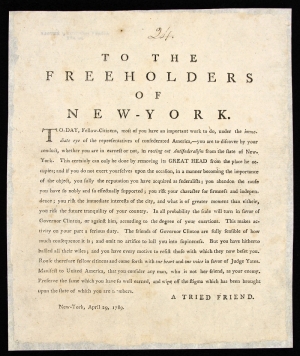
To the Freeholders of New-York, April 29, 1789, DeWitt Clinton Broadside Collection, GR 78-10.24
The Albany Institute of History & Art is home to what is likely the earliest collection of political material specifically assembled as a political collection—the DeWitt Clinton Broadside Collection, which encompasses over one hundred broadsides ranging in date from 1775 to 1813.
A broadside is a single sheet of paper printed with information on one side. Donated to the Albany Institute by Theodoric Romeyn Beck (1791–1855), the broadsides collection would be tucked away and forgotten about, rediscovered and acclaimed, and stored once more, hidden to the world at large, until a local political memorabilia collector learned about the Institute’s collection in 2018, and was thrilled by the discovery. Historically, broadsides were ephemeral sources of information created to serve specific, temporary purposes. After serving their purpose they were either thrown away or repurposed and since paper was a scarce commodity in early America, their survival today is rare.
Fellow Citizens! DeWitt Clinton’s Broadsides of the Early Republic exhibition focuses on five New York State gubernatorial elections, the context of American life at the time the broadsides were written, and the life and legacy of DeWitt Clinton. It will include a selection of nearly twenty political broadsides, along with contemporary paintings, artifacts from the era, and a rare map of New York from 1796.
Program and exhibition support is made possible in part by the New York State Council on the Arts with the support of Governor Andrew M. Cuomo and the New York State Legislature. Season exhibition and program support is provided by Phoebe Powell Bender, Mr. and Mrs. George R. Hearst III, Charles M. Liddle III, Lois and David Swawite, and the Carl E. Touhey Foundation, Inc.
New Book | Race and Modern Architecture
From the U. of Pittsburgh Press:
Irene Cheng, Charles L. Davis II, and Mabel O. Wilson, eds., Race and Modern Architecture: A Critical History from the Enlightenment to the Present (Pittsburgh: University of Pittsburgh Press, 2020), 424 pages, ISBN: 978-0822946052, $45.
 Although race—a concept of human difference that establishes hierarchies of power and domination—has played a critical role in the development of modern architectural discourse and practice since the Enlightenment, its influence on the discipline remains largely underexplored. This volume offers a welcome and long-awaited intervention for the field by shining a spotlight on constructions of race and their impact on architecture and theory in Europe and North America and across various global contexts since the eighteenth century. Challenging us to write race back into architectural history, contributors confront how racial thinking has intimately shaped some of the key concepts of modern architecture and culture over time, including freedom, revolution, character, national and indigenous style, progress, hybridity, climate, representation, and radicalism. By analyzing how architecture has intersected with histories of slavery, colonialism, and inequality—from eighteenth-century neoclassical governmental buildings to present-day housing projects for immigrants—Race and Modern Architecture challenges, complicates, and revises the standard association of modern architecture with a universal project of emancipation and progress.
Irene Cheng is an architectural historian and associate professor at the California College of the Arts. Charles L. Davis II is an assistant professor of architectural history and criticism at the University at Buffalo, SUNY. Mabel O. Wilson is the Nancy and George E. Rupp Professor at the Graduate School of Architecture, Planning, and Preservation and a professor in African American and African Diasporic studies at Columbia University.
C O N T E N T S
Acknowledgments
Introduction — Irene Cheng, Charles L. Davis II, and Mabel O. Wilson
I. Race and the Enlightenment
1 Notes on the Virginia Capitol: Nation, Race, and Slavery in Jefferson’s America — Mabel O. Wilson
2 American Architecture in the Black Atlantic: William Thornton’s Design for the United States Capitol — Peter Minosh
3 Drawing the Color Line: Silence and Civilization from Jefferson to Mumford — Reinhold Martin
4 From ‘Terrestrial Paradise’ to ‘Dreary Waste’: Race and the Chinese Garden in European Eyes — Addison Godel
II. Race and Organicism
5 Henry Van Brunt and White Settler Colonialism in the Midwest — Charles L. Davis II
6 The ‘New Birth of Freedom’: The Gothic Revival and the Aesthetics of Abolitionism — Joanna Merwood-Salisbury
7 Structural Racialism in Modern Architectural Theory — Irene Cheng
III. Race and Nationalism
8 Race and Miscegenation in Early Twentieth-Century Mexican Architecture — Luis E. Carranza
9 Modern Architecture and Racial Eugenics at the Esposizione Universale di Roma — Brian L. McLaren
10 The Invention of Indigenous Architecture — Kenny Cupers
IV. Race and Representation
11 Erecting the Skyscraper, Erasing Race — Adrienne Brown
12 Modeling Race and Class: Architectural Photography and the U.S. Gypsum Research Village, 1952–1955 — Dianne Harris
V. Race and Colonialism
13 Race and Tropical Architecture: The Climate of Decolonization and “Malayanization” — Jiat-Hwee Chang
14 ‘Compartmentalized World’: Race, Architecture, and Colonial Crisis in Kenya and London — Mark Crinson
15 Style, Race, and a Mosque of the “Òyìnbó Dúdú” (White-Black) in Lagos Colony, 1894 — Adedoyin Teriba
VI. Race and Urbanism
16 Black and Blight — Andrew Herscher
17 And Thus Not Glowing Brightly: Noah Purifoy’s Junk Modernism — Lisa Uddin
18 Open Architecture, Rightlessness, and Citizens-to-Come — Esra Akcan
Notes
Bibliography
Contributors
Index
Online Panel | Print Culture and Propaganda in the American Revolution
Christie’s presents this free online panel (via Zoom) in conjunction with its Americana week:
 Print Culture and Propaganda in the American Revolution: Selections from the Collection of Ambassador J. William Middendorf
Tuesday, 19 January 2021, noon (EST)
Moderated by Peter Klarnet, Senior Specialist, with a tribute by John Hays, Deputy Chairman
Panelists
• Philip Mead (Director of Curatorial Affairs and Chief Historian, Museum of the American Revolution, Philadelphia)
• Nancy Siegel (Professor of Art History and Museum Studies Coordinator, Towson University, Towson, Maryland)
• Allison Stagg
• Amy Torbert (Andrew W. Mellon Foundation Assistant Curator of American Art, Saint Louis Art Museum)
Image: Lot 306 of sale 18947. Phillip Dawe, engraver, The Bostonian’s Paying the Excise Man or Tarring and Feathering (London: Robert Sayer & John Bennett, 1774; Collection of Ambassador J. William Middendorf II).










 Enfilade
leave a comment