New Book | Aristocratic Education
From UNC Press:
Mark Boonshoft, Aristocratic Education and the Making of the American Republic (Chapel Hill: The University of North Carolina Press, 2020), 296 pages, ISBN: 978-1-469659541 (ebook), $23 / ISBN: 978-1469661360 (paperback), $30 / ISBN: 978-1469659534 (hardcover), $95.
 Following the American Revolution, it was a cliché that the new republic’s future depended on widespread, informed citizenship. However, instead of immediately creating the common schools–accessible, elementary education—that seemed necessary to create such a citizenry, the Federalists in power founded one of the most ubiquitous but forgotten institutions of early American life: academies, privately run but state-chartered secondary schools that offered European-style education primarily for elites. By 1800, academies had become the most widely incorporated institutions besides churches and transportation projects in nearly every state.
In this book, Mark Boonshoft shows how many Americans saw the academy as a caricature of aristocratic European education and how their political reaction against the academy led to a first era of school reform in the United States, helping transform education from a tool of elite privilege into a key component of self-government. And yet the very anti-aristocratic critique that propelled democratic education was conspicuously silent on the persistence of racial and gender inequality in public schooling. By tracing the history of academies in the revolutionary era, Boonshoft offers a new understanding of political power and the origins of public education and segregation in the United States.
Mark Boonshoft is assistant professor of history at Duquesne University.
C O N T E N T S
List of Figure and Tables
Acknowledgments
Introduction: Why Academies?: Aristocratic Education in Revolutionary America
Part I. From Denominational Schools to Nationalist Institutions, 1730–1787
1 The Emergence of Academies: The Great Awakening and Colonial Elite Formation
2 The Academy Effect: Civic Education and the American Revolution
3 Rebuilding Academies: Education and Politics in the Confederation Era
Part II. The Culture of Academies, 1780–1800
4 Defining Merit: Academies and Inequality
5 Diplomacy and Dance: The Geopolitics of Ornamental Education
Part III. From Aristocratic Education to Reform, 1787–1830
6 Creating Consensus: The Politics of State Support for Academies
7 The First Era of School Reform: War, Panic, and Popular Education
Epilogue: The Legacy of Aristocratic Education
Appendix
Notes
Bibliography
HECAA Emerging Scholars Showcase

George Lambert, Classical Landscape, 1745, oil on canvas, 41 × 46 inches
(London: Tate)
◊ ◊ ◊ ◊ ◊
HECAA Emerging Scholars Showcase
Online, Saturday, 7 November 2020, 2:00–3:30pm (EST)
Please mark your calendars for the first HECAA Emerging Scholars Showcase on Saturday, November 7, from 2:00 to 3:30pm EST. We will hear from our first seven emerging scholars present their research in 3– to 5–minute presentations, after which we will open up the floor to questions and comments. The intention of these showcases is to create networking opportunities, and we look forward to your audience participation in support of our emerging scholars.
We received an overwhelming number of applications, ranging geographically from China, India, and Australia, to Brazil, Europe, and across the USA. The topics likewise range in their geographical origin, theoretical approach, materials, techniques, and methods. We will also hold two additional showcases on 6 February 2021 and 17 April 2021.
Registration is not required. A Zoom link will be sent out to all HECAA members the week before November 7. If you have any questions or concerns, please contact Dani Ezor (dezor@smu.edu). Thank you!
Print Quarterly, September 2020

Johann Jakob Mettenleiter, Double Portrait of Johann Elias Haid and Johann Jakob Mettenleiter, ca. 1778–84, oil on copper, 31 × 38 cm (image courtesy Boris Wilnitsky Fine Arts, Vienna).
◊ ◊ ◊ ◊ ◊
The eighteenth-century in the latest issue of Print Quarterly (with apologies for being so slow! -Craig).
Print Quarterly 37.3 (September 2020)
A R T I C L E S
Julie Mellby, “Audubon’s Copperplates for Birds of America”, pp. 283–93.
After a brief introduction to John James Audubon’s (1785–1851) life and the publication history of his famous Birds of America, this article explores the afterlife of the copperplates. Partly damaged during a fire and later sold as used copper, some of these objects were eventually acquired and restored by William E. Dodge II (1832–1903). Their history interestingly overlaps with the history of important American institutions, such as the Metropolitan Museum of Art and the Princeton University Art Museum.
Marianne A. Yule, “A Friendship Portrait of J. J. Mettenleiter and J. E. Haid”, pp. 294–99.
This piece focuses on a newly discovered painting and its related mezzotint, the only known collaborative work between the printmaker John Elias Haid (1739–1809) and the painter Johann Jakob Mettenleiter (1750–1825). It explores the history of the image and identifies all the prints depicted therein.
N O T E S A N D R E V I E W S
Peter Van Der Coelen, Review of Henk van Nierop, The Life of Romeyn de Hooghe 1645–1708: Prints, Pamphlets, and Politics in the Dutch Golden Age (2018), pp. 314–16.
The note, as the book it reviews, sheds light on the lesser known, yet extremely prolific Romeyn de Hooghe (1645–1708), a printmaker operating between the Netherlands and Paris. His prints depict the political events of the day, such as the French invasion of Holland, as well as fashionable pastimes, as exemplified by his illustrations for a treatise on wrestling. De Hooghe’s life and work attest to the rising dominance of France all over Europe in the age of Louis XIV, both politically and artistically.
Domenico Pino, Review of Xavier F. Salomon, Andrea Tomezzoli and Denis Ton, Tiepolo in Milan: The Lost Frescoes of Palazzo Archinto (2019), pp. 319–21.
The catalogue under review reconstructs a cycle of frescoes commissioned for an aristocratic Milanese palace and destroyed during World War II. The note focuses on one chapter in particular, analysing Giambattista Tiepolo’s (1697–1770) early career as a book illustrator in Verona and Milan in the 1720s and ’30s, reading it in the context of the cultural fervour that spread all over Italy following the war of Spanish succession.
Domenico Pino, Review of Canaletto & Venezia (2019), pp. 321–22.
The note offers an overview of eighteenth-century Venice and the cultural fervour it hosted. The exhibition catalogue explores in detail the artistic career of Canaletto (1697–1768), Giambattista Tiepolo (1697–1770) and Giambattista Piazzetta (1682–1754), and discusses the developments of artistic trends in furniture, glass, porcelain and architecture in Venice throughout the century up to the fall of the Republic in 1797.
Elizabeth Rudy, Review of Aude Prigot, La Réception de Rembrandt à traversles estampes en France au XVIIIe siècle (2018), pp. 322–25.
The note explores the impact Rembrandt had on artists from the eighteenth through to the twenty-first century. In particular it focuses on the practice of collecting his prints in eighteenth-century France and that of copying his composition in the later part of the century. The main case studies are five French artists, among them Claude-Henri Watelet (1718–86) and Dominique Vivant-Denon (1747–1825).
New Book | Where Caciques and Mapmakers Met
From UNC Press:
Jeffrey Alan Erbig, Where Caciques and Mapmakers Met: Border Making in Eighteenth-Century South America (Chapel Hill: The University of North Carolina Press, 2020), 280 pages, ISBN: 978-1469655055 (ebook), $20 / ISBN: 978-1469655048 (paperback), $25 / ISBN: 978-1469655031 (hardcover), $90.
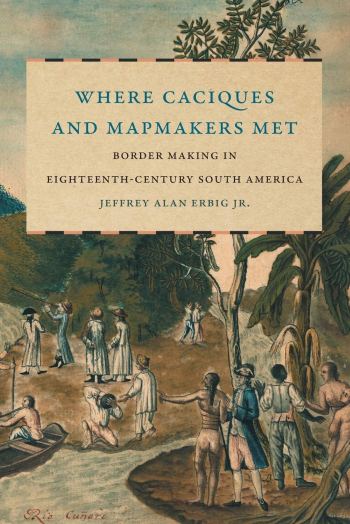 During the late eighteenth century, Portugal and Spain sent joint mapping expeditions to draw a nearly 10,000-mile border between Brazil and Spanish South America. These boundary commissions were the largest ever sent to the Americas and coincided with broader imperial reforms enacted throughout the hemisphere. Where Caciques and Mapmakers Met considers what these efforts meant to Indigenous peoples whose lands the border crossed. Moving beyond common frameworks that assess mapped borders strictly via colonial law or Native sovereignty, it examines the interplay between imperial and Indigenous spatial imaginaries. What results is an intricate spatial history of border making in southeastern South America (present-day Argentina, Brazil, and Uruguay) with global implications.
Drawing upon manuscripts from over two dozen archives in seven countries, Jeffrey Erbig traces on-the-ground interactions between Ibero-American colonists, Jesuit and Guaraní mission-dwellers, and autonomous Indigenous peoples as they responded to ever-changing notions of territorial possession. It reveals that Native agents shaped when and where the border was drawn, and fused it to their own territorial claims. While mapmakers’ assertions of Indigenous disappearance or subjugation shaped historiographical imaginations thereafter, Erbig reveals that the formation of a border was contingent upon Native engagement and authority.
Published with support provided by the William P. Clements Center for Southwest Studies at Southern Methodist University in Dallas, Texas.
Jeffrey Alan Erbig Jr. is assistant professor of Latin American and Latino studies at the University of California, Santa Cruz.
C O N T E N T S
List of Figures, Maps, and Tables
Acknowledgments
Abbreviations
Introduction
1 An Archipelago of Settlements and Tolderías
2 Projecting Possession
3 Mapping the Tolderías’ Mansion
4 Simultaneous Sovereignties
5 Where the Lines End
Conclusion
Notes
Bibliography
Call for Essays | Academic Research and the Contemporary Museum
From the Call for Articles:
Academic Research and the Contemporary Museum (working title)
Collection of essays edited by Dr Nicola Pickering, to be published by Routledge
Proposals due by 30 November 2020
This publication intends to re-establish the importance of focused and supported academic object-based research in museum practice and encourage a more robust debate within the museums sector surrounding the requirement and benefits of this work. It aims to reveal how new and creative academic research can be of value to audience-focused outcomes and public engagement work in museums, something that has not received the attention it should have up to now.
In this publication ‘academic research’ will be considered as activity of a scholarly nature, involving in- depth study of museum objects, drawing heavily on the examination of primary and secondary sources, and undertaken by subject-specialists using methodologies drawn from academic disciplines. This book will offer a unique opportunity for readers to see how new academic research can successfully inform visitor-centred practices in museums, and public outcomes for non-specialists, rather than remain the preserve of elitist curators and be produced for limited and privileged audiences.
This book will contain case studies that highlight the value of skilfully and appropriately transferring and translating academic research into public-facing projects and outcomes in the museums sector. Sympathetically integrated into public interpretation and education projects, and astutely linked to contemporary issues, new object-focused and audience-focused academic research can assist in widening access and participation and contribute to museum work in areas such as wellbeing, accessibility, social justice and sustainable funding. Thus, it can complement and bolster visitor-centred approaches, rather than work in opposition to them. It is hoped that the case studies collected in this volume will show that primary research and object-based scholarship in curatorial practice, which focuses on the needs of audiences, as well as collaborations with academics and academic organisations, can enhance the public impact and wider appeal of museums.
Case studies that feature examples of object-focussed research drawing on alternative theories (for example post-colonial, feminist, critical race, post-human and environmental theories) will highlight how museums can reinterpret objects from multiple and new perspectives. This might then show how new, or a wider range of, audiences may then be engaged in the work of the museum through the curatorial, learning, engagement and community projects that draw on this fresh research. Such activity can assist in widening access and participation and contribute to museum work in areas such as wellbeing, accessibility, social justice and sustainable funding.
Case Studies Sought
Case studies—each approximately 5,000-6,000 words—of successful and innovative methodologies, practices and projects in which new and creative academic object-based research has been employed to enhance public-facing outcomes are sought for this publication.
This book aims to discuss the controversies and extend the current debate regarding curatorial approaches. Thus, case studies should discuss new ways of thinking about the role of content specialists or expertise and academic research in museums, and highlight new and creative uses of academic research in collections-based projects. Case studies might be examples of innovative and imaginative undertakings, methodologies and practices, those highlighting the value of transferring and translating academic research into public-facing projects and outcomes in the museums and heritage sector. The case studies will come together to show why this is so important, how to approach such activities, and the benefits of pursuing such projects.
The case studies should help to show how new, or a wider range of, audiences may then be engaged in the work of the museum through the curatorial, learning, engagement and community projects that draw on this fresh research. If possible, the benefits of primary research and content-focussed scholarship to successful measurable outcomes (increased visitor numbers, greater visitor engagement, raised income through commercial activities, sponsorship or grant awards, changes in diversity of audiences) should be highlighted in the case studies.
Case studies that contribute to the current debate surrounding curatorial practice, museum management and public engagement will be positively received.
The necessity of strong partnerships and interdisciplinary working might be highlighted: successful case studies in which academic staff have worked alongside museum staff to achieve innovative outcomes are sought. In doing so it is hoped this publication will assist in showing how scholarly research can be made accessible to the general public in an effective way, and help museum professionals, academics and students to see how this might be done well. Potential ways that external partnerships and internal expertise within museum and heritage organisations might be developed and maintained could be discussed in the case studies.
We are seeking case studies from any country, from a variety of types of museum (national, trust/charity, independent, local authority, university), and it is hoped they will feature a range of collection objects, subject matters, spaces, locations and budgets. Examples from museums outside of the UK and those that have an international dimension or show engagement with source communities from around the world are actively sought.
Your case study must fall into one of the following five categories:
o University museums and academic partnerships with museums.
o Public–privatepartnerships.
o Untold stories (e.g. gender and sexuality / under-represented, disenfranchised and marginalised groups / post-colonial interpretation).
o Retold stores and contemporary issues (e.g. community stories, lost and forgotten stories, audience interest reinvigorated).
o Difficult spaces and projects undertaken on small and restricted budgets (e.g. at local authority museums, independent museums).
The case study chapters will be presented thematically, examining specific research themes as outlined above. The case studies will combine to show the variety of primary, object-focused and academic research that is being undertaken in museums in projects that have visitor-focused outcomes.
Required
• Summary of your proposed contribution (no more than one side of A4).
• A list of any suggested illustrations, tables etc.
• Author CV (and list of previous published material if applicable).
MuseumResearchContributions@gmail.com
Deadline
Midday on Monday, 30th November 2020.
More information is available here.
.
Public Lecture Course | Ceramics in Britain
The series, originally scheduled for the spring, will now take place online; from the Mellon Centre:
Public Lecture Course, Ceramics in Britain, 1750 to Now
Online, Paul Mellon Centre for Studies in British Art, London, Thursdays, 5 November — 10 December 2020
 Pre-recorded lectures to be released weekly at 3pm GMT on Thursdays and a live Q&A (Zoom) on 10 December 2020 at 6pm GMT
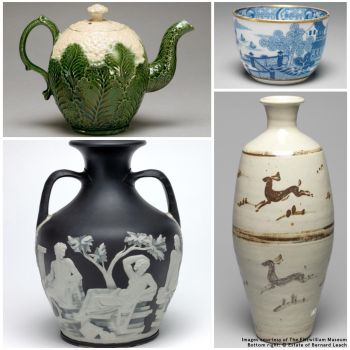
This course, delivered by experts in the field, will explore five key influential developments in the history of British ceramics since the mid-eighteenth century, examining the multiple ways in which innovators, entrepreneurs, and artists have reinvigorated the field. While the story of ceramics is a global one, Britain has played a leading role in the last three centuries, a period in which British invention has shaped developments and brought constant renewal to the industry.
By 1750, ceramics of different types were available to all levels of society. However, the uniquely British innovation of combining print culture and ceramics, transfer-printing political propaganda, and the graphic satire of London’s leading caricaturists onto earthenware, enabled these contemporary controversial messages to be understood by all classes. During the same period, scientific experimentation by Josiah Wedgwood led to the invention of new bodies and glazes, many copying the ceramics and glass of ancient Greece and Rome. His range and ambition, summed up by his aim to become ‘Vase Maker General to the Universe’, helped to change ceramic tastes to an unprecedented degree.
The production of an abundance of styles characterised the nineteenth century. However, blue and white—one of the most distinctive visual effects in ceramics—became, and remained, more popular than any other. Heavily influenced by porcelain exported from Asia, Britain became the leading ceramic producer of this style, driving international trade and retail opportunities. ‘Chinamania’ gripped the nation; debates about taste and authenticity drove collectors, consumers, and creators.
Ceramics was largely unaffected by the first wave of anti-industrialism in England. Neither William Morris nor the Arts and Crafts movement fully established a new type of pottery. However, an urge to turn away from the industrially-produced ceramics of the late nineteenth century, combined with a renewed interest in form, earlier Chinese ceramics, and abstract art, gave rise to a wave of pioneering British potters who insisted on the importance of the handmade and established the role of the ‘artist-potter’. This philosophy was widely popularised by the influential studio potter, Bernard Leach, who spent formative periods in China and Japan and wrote that ‘all my life I have been a courier between East and West’.
While studio ceramics continue to flourish today, global economics and advanced production technology have greatly impacted the ceramics industry in Staffordshire, the traditional heartland of British ceramics production. Artists have played a key role in documenting and commentating on these changes. The course will conclude with an artist’s examination of the decline of ceramic manufacturing and its associated artisanal skills, emphasising the importance of sustaining the intangible heritage of this longstanding and important industry.
No prior art historical knowledge is necessary.
Thursday, 5 November
Patricia Ferguson (Project Curator, British Museum), Pots with Attitude: British Satire on Ceramics, 1750–1820
Thursday, 12 November
Catrin Jones (Chief Curator, Wedgwood Museum), Josiah Wedgwood: Experimentation and Innovation
Thursday, 19 November
Rebecca Wallis (Curator, National Trust, London and South East), ‘Blue and White’ in Nineteenth-Century Britain and Beyond
Thursday, 26 November
Simon Olding (Director of the Crafts Study Centre, University for the Creative Arts, Farnham), ‘Beyond East and West’: The Founding of British Studio Ceramics
Thursday, 3 December
Neil Brownsword (Artist and Professor of Ceramics, Staffordshire University), Obsolescence and Renewal: Reimagining North Staffordshire’s Ceramic Heritage
Thursday, 10 December
Ceramics in Britain: Live Q&A
In Process | Catalogue Raisonné of Porcelain by Lücke
Enfilade doesn’t include a lot of these sorts of notices. It’s nice, however to note who is working on what, and I’m glad to include more. This one comes from ArtHist.net:
In Process | Catalog Raisonné, Porcelain by Johann Christoph Ludwig Lücke (ca. 1703–1780)
Vanessa Sigalas
Dear Colleagues,
I am researching the porcelain oeuvre of Johann Christoph Ludwig Lücke (ca. 1703–1780). Lücke is mostly known as ivory carver with an incredibly diverse repertoire of thematic subject matters, spanning from classical antiquity, folk and genre depictions, and traditional portraits to medical curiosities. He worked as an itinerant artist for various aristocratic and bourgeois clients. Besides ivory, he also worked in stone, wood, wax, papier-mâché, terracotta, faience, and porcelain. While his ivories have gotten more attention in recent scholarship, his porcelain creations have not been further investigated after the early 1980s, when Christian Theuerkauff published two essays on the topic.
Lucke worked for several porcelain manufactories during his lifetime: Meissen (1728/29), Vienna (1750/51) and Höchst (1752). (He had also negotiated with the porcelain factories in Fürstenberg and Berlin). In the same year (1752), he went to Copenhagen to make porcelain himself (although not very successful). In 1754, he tried to found a porcelain factory in Schleswig. However, he was not successful in producing porcelain there either. Nevertheless, as a porcelain modeller, he produced a fascinating and versatile body of work. Although Lücke’s time at the Meissen factory lasted less than ten months—he began in April 1728 and was dismissed in January 1729—his models demonstrates the divergences and similarities between ivory and porcelain and the different methods of working with them. His work report for the Meissen manufactory, though incomplete, shows that Lücke’s tasks were diverse. He modelled figural handles and applications for vessels as well as dishes, pipe bowls, and even a cannon. At Höchst, for example, where he worked in 1752, he created a series of fifteen comedians, recalling several ivory commedia figures that he had created twenty years earlier while still in Dresden.
I am in the process of creating a catalog raisonné for his porcelains and would appreciate any notification of their whereabouts, either in private or museum collections.
Many thanks, and all best wishes,
Vanessa
—
Dr. phil. Vanessa Sigalas
Kunsthistorikerin / Art Historian
92 Meadowbrook Rd
West Hartford CT 06107
USA
The French Porcelain Society’s Online Symposium, 2020
The programme includes some eighteenth-century offerings; from The French Porcelain Society:
The French Porcelain Society’s Online Symposium
Celebrating John Mallet’s 90th Birthday
7–8 November 2020
J. V. G. Mallet’s achievements in the field of ceramics are many as proved by his copious bibliography. It is however, John’s ground-breaking work in the field of istoriato maiolica of the 16th century and particularly his focus on the most important Renaissance maiolica-painters of the period, which has to be acknowledged as a major factor behind the resurgence of interest in this fascinating type of painting on pottery.
Our international online symposium, over two afternoons, will focus on John’s main area of research, istoriato maiolica or ‘narrative ware’. This extraordinary pictorial language flourished in the lands of the Dukes of Urbino, whose humanist court inspired Baldassar Castiglione’s The Book of the Courtier and which was Raphael birthplace. The imagery created in Raphael’s workshop was such a powerful influence on istoriato, that it was once believed that Raphael and his pupils actually painted the wares, leading it to be called ‘Raphael ware’.
Most notable are John’s magisterial articles on Urbino istoriato. Applying the same method that art historians use for painting, he has been able to group stylistically many different istoriato painters, and give names to otherwise unknown important maiolica masters, including: The ‘In Castel Durante Painter’, ‘The Master of the Apollo Basin’, ‘The Milan Marsyas Painter’, and ‘The Painter of the Coal Mine Dishes’. John also has written extensively on the painters active in the workshop of Guido Durantino, around the art of the great Nicola da Urbino, on Francesco ‘Urbini’, on Maestro Giorgio of Gubbio, and on Xanto—one of the most intriguing personalities in the world of ceramics, on whom John organised a ground-breaking monographic exhibition at the Wallace Collection in 2007. His catalogue of the maiolica in the Hockemeyer Collection in Bremen is a landmark of scholarship.
The symposium will give particular emphasis to the relationship between istoriato and graphic sources originating in and around Raphael’s workshop, 500 years after the death of the Urbino master in 1520. Reflecting John’s wide-ranging knowledge and interests in many other fields of ceramics, the symposium will also feature lectures on European pottery and porcelain.
The event is free and open to all, but donations are always appreciated. For more information and registration details, please contact the organiser Dr Elisa Paola Sani at FPSenquiries@gmail.com.
◊ ◊ ◊ ◊ ◊
Maiolica in the Shadow of Raphael
Saturday, 7 November 2020, 16.00–19.00 UK GMT
Welcome: Dame Rosalind Savill, DBE (President, The French Porcelain Society, London)
Introduction: Timothy Wilson (Honorary Keeper, Ashmolean Museum of Art, Oxford)
• Claudio Paolinelli (Co-curator of Raphael Ware, Urbino), Virtual Tour of Raphael Ware, the Maiolica Show in Urbino Ducal Palace
• David Ekserdjian (University of Leicester), Xanto and Raphael
• Suzanne Higgott (Curator, The Wallace Collection), The Wallace Collection Bathing Nymphs
• Carmen Ravanelli Guidotti (former Keeper, M.I.C., Faenza), Raphaelesque Taste: An Istoriato from an Ancient Italian Collection
• Marino Marini (Keeper, Museo del Bargello, Florence), Un’iconografia raffaellesca su una coppa faentina al Bargello
• Karine Tsoumis (Curator, Gardiner Museum of Ceramic Art, Toronto), Portable Worlds: Maiolica in the Serenissima
• Justin Raccanello (Author and Lecturer, London), Raphaelism and Raffaelleschi
• Michael J. Brody (Jefferson University, Philadelphia), A Mythological Dish by Sforza di Marcantonio Dated 1548
• Elisa Paola Sani (Research Fellow, The Courtauld Gallery, London), In the Shadow of Nicola da Urbino
◊ ◊ ◊ ◊ ◊
A Celebration of John Mallet
Sunday, 8 November 2020, 16.00–19.00 UK GMT
Chair: Timothy Wilson (Honorary Keeper, Ashmolean Museum of Art, Oxford)
• Valentina Mazzotti (Keeper of M.I.C., Faenza), John Mallet, Fundamental Contributions in ‘Faenza’
• Errol Manners, FSA (Author and Lecturer, London), Antoine-Salomon Taunay and Louis, Duc d’Orleans, the Travels of a Chemist
• Francoise Barbe (Conservateur en chef, Département des Objets d’art, Louvre, Paris), French Lead Glazes at the Time of Palissy
• Camille Leprince (Author and Lecturer, Paris), Collecting and Reproducing Raphael Ware in 17th-Century France
• Cristina Maritano (Curator of ceramics, Palazzo Madama, Turin), Raphael on the Pharmacy Shelf: An 18th-Century Ligurian Set
• Roger Massey (Author and Lecturer, London), A Bristol Porcelain Figure in the Schreiber Collection at the V&A
• Raffaella Ausenda (Author and Lecturer, Urbino), Maiolica in the Bossi Collection at the Castello Sforzesco, Milan
• Sir Timothy Clifford (former Director, National Gallery of Scotland), Few Thoughts for John
• Giulio Busti (Honorary Curator, Museo delle Ceramiche, Deruta), Un saluto a John
• John Mallet (Former Keeper of the Ceramics Department, Victoria and Albert Museum, London), Collecting for the V&A
Call for Articles | Reframing Eighteenth-Century European Ceramics
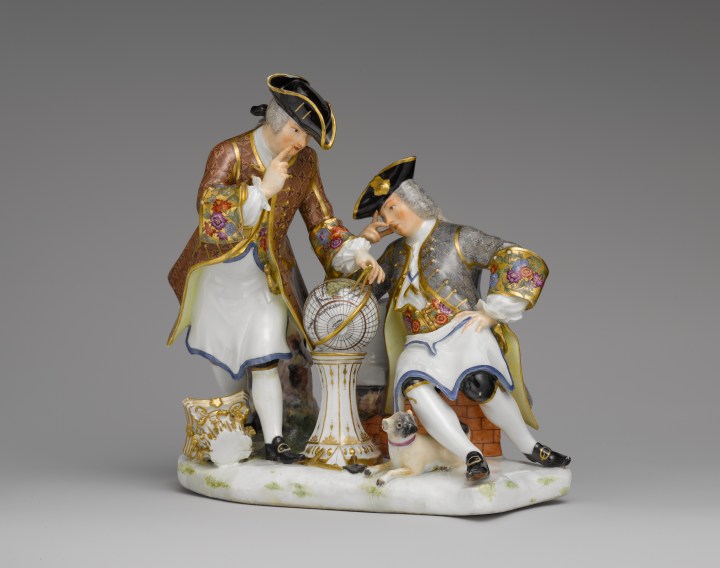
Two Freemasons, modelled by Johann Joachim Kändler, Meissen, ca. 1744; hard-paste porcelain, enamels, and gold; 23 × 24 × 15 cm
(New York: The Metropolitan Museum of Art, Gift of Irwin Untermeyer, 1964. 64.101.112)
◊ ◊ ◊ ◊ ◊
From the Call for Papers:
Reframing Eighteenth-Century European Ceramics
The French Porcelain Society Journal 9 (2022)
Proposals due by 1 February 2021; completed articles due by 1 September 2021
The French Porcelain Society Journal is the leading academic, peer-reviewed English-language publication on European ceramics and their histories, illustrated in full colour. Over recent years we have broadened our mandate to encompass all European ceramics from 1450 to 1950. Our next issue, volume IX, to be published in 2022, will concentrate on the eighteenth-century, which saw the discovery of ‘white gold’ (porcelain manufactured in Europe), embraced a widespread interest in the Age of Enlightenment, coupled with rising political upheavals and a consumer revolution for the luxury goods market. Yet what role did ceramics play within this? Can we rethink the traditional roles of the patron, the consumer, and the collector? What impact did the social construction of gender, race, and class have on ceramic production, design, markets, and use? Beyond their technological developments, how did ceramics reflect and respond to the significant artistic, cultural, social, economic, spiritual, and political matters of their time? This forthcoming issue of FPS Journal will challenge us to rethink accepted definitions by presenting works that demonstrate the tremendous variety of subjects and purposes of European ceramics. We are seeking articles that reframe our traditional perceptions, paying attention to materials and environments that re-evaluate conventional approaches to ceramic history, and welcome proposals that introduce historically under-represented objects or subjects. Articles are not restricted to French porcelain but may also include Spanish, Italian, Portuguese, Dutch, English, Scandinavian, German, and Austrian porcelain and earthenware.
Topics for consideration may include but are not limited to the following:
• Displaying ceramics in eighteenth-century and later interiors, exhibiting practices and architectural spaces
• Ceramics in eighteenth-century literature
• Socio-economic factors influencing eighteenth-century ceramic design or production
• Intersections between ceramics and the history of dining and food culture
• Recycling and repurposing eighteenth-century ceramics
• Collaboration and competition between factories
• Ceramics, politics and nationalism
• Patronage
• Ceramics, science and enlightenment
• Originality and invention in manufacture and design
• Eighteenth-century ceramics and visual culture
• Ceramic encounters between cultures through colonization, migration, trade, and war
• Eighteenth-century ceramics and the museum, acquisition, and display
• Ceramics and the art market
• Collecting ceramics in the eighteenth century
• Collecting eighteenth-century ceramics after 1800
Submissions in the first instance should be a summary of no more than 500 words, with a brief description of the argument, a historiography and a note of the research tools and sources used. Articles must be original; we do not accept modified versions of articles published elsewhere electronically or in print. Please include a brief biography. The journal accepts articles in French as well as in English. The volume will comprise about 15 articles that will be peer reviewed by the editorial board and the FPS council of academic and museum specialists which includes: Dame Rosalind Savill, DBE, FBA, FSA (Curator Emeritus, The Wallace Collection, London); Oliver Fairclough, FSA; John Whitehead, FSA; Errol Manners, FSA; Patricia Ferguson; Dr. Diana Davis; and Dr. Caroline McCaffrey-Howarth (Visiting Research Fellow University of Leeds and Curator, Victoria & Albert Museum). Articles should be between 4,000 and 8,000 words in length excluding endnotes. Up to 15 high-resolution images per article will be accepted.
Please send abstracts as an e-mail attachment to Patricia Ferguson, patricia.f.ferguson@gmail.com; Caroline McCaffrey-Howarth c.mccaffrey-howarth@leeds.ac.uk; and Diana Davis diana_davis@hotmail.co.uk by 1 February 2021. If your abstract is accepted, articles and images will be due by 1 September 2021. Publication is provisional on satisfactory peer review. For further details, please see the FPS website.
Call for Papers | On Portraiture
From ArtHist.net:
On Portraiture: Theory, Practice, and Fiction — From Francisco de Holanda to Susan Sontag
University of Lisbon, 26–28 April 2021
Proposals due by 30 November 2020
Centro de investigação e de estudos em belas-artes (CIEBA) – Artistic Studies Research Centre, Faculty of Fine Arts, University of Lisbon
This colloquium intends to discuss the theory and practice of artistic, historical, anthropological, social, and political experience on the topic of portraiture, as well as the fictional dimension contained within it. Located at the intersection of several disciplinary fields, the discussion(s) and papers will address the portrait as a concept, theme, process, object (monument and document), and device, in its multiple developments and in its successive conceptual, technological, and contextual updates. More than defining a temporal framework, the subtitle—From Francisco de Holanda to Susan Sontag —underscores the dynamic porosity on the researched topic in the fields of art and literature, as well as, in its mutual reversibility.
Francisco de Holanda, humanist and 16th-century Portuguese artist, is the author of Do Tirar pelo Natural [On Portraiture], the first treatise dedicated to portraiture in early modern Europe, which he concluded in 1549, in the decade following his return from a trip to Italy undertaken in 1538 to 1540, as member of the embassy of Ambassador D. Pedro de Mascarenhas. One objective for Holanda was to meet Michelangelo Buonarroti, in addition to observing and drawing fortresses and the most outstanding works of art across Italy. Upon his return, Holanda undertook writing Da Pintura Antiga [On Ancient Painting], concluded on October 13 (St. Lucas Day) 1548, as it is written at the end of Book II, followed by his second treatise, Do Tirar polo Natural [On Portraiture]. These two works were prepared for publication and were even translated into Spanish in 1563, by his friend, the Portuguese painter Manuel Denis. These treatises, written almost simultaneously, would only see publication, in Portuguese and Spanish, only in the 19th century. At the end of the Do Tirar polo Natural, Holanda states that the text was completed on January 3rd, 1549, only a few months after the completion of the two Books of Da Pintura Antiga. In fulfilment of John B. Bury’s ground-breaking research, a bilingual edition of this portrait treatise, published by Paul Holberton Publishing in London, will be presented during this Congress.
Indeed, the two great pillars of Francisco de Holanda’s theory of art—the imitation of himself, nature, and antiquity on one hand, and idea, on the other—have, precisely, as a point of departure, the artist’s creative process which Holanda discusses in his first two treatises. The importance of Do Tirar polo Natural for the theory of art, which Holanda explains and abundantly illustrates in his two books in On Ancient Painting, as well as in his drawings and illuminated albums, especially in As Antigualhas [On the Antique], makes Holanda’s need to write a portrait treatise fully justified. As an autonomous work, Do Tirar polo Natural complements Da Pintura Antiga. This treatise’s structure, in the form of dialogues, follows the model used in Book II of Diálogos em Roma [Dialogues in Rome], but here, instead of many interlocutors, is reduced to conversations between two protagonists, Brás Pereira and Feramando, the disciple and master, as well as the alter ego of Holanda. The themes and issues defined in Do Tirar polo Natural extend, deepen, and, above all, specify in detail questions regarding portraiture, themes related to the representation of the human figure which Holanda took up in Chapters 38 to 41 in Book I of Da Pintura Antiga. These chapters lack the decisive contributions, which throughout the eleven, small dialogues of Do Tirar polo Natural, Holanda describes as precepts for a painter to ‘portray’ or ‘paint from life’ the ‘persona’ of a sitter. In Do Tirar, Holanda distinguishes the portrait as distinctive from other representations of the human figure.
In The Volcano Lover, Susan Sontag begins with documentation related to three historical figures from the 18th century, expanding them into a fictional extension where they appear as characters or doubles; emerging as figures stabilized in the credibility of portraits, thus questioning their presence throughout the history of art and the history of images. These figures are the diplomat, collector, and volcanologist William Hamilton; his wife Emma Hamilton, lover of Admiral Nelson and the muse of the painter George Romney; and Admiral Nelson. The portraits directly refer to those of William Hamilton, made by Joshua Reynolds, and those of Emma Hamilton, made by George Romney and Élisabeth Vigée-Lebrun. The questions asked regard the genesis of the sensitive body, in the example of the statue of Condillac, and the metamorphosis of the statue in the myth of Pygmalion; the metamorphosis of beings in the morphological accidents of the earth and in natural objects that retain their name and history; the ideal portrait; the impossibility of describing the beauty of a face or a body, delegated to the rhetorical artifice of metaphor; the portrait as a theme and as a model; the genre of statues: action and stillness, narcissism and modesty; effigies: symbolic death; cameos: miniaturization of the portrait, living picture: representation staged inside a box or in a place surrounded by the frames of the paintings; the body in pose: support and object of the representation of a representation; the body as the embodiment of the work; the ephemerality of the body and the perpetuity of the portrait; the figure, the portrait and the recognition that erases or illuminates the name. And the ruin of it all, because ruin is the inevitable destiny of human bodies and their representations, some and others relegated to the future of our time.
In conjunction with these topics the main thematic lines of the colloquium are defined as:
• The portrait as a place and the place of the portrait in the visual culture of all periods
• Time and trans-temporality in and of the portrait
• The portrait as theory and the theories of the portrait
• The portrait as fiction
In the transversality of these lines, the following sub-themes are proposed:
The body and the portrait; Portrait: presence and representation; Portrait, self-portrait and self-representation; The expanded portrait: media, intermediary and mediation; Portrait: iconism, symbolism and similarity; Metonymic portrait; Portrait galleries; The portrait as a connotative place; The double and the portrait; The portrait and the mask; Portrait and genre: the collector and the collection; Portrait and gender: the artist and the model; Portrait: celebration and power; Portrait: celebration of anonymity; Portrait: show and monstrosity; The statistical portrait; Avatar: copy without original; The Impossible Portrait; The composite portrait; Portrait: the desecration of the body.
Keynote speakers will be selected according to the sessions formed from the submitted proposals and the thematic lines of this congress. The official languages are Portuguese, English, French, Italian, and Spanish.
All those interested in participating must send an abstract of up to 400 words, including title, name, affiliation, and text, along with a brief curriculum summary of 50 words maximum by 30 November 2020. Proposals should be submitted in doc. file from Office Word, according to the template available HERE and sent to onportraiture.congress@belasartes.ulisboa.pt. The email’s subject and the attached file should be designated as follows: NAME_SURNAME_TITLE OF PAPER. Results will be released by 31 December 2020.
Authors from selected papers are invited to participate in an optional pitch session (5 min/5 slides), which will take place on 15 January 2021 between 14.00 and 19.00 (in Lisbon).










 Enfilade
leave a comment