Lecture | Kate Smith, On Loss and Dispossession
From Eventbrite:
Kate Smith, Loss and Dispossession in the Long Eighteenth Century
University of Edinburgh, 17 March 2020
 Dr Kate Smith (University of Birmingham) delivers the inaugural lecture for the Material Culture in the 17th and 18th Centuries Research Group. Histories of material culture have often focused on questions of presence: how objects in the past were made, purchased, used and repaired. In contrast, Kate Smith’s paper will explore what happened when objects were absent. More particularly, it will examine how eighteenth-century Britons developed systems to deal with loss and what such systems required of them. It will show that, when faced with loss, individuals were called upon to recall their possessions and describe them in full. To make their possessions recognisable to others, and thus increase the possibilities of reclamation, eighteenth-century Britons had to draw out the salient features of missing things. In doing so, they reveal much about what they imagined their possessions to be. The paper considers questions of description, attention, memory and the self to show the complex knowledge, practices and systems constructed and utilised in response to loss. Register here.
Tuesday, 17 March 2020, 17.30–19.00
Playfair Library Hall
South Bridge, Edinburgh
Call for Papers | Piranesi @300
From the Call for Papers, which also includes Italian and French versions:
Piranesi @300
Rome, 27–30 January 2021
Proposals due by 30 April 2020
Organized by Mario Bevilacqua and Clare Hornsby
Concluding the year celebrating the 300th anniversary of the birth of Giovanni Battista Piranesi (1720–1778), this conference aims to reveal new aspects of his life and works, their contexts, and critical fortune, and we are seeking proposals for a comparison of interdisciplinary themes and innovative methodologies.
Some ideas of themes that could be addressed:
Piranesi as Artist, Theorist, Entrepreneur, and Merchant
Many aspects of Piranesi’s life and work still remain in the shadows: we hope to discover new documentary data, new drawings, new interpretations, new networks.
Piranesi and History
The Mediterranean civilizations, the fall of the Empire, the Middle Ages and the Renaissance. Egypt, Etruria, Greece, Rome. From the fall of the Empire to the Renaissance. Piranesi and the texts of his books, the birth of archaeology, the philosophy of history in 18th-century Europe.
Piranesi: Europe, America, the World
Piranesi as ‘global’ artist. His lasting reputation – from Rome across 18th-century Europe – takes on different aspects in different European contexts: England, France, Germany, Russia – and in the more distant United States and Latin America, Australia and Japan, maintaining close yet changing relationships with art, literature, photography and cinema.
Piranesi as Architect: Monument, City, Utopia
Though constantly designing, he was the architect of only one building, S. Maria del Priorato on the Aventine hill yet Piranesi always signed himself ‘architect’. His vision of Roman architecture and of the ancient metropolis states certainties and raises concerns about the dystopian future of the global city.
Piranesi in the Global 21st Century: New Methods for New Paths of Research
We can ask questions about Piranesi in the context of contemporary scenarios. His work continues to provoke reflection, inspire new projects and interpretations.
The languages of the conference are English, Italian and French, and the event will be open to the public. We invite doctoral students, postdoctoral researchers, established scholars to submit proposals for papers that contain new research or use new approaches. These will fall into two groups:
1) 15-minute presentations on one event, object, or discrete theme
2) 30-minute presentations on wider issues
Please send a 250-word CV and an abstract in English, French, or Italian of either 500 words (for a 15-minute talk) or 1000 words (for 30-minute talk); the abstract should make clear the new content of the contribution. Submissions should be sent to Piranesi300@gmail.com by April 30th 2020. We plan to offer accommodation in Rome to speakers at the conference though we are not able to assist with travel costs. We propose to publish a volume of the papers of the conference.
Supporting Institutions
Centro Studi Cultura e Immagine di Roma / Biblioteca Nazionale Centrale
Istituto Centrale per la Grafica
The British School at Rome
Académie de France à Rome – Villa Médicis
Conference Organisers
Mario Bevilacqua and Clare Hornsby
Scientific Committee
Francesca Alberti (Académie de France à Rome), Fabio Barry (Stanford University), Mario Bevilacqua (Università degli Studi di Firenze, CSCIR), Clare Hornsby (British School at Rome), Giorgio Marini (Ministero Beni Culturali), Heather Hyde Minor (Notre Dame Rome), Susanna Pasquali (La Sapienza Roma), Frank Salmon (Cambridge University), Giovanna Scaloni (Istituto Centrale per la Grafica).
Exhibition | Piranesi 300

From the Staatliche Museen zu Berlin:
Piranesi 300
Kunstbibliothek, Berlin, 5 October 2020 — 7 February 2021
The Kunstbibliothek is celebrating the 300th anniversary of the birth of the Italian architectural visionary Giovanni Battista Piranesi (1720–1778) with a special exhibition at the Kulturforum. The exhibition revolves around the Kunstbibliothek’s unique collection of drawings by Piranesi and the ornate books he published, as well as the rich collection of prints held by the Kupferstichkabinett. In collaboration with early career researchers from Humboldt-Universität zu Berlin, the Kunstbibliothek has conceived of the exhibition as a stage on which Piranesi appears in all his roles—as archaeologist, designer, scholar, set designer, and visionary.
Exhibition | Sublime Ideas: Drawings by Giovanni Battista Piranesi
From The Morgan:
Sublime Ideas: Drawings by Giovanni Battista Piranesi
The Morgan Library & Museum, New York, 29 May — 13 September 2020

Giovanni Battista Piranesi, Architectural Fantasy, 18th century (New York: The Morgan Library & Museum, Gift of Mr. Janos Scholz, 1974.27).
In a letter written near the end of his life, Giovanni Battista Piranesi (1720–1778) explained to his sister that he had lived away from his native Venice because he could find no patrons there willing to support “the sublimity of my ideas.” He resided instead in Rome, where he became internationally famous working as a printmaker, designer, architect, archaeologist, theorist, dealer, and polemicist. While Piranesi’s lasting fame is based above all on his etchings, he was also an intense, accomplished, and versatile draftsman, and much of his work was first developed in vigorous drawings. The Morgan holds what is arguably the largest and most important collection of these works, including early architectural caprices, studies for prints, measured design drawings, sketches for a range of decorative objects, a variety of figural drawings, and views of Rome and Pompeii. These works form the core of the exhibition. Supplemented with seldom-exhibited loans from a number of private collections, Sublime Ideas will offer a broad survey of Piranesi’s work as a draftsman, celebrating the 300th anniversary of the artist’s birth.
Exhibition | Turner: Quest for the Sublime

J.M.W. Turner, Small Boats beside a Man-o’-War, 1796–97, gouache and watercolor on paper, 14 × 24 inches
(Tate: Turner Bequest 1856)
◊ ◊ ◊ ◊ ◊
Press release for the exhibition now on view at the Frist Art Museum:
J.M.W. Turner: Quest for the Sublime
Frist Art Museum, Nashville, 20 February — 31 May 2020
The Frist Art Museum presents J.M.W. Turner: Quest for the Sublime, an exhibition of extraordinary oil paintings, luminous watercolors, and evocative sketches by Joseph Mallord William Turner (1775–1851), a central figure in the Romantic movement widely recognized as Britain’s greatest painter and among the most highly regarded landscape painters in Western art. Selected from Tate’s Turner Bequest and organized in cooperation with Tate, the exhibition made its sole U.S. appearance in the Frist’s Ingram Gallery from February 20 through May 31, 2020.
Long admired for his ingenuity, originality, and passion, Turner strove to convey human moods and the feeling of awe aroused by nature’s immensity and power—its palpable atmospheres, pulsating energy, the drama of storms and disasters, and the transcendent effect of pure light. With approximately 75 works, the exhibition conveys highlights in the British painter’s career from the 1790s to the late 1840s, from dizzying mountain scenes and stormy seascapes to epic history paintings and mysterious views of Venice.
The Romantic movement of the late 18th- through mid-19th centuries arose in response to the Enlightenment emphasis on reason over emotion. “For Turner, psychological expression and the liberation of the imagination were of paramount importance,” says David Blayney Brown, senior curator, 19th-century British art, Tate Britain. “He achieved these goals in images of the landscape that evoked human moods by portraying extreme contrasts of intense light and gloomy clouds, dramatic topographies, and energetic brushstrokes.”
Turner portrays climatic events not only as compelling forces by themselves, but also as settings and metaphor for historical and modern dramas. “Mountains and sea show the world in motion: the glacial creep of geological change in the Alps, the sudden fall of a rock propelled by an avalanche, the changing appearance of Mont Rigi according to time and weather, the swell and heave of the sea,” says Brown. Societal and technological changes are captured as well, with images of steamships and other suggestions of industry signaling the forthcoming machine age. The exhibition also includes elemental images of sea and sky, painted late in Turner’s life, which appear nearly abstract.
The concept of the Sublime was central to Romanticism. “As industrialization progressed, people gradually began to develop a longing for the awe-inspiring power and beauty of untouched nature and natural forces. Turner was able to cater to this interest in his landscape paintings,” says Brown.
Organized thematically, the exhibition begins by examining Turner’s early aptitude at landscape painting while attending the Royal Academy Schools. Works in the section show his masterly adaptation of early influences and the first instances of what would become a lifelong habit of summer touring across Europe to make sketches and studies, which he would later make into studio paintings.
The next sections include Turner’s first impressions of the mountains, glaciers, and lakes of the Swiss Alps. “Turner’s early scenes of Switzerland and Italy are often somber or stormy in mood and coloring, reflecting a region that was as unstable politically as it was in its geology and climate,” says Brown. “In later works, he communicates a sense of rapture and harmony that may be related to the return of peace to Europe after the Napoleonic Wars.”
Other sections provide insight into Turner’s process and working methods by exploring sketchbook studies, works in progress, and watercolors at various stages of completion. The exhibition concludes with a section devoted to Turner’s fascination with the sea. “As time passes, there is a progression from a more substantial, three-dimensional style to one that is more impressionistic and less solid,” says Brown. “In these often-unfinished paintings, Turner stripped away subject and narrative to capture the pure energy of air, light, and water.”
Lecture | Steven Parissien, On George IV and the Horse

George Stubbs, George IV, when Prince of Wales, detail, 1791, oil on canvas, 103 × 128 cm
(Royal Collection Trust, RCIN 400142)
◊ ◊ ◊ ◊ ◊
In connection with the exhibition George IV: Art & Spectacle now on view at Buckingham Palace:
Steven Parissien, George IV and the Horse
The Queen’s Gallery, Buckingham Palace, 26 February 2020
One of George IV’s greatest passions was horseracing. In this lunchtime lecture, Steven Parissien, Chief Executive of Palace House, Newmarket, examines the ways in which George utilised the image of the thoroughbred horse to define and bolster his royal image. 13:00–14:00
Summer Course | From Print to Paint
From ArtHist.net:
From Print to Paint: Histories and Methods of Artistic Production
Utrecht, 13–17 July 2020
Applications due by 1 April 2020
How do artists master their art? Does painting in oil result in different working procedures and visual effects compared to other media? Which material and technical properties determine the creative possibilities of prints, sculptures, and the applied arts? What can art historians learn from re-making art, re-working historical recipes, or reproducing material objects? This course will immerse you in discussions related to art production and (re-)making, materials and materiality, and techniques and technology.
This course is highly interactive and has a firm hands-on component. It integrates methods typical for the humanities and historical disciplines with practical work in the studio or lab. At one moment you may find yourself decoding a recipe for writing ink in a historical manuscript; at another moment you might be introduced to the practicalities of the printing press. During one lab session you might be mixing pigment with different binding media to make oil and tempera paint, and on the next day you might be working with fire to cast a small metal object. You will benefit from Utrecht University’s Kunstlab and the research and expertise of the ERC-funded research project ARTECHNE. Upon completion, you will have deepened your knowledge in the artistic production of art with insights from recent developments in technical art history and heritage studies. This is the one-week version of the course. You can also choose to participate in the extended version (two weeks) that includes visits to museums throughout the Netherlands.
Lecturers
Jessie Wei-Hsuan Chen (main lecturer), Sven Dupré (guest speaker), Mireille Cornelis (guest speaker)
Target audience
Students who wish to take this course should have some academic training, as there will be substantial readings and intensive discussions. This course is also suitable for MA and PhD students who wish to apply historical remaking as a methodology and learn practical skills, as no previous experience in artistic production and making is required.
Course fee for the one-week version
€650 (included: course + course materials)
Housing fee: €200
Course fee for the extended version
€1150 (included: course + course materials + travel costs and entry fees to site visits)
Housing fee: €350
Housing through Utrecht Summer School. Summer school housing is optional. Students can also choose to arrange their own accommodation.
How to apply?
Please include a brief motivation to introduce who you are and why you want to take this course. This is to help the instructors learn the level of experience to better plan the lab sessions. Applications are reviewed on a rolling basis. As there is limited space in the lab, interested participants are advised to apply as soon as possible.
More information
Please contact the Course Director and ARTECHNE Project Associate Jessie Wei-Hsuan Chen at w.h.chen@uu.nl.
Film | Portrait of a Lady on Fire
From the official website for the film, which opened in France last fall:
Portrait de la jeune fille en feu, directed by Céline Sciamma and starring Noémie Merlant and Adèle Haenel, 120 minutes, 2019.
France, 1760. Marianne (Noémie Merlant) is commissioned to paint the wedding portrait of Héloïse (Adèle Haenel), a young woman who has just left the convent. Because Héloïse is a reluctant bride-to-be, Marianne arrives under the guise of companionship, observing Héloïse by day and secretly painting her by firelight at night. As the two women orbit one another, intimacy and attraction grow as they share Héloïse’s first moments of freedom. The portrait soon becomes a collaborative act of and testament to their love.
Winner of a coveted Cannes prize and one of the best reviewed films of the year, Portrait of a Lady on Fire solidifies Céline Sciamma as one of the most exciting filmmakers working in the world today. Noémie Merlant and Adèle Haenel turn the subtle act of looking into a dangerous, engrossing thrill, crafting the most breathtaking and elegant performances of the year. To watch Marianne and Héloïse fall in love is to see love itself invented onscreen.
Conference | Art and the Actuarial Imagination
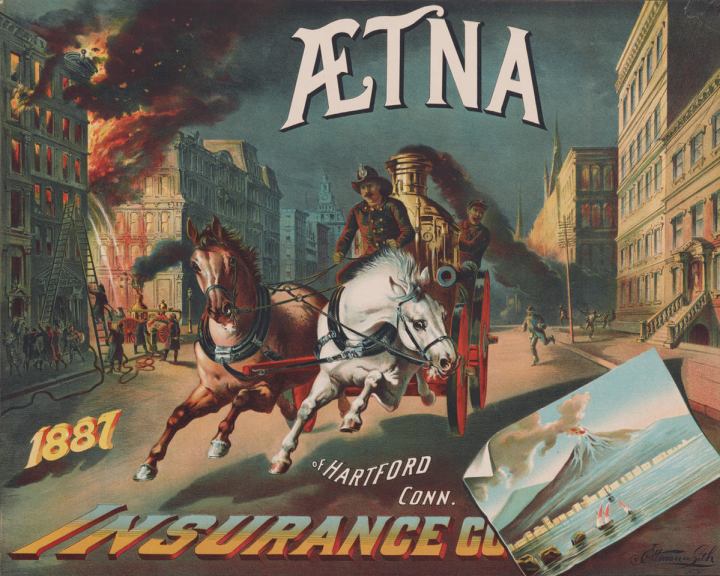
Aetna Insurance Co of Hartford Conn., detail, 1887, color lithograph, J. Ottman Lithographic Company, 67 × 49 cm
(Huntington Library, Jay T. Last Collection)
◊ ◊ ◊ ◊ ◊
Registration is available here:
Art and the Actuarial Imagination
The Huntington Library, Art Museum, and Botanical Gardens, San Marino, California, 10–11 April 2020
Insurance now plays pivotal roles in the construction, exhibition, and value of contemporary art and architecture. This two-day conference brings together interdisciplinary scholars to examine how insurance has constructed and inflected the civic, economic, and moral life of art and architecture from the early modern period to the present. Registration for this two-day conference is $25, with an optional buffet lunch each day for $20. Conference registration is $10 for current Huntington docents, and free for current Long-Term Fellows and students with a current student ID. Please bring your ID to event-day check-in. Students, please note school affiliation after your name when registering.
F R I D A Y , 1 0 A P R I L 2 0 2 0
8:30 Registration and coffee
9:30 Welcome by Steve Hindle (The Huntington)
9:35 Remarks by Avigail Moss (University of Southern California) and Matthew Hunter (McGill University), Art and the Actuarial Imagination: Propositions
10:00 Session 1: The Artist as Actuary
Moderator: James Glisson (Santa Barbara Museum of Art)
• Sophie Cras (Université Paris 1 Panthéon-Sorbonne), Art, Insurance and Post-Statistics Politics
• Melanie Gilligan (Royal Institute of Art, Stockholm), Films About Social Systems: Depicting Contingency
12:00 Lunch
1:00 Session 2: Incorporating Liability
Moderator: Matthew Hunter (McGill University)
• Nina Dubin (University of Illinois at Chicago), Eros, Inc.: Cupid, Corporate Form, and the Crash of 1720
• Avigail Moss (University of Southern California), Ars Longa, Vita Brevis: The Fine Art & General Insurance Company, Ltd.
3:00 Break
3:15 Session 3: The Hedge: Landscape and Power
Moderator: Avigail Moss (University of Southern California)
• Matthew Hunter (McGill University), The Sun is God: Turner, Angerstein and Insurance
• Richard Taws (University College London), The Loss Adjuster: Charles Méryons Speculations
S A T U R D A Y , 1 1 A P R I L 2 0 2 0
9:00 Registration and coffee
9:30 Session 4: External Exposures
Moderator: Theodore Porter (University of California, Los Angeles)
• Timothy Alborn (Lehman College CUNY), Revisions of Mirzah: Death’s Trap Doors, 1711–1915
• Arindam Dutta (Massachusetts Institute of Technology), Money in the Material World: Speculation and Building in the Eighteenth Century
11:30 Lunch
12:30 Session 5: Double Indemnity
Moderator: Jennifer Greenhill (University of Southern California)
• Hannah Farber (Columbia University), Seals, Marks, and Emblems: Art as the Basis for Property Claims
• Ross Barrett (Boston University), Speculative Vision: Daniel Huntington, Land Looking, and the Panic of 1837
2:30 Break
2:45 Session 6: Moral Hazards
Moderator: Sophie Cras (Université Paris 1 Panthéon-Sorbonne)
• Oliver Wunsch (Boston College), Pastel and the Portraiture of Risk
• Marina Vishmidt (Goldsmiths, University of London), No Sure Thing: Art, Speculative Subjectivities, and Actuarial Genres
4:45 General Reflections and Q&A
Moderator: Steve Hindle (The Huntington)
Discussants: Ross Barrett, Sophie Cras, Nina Dubin, Matthew Hunter, Avigail Moss, and Oliver Wunsch
Exhibition | Painting Edo
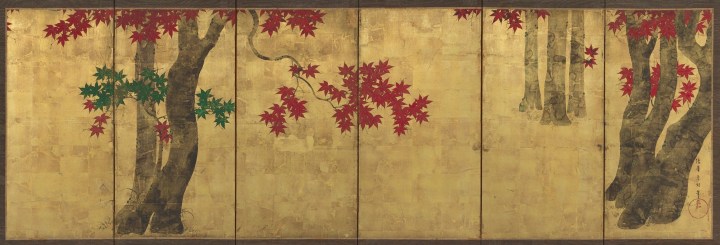
Tawaraya Sōri, Autumn Maple Trees, painted screen, second half of the eighteenth century
(Feinberg Collection, TL42147.39)
◊ ◊ ◊ ◊ ◊
Press release (3 February 2020) for the exhibition:
Painting Edo: Japanese Art from the Feinberg Collection
Harvard Art Museums, 14 February — 18 July 2021
Curated by Rachel Saunders and Yukio Lippit
Beginning February 14, 2020, the Harvard Art Museums present Painting Edo: Japanese Art from the Feinberg Collection, a special exhibition of more than 120 of the finest works from the preeminent collection of Robert S. (Harvard class of 1961) and Betsy G. Feinberg; the exhibition runs through July 26, 2020. Painting Edo offers a window onto the supremely rich visual culture of Japan’s early modern era and explores how the Edo period (1615–1868), and the city of Edo (present-day Tokyo), expressed itself during a time of artistic renaissance. A striking array of paintings in all the major formats will be on display—hanging scrolls, folding screens, sliding doors, fan paintings, and woodblock-printed books, among others—from virtually every stylistic lineage of the era, telling a comprehensive story of Edo painting on its own terms.
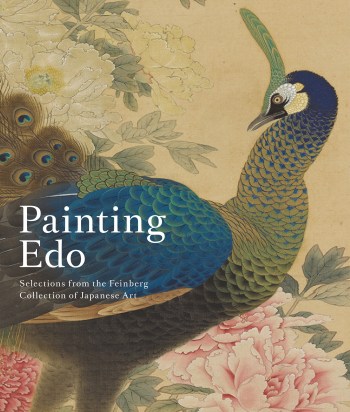 Painting Edo, organized by the Harvard Art Museums, is co-curated by Rachel Saunders, the Abby Aldrich Rockefeller Curator of Asian Art at the Harvard Art Museums, and Yukio Lippit, the Jeffrey T. Chambers and Andrea Okamura Professor of History of Art and Architecture at Harvard University. The exhibition will be on view exclusively at the Harvard Art Museums; an illustrated publication by Saunders and Lippit accompanies the show.
“Painting Edo is one of the largest exhibitions ever presented at the Harvard Art Museums—and fittingly so, since the Feinberg Collection is one of the largest gifts of art ever promised to this institution,” said Martha Tedeschi, the Elizabeth and John Moors Cabot Director of the Harvard Art Museums. “We are immensely grateful to the Feinbergs, whose great care and vision will ensure that the beauty and material ingenuity of these works reach viewers today and for generations to come.”
Robert S. and Betsy G. Feinberg generously promised their collection of more than 300 works of Japanese art to the Harvard Art Museums in 2013. Judiciously assembled over nearly fifty years, the collection—the finest private collection of Edo period Japanese painting in the United States—offers an exceptional opportunity to explore continuities and disruptions in artistic practice in early modern Japan. The museums’ stewardship of the collection ensures access by students, faculty, scholars, and the public, and allows for teaching, research, and further documentation of these important works.
The Feinberg Collection is notable not only for its size and remarkable quality, but also for its comprehensiveness. It comprises representative paintings from virtually every stylistic lineage of the era: from the gorgeous decorative works of the Rinpa School to the luminous clarity of the Maruyama-Shijō School, from the monochromatic indexes of interiority of so-called Nanga, or Southern School, painting to the actors and courtesans of the pleasure quarters depicted in ukiyo-e, to the inky innovations of the so-called eccentrics. A complete catalogue of the Feinberg Collection will be published by the museums in late summer 2020.
 Over the last five years, since the museums reopened in 2014, select objects from the Feinberg Collection have been on display in extended thematic installations in the East Asian gallery on Level 2. The rotating presentation of these works was designed not only to introduce strengths of the collection to visitors, but also to broaden access for teaching and research. These initial installations provided a preview of the amazing range of works now united in the powerhouse Painting Edo exhibition.
“I had the pleasure of meeting the Feinbergs and viewing their collection for the first time in the late 1990s while I was a student,” said Professor Lippit. “That experience gave me an appreciation for the study of new objects and cultural histories, and since becoming a faculty member at Harvard I have been actively teaching with the Feinberg Collection, inviting students to view and discuss the paintings.”
Painting Edo begins in the Special Exhibitions Gallery on Level 3 and expands into three adjacent galleries typically reserved for installations that support university coursework. This is the first time the museums mount a single exhibition across all four spaces. Visitors are greeted by Tani Bunchō’s Grasses and Moon (1817), a large painting that encapsulates the Japanese tradition of moon-viewing, before being immediately enveloped by Sakai Hōitsu’s Birds and Flowers of the Twelve Months (c. 1820–28), a stunning group of 12 hanging scrolls that together create a paradisal garden in which all the seasons flower simultaneously. From this introductory gallery, visitors are encouraged to wander at will to discover the major schools and styles of painting. Galleries are organized to reflect Edo period conceptions of lineage, offering a view of how “Edo” was articulated by and for its own creators and consumers.
“The Feinbergs have collected so carefully and with such dedication over the years that they have formed a truly comprehensive collection,” said Saunders. “That is particularly significant for us as a teaching museum because it allows us to look at the whole gamut of Edo painting within the exhibition, including virtually every major lineage and painting format.”
Additional Highlights
• Maruyama Ōkyo’s Peacock and Peonies (1768), a hanging scroll with a resplendent peacock rendered with Western-style anatomical precision against a luxuriant background of peonies [Intro section]
• A Portuguese Trading Ship Arrives in Japan (17th century), a pair of six-panel folding screens that depicts the arrival of a ship into port and the procession of its captain into town, an annual voyage made by the Portuguese to trade silver, silks, and spices [Floating Worlds section]
• Tawaraya Sōri’s Autumn Maple Trees (second half 18th century), one of only a handful of works that survive by the artist and widely regarded as his masterpiece [School of Kōrin section]
• Ikeno Taiga’s The Poet Su Shi and Meng Jia Loses His Hat (18th century), a pair of six-panel folding screens depicting two renowned figures in acts of elegant disregard for societal norms [Eccentricity section]
• Lotus in Autumn (1872), a wildly brushed hanging scroll by the female artist Okuhara Seiko, whose Chinese-style ink paintings became hugely popular in the years immediately following the Meiji Restoration of 1868, a time that ushered in Japan’s modern era [Remembering Edo section]
• Twenty fans by Suzuki Kiitsu, displayed against a deep blue backdrop, evoking the moment at the end of summer when Japanese men and women would cast their used fans into the river in celebration of the arrival of autumn [Remembering Edo section]
A rotation of select exhibition objects will take place between May 4 and 7 to preserve light-sensitive works as well as to add other fine examples of painting. Galleries will remain open to the public on these dates.
Publications
Two catalogues will be released in conjunction with the exhibition, both published by the Harvard Art Museums and distributed by Yale University Press. The first, Painting Edo: Selections from the Feinberg Collection of Japanese Art, is a companion to the exhibition; it offers a sweeping and lavishly illustrated overview of a transformative era in Japanese art-making as told through superb examples from the finest private collection of Edo period painting in the United States. It includes essays by Rachel Saunders and Yukio Lippitt. The second book, a comprehensive Catalogue of the Feinberg Collection of Japanese Art, will be published in late Summer 2020. Edited by Rachel Saunders, the volume includes new photography and commentary from a range of authors on each of the more than 300 works in the Feinberg Collection.
Rachel Saunders and Yukio Lippit, Painting Edo: Selections from the Feinberg Collection of Japanese Art (Cambridge: Harvard Art Museums, 2020), 180 pages, ISBN: 978-030025089, $35.
Rachel Saunders, ed., Catalogue of the Feinberg Collection of Japanese Art (Cambridge: Harvard Art Museums, 2020), 264 pages, ISBN: 978-0300250909, $65.










 Enfilade
leave a comment