Call for Papers | Beyond the Academy: Architectural History
From the Call for Papers:
The Society of Architectural Historians of Great Britain Architectural History Workshop
Beyond the Academy: Architectural History in Heritage, Conservation, and Curating
The Gallery, 70 Cowcross Street, London, 21 March 2020
Proposals due by 17 January 2020
The Society of Architectural Historians of Great Britain (SAHGB) invites presentation proposals for the Architectural History Workshop in 2020. This is our annual event for postgraduate students and early career professionals to share and develop their ideas; it aims to provide an informal and supportive space away from your own institution where you can discuss, debate, practice and enjoy the company of like-minded researchers and scholars working within the history of the built environment, broadly conceived. The theme of this year’s Workshop is Beyond the Academy: Architectural History in Heritage, Conservation, and Curating. Architectural history is practised in a number of fora: in academia, heritage, museums and collections. Academic research and skills have uses beyond the academy and in a competitive and precarious job market, architectural historians need to be open to a wide set of potential career paths.
We welcome doctoral students and early career professionals in architectural history, heritage, conservation, etc. The event is limited to postgraduate students (full-time or part-time) and early career professionals (those who have completed their postgraduate qualification within the last 5 years). Sessions will be structured to reflect the diversity of presentation styles needed for contemporary practice in architectural history, rather than in themes. Break-out sessions will be facilitated by a panel of invited professionals and scholars to be announced in due course.
This year we are encouraging scholars to present their research in ways that encourage discursive engagement. Research may be at any stage, from a proposal, final work as you write-up, post- doctoral reflections, or anything in-between.
We invite participation in a number of presentation styles including:
• Object-based and/or single-image presentations
• Reports or heritage statements
• Methodological reflections
Proposals can be for either
• 10-minute presentations
• Conference posters (A3 sheet in a standard format)
We welcome research on all periods and all places relating to the study of buildings, the built environment and associated histories that address a full range of methodological approaches to architectural history. All disciplinary approaches are welcome, including but by no means limited to:
• Architecture and Theory
• Urban History, Histories of Architectural Ecologies
• Art History, Material and Visual Culture
• History, Social and Cultural History
• Archaeology, Anthropology, Geography
• Heritage and Conservation of the Built Environment
Proposals should be no longer than 250 words, and indicate whether they are for posters or presentations. If you are interested in making a contribution, please complete the submission form on our website. The closing date for applications is Friday 17 January 2019. The result of all applications will be communicated by Friday, 1 February, with confirmation from the speakers requested by the second week of February. The Workshop will take place on Saturday, 21 March at The Gallery, 70, Cowcross Street, London, EC1M 6EL. No funding is available and a contribution of £10 is requested from all attendees to cover costs (inclusive of all catering). For further information or clarification of any sort please contact the conference organizers at ahw@sahgb.org.uk.
The Burlington Magazine, December 2019
The eighteenth century in The Burlington:
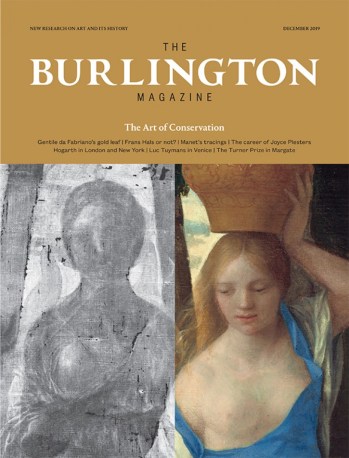
The Burlington Magazine 161 (December 2019)
 A R T I C L E S
• François Marandet, “A Modello by James Thornhill for Addiscombe House, Surrey,” pp. 1028–33. An oil sketch in the Musée des Beaux-Arts, Rouen, is here identified as James Thornhill’s modello for the ceiling painting of the staircse hall at Addiscombe House, near Croyden, begun c.1702 and demolished in the 1860s. It depicts the classical gods as an allegory of the days of the week.
R E V I E W S
• Charles Avery, Review of the exhibition Forged in Fire: Bronze Sculpture in Florence under the Last Medici (Palazzo Pitti, 2019–20), pp. 1044–47.
• David Bindman, Review of the exhibition, Hogarth: Cruelty and Humor (Morgan Library and Museum, 2019), pp. 1047–48.
• Brian Allen, Review of the exhibition Hogarth: Place and Progress (Sir John Soane’s Museum, 2019–20), pp. 1048–51.
• Emily M. Weeks, Review of the exhibition Inspired by the East: How the Islamic World Influenced Western Art (British Museum, 2019–20), pp. 1051–53.
• Xavier F. Salomon, Review of the exhibition Luigi Valadier: Splendour in Eighteenth-Century Rome (Galleria Borghese, 2019–20), pp. 1053–55.
• Clare Hornsby, Review of Robin Simon and MaryAnne Stevens, eds., The Royal Academy of Arts: History and Collections (Yale University Press, 2018) and Nicholas Savage, Burlington House: Home of the Royal Academy of Arts (Royal Academy of Arts, 2018), pp. 1060–61.
• Jörg Zutter, Review of Chris Fischer, Venetian Drawings: Italian Drawings in the Royal Collection of Graphic Art (Statens Museum fur Kunst, National Gallery of Denmark, 2018), p. 1064.
• Thomas Stammers, Review of Charlotte Guichard, La griffe du peintre: La valeur de l’art, 1730–1820 (Seuil, 2018), pp. 1066–67.
• Richard Stephens, Review of Wayne Franits, Godefridus Schalcken: A Dutch Painter in Late Seventeenth-Century London (Amsterdam University Press, 2018), p. 1074.
O B I T U A R Y
• Anthony Geraghty, Kerry Downes (1930–2019), p. 1075.
Exhibition | Luigi Valadier: Splendour in Eighteenth-Century Rome
Now on view at the Galleria Borghese . . . Of the 72 objects included, only 22 were included in the related Frick exhibition, as noted by Xavier Salomon in his review for The Burlington (December 2019), p. 1053.
Luigi Valadier: Splendour in Eighteenth-Century Rome
Galleria Borghese, Rome, 30 October 2019 — 2 February 2020
Curated by Anna Coliva
 Ma ciò che la mostra vuole esaltare è la possibilità davvero unica di ammirare le opere del grande artefice all’interno di un contesto decorativo, quale quello della Villa Borghese, capace di restituire, di per sé, quella particolare compresenza di pittori, scultori e artigiani che l’architetto Antonio Asprucci aveva diretto nel rinnovamento del Palazzo di città e della Villa voluto dal principe Marcantonio IV Borghese; artisti che, nei medesimi anni, non solo avevano condiviso molte delle principali imprese artistiche romane ma i cui rapporti diretti con Luigi Valadier sono ampiamente documentati: è il caso, solo per fare un esempio, dell’intagliatore di marmi Lorenzo Cardelli, già nella bottega di Piranesi, che con il grande orafo collaborerà tanto nell’esecuzione del camino della Sala XVI, decorato con applicazioni in bronzo di Valadier, quanto nella realizzazione di manufatti destinati alla committenza anglosassone.
La Villa, che custodisce alcuni dei capolavori, come l’Erma di Bacco e la coppia di Tavoli dodecagonali, sintetizza così il gusto dominante a Roma intorno alla metà del secolo, dove i raffinati apparati decorativi risplendono di un declinante rococò che coesiste con le nuove tendenze stilistiche ispirate all’antico. Di questo particolare contesto culturale, nel senso più ampio, Valadier è protagonista assoluto.
Se la committenza Borghese costituì il filo conduttore dell’attività di Valadier, il rango e il numero dei committenti rivelano lo straordinario successo della sua carriera di orafo e argentiere, esaltando la vastità di campo, l’originalità e l’impronta internazionale della sua produzione, che la mostra intende rappresentare con importanti testimonianze. I prestiti spaziano dalle grandi lampade d’argento per il santuario di Santiago di Compostela, al San Giovanni Battista del Battistero Lateranense, per la prima volta visibili fuori della loro collocazione originale; dal servizio per pontificale della cattedrale di Muro Lucano alle sculture della cattedrale di Monreale; e, ancora, saranno esposte le riproduzioni in bronzo di celebri statue antiche per re Gustavo III di Svezia, Madame du Barry e il conte d’Orsay; il mirabile sostegno del cammeo di Augusto, realizzato su commissione di Pio VI per il Museo Sacro e Profano in Vaticano, oltre alle straordinarie invenzioni dei superbi desert, come quello commissionato dal Balì di Breteuil e poi venduto a Caterina II di Russia, oggi a San Pietroburgo, e la ricostruzione del tempio di Iside a Pompei per Maria Carolina d’Austria.
Una importante sezione sarà dedicata ai disegni, strumento fondamentale per comprendere l’evolversi del procedimento creativo di Valadier e la sua traduzione attraverso l’attività della grande e articolata bottega. Il prezioso volume della Pinacoteca Comunale di Faenza, per la prima volta interamente catalogato in occasione della mostra, ne offre una rassegna variegata, che sarà apprezzabile anche attraverso riproduzioni digitali. I disegni offrono inoltre la testimonianza di opere oggi disperse, come il sontuoso servizio in argento dorato realizzato per i Borghese, i cui pochi oggetti giunti fino a noi saranno riuniti in questa occasione.
In mostra saranno presenti alcuni totem multimediali dedicati ai Luoghi di Luigi Valadier a Roma: siti, chiese, palazzi e ambienti che conservano le sue opere o comunque significativi, come la casa-studio in via del Babuino. Un invito a trasferire questo percorso virtuale nella realtà, per comprendere meglio quel Valadier “romano”, decoratore nella più splendida e “moderna” Villa di delizie della città eterna, ma espressione di quel gusto internazionale che da Roma partiva per diffondere un gusto ricercato e imitato in tutta Europa.
Geraldine Leardi, ed., Valadier: Splendore nella Roma del Settecento (Milan: Officina Libraria, 2019), 376 pages, 978-8833670638, 48€.
New Book | Dress in the Age of Jane Austen: Regency Fashion
From Yale UP:
Hilary Davidson, Dress in the Age of Jane Austen: Regency Fashion (New Haven: Yale University Press, 2019), 336 pages, ISBN: 978-0300218725, $40.
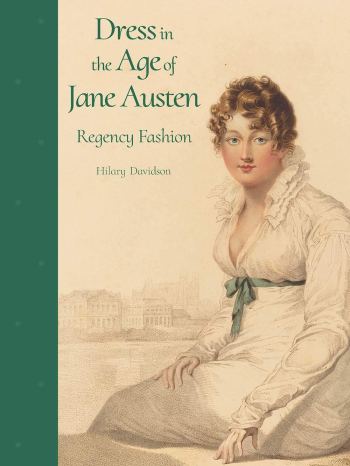 A comprehensive and beautifully illustrated examination of dress, clothing, fashion, and sewing in the Regency seen through the lens of Jane Austen’s life and writings
This lively book reveals the clothing and fashion of the world depicted in Jane Austen’s beloved books, focusing on the long Regency between the years 1795 and 1825. During this period, accelerated change saw Britain’s turbulent entry into the modern age, and clothing reflected these transformations. Starting with the intimate perspective of clothing the self, Dress in the Age of Jane Austen moves outward through the social and cultural spheres of home, village, countryside, and cities, and into the wider national and global realms, exploring the varied ways people dressed to inhabit these environments. Jane Austen’s famously observant fictional writings, as well as her letters, provide the entry point for examining the Regency age’s rich complexity of fashion, dress, and textiles for men and women in their contemporary contexts. Lavishly illustrated with paintings, drawings, historic garments, and fashion plates—including many previously unpublished images—this authoritative yet accessible book will help readers visualize the external selves of Austen’s immortal characters as clearly as she wrote of their internal ones. The result is an enhanced understanding of Austen’s work and time, and also of the history of one of Britain’s most distinctive fashion eras.
Hilary Davidson is a dress and textile historian based between Britain and Australia, and an Honorary Associate at the University of Sydney. She has curated, lectured, broadcast, and published extensively in her field.
Attingham Offerings for 2020
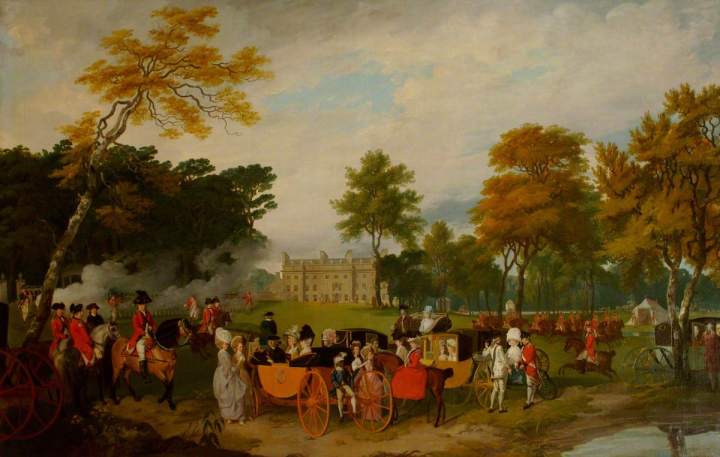
Francis Wheatley, The Earl of Aldborough Reviewing Volunteers at Belan House, County Kildare, 1782 (later changes ca.1787 and extended ca.1810), oil on canvas, 155 × 265 cm (National Trust, Waddesdon Manor, bequeathed by James de Rothschild, 1957).
◊ ◊ ◊ ◊ ◊
Next year’s Attingham offerings:
The Attingham Study Programme: The Historic House in Ireland, 3–11 June 2020
Applications due by 27 January 2020
This intensive nine-day study programme will examine the Irish country house and its wider estate, in the context of its changing ownership and presentation. Some visits will focus on houses with original decorative schemes and collections, allowing members to study the unique features of Irish design, while others will look at houses as the setting for outdoor and leisure pursuits.
The programme’s first base will be the Centre for the Study of Historic Irish Houses and Estates at the University of Maynooth, from where it is planned to visit Carton House and Castletown House, both significant Palladian villas, whose interior decoration was conceived by the Lennox sisters; the latter complemented by a series of rare estate buildings and monuments. We will also explore the Casino at Marino, Newbridge House, and Leixlip Castle, Co. Kildare, bought by the Hon. Desmond Guinness in 1958, and from where the Irish Georgian Society was founded.
The course will travel south to Cork through Waterford via Monksgrange House in Co. Wexford, where Irish Arts and Crafts furniture was made in the 1920s and which has a delightful ‘Lutyenesque’ garden. There will also be a short visit to the Dunbrody Famine Ship at New Ross which carried thousands of emigrants to North America in the 1840s. From Cork the Neo-Classical interiors at Fota House will be explored, as well as the romantic waterside retreat of Bantry House on the south-west coast. We also plan to visit Curraghmore, home of the Marquess of Waterford, whose ancestors arrived in 1170, and Lismore Castle, the seat of the Devonshires in Ireland.
The study programme will be directed by Elizabeth Jamieson and will include visits to other privately-owned houses as well those listed. It will be supported by a series of lectures and seminars delivered by expert speakers. The course will start and finish in the historic city of Dublin.
69th Attingham Summer School, 2–19 July 2020
Applications due by 27 January 2020
The 69th Attingham Summer School, an 18-day residential course directed by David Adshead and Tessa Wild, will visit country houses in Sussex, Oxfordshire, Derbyshire, Northamptonshire, and Norfolk. From West Dean, our first base, we will study, among other houses and gardens: the complex overlays of Arundel Castle, the ancestral seat of the Dukes of Norfolk; Petworth House, where the patronage of great British artists such as Turner and Flaxman enrich its Baroque interiors; Uppark, a Grand Tour house; Standen, an Arts and Crafts reinterpretation of the country house.
In the Midlands a series of related houses will be examined: Hardwick Hall, unique among Elizabethan houses for its survival of late 16th-century decoration and contents; Bolsover Castle, a Jacobean masque setting frozen in stone; and Chatsworth, where the collections and gardens of the Dukes of Devonshire span more than four centuries. Other highlights include the superb collections and landscaped gardens at Boughton House, ‘the English Versailles’; Calke Abbey, with its left ‘as found’ interiors; and the crisp neo-Classical Kedleston Hall.
Based in Norwich, the final part of the course will explore the estates and collections of Norfolk, a coastal county of rich contrasts and exceptional houses. Our itinerary will include Blickling, the fine Jacobean house of Sir Henry Hobart and later of the Earls of Buckingham, renowned for its Long Gallery and superb book collection; Felbrigg Hall, a 17th-century house with important Grand Tour collections and mid 18th-century interiors by James Paine; Houghton Hall, the great Palladian country seat of Sir Robert Walpole the first ‘Prime Minister’, with its unrivaled work by William Kent; and Sheringham Park, a favorite work of Humphry Repton, for which he produced one of his famous Red Books.
Throughout the course, lectures, seminars, and discussions will be held on all aspects of the country house including conservation and restoration, display and interpretation. Several private houses and collections will also be visited.
Royal Collection Studies, 6–15 September 2020
Applications due by 7 February 2020
Directed by Rebecca Lyons and run on behalf of Royal Collection Trust, this strenuous 10-day course is based near Windsor and will visit royal palaces in and around London with specialist tutors (many from the Royal Collection Trust) and study the patronage and collecting of the Royal Family.
From College Library to Country House, 14–18 September 2020
Applications due by 12 February 2020
From College Library to Country House is conceived from the perspective of the British aristocracy and gentry whose education centered upon preparing to run the country estate, including house and collections, and will argue for the importance of the library and the book collection in this process. This intensive residential course is based in the exceptional surroundings of Clare College in the center of the University of Cambridge. Directed by Andrew Moore, the programme focuses upon a series of iconic libraries including those at Houghton Hall and Holkham Hall.
French Eighteenth-Century Studies at the Wallace Collection, 5–9 October 2020
Applications due by 25 February 2020
Directed by Helen Jacobsen, this 5-day non-residential program aims to foster a deeper knowledge and understanding of French 18th-century fine and decorative art. Based at the Wallace Collection with one full study day at Waddesdon Manor this course is intended primarily to aid professional development with object-based study.
The Wallace’s History of Collecting Seminars, 2020
Next year at The Wallace:
History of Collecting Seminars
The Wallace Collection, London, 2020
The History of Collecting seminar series was established as part of the Wallace Collection’s commitment to the research and study of the history of collections and collecting, especially in the eighteenth and nineteenth centuries in Paris and London. The seminars are free, no bookings required; each begins at 5.30pm. To join the History of Collecting mailing list and receive updates on the future programme, please email your interest to collection@wallacecollection.org.
Monday, 27 January
Camilla Pietrabissa (Associate Lecturer, Bocconi University, Milan), From Nature: Jean-Baptiste Oudry and the Taste for Landscape Paintings under Louis XV
Monday, 24 February
Errol Manners (Dealer in Historic Ceramics), The Mystery of Redwares in Princely Collections
Monday, 30 March
Janet M. Brooke (Independent Scholar, Montreal), The Gilded Age in Canada: Reconstructing the Life and Afterlife of the Sir William Van Horne Collection
Monday, 27 April
Ellinoor Bergvelt (Guest Researcher University of Amsterdam / Research Fellow, Dulwich Picture Gallery), The Dutch King Willem II (1792–1849) as Collector and Source of Some Important Pictures in the Wallace Collection
Monday, 18 May
Arthur Bijl (Assistant Curator of Ottoman, Middle Eastern and Asian Arms and Armour, The Wallace Collection), Marvels in Lucknow: ‘Ajab and Asaf al-Dawla’s Collection of Curiosities
Monday, 29 June
Krystle Attard Trevisan (PhD Candidate, Institute of English Studies, School of Advanced Study, University of London), The ‘Primo Costo’ Inventory of Count Saverio Marchese (1757–1833): Mapping the Print Market in Malta and its European Connections
Monday, 27 July
Sara Ayres (Independent Scholar, London), Descriptions of Collections and Their Display at the Stuart Court in 1669 in a Manuscript Account of Prince George of Denmark’s Grand Tour, 1668–1670
Monday, 28 September
Heike Zech (Head of Decorative Arts before 1800 and History of Craft, Germanisches Nationalmuseum, Nuremberg), Germanic and Gentle? The Foundation and Early Collections of the Germanisches Nationalmuseum in Nuremberg
Monday, 26 October
Valérie M. C. Bajou (Chief Curator, Versailles Palace), The Paintings by Horace Vernet in Louis-Philippe’s Private Collection: Commission, Purpose, Display, and Destination
Monday, 30 November
Helen Jacobsen (Senior Curator, The Wallace Collection), Creating a Market: Dealers, Auctioneers, and the Passion for Riesener Furniture, 1800–1882
Exhibition | Fiji: Art & Life in the Pacific
Press release (19 November 2019) for the exhibition (noted previously here). . .
Fiji: Art & Life in the Pacific
Sainsbury Centre, Norwich, 15 October 2016 — 12 February 2017
Los Angeles County Museum of Art, 15 December 2019 — 19 July 2020
Peabody Essex Museum, Salem, Massachusetts, 12 September 2020 — 3 January 2021
Curated by Steven Hooper, Karen Jacobs, Katrina Igglesden, and Nancy Thomas

Double Portable Temple (bure kalou), Fiji, early 19th century; coir, wood, reed, and shells, 44 × 25 × 21 inches (Salem, Massachusetts: Peabody Essex Museum, gift of Joseph Winn Jr. in 1835, photo by Jeffrey Dykes).
The Los Angeles County Museum of Art presents Fiji: Art & Life in the Pacific, the first substantial project on the art of Fiji to be mounted in the U.S. The exhibition features over 280 artworks drawn from major international collections, including Fiji Museum, the British Museum, the Museum of Archaeology and Anthropology (Cambridge), the Smithsonian, and distinguished private collections. The exhibition includes figurative sculpture, ritual kava bowls, breastplates of pearl shell and whale ivory, large-scale barkcloths, small portable temples, weapons, and European watercolors and paintings. Additionally, Fiji: Art & Life in the Pacific showcases historical photographs from LACMA’s recently acquired Blackburn Collection, as well as a newly commissioned 26-foot double-hulled sailing canoe (drua) constructed in Fiji using traditional materials and techniques.
Fiji: Art & Life in the Pacific was organized and curated by Professor Steven Hooper, Dr. Karen Jacobs, and Ms. Katrina Igglesden at the Sainsbury Centre in Norwich, England, where it was on view October 15, 2016–February 12, 2017. The exhibition has been reformatted for the presentation at LACMA, with additional major loans from U.S. collections. The exhibition at LACMA is curated by Nancy Thomas, senior deputy director, art administration and collections at LACMA, with support from the organizing curators.
“LACMA is pleased to collaborate with Professor Steven Hooper and his colleagues from the Sainsbury Centre, Norwich,” said Nancy Thomas. “Research for the project was informed by over 40 years of collaboration with Indigenous Fijian and international scholars and support from the UK’s Arts & Humanities Research Council and the Fijian government, resulting in this deeply researched and comprehensive exhibition.”
Fiji: Art & Life in the Pacific is presented in the Lynda and Stewart Resnick Exhibition Pavilion, a major expansion of LACMA’s campus made possible through a landmark gift from trustee Lynda Resnick and Stewart Resnick, the philanthropists and entrepreneurs behind The Wonderful Company and FIJI Water. Since the Resnick Pavilion opened in 2010, its reconfigurable galleries have hosted nearly 50 significant exhibitions covering a diverse cross-section of art history. FIJI Water is the presenting sponsor of the exhibition.
“It’s an honor to be able to share the beauty of Fijian arts and culture through this stunning exhibition,” said LACMA CEO and Wallis Annenberg Director Michael Govan. “We’re pleased to present this show in the Resnick Pavilion, which has become the heart of LACMA’s campus. I’m deeply grateful to Lynda and Stewart for their commitment to bringing this important exhibition to the U.S., and for their incredible legacy benefiting the larger cultural community of Los Angeles.”
“Fiji holds a very special place in our hearts, and Stewart and I are gratified to support this exhibition,” said Lynda Resnick, vice chair and co-owner of The Wonderful Company. “It is our hope that these works from across the archipelago will help visitors fully appreciate the country’s magnificent culture.”
Following the presentation at LACMA, the exhibition will be on view at the Peabody Essex Museum in Salem, Massachusetts, from September 12, 2020 through January 3, 2021. FIJI Water is also presenting sponsor of the Peabody Essex Museum presentation. In addition, generous support from FIJI Water funded the construction of the drua and its transportation from Fiji to Los Angeles.
Consisting of an archipelago of more than 300 islands, Fiji’s landscape is rich, with fertile soils on most islands providing ample food crops and lagoons with extensive reef systems supplying fish and shellfish. The local environment produced the majority of materials represented in the exhibition, including a wide variety of timbers for housing, canoes, and weapons; plant materials for textiles, mats, roofing, ropes, and bindings; clay, bamboo, and coconuts for containers; and shells and other marine materials for adornments.
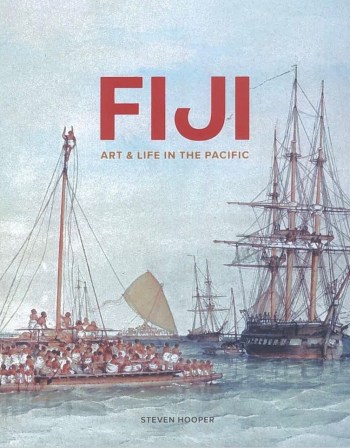 Fiji: Art & Life in the Pacific showcases the range and quality of these artworks from the past two centuries and highlights the skill and creative adaptability of the artists and craftspeople who made them. The exhibition presents these artworks in eight thematic sections, including: Voyaging, Fiber and Textile Arts, Warfare, Embodying the Ancestors, Adorning the Body, Chiefly Objects, Respecting the Ancestors, and Fiji Life. The later section illustrates 19th-century Fiji with 22 remarkable photographs including studio portraits, landscapes, architecture, and other features of daily life.
The first section, Voyaging, focuses on the role and implements of travel by sea. Nearly 3,000 years ago, explorers likely from the current region of Vanuatu, undertook a 500-mile voyage before settling in Fiji. Subsequent migrations took place, with voyagers settling on the two main islands Viti Levu and Vanua Levu, while others inhabited outer islands where canoe transport was essential. In the 18th century, immigrant Samoan and Tongan canoe builders working for Fijian chiefs introduced a new Micronesian-style rig which led to the development of massive double-hulled canoes in the 19th century, often measuring more than 100-feet long. Fast-moving canoes were used for regional transport and for fishing, while spears and nets were the main fishing methods in Fiji in the 19th century. In addition to fishing equipment, this section features a contemporary drua (double-hulled sailing canoe). Without a fixed bow or stern, drua can sail in either direction by adjusting the mast and sail. They provided open-ocean transport and troop transportation in times of warfare. The drua featured in LACMA’s exhibition was commissioned as a heritage project in Fiji to encourage the retention of canoe-building skills. It has no metal components and is made from local timber with coconut-husk-fiber lashings, shell decorations, and a pandanus-leaf matting sail.
Fiber and textile arts were and remain today a significant aspect of Fijian culture. Masi is the Fijian word for the paper mulberry tree as well as for the cloth made from its inner bark. To produce it, the bark is stripped from young tree saplings and the inner bark is separated and soaked in water. The bark is then beaten into thin sheets, layered and folded and joined to make cloths of any size. Masi can then be decorated by stenciling, rubbing, or painting. Large presentation cloths have been made for investitures, weddings, or state gifts. A striking three-piece barkcloth attire, an example of which is on view in this section, could be worn by both men and women on important ceremonial occasions. Other textile arts included elaborate woven mats, which could be used as prestige gifts; as well as rectangular baskets and fans which showed off virtuoso weaving techniques and served as popular exchange items.
Warfare was frequent in Fiji until the mid-19th century and the country continues to maintain a proud martial tradition. More than weapons, Fijian clubs and spears are ritual objects and expressions of supreme carving and military skill. The multiple clubs on view in this section represent the widest range of their design. A club or two was the expected accoutrement for active Fijian men, and pomp and display were important aspects of military action. Combat was traditionally preceded by vigorous parading, performance, and boasting.

Double Figure Hook, Fiji/Tonga, 18th to early 19th century; sperm whale ivory, fiber, and glass beads, 5 inches (Museum of Archaeology and Anthropology, University of Cambridge, collected by Sir Arthur Gordon, Viti Levu, 1876, 1955.247).
A section of the exhibition is dedicated to works embodying the ancestors. While it seems that figures were not worshipped as deities, they were kept in temples and shrines as embodiments of deified deceased individuals, usually ancestors. Figures from the 19th century are rare from Fiji, with just a few dozen examples, some preserved in Fiji Museum, Suva. There appear to be two basic figure types, standing figures with bases or pegs, and those incorporated into hooks used for suspending offerings. This section features one of only three known surviving double-figure hooks made of whale ivory, collected in 1876 by the first resident British governor of Fiji, Sir Arthur Gordon. Field reports refer to such hooks as “the most revered of all objects.”
Adorning the body was an aspect of Fijian ceremony and expression and included necklaces, pendants, and other precious wares. Key forms of personal ornament shown in this section are whale-ivory and pearl-shell breastplates, valued for their subtle design variations and alluring reflective and color properties, which were suited for chiefly wear. Fijians themselves did not hunt whales, but obtained teeth from sperm whales stranded on local reefs and beaches and from European traders in the 19th century. As a result, whale ivory was the basis for many other forms of ‘valuables’, retained or gifted at events or occasions of social exchange. Sperm whale teeth were sawn vertically and horizontally to produce thin “tusks” which were strung closely together to create striking necklaces.
The section on chiefly objects highlights the tabua, the most significant Fijian valuable. Made from a sperm whale tooth that had been oiled, smoked, polished, and fitted with a coconut-husk fiber cord, it is presented as a gift on important occasions. At such occasions, the donors and recipients hold the tabua in their hands and make formal speeches to acknowledge the participants and explain the purpose of the offering. For Fijians, whale teeth were symbolically associated with the cosmological power of the sea and of chiefs. This section also examines the cultural importance of yaqona, an important drink known generally in the Pacific as kava. The pounded or powdered root of a species of pepperbush is mixed with fresh water in a large wooden bowl, then served with respectful formality to guests in coconut-shell cups. Though yaqona is nonalcoholic, it has relaxing properties and is still consumed by Fijians formally or socially on occasions when relatives or friends gather. Other forms of chiefly regalia are showcased in this section, including finely carved clubs and elaborate headrests.
A number of works in the exhibition provide insight into traditional Fijian Life. This section highlights implements for the making of masi, an adze for cracking of ivi nuts, a bamboo tube for the transportation of water, and an end-blown trumpet for multiple forms of communication. A key domestic object was the bar headrest, made of single or multiple pieces of wood, which offered air circulation and protection for hairdos on tropical nights for sleepers reclining on woven mats. Other works in this section include pottery such as elaborate multi-chambered vessels that often took the shape of natural forms including turtles or citrus fruits. They were rubbed with hot resin from dakua trees to achieve a glossy varnish.
Religious observance in the early 19th century focused mainly on divine ancestors to whom temples were dedicated rather than creator gods, as found in many other areas of the world. In Fiji there was a direct correlation between divine power and phenomena that affected human life, such as rain, drought, crop fertility, and especially illness. Accordingly, there was a very practical aspect to Fijian ritual, which involved prayers, chants, sacrificial offerings, obeisance, and other forms of worship in order to please the gods and elicit from them desired outcomes. The section Respecting the Ancestors features model temples which duplicate the architecture of full-scale temples and were possibly taken as portable shrines on canoe voyages. They are made of great lengths of coconut-husk-fiber cordage and their elaborate construction was a form of sacrifice and skilled sacred work. In pre-Christian ritual, yaqona was made in concentrated form for consumption by priests, who sucked it through a reed tube from a shallow dish, some of which had elaborately carved pedestals. A wide range of these dishes are included in this section, along with rare anthropomorphic bowls presenting human or animal-like characteristics.
The exhibition also presents a remarkable display of period photographs from Fiji. Nineteenth-century photographs of the Pacific were produced by foreign travelers, commercial entrepreneurs, and professional photographers, most often men from New Zealand, Australia, Canada, and Britain. Works in this section come from LACMA’s extensive collection of Pacific photography, which includes several hundred photographs, albums, cartes-de-visite, and stereographic photos of Fiji. Many images are examples of staged studio portraiture—they capture traditional dress, weapons, and hairstyles, yet impose a colonial perspective on the sitter. Additional images document landscapes and architecture or feature aspects of daily life. As photo archives are digitized and more widely shared, it is anticipated that continuing research will help others find the relatives of original subjects, to reclaim details of lost traditions, and to communicate the rich history of the region.
Steven Hooper, Fiji: Art & Life in the Pacific (Norwich: University of East Anglia, 2016), 288 pages, ISBN: 978-0946009701, $40.
New Book | Shopping Spaces and the Urban Landscape
From Amsterdam UP:
Clé Lesger, Shopping Spaces and the Urban Landscape in Early Modern Amsterdam, 1550–1850 (Amsterdam: Amsterdam University Press, 2020), 268 pages, €119.
 In this study, the appearance and location of shops in Amsterdam during the early modern period is linked to major changes in the urban economy, the size and socio-spatial distribution of its population, and the structure of the urban grid. Not only is there ample attention for the spatial distribution of shops across the urban landscape, but for the first time it is also accurately charted what the exterior and interior of Amsterdam shops actually looked like and how they changed in the course of the centuries. Partly as a result of this, it has proved possible to give an impression of the ways in which retailers and customers interacted.
Clé Lesger is an associate professor of economic and social history at the University of Amsterdam. His main fields of interest are urban history in general, the retailing industry, and patterns of land-use and residential segregation in early modern and modern cities. Recently he published a history of retailing in Amsterdam (1550–2000) and co-edited with Jan Hein Furnée The Landscape of Consumption: Shopping Streets and Cultures in Western Europe, 1600–1900 (Palgrave 2014).
New Book | Art, Trade, and Imperialism in Early Modern French India
From Amsterdam UP:
Liza Oliver, Art, Trade, and Imperialism in Early Modern French India (Amsterdam: Amsterdam University Press, 2019), 260 pages, ISBN: 978-9463728515, €99.
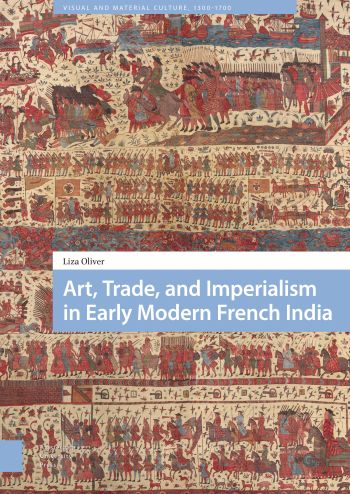 French mercantile endeavors in late seventeenth- and eighteenth-century India were marked by novel intersections of aesthetics, science, and often violent commercialism. Connecting all of these worlds were the thriving textile industries of India’s Coromandel Coast. This book focuses on the integration of the Coromandel textile industries with French colonies in India from the founding of the French East India Company in 1664 to its debilitating defeat by the British during the Seven Years’ War. Narratives of British trade and colonialism have long dominated eighteenth-century histories of India, overshadowing the French East India Company’s far-reaching sphere of influence and its significant integration into the political and cultural worlds of South India. As this study shows, the visual and material cultures of eighteenth-century France and India were deeply connected, and together shaped the century’s broader debates about mercantilism, liberalism, and the global trade of goods, ideas, and humans.
Liza Oliver is the Diana Chapman Walsh Assistant Professor in Art History and South Asia Studies at Wellesley College.
Call for Papers | Décoration intérieure et plaisir des sens
From the Call for Papers:
Décoration intérieure et plaisir des sens, 1700–1850
University of Geneva, 28–29 May 2020
Proposals due by 13 January 2020
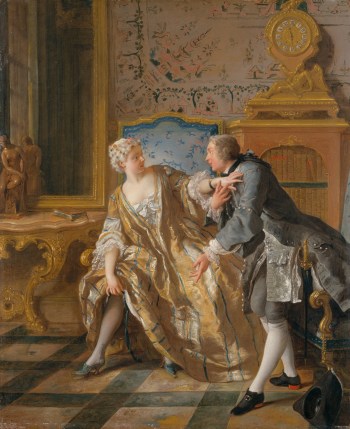
Jean-François de Troy, La jarretière détachée (The Garter), 1724, oil on canvas, 65 × 54 cm (New York: The Metropolitan Museum of Art, Jayne Wrightsman Collection).
Dans la lignée des travaux de Goubert (Du Luxe au confort, 1988), de Crowley (The Invention of Comfort, 2001) et de DeJean (The Age of Comfort, 2009), ce colloque souhaite revenir sur la part que tenait le plaisir sensoriel dans l’organisation des espaces intérieurs en Europe entre 1700 et 1850. Plusieurs traités d’architecture du XVIIIe siècle tels que celui de Boffrand (1745) ou plus tard de Le Camus de Mézières (1780) mettent l’accent sur l’importance des sens dans la disposition et la décoration des pièces. Ces textes soulignent que certains arrangements, pour reprendre le terme de l’époque, doivent créer une impression de plaisir et de bien-être sur ses usagers. Cette idée d’un décor qui éveille les différents organes de perception du corps humain dans le but de produire un effet sur le spectateur s’inscrit dans une approche sensualiste de l’architecture. Cette préoccupation est alors désignée par de nombreux auteurs sous les termes d’« agrément » et de « commodité » qui permettent d’exprimer, avant qu’il n’apparaisse au début du XIXe siècle, le concept de confort [1].
[1] Joan DeJean, The Age of Comfort: When Paris Discovered Casual and the Modern Home Began (New York, Bloomsbury, 2009).
Nous proposons de privilégier trois grands axes de réflexion, qui n’épuisent évidemment pas le champ des possibles:
I. DE LA THÉORIE A LA PRATIQUE
Le premier axe est consacré à la place de l’agrément et du confort dans les ouvrages théoriques et à l’impact de ceux-ci dans la production de décors. Il s’agira ainsi de déterminer la part accordée aux sens et au corps non seulement dans les traités d’architecture, mais aussi les textes destinés aux artistes décorateurs, comme le livre d’André Jacob Roubo (L’Art du menuisier en meubles, 4 vols, 1769–75), et, plus incidemment, dans les recueils de modèles (Jean-Charles Delafosse (Nouvelle Iconologie historique, 1768). L’intérêt porté aux sensations dans ces ouvrages peut être pensé (/envisagé) en regard de la philosophie sensualiste (Condillac, Traité des sensations, 1754) mais aussi de la littérature libertine du siècle des Lumières (La Petite Maison de Bastide, 1763).
Nous interrogerons les fondements idéologiques de cette préoccupation nouvelle pour le corps, mais aussi le reflet de cet intérêt dans le développement d’un langage spécifique et dans l’apparition de nouveaux termes désignant des biens mobiliers. L’éventuel impact de cette nouvelle exigence sur la créativité des artisans, sur les innovations techniques et formelles, sera également questionné.
II. NORMES ET USAGES
Le deuxième axe de réflexion propose d’interroger la notion d’agrément à l’aune des normes sociales et de l’usage des différentes pièces de l’habitat. Dans l’historiographie plus ou moins récente, l’idée de confort est régulièrement associée aux lieux dits de l’« intime » qui apparaissent simultanément à l’art de la distribution (petits appartements, boudoirs, salles des bains, etc.). Il sera intéressant de se demander si l’opposition entre les espaces d’apparat et ceux plus privés, dédiés au confort et au bien-être des individus, est pertinente pour appréhender les meubles et objets composant les décors produits entre l’Ancien Régime et la Monarchie de juillet. Quels mécanismes sociaux, économiques ou culturels ont pu favoriser un nouvel idéal consistant à rechercher des sensations agréables dans les intérieurs ? Dans quelles mesures (et quand ?) le confort du quotidien devient-il un marqueur social permettant d’affirmer son rang ? Comment penser les rapports entre le confort et le luxe ? Et enfin peut-on observer des changements dans l’étiquette de cour en lien avec la notion de confort ?
III. MATÉRIALITÉ ET RESTAURATION
Le troisième axe est orienté sur des questions matérielles. Il conviendra alors d’étudier l’importance du confort dans l’évolution des formes données au mobilier. Nous prendrons aussi en compte les questions économiques relatives aux matériaux utilisés. Les essences de bois et de tissus exotiques importés des nouvelles colonies, comme l’ébène, le coton ou la soie, attisent les curiosités et jouissent d’un grand intérêt en raison de leurs caractéristiques agréables.
Une grande importance sera également donnée aux questions de transformation et de réemploi des objets. Il s’agira notamment de considérer la place du confort dans l’histoire de l’adaptation et la mise au goût du jour d’intérieurs existants. Ceux-ci connaissent, au cours de leur existence, de nombreuses restaurations et modifications visant à leur conserver une certaine modernité et utilité. Quelle place tient le confort dans l’adaptation de formes anciennes aux évolutions de la mode ?
Des questions relatives aux restaurations du XXe siècle pourront également être abordées. Le constat montre qu’en dépit des principes déontologiques de la conservation restauration des biens culturels prônant les valeurs de lisibilité de l’œuvre, de visibilité et de réversibilité de traitement, la restauration du mobilier a toujours eu cette particularité de présenter une dualité entre exigences déontologiques et remise en état de présentation et d’utilisation. Dans quelle mesure, la restauration n’est-elle pas un acte de création, lorsqu’il s’agit d’une intervention fondamentale ? Lorsque l’objet a été modifié postérieurement à sa création, faut-il revenir à son état originel ?
Modalités pratiques
Le colloque durera une journée et demie et sera conclu par une visite guidée. Les communications, d’une durée de 30 minutes, pourront être prononcées en français ou en anglais. Elles seront suivies de minutes d’échanges avec le public. Elles devront s’efforcer, dans la mesure du possible, de soulever des questions afin de susciter la discussion.
Les propositions sont attendues pour le 13 janvier 2020 au plus tard. Elles devront être composées d’un titre, d’un résumé ne dépassant pas 300 mots à l’adresse email decoration.et.plaisir@gmail.com. Elles devront être accompagnées d’un CV, ainsi que, pour les doctorants, de l’intitulé de la thèse et des noms du ou des directeur(s) de recherche. Une réponse sera adressée aux participants au plus tard le 15 février 2020.
Colloque organisé par
• Noémi Duperron, Université de Genève
• Maxime Georges Métraux, Université Paris-Sorbonne et Galerie Hubert Duchemin
• Barbara Jouves, Université Paris 1 Panthéon-Sorbonne
• Marc-André Paulin, Université Lille 3 et Centre de Recherche et de Restauration des Musées de France
• Bérangère Poulain, Université de Genève










 Enfilade
leave a comment