New Book | Ancient Marbles in Naples in the Eighteenth Century
From Brill:
Eloisa Dodero, Ancient Marbles in Naples in the Eighteenth Century: Findings, Collections, Dispersals (Leiden: Brill, 2019), 630 pages, ISBN: 978-9004362857, €139 / $167.
 In Ancient Marbles in Naples in the Eighteenth Century Eloisa Dodero aims at documenting the history of numerous private collections formed in Naples during the 18th century, with particular concern for the ‘Neapolitan marbles’ and the circumstances of their dispersal. Research has thus made it possible to formulate a synthesis of the collecting dynamics of Naples in the 18th century, to define the interest of the great European collectors, especially British, in the antiquities of the city and its territory and to draw up a catalogue which for the first time brings together the nucleus of sculptures reported in the Neapolitan collections or coming from irregular excavations, most of which shared the destiny of dispersal, in some cases here traced in definitive fashion.
Eloisa Dodero is curator archaeologist at the Capitoline Museums, Rome. She is involved in the publication of the Paper Museum of Cassiano dal Pozzo (Brepols) and in a new, revised edition of Taste and the Antique: The Lure of Classical Sculpture (Brepols).
C O N T E N T S
List of Figures
List of Abbreviations
Introduction
1 The Collections of Antiquities in Naples in the 18th Century: A Changing Scenario
2 Sources for a Knowledge of the Neapolitan Collections of Antiquities in the 18th Century
• The Descrizioni of Naples and the Travel Literature in the 17th and 18th Century
• Erudite Works, Epigraphic Sylloges and Corpora
• The Correspondence of Antiquarians
• Catalogues of Collections
• Private Archives, Inventories and Auction Catalogues
• The Evidence Offered by the Paintings
• The Townley Archive, the Townley Drawings and the Topham Collection of Drawings
3 Collections of Antiquities in Naples between the End of the 17th and the Closing Years of the 18th Century
• Sculptures as Furniture: Ancient Marbles in Old Palaces and Stately Homes
• The Leading Collectors
• Small Collections of Vases, Inscriptions, Coins, Gems
• Wunderkammern in Naples
• The Collections of the Religious Orders
• The Collections of the Foreigners
4 The Channels of Dispersal of the Neapolitan Marbles from the Viceregal Period to the End of the 18th Century
• The Spanish Viceroyalty and the Austrian Viceroyalty
• The Age of the Bourbons
• Marbles of Neapolitan Origin in 18th-Century British Collections
Conclusions
Catalogue – Part 1: Ancient Marbles in 18th-Century Neapolitan Collection
Sculptures as Furniture: Ancient Marbles in Old Palaces and Stately Homes
• Palazzo Carafa di Colubrano (cat. no. 1–43)
• Villa Mazza (cat. no. 44–50)
• Palazzo Firrao (cat. no. 51–52)
• Palazzo Cellamare (cat. no. 53–64)
• The Gaetani d’Aragona, Dukes of Laurenzano (cat. no. 65–71)
The Leading Collectors
• Giuseppe Valletta (cat. no. 72–122)
• Felice Maria Mastrilli (cat. no. 123–133)
• Giovanni Battista Carafa Duke di Noja (cat. no. 134–138)
Small Collections of Vases, Inscriptions, Coins, Gems
• Ferdinando Galiani (cat. no. 139–140)
Wunderkammern in Naples
• Francesco Antonio Picchiatti (cat. no. 141–145)
The Collections of the Foreigners
• Sir William Hamilton (cat. no. 146–200)
• Vinzenz von Rainer zu Harbach (cat. no. 201–202)
Catalogue – Part 2: Sculptures Found in Naples and Its Surroundings Between the 17th and the 18th Century
Pimentel’s Excavations at Cuma (cat. no. 203–217)
The Dispersal
• Berlin (cat. no. 218–222)
• Paris (cat. no. 223–224)
• Saint Petersburg (cat. no. 225)
• Rome (cat. no. 226–233)
Hadrawa’s Excavations in Capri (cat. no. 234–240)
Neapolitan Marbles in British Collections
• Wilton House
• Other Collections Assembled in the First Half of the 18th Century (cat. no. 241)
• Charles Townley Collection (cat. no. 242–252)
• Lyde Browne Collection (cat. no. 251–253)
• Henry Blundell Collection (cat. no. 254–255)
• Thomas Hope Collection (cat. no. 256)
Archival Sources
Bibliography
Index of Sculptures by Location
General Index
New Book | The Lost Library of the King of Portugal
On 1 November 1755, Lisbon was devastated by a massive earthquake. From PHP:
Angela Delaforce, The Lost Library of the King of Portugal (London: Paul Holberton Publishing, 2019), 208 pages, ISBN: 978-1912168156, £45.
 The destruction on the morning of All Saints Day 1755 of the heart of the city of Lisbon by an earthquake, tidal wave and the urban fires that followed was a tragedy that divides the 18th century in Portugal. One casualty on that fatal morning was the Royal Library, one of the most magnificent libraries in Europe at the time. The Lost Library of the King of Portugal tells the story of the lost library—its creation, collection, and significance.
This 18th-century library was founded by the Bragança monarch Dom João V shortly after he came to the throne in 1706 and was housed at the heart of the royal palace, the Paço da Ribeira, in Lisbon. The king’s abiding ambition was to create one of Europe’s great court libraries, and, at the time of his death in 1750, it was reputed to be one of the most magnificent libraries in Europe. The Royal Library was also composed of a Cabinet of Prints and Drawings, medals and scientific instruments as well as a Cabinet of Natural History with specimens from across Portugal’s global empire.
This documented study describes the creation of the library, its cultural significance in 18th-century Portugal, the acquisition of single volumes as well as entire libraries from across Europe, and the role in this of Portugal’s most talented diplomats. It includes the collection of manuscripts from the celebrated library of Charles Spencer, 3rd Earl of Sunderland and the unpublished correspondence exchanged during the negotiations between London and Lisbon. Throughout his reign, the devout Dom João V set out to conjure up his own vision of Rome and the papal court he never saw. Two chapters are devoted to Italy—one to the talented archaeologist Francesco Bianchini at the papal court, including the unpublished correspondence between him and his royal patron Dom João V, as well as the guides to Rome and art and architecture at the ducal courts of northern Italy, both commissioned by the king.
When the library was destroyed in 1 November 1755 by the earthquake, tidal wave, and the fires that followed, only a few books, manuscripts, and albums of prints were saved, and the author traces their final journey with the royal family and court to Brazil on the eve of the invasion by Napoleon’s army in November 1806.
Exhibition | Dutch Masters Revisited
Now on view at the Amsterdam Museum:
Dutch Masters Revisited
Amsterdam Museum, Hermitage Amsterdam, 30 September 2019 — 2 February 2020
Curated by Jörgen Tjon a Fong

Humberto Tan, Ruud-Gullit as Jacob Rühle, photograph.
This fall the Amsterdam Museum wing of Hermitage Amsterdam presents Dutch Masters Revisited. Curated by Jörgen Tjon a Fong (Urban Myth), this exhibition complements the Amsterdam Museum’s permanent exhibition at Hermitage Amsterdam Portrait Gallery of the 17th Century (formerly known as Dutchmen of the Golden Age). Surrounded by the huge group portraits in the grand hall, Dutch Masters Revisited shows thirteen portraits of prominent Dutch citizens posing as people of colour who, based on historical research, are known to have lived in the 17th- and 18th-century Netherlands.
Viewing the subjects depicted in the works presented in Portrait Gallery of the 17th Century, one could easily (and erroneously) assume that at the time the Netherlands’ entire population was white. After all, everyone included in these group portraits is white. But while they may not be depicted in these works, the city of Amsterdam was also home to people of colour. White people and people of colour have been living together in the Netherlands for centuries. And in the 17th and 18th centuries, Amsterdam in particular was a home to people from all corners of the globe.
Theatre maker Jörgen Tjon A Fong, who curated Dutch Masters Revisited notes: “I was amazed to discover this vibrant community of people with non-Western roots living in 17th-century Amsterdam. They could be found in all walks of life. A lot of people aren’t aware of this. So far, these individuals’ stories have been left untold. It’s important that we start doing so—to paint a more complete picture of our past. In the photo exhibition Dutch Masters Revisited various historical people of colour who so far have remained hidden from view are given a face. By doing so, this part of our history can become visible to all citizens of Amsterdam and the rest of the Netherlands.”
In Dutch Masters Revisited, prominent Dutch people of colour—including footballer Ruud Gullit, rapper Typhoon, comedian/presenter Jörgen Raymann, singer Berget Lewis, politician Sylvana Simons, and hospitality tycoon Won Yip—take on the role of historical Dutch citizens of colour. Photographers Humberto Tan, Ahmet Polat, Stacii Samidin, and Milette Raats portrayed their well-known sitters in the style of Rembrandt and his contemporaries, against the backdrop of special locations like the Rijksmuseum, Internationaal Theater Amsterdam, Museum van Loon, Hortus Botanicus, and the Amsterdam Museum’s own building.
The sitters have certain things in common with the individuals they portray. For example, Humberto Tan has photographed footballer Ruud Gullit in the role of Jacob Rühle (1751–1828). Jacob Rühle was the son of WIC employee and slave trader Anthony Rühle and the African woman Jaba Botri. In 1798 the fabulously wealthy Jacob moved to Amsterdam. Here, he eventually headed the family business—with great success. Like Ruhle, Ruud Gullit is the son of a white and a black parent. Dutch Masters Revisited puts a face to Rühle’s name, telling his story together with twelve other people of colour who lived in the Netherlands during the 17th and 18th centuries.
Since November 2014, the Amsterdam Museum and the Rijksmuseum have jointly presented the largest collection of group portraits in the world, in the permanent exhibition Portrait Gallery of the 17th Century at Hermitage Amsterdam. Displayed on the walls of an impressive grand hall, these group portraits of Amsterdam militiamen and regents form the heart of a presentation dealing with life in the Dutch cities and towns of the 17th century. In this setting, the thirteen photo portraits of 17th-century people of colour enter into dialogue with the group portraits, which feature exclusively white men and women.
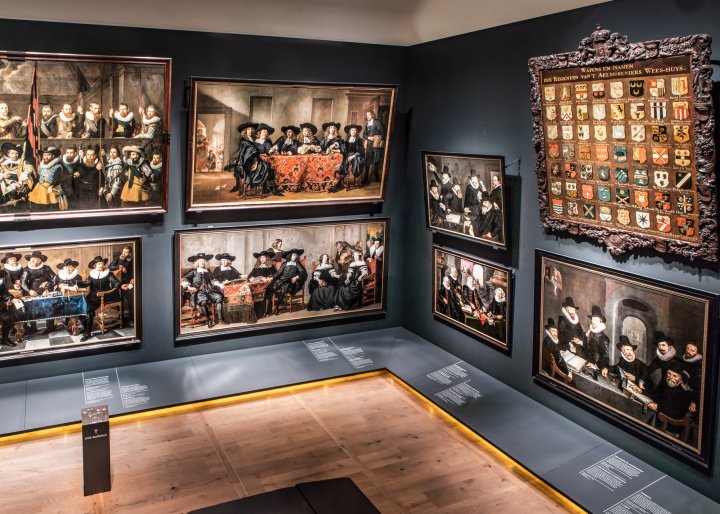
The grand hall at the Hermitage Amsterdam, where the Amsterdam Museum’s ‘Portrait Gallery of the 17th Century’ is on display; it was formerly called the ‘Portrait Gallery of the Golden Age’ (Photo by Joel Frijhoff, via Amsterdam Museum).
◊ ◊ ◊ ◊ ◊
Nina Siegal recently wrote about the installation and its larger context in the article, “A Dutch Golden Age? That’s Only Half the Story,” The New York Times (25 October 2019).
New Book | Aquatint Worlds
From Yale UP:
Douglas Fordham, Aquatint Worlds: Travel, Print, and Empire, 1770–1820 (London: The Paul Mellon Centre for Studies in British Art, 2019), 384 pages, ISBN: 978-1913107048, £45 / $60.
 In the late 18th century, British artists embraced the medium of aquatint for its ability to produce prints with rich and varied tones that became even more stunning with the addition of color. At the same time, the expanding purview of the British empire created a market for images of far-away places. Book publishers quickly seized on these two trends and began producing travel books illustrated with aquatint prints of Indian cave temples, Chinese waterways, African villages, and more. Offering a close analysis of three exceptional publications—Thomas and William Daniell’s Oriental Scenery (1795–1808), William Alexander’s Costume of China (1797–1805), and Samuel Daniell’s African Scenery and Animals (1804–5)—this volume examines how aquatint became a preferred medium for the visual representation of cultural difference, and how it subtly shaped the direction of Western modernism.
Douglas Fordham is associate professor of art history at the University of Virginia.
Call for Submissions | Percy G. Adams Prize
From SEASACS:
Percy G. Adams Prize, SEASECS
Submissions due by 30 November 2019
The Southeastern American Society for Eighteenth-Century Studies (SEASECS) awards a biennial prize of $500 for the best article on an eighteenth-century subject published in a scholarly journal, annual, or collection. Eligible publications for this year must have been published between September 1, 2018 and August 31, 2019. Authors must be members of SEASECS at the time of submission. Articles may be submitted by the author or by another member. The deadline for submissions is November 30, 2019. Please send submissions as PDF files, and address any queries about the prize to the Committee Chair, Amanda Strasik, at Amanda.Strasik@eku.edu.
Symposium | Hadrian’s Villa and Its Reception
From ArtHist.net:
Villa Adriana: Die kaiserliche Residenz und ihre Rezeption
Zentralinstitut für Kunstgeschichte, Munich, 4 December 2019
Organized by Cristina Ruggero
Diese Veranstaltung ist Teil einer bis 2020 ausgelegten, semesterübergreifenden Reihe im Kontext des DFG-Projekts Mikrokosmos Villa Adriana: Ein künstlerischer Interaktionsraum im Europa des 18. und 19. Jahrhunderts am Zentralinstitut für Kunstgeschichte, München.
P R O G R A M M
17.30 Cristina Ruggero (Zentralinstitut für Kunstgeschichte, München), Angebot und Nachfrage: Die aegyptiaca aus der Hadriansvilla in Rom, Paris, München
17.45 Mariette de Vos Raaijmakers (Università degli Studi di Trento), Hadrian und der Nil: Die Palestra in der Villa Hadriana und ihr Dekorationsprogramm
Innerhalb des weitläufigen architektonischen Komplexes der Hadriansvilla ist die sog. Palestra bemerkenswert für ihre Architektur und Ausstattung. Das ikonografische Programm und die Entstehungszeit (133–134) belegen einen Zusammenhang mit Antinoos‘ Tod (130) und eine ausgeprägte Ägypten-Rezeption. Im Rahmen eines vierjährigen Forschungsprojekts konnte die Universität von Trient (2003–2007) Architektur und Dekoration der Palestra dokumentieren. Der Vortrag fasst die Funde und Ergebnisse des Projekts zusammen.
18.30 Redha Attoui (Université Badj Mokhtar Annaba, Algerien), Schematic Reconstruction of the Construction Process Used in a Part of the Palestra, Villa Adriana
Although leveling is a fundamental part of the building process, our knowledge of old leveling systems is limited, mainly because of their invisible and temporary nature. However, thanks to the case study of the red signs discovered on the wall surfaces in the ‘Palestra’ at Villa Adriana, we have acquired a new understanding of this specific technique. The results allow suggesting a schematic reconstruction of the construction process used in a part of the complex.
Exhibition | Canova and Thorvaldsen

Antonio Canova, The Three Graces, 1813–16
(St. Petersburg: State Hermitage Museum)
◊ ◊ ◊ ◊ ◊
From the press release (via Art Daily) for the exhibition:
Canova and Thorvaldsen: The Birth of Modern Sculpture
The Gallerie d’Italia—Piazza Scala, Milan, 25 October 2019 — 15 March 2020
Curated by Stefano Grandesso and Fernando Mazzocca
The Gallerie d’Italia—Piazza Scala, Intesa Sanpaolo’s museum in Milan, presents Canova and Thorvaldsen: The Birth of Modern Sculpture, on display from 25 October 2019 to 15 March 2020. The exhibition tells the story of the two great sculptors, Italian Antonio Canova (1757–1822) and Danish Bertel Thorvaldsen (1770–1844), focusing on their rivalry and how they transformed the very idea of sculpture and its techniques to create works of art that inspired their contemporaries and generations of artists that followed. Italy played a central role to both sculptors’ lives, and careers and the exhibition brings over 150 works together from across Italy and further afield to Milan with key works from the Intesa Sanpaolo collection to be shown together for the first time.
 The city of Rome was particularly important to both artists. Canova arrived in 1781 and remained in the city until his death in 1822, while Thorvaldsen settled in the city in 1797, spending the next forty years there. It was in Rome that the two great masters began engaging in one of the most famous and fruitful instances of artistic competition in history, interpreting identical themes and subjects to create a number of masterpieces: classical mythological works, such as Psyche Revived by Cupid’s Kiss, Venus, Paride, Hebe, and The Three Graces—which embodied some of life’s great themes, from the brevity of youth, the enchantment of beauty, to temptation and heartbreak. Canova and Thorvaldsen brings together the fruits of this historic competition and ongoing rivalry for the first time, including Canova’s celebrated Graces from the State Hermitage Museum alongside Thorvaldsen’s Cupid and The Graces from the Thorvaldsen Museum, offering visitors the unique opportunity to compare each of these masters’ approach and style.
Both Canova and Thorvaldsen were celebrated by their contemporaries and by critics of the era for their appreciation for the classical world and ability to reinterpret classical themes through the lens of the modern day. Canova was seen as a revolutionary artist in Italy and abroad who gave sculpture precedence over all other forms of art by confronting ancient works and reinterpreting them for a contemporary audience. Keeping a close eye on the work and strategy of his rival, Thorvaldsen was inspired by a stricter and more conservative adherence to classical norms, beginning a new period of Nordic art inspired by Mediterranean civilisations.
 Both artists not only revolutionised an approach to classical ideals in sculpture but also advanced new techniques. Each established large studios the size of complex workshops with numerous colleagues, and students and were able to break free from the constraints that clients typically placed on sculpture due to the high costs of marble or bronze. Thanks to the technical innovations like the use of preparatory plaster models, introduced by Canova and used on a large scale by Thorvaldsen the sculptors had—for the very first time—the freedom to express their own poetic vision through statues designed without being commissioned.
The unprecedented pairing of these two great sculptors is made possible through Intesa Sanpaolo’s partnerships with the Thorvaldsen Museum in Copenhagen and the State Hermitage Museum in St. Petersburg, as well as the contribution of major works loaned by museums and private collections in Italy and abroad including the Vatican Library, the Uffizi Galleries in Florence, the J. Paul Getty Museum in Los Angeles, the Museo Nacional del Prado in Madrid, the Pinacoteca di Brera gallery and Pinacoteca gallery of the Ambrosian Library in Milan, the Metropolitan Museum in New York, the Museo e Gypsotheca Antonio Canova in Possagno, the National Gallery of Ancient Art in Rome, and the Gallerie dell’Accademia in Venice.
Stefano Grandesso and Fernando Mazzocca, Canova e Thorvaldsen: La nascita della scultura moderna (Milan: Skira, 2019), 408 pages, ISBN: 885724252, €42.
More information about the exhibition (in Italian) is available here»
Lecture Series | Perspectives on Collecting
From ArtHist.net:
Perspectives on Collecting: A Four-Part Lecture Series
Strawberry Hill House, London, 6–27 November 2019
Strawberry Hill Trust hosts a four-part lecture series exploring perspectives on collecting from renowned speakers: David Starkey, historian and presenter; Tim Knox, Director of the Royal Collection; Martin Caiger-Smith, author and Head of the MA Curating the Art Museum programme at The Courtauld Institute of Art; and Tristram Hunt, Director of the Victoria & Albert Museum. The lectures will begin at 7.30pm in the Waldegrave Drawing Room by kind permission of St Mary’s University. Guests are invited to arrive from 6.45pm to enjoy a complimentary glass of fizz in Horace Walpole’s magnificent Gallery.
Wednesday, 6 November
David Starkey, Holbein and The Tudor Court
Wednesday, 13 November
Tim Knox, The Rise and Fall of the Country House Museum
Wednesday, 20 November
Martin Caiger-Smith, Antony Gormley’s Interventions in Historic Collections
Wednesday 27 November
Tristram Hunt, Collecting the Home
Exhibition | Inspired by the East

Now on view at The British Museum:
Inspired by the East: How the Islamic World Influenced Western Art
The British Museum, London, 10 October 2019 — 26 January 2020
Islamic Arts Museum Malaysia, Kuala Lumpur, 20 June — 20 October 2020
Curated by Julia Tugwell and Olivia Threlkeld

Levni (active ca. 1703–1730), leading artist at the court of Sultan Ahmet III, A European Gentleman in a Red Coat, Ottoman School painting, Turkey, early eighteenth century (London: The British Museum, 1960,1112,0.2).
Charting the fascinating history of cultural and artistic interactions between East and West, this exhibition explores the impact the Islamic world has had on Western art for centuries. Artistic exchange between East and West has a long and intertwined history, and the exhibition picks these stories up from the 15th century, following cultural interactions that can still be felt today. Objects from Europe, North America, the Middle East, and North Africa highlight a centuries-old tradition of influence and exchange from East to West. The diverse selection of objects includes ceramics, photography, glass, jewellery, and clothing, as well as contemporary art, showcasing how artistic exchange influenced a variety of visual and decorative arts. The exhibition concludes with a 21st-century perspective, through the eyes of four female artists from the Middle East and North Africa who continue to question and subvert the idea of Orientalism in their work and explore the subject of Muslim female identity.
The show takes a deeper look at the art movement of Orientalism—specifically the way in which North Africa and the Middle East were represented as lands of beauty and intrigue, especially in European and North American art. Reaching its height during the 19th century, this genre often blurred the lines between fantasy and reality—and as Palestinian-American scholar Edward Said argued—often misrepresenting life in the so-called ‘Orient’. This exhibition seeks to demonstrate a longer, more complex history of influence and inspiration from 1500 through to present day. An exchange of art and ideas which may have been driven by interests such as pilgrimage, warfare, diplomatic encounters, colonial interests, or simply an interest in adapting artistic techniques.
 Conceived and developed in collaboration with the Islamic Arts Museum Malaysia, Inspired by the East: How the Islamic World Influenced Western Art includes generous loans from their extensive collection of Islamic and Orientalist art. The exhibition and collaboration highlight centuries of cultural exchange between East and West and its continuing importance today. It will be on display at the Islamic Arts Museum Malaysia (IAMM), Kuala Lumpur, from 20 June to 20 October 2020.
Curators Julia Tugwell and Olivia Threlkeld provide more information here»
William Greenwood and Lucien de Guise, eds., Inspired by the East: How the Islamic World Influenced Western Art (London: British Museum Press, 2019), 256 pages, ISBN: 978-0714111933, £30.
Exhibition | Luca Giordano (1634–1705)

Luca Giordano, Ariane abandonnée (Ariadne Abandoned),1675–80, 203 × 246 cm, oil on canvas
(Verona: Museo di Castelvecchio)
◊ ◊ ◊ ◊ ◊
Opening next month at the Petit Palais:
Luca Giordano: The Triumph of Neapolitan Painting / Le triomphe du baroque napolitain
Petit Palais, Paris, 14 November 2019 — 23 February 2020
The Petit Palais presents the first ever retrospective in France of works by the Neapolitan painter Luca Giordano (1634–1705), one of the most brilliant European artists of the 17th century. The exhibition highlights the exceptional virtuosity of this illustrious Seicento painter with nearly ninety works, monumental paintings and drawings, assembled thanks to exceptional loans from the Museo di Capodimonte, Naples, the main churches in Naples, and numerous European institutions, including the Museo del Prado. Following the exhibition of works by the sculptor Vincenzo Gemito (1852–1929), this retrospective is part of the season that the Petit Palais is devoting to Naples this autumn in partnership with the Museo di Capodimonte.
Exhibition Curators
• Christophe Leribault, director of the Petit Palais
• Sylvain Bellenger, director of the Museo e Real Bosco di Capodimonte
• Stefano Causa, teacher at the Università degli Studi Suor Orsola Benincasa, Naples
• Patrizia Piscitello, leader of the Exhibitions and of Loans Department of the Museo e Real Bosco di Capodimonte
From the press release:
À partir du 14 novembre, le Petit Palais présente pour la première fois en France une rétrospective consacrée au peintre napolitain Luca Giordano (1634–1705), l’un des artistes les plus brillants du XVIIe siècle européen. L’exposition met en valeur l’exceptionnelle virtuosité de cette gloire du Seicento à travers la présentation de près de 90 œuvres, tableaux monumentaux et dessins, réunis grâce aux prêts exceptionnels du musée de Capodimonte à Naples, des principales églises de la ville et de nombreuses institutions européennes dont le musée du Prado. Avec l’exposition sur le sculpteur Vincenzo Gemito (1852–1929), cette rétrospective constitue le second volet de la saison que le Petit Palais consacre à Naples cet automne en partenariat avec le musée de Capodimonte.
Organisée selon un axe chronologique tout en ménageant des rapprochements avec des toiles majeures d’autres peintres, le parcours de l’exposition souhaite apporter une vision renouvelée de l’artiste et montrer comment Giordano a su tirer le meilleur des différents courants stylistiques de l’époque pour aboutir aux formules qui séduisirent son siècle.
Formé dans le sillage de Jusepe de Ribera (1591–1652), espagnol de naissance mais napolitain d’adoption, Giordano assimila avec maestria son génie ténébriste tout en commençant sa carrière à succès par des quasi-pastiches d’œuvres de Raphaël, de Titien comme de Dürer. Un séjour de formation à Rome vers 1653 le mit toutefois en contact avec la modernité baroque et les innovations d’un Rubens comme d’un Pierre de Cortone. C’est grâce à sa capacité à intégrer les innovations de son temps comme des maîtres du passé que l’œuvre de Giordano évolua continuellement depuis le naturalisme jusqu’à des mises en scène baroques d’une fougue inégalée.
Très vite reconnu dans toute la péninsule italienne, il reçoit de très nombreuses commandes et exécute près de 5 000 tableaux et ensembles de fresques d’où son surnom de « Luca fa presto » (Luca qui va vite) ! Il reste le peintre par excellence des églises de Naples qui sont remplies de ses toiles d’autel dont l’exposition présentera une sélection. Ces immenses compositions frappent par leur dramaturgie complexe, mettant en scène les saints de la Contre-Réforme comme les patrons tutélaires de la ville, notamment San Gennaro (saint Janvier). L’immense tableau San Gennaro intercédant pour les victimes de la peste rappelle le contexte terrible de cette période qui vit la plus grande ville d’Europe méridionale perdre la moitié de ses habitants à la suite de la peste de 1656.
L’exposition met en valeur le contraste entre des compositions tourmentées, Crucifixion de Saint Pierre (par Giordano et par Mattia Pretti), Martyr de saint Sébastien (idem), terrible Apollon et Marsyas (par Giordano et par Ribera) et, dans un registre sensuel hérité du Titien, de langoureuses Vénus, Ariane abandonnée ou Diane et Endymion.
Son rayonnement dépassa l’Italie et, s’il refusa les sollicitations royales pour l’attirer à Paris, il s’installa à la cour de Charles II d’Espagne à partir de 1692, où il réalisa d’immenses fresques notamment, pour le Cazón del Buen Retiro à Madrid, le monastère de l’Escorial ou encore la cathédrale de Tolède. L’exposition évoque d’ailleurs cet aspect majeur de son œuvre en proposant aux visiteurs une expérience immersive dans une salle de projection.










 Enfilade
leave a comment