Call for Papers | Animaterialities
From ArtHist.net:
Animaterialities: The Material Culture of Animals (including Humans)
Sixteenth Material Culture Symposium for Emerging Scholars
University of Delaware, 24–25 April 2010
Proposals due by 5 December 2019
The Center for Material Culture Studies at the University of Delaware invites submissions for graduate student papers that examine the relationship between material culture and animal studies for its biennial Emerging Scholars Symposium (April 24–25, 2020). This symposium merges the interdisciplinary study of animals—and the related critical conversations surrounding animality, species, agency, objectivity, and subjectivity—with material culture studies.
Five years after the Audubon Society’s startling Birds and Climate Change Report, we continue to hear about the prices non-human animals pay for human choices: extinction, loss of habitat, and poisoned food sources. The present moment begs, more than ever, critical questions about the intersections between the material world and the (fellow) animals with whom we share it. We thus propose the theme ‘animaterialities’, a term which acknowledges the constant presence of other-than-human animals as physical bodies entangled in various anthropocentric systems, whether political, economic or cultural. Animaterialities encourages participants to consider animals not as passive forms of matter for human use, but as active beings capable of resilience in the face of humans’ material domination and exploitation. Finally, it recognizes the necessary turn material culture studies must take when applied to other-than-human animals, as opposed to artificial, vegetal, or mineral subjects/materials.
Generative questions might include:
• How do material objects define or challenge the boundaries between humans, animals, and objects?
• How are animals transformed into material forms?
• How are animals made visible or invisible in the built environment, text, image, material goods, the archive, and the museum?
• How do animal materialities cut across, complicate, and generate global, hemispheric, and imperial worlds?
• How can we re-conceptualize materialities and animalities as active agents in their worlds, rather than passive participants?
Contributions to this theme may take, but are not limited to, the following forms:
• The production and conservation of animal materials
• Materials that imitate animals
• Animals as objects, the “thingness” of animals, and defying objective treatment
• The materialities of animal labor
• Experimentation with animals and animal materials
• Animal classification, collecting, and display
• Material culture of living history farms, zoos and zoological gardens, and preserves
• Visual culture and representation of animal materials
• The social life of animals
• The material aspects of animal abuse
Submissions: Proposals by current graduate students and recent graduates (May 2019 or later) should be no more than 250 words. Up to two relevant images are welcome. Send your proposal and a current c.v. (two pages or fewer) to emergingscholars2020@udel.edu.
Deadline: Proposals must be received by December 5th, 2019. Speakers will be notified of the committee’s decision by the end of January 2020. Confirmed speakers will be asked to provide digital images for use in publicity and are required to submit their final papers and presentations/slide decks ahead of the conference. Travel grants will be available for participants.
Fellowships | Bard Graduate Center, 2020–21
The fellowship programs at Bard Graduate Center (BGC) are designed to further the institution’s goal of promoting research in the areas of decorative arts, design history, and material culture—what we call the “cultural history of the material world.” We offer a number of fellowship opportunities for researchers working in these and allied areas. We are currently accepting applications for two types of fellowships, see below for details. For questions, please contact fellowships@bgc.bard.edu.
Bard Research Fellowships, 2020–21
Applications due 15 November 2019
Bard Graduate Center is pleased to announce its Fields of the Future Initiative, a funded research fellowship and mentorship program aimed to help promote diversity and inclusion in the advanced study of the material world. As a reflection of the need to explore and expand the sources, techniques, voices, perspectives, and questions of interdisciplinary humanities scholarship, our research fellowship theme for academic year 2020–21 is “How do we know?” We invite scholars from university, museum, and independent backgrounds with a PhD or equivalent professional experience, as well as current doctoral students, to apply for funded research fellowships, to be held during the 2020–21 academic year. Applicants are asked to address in a cover letter how their projected work will bear on this question. The fellowships are intended to fund collections-based research at Bard Graduate Center or elsewhere in New York, as well as writing or reading projects in which being part of our dynamic research environment is intellectually valuable. Eligible disciplines and fields of study include—but are not limited to—art history, architecture and design history, economic and cultural history, history of technology, philosophy, anthropology, and archaeology. Learn more»
Bard Visiting Fellowships, 2020–21
Applications due 1 February 2020
Bard Graduate Center invites scholars from university, museum, and independent backgrounds with a PhD or equivalent professional experience to apply for non-stipendiary visiting fellowships, to be held during the 2020–21 academic year. The theme for this period is “How Do We Know?” Applicants are asked to address in a cover letter how their projected work will bear on this question. Bard Graduate Center Visiting Fellowships, which are intended for scholars who have already secured means of funding, provide scholars with workspace in the Bard Graduate Center Research Center and enable them to be a part of our dynamic scholarly community in New York City. Eligible disciplines and fields of study include—but are not limited to—art history, architecture and design history, economic and cultural history, history of technology, philosophy, anthropology, and archaeology. Visiting Fellowships may be awarded for anywhere from one month to the full academic year. Learn more»
Call for Papers | ‘Dark Enlightenments’

From the conference website:
‘Dark Enlightenments’: David Nichol Smith Seminar in Eighteenth-Century Studies XVII
Adelaide, Australia, 2–4 December 2020
Early proposals due by 1 November 2019; regular proposals due by 1 March 2020
The Australian and New Zealand Society for Eighteenth-Century Studies (ANZSECS), Flinders University, and the University of Adelaide invite you to the 17th David Nichol Smith (DNS) Seminar for Eighteenth-Century Studies. Inaugurated in 1966 by the National Library of Australia, the DNS is the leading forum for eighteenth-century studies in Australasia. It brings together scholars from across the region and internationally who work on the long eighteenth century in a range of disciplines, including history, literature, art and architectural history, philosophy, theology, the history of science, musicology, anthropology, archaeology, and studies of material culture.
The theme for this conference is ‘Dark Enlightenments.’ We ask delegates to consider the dark, shadowy aspects of enlightenment processes of the eighteenth century. When broadly conceived, the theme is open to numerous up-to-the-minute, interdisciplinary possibilities, including (for example):
• the dark side of the public sphere, such as expressed in satire and polemic
• Empire and enlightenment
• critiques of empathy and humanitarianism
• negative emotions
• crime, conflict and violence
• the use and abuse of the past
• progress and ethics (political, social, scientific)
• war
• romanticising death
• the Gothic
• the numinous eighteenth century
• the transformation of night-time
• developments in notions of privacy, secrecy and the hidden self
• the ‘shady’ moralities of libertinism
• the aesthetics of darkness and light
This, we believe, is a particularly timely theme, partly owing to the nationalist turn in global politics, and the recent controversy stirred in Australia by the proposed Ramsay Centre for Western Civilisation. It offers both sides of the political spectrum the opportunity to interrogate and fully understand the costs, benefits, and legacies of eighteenth-century ‘progress’. It is also a theme designed to emphasise the Enlightenment in its moral complexity and richness, and the wide range of domains (from the everyday to philosophical thought) that contributed to its production.
We also welcome papers for subjects that fall outside the main conference theme. Proposals for 20-minute papers should consist of a title, 250-word abstract, and short bio sent via email as a pdf attachment to DNS2020@flinders.edu.au. We also accept proposal for panels of three papers, which should include all the above for each presenter, a panel title, and if possible, the name and short bio of the panel chair.
Deadlines for submissions
For early deliberation: 1 November 2019. A first round of acceptances will be made shortly after this date to facilitate international attendance.
Final deadline: 1 March 2020
Keynotes
Associate Professor Kate Fullager (Macquarie)
Professor Sasha Handley (Manchester)
Associate Professor Eugenia Zuroski (McMaster)
◊ ◊ ◊ ◊ ◊
Attention Early Career Researchers!
Aspiring to deliver a keynote lecture at a major international conference? Here’s your chance! We’d like to invite early career researchers to propose a keynote lecture addressing the conference theme. This scheme is open to all topics and areas of expertise in literary/humanities studies broadly defined, and to researchers who are in regular university employment as well as those who are not. Applicants must:
• have an outstanding research track record relative to opportunity;
• be within 5 years after award of the PhD (extended to 7 if not in stable university employment or with a significant career interruption).
To apply, please submit a proposed title, 300–400 word abstract, a bio, and a CV (3 pages max) to DNS2020@flinders.edu.au.
In making a selection diversity and the presence of under-represented groups will be recognised, as well as the spectrum of existing keynotes at the conference. We also reserve the right to seek third-party testimony as to the researcher’s capacity to speak and deliver scholarly presentations. The winner will deliver the proposed keynote lecture, with flights, accommodation, and registration covered. The deadline for early career researcher keynote proposals is 1 November 2019.
Visiting Fellowship | University of Glasgow Library
From the University of Glasgow Library:
University of Glasgow Library Visiting Research Fellowships, 2020
Applications due by 15 November 2019
The University of Glasgow Library is pleased to announce that its Visiting Research Fellowships scheme for 2020 is now open. This scheme seeks to support scholars from across academic disciplines to come to Glasgow to work on our unique research collections.
Glasgow is proud to have an outstanding library of old, rare and unique material, including many illuminated medieval and renaissance manuscripts of international importance, and more than 10,000 books printed before 1601. It also houses extensive collections relating to art, literature and the performing arts, as well as the University’s own institutional archive which dates back to the 13th century. It is also home to the Scottish Business Archive, with over 400 collections dating from the 18th century to the modern-day.
The Fellowships are competitive peer-assessed awards. They are designed to provide financial support towards the costs of travel and accommodation to enable researchers to work on the unique collections held in the University Library. The successful recipients should spend between two and four weeks over the course of a year working with the collections in Glasgow. Two Fellowships are offered by the William Lind Foundation to support research into Scottish business history, otherwise, the scope of proposals is open to applicants to define.
Applicants are asked to complete the application form (available here) and to submit along with a short CV to information-services-businessteam@glasgow.ac.uk. The deadline for receipt of applications is 12pm on 15th November 2019.
Terms
• The value of the award is up to £2000.
• The award will be made for a project relating to the University of Glasgow Library collections. Applicants will be at any stage of their academic career but must be the holder of a completed PhD. Independent and emeritus scholars may also apply.
• The award will cover a period of at least two and no more than four weeks in the calendar year 2020.
• Scholars will make their own arrangements for travel and accommodation. Travel, subsistence, and other reasonable research expenses will be eligible to be claimed to a value of £2000.
• Applications will be peer-reviewed by a panel of University of Glasgow academics. Applicants will be notified of decisions by 19th December 2019.
• Acknowledgment of the award should be made in any future publications resulting from research undertaken during this award.
• Visiting Scholars are expected to submit a short report of their research findings for inclusion on the Library website and/or the Friends of Glasgow University Library newsletter.
Exhibition | Hogarth: Place and Progress
Press release (via Art Daily) for the exhibition:
Hogarth: Place and Progress
Sir John Soane’s Museum, London, 9 October 2019 — 5 January 2020
 Hogarth: Place and Progress unites all of the paintings and engravings in Hogarth’s series for the first time, displayed across the Georgian backdrop of Sir John Soane’s Museum. Through these works the exhibition will explore the artist’s complex stance on morality, society, and the city, and the enduring appeal of his satires.
• The concept of progress has positive connotations in the twenty-first century but was often construed negatively in Hogarth’s time. Hogarth’s complex and often darkly satirical narrative progresses move from moral abandon and social ostracism, to poverty, madness and death.
• New research pinpoints precise locations in London depicted in Hogarth’s works and examines the key role they play in a moral reading of Hogarth’s paintings.
• Hogarth’s ability to see beyond social conventions continues to resonate with 21st-century audiences, as he presented with wit and empathy the depictions of immorality and vice that he perceived in all classes of society.
The Soane Museum’s own Rake’s Progress and An Election will be joined by Marriage A-la-Mode from the National Gallery, The Four Times of Day from the National Trust and The Trustees of the Grimsthorpe and Drummond Castle Trust, as well as the three surviving paintings of The Happy Marriage from Tate and the Royal Cornwall Museum. The exhibition also includes engraved series of prints, lent by Andrew Edmunds, such as The Four Stages of Cruelty, Industry and Idleness, and Gin Lane and Beer Street. The works span Hogarth’s career as an engraver and painter and the exhibition will explore Hogarth’s increasing skill—or progress—in both fields, culminating in the masterly execution of An Election.
Hogarth’s concept of ‘progress’ was influenced by John Bunyan’s The Pilgrim’s Progress, where the word described a journey towards moral and spiritual redemption through dismal places: from the City of Destruction to the Slough of Despond and Valley of Humiliation. Hogarth: Place and Progress explores how Hogarth’s series depict this idea. Hogarth’s narratives move from moral abandon and social ostracism, to poverty, madness and death and are often presented as highlighting the follies of the upper classes.
The exhibition also examines the idea that Hogarth was not simply ‘the people’s champion,’ but increasingly his narrative series perceived immorality and impropriety at all levels of society. Those most likely to be safe from Hogarth’s satirical wit were those who knew their ‘place’ in the social order and lived up to the positive ideals of their class, high and low alike.
Hogarth’s self-titled ‘Modern Moral Subjects’ present detailed characters, plots and changes of scene, set in specific and recognisable locations. The idea of spiritual progress is shown through visible representations of London life. The key geographic contrast is between the City of London, with its winding alleys and crumbling houses, livery guilds, the Mansion House and Monument, associated with merchants, and the West End where the landed aristocracy live in spacious and orderly squares, physically nearer to the royal place of St James. Between the two, the area around Covent Garden is repeatedly presented as a hotbed of immorality. In A Rake’s Progress, the Rake moves from the City of London to an extravagant property in the West End, then a brothel in Covent Garden, and ultimately travels outside the City walls, ending up in Bedlam, where his dissolute life has led him to insanity and death. The exhibition demonstrates how Hogarth’s ‘Modern Moral Subjects’ married the idea of progress with the moral geography of London, in a dynamic and evolving way throughout his own progress as an artist.
Bruce Boucher, David Bindman, Frederic Ogee, and Jacqueline Riding, Hogarth: Place and Progress (London: Sir John Soane’s Museum, 2019), 144 pages, ISBN: 978-1999693213, £25.
Study Day | Understanding Stone Cantilevered Stairs
From The Georgian Group:
Study Day: Understanding Stone Cantilevered Stairs
Somerset House, London, 16 October 2019
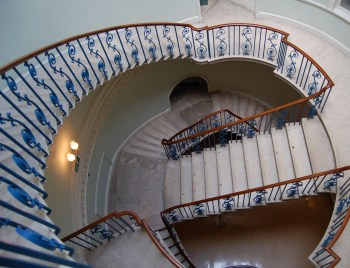
Staircase of he Navy Office, Somerset House, London.
The Georgian Group is holding a study day at Somerset House that will explore stone cantilevered stairs as a characteristic feature of Georgian architecture. The day is aimed at owners and custodians of buildings containing stone cantilevered stairs, as well as architects, surveyors, and structural engineers involved in the repair of existing stairs or the construction of new ones.
The study day will cover three broad areas:
History: The origins and development of stone cantilevered stairs and their importance to Georgian architecture
Structure: Why they work and how they are built
Repairs: What can go wrong, common problems and how they can be repaired
Speakers
• Russell Taylor — Principal of Russell Taylor Architects, an architect in the Classical tradition who has made a special study of the subject
• Sam Price — Founding Partner of Price and Myers, the leading structural engineer on stone cantilevered stairs, the author of several articles on the subject
• Helen Rogers — Engineer at Price and Myers, a specialist engineer and lecturer on stone cantilevered stairs
• Adam Stone — Managing Director of Chichester Stoneworks, a masonry contractor with wide experience in stone design, not least in cantilevered stairs, several of which have won awards
The event is open to all (members and non-members) and includes lunch and refreshments, £135. Doors open at 9am, lectures begin at 9.30am.
Call for Papers | Sensory Experience in 18th-Century Art Exhibitions
From ArtHist.net:
Sensory Experience in 18th-Century Art Exhibitions / L’expérience sensorielle dans les expositions d’art au XVIIIe siècle
Musée du Louvre, Paris, Autumn 2020; Louvre-Lens Museum, Spring 2021
Proposals due by 15 December 2019
Throughout the 18th century, the exhibitions of the Royal Academy of Painting in Paris—by setting the horizon of expectation—have created a habitus among European visitors and especially Parisians. Moreover, they have aroused the curiosity and the desire of the French public and of other nations who where inspired by the Salon. During this period, the Salon du Louvre became a highly popular event, where crowds gathered to see, be seen and to learn. Hence, the Salon embodied without any doubt the image of the Parisian social theatre and thus also indirectly that of the pleasure of the senses for educated European audiences. In other words, visiting the Salon or any other art exhibition in the 18th century, where the desire to be entertained and to learn was intertwined, presented itself as an experience in which the various senses were invoked and stimulated. The notion of a ‘sensory body’ becomes relevant: not only sight, but also the senses of hearing, taste, touch, and smell were interpolated in a varied and complex manner at various moments during the visit.
The conference will focus on the sensations that visitors felt during their experience of art exhibitions. The latter are to be understood in their broadest sense during the long 18th century (1665–1815). The starting point is the moment when the Salon du Louvre became the role model for a growing number of temporary exhibitions, in Paris and in French provinces, at the Royal Academy in London, and, more broadly in Europe. All other spaces of sociability where works of art were subjected to the critical gaze of the public must be taken into account: galleries and private art collections, royal collections, temporary exhibitions, auction rooms, museums… In the context of research about the history of sensibilities and senses, this conference thus aims at defining the new perceptions that flourish in the Age of Enlightenment by questioning the sensory experience and the constitution of the sensory body in the specific context of exhibition spaces.
The understanding of this sensory body in its entirety implicates numerous elements that play an essential role in its constitution. Given the richness of the topic related to the sensory experience in 18th-century art exhibitions, the conference will be divided into two sessions that will take place a few months apart, and in two different locations.
Session 1
The Experience of the Visit: From Spectator to Critic
This first session focuses on the sensory experience of the public when visiting an exhibition – whether it is a collection, a museum, or a temporary presentation of works of art. While 18th century art exhibitions in Europe contributed to urban identity, they also helped to define the identity of the larger public, as well as the single spectator, and the critic. It will be a question of capturing these actors, their visits to exhibitions, their sensory impressions, and the emergence of feelings as they developed along an exhibition tour, likewise further encounters with other visitors, with the spatial context and display of art. In order to encourage comparative research, we call for proposals on various exhibition spaces in various European cities, relating to the following two axes:
• The public, an individual or a group of individuals visiting the exhibition, engaged in the activity and experiences emotional, sensory and physical effects during the whole visit of the exhibition. The presence of other visitors, this more or less colourful crowd that implied a perpetual body interaction, as well as the view of the exhibition played a central role on the senses, the sensitivity and the body of each visitor. Within this audience, the writers that appear at the time of the exhibitions related these experiences to their readers, qualifying and theorizing them. Art criticism is thus no longer simply a primary source for art history, the history of the senses, and questions of reception, but becomes also a research subject by itself. How, in other words, did the sensations, emotions and feelings experienced by critics stimulate and transform art criticism itself? The reality and the sensory experience of the visitor are not necessarily the same in Paris as elsewhere in Europe: Hence, we would like to discover and understand these differences and similarities.
• The space and the exhibition, meaning the immediate environment, the exhibition design, but also the geographical territory with which the individual and its senses are engaged, play a central role in the experience of the spectator’s sensory body. By providing stimuli, they cause sensations and an intense and specific cognitive activity. What kind of effects did the dimensions of the room(s), the movements of the body in the space, the encounter with the art and the exhibition design, the lighting as well as the symbolic aspects of the space have on visitors’ sensory experiences, both in their expectation and during the visit of the exhibition? We will therefore focus on the different affects and effects that this experience catalyzed for each of the senses, sensations, and emotions that inhabited the spectator during and beyond the visit. An experience that is constituting an important part of the horizon of expectation for exhibitions. We can ask ourselves about the different approaches to installation and hanging, but also about the extent to which these approaches had an impact on visitors’ sensations, their perceptions, and their feelings, whatever nature they are, and on the evolution and constitution of their sensibility, of their sensitive body. What role do the symbolic and physical aspects of space play in this experience? How are these effects translated through the written word?
Session 2
The Experience of the Work of Art: From Emotion to Sensation
The second session is intended to invite reflection on the representation of emotions and human sensorium as well as on the reception of these elements when works of art were exhibited publicly in 18th-century Europe. The objective is to study how artists express their perception of the sensitive and the sensory, and how the spectator’s senses react while looking at the works. We will take into account all aspects of the Fine Arts (painting, sculpture, drawing, engraving) and consider also different genres (history, portrait, genre scene, landscape, still life). For this session, we call for proposals around two axes:
• The works, these modes of representation of feelings and the sensory, evoke the sensitivity of the artist as well as that of the human being in general. According to what theoretical and practical criteria did artists translate the spectrum of emotions, but also that of sensory perceptions through the represented body, its gestures, its personality traits or its staging? We are obviously thinking of the rules governing the representation of passions such as those of the ‘ut pictura poesis’, but especially of the attempts to renew them during the 18th century. It is not only a question of revisiting the interactions between theatrical staging and pictorial composition, but also of exploring all the components of mimesis, that is common to the Fine Arts and the performing arts, in order to reinforce the sensory and sensitive delight of art: expression, gestures, costume, decor, colour.
• The senses, (inter)linked with the organs of perception (sight, taste, hearing, smell and touch), are defined by and react to the contact with context, the exhibition as a whole, other individuals, and specific works of art. We would like to understand how the spectator’s senses apprehend, perceive—or even feel—the encounter with a particular work or with the ensemble of works. According to which criteria does sensory perception stop at the level of analysis and reasoning? When and how does this experience lead to a true reaction, whether it is sensitive, sensory or physical? We know that in the 18th century, the research on perception and cognition led to numerous publications on sensualist philosophy, physiology and physiognomy. How did artists consider these new contributions to the history of medicine, science and technology, and how did they translate them within their works? This axis will explore the boundaries between the experience of each of the senses and the relationships that emerge between them in order to get an overall picture of all the sensations and feelings provoked by specific works, particularly by those representing feelings, emotions and allusions to the senses. In this axis, priority will be given to proposals based on sources from various fields (history, literature, philosophy, but also science and medicine) in order to renew the reflection on the phenomenon of exhibitions.
Schedule
Proposals for original contributions in English or French (title and abstract of up to 300 words and short CV of up to 250 words) should be sent by 15 December 2019 to corps.sensoriel@gmail.com
Response from the Scientific Committee: January 2020
Conference dates: Autumn 2020 and Spring 2021
Selected papers will be published after the conference.
Scientific Committee
Markus A. Castor (German Center for Art History, Paris)
Guillaume Faroult (Louvre Museum, Painting Department)
Dorit Kluge (hwtk, Berlin)
Gaëtane Maës (Université de Lille, IRHiS)
Françoise Mardrus (Louvre Museum, Dominique-Vivant Denon Center, Research and Collection Director)
Isabelle Pichet (UQTR, Québec)
Luc Piralla (Louvre-Lens Museum)
New Book | The New Town of Edinburgh
From Birlinn Ltd:
Clarisse Godard Desmarest, ed., The New Town of Edinburgh: An Architectural Celebration (Edinburgh: John Donald, 2019), 336 pages, ISBN: 978-1910900352, £40.
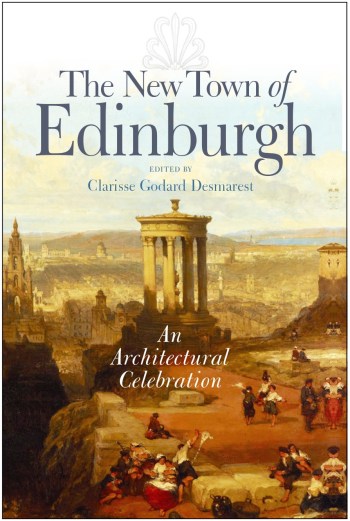 This collection of innovative essays celebrates the New Town of Edinburgh over the 250 years since its original creation. The contributing authors discuss the intellectual, economic, and political contexts that provided the impetus for the city of Edinburgh to expand north of the Old Town, and analyse the New Town’s unique architectural status in terms of its size, monumentality, and degree of preservation. For centuries, Scotland has pursued innovation, improvement, commerce, and contact with England and the Continent; and since medieval times it has been an urbanising land of planned towns. This book reflects on the constantly changing dialogue between Edinburgh’s Old and New Towns—from the eighteenth century to the present time—as the city became increasingly commercialised. It also compares Edinburgh’s New Town with more recent new towns elsewhere, notably nineteenth-century Dunedin in New Zealand and Scotland’s planned new-town movement of the twentieth century. The age of conservation is another of the central themes. By drawing on different approaches to the new town phenomenon in Scotland, this volume pays tribute to Scotland’s vibrant capital and offers insights into new research on Scotland’s urban development.
Clarisse Godard Desmarest is a lecturer at the University of Picardie Jules Verne, Amiens, and a fellow of the Institut Universitaire de France. She specialises in Scottish architectural history and heritage, and has held fellowships at the Institute of Advanced Studies in the Humanities (IASH), Edinburgh College of Art and the School of History, Classics and Archaeology at the University of Edinburgh. She holds an ‘Agrégation in English’ and is a graduate of Sciences Po Paris. Her doctorate at the Sorbonne, jointly supervised by the University of Edinburgh, was awarded a national prize in France for the best thesis on a Scottish subject.
New Book | Calton Hill
From Birlinn Ltd:
Kirsten Carter McKee, Calton Hill and the Plans for Edinburgh’s Third New Town (Edinburgh: John Donald, 2018), 224 pages, ISBN: 978-1910900178, £25.
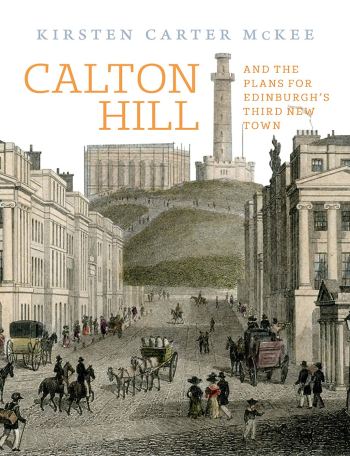 Calton Hill, on the eastern edge of Edinburgh’s centre, has a special relationship with the city. Development of the hill and its surrounding area (often referred to as Edinburgh’s ‘Third New Town’) began in the late eighteenth and early nineteenth centuries by a decision-making elite, who proposed to change the site from a rural periphery into the new urban core of the city. This book shows that the architecture and urban design on Calton Hill was a demonstration of Scotland’s cultural identity and political allegiance to the British State—as key enlightenment figures and theories were celebrated alongside the British naval heroes and the House of Hanover in the early stages of its development. However, as Scotland’s identity within Britain evolved through changes in governance in the nineteenth and early twentieth centuries, Calton Hill—and all that its neo-Greek architecture came to represent—became a metaphor for the friction between Scottish and British Nationalism, resulting in it being considered a ‘Nationalist Shibboleth’ by the last years of the twentieth century. This book considers how the architectural expression of Calton Hill has been perceived, accepted and rejected as ideas surrounding cultural identity, governance and nationalism have changed over the last 200 years.
Kirsten Carter McKee is an architectural historian and cultural landscape specialist. She has a PhD from the University of Edinburgh and has worked for a number of organisations as an archaeologist, historic buildings specialist, and heritage consultant. She is currently a research and teaching fellow in architectural history and conservation at the University of Edinburgh.
New Book | A Rare Treatise on Interior Decoration and Architecture
From Getty Publications:
Simon Swynfen Jervis, ed., A Rare Treatise on Interior Decoration and Architecture: Joseph Friedrich zu Racknitz’s Presentation and History of the Taste of the Leading Nations, translated by Simon Swynfen Jervis (Los Angeles: Getty Publications, 2020), 368 pages, ISBN: 978-1606066249, $85.
 Baron Joseph Friedrich zu Racknitz’s pioneering Presentation and History of the Taste of the Leading Nations in Relation to the Interior Decoration of Rooms and to Architecture (Darstellung und Geschichte des Geschmacks der vorzüglichsten Völker in Beziehung auf die innere Auszierung der Zimmer und auf die Baukunst), published between 1796 and 1799, is little known today. Racknitz, a German aristocrat, traced an early global history of design and ornament through discussions of what he distinguished as twenty-four essential regional historical tastes. He included those of a diverse group of ancient classical civilizations, European nations and peoples, Eastern civilizations, and more exotic reaches of the world.
This sensitive and informed translation also includes reproductions of the original color plates and essays on Racknitz’s biography, his publication, and the German Enlightenment context, making this an essential volume for studying eighteenth- and nineteenth-century architecture, decorative arts, and garden design.
Simon Swynfen Jervis has worked extensively as a curator, writer, and scholar of decorative arts. He has authored dozens of books, articles, guidebooks, and exhibition catalogues and organized exhibitions at British, European, and American institutions.










 Enfilade
leave a comment