Exhibition | A Tea Journey

Richard Collins, The Tea Party, 1727
(London: Goldsmiths’ Company)
◊ ◊ ◊ ◊ ◊
From Compton Verney:
A Tea Journey: From the Mountains to the Table
Compton Verney Art Gallery & Park, 6 July — 22 September 2019
Visitors will follow the tea leaf from plant to pot, beginning with its roots in Chinese culture through to its adoption and appropriation into British society. A Tea Journey raises questions about what the humble cup of tea has evolved to represent in international, social, philosophical, and visual cultures. The exhibition combines rare, historic teaware from China, Japan, and India with responses by contemporary artists including Robin Best, Adam Buick, Phoebe Cummings, Charlotte Hodes, Takahiro Kondo, Ian McIntyre, Bruce Nuske, Selina Nwulu, Bouke de Vries, Hetain Patel, Paul Scott, Julian Stair, and Edmund de Waal. Visitors are also invited to explore The Tea Sensorium, which offers a multi-sensory appreciation of tea, from the leaf itself and art inspired by tea, as well as becoming a sight for artist-led workshops and discussions.
New Book | Iconoclasm in New York: Revolution to Reenactment
Scheduled for publication this fall from Penn State UP:
Wendy Bellion, Iconoclasm in New York: Revolution to Reenactment (University Park: The Pennsylvania State University Press, 2019), 280 pages, ISBN: 978-0271083643, $125.
 King George III will not stay on the ground. Ever since a crowd in New York City toppled his equestrian statue in 1776, burying some of the parts and melting the rest into bullets, the king has been riding back into American culture, raising his gilded head in visual representations and reappearing as fragments. In this book, Wendy Bellion asks why Americans destroyed the statue of George III—and why they keep bringing it back.
Locating the statue’s destruction in a transatlantic space of radical protest and material violence—and tracing its resurrection through pictures and performances—Bellion advances a history of American art that looks beyond familiar narratives of paintings and polite spectators to encompass a riotous cast of public sculptures and liberty poles, impassioned crowds and street protests, performative smashings and yearning re-creations. Bellion argues that iconoclasm mobilized a central paradox of the national imaginary: it was at once a destructive phenomenon through which Americans enacted their independence and a creative phenomenon through which they continued to enact British cultural identities. Persuasive and engaging, Iconoclasm in New York demonstrates how British monuments gave rise to an American creation story. This fascinating cultural history will captivate art historians, specialists in iconoclasm, and general readers interested in American history and New York City.
Wendy Bellion is Professor and Sewell C. Biggs Chair of American Art History at the University of Delaware. She is the author of the award-winning Citizen Spectator: Art, Illusion, and Visual Perception in Early National America.
Exhibition | Cost of Revolution: The Life and Death of an Irish Soldier
Press release (15 May 2019) for the exhibition:
Cost of Revolution: The Life and Death of an Irish Soldier
Museum of the American Revolution, Philadelphia, 28 September 2019 — 17 March 2020
Exploring the toll of war and revolution through the eyes of Irish soldier Richard St. George

Thomas Gainsborough, Portrait of Richard St. George, 1776 (Melbourne: National Gallery of Victoria).
Tickets are now on sale for the upcoming special exhibition Cost of Revolution: The Life and Death of an Irish Soldier, which opens on 28 September 2019 and runs through 17 February 2020 at the Museum of the American Revolution, the exhibition’s exclusive venue. Based on new discoveries made by the Museum’s curators, Cost of Revolution presents the untold story of Richard St. George, an Irish soldier and artist whose personal trauma and untimely death provide a window into the entangled histories of the American Revolution and the ensuing Irish Revolution of 1798.
“You may not have heard the name Richard St. George before, but you’ll be astonished by what his life can tell us about America and Ireland in the Age of Revolutions,” said Dr. R. Scott Stephenson, President and CEO of the Museum of the American Revolution. “This exhibit extends the Museum’s internationally acclaimed story-driven approach onto the global stage to examine the broader influence of the American Revolution through St. George’s remarkable personal journey.”
As a young officer in the British Army, Richard St. George crossed the Atlantic in 1776 to try and stop the growing American Revolution. He returned home to Ireland after surviving a severe head wound at the Battle of Germantown, near Philadelphia, in 1777. Back in Ireland, he found his native country roiled by the effects of the revolutionary spirit sweeping across America and Europe. St George became an outspoken critic of the growing movement to establish an Irish republic independent from the British Empire in the 1790s. A few months before the outbreak of the Irish Revolution of 1798, St. George’s tenants ambushed and killed him.
The 5,000-square-foot exhibition will chronicle St. George’s dramatic journey with more than 100 artifacts, manuscripts, and works of art from Australia, Ireland, England, and the United States, many of which will be on display in America for the first time. It will also present one of the largest collections of objects from Ireland’s 18th-century revolutionary history and war for independence ever displayed in Philadelphia.
Five portraits of Richard St. George—created over the span of 25 years—are known to survive and will be reunited in this exhibit for the first time since they left the possession of St. George’s descendants more than a century ago. Every known piece of surviving artwork by St. George himself—including cartoons, sketches from his military service in America, and a self-portrait—also will be assembled for the first time in this exhibit. Together, the portraits, cartoons, and sketches reveal the physical and emotional toll of revolution.
Key Artifacts

Xavier della Gatta, Painting of the Battle of Germantown, 1782 (Philadelphia: Museum of the American Revolution).
• A portrait of Richard St. George by Thomas Gainsborough (1776) depicting him just before he shipped out for New York to fight against the growing American Revolution, on loan from Australia’s National Gallery of Victoria (Melbourne).
• Three portraits of Richard St. George by Irish artist Hugh Douglas Hamilton (1790s) that show St. George as he struggled to manage the pain of the traumatic headwound he received during the American Revolutionary War. One of the portraits, on loan from the National Gallery of Ireland in Dublin, depicts him grief-stricken, mourning at his wife’s tomb. Hamilton painted this portrait as a movement for Irish independence, which St. George opposed, was on the rise.
• A signed self-portrait of Richard St. George, recently donated to the Museum, that depicts him in a forlorn landscape wearing a silk head wrap to cover the scars of his head wound. This portrait is a rare example of art created by a veteran of the American Revolutionary War that refers to personal pain sustained during the War.
• Paintings of the Battles of Paoli and Germantown by Italian artist Xavier della Gatta that St. George helped to create in 1782 to reflect on his participation in those battles. The paintings are in the Museum’s permanent collection.
• The British Army uniform coat and pistol that belonged to Richard St. George’s grandfather, on loan from the National Army Museum in London.
• The 1775 bound maps of the estate of Richard St. George in County Galway, on loan from the Galway County Council Archives in Galway, Ireland.
• A trephine, or skull saw, of the type that was used to operate on Richard St. George’s head following the Battle of Germantown, on loan from the Mütter Museum of the College of Physicians of Philadelphia.
• American illustrator Howard Pyle’s 1898 painting The Attack upon the Chew House, which depicts the carnage of the Battle of Germantown, on loan from the Delaware Art Museum.
• The red uniform coat worn by British Army Lieutenant Ely Dagworthy on loan from Dumbarton House and the National Society of The Colonial Dames of America.
• The August 24, 1776 Leinster Journal, one of the first printings of the American Declaration of Independence in an Irish newspaper, on loan from the National Library of Ireland in Dublin, Ireland.
• A green uniform coat worn by Irish Revolutionary Henry Joy McCracken and a pike head carried by the United Irishmen during Ireland’s fight for independence from Great Britain in 1798, on loan from the National Museums of Northern Ireland (Ulster Museum) in Belfast.
• A rare silk flag carried by the Delaware militia that the British light infantry captured during the Philadelphia Campaign of 1777, on loan from the Delaware Historical Society.
• Richard St. George’s personal sketches from the American Revolutionary War, on loan from a private collection. One sketch depicts St. George being carted off the battlefield following his wounding at the Battle of Germantown in 1777.
• Lord Edward Fitzgerald’s ribbon and Theobald Wolfe Tone’s membership certificate from the United Irishmen, on loan from the National Museum of Ireland in Dublin. Both Fitzgerald and Wolfe Tone died while helping to lead the United Irishmen in their struggle for Irish independence from Great Britain in 1798. The ribbon, taken from Fitzgerald’s body after his death, served as a memento of the Irish Revolution and was used to inspire later Revolutionaries in South America.
Programming Highlights
• Saturday, September 28 and Sunday, September 29, the exhibit’s opening weekend, the Museum’s flagship living history event, Occupied Philadelphia, will bring together dozens of costumed interpreters to recreate the 1777–78 British occupation of Philadelphia on the Museum’s outdoor plaza.
• Tuesday, October 1, the Museum will host an evening lecture by Martin Mansergh, a collateral descendant of Richard St. George and a noted historian who is a former Irish Fianna Fáil politician and played a key role in the Northern Ireland peace process.
• Friday, October 3 through Sunday, October 5, the Museum will host the 2019 International Conference on the American Revolution in partnership with the Pritzker Military Museum and Library. This event will bring noted historians, writers, and curators from Ireland, Scotland, England, and the United States together to explore military, political, social, and artistic themes from the Age of Revolutions.
• The exhibition will come to life with special events and daily programs exploring the artistic and cultural traditions of Richard St George’s world. Highlights include musical and theatrical performances, artisan workshops and demonstrations, talks by noted historians as part of the Museum’s Read the Revolution series, and tours of the exhibition.
Deborah Sampson, Her Diary, and Women in the American Revolution
As reported this week by in The New York Times:
Alison Leigh Cowan, “The Woman Who Sneaked into George Washington’s Army,” The New York Times (2 July 2019). A rediscovered diary, now at the Museum of the American Revolution, sheds light on the life of Deborah Sampson, who fought in the Continental Army.
Hers has always been one of the more astonishing, if little-known, tales of the American Revolution: a woman who stitched herself a uniform, posed as a man and served at least 17 months in an elite unit of the Continental Army. Wounded at least twice, Deborah Sampson carried a musket ball inside her till the day she died in 1827.
While historians agree that Sampson served in uniform and spilled blood for her country, gaps in the account have long led some to wonder whether her tale had been romanticized and embellished — possibly even by her.
Did she fight in the decisive Battle of Yorktown, as she later insisted on multiple occasions? And how did she keep her secret for the many months she served in Washington’s light infantry?
Now, scholars say the discovery of a long-forgotten diary, recorded more than 200 years ago by a Massachusetts neighbor of Sampson, is addressing some of the questions and sharpening our understanding of one of the few women to take on a combat role during the Revolution.
“Deb Sampson, her story is mostly lost to history,’’ said Dr. Philip Mead, the chief historian and director of curatorial affairs of the Museum of the American Revolution in Philadelphia. “So, finding a little piece of it is even more important than finding another piece of George Washington’s history.”
The museum bought the diary for an undisclosed sum after Dr. Mead spotted it at a New Hampshire antiques show last summer. He plans to showcase it next year with other items about the role American women played in the Revolution, as part of a larger celebration of the 100th anniversary of the 19th Amendment. . . .
The full article is available here»
New Book | Reconsidering Interpretation of Heritage Sites
From Routledge:
Anne Lindsay, Reconsidering Interpretation of Heritage Sites: America in the Eighteenth Century (New York: Routledge, 2019), 208 pages, ISBN: 978-1629582702 (hardback), $150 / ISBN: 978-1629582719 (paperback), $40.
 Reconsidering Interpretation of Heritage Sites chronicles and problematizes the representation of the eighteenth century in museums and heritage sites, whilst also challenging public historians to alter their perceptions of what might be possible when interpreting such sites.
Much of the history consumed at eighteenth-century historic sites is one-dimensional, white, male, heteronormative, and very focused on power and wealth. Anne Lindsay argues that this narrative may be challenged through an engagement with the everyday life of the past, creating thought-provoking and challenging experiences that will connect with the modern visitor on a deeper level. Unlike other work that has been done in the field, the book provides a constructive study that engages in a horizontal analysis of a century over a geographic region. As a result, Lindsay provides a unique opportunity for scholars and practitioners to reflect on the types and tone of messages usually conveyed about the eighteenth century.
Reconsidering Interpretation of Heritage Sites will be invaluable to scholars and practitioners working in the fields of museum and heritage studies and history. It will be particularly interesting to those who want to know more about how the lived experience of the past may be interpreted at historic sites and how this could be used to engage with contentious histories.
Anne Lindsay is an assistant professor of history and coordinator of the Capital Campus Public History Program at California State University, Sacramento. She holds a PhD in public history from the University of California, Riverside. Her research considers eighteenth-century heritage tourism for twenty-first century audiences. As a practitioner, she works in historic preservation and heritage tourism. She lives in northern California with her husband and three furry research assistants.
C O N T E N T S
Introduction
1 Interpreting the Lived Experience of Individuals and Families in the Eighteenth Century
2 Eighteenth-Century Interpretations of Environmental and Global Contexts at Historic Sites
3 Breathing Life into Historic House Museums
4 Interpreting Eighteenth-Century Streets and Gardens in the Urban Environment
5 Problematizing Eighteenth-Century Interpretation in the Homes of the Founders
Epilogue
Index
New Title | ‘The Only Unavoidable Subject of Regret’
From The University of Virginia Press:
Mary Thompson, ‘The Only Unavoidable Subject of Regret’: George Washington, Slavery, and the Enslaved Community at Mount Vernon (Charlottesville: The University of Virginia Press, 2019), 520 pages, ISBN: 978-0813941844, $30.
 George Washington’s life has been scrutinized by historians over the past three centuries, but the day-to-day lives of Mount Vernon’s enslaved workers, who left few written records but made up 90 percent of the estate’s population, have been largely left out of the story.
In “The Only Unavoidable Subject of Regret,” Mary Thompson offers the first comprehensive account of those who served in bondage at Mount Vernon. Drawing on years of research in a wide range of sources, Thompson brings to life the lives of Washington’s slaves while illuminating the radical change in his views on slavery and race wrought by the American Revolution.
Thompson begins with an examination of George and Martha Washington as slave owners. Culling from letters to financial ledgers, travel diaries kept by visitors and reminiscences of family members as well as of former slaves and neighbors, Thompson explores various facets of everyday life on the plantation ranging from work to domestic life, housing, foodways, private enterprise, and resistance. Along the way, she considers the relationship between Washington’s military career and his style of plantation management and relates the many ways slaves rebelled against their condition. The book closes with Washington’s attempts to reconcile being a slave owner with the changes in his thinking on slavery and race, ending in his decision to grant his slaves freedom in his will.
Mary V. Thompson, Research Historian at George Washington’s Mount Vernon, is the author of ‘In the Hands of a Good Providence’: Religion in the Life of George Washington (Virginia).
A Looking Glass from Mount Vernon Recreated by Eli Wilner & Co.
Press release, via Art Daily (29 June 2019) . . .

Reproduction of George and Martha Washington’s Front Parlor Looking Glass, made in 2018–19 by Eli Wilner & Co. (Photo by Gavin Ashworth).
In early 2017, Curator Adam Erby contacted Eli Wilner & Company about recreating a looking glass from an archival photo for the front parlor at George Washington’s Mount Vernon. Mr. Erby was already familiar with the firm’s capabilities in working from photos, including recreating a large pair of lost overmantle mirrors for Lyndhurst Mansion, a National Trust for Historic Preservation site in Tarrytown, New York.
In this case, the frame in the photo is in fact still in existence, but it is in the possession of another institution, and for various reasons, unavailable for long term loan. George and Martha Washington purchased the original elaborate English neoclassical looking glass from New York City merchants J. & N. Roosevelt on April 15, 1790, during the brief period of time the United States capital was in New York. They moved the mirror with them to Philadelphia for the duration of the presidency and then back to Mount Vernon where it took pride of place in the front parlor. Martha Washington thought so highly of the looking glass that she bequeathed it to her granddaughter Eleanor ‘Nelly’ Parke Custis Lewis in her will as “the large looking glass in the front Parlour.” It remained in the hands of descendants until they sold it to an institution in the 1870s. The original looking glass had lost many of its original elements and recreating them in the new mirror required careful research and coordination between Erby and the Wilner team.
After several months of discussion and establishing agreements as to how to financially and logistically make this unique project happen, an on-site meeting was arranged to view the original frame in storage in Washington D.C. There, Mr. Erby, along with Williamsburg, Virginia based conservator Thomas Snyder and two members of the Wilner team, took detailed measurements and discussed various observations on the original looking glass, particularly where there appeared to be missing elements and prior restoration attempts. Due to various circumstances, including the missing design elements, this replica would have to be an “inspired copy”.
In January of 2018, Mr. Erby and Senior Curator Susan Schoelwer personally met with the Wilner team at their studio in Long Island City, New York to finalize some subtle details regarding the overall flow of the elaborate crest design. With agreement from all involved regarding the scale and design of the inner frame, the wood profile was shaped and a system designed for securing the mirrored glass into the interior sections of the frame. After carving the lamb’s tongue ornament on the inner frame, and creating rows of beads to be applied, work on the elaborate crest elements was begun. This incredibly intricate and fragile design incorporated wire armature elements to support the delicate hand carved details.
The various elements of the frame and crests were then water gilded in the same manner as the original frame would have been. First, multiple layers of gesso were painted and sanded. This smooth surface was then painted with layers of ochre and red clay to recreate a similar tone to the original. Next gold leaf was applied with a squirrel hair brush and a water/alcohol/glue mixture known as ‘gilder’s liquor’, and the entire surface was selectively burnished. At the curator’s direction, the surface should look “15 years old”, therefore the finishers did minimal rub to the gilding. This was an unusual challenge for the Wilner studio, as normally the artisans are tasked with making a replica frame look older, rather than newer.
In January of 2019, during a follow up on-site visit to the Wilner studio, one last decision was handed over to Mr. Erby and Dr. Schoelwer to choose from two options of corner straps. Both of the existing frames that were being used as studies for the design were missing their original straps, so further research was done by the Wilner team to offer historically and aesthetically appropriate choices. Though these elements are purely superficial and do not actually function structurally, the width is critical to cover the edges of the glass contained inside. The straps needed to be sufficiently wide for tiny nails to be hammered through to the wood substrate, while maintaining an aesthetic delicacy consistent with the rest of the object. The straps on the original frames were most likely lost because they were only adhered with glue which dried out over time.
Within hours of this final decision, the frame was fully assembled, corner straps and all. The looking glass was then immediately secured inside a travel crate, ready to be shuttled to Mount Vernon by a trusted fine art shipper. In February 2019, the looking glass was officially installed in the front parlor at Mount Vernon and the fully restored room was reopened to the public shortly thereafter on February 16th, 2019, just in time for President’s Day weekend.
Coincidentally, just as the Wilner staff were wrapping up this two-year long project, they were contacted by Abigail Horrigan, Director of Marketing Partnerships, and Carrie Villar, Acting Vice President of Historic Sites from the National Trust for Historic Preservation, to advise on the restoration of frames enclosing four important portraits at Woodlawn Mansion.
Woodlawn, the first site operated by the National Trust, was originally part of George Washington’s Mount Vernon estate. In 1799, he gave the site to his nephew, Lawrence Lewis, and Lewis’ new bride, the aforementioned Eleanor ‘Nelly’ Parke Custis, Martha Washington’s granddaughter, in hopes of keeping Nelly close to Mount Vernon. The newly-married couple built the Georgian/Federal house designed by William Thornton, architect of the U.S. Capitol.
The frames sent to Eli Wilner & Company for restoration hold portraits of former owners of Woodlawn. In addition to two paintings of Nelly, there is a companion portrait of her husband Lawrence in a matching frame. The fourth frame was for a portrait of Senator Oscar Underwood from Alabama, who lived at the mansion from 1925 until his death in 1929.
The Nelly and Lawrence portraits are always on exhibit and are key parts of the site’s public tour interpretation. The condition of the frames, which included much cracking and losses to ornaments and gilding was beginning to detract from Woodlawn’s overall appearance and visitor experience.
At the Wilner Studio, the four frames were treated as thoughtfully as possible in order to retain the original character of the gilded surfaces. After gentle cleaning and various structural reinforcements, all losses to the ornaments were filled and then patinated to cosmetically blend with the original surface. In April 2019, the frames were reunited with the paintings and are now back on view to the public.
Eli Wilner & Company is extremely proud to add all of these projects to their list of framing accomplishments that have helped in preserving iconic moments and individuals in American History. Their most notable projects include: reframing Emanuel Leutze’s monumental Washington Crossing the Delaware for the Metropolitan Museum of Art , a total of 22 projects for the White House, and pairing the flag salvaged from Custer’s Last Stand with a period frame.
George Washington’s Mount Vernon and the National Historic Trust for Historic Preservation sites Woodlawn and Lyndhurst Mansion all directly benefited from Eli Wilner & Company’s philanthropic outreach and museum funding programs. All not-for-profit and government-supported public institutions are invited to submit proposals for historical picture framing projects on an ongoing basis. Proposals are reviewed daily.
New Book | The American Duchess Guide to 18th-Century Beauty
This companion volume to The American Duchess Guide to 18th–Century Dressmaking is scheduled to be released in July, when it will be available at Amazon, Barnes & Noble, and other major booksellers.
Lauren Stowell and Abby Cox, with Cheyney McKnight, The American Duchess Guide to 18th-Century Beauty: 40 Projects for Period-Accurate Hairstyles, Makeup, and Accessories (Salem: MA, Page Street Publishing, 2019), 240 pages, ISBN: 978-1624147869, $25.
 Ever wondered how Marie Antoinette achieved her sky-high hairstyle or how women in the 1700s created their voluminous frizz hairdos? The American Duchess Guide to 18th-Century Beauty answers all your Georgian beauty questions―and teaches you all you need to know to recreate the styles yourself. Learn how to whip up your own pomatum and hair powder and correctly use them to take your dos to the next level. From there, dive into the world of buckles, hair cushions, and papillote papers with historically accurate hairstyles straight from the 1700s. And top all your hair masterpieces with millinery from the time period, from a French night cap to a silk bonnet to a simple, elegant chiffonet. With step-by-step instructions and insightful commentary, this must-have guide is sure to find a permanent place on the shelves of 18th-century beauty enthusiasts.
Lauren Stowell and Abby Cox are the authors of The American Duchess Guide to 18th-Century Dressmaking, and their company, American Duchess Inc., has been providing historically accurate lady’s shoes since 2011. Their shoes and accessories have been used in productions all over the world, including ABC’s Once Upon a Time, Starz’s Outlander and American Gods, Broadway’s Hamilton: An American Musical, Dangerous Liaisons, and Cinderella. Their shoes have also been used by the New York Metropolitan Opera and Ford’s Theater and have walked the red carpet at the Academy Awards. They live in Reno, Nevada.
As Stowell and Cox describe the project on their blog:
The recipes in the book come from primary sources like Toilet De Flora (1772) and Plocacosmos (1782), among others. These books have multiple recipes for various types of pomades, powders, rouges, paints, perfumes, and dyes, some of which contain ingredients that are not available today. We went with the simplest and most accessible recipes, all with natural and safe ingredients easily obtained.
Exhibition | Three Centuries of Chinese Reverse Glass Painting
Now on view in Switzerland at the Vitromusée Romont:
Reflets de Chine: Trois siècles de peinture sous verre chinoise
Vitromusée Romont, 16 June 2019 — 1 March 2020
 As a museum entirely dedicated to the glass arts, the Vitromusée Romont houses a collection of more than 1300 reverse glass paintings—in addition to stained glass, glass containers, graphic works and tools related to glass arts. No museum in Switzerland or abroad, nor any private collection, holds such an important collection of this particular art in terms of quality, variety and quantity.
For its next temporary exhibition, the museum will highlight a form of artistic production little known to date, that of Chinese reverse glass painting. This will be the first exhibition in Switzerland devoted exclusively to this art created in China between 1750 and 1950, retracing its long history: from its conception in the 18th century with the successful artistic encounter between Chinese painting and that of Europe, to its subsequent ‘globalization’ before becoming a widespread popular art within China.
More information is available as a PDF file here»
Call for Papers | Reconsidering Chinese Reverse Glass Painting
From ArtHist.net:
China and the West: Reconsidering Chinese Reverse Glass Painting
Vitromusée Romont, 14–16 February 2020
Proposals due by 15 September 2019
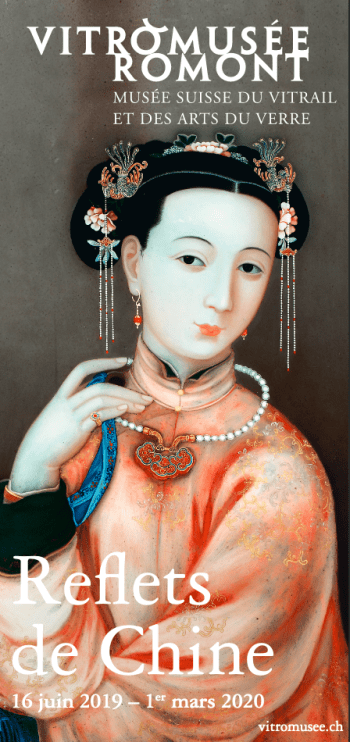 The Vitrocentre and Vitromusée Romont are pleased to announce the Call for Papers for an international conference on Chinese reverse glass painting and related research fields including other media to be held at the museum in Romont, Switzerland 14–16 February 2020. The workshop is jointly organized by the Vitrocentre and Vitromusée Romont and the Section of East Asian Art History (KGOA) at the University of Zurich. It will be held in conjunction with an important exhibition of Chinese reverse glass paintings, held at the museum from 16 June 2019 to 1 March 2020.
Devoted entirely to the glass arts, the Vitromusée Romont houses, manages and showcases important collections that bring together stained-glass windows, reverse glass painting, objects in glass, and graphic works, as well as tools and materials related to the glass arts. The Vitrocentre, its scientific partner, has core tasks primarily in researching the art history of glass arts. For the first time in Switzerland and at international scale, the Vitromusée presents a major survey dedicated to Chinese reverse glass painting, tracing its long history, little known to date. The exhibition gathers examples of the genre from two major collections, from Germany and France, as well as the Vitromusée’s own collection, and features both reverse glass paintings made for export to Europe and for local consumption within China.
The workshop aims to
• open a cross-cultural dialogue between scholars of Asian art and to offer a platform for the presentation and discussion of recent research on Chinese reverse glass paintings and popular culture
• revise historical approaches that have been prevalent in the study and research of Chinese reverse glass paintings and related fields
• elaborate on the existing theories and methodology on the topic
• form new research approaches and methods by young, emerging scholars.
Scholars and curators of Asian art from Europe and beyond are invited to submit their proposals for contributions on Chinese reverse glass paintings. Presenters can be either established scholars (working at museums, universities, or independent scholars) or junior scholars (holding an MA or PhD degree).
Possible topics for the workshop presentations on Chinese reverse glass paintings include
• Chinese reverse glass paintings as points of knowledge transfer between East and West
• Chinese reverse glass paintings in the context of cultural appropriation
• The question of export vs. local consumption of Chinese reverse glass paintings
• Chinese reverse glass paintings as popular and/or elite art
• Technical aspects, types of glass and painting techniques in Chinese reverse glass paintings
• Types of frames in Chinese reverse glass paintings and their meanings
• Connections of Chinese reverse glass paintings to Chinese popular prints
• Connections of Chinese reverse glass paintings to porcelain (Compagnie des Indes orientales, etc.)
• The question of 3D aesthetics in Chinese reverse glass paintings
• Various themes and motives represented in the Chinese reverse glass paintings
• Gaps in understanding of Chinese reverse glass paintings in the East and in the West
• Reception of Chinese reverse glass paintings in the West
• Other East Asian traditions of reverse glass paintings
• Collection histories of the Chinese reverse glass paintings in the West
The languages of the workshop are English, French, and German. Presentations are to last twenty minutes, followed by a ten-minute discussion period. The presentations and the viewing of the exhibition will take place on the first two days of the symposium (14-15 February). The final day (16 February) is an optional day with tours of local historical sites.
Please send a presentation title, a paper proposal (maximum 250 words), and a CV to Elisa Ambrosio (elisa.ambrosio@vitrocentre.ch) by 15 September 2019. Notifications of acceptance will be sent by 15 October 2019. The workshop will cover the costs of accommodation and food during the workshop. Participants are expected to pay for their own transportation. In case you have any questions, please contact: Elisa Ambrosio, elisa.ambrosio@vitrocentre.ch.
Organizational Committee
• Francine Giese (Director of the Vitromusée & Vitrocentre Romont)
• Hans Bjarne Thomsen (Professor of East Asian Art History, University of Zurich)
• Elisa Ambrosio (Curator of the Vitromusée Romont and scientific collaborator of the Vitrocentre Romont)










 Enfilade
leave a comment