Call for Essays | Studi Neoclassici
From ArtHist.net:
Studi Neoclassici: Rivista internazionale 8 (2020)
Submissions due by 31 March 2020
 The journal Studi Neoclassici, created with the aim of publishing the results of the activity promoted by the ‘Istituto di ricerca per gli studi su Canova e il Neoclassicismo’ (‘Research Institute for Studies on Canova and Neoclassicism’) of Bassano del Grappa, has been a tool for disseminating research of the Edizione Naionale delle Opere di Antonio Canova (National edition of the works of Antonio Canova), that converge in the critical editions of the enormous Canova’s epistolary, with the historical, biographical, stylistic insights that matter requires. The major scholars of Neoclassicism constitute the scientific and editorial council of the journal.
The magazine proposes itself to the attention of scholars in various fields of research, from history to literature, from archeology to art history, from the history of culture to art criticism to the history of collecting, from the history of music to that of dance and costume.
Journal articles follow the same methodological approach that characterized the “Canovian Weeks”, i.e. the formula of connecting different artistic and cultural experiences, from literature to art history, to history and to other arts included in the historical period between second half of the eighteenth and the first decades of the twentieth century, with the intention of proposing a complete and not only specialized picture of the theme.
Studi Neoclassici publishes monographic numbers and free topic numbers relating to the historical period of the journal, the texts of which, selected through a ‘Call for papers’ procedure, are all—except for rare and justified exceptions—subject to peer review by a ‘double blind’ peer review procedure. In the case of exceptions it is the management, in its collegiality, that after careful examination assumes the responsibility of accepting the texts.
The number 8, 2020 will host free articles and one or two reviews of volumes relating to the period covered by the magazine. The editorial rules are available here. Texts can be presented in Italian, German, French, English, or Spanish; must not exceed 35,000 characters (spaces and notes included); and must be sent by 31 March 2020 to giuliana.ericani@gmail.com or gianpavese@gmail.com.
Print Quarterly, December 2019
The eighteenth century in the current issue of Print Quarterly:
Print Quarterly 36.4 (December 2019)

Étienne Fessard and Augustin de Saint-Aubin, after Charles Natoire, Gaetano Brunetti, and Paolo Antonio Brunetti, Perspective View of the Chapel of Enfants Trouvés in Paris, 1759, etching and engraving, sheet (trimmed) 80 × 59 cm (New York, Metropolitan Museum of Art).
A R T I C L E S
Rena M. Hoisington, “Étienne Fessard’s Prints of the Chapel of the Hôpital des Enfants Trouvés in Paris,” pp. 404–25.
Soon after Charles Natoire (1700–1777) completed his cycle of paintings for the Chapel of the Hôpital des Enfants Trouvés in Paris, Fessard announced a subscription plan for a series of prints reproducing them. Often addressed merely for their documentary value, these prints are here analysed as objects in themselves. The article explores their complex publication history and assesses them in the context of Fessard’s career. Also analysed is the series’ repercussion on the reputation of the artists involved in their realization, Natoire included.
N O T E S A N D R E V I E W S
Colin Harrison, Review of Peter Whitfield, Oxford in Prints: 1675–1900 (Bodleian Library, 2016), p. 448.
The book explores how Oxford has been pictured between 1675 and 1922 by illustrating a selection of volumes in the collection of the Bodleian Library. The largest group consists of almanacks printed by the University, which took their definitive format of a topographical headpiece with a calendar beneath in the early eighteenth century.
Jean Michel Massing, Review of Cheryl Finley, Committed to Memory: The Art of the Slave Ship Icon (Princeton University Press, 2018), p. 484–88.
The book “focuses on the life, and afterlife, of famous anti-slavery icon,” the 1788 engraved Plan of an African Ship’s lower Deck with Negroes in the proportion of only one to a Ton (484). Part One “considers abolitionist slave ship prints from the period 1788 to 1900; the remainder of the book is devoted to their stature as an icon reappropriated by twentieth-century African American, British and African artists” (488).
P U B L I C A T I O N S R E C E I V E D
Mungo Campbell and Nathan Flis, eds., William Hunter and the Anatomy of the Modern Museum, exhibition catalogue (Yale Center for British Art, and The Hunterian, University of Glasgow, in association with Yale University Press, 2018), p. 472.
Exhibition | Portraying Pregnancy
From the press release for the exhibition:
Portraying Pregnancy: From Holbein to Social Media
The Foundling Museum, London, 24 January — 26 April 2020
Curated by Karen Hearn
Th e Foundling Museum is proud to present the first major exhibition to explore representations of the pregnant female body through portraits from the past 500 years, Portraying Pregnancy: From Holbein to Social Media, which opens on 24 January 2020.
Until the twentieth century, many women spent most of their adult years pregnant. Despite this, pregnancies are seldom made apparent in surviving portraits. This exhibition brings together images of women—mainly British—who were depicted at a time when they were expecting (whether visibly so or not). Through paintings, prints, photographs, objects, and clothing from the fifteenth century to the present day, Portraying Pregnancy explores the different ways in which pregnancy was, or was not, represented; how shifting social attitudes have impacted on depictions of pregnant women; how the possibility of death in childbirth brought additional tension to such representations; and how more recent images, which often reflect increased female agency and empowerment, still remain highly charged. This exhibition is the first of its kind and provides an exceptional opportunity to situate contemporary issues of women’s equality and autonomy in a 500-year context.
The earliest portrait featured in the exhibition—and a major highlight—is Hans Holbein II’s beautiful drawing of Sir Thomas More’s daughter, Cicely Heron, made in 1526–27, lent by Her Majesty The Queen from the Royal Collection. Sketched from life, it is a rare, clear-eyed, observation of a pregnant woman. In many pre-twentieth-century works in the exhibition, however, the sitter’s pregnancy has been edited out. The mezzotint made after Sir Joshua Reynolds’s full-length portrait of Theresa Parker, for example, shows no visible sign of her pregnancy, in line with conventions of the time, despite rich documentary evidence that by her second sitting in February 1772, Theresa was heavily pregnant.
Today, women with access to birth control can expect to plan if, or when, they become pregnant. Prior to the 1960s, many women would have experienced, between marriage and menopause, a number of pregnancies—and their daily lives might alter little for most of the gestation period. This is exemplified in a portrait of the celebrated eighteenth-century actress, Sarah Siddons, shown in the role of Lady Macbeth, which she famously played up until the final weeks of pregnancy.
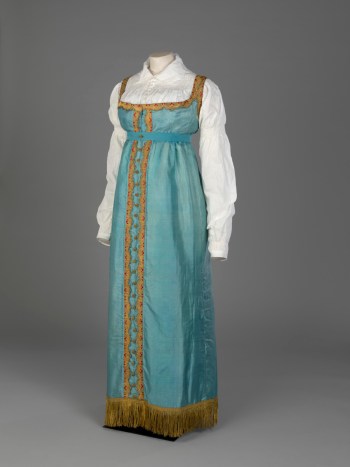
Russian style dress belonging to Princess Charlotte, ca. 1817, silk, gold, metallic and silk lace, gold metallic fringe (Royal Collection Trust, 74709).
Fear of dying in childbirth was very real, and often justified. Until the early twentieth century, most births took place at home, often attended by family members, and consequently many women witnessed death in childbirth. Elizabethan and Jacobean portraits of visibly pregnant women, such as Marcus Gheeraerts II’s portrait of a heavily-pregnant unknown woman, dated 1620, appeared in the same era as the ‘mother’s legacy’ text—in which a woman wrote a ‘letter’ for the benefit of her unborn child, in case she should not survive her confinement. An example is the manuscript that the well-educated Elizabeth Joscelin wrote in 1622 for the child that she was carrying. Maternal mortality is also powerfully represented by George Dawe’s 1817 portrait of the pregnant Princess Charlotte, the heir to the British throne, wearing a fashionable loose ‘sarafan’ dress, as well as by the actual surviving garment, lent by Her Majesty The Queen from the Royal Collection, which will be displayed alongside it. Charlotte died in childbirth, in November that year.
While Christianity played a central role in everyday life, conceiving a baby (or not), was seen as a gift from God. Historically, the New Testament story of The Visitation—the meeting of the pregnant Virgin Mary and her cousin, Elizabeth—was a particularly inspiring and comforting one for pregnant women. Images of it had been widespread in England prior to the sixteenth- century Reformation, and reappeared in the late nineteenth and early twentieth centuries. The Pre-Raphaelite artists’ doctrine of absolute realism saw them model their depictions of it on pregnant women among their own social circle.
Augustus John’s ca. 1901 full-length portrait of his wife, Ida, must have seemed astonishingly transgressive to viewers at the time, as it clearly depicts her as pregnant. It was not until the later twentieth century that pregnancy stopped being ‘airbrushed out’ of portraits. In 1984, the British painter, Ghislaine Howard, produced a powerful self-portrait of herself as heavily pregnant. However, the watershed moment occurred internationally in August 1991, when Annie Leibovitz’s photographic portrait of the actress, Demi Moore, naked and seven months pregnant, appeared on the cover of Vanity Fair magazine. This image was considered so shocking that some retailers refused to stock the issue. Nevertheless, it marked a culture shift and initiated the trend for more visible celebrations of pregnant bodies—especially nude ones. In 2017, Leibovitz returned to the theme, photographing the pregnant tennis champion, Serena Williams, naked, for Vanity Fair’s August cover.
The final photograph in the exhibition, by Awol Erizku, was commissioned by the singer, Beyoncé Knowles, who posted it on Instagram on 1 February 2017. Erizku’s iconographically complex portrait of Beyoncé, pregnant with twins, veiled and kneeling in front of a screen of flowers, became the most liked Instagram post of that year. Beyoncé’s image powerfully demonstrates how some women have succeeded in taking ownership not just of representations of their pregnant bodies, but also the distribution of their portraits.
This exhibition, curated by Professor Karen Hearn FSA, previously the curator of sixteenth- and seventeenth-century British art at Tate Britain (1992–2012) and now Honorary Professor at University College London, is the first of its kind and provides an exceptional opportunity to situate contemporary issues of women’s equality and autonomy in a 500-year context; it forms part of the Foundling Museum’s ongoing programme of exhibiting art that reflects its mission to celebrate the power of individuals and the arts to change lives. The exhibition is supported by the Drapers’ Company, Norland College and the 1739 Club.
Karen Hearn, Portraying Pregnancy: Holbein to Social Media (London: Paul Holberton, 2020), 112 pages, ISBN: 978-1911300809, £18.
Blake’s ‘Ancient of Days’ on St. Paul’s Dome

A reproduction of William Blake’s The Ancient of Days from 1827 projected by Tate Britain onto St Paul’s Cathedral in London, 2019
(Photo by Alex Wojcik for Tate)
◊ ◊ ◊ ◊ ◊
There’s one more night to see Blake’s Ancient of Days projected onto the London skyline; the Tate Britain exhibition is on view until February 2; from the Tate press release (28 November 2019). . .
William Blake’s final masterpiece will illuminate the iconic dome of St Paul’s Cathedral to celebrate the artist’s birthday. The dramatic illustration The Ancient of Days (1827) was described by Blake as “the best I have ever finished” and will be visible across London this weekend. Tate Britain is currently staging the UK’s largest survey of works by Blake for a generation and has collaborated with St Paul’s Cathedral—home to the most visited Blake memorial in the UK—to recreate his vision on a monumental scale
Now renowned as a poet, Blake also had grand ambitions as a visual artist, proposing vast frescos that were never realised. Living and working in London for most of his life, the artist imagined adorning the walls of churches and public buildings in the city. The cityscape of London, dominated by St Paul’s Cathedral, inspired Blake’s powerful artworks and writing. His well-known poem Holy Thursday 1789 refers to “the high dome of Pauls.” Created as a frontispiece for the 1794 prophetic book Europe a Prophecy, The Ancient of Days is on loan to the exhibition at Tate Britain from the collection of the Whitworth, The University of Manchester and has become one of Blake’s best-known images. Through projections, Tate Britain will re-envision the small yet imposing illustration on an awe-inspiring scale, more than two centuries later.
Shaped by his personal struggles in a period of political terror and oppression, Blake’s radical beliefs meant he received little recognition in his own lifetime. November 28, 2019 would have been his 262nd birthday. In the almost two centuries since his death, Blake has become one of Britain’s most beloved artists and an inspiration to generations of musicians, writers, artists, and performers worldwide. Buried in relative obscurity in a common grave, the memorial to William Blake now installed in the crypt of St Paul’s Cathedral is visited by thousands each year.
Martin Myrone, Senior Curator, pre-1800 British Art, said: “Blake was an artist of gigantic imagination and vision, who has fired the creative ambition of generations. Seeing Blake’s work on a huge scale on this iconic building restores a sense of his towering presence in British culture.”
Paula Gooder, Chancellor of St Paul’s Cathedral, said: “St Paul’s Cathedral is delighted to continue our partnership with Tate by hosting this projection of The Ancient of Days onto the dome of the Cathedral. This collaboration is made even more special because of the memorial in our Crypt to William Blake. We hope that the projection of this iconic image will be an inspiration to all who see it.”
The projections will run from 28 November until 1 December 2019, from 16.30 until 21.00 each evening. The project has been realised by Tate in collaboration with St Paul’s Cathedral, projection partners EMF Technology Ltd, and with the kind support of the Whitworth Art Gallery, The City of London, City of London School, and animation director Sam Gainsborough. The exhibition William Blake at Tate Britain is curated by Martin Myrone, Senior Curator, pre-1800 British Art, and Amy Concannon, Curator, British Art 1790–1850.
Call for Papers | Interpreting Italians Abroad
From ArtHist.net:
Interpreting Italians Abroad: The Migration of Ticinese Architects in the Early Modern Era
Erlangen, 24–25 April 2020
Proposals due by 10 January 2020
From at least the thirteenth to the nineteenth centuries, architects—including painter and sculptor-architects—from Ticino and northern Lombardy migrated and worked in great numbers across Europe. Their movements extended from the Iberian Peninsula to Russia, and they were also active throughout Italy itself. These architects moved in extended family networks, often bringing whole teams of masons and other artists on their journeys abroad, and many returned to their home valleys each winter. Despite the prevalence of these migrations throughout Europe and the high number of artists and architects involved, there has not yet been a comprehensive study of their movements, their effect on the regions in which they worked, or the influence of these different environments on the Ticinese themselves. The absence of such a study is particularly acute for the sixteenth and seventeenth centuries as it has long been assumed that the Ticinese and Lombards were key agents in the development of Renaissance architecture in other regions of Europe.
The earliest attempts to quantify this migration consisted mainly of lists of architects and where they worked and were often colored by a nationalistic interpretation of their role in European art history (most notably their inclusion in the series from the 1930s, L’opera del genio italiano all’estro). Later studies (such as those by Crivelli, 1966–1971) turned away from such overtly politically motivated interpretations, but still failed to address key questions why such migration was desirable from the point of view of either the artists or their patrons, what exactly was their effect on the regions in which they worked, and how they related to local architects and craftsmen.
Contemporary studies have consisted mainly of focused case studies of individual architects or families working in a specific region but have tended to isolate these figures from their local environments. Although Ticinese architects worked in great numbers throughout Italy itself, specific studies of their activities have been comparatively limited, with a focus mainly on Genoa. Other studies address outstanding figures such as Carlo Maderno, Francesco Borromini, and Domenico and Carlo Fontana, whose fame has seemingly allowed them to transcend their Ticinese origins.
This workshop proposes to address the totality of the phenomena of Ticinese artistic migration across Europe in light of recent developments in migration studies, network studies, center-and-periphery studies, and studies of cultural and stylistic transfer. Both finished papers and works-in-progress are welcome.
Some themes that might be addressed include:
• What affect did Ticinese architects have on their environments? How were they changed by their new surroundings?
• What relationship did the migratory architects have to local colleagues and professional bodies such as guilds?
• Why were the Ticinese desirable as architects and workers?
• How were their professional networks structured and how did they function? Can professional connections beyond extended family networks be identified?
• What facilitated their movement in some regions (Central Europe, Spain and Portugal, Italy) more than others (France, England, the Netherlands)?
• What role did the Ticinese architects play in the development of Renaissance forms in architecture across Europe? Can this influence be evaluated against other sources of knowledge such as prints and books or travel to Italy itself by patrons and foreign architects?
• How does ‘influence’ or ‘stylistic transfer’ actually work in a given environment? What individuals or cultural factors are at play in this process?
• How can the idea of the Ticinese as agents of the Italian Renaissance be reconciled with the fact of their stylistically plural work (for example their work in Gothic or Netherlandish styles)?
The workshop will take place at the Institute of Art History in Erlangen, Germany on 24–25 April 2020. Please send an abstract in either English or Italian (max. 300 words) and a short CV to Sarah W. Lynch (sarah.lynch@fau.de) by 10 January 2020.
Call for Papers | Queer Crossings, Unruly Locales, 1500–1800
From the Call for Papers:
Queer Crossings, Unruly Locales, 1500–1800
University of California, Santa Barbara, 28–29 February 2020
Proposals due by 5 December 2019
The Early Modern Center at the University of California, Santa Barbara invites proposals for our annual conference Queer Crossings, Unruly Locales, 1500–1800, to be held on February 28 and 29, 2020. We are happy to announce our two keynote speakers: Melissa E. Sanchez (University of Pennsylvania) and Rajani Sudan (Southern Methodist University).
Queer Crossings, Unruly Locales, 1500–1800 will explore the intersection between queer studies and the study of mobilities, crossings, and networks, both local and global, in early modern England and around the world. We invite conversations that address and interrogate the concept of ‘queer crossings’ and ‘unruly locales’ broadly construed. We seek to answer questions such as: What constitutes a crossing? What does it mean to read locales as unruly? What power dynamics reveal themselves in weighing queer crossings and unruly locales? How do travel narratives reveal and abound with queerness in terms of identity, time, relations, and other perspectives? Who or what has the privilege of crossing, queerness, or unruly-ness?
Possible topics include, but are not limited to:
• The global early modern
• Borderlands
• Gender, sexuality, trans, and queer studies in the global early modern
• Queer philology
• Migration and migratory studies
• Crossings of genre
• Critical race studies
• Global mobility and crossings
• Travel narratives/narratives of exploration
• Critical food studies; ‘fusion’ as crossing/queer
• Translation and mediation
• Currency, capital, and trade across early modern periods/borders
• Connected histories
• Queering the archive
We invite abstracts of 150 to 200 words and a one-page CV to be sent to emcfellow@gmail.com by November 20, 2019. We envision and invite both twenty-minute panel presentations and ten-minute roundtable presentations; we will also consider complete panel or roundtable proposals. If you have further questions, please feel free to contact the conference organizer, Giorgina Paiella, at emcfellow@gmail.com.
Call for Papers | Boston University Graduate Symposium — Environment
From Boston University:
Environment: Awareness, Exchange, and Impact
36th Annual Boston University Graduate Symposium in the History of Art & Architecture
Museum of Fine Arts, Boston, 28 March 2020
Coordinated by Bailey Benson and Rebecca Arnheim
Proposals due by 6 December 2019
Conversations about the environment are a prominent and contentious aspect of life in the 21st century, but the environment has always been an omnipresent force. Serving both as a stage for human performance and as an active agent in shaping human actions, the environment permeates the consciousness and creative output of artists and architects, as well as influencing interactions with their works. The topic of ‘the Environment’ serves as a nexus for discussions surrounding the natural, the man-made, the built, and the social, among others.
The 36th Annual Boston University Graduate Symposium in the History of Art & Architecture invites submissions that consider the theme of ‘the Environment’. How have interactions with, and interpretations of, natural and man-made environments informed artistic and architectural work? How do various locations, identities, and political climates impact the production of art and architecture?
Possible subjects include, but are not limited to, the following: landscape painting; architectural responses to the environment; garden design and landscaping; responses to climate change and sustainability; expressions of real or imagined spaces; ceremonial and spiritual engagement; land use and reclamation as it relates to artistic practice; environmental activism and justice; political interventions and implications; the gendering of environment; and climate disasters, displacement, and the anthropocene. We welcome submissions from graduate students at all stages of study, and from any area of study.
Papers must be original and previously unpublished. Please send an abstract (300 words or fewer), a paper title, and a CV to bugraduatesymposiumhaa@gmail.com. The deadline for submissions is Friday, December 6, 2019. Selected speakers will be notified by December 20, 2019, and are expected to accept or decline the offer within a week of notification. Papers should be 20 minutes in length and will be followed by a question and answer session. The Symposium will be held Saturday, March 28, 2020, with a keynote lecture Dr. Christopher Heuer, and graduate presentations in the Trustees Room of the Museum of Fine Arts, Boston.
This event is generously sponsored by the Boston University Center for the Humanities; the Boston University Department of History of Art & Architecture; the Museum of Fine Arts, Boston; and the Boston University Graduate Student History of Art & Architecture Association. Additional information is available here.
Call for Papers | Unleashing the Senses in the Art of the Americas
From ArtHist.net:
Touch, Taste, Turn: Unleashing the Senses in the Art of the Americas
Fifth Annual Symposium of Latin American Art
Institute of Fine Arts, New York University, 2–4 April 2020
Proposals due by 13 January 2020
The Institute of Fine Arts at New York University, The Graduate Center at the City University of New York, Columbia University in the City of New York, and the Institute for Studies on Latin American Art (ISLAA) are pleased to announce the Fifth Annual Symposium of Latin American Art. Touch, Taste, Turn: Unleashing the Senses in the Art of the Americas will be held in New York on April 2, 3 and 4, 2020. The symposium will include keynote lectures by María Magdalena Campos-Pons and Claire Tancons, and a methodological workshop for the panelists led by Constance Classen.
Cultural and artistic practices that engage with multiple senses (e.g. sight, smell, hearing, taste, touch, and beyond) have a long history in the Americas. Indigenous civilizations and Afro-diasporic communities have developed artifacts and practices that promote forms of knowledge grounded in presence, materiality, and sensorial perception. Examples include Andean quipus or knotted cords used to communicate information, Haitian Vodun visual and ritualistic practices summoning sensorial and spiritual energies, and seventeenth-century Tupinambá ceremonial feather capes. These legacies continue to inspire artists today, such as Cecilia Vicuña, who produces environments that evoke quipus; María Magdalena Campos-Pons, whose mixed-media works incorporate bodily interventions and soundscapes; and Guadalupe Maravilla, whose performances explore movement and the experience of migration.
With these precedents in mind, this year’s iteration of the symposium will bring together interdisciplinary and cross-temporal scholarship focusing on objects and practices by makers and artists in the Americas that engage in multisensorial experiences. By placing an emphasis on multiple senses and their interrelation, the event will draw upon and expand on the ‘sensory turn’, an approach more commonly associated with disciplines such as anthropology, history, and cultural studies since the late 1980s. Unleashing the senses poses important challenges to art history, a discipline founded on the privileging of sight, by underscoring the role of multiple senses in the creation of meaning.
Our event will recall previous undertakings by art historians and critics in the Americas who have embraced the sensorial to analyze or theorize Latin American, Caribbean, and Latinx art. Examples range from Brazilian poet Ferreira Gullar’s 1959 Manifesto Neo-Concreto to Nuyorican artist Raphael Montañez Ortiz’s multimedia pedagogical projects in the 1970s, as well as the 1981 “Primer Coloquio Latinoamericano de Arte No Objetual y de Arte Urbano” in Medellín. Anticipating the ‘sensory turn’, these efforts brought attention to practices previously undervalued in art history such as vernacular music and culture, self-taught arts and crafts, and performance.
Inspired by the rich and diverse artistic and historiographical production of the Americas, this event revolves around questions such as: What does a multisensorial approach bring to the understanding of Latin American, Caribbean, and Latinx art? Conversely, what does the production of those regions bring to the understanding of multisensorialism? What strategies can artists and scholars adopt to complicate the sense of sight? How are sensorial experiences conditioned by social, cultural, and historical variables, and how can they help us understand those variables? How does a multisensorial model put pressure on art history? How can museums and cultural institutions promote experiences that go beyond visuality? Possible themes include but are not limited to:
• Immersive, participatory, and multisensorial installations (including soundscapes, haptic media, and techniques, olfactory and edible artworks, etc.)
• Artistic engagements with kinesthesia and synesthesia
• Motion, performance, and physicality
• The relation between multisensoriality and intermedial practices
• Landscape, the built environment, and the senses
• Artistic and cultural deployment of psychotropics
• Technology’s potential for sensorial expansion
• Challenges to the hierarchization of the senses
• The politics of sensorial repression or negation
• Archival practices that transcend visual documentation
• Spiritual knowledges, magical thinking, and ritualistic practices
• Art engaging bodily pleasure and desire
• Accessibility issues in curatorial and pedagogical strategies
• The ‘sensory turn’, interdisciplinary methodologies, and art history
Current graduate students, recent graduates, and emerging scholars are invited to apply, especially those based in Latin America and the Caribbean. Topics from all historical periods of Latin American / Latinx / Chicanx / and Caribbean art (e.g. pre-Columbian, Colonial, Modern, Contemporary), as well as fields outside the realm of art history, but grounded in visual material (e.g. Cinema and Media Studies, Latin American and Latinx studies, Visual Culture) are highly encouraged. Abstracts will be accepted in English, Spanish, and Portuguese.
To apply, please submit an abstract of up to 300 words to symposium@islaa.org by Monday, January 13, 2020. Applicants will be notified of their acceptance by Monday, February 3, 2020. Presentations will be limited to 20 minutes, with additional time for discussion. In your application, please indicate your current institutional affiliation and from where you will be traveling, as well as the languages you speak. Limited funding may be available to assist with travel expenses.
This symposium is generously funded by the Institute for Studies on Latin American Art (ISLAA), the Rewald Endowment of the Graduate Center’s Ph.D. Program in Art History, and the Department of Latin American and Iberian Cultures and the Institute for Latin American Studies at Columbia University. It is coordinated by Professors Edward J. Sullivan, Helen Gould Sheppard Professor in the History of Art at the Institute of Fine Arts; Anna Indych-López, Professor of 20th-Century Latin American and Latinx Art at the Graduate Center; Katherine Manthorne, Professor of Art of the United States, Latin America, and their Cross-Currents, 1750–1950 at the Graduate Center; Lisa Trever, Lisa and Bernard Selz Associate Professor in Pre-Columbian Art History and Archaeology; Alexander Alberro,Virginia Bloedel Wright ’51 Professor of Art History, Barnard; and Kellie E. Jones, Professor. The symposium is organized by current PhD candidates Horacio Ramos and Francesca Ferrari and PhD students Juan Gabriel Ramírez Bolivar, Gwen Unger, Julián Sánchez González, and Tie Jojima.
For further information or with any questions, please contact symposium@islaa.org.
Rijksmuseum Fellowship Programme, 2020–21
From the fellowship announcement:
The Rijksmuseum Fellowship Programme, 2020–21
Applications due by 19 January 2020
The Rijksmuseum welcomes international, independent research proposals which open new perspectives on the museum’s collection, its history, and activities. The purpose of the Rijksmuseum Fellowship Programme is to encourage and support scholarly investigation, and to contribute to academic discourses while strengthening bonds between the museum and universities. The programme enables highly talented candidates to base part of their research at the Rijksmuseum, and offers access to the museum’s expertise, collections, library, and laboratories. Furthermore, the programme facilitates opportunities for Fellows to engage in workshops and excursions to encourage exchange of knowledge—amongst both themselves and the broader museum audience.
Application and Procedure
Please review the eligibility, funding, and application requirements by visiting the Rijksmuseum website. For the 2020–2021 academic year, candidates can apply for:
• Andrew W. Mellon Fellowship for research in art and cultural history – apply here
• Terra Foundation Fellowship for research in American Photography – apply here
• Johan Huizinga Fellowship for historical research – apply here
• Migelien Gerritzen Fellowship for conservation and scientific research – apply here
• Anton C.R. Dreesmann Fellowship for art historical research – apply here
The closing date for all applications is 19 January 2020, at 6.00pm (Amsterdam time/CET). No applications will be accepted after this deadline. All applications must be submitted online and in English. Applications or related materials delivered via email, postal mail, or in person will not be accepted. Selection will be made by an international committee in February 2020. The committee consists of eminent scholars in the relevant fields of study from European universities and institutions, and members of the curatorial and conservation staff of the Rijksmuseum. Applicants will be notified by 15 March 2020. All Fellowships will start in September 2020. For questions concerning the application procedure, contact the Coordinator of the Fellowship Programme (fellowships@rijksmuseum.nl).
Call for Papers | Veiling the Body
From ArtHist.net:
Veiling the Body: Cloth, Skin, Membrane, Paper
The John Rylands Research Institute, University of Manchester, 11–12 June 2020
Proposals due by 20 January 2020
The word ‘veil’ most commonly connotes a piece of cloth worn on the body not primarily for warmth or protection, but as a symbol, usually of modesty or withdrawing from a public realm. In many cultures, veils have held a contradictory status of concealing the (most often female) body and of heightening the significance of exposure. In Europe, the word ‘veil’ and its cognates have also variously connoted: human skin and bodily membranes; draperies and curtains in religious and secular spaces; relics; and the separations between material and spiritual realms. In all contexts, the word points to secrecy and hiddenness, inflected with the potential for exposure and display.
Veiling the Body will bring together these themes in a cross-disciplinary workshop to explore the themes of secrecy and exposure, as well as the interrelations between the skin and membranes of our bodies, the cloths that cover them, and the materials with which we represent both. We welcome proposals on themes including, but not limited to:
• Religious veils and relics
• Anatomical and medical images of unveiling
• Spiritual or ethereal veils
• The resonances between skin and cloth
• Clothing, veiling and exposure of the body
• Images that veil, or work in unique ways to represent veils
• The material culture of veils, skin and membranes
With this workshop, we aim to make connections across disciplines, time periods and locations. We invite proposals for 20-minute papers from scholars across the arts and humanities, museum staff, and artists working on the themes of veils and bodies from any place and time. Proposals of no more than 250 words, along with a short bio, should be sent to veilingthebody2020@gmail.com by 20th January 2020. Travel and accommodation will be provided for speakers, and conference fee waivers will be available for attendees who do not have research budgets.
In addition to conference-style paper sessions, the workshop will include collections encounters with historic and contemporary material. The workshop will be held in the Historic Reading Room of the John Rylands Library in Manchester.










leave a comment