Conference | Recycling Luxury

From ArtHist.net:
Recycling Luxury
Christie’s Education, 42 Portland Place, London, 5 July 2019
Organized by Jacqui Ansell and Marie Tavinor
The concept of luxury is associated with ideas of excess (luxus) or even worse immodesty (luxure). An infamous example involving Cleopatra dissolving a priceless pearl and swallowing it encapsulates some common associations between luxury and immorality, or luxury as intrinsically linked to the idea of waste. The Christie’s Education Recycling Luxury Conference intends to go beyond the common connotations attached to the concept of luxury, and challenge them. It will posit that luxury cannot be seen entirely in the light of dissipation. Rather it will explore the links between luxury and the idea of recycling i.e. the re-using, repurposing, remaking, reshaping of luxury materials and objects across time and place, hence giving more space for discussion to this understudied historical phenomenon.
Designed to coincide with Classic Week at Christie’s London, the conference is organised by Jacqui Ansell and Dr. Marie Tavinor. To attend, please register here.
P R O G R A M M E
9.15 Coffee and registration
9.45 Welcome
10.00 Panel 1: The Circular Economy
• Sarah Fergusson (McTear’s Auctioneers), The Virtue of Auction Houses
• Levi Higgs and Dianne Batista (David Webb Archives), Lady’s Own Stones: Refashioning Gems of Yesterday into Jewels of Today
• Joy McCall (Christie’s), Re-appropriate in the Making of Late 20th-Century Furniture
11.00 Panel 2: Thrifty Opulence
• Isabella Campagnol (Istituto Marangoni), ‘Broken and Useless’: Notes on Fashion and Textile Recycling and Repurposing in 18th-Century Venice
• Jennifer Halton (Imperial College), Luxury as Spectacle: Making Festivals in Early Modern Florence
• Rosamund Weatherall (National Trust), Re-birth: The Spangled Bed from Knole
• Rachel Perry (University of Haifa), Rags to Riches: Jean Dubuffet’s Rehabilitiation of Mud
12.15 Discussion
12.30 Lunch break
13.30 Panel 3: Symbolic (Re-)Appropriation
• Ian Cockburn (Independent Scholar), Crossing Religious Boundaries: Luxury Islamic Silks and Ivories from al-Andalus
• Susan Jaques (Author and Journalist), ‘This Heavy Thing’: Catherine the Great’s Coronation Crown
• Uta Coburger (State Palaces and Gardens of Baden-Wuerttemberg), Pretty in Pink: The Re-Use of Mannheim Court Fashion by the Jesuits in the 18th Century
14.30 Panel 4: Provenance as a form of Recycling?
• Diana Davis (Independent Researcher), Recycled, Redecorated, Renewed: A Porcelain Inkstand by Edward Holmes Baldock
• Isabelle Cartier-Stone (Christie’s), The Rothschilds and Renaissance Jewellery
• Gil Darby (Independent Scholar), Pearls and La Peregrina
15.20 Discussion
15.40 Tea
16.00 Panel 5: The Afterlife of Luxury
• Pascal Bertrand (Université Bordeaux Montaigne), The Case Study of a ‘Tinkered’ Tapestry
• Catrin Jones (Holburne Museum), ‘Aux Plaisirs des Dames’: A Meissen Bourdaloue Transformed
• Caroline McCaffrey-Howarth (V&A / University of Leeds), Is a Vase Really a Vase When It Used to Be a Chamberpot?
• Joseph Robson (Christie’s), Italian Archeological Jewellery: From Antiquity to the Antiquarian
• Benjamin Wild (Independent Scholar), Liminal Luxury: The Cost and Value of Fancy Dress Costume
17.15 Discussion
17:35 Closing remarks by Jonathan Faiers (University of Southampton)
17:45 Wine reception
Conference | Keywords of Mobility
From ArtHist.net:
Keywords of Mobility: Paradigms of Movement in Premodern Material Culture
The Norwegian Institute in Rome, 6–7 June 2019
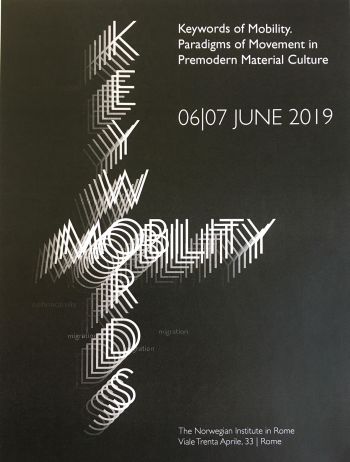 The history of art has been engaged with mobility for centuries. Movement, with its limits and potentials, constitutes in several ways a founding principle of the discipline, and its fascination or rejection stands at the core of much of its narrative. But the recent (re)turn to mobility is rapidly reframing many assumptions about the discourses and practice of the discipline itself. How has art history and, more generally, the study of material cultures, absorbed and reacted to the mobility turn? What kind of theoretical frameworks has, does, and will the discipline, in its broader acceptance, foster and promote? How is mobility—whose intangible nature makes it a rather elusive object of study—embraced and developed in art historical projects?
More than a decade after Sheller and Urry’s call for a ‘mobility turn’, this workshop invites scholars of the premodern period to reconsider the role of art history and material studies in a de-sedentarized, mobile world. Our scope is to reflect and redefine a set of critical terms, whose use (and sometimes abuse) is central to current debates. In doing so, we do not intend to propose a ‘grand narrative’ of mobility, but rather to explore a new set of questions, theoretical approaches, and ideas, in order to understand practices, meanings, forces, and impacts of movement in premodern art.
T H U R S D A Y , 6 J U N E 2 0 1 9
9.30 Registration
9.45 Welcome by Christopher Prescott (Director of The Norwegian Institute in Rome)
10.00 Morning Talks
• Mattia Biffis (Oslo), Mobility What? Viewing Movement Tridimensionally
• Yannis Hadjinicolaou (Hamburg), Flying: Falconry as an Image Vehicle
• Bronwen Wilson (Los Angeles), The Itinerary, the Line, and the Limits of the Page
• Hagi Kenaan (Tel Aviv), Visual Network: The Case of Graffiti
13.00 Lunch break
14.30 Afternoon Talks
• Janina Wellmann (Lüneburg), Rhythm: A New Episteme around 1800
• Meha Priyadarshini (Edinburgh), Boats, Bales, and Ballads: The Material and Culture Practice of Transportation in the Early Modern Period
• Piers Baker-Bates (London), Travelling between the Viceroyalties: The Cosmopolitanism of Works of Art within the 16th-Century Hispanic World
• Stefan Neuner (Berlin), The Ferryman and the Obsessed: Connectivity in Urban and Social Space in Venice around 1500 according to Vittore Carpaccio
18.00 Aperitivo
20.00 Dinner
F R I D A Y , 7 J U N E 2 0 1 9
9.50 Welcome by Sam Hardy (The Norwegian Institute in Rome)
10.15 Morning Talks
• Miriana Carbonara (East Anglia), Art and Borders: A Methodology
• Federico Zuliani (Turin), Migrant Bibles: Relocating Objects and Beliefs in Early Modern Europe
• Aron Vinegar (Oslo), On Habit’s Remainder and the Subject Matter of Inertia
13.00 Lunch break
14.30 Afternoon Talks
• Peter Gillgren (Stockholm), Siting: Mobility and Materiality
• Ivo Van der Graaff (New Hampshire), The Architecture of Departure and Arrival in the Early Roman Empire
• Tiffany Racco (Washington DC), The Performance of Speed: Luca Giordano’s Recurring Role as the Fast Painter
17.00 Concluding Remarks
17.30 Visit to the Fontana dell’Acqua Paola
20.00 Dinner
New Book | Inventing Boston
From Yale UP:
Edward S. Cooke, Inventing Boston: Design, Production, and Consumption, 1680–1720 (New Haven: Yale University Press, 2019), 232 pages, ISBN: 978-0300232110, $60.
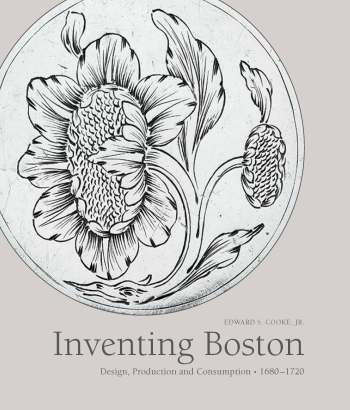 During the late 17th and early 18th centuries, Boston was both a colonial capital and the third most important port in the British empire, trailing only London and Bristol. Boston was also an independent entity that pursued its own interests and articulated its own identity while selectively appropriating British culture and fashion. This revelatory book examines period dwellings, gravestones, furniture, textiles, ceramics, and silver, revealing through material culture how the inhabitants of Boston were colonial, provincial, metropolitan, and global, all at the same time. Edward Cooke’s detailed account of materials and furnishing practices demonstrates that Bostonians actively filtered ideas and goods from a variety of sources, combined them with local materials and preferences, and constructed a distinct sense of local identity, a process of hybridization that exhibited a conscious desire to shape a culture as a means to resist a distant, dominant power.
Edward S. Cooke, Jr. is the Charles F. Montgomery Professor of the History of Art at Yale University.
More information about the book is available from the Paul Mellon Centre.
Exhibition | Printing the Pastoral

Jean-Baptiste Huet, Activities on the Farm, ca.1795, copperplate-printed cotton, 89 × 72 inches
(Saint Louis Art Museum)
◊ ◊ ◊ ◊ ◊
Press release (15 May 2019) for the exhibition:
Printing the Pastoral: Visions of the Countryside in 18th-Century Europe
Saint Louis Art Museum, 24 May — 1 December 2019
Curated by Genevieve Cortinovis and Heather Hughes
The Saint Louis Art Museum presents Printing the Pastoral: Visions of the Countryside in 18th-Century Europe, a free exhibition examining the early development of one of the most recognizable textile genres: copperplate-printed cotton, popularly known as toile.

Nicolaes Berchem, ‘The Shepherd Playing the Flute’, etching; sheet: 8 × 6 inches (Saint Louis Art Museum).
Toile has remained popular since its inception more than 250 years ago, when technological advances allowed textile printers to exploit the type of copperplates long used by artists to print on paper. Artisans were then able to create nuanced, intricate designs, and their creativity flourished. The emergence of copperplate-printed textiles coincided with the taste for scenes of country life and other pastoral imagery in Europe. Middle- and upper-class audiences clamored for fabrics patterned with idyllic scenes of shepherds, ladies on swings, amorous couples, and village celebrations. Textile printers responded, drawing inspiration from a wide variety of sources.
This exhibition reveals the nostalgia for pastoral themes common to 18th-century textile consumers and art collectors by pairing furnishing fabrics, ceramics, and paintings with prints by—or after—Rembrandt van Rijn, Nicolaes Berchem, Paulus Potter, Jean-Honoré Fragonard, and François Boucher. A reconstructed bed, complete with coverlet and curtains, illustrates the visual impact of these innovative fabrics in the 18th-century home. Printing the Pastoral includes a number of textiles never before exhibited at the museum, including a recent gift of printed cottons from Richard and Suellen Meyer and a loan from the Missouri History Museum of an important early English copperplate-printed textile.
The exhibition is curated by Genevieve Cortinovis, Andrew W. Mellon Foundation Assistant Curator of Decorative Arts and Design, and Heather Hughes, senior research assistant and manager of the Study Room for Prints, Drawings and Photographs.

Associate textile conservator Miriam Murphy installs Printing the Pastoral: Visions of the Countryside in 18th-Century Europe at SLAM.
Gwendolyn DuBois Shaw Named Director of History at NPG in DC
From the press release (23 May 2019) . . .
 The Smithsonian’s National Portrait Gallery has appointed Gwendolyn DuBois Shaw, undergraduate chair and associate professor of history of art at the University of Pennsylvania, as the museum’s new director of history, research and scholarship / senior historian. Shaw will work with the History, Curatorial, and Audience Engagement departments to strengthen the museum’s scholarly programs and be a thought leader on the connections between portraiture, biography and identity in America. Shaw is the first woman to hold this senior position at the National Portrait Gallery.
“I have long admired Gwendolyn’s scholarship and her particular focus on looking at contemporary issues through the lens of both history and portraiture,” said Kim Sajet, director of the National Portrait Gallery. “Her research has spanned chronologies from the 17th century through today, merging interests in fine arts with those of popular culture. I am looking forward to having Gwendolyn help us think in fresh ways about our nation’s history as we reinstall our galleries in conjunction with a major upgrade to our lighting systems, and I know she will introduce audiences to larger social, historical, economic, and political topics of conversation and debate.”
Shaw is already well known to the National Portrait Gallery. She is a current member of the PORTAL = Portraiture + Analysis advisory board, the museum’s scholarship and research arm; and in 2016 she served as the senior fellow and host scholar of the museum’s Richardson Symposium: Racial Masquerade in American Art and Culture. Recent books published by the Portrait Gallery feature her writing. For example, her essay “‘Interesting Characters by the Lines of Their Faces’: Moses Williams’s Profile Portrait Silhouettes of Native Americans” was written in 2018 for the exhibition catalogue Blackout: Silhouettes Then and Now, and she also penned “Portraiture in the Age of the Selfie,” the lead essay for the catalogue that accompanied the 2016 Outwin Boochever Portrait Competition.
Shaw, who received her doctorate in art history from Stanford University, has focused for more than two decades on race, gender, sexuality, and class in the art of the U.S., Latin America, and the Caribbean. In 2000, she was appointed assistant professor of history of art and African and African American studies at Harvard University, and in 2005, she began teaching at the University of Pennsylvania. Since 2012, she has served as the chair of the undergraduate program in the History of Art Department. Shaw has published extensively, and her most widely read titles include Seeing the Unspeakable: The Art of Kara Walker (2004) and Portraits of a People: Picturing African Americans in the Nineteenth Century. She has curated several major exhibitions, notably Represent: 200 Years of African American Art for the Philadelphia Museum of Art (2015) and Kara Walker: Virginia’s Lynch Mob and Other Works, for the Montclair Art Museum in New Jersey (2018).
Exhibition | Buried by Vesuvius: Treasures from the Villa dei Papiri

Press release (13 May 2019) from The Getty:
Buried by Vesuvius: Treasures from the Villa dei Papiri
Getty Villa, Pacific Palisades (Los Angeles), 26 June — 28 October 2019
Curated by Kenneth Lapatin
The Getty Villa is modeled on the Villa dei Papiri at Herculaneum, an ancient Roman villa buried by the eruption of Mount Vesuvius in AD 79. Rediscovered in the 1750s and explored further in the 1990s and early 2000s, the Villa dei Papiri has yielded spectacular colored marble and mosaic floors, frescoed walls, a large collection of bronze and marble statuary, and a unique library of more than a thousand papyrus scrolls (from which it gets its name). Buried by Vesuvius: Treasures from the Villa dei Papiri presents many of the most significant artifacts discovered in the 1750s, along with recent finds from the still active archeological site, and explores ongoing efforts to open and read the badly damaged papyri.
 “The Villa dei Papiri is one of the most luxurious private residences of the ancient classical world ever discovered and one which had an important role in the early history of archeology. Especially important are its unique collection of ancient bronze statuary and antiquity’s only surviving library of papyrus scrolls, which provide an unprecedented insight into the philosophical interests of its aristocratic Roman occupant—none other than the father-in-law of Julius Caesar,” says Timothy Potts, director of the J. Paul Getty Museum. “Among the most impressive of these finds is a rare bronze sculpture of a drunken satyr, which, as part of a collaborative conservation project with the Museo Archeologico Nazionale di Napoli (MANN), is undergoing analysis and conservation treatment in our conservation studios before going on display in the exhibition.”
Potts adds, “For several decades, we have worked closely with Italian colleagues and institutions in conserving, protecting, researching and celebrating Italy’s extraordinary cultural heritage. We are delighted now to be collaborating with MANN, the Parco Archeologico di Ercolano (PA-Erco), and the Biblioteca Nazionale “Vittorio Emanuele” di Napoli (BNN) in organizing this exhibition. We have had several successful collaborative conservation projects with MANN over the past few years including, most recently, their monumental funerary vessel (krater) from Altamura in 2018, and three of their splendid bronzes: the Ephebe (Youth) in 2009, the Apollo Saettante in 2011, and the over-life-size sculpture of Tiberius in 2013.”
The Villa dei Papiri was a sumptuous private residence on the Bay of Naples, just outside the Roman town of Herculaneum. Deeply buried by the eruption of Mount Vesuvius in AD 79, it was rediscovered in 1750 when well-diggers struck a spectacular circular multi-colored marble floor that belonged to the luxurious Roman villa (a full-scale replica of this floor decorates the Getty Villa’s Temple of Hercules gallery). Under the sponsorship of King Charles VII, Karl Weber, a Swiss military engineer in the royal guard, was entrusted with excavating the site. Weber directed a crew of conscripts and convicts to dig a series of shafts and tunnels to seek and remove the most impressive finds to augment the collections of the recently established Royal Herculanean Museum. Although his superiors were chiefly interested in recovering artifacts to enhance the royal collections, Weber carefully recorded their findspots and architectural contexts.
Weber’s excavation plan of the Villa dei Papiri, on display in the exhibition, provides detailed evidence for the layout and decoration of the building, including discovery dates and locations of sculptures, frescos, papyri, columns, pools, fountains, gutters, hinges, and other architectural features. In the early 1970s, when J. Paul Getty decided to replicate the Villa dei Papiri for his museum in Malibu, his architects relied on Karl Weber’s eighteenth-century plan, since the original building remained inaccessible underground. They also employed elements from other ancient structures discovered around the Bay of Naples.
“It is only fitting that the first major exhibition on the Villa dei Papiri takes place at the Getty Villa, which is a recreation of the famous villa in Herculaneum,” says Kenneth Lapatin, curator of antiquities at the J. Paul Getty Museum. “Recreating the Villa dei Papiri appealed to Mr. Getty because of its association with Julius Caesar through his father-in-law, Lucius Calpurnius Piso Caesoninus, the villa’s supposed owner. Getty often compared himself to ancient Roman rulers and particularly admired Julius Caesar and the emperor Hadrian, a fellow art collector and villa owner. Although Getty, unlike Hadrian, did not live in his villa, his reconstruction was a key component in his attempts to refashion himself from a Midwestern businessman into a European aristocrat.”

Drunken Satyr, 1st century BC – 1st century AD, bronze
(Naples: Museo Archeologico Nazionale di Napoli)
◊ ◊ ◊ ◊ ◊
One of the most significant finds recovered in the 1750s was a first-century bronze statue of a Drunken Satyr in dynamic motion. The middle-aged figure was praised by the eighteenth-century German scholar J. J. Winckelmann as one of the most beautiful bronze statues to survive from antiquity. The satyr, a mythical follower of the wine god Bacchus, wears a pine wreath with flower clusters and has pointed ears, small horns, wild hair, and wattles. He snaps his right thumb and middle finger in a gesture associated by ancient authors with Bacchic abandon. A replica of the satyr can be found in the Getty Villa’s Outer Peristyle pool.
The ancient Drunken Satyr, which is usually on view in Naples, arrived to the Getty early in October 2018 for conservation treatment and analysis as part of a collaborative project with MANN. The project aims to identify past interventions—what was done to the statue in both ancient and early modern times to repair it, stabilize it, or change its appearance. There will also be an investigation of any potential instabilities, including metal corrosion and the connection between the statue’s various parts, as well as their connections to its early modern stone base. In collaboration with their colleagues at MANN, Getty conservators will also evaluate possible aesthetic issues, considering how to best display the sculpture to enhance viewers’ appreciation of its artistry. How the statue was originally manufactured will also be explored through techniques such as X-radiography, endoscopy, technical imaging, and non-invasive analytical methods.
Another important discovery was the cache of approximately 1,100 papyrus scrolls recovered from the ancient villa in 1752–54, which constitute the only surviving library from the classical world. Camillo Paderni (ca. 1715–1781), the first director of the royal museum in Portici, was the first to attempt to open the carbonized scrolls by slicing the scrolls lengthwise, cutting through their charred outer ‘bark’ to expose the writing. The texts were copied for study and eventual publication, and then the papyri were scraped to reveal additional layers. In 1753, Father Antonio Piaggio, a curator of manuscripts at the Vatican, devised a more successful system, inventing and refining a series of unrolling machines, one of which is on view in the exhibition.
In the late 1900s and early 2000s, advanced imaging technologies enhanced the legibility of the previously opened papyri. Today, they offer the prospect of digital unrolling and decipherment of the hundreds that remain closed. An in-gallery video addressing recent attempts to virtually open and read the scrolls will also be part of the exhibition. In addition, a group of papyrus scrolls on loan from Bibiloteca Nazionale “Vittorio Emanuele” in Naples, which will be on display for the first time in the US, will undergo a major research project at UCLA of imaging and virtual unscrolling prior to being placed in the exhibition. The results of the project will be available later in the summer after the exhibition opens.
Most of the texts opened to date are Greek philosophical treatises, particularly by Philodemus of Gadara (about 110–30 BC), a follower of Epicurus. The Athenian philosopher Epicurus (341–270 BC) founded a popular school called the Garden, which recognized pleasure as the greatest good. Images of Greek intellectuals, including busts of Epicurus, and other artifacts, such as a bronze piglet and a portable sundial, recovered from the Villa dei Papiri, further reflects the owner’s interest in Epicurean philosophy and rhetoric.
The rooms and gardens of the Villa dei Papiri were enlivened by approximately 90 sculptures in bronze and marble depicting mythological figures, athletes, rulers, statesmen, poets, and philosophers. Portraits of eminent figures of the Hellenistic period (323–31 BC) predominate, which reflects the particular interests of the villa’s owners in Hellenistic philosophy and politics. The arrangement of the sculptures also appears to have been programmatic, presenting particular groupings that invited viewers to compare the accomplishments and failings of the subjects as well as the artistic styles of the works.

Runner, 1st century BC – 1st century AD, bronze, 119 inches high (Naples: Museo Archeologico Nazionale di Napoli; photo by Giorgio Albano).
For wealthy Romans, otium, or leisure, presented a chance to forget the concerns of urban life, abandon worry about politics or business (negotium). A seaside estate such as the Villa dei Papiri was the perfect place for an escape. Its owners could host elaborate banquets where guests were surrounded by art, sating both their gastronomic and aesthetic appetites. Gardens, baths, and athletic spaces, as well as long walkways for undistracted contemplation, invited visitors to pause and discuss the representations of mythological figures, men of letters, and famous statesmen. The exhibition will include many of these ancient bronze and marble representations, not far from their replicas on display throughout the Getty Villa’s gardens, including two famous figures of bronze runners.
Exploration of the Villa dei Papiri was abandoned in 1764 and remained entirely buried for more than two centuries until new excavations were undertaken in the 1990s and 2000s. Renewed interested brought to light a portion of the building’s atrium as well as lower levels that were unknown in the eighteenth century.
Among the new discoveries were rooms with colorful mosaic floors and spectacular frescoed walls and stuccoed ceilings. Finds also included a seaside pavilion and swimming pool, where archaeologists recovered two marble sculptures and luxurious wood and ivory furniture components, on view here for the first time. These recent excavations helped clarify the chronology of the villa, which is now thought to have been built around 40 BC, with the seaside pavilion added around AD 20. Ongoing research continues to advance our understanding of the initial finds from the site.
Buried by Vesuvius: Treasures from the Villa dei Papiri was organized in collaboration with the Museo Archeologico Nazionale di Napoli, Parco Archeologico di Ercolano, and Biblioteca Nazionale di Napoli “Vittorio Emanuele III”, and with the generous participation of the Bodleian Libraries of the University of Oxford and the Metropolitan Museum of Art New York. The exhibition is made possible with major support from Elizabeth and Bruce Dunlevie. It is generously supported by The Spogli Family Foundation. Additional support is provided by the J. Paul Getty Museum’s Villa Council and the Italian Cultural Institute.
The exhibition is curated by Kenneth Lapatin, curator of antiquities at the J. Paul Getty Museum. He is the author or coauthor of numerous books and articles on ancient art and its modern reception, including Guide to the Getty Villa (2018); The Last Days of Pompeii: Decadence, Apocalypse, Resurrection (2012); Luxus: The Sumptuous Arts of Greece and Rome (2015); and Power and Pathos: Bronze Sculpture of the Hellenistic World (2015).
Kenneth Lapatin, Buried by Vesuvius: The Villa dei Papiri at Herculaneum (Los Angeles: Getty Publications, 2019), 296 pages, ISBN: 978-1606065921, $65.
Getty Appoints Naoko Takahatake Curator of Prints and Drawings
Press release (May 2019) from The Getty:
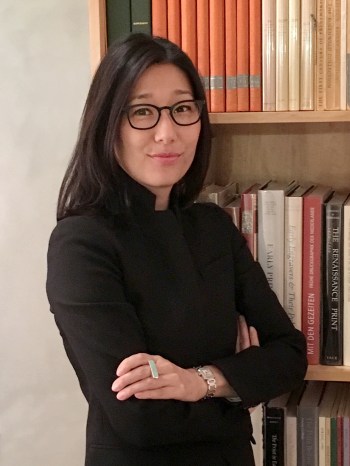 The Getty Research Institute (GRI) announced today the appointment of Naoko Takahatake as Curator of Prints and Drawings.
“Naoko Takahatake is a gifted curator and has extensive expertise working with works on paper of the greatest importance,” said Mary Miller, director of the Getty Research Institute. “She has been a prominent colleague and critical figure in the field here in Los Angeles and internationally. We are excited to welcome her to the GRI, where she will be responsible for our exceptional collection of works on paper. I’m confident she will help us expand and present our already broad holdings in meaningful ways.”
Takahatake comes to the Getty from the Los Angeles County Museum of Art (LACMA), where she has been curator of prints and drawings since 2010, overseeing the collection of Old Master works on paper. At LACMA she curated and co-curated numerous exhibitions of prints and drawings from the Renaissance to the contemporary, most recently The Chiaroscuro Woodcut in Renaissance Italy in 2018, which travelled to the National Gallery of Art, Washington. She also engaged in several collaborative research projects with conservators and conservation scientists, and led a major grant-funded project to reorganize and inventory the entire prints and drawings collection. Before her tenure at LACMA, she was an Andrew W. Mellon Curatorial Fellow in the Department of Old Master Prints at the National Gallery of Art, Washington. She previously served as Research Associate at the Center for Advance Study in the Visual Arts and as Michael Bromberg Fellow in the Department of Prints and Drawings at the British Museum.
“The GRI is home to more than 30,000 works on paper that together illustrate a comprehensive and multi-faceted overview of the history of printmaking from the Renaissance to today,” said Marcia Reed, chief curator at the Getty Research Institute. “Dr. Takahatake has an important role as caretaker of this truly one-of-a-kind collection. I am thrilled that we have found a curator with the knowledge and vision to lead our work in this area.”
Takahatake earned her Bachelor of Arts in Art History and Italian from Vassar College, and her master’s and doctorate degrees from the University of Oxford, the latter with a dissertation on the print industry in 16th- and 17th-century Bologna. A specialist in Italian Renaissance and Baroque print history, her scholarly research interests include the technical study of printmaking processes and the history of print publishing and collecting. Her catalogue on Italian chiaroscuro woodcuts was a finalist for the Alfred H. Barr Jr. Award in 2019. She is a member of the editorial board of Print Quarterly, and has published numerous papers, essays, and articles and participated in major symposia internationally.
”It is an immense pleasure and privilege to be joining the curatorial team at the GRI, with its notable collections and research resources,” said Takahatake. “The Getty’s profound commitment to advancing the appreciation of the history of prints and drawings has inspired audiences in Los Angeles and internationally. I am looking forward to participating in its outstanding programs of exhibitions, education, and scholarship, while helping to expand the collection.”
Takahatake starts at the Getty Research Institute in July.
Print Quarterly, June 2019

Francisco Goya, Tan poco (So little), plate 36 of the Disasters of War, ca. 1810–13, etching and aquatint, 157 × 205 mm
(London: British Museum)
◊ ◊ ◊ ◊ ◊
The eighteenth century in the current issue of Print Quarterly:
Print Quarterly 36.2 (June 2019)
A R T I C L E S
Natalia Keller, “On Goya’s Disasters of War, Plates 69 and 36,” pp. 139–45.
Francisco Goya (1746–1828) paid careful attention to both the visual and textual components of his compositions. The concise titles accompanying the images of his prints were an important reflection of their author’s intention. The article highlights how posthumous changes made by the Royal Academy to the Disasters of War series substantially changed their meanings. The change from Nada. Ello lo dice to Nada. Ello dirá has been noted and discussed. An explanation and interpretation of Goya’s hitherto overlooked original title Tan poco (‘So little’), which was erroneously changed to Tampoco, is here proposed.
N O T E S A N D R E V I E W S
Stephen Bergquist, “Reversed States of Two Landscapes by Crescenzio Onofri,” pp. 181–85.
“Onofri’s etches oeuvre consists of twelve landscape prints after his own series of paintings of 1696, five with mythological subjects, in larger format, and seven in pure landscape, in smaller format” (183). Bergquist corrects the misidentification in The Illustrated Bartsch (volume 45, 1990) of two states of two of the landscape prints: The Double-Arched Bridge and A Waterfall.
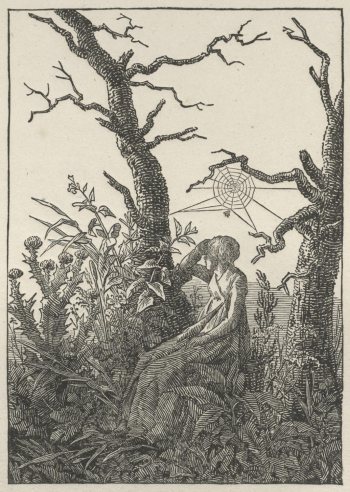
Caspar David Friedrich, Woman Seated under a Spider’s Web (Melancholy), ca. 1803, woodcut, 171 × 121 mm (Philadelphia Museum of Art).
Elizabeth McGrath, Review of Temi Odumosu, Africans in English Caricature 1769–1819: Black Jokes, White Humor (Brepols, 2017), pp. 185–88.
Temi Odumosu’s book addresses the black figure in British satirical prints by artists such as Thomas Rowlandson, James Gillray, Isaac and George Cruikshank, and Richard Newton, some of it a low-point in the history of racist imagery. Odumosu demonstrates how the ultimate target of the satire is almost always white people, the black characters in the prints being there as agents, or simply elements, in the mockery of others. Through her dedicated researches, Odumosu has uncovered a mass of new information and teased out previously baffling contemporary references, including to popular songs, theatre, and opera. In short, the book is, according to McGrath, “a triumph of historical scholarship which has particular importance for and relevance to the understanding of society in Britain today” (188).
Peter Prange, Review of John Ittmann, ed., Enchanted World of German Romantic Prints, 1770–1850 (Yale University Press, 2017), pp. 226–31.
John Smith Philipps bequeathed his collection of about 8,500 German prints to the Pennsylvania Academy of Fine Arts in Philadelphia. “In 1985 it was purchased by the Philadelphia Museum of Art and a first exhibition entitled Art and Nature: German Printmaking, 1750–1850 followed in 1992. It is now the subject of the extensive volume The Enchanted World of German Romantic Prints, 1770–1850. . .” (227).
P U B L I C A T I O N S R E C E I V E D
• Florian Knothe, Pascal-François Bertrand, Kristel Smentek, and Nicholas Pearce, Imagining Qianlong: Louis XV’s Chinese Emperor Tapestries and Battle Scene Prints at the Imperial Court in Beijing, exhibition catalogue (Hong Kong University Press, 2017), p. 208.
• The Multigraph Collective, Interacting with Print: Elements of Reading in the Era of Print Saturation (The University of Chicago Press, 2018), p. 208.
• Pietro Giovanni Guzzo, et al., Ercolano e Pompei: Visioni di una scoperta / Herculaneum and Pompeii: Visions of a Discovery (Skira, 2018), pp. 208–09.
• Nicola Streeten and Cath Tate, eds., with contributions by Sheila O’Connell, Simon Grennan, Elizabeth Crawford, Carol Bennett, and Sofia Niazi, The Inking Woman: 250 Years of British Women Cartoon and Comic Artists (Myriad Editions, 2018), p. 209.
Hogarth’s ‘William Wollaston and His Family’ to Remain in Leicester
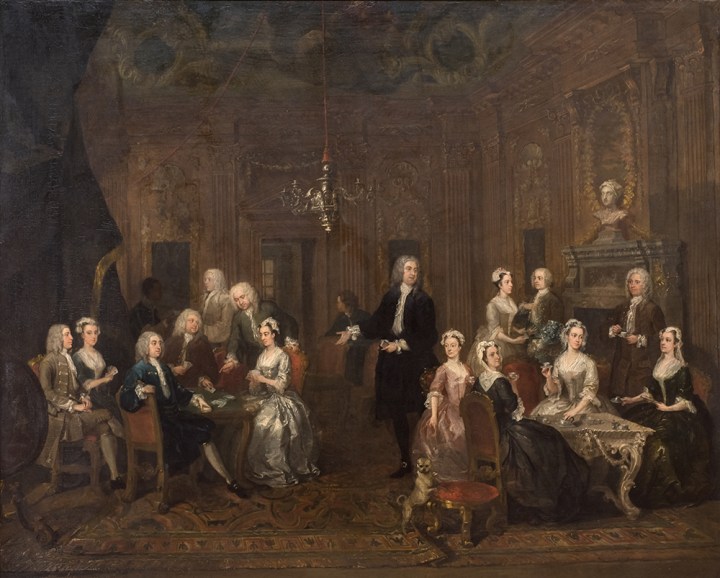
William Hogarth, William Wollaston and His Family in a Grand Interior, signed and dated 1730, oil on canvas, 99 × 125 cm (Leicester: New Walk Museum and Art Gallery).
◊ ◊ ◊ ◊ ◊
Press release (24 May 2019) from the UK’s Art Fund:
An important painting by 18th-century English artist William Hogarth has been saved for the nation following a crowdfunding campaign and support from Art Fund. The painting William Wollaston and His Family in a Grand Interior has been acquired by the New Walk Museum and Art Gallery in Leicester where it has been displayed on a loan basis for 75 years. The work was acquired via the Acceptance in Lieu scheme following the ‘Save the Hogarth Campaign’, which raised over £500,000.
William Hogarth was born in London at the end of the 17th century and is best known for his moral series including A Rake’s Progress and Marriage A-la-Mode and his prints such as Beer Street and Gin Lane. He was also recognised for his ‘conversation pieces’—informal group portraits that depict a large amount of people who were often families.
William Wollaston and His Family in a Grand Interior is a conversation piece that depicts the family of William Wollaston, who was MP for Ipswich from 1733 until 1741. Hogarth was commissioned to paint the piece following a period of mourning for the family after the death of William’s elder brother Charlton Wollaston, the former head of the family. This is reflected in the black clothing of some of the sitters, as well as the cloths hung over the wall decoration and Charlton’s bust on the mantelpiece. The painting has been passed down through the Leicester Wollaston family, who have lived in the county of Leicestershire since 1652.
The work will remain on display to the public until 6 September 2019, before being removed for conservation cleaning in preparation for a series of public events and and an exhibition dedicated to the work and Hogarth in early 2020.
Stephen Deuchar, Director of Art Fund, said: “This is such a great acquisition for Leicester—a real coup to have acquired a work of such landmark significance to both Hogarth’s career and the wider history of 18th-century British art. We are delighted to have helped.”
Exhibition | The Sweetness of Life
From the Norton Simon:
The Sweetness of Life: Three 18th-Century French Paintings from The Frick Collection
Norton Simon Museum, Pasadena, 14 June — 9 September 2019
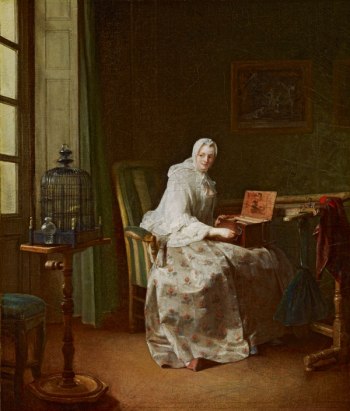
Jean-Siméon Chardin, Lady with a Bird-Organ, 1753 (?), oil on canvas (lined), 20 × 17 inches (New York: The Frick Collection).
Jules and Edmond de Goncourt, the eminent 19th-century historians of French art and society, baptized the 1700s the ‘century of women’. Though 18th-century women did make strides in the sciences, literature, and the arts, they were most often portrayed in genre scenes pursuing leisurely, quotidian pleasures and tasks. Three superb 18th-century French genre paintings from The Frick Collection in New York, part of an ongoing reciprocal exchange program, are on view this summer at the Museum. These artfully constructed visions of contemporary life and fashion, as depicted by François Boucher, Jean-Baptiste Siméon Chardin and Jean-Baptiste Greuze, provide viewers with an intimate look at the lives of middle-class French women of the 1740s and 1750s. The paintings will be installed in the Museum’s 18th-century Rococo gallery among its own works by Chardin and Boucher, as well as paintings by Jean-Antoine Watteau and Jean-Honoré Fragonard.
S E L E C T E D P R O G R A M M I N G
• David Pullins (Assistant Curator, The Frick Collection), Female Models in the ‘Century of Women’: From Fiction to Reality in Chardin, Boucher, and Greuze
Saturday, 15 June, 4:00pm
• Kimberly Chrisman-Campbell (Fashion Historian), Fashioning the Feminine in 18th-Century France: Dress, Desire and Domesticity in Three Works from The Frick Collection
Saturday, 24 August 24, 4:00pm










 Enfilade
leave a comment