Call for Essays | Museum Media(ting)
From ArtHist.net:
Museum Media(ting): Emerging Technologies and Difficult Heritage
Edited by Theopisti Stylianou-Lambert, Antigone Heraclidou, and Alexandra Bounia
Abstracts due by 15 July 2019; finished essays due by 15 January 2020
This edited volume with the working title Museum Media(ting): Emerging Technologies and Difficult Heritage examines theoretical approaches and case studies that demonstrate how emerging technologies can display, reveal, and negotiate difficult, dissonant, negative, or undesirable heritage. We are particularly interested in how emerging technologies in museums have the potential to reveal unheard or silenced stories, challenge preconceptions, encourage emotional responses, introduce the unexpected, and overall provide alternative experiences. By emerging technologies, we refer to contemporary advances and innovations in technology such as virtual reality, augmented reality, mixed reality, holograms, artificial intelligence, gamification, smart systems, etc.
How can museums, with the help of technology, manage to tell unheard stories, touch upon issues of difficult heritage, and narrate stories of unprivileged groups of people such as minorities, women, LGBT, immigrants, etc.? How can museums explore alternative sides of history, different from the political/ diplomatic/ military history which is the norm, such as social history, history of education, history of migration, etc., giving therefore emphasis not so much on the knowledge/ collection of information, but to multiperspectivity, inclusiveness, tolerance and social cohesion? How and to what extent the use of technology in museums/ art spaces, facilitates the understanding of issues dealing with contested history? How can emerging technologies provide not only cognitive experiences but also affective ones?
The volume may include chapters that deal with the following themes:
• Emerging technologies in museums
• Innovative interactive media/ installations
• Art and technology for difficult heritage
• Crowdsourcing/ participatory methods
• Oral histories and emerging technologies
• Deep mapping approaches
• Affective responses
• Cultural tourism and difficult or dark heritage
• Alternative experiences
• Evaluation studies of specific applications of emerging technologies applied to difficult heritage in museums
• Other themes related to the key questions of the call
The papers can be theoretical in nature or/ and explore specific case studies. We encourage proposals that demonstrate specific uses of emerging technologies in museums and other cultural sites as well as evaluation studies.
The volume will be edited by Theopisti Stylianou-Lambert (Cyprus University of Technology/ Research Centre on Interactive Media, Smart Systems and Emerging Technologies – RISE), Antigone Heraclidou (Research Centre on Interactive Media, Smart Systems and Emerging Technologies – RISE) and Alexandra Bounia (UCL Qatar/ University of the Aegean) and will be published by a well-known academic publisher.
To submit an abstract, please send a 500-word abstract (including references) and a short bio for each author (up to 70 words each) to theopisti.stylianou@cut.ac.cy and a.heraclidou@rise.org.cy by July 15th 2019. Applicants will receive a response within a month’s time. The selected authors will be expected to deliver a full paper (6000–8000 words) by January 15th 2020.
The Digital Piranesi

Along with highlighting the project generally, this posting also aims to publicize a related two-year post-doc position (May 31 is the application due date).
The Digital Piranesi is a developing digital humanities project that aims to provide an enhanced digital edition of the works of Italian illustrator Giovanni Battista Piranesi (1720–1778). This project aims to make Piranesi’s views, maps, and texts accessible in a complete digital collection and, in an interactive digital edition, to make them visible, legible, and searchable in ways that the original works are not. The scale and breadth of Piranesi’s works require innovative methods of presentation, discovery, and analysis. By digitally illuminating and enacting many of the graphic features of his designs, this project will provide new ways of seeing this rare and complex historical material.
The University of South Carolina is one of fewer than ten institutions to hold a complete set of Piranesi’s posthumous Opere (1837–39), a set of twenty-nine elephant-folio volumes, housed in the Irvin Department of Rare Books and Special Collections, that assembles all of his individual publications (such as Views of Rome and Imaginary Prisons). Alternatively historical and imaginative, Piranesi’s representations of ruins are exercises in rigorous archeological investigation as much as they are fanciful experiments in urban imagination. The Digital Piranesi aspires to appeal to these two elements of Piranesi’s own works—the historical and the imaginative—and to explore the ways that Piranesi’s works seem to predict many elements of digital design. His illustrations of ruins and crypts are immersive, his architectural studies often consist of multiple layered images, and his maps and ruins include detailed alphabetic keys. His indexed maps, annotated architectural studies, immersive interiors, and multi-image views push the limits of the printed page. While his earliest works were individual engravings of Roman ruins marketed towards visitors on the grand tour, he quickly began producing increasingly larger images and adding not only textual keys but also indices, prefaces, and dissertations. Pushing against the limits not only of the printed page but also of the bound book, his multi-plate engravings become elaborate foldouts in bound volumes, and the references in his maps and indices direct users through unnumbered pages and between different publications. His works are rare—his complete works are exceedingly so—and they constitute a colossal corpus with expansive pedagogical and scholarly potential lacking in any comprehensive searchable index. The Digital Piranesi aims to make the content and connections in this rich body of work easily accessible and searchable.
Piranesi’s architectural views and his referential networks require complex interactions with the spaces of the printed, illustrated book. These ways of interacting with print—tracing cross-references, ‘reading’ an image through its explanatory key—call for specific methods of preservation and display beyond producing digital images. The Digital Piranesi heeds this call by performing the links that Piranesi forges between maps, indices, and images; across unnumbered pages in multiple volumes; and within heavily-annotated engravings. Piranesi’s images are most frequently viewed individually, divorced from their original larger networks of cross-referencing. The digital environment, although it is unable to reproduce the materiality of his original works, offers a way of experiencing Piranesi’s works that is complementary to his vision. Digitally representing not only Piranesi’s images but also their interconnections, composite layers, and verbal references promises to reveal new insights about eighteenth-century Rome, the birth of art history as a discipline, and the graphical representation of knowledge.
With the support of a grant from the National Endowment for the Humanities’ Division of Preservation and Access for 2019–21, the University of South Carolina is able to hire a postdoctoral fellow, who will contribute to the digital project’s ongoing development and assist in curating an exhibit to commemorate the tricentennial of Piranesi’s birth in the fall of 2020. The application deadline is 31 May 2019. More information is available here.
Call for Papers | Palaces for Rent: Real Estate in 18th-Century Rome

From the Call for Papers (which includes the Spanish version):
Palaces for Rent: Real Estate in 18th-Century Rome
Palacios en alquiler: Patrimonio inmobiliario en la Roma del siglo XVIII
Departamento de Historia del Arte, UNED, Madrid, 14–15 November 2019
Organized by Pilar Diez del Corral
Proposals due by 31 July 2019
This conference is developed within the frame of the research project Ramón y Cajal (2017-22131) devoted to “Artistic Academies, Diplomacy, and Identity of Spain and Portugal in Rome during the First Half of the 18th Century” (“Academias artísticas, diplomacia e identidad de España y Portugal en la Roma de la primera mitad del siglo XVIII”) by Dr Pilar Diez del Corral. The secondary aspect of the aforementioned project to be addressed is the accommodation problem that representatives of foreign countries encountered in Rome. The impact of this issue goes beyond the mere anecdote to affect diplomatic and logistical aspects of visitors’ time in Rome. From an art historical perspective this approach allows for the study of the economic investment made by those people, the composition of their household from the staff to the material display, issues regarding restoration, construction plans, and other works in the palaces.
The conference aims to bring together scholars specializing in architecture, social history, decorative arts, and so on to explore the topic of Rome as a city of foreigners, who usually came to the city for church positions or to develop diplomatic or commercial missions that forced them to stay for long periods. The conference seeks to address the supply of palaces in Rome and the problems derived from the influence of high-ranking foreigners, who looked for accommodations fitting their dignity, and who in so many cases were forced to undertake significant works to prepare their new residences. Potential topics for discussion could include but are not limited to
• Roman palaces, construction aspects
• Internal organization of the palaces, spaces, and etiquette
• Decoration and internal design, magnificence, and display
• Roman households
• Ambassadors, legates, cardinals, and other representatives in Roman residences
• Topography of power and diplomacy
• Private and public spaces for the artistic creation within the palaces: academies, libraries, collections, intellectual gathering, theaters, etc.
• Economic issues such as problems relating to rents, non-payments, etc.
Please submit a one-page proposal (Word format) in Spanish or English (other European languages could be accepted) comprising title, abstract, and a short biographical note to palaciosromanos@gmail.com no later than 31 July 2019. The selected participants will be notified by 1 September. The conference outcomes might be followed by the publication of a collective work, subject to peer-review and selection depending on the quality and innovation of the papers.
Scientific Direction
Pilar Diez del Corral Corredoira (UNED, Madrid)
Scientific committee
Diana Carrió-Invernizzi (Dpto. Historia del Arte, UNED, Madrid)
Angela Cipriani (former director of the Archivio Storico di San Luca, Rome)
Almudena Negrete Plano (Europaschule Friedensburg Oberschule, Berlin)
Álvaro Pascual Molina (Dpto. Historia del Arte, UNED, Madrid)
Carlos Pena Buján (independent scholar, Madrid)
Conference | Collecting and Display: A Matter of Access
From H-ArtHist:
Collecting and Display: A Matter of Access
Munich, 22 June 2019; and London, 24 June 2019
Organized by Susan Bracken, Andrea Gáldy, and Adriana Turpin
Since its foundation in 2004, the international forum Collecting & Display has investigated numerous aspects of both collections and collectors. Such activity has taken place at regular seminars and at our conferences and has resulted in a number of publications. For June 2019 we plan an international conference at two venues: Munich (22nd) and London (24th). Speakers and attendees are welcome to book either part of the conference separately or both as a package. The 2019 conference aims to extend the discussion of the nature and pertinence of collections by focusing on the spaces in which they were displayed and how access to those spaces was controlled. By examining how collections were displayed, used and presented, and who had access to these spaces, we hope to develop a deeper understanding of the meaning of collections to their owners and of their significance to contemporaries.
S A T U R D A Y , 2 2 J U N E 2 0 1 9
Ludwig-Maximilians-Universität München, Institut für Kunstgeschichte, Room 007, Zentnerstr. 31, 80798 München
10.00 Registration and welcome
10.30 Morning Talks
• Orsolya Bubriák (Institute of Art History, Research Centre for the Humanities, Hungarian Academy of Sciences), The Kunstkammer of Johann Septimius Jörger in Nuremberg
• Virginie Spenlé (Director, Kunstkammer Georg Laue Inventarisierung und wissenschaftliche Bearbeitung des Bestandes), Leonhard Christoph Sturm (1669–1719) and an Ideal Architecture for Dynastic Collections
• Mary Malloy (Fellow of the Peabody Museum of Archaeology and Ethnology, Harvard University), The Catalogue as Invitation: Recruiting Visitors to Collections in Seventeenth-Century Europe
• Catherine Phillips (Independent Scholar), Paintings, Prints, Squirrels, and Monkeys: Catherine the Great’s Hermitage
1.00 Lunch
2.00 Afternoon Talks
• Paweł Ignaczak (Academy of Fine Arts, Warsaw), A Parisian Collection in a Polish Castle: Lights and Shadows of a Prestigious Location in the Context of the Struggle for National Identity
• Cecilia Riva (Collection Cataloguer, Palazzo Ducale, Venice), ‘A Well-known Subject for Photographic Reproduction’: The Layard Collection as an Example of Nineteenth-Century Advertising
• Sarah Coviello (Warburg Institute, London), ‘A scholar collects, exhibits, and writes about it’: The Personal Study Collections of Twentieth-Century Art Historians
• Maria Höger (Department für Kunst- und Kulturwissenschaften der Donau-Universität Krems, Art / Brut Center Gugging), ‘Art Brut’ and ‘Outsider Art’ – ‘Ghettoization’ of Art and Their Creators?
• Laura Humphreys (Curatorial Project Manager at the Science Museum in London), New Frontiers for the Science Museum Group Collection
5:30 Drinks reception
M O N D A Y , 2 4 J U N E 2 0 1 9
IHR, Senate House, Wolfson Room, Malet Street, London WC1E 7HU
9.30 Registration
9.45 Welcome and introduction
10.00 Morning Talks
• Anne Harbers (Radboud University, The Netherlands), His & Her Royal Collections: The Synergies and Symbiosis of Selecting a Publicity Channel
• Esmee Quodbach (Assistant Director of the Center for the History of Collecting at The Frick Collection and Frick Art Reference Library), To See or Not to See: The Visibility of the John G. Johnson Collection in Philadelphia, c.1880 to the Present
• Julia Rössel (Research Assistant in the project ‘Kupferstichkabinett Online’ of the Herzog August Bibliothek, Wolfenbüttel), Displaying Print Collections: Location, Site, Practice
• Anne Nellis Richter (Adjunct Professorial Lecturer, Department of Art, American University, Washington DC), ‘An Excess of Folly’: Townhouses as Public Art Galleries in Early Nineteenth-Century London
• Isobel Caroline MacDonald (University of Glasgow and The Burrell Collection), A Private Collection on Public Display: The Significance of (Sir) William Burrell’s (1861–1958) Loan Collection
1.00 Lunch
2:00 Afternoon Talks
• Alison Clarke (University of Liverpool and the National Gallery, London), In a Better Light: Agnew’s, Spatiality, and Connoisseurial Practice, c.1875–1916
• Rebecca Tilles (Associate Curator of 18th-Century French and Western European Fine and Decorative Arts at Hillwood Estate, Museum & Gardens), The Homes and Collecting Display of Marjorie Merriweather Post
• Laia Anguix (Northumbria University-Department of Arts), ‘In Deplorable Conditions and Totally Inadequate for the Housing of the Collections’: Storage, Conservation, and Access in Public Collections, The Case of the Laing Art Gallery in Newcastle
• Megakles Rogakos (The American College of Greece), The Work of an ACG Art Curator
5.00 Drinks reception
Call for Articles | Africa: Trade, Traffic, and Collections
From H-ArtHist:
Journal for Art Market Studies, Special Issue on “Africa: Trade, Traffic and Collections,” Guest Edited by Felicity Bodenstein
Planned for December 2019
Abstracts due by 7 June 2019; accepted articles due by 15 September 2019
Felicity Bodenstein will be guest editor of our upcoming issue on the subject of “Africa: Trade, Traffic and Collections,” provisional publication date December 2019. We would like to explore the history of trade in artefacts from Africa, including mechanisms controlling the movement of objects, campaigns against illegal transfers, and the role of provenance in the creation of market value.
The following research subjects may serve as impulses for contributions to the issue:
• The early history of trade in African objects from the eighteenth century onwards
• Concepts of value and price development in the market for ‘ethnographic’ objects from Africa
• Trade, theft, and trophy enterprises in African objects (for example through analysis of market types, acquisitions, and provenance)
• Campaigns against illegal trade and transfers from a historical perspective
• The role of the art trade in creating diasporas of objects from Africa
• The formation of African artefact collections, be it private or public
• The relationship between museum collections and the market for African objects, with special focus on actors, agents, and networks of the trade in African artefacts
• Research into the history of collecting African objects that arrived in the West through trade intermediaries, triggered by economic, political, or war-related events
• Case studies that highlight trade actors and networks in African objects
Since 2017 the Institute for Art History and Historical Urban Studies at Technische Universität Berlin has been publishing the Open Access Journal for Art Market Studies (JAMS). Under the auspices of the Institute’s well-established Forum Kunst und Markt / Centre for Art Market Studies, the publication presents interdisciplinary research results on past and present art markets. The Journal conforms to Open Access standards including website submission and peer reviews. It is also registered on the DOAJ database. Articles are published both as pdf and in HTML format, they are DOI-registered and usually subject to a CC BY-NC copyright license.
Please submit your abstract for an article by 7 June 2019 to s.meyer-abich@tu-berlin.de.
Deadline abstract (2,000 characters/ 400 words): 7 June 2019
Deadline article (30,000 characters/ 6,000 words): 15 September 2019
Clark Fellowship in Digital Art History, Fall 2020
From H-ArtHist:
Clark Fellowship in Digital Art History
Clark Art Institute, Williamstown, Massachusetts, Fall 2020
Applications due by 15 October 2019
This fellowship supports a residency at the Clark Art Institute of one semester for a scholar at any stage of their career involved in a project that is either born-digital or has a substantial component that exists outside the publishing model of the monographic book. The project should contain not only a digital component but also a critical awareness of the methodological possibilities, problems, and questions in applying digital methods to art history today. This fellowship is particularly aimed at scholars working on material that is pre-1900.
The Clark Art Institute combines a public art museum with a complex of research and academic programs, including a major art history library. The Clark is an international center for discussion on the nature of art and its history. Fellowships are awarded every year to established and promising scholars with the aim of fostering a critical commitment to inquiry in the theory, history, and interpretation of art and visual culture. In addition to providing an opportunity for sustained research for fellows, outside of their usual professional obligations, the Clark encourages them to participate in a variety of collaborative and public discussions on diverse art historical topics as well as on larger questions and motivations that shape the practice of art history. For more information please visit the website. Applicants are required to complete an online application form. All materials must be submitted in English.
At Christie’s | Masterpieces from a Rothschild Collection
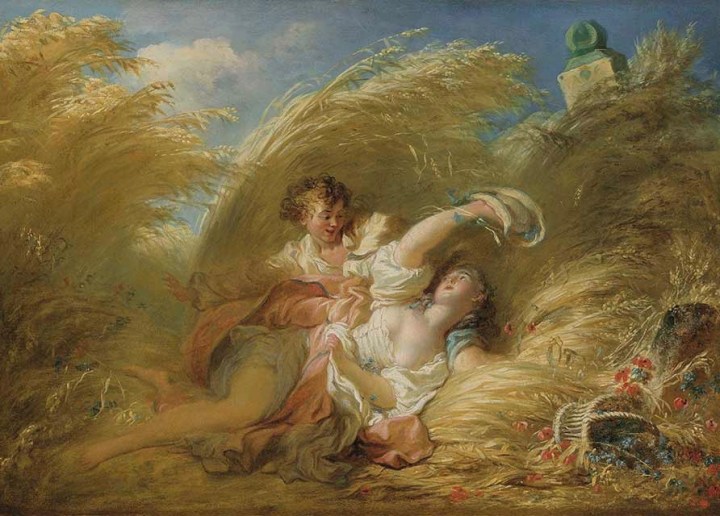
Jean-Honoré Fragonard, Dans les blés
(estimate: £700,000–1 million)
◊ ◊ ◊ ◊ ◊
From the press release (via Art Daily) . . .
Masterpieces from a Rothschild Collection (Sale 17726)
Christie’s, London, 4 July 2019
Telling the remarkable story of objects collected across centuries and treasured for generations, Christie’s will offer a landmark collection sale Masterpieces from a Rothschild Collection in London on 4 of July (Sale 17726). Comprising approximately 57 lots—each with exceptional provenance—this sale includes important European furniture and works of art collected by members of the prominent Rothschild banking family, particularly by Baron Gustave de Rothschild (1829–1911), and housed in some of the family’s magnificent residences.
The sale captures the spirit of le goût Rothschild—the celebrated aesthetic that has influenced many European and American interiors since the 19th century, following the collecting traditions of European royal courts during the Renaissance, Baroque, and Enlightenment periods. With estimates ranging from £10,000 to £2.5 million, select highlights will be on view in New York between 25 and 30 April and in Hong Kong from 24 to 27 May, followed by the London preview which opens to the public on 29 June.
Charles Cator, Deputy Chairman, Christie’s International: “The Rothschild name is synonymous with collecting at the very highest level, with many of the world’s greatest works of art having a Rothschild provenance. Their fabled name is added to the extraordinary roll call of illustrious owners of these masterpieces—many of them royal—from Louis XV and Marie Antoinette to William Beckford and Prince Demidoff. This sale is a celebration of connoisseurship and passionate collecting, and we are very proud to have been entrusted with these masterpieces. With the great resonance of the Rothschild provenance among collectors and institutions this is an unparalleled opportunity, which marks a very special high point in my long career at Christie’s. It is thrilling to have the privilege of handling these supreme works.”
Highlights include
Furniture with Royal Provenance
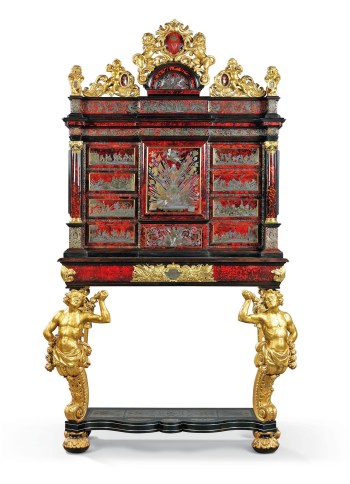
One of a pair of royal Flemish tortoiseshell, brass, pewter, inlaid ‘boulle’ marquetry, and giltwood cabinets attributed to Hendrick van Soest, Antwerp, ca. 1713 (estimate: £1.5–2.5million).
The top lot of the sale, a pair of royal Flemish tortoiseshell, brass, and pewter inlaid marquetry and giltwood cabinets, was commissioned in Antwerp around 1713 for Philip V King of Spain, the second son of the Grand Dauphin and grandson of Louis XIV (estimate: £1.5–2.5 million). This highly important pair of cabinets on stand, inlaid with superb and precious marquetry panels in tortoiseshell and engraved metals, belongs to a group of four cabinets originally commissioned for Philip V King of Spain from the workshop of the celebrated Antwerp furniture-maker and dealer Henrick Van Soest (1659–after 1726), one of the most prestigious cabinetmakers of Flanders who worked in the great tradition of Netherlandish marquetry furniture.
Commissioned by Queen Marie Antoinette of France, almost certainly for her Petit Trianon, a Louis XVI ormolu-mounted mahogany table à écrire, circa 1780, is by Jean-Henri Riesener, the Queen’s favoured cabinetmaker (estimate: £600,000–1,000,000). Notably, the table is marked with Marie Antoinette’s garde-meuble brand, which was applied to her personal furniture after 1784.
Further lots with royal provenance include a sundial by Julien Le Roy (1686–1759), which is thought to have been commissioned by King Louis XV (1710–1774) (estimate: £60,000–80,000).
Traditionally from the Spanish royal family and part of a very small group of luxurious 18th-century furniture incorporating Sèvres porcelain plaques is a Louis XVI ormolu, Sèvres porcelain and marquetry guéridon, circa 1782–83, by one of the most famous ébénistes of the late 18th century, Martin Carlin (estimate: £400,000–600,000). Acquired by Baron Gustave de Rothschild, this lot is closely related to a guéridon in The Frick Collection. Other lots with notable links to leading institutions include a magnificent late Louis XV ormolu-mounted ebony and Japanese lacquer ensemble consisting of two commodes and a pair of encoignures by Bernard III van Risenburgh, son of the celebrated master known as BVRB. Conceived in a bold avant-gardist neo-classical style, the commodes from this group are closely related to the masterpiece by the same ébéniste now at The Metropolitan Museum of Art. The group comprises three lots with a combined estimate of £1,500,000 to £2,500,000.
Kunstkammer Objects
A set of ten parcel-gilt polychrome square enamel plaques by Leonard Limousin, circa 1550, each depicting an apostle in a circular wreath and with an identifying banner, have an estimate of £200,000 to £300,000. Also acquired by Baron Gustave de Rothschild, ‘The Rothschild Apostles’ exemplify Limousin’s finest creations in his clear sense of colour and the lively and original compositions. Two of the plaques, of Saint Andrew and Saint Bartholomew, are signed ‘LL’. These plaques formed part of a larger set of sibyls, prophets, and saints that adorned the antependium of an altar in the now-lost church of Santa Maria della Celestia in Venice. A number of the other plaques from the antependium, and also a liturgical lamp that hung above the altar, remained in the Rothschild family until recently; one is in the Correr Museum in Venice.
An important German silver-gilt double-cup, mark of Hans Beutmuller, Nuremberg, 1594–1602, was in the collections of both Baron Mayer Carl von Rothschild and Baroness James de Rothschild (estimate: £200,000–300,000). It is in the Gothic style revived in Nuremberg by Hans Petzold (1551–1633) at the end of the 16th century. Hans Beutmüller (1588–1622) worked with Petzold and ranked, in his own right, among the most reputable Nuremberg goldsmiths. A Venetian rectangular parcel-gilt, gilt-bronze, and rock crystal casket, circa 1600, belonged to the renowned collector and author William Beckford in the early 19th century (estimate: £100,000–150,000). With the precious use of rock crystal and Islamic-inspired lacquer decoration, it is obvious why it would have appealed to Beckford. When this casket was sold in the celebrated Fonthill Abbey sale of 1823, it was said to have come from the collection of Pope Paul V Borghese, who could have commissioned it himself. The casket was purchased at the Fonthill sale by an agent on behalf of the 2nd Earl Grosvenor.
Old Master Paintings
David Teniers’ lively and brilliantly observed The Ham Dinner was painted in 1648, when the artist was at the height of his powers (estimate: £800,000–1.2 million). Executed on an impressively large copper plate, allowing for a high degree of finish, it is an excellent example of the tavern scene genre that Teniers developed and excelled in. The painting has exceptional provenance, having been in the collection of Charles Ferdinand, Duke of Berry (1778–1820), son of the future King Charles X of France, and later belonging to Count Anatoly Nikolaievich Demidov, 1st Prince of San Donato (1813–1870), a Russian industrialist and one of the most significant collectors of his day. A further highlight is Jean-Honoré Fragonard’s dynamically designed, vibrantly coloured, and masterfully executed Dans les blés (estimate: £700,000–1 million), a masterpiece of the artist’s full maturity and an outstanding example of the artist’s intimate, small-scale ‘boudoir’ pictures, which are recognised as his most original and lasting contribution to the history of art.
Exhibition | Power Couples: The Pendant Format

Barthel Bruyn the Younger, Portrait of a Gentleman and Portrait of a Lady, ca. 1555–65, oil on panel (Salt Lake City: Utah Museum of Fine Arts, University of Utah).
◊ ◊ ◊ ◊ ◊
Opening in July at UMFA:
Power Couples: The Pendant Format in Art
Utah Museum of Fine Arts, University of Utah, Salt Lake City, 11 July — 8 December 2019
Curated by Leslie Anderson
Power Couples: The Pendant Format in Art considers how two interdependent works, called ‘pendants’, convey meaning. The study of this popular format reveals a variety of artistic strategies at play—desires to communicate social hierarchy, gender roles, racial issues, complementary ideas, the passage of time, the continuity of space, and the appearance of truth in art.
Drawn from the UMFA’s rich collection and strengthened with select loans, the expansive exhibition will display works conceived as pairs in European, American, and regional art from the fifteenth century until the present day. Artists on view include Barthel Bruyn the Younger, Dirck Hals, Peeter Neefs the Elder, Gabriel and Augustin de Saint-Aubin, Gilbert Stuart, Edmonia Lewis, Robert Rauschenberg, Lorna Simpson, Nina Katchadourian, Kerry James Marshall, and Roni Horn. Leslie Anderson, curator of European, American, and regional art, organized this exhibition for the UMFA.
Despite its prevalence across time periods and cultures, the pendant, unlike its hinged predecessor the diptych, has never before been the subject of a comprehensive exhibition.
Call for Papers | Power Couples: The Pendant Format
Symposium | Power Couples: The Pendant Format in Art
Utah Museum of Fine Arts, University of Utah, Salt Lake City, 4 October 2019
Organized by Leslie Anderson
Proposals due by 15 June 2019
The Utah Museum of Fine Arts at the University of Utah will host an interdisciplinary symposium to coincide with the upcoming special exhibition Power Couples: The Pendant Format in Art (11 July — 8 December 2019), which will examine ideas imparted by two interdependent works (called pendants) from the fifteenth century until the present day. Papers that consider works conceived as pairs in the visual arts, literature, and music are invited, and new research related to pairs in other disciplines is encouraged. What are the artistic strategies at play in the creation of companion pieces? How do the format and display (or experience) of pendants communicate meaning?
Advanced graduate students, as well as established and emerging scholars, are invited to apply. Please submit an abstract of 250–300 words and a CV to both leslie.anderson@umfa.utah.edu and iris.moulton@umfa.utah.edu by 15 June 2019. Selected participants will be notified on or before 15 July 2019.
This symposium is organized by Leslie Anderson, Curator of European, American, and Regional Art, and Iris Moulton, Coordinator of Campus Engagement, at the Utah Museum of Fine Arts, University of Utah.
Keynote Speaker
Wendy N. E. Ikemoto is Associate Curator of American Art at the New-York Historical Society. She served as organizing curator for Rockwell, Roosevelt & the Four Freedoms (2018), Betye Saar: Keepin’ It Clean (2018–19), Bettina von Zwehl: Meditations in an Emergency (2018–19), and Augusta Savage: Renaissance Woman (2019), and as curator for Panoramic Perspectives (2019–20). She is planning an upcoming exhibition on the American romantic artist John Quidor. Prior to joining the New-York Historical Society, Ikemoto worked in academia at The Courtauld Institute of Art in London and Vassar College in New York and in secondary education at a school for Native Hawaiian students. She holds a BA in Art History from Stanford University and an AM and PhD in the History of Art and Architecture from Harvard University. Her publications include Antebellum American Pendant Paintings: New Ways of Looking (Routledge, 2017) and articles in American Art and The Burlington Magazine.
Conference | The Artistic Taste of Nations, 1550–1815
From the Vrije Universiteit Amsterdam:
The Artistic Taste of Nations: Contesting Geographies of European Art, 1550–1815
Vrije Universiteit Amsterdam, 13–15 June 2019
Organized by Ingrid Vermeulen and Huigen Leeflang
The school of art is a fundamental art-historical concept. When it emerged in the early modern period, it was variously used to indicate academies, the style of art works and local, regional, or national taste. As such it gave rise to an artistic geography, which was debated in the context of academies, art literature, markets, and collections all over Europe. This conference aims to address the vitality as well as the pitfalls of the concept of school for the geography of European art.
 T H U R S D A Y , 1 3 J U N E 2 0 1 9
12.00 Registration
12.30 Welcome by Gert-Jan Burgers (director research institute CLUE+) and Ingrid Vermeulen (Vrije Universiteit)
13.00 Academies of Art and Artistic Nations
Moderator: Arno Witte (KNIR Rome/ Universiteit van Amsterdam)
• Susanne Kubersky-Piredda (Bibliotheca Hertziana, Max-Planck-Institut für Kunstgeschichte Rome), Notions of Nationhood and Artistic Identity in 17th-Century Rome
• Maria Onori (Sapienza Università di Roma), Spanish Artists and the Academies: Places of Belonging in the Second Half of the 17th Century in Rome
• Ludovica Cappelletti (Politecnico di Milano), Shaping Architecture: The Case of the Regia Accademia di Pittura, Scultura e Architettura in Mantua
14.45 Break
15.15 Drawings, Connoisseurship, and Geography
Moderator: Klazina Botke (Vrije Universiteit)
• Simonetta Prosperi Valenti Rodinò (Università di Roma ‘Tor Vergata’), Father Sebastiano Resta (1635–1714) and the Italian Schools of Design
• Federica Mancini (Musée du Louvre), Connoisseurship beyond Geography: Some Puzzling Drawings from Filippo Baldinucci’s Personal Collection
• Sarah W. Mallory (Harvard University), Arthur Pond’s Prints in Imitations of Drawings: Connoisseurship and the National School in Early 18th-Century Britain
17.00 Drinks reception
F R I D A Y , 1 4 J U N E 2 0 1 9
9.00 Registration
9.30 The Taste and Genius of Nations
Moderator: Marije Osnabrugge (Université de Genève)
• Ingrid Vermeulen (Vrije Universiteit), The ‘Taste of Nations’: Roger de Piles’s Diplomatic Views on European Art
• Pascal Griener (Université de Neuchâtel), How Do Great Geniuses Appear in a Nation? A Historiographical Problem for the Enlightenment Period
10.40 Break
11.10 Print Collecting and School Formation
Moderator: Huigen Leeflang (Rijksmuseum)
• Gaëtane Maës (Université de Lille), Between Theory and Practice: Dezallier d’Argenville’s Idea on Print Collections
• Véronique Meyer (Université de Poitiers), Des Notices générales au Manuel du Curieux: Michael Huber et l’Ecole française de gravure (From Notices Générales to Manuel du Curieux: Michael Huber and the French School of Printmaking)
• Stephan Brakensiek (Universität Trier), Chronology and School: Questioning Two Competing Criteria for the Classification of Graphic Collections around 1800
13.00 Lunch break
14.00 Transnational Identities
Moderator: TBA
• Elisabeth Oy-Marra (Johannes Gutenberg Universität Mainz), Towards the Construction of an Italian School: The Transformative Power of Place in Bellori’s Lives
• Marije Osnabrugge (Université de Genève), Claimed by All or Too Elusive to Include: The Place of Mobile Artists in Artist Biographies and the Local Canon
• Ewa Manikowska (Polish Academy of Sciences Warsaw), The Galeriewerk and the Self-Fashioning of Artists at the Dresden Court
15.45 Break
16.15 Practices of Classification
Moderator: Ingrid Vermeulen (Vrije Universiteit)
• Everhard Korthals Altes (Technische Universiteit Delft), The Dutch and Flemish Schools of Painting in 18th-Century Art Literature, Auction Catalogues, and Collections: Together or Apart?
• Huigen Leeflang (Rijksmuseum), Pieter Cornelis van Leyden’s Collections of Prints and Paintings: Content, Organization, and Schools
• Irina Emelianova (Accademia di Architettura di Mendrisio (Ch), «In the school of the Netherlands I joined two schools, Flemish and Holandaise, I even added some German painters»: The Problem of European Artistic Schools in the Context of the Russian Enlightenment
18.30 Conference dinner for speakers and moderators at the Botanical Gardens, Vrije Universiteit
S A T U R D A Y , 1 5 J U N E 2 0 1 9
9.00 Registration
9.30 Schools Going Public: The Picture Gallery
Moderator: Everhard Korthals Altes (Technische Universiteit Delft)
• Cécilia Hurley (École du Louvre/ Université de Neuchâtel), In Search of a Higher Order: The Organisation of the Munich Hofgartengalerie at the End of the 18th Century
• Christine Godfroy-Gallardo (HICSA Université Paris I – Sorbonne), An Organisation by Schools Considered Too Commercial for the Newly Founded Louvre Museum
• Pier Paolo Racioppi (Fondazione IES Abroad Italy Rome), The ‘Louvre Effect’: The New Arrangement of the Vatican Pinacoteca and Guattani’s Catalogue I più celebri quadri delle diverse scuole italiane (1820)
11.15 Break
11.30 Panel discussion and closing remarks










 Enfilade
leave a comment