Courtney Martin Named Director of YCBA
Press release (10 April 2019) from the YCBA:
 Courtney J. Martin ’09 Ph.D., deputy director and chief curator of Dia Art Foundation, will be the next director of the Yale Center for British Art (YCBA), President Peter Salovey announced today.
“I am delighted to announce the appointment of Courtney J. Martin,” Salovey said. “An esteemed scholar of historical and contemporary art, she will use her extensive experience in research, teaching, and curation to further infuse the arts into the university’s work and shape the YCBA’s leadership in the field of British art.”
Martin is familiar with Yale, having earned her doctorate in history of art from the university. As a graduate student, she contributed substantially to the YCBA’s award-winning 2007 exhibition, Art and Emancipation in Jamaica. Her dissertation on British art and artists in the 1970s will soon be published as a book.
Before pursuing her Ph.D., Martin worked in the media, arts, and culture unit of the Ford Foundation in New York City. After receiving her doctorate, she conducted research and taught at Vanderbilt University and then joined the faculty of Brown University where she fostered understanding and appreciation of art, while using the work of artists to launch conversations and inspire discoveries across disciplines, Salovey said. In 2015, Martin joined Dia — a nonprofit organization that supports and presents commissions, exhibitions, and site-specific installations — as adjunct curator for an exhibition of the American painter Robert Ryman at Dia:Chelsea. In 2017, she became the deputy director and chief curator at Dia, where she oversees a complex operation that includes acquisitions, exhibitions, programming, research, and publications.
“With her love of Yale and extensive experience in teaching, research, and leading projects at museums, Courtney is committed to providing outstanding educational opportunities for our students, scholarly material for our faculty, and enriching experiences for the thousands of visitors that enjoy the YCBA every year,” Salovey said. “She is attentive to the core collection of 17th-, 18th-, and mid-19th-century art as well as modern and contemporary British art. I know that she will deftly guide the YCBA’s ever-increasing international prominence in the years ahead.”
Salovey praised current YCBA Director Amy Meyers, who will retire on June 30 after a 17-year tenure, “for making the YCBA one of the foremost destinations in the world for the study of British art and culture and an integral part of Yale and our home city.”
“The center has an amazing wealth of resources, not the least of which is its Louis Kahn building. I am so pleased to be returning to the YCBA and to New Haven,” said Martin. “Amy Meyers has expertly stewarded the collection for nearly 20 years. I look forward to further developing the many enagaging exhibitions, publications, and programs that have earned the center its international acclaim.”
Salovey expressed appreciation to the members of the search committee: Ruth Yeazell, Sterling Professor of English and the committee’s chair; Timothy Barringer, the Paul Mellon Professor in the History of Art; Edward Cooke, the Charles F. Montgomery Professor of the History of Art; Anoka Faruqee, director of graduate studies in painting/printmaking at the Yale School of Art; Susan Gibbons, the Stephen F. Gates ’68 University Librarian; Pericles Lewis, vice president for global strategy and deputy provost for international affairs; Ian McClure, the Susan Morse Hilles Chief Conservator of the Yale University Art Gallery; and Keith Wrightson, the Randolph W. Townsend Jr. Professor of History.
Lecture | Marcia Reed, Engraving China’s Last Golden Age
From Eventbrite:
Engraving China’s Last Golden Age: Qianlong Emperor’s Copper Plates
John Rylands Library, Manchester, 16 May 2019
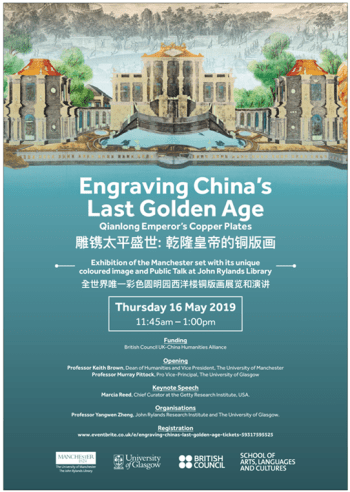 The recent discovery of a complete set of 圆明园西洋楼铜版画 (engravings of European Palaces in Yuan Ming Yuan) at the John Rylands Library, University of Manchester, and the presence of a complete set of 乾隆西征铜版画 (engravings of The Qianlong Emperor’s Western Campaigns) at the Hunterian Museum, University of Glasgow, makes Britain home to two of the most unusual and rare sets of engravings ever made. This is a most significant find, not just for Britain but also—and more importantly—for the study of 18th-century China, its engagement with Europe, and Anglo-Chinese relations in the 19th century and in the future. This discovery also presents challenges, as the two sets need considerable conservation and research.
This public event will digitally showcase some of the known complete sets, and—conservation work permitting—will also physically display the Manchester set, which uniquely contains a hand coloured plate.
Keynote: Marcia Reed (Chief Curator at the Getty Research Institute), followed by a Q&A discussion hosted by Professor Yangwen Zheng (University of Manchester). Thursday, 16 May 2019, 11:45am.
New Book | Chinese Architecture: A History
From Princeton UP:
Nancy Shatzman Steinhardt, Chinese Architecture: A History (Princeton: Princeton University Press, 2019), 400 pags, ISBN: 978-0691169989, $65 / £50.
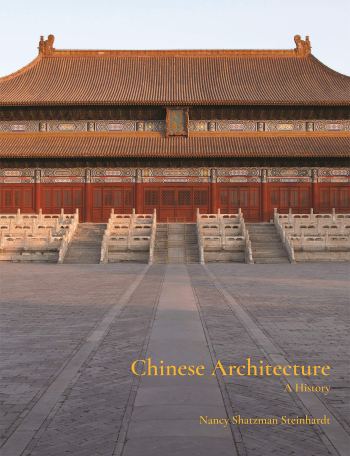 Throughout history, China has maintained one of the world’s richest built civilizations. The nation’s architectural achievements range from its earliest walled cities and the First Emperor’s vision of city and empire, to bridges, pagodas, and the twentieth-century constructions of the Socialist state. In this beautifully illustrated book, Nancy Shatzman Steinhardt presents the first fully comprehensive survey of Chinese architecture in any language. With rich political and historical context, Steinhardt covers forty centuries of architecture, from the genesis of Chinese building through to the twenty-first century and the challenges of urban expansion and globalism.
Steinhardt follows the extraordinary breadth of China’s architectural legacy—including excavation sites, gardens, guild halls, and relief sculpture—and considers the influence of Chinese architecture on Japan, Korea, Mongolia, and Tibet. Architectural examples from Chinese ethnic populations and various religions are examined, such as monasteries, mosques, observatories, and tombs. Steinhardt also shows that Chinese architecture is united by a standardized system of construction, applicable whether buildings are temples, imperial palaces, or shrines. Every architectural type is based on the models that came before it, and principles established centuries earlier dictate building practices. China’s unique system has allowed its built environment to stand as a profound symbol of Chinese culture.
With unprecedented breadth united by a continuous chronological narrative, Chinese Architecture offers the best scholarship available on this remarkable subject for scholars, students, and general readers.
Nancy Shatzman Steinhardt is professor of East Asian art and curator of Chinese art at the University of Pennsylvania. She has written, edited, or translated ten books, including China’s Early Mosques and Traditional Chinese Architecture: Twelve Essays (Princeton).
New Book | Ottoman Baroque
From Princeton UP:
Ünver Rüstem, Ottoman Baroque: The Architectural Refashioning of Eighteenth-Century Istanbul (Princeton: Princeton University Press, 2019), 336 pages, ISBN: 978-0691181875, $65 / £50.
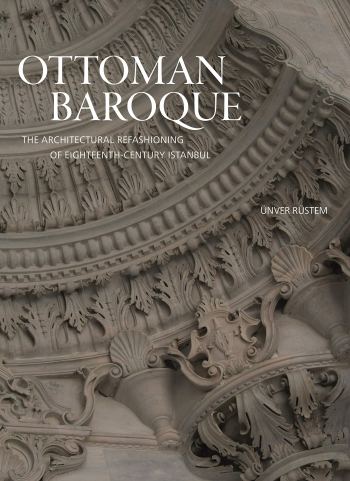 With its idiosyncratic yet unmistakable adaptation of European Baroque models, the eighteenth-century architecture of Istanbul has frequently been dismissed by modern observers as inauthentic and derivative, a view reflecting broader unease with notions of Western influence on Islamic cultures. In Ottoman Baroque—the first English-language book on the topic—Unver Rustem provides a compelling reassessment of this building style and shows how between 1740 and 1800 the Ottomans consciously coopted European forms to craft a new, politically charged, and globally resonant image for their empire’s capital.
Rüstem reclaims the label ‘Ottoman Baroque’ as a productive framework for exploring the connectedness of Istanbul’s eighteenth-century buildings to other traditions of the period. Using a wealth of primary sources, he demonstrates that this architecture was in its own day lauded by Ottomans and foreigners alike for its fresh, cosmopolitan effect. Purposefully and creatively assimilated, the style’s cross-cultural borrowings were combined with Byzantine references that asserted the Ottomans’ entitlement to the Classical artistic heritage of Europe. Such aesthetic rebranding was part of a larger endeavor to reaffirm the empire’s power at a time of intensified East-West contact, taking its boldest shape in a series of imperial mosques built across the city as landmarks of a state-sponsored idiom.
Copiously illustrated and drawing on previously unpublished documents, Ottoman Baroque breaks new ground in our understanding of Islamic visual culture in the modern era and offers a persuasive counterpoint to Eurocentric accounts of global art history.
Ünver Rüstem is assistant professor of Islamic art and architecture at Johns Hopkins University.
C O N T E N T S
Acknowledgments
Notes on Captions, Transliterations, and Translations
Introduction
1 Setting the Scene: The Return to Istanbul
2 Pleasing Times and Their ‘Pleasing New Style’: Mahmud I and the Emergence of the Ottoman Baroque
3 A Tradition Reborn: The Nuruosmaniye Mosque and Its Audiences
4 The Old, the New, and the In-Between: Stylistic Consciousness and the Establishment of Tradition
5 At the Sultan’s Threshold: The Architecture of Engagement as New Imperial Paradigm
Conclusion
Notes
Bibliography
Index
Image Credits
New Book | Wallpapers at Temple Newsam
From John Sandoe Books in London, published by Leeds Art Fund:
Anthony Wells-Cole and Barbara Walker, Wallpapers at Temple Newsam: 1635 to the Present, Issue 3 of Leeds Art Studies (Leeds: Leeds Art Collections Fund, 2018), 367 pages, ISBN: 978-0954797959, £50.
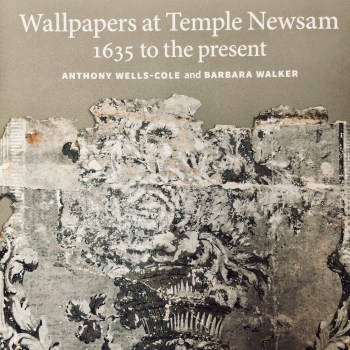 Stunning, large format illustrated catalogue of the wallpapers at Temple Newsam, one of the few significant collections in this country. Though many rooms were damaged or stripped of their papers, an enormous amount of conservation work has been achieved over several decades. Not least, a new company—the now famous Zoffany & Co.—was created to make meticulous reproductions of some of the wallpapers based on fragments. The wall coverings at Temple Newsam date from about 1700 to the present day, including half a century of rather unsympathetic redecoration from the 1930s on. Most of the historic Temple Newsam wallpapers have been found since 1979 during structural repair works and during restoration of the house between 1980 and 2009.
Ros Byam Shaw supplies a review in the March 2019 issue of The World of Interiors, pp. 63–64.
Some rooms revealed a rich palimpsest of patterns, stuck one on top of the other—17 layers in one maid’s bedroom. In all, some 400 different wallpapers were discovered, the earliest dating back to the turn of the 18th century—or to 1635 if you count the pieces of embossed and gilded leather wall hanging found in a room once used as a chapel. This beautifully produced book is a catalogue of these papers, each photographed in colour, each with a provenance. . . . [After 1983 Temple Newsam] began to receive donations of wallpaper, most notably from the Burford antique dealer Roger Warner (WoI Jan 2009), including samples from the archive of his grandfather’s company, Jeffrey & Co. Sixty-four different papers came from another large house, Ashburnham Place in Sussex. At least half of the book is devoted to these and to pieces salvaged from private homes . . .
At Christie’s | Desmarais Collection

Jean-Henri Riesener, Louis XVI Ormolu-Mounted Bois Satine, Amaranth, Sycamore, and Marquetry Commode, 1774 (Lot 51: estimate: $700,000–1,000,000).
◊ ◊ ◊ ◊ ◊
Press release for the sale:
The Desmarais Collection: A Pied-à-terre in New York (Sale 17442)
Christie’s, New York, 30 April 2019
Christie’s presents The Desmarais Collection: A Pied-à-terre in New York, encompassing a remarkable selection of furniture, paintings, and porcelain to be offered in a dedicated sale on April 30 in New York, during the Classic Week series of sales. The collection is from the New York pied-à-terre of the distinguished Canadian couple Paul and Jacqueline Desmarais, which was decorated by the internationally acclaimed interior designer Juan Pablo Molyneux. Comprised of more than 150 lots, the collection features a sumptuous and sophisticated group of French 18th- and 19th-century furniture by many of the best makers such as Riesener and Weisweiler, Sèvres porcelain, silver, and paintings including works by the artists François Boucher and Élisabeth Louise Vigée Le Brun. The sale also features a selection of deluxe upholstered custom furniture and accessories specially ordered by J.P. Molyneux Studio, with luxurious fabrics by makers such as Prelle and Antico Setificio.
Paul Desmarais Sr. (1927–2013) was the former CEO of Power Corporation of Canada, and Jacqueline (1928–2018) was a philanthropist who was recognized as one of the most important patrons of Quebec’s arts scene. Jacqueline sat on the board of directors at the Orchestre symphonique de Montréal, and in honor of her philanthropic contributions she was named an officer of the Order of Canada, to the National Order of Quebec and to France’s Legion of Honour.

Lot 123: Élisabeth Louise Vigée Le Brun, Portrait of a Young Girl, Half-length, ca. 1767. Estimate: $50,000–70,000. From the catalogue entry, “This charming portrait of a child is one of the earliest oil paintings that the artist executed, soon after she lost her father, the pastellist Louis Vigée, in May of 1767, when she was barely twelve years old.”
Will Strafford, Senior International Specialist, European Furniture & Decorative Arts, comments: “Christie’s is proud to offer this superb collection of French furniture, paintings and Sèvres porcelain on behalf of the Desmarais family, one of Canada’s leading families, noted as much for their acumen in the business world as for their generous philanthropy. The collection furnished their New York pied-à-terre in the Pierre hotel, and was the result of their long and fruitful collaboration with the noted interior designer Juan Pablo Molyneux.”
Juan Pablo Molyneux adds: “It was a great pleasure working with Monsieur and Madame Desmarais on their New York home. Jacqueline Desmarais reflected a very strong personality in her taste and had a very sophisticated approach when selecting styles, colors, and objets d’art. We worked side by side to produce the correct environment for this exceptional collection of 18th- and 19th-century period furnishings.”
Among the collection highlights, the Riesener commode is a spectacular work: a Louis XVI masterpiece in ormolu and lush naturalistic marquetry that Jean-Henri Riesener made for the hôtel du Garde-Meuble (the administration in charge of furnishing royal residences) in 1774, the year he was appointed cabinetmaker for the King (lot 51). Other highlights include an elegant early 19th-century vase from Russia’s imperial stone-cutting workshops and one of the most complete 18th-century Sèvres porcelain services still in private hands, decorated with images from the Comte de Buffon’s Natural History of Birds (lot 17). Eighteenth-century paintings include a beautiful Portrait of a Young Girl by Élisabeth Louise Vigée Le Brun (lot 123) and Vénus et les amours by François Boucher (lot 112), First Painter to the King under Louis XV.
Exhibition | Homer
Press release for the exhibition:
Homer / Homère
Musée du Louvre-Lens, 27 March — 22 July 2019
Curated by Alain Jaubert, Alexandre Farnoux, Vincent Pomarède, Luc Piralla, and Alexandre Estaquet-Legrand
 The Musée du Louvre-Lens presents one of the most ambitious exhibitions ever devoted to Homer, the ‘prince of poets’, author of two celebrated epics, The Iliad and The Odyssey, that have been an integral part of Western societies since antiquity. It explores the origins of Homer’s fascinating influence on Western artists and culture down the centuries and sheds light on its many mysteries.
Achilles, Hector, Ulysses: these names continue to resonate in people’s minds today. From antiquity to the Renaissance, artists borrowed from Homer’s stories a multitude of fundamental subjects that have shaped the history of art. What is the reason for this uninterrupted success? This exhibition of international scope sets out to explore how artists drew on Homer and the heroes of The Iliad and The Odyssey. It also provides an opportunity to examine numerous questions: Did Homer exist? Was he the sole author of these monumental works? Where and when did he live?
‘Homeromania’ has led the Homeric poems to be used repeatedly as sources of inspiration. The exhibition explores the various aspects of this phenomenon and analyses its diverse manifestations in language, literature, the sciences, the arts, morality, and life. Through almost 250 works, dating from antiquity to the present day, the exhibition offers an unprecedented immersion in the riches of the Homeric world. It presents a selection of works as dense and varied as Homer’s influence, ranging from paintings and objects from ancient Greece, sculptures and casts, and tapestries to paintings by Rubens, Antoine Watteau, Gustave Moreau, André Derain, Marc Chagall, and Cy Twombly.
After a prelude devoted to the gods of Olympus, visitors begin their visit by discovering the ‘prince of poets’ and above all the mysteries that surround him. They then begin their visit in the company of the principal heroes of The Iliad and The Odyssey: archaeological objects and modern works evoke the way in which these seminal sagas, reconsidered, reinterpreted, and updated so many times, have been captured in images over time. The exhibition includes a detour by way of other poems from the Epic Cycle that were lost over the course of time and which contained narratives recounting the most famous scenes of the Trojan War, including the Trojan horse, the death of Achilles, and the abduction of Helen. These episodes reveal the full extent of the ancient epic literature and the miraculous nature of the conservation of Homer’s work. The adventure ends with an exploration of the phenomena of ‘Homeromania’ that has marked the science of archaeology and inspired works and behaviour, based on the extensive imitation of Homer that even extended to everyday life.
Curators: Alain Jaubert, writer and filmmaker, Alexandre Farnoux, director of the École Française d’Athènes, Vincent Pomarède, assistant general administrator of the Louvre, Luc Piralla, assistant director of the Musée du Louvre-Lens, assisted by Alexandre Estaquet-Legrand.
New Book | Hellenomania
From Routledge:
Katherine Harloe, Nicoletta Momigliano, and Alexandre Farnoux, eds., Hellenomania (New York: Routledge, 2018), 332 pages, ISBN: 978-1138243248, $150.
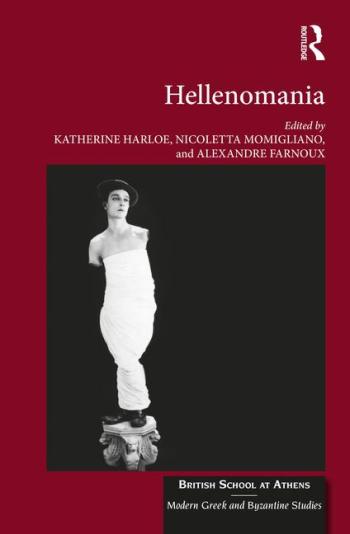 Hellenomania, the second volume in the MANIA series, presents a wide-ranging, multi-disciplinary exploration of the modern reception of ancient Greek material culture in cultural practices ranging from literature to architecture, stage and costume design, painting, sculpture, cinema, and the performing arts. It examines both canonical and less familiar responses to both real and imagined Greek antiquities from the seventeenth century to the present, across various national contexts. Encompassing examples from Inigo Jones to the contemporary art exhibition documenta 14, and from Thessaloniki and Delphi to Nashville, the contributions examine attempted reconstructions of an ‘authentic’ ancient Greece alongside imaginative and utopian efforts to revive the Greek spirit using modern technologies, new media, and experimental practices of the body. Also explored are the political resonances of Hellenomaniac fascinations, and tensions within them between the ideal and the real, the past, present, and future.
Part I examines the sources and derivations of Hellenomania from the Baroque and pre-Romantic periods to the early twentieth century. While covering more canonical material than the following sections, it also casts spotlights on less familiar figures and sets the scene for the illustrations of successive waves of Hellenomania explored in subsequent chapters. Part II focuses on responses, uses, and appropriations of ancient Greek material culture in the built environment—mostly architecture—but also extends to painting and even gymnastics; it examines in particular how a certain idealisation of ancient Greek architecture affected its modern applications. Part III explores challenges to the idealisation of ancient Greece, through the transformative power of colour, movement, and of reliving the past in the present human body, especially female. Part IV looks at how the fascination with the material culture of ancient Greece can move beyond the obsession with Greece and Greekness.
Katherine Harloe is Associate Professor of Classics and Intellectual History at the University of Reading. Her research specialisms are the history of classical scholarship and the reception of Greek and Roman antiquity in European (especially German) culture from the mid-eighteenth to the mid-twentieth centuries. In addition to numerous articles, she is author of Winckelmann and the Invention of Antiquity: History and Aesthetics in the Age of Altertumswissenschaft (2013) and co-editor of Thucydides and the Modern World: Reception, Reinterpretation, and Influence from the Renaissance to Today (2012).
Nicoletta Momigliano is Professor of Aegean Studies at the University of Bristol, specialising in Minoan archaeology and its reception. She has directed and co-directed several archaeological projects in Crete and Turkey, and has published many articles and book on Aegean subjects, including Cretomania: Modern Desires for the Minoan Past (2017, co-edited with Alexandre Farnoux) and Archaeology and European Modernity: Producing and Consuming the Minoans (2006, co-edited with Yannis Hamilakis).
Alexandre Farnoux is Professor of Archaeology and History of Art at the University of Paris IV (Sorbonne) and, since 2011, has been Director of the French School in Athens. He is an expert on the archaeology of Delos and especially of Crete, where he has directed excavations at Malia and Dreros. He has published many works on Greek and Aegean topics, including Cnossos, l’archéologie d’un rêve (1993) and Homère, le prince des poètes (2010).
C O N T E N T S
Hellenomanias from Early Modern to Modernism
1 Fiona Macintosh, Modern Stage Design and Greek Antiquity: Inigo Jones and His Greek Models
2 Katherine Harloe, Winckelmania: Hellenomania between Ideal and Experience
3 Richard Jenkyns, The British Reception of Greek Visual Culture in the Nineteenth and Twentieth Centuries
Ideal and Real Structures of Hellenomania
4 Frank Salmon, The Ideal and the Real in British Hellenomania, 1751–1851
5 Athena Leoussi, Making Everyone Greek: Citizens, Athletes, and Ideals of Nationhood in Nineteenth-Century Britain, France and, Germany
6 Lena Lambrinou, The Parthenon from the Greek Revival to the Modern Movement
7 David Watkin, The Greek Spirit: Current Architecture and Sculpture in England
Hellenomania Comes to Life: Colour, Movement, and the Body
8 Charlotte Ribeyrol, From Galatea to Tanagra: Victorian Translations of the Controversial Colours of Greek Sculpture
9 Pantelis Michelakis, ‘Grecian Dances’ and the Transformations of Corporeality in the Age of Moving Images
10 Artemis Leontis, Fashioning a Modern Self in Greek Dress: The Case of Eva Palmer Sikelianos
11 Eleni Sikelianou, From Delphi, 1927
12 Martin Winkler, Aphroditê kinêmatographikê: Venus’ Varieties and Vicissitudes
Beyond Hellenomania?
13 Esther Solomon and Styliana Galiniki, Las Incantadas of Salonica: Searching for ‘Enchantment’ in a City’s Exiled Heritage
14 Eleana Yalouri, Afterword: Hellenomanias Past, Present, and Future
Index
Exhibition | Canova and the Antique

Now on view in Naples at the MANN:
Canova and the Antique
Museo Archeologico Nazionale di Napoli, Naples, 28 March — 30 June 2019
Curated by Giuseppe Pavanello
The magnificent art of Antonio Canova (1757–1822) has rightly earned him praise as “the last of the ancients and the first of the moderns.” This exhibition focuses on Canova’s constant, intense, and fruitful relationship with classical antiquity, which made him known as “the new Phidias” among his contemporaries. Throughout the course of his artistic activity, Canova followed Winckelmann’s call “to imitate but not to copy the ancients” in order to “become inimitable.”

Antonio Canova, Dancer with Hands on Hips, 1811–12 (Saint Petersburg: State Hermitage Museum).
The exhibition is organised on two floors and displays over 110 works by Canova, including drawings, sketches, paintings, plaster casts, and marble sculptures. It showcases some of Canova’s greatest masterpieces, such as the famous group of The Graces on loan from the Hermitage State Museum in Saint Petersburg. The National Archaeological Museum of Naples is in a uniquely privileged position to present this complex and fascinating dialogue between Canova’s works and the great works of antiquity, with stunning pieces that can delight the modern spectator as thoroughly as they did Canova’s contemporaries.
The two installations dedicated to Canova in the entrance hall of the Museum are hosted in theatre-like round structures with a six-metre diameter. The visual journey takes the visitor through virtual imagery and scientific study, going from a single detail to a bird’s eye view, from the butterfly of Cupid and Psyche, to Hercules hurling Lichas, the great myths sculpted in marble and the polychrome paintings on a dark background, dedicated to dance. Adriano Giannini’s voice and the original soundtrack by the cello-player Giovanni Sollima contribute to a show that mixes deep emotion and accurate knowledge.
Canova visited Naples in 1780 to admire the beauties of the city and the antiquities of Herculaneum and Paestum. In his second Quaderno di Viaggio he writes about Naples: “everywhere is like Heaven.” He also reports of his visits to the Sansevero Chapel—where he appreciated the Dead Christ (Veiled Christ) by Giuseppe Sammartino—to the Gallery of Capodimonte, and to the Museum of Portici, where all the antiquities from the Vesuvian area had been gathered. Among the bronzes from the Villa of Papyri of Herculaneum he praises the Seated Mercury for “its wonderful beauty.” Canova obtained permission to draw the nude at the Academy (of Fine Arts), then in the area of San Carlo alle Mortelle. Today, in the Academy’s Gipsoteca, it is possible to admire some of Canova’s plaster models. The master returned to Naples in 1787 and carved for Francesco Maria Berio the marble group Venus and Adonis, to be placed in a little temple in the garden of the marquis’ palace, along via Toledo. The work, inscribed in the genre “delicate and gentle,” is today in Geneva. For the Neapolitan Onorato Caetani he sculpted the group Hercules and Lichas, classified in the genre “strong” or “fierce,” taking inspiration from the ideal model of the Farnese Hercules and from the composition of Hector and Troilus—both on display at the MANN. The Herm of a Vestal, commissioned by the count Paolo Marulli d’Ascoli, would leave Naples for Switzerland first and for the Getty Museum of Los Angeles later. After the short life of the Parthenopean Republic, the Bourbon king Ferdinand IV asked Canova to sculpt for him a portrait-statue. In 1821, as suggested by the master himself, it was placed in the niche of the monumental staircase of the Royal Bourbon Museum, today Museo Archeologico Nazionale. During the French decade Canova carved the marble busts, today lost, of Caroline and Joachim Murat, known through their plaster models. In the same period, the king Joseph Bonaparte and his successor Joachim Murat commission an Equestrian Monument to Napoleon, but, with the French domination coming to an end, the work was never completed. When the Bourbon king of Naples Ferdinand I regained the throne as king of the two Sicilies, he asked Canova to complete the piece with the statue of his father, Charles III. The monument can be admired today in Piazza Plebiscito.
Blasco Pisapia and Valentina Moscon, Canova e l’Antico (Milan: Electa, 2019), 360 pages, ISBN: 978-8891825063.
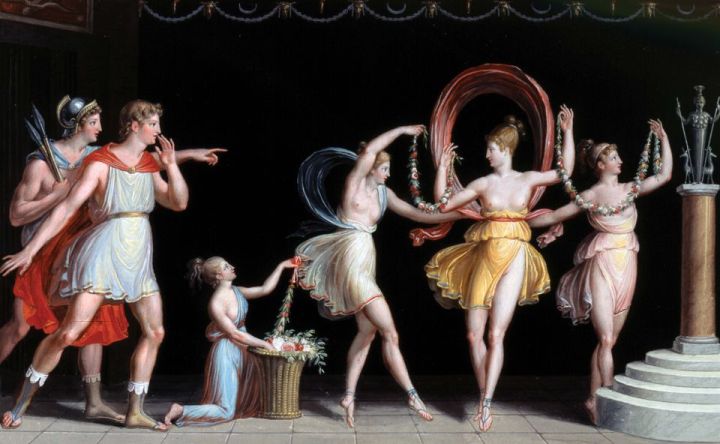
Antonio Canova, Theseus and Pirithous in the Temple of Diana Ortia See Diana Dancing, between Two Dancers, in Front of the Figure of Artemis of Ephesus (Abduction of Helen), 1799, tempera (Possagno: Gypsotheca e Museo Antonio Canova). The painting is one of 34 works inspired by Pompeiian wall paintings.
Call for Papers | Un-Fair Trades
From the Call for Papers:
Un-Fair Trades: Artistic Intersections with Social and Environmental Injustices in the Atlantic World, 1500–Present
The Graduate Center, CUNY, New York, 10–11 October 2019
Hosted by the Art History Department, The Graduate Center, CUNY
Proposals due by 15 May 2019
Artists have engaged with issues of oppression and exploitation—byproducts of colonialist and capitalist systems—throughout the history of transatlantic encounters: from slavery and resource extraction; to exploitative labor practices and the environmental consequences of industrialization; and human rights movements and climate change anxieties of the past century. This conference will examine a multitude of artistic responses to increasing global connections, which could include plantation scenes, images of the Middle Passage, social reform photography, industrialized cityscapes, and images of workers and employment. When examined through the lens of our contemporary social and environmental concerns, artworks whose motifs intersect with these imbalances of power compel us to analyze the visualizations of oppression and environmental degradation from a new perspective. Amid the 21st-century activist revival (with movements like Occupy Wall Street, #BlackLivesMatter, #NODAPL, and #MeToo) it is more prescient than ever to acknowledge, examine, and reflect upon both historic and perpetuating inequalities.
Un-Fair Trades seeks to establish a forum for intersectionality, Pan-American approaches, and transnational perspectives. We welcome paper abstracts that utilize an array of theoretical approaches to the visual culture of the Americas, Europe, and Africa and intersect with the issues of equity, equality, and environmentalism. We invite proposals for papers that critically engage with, but are not limited to, depictions of
• Native artists and indigenous populations amid forced migration and assimilation
• Harvested land and the plantation economy.
• Forced labor, the Middle Passage, and the Triangle trade
• The visual, economic, and social treatment of minority populations
• Scientific expeditions, expansionism, and extractive industries in the American West
• Exploitative labor practices, trades, and environmental damage caused by the Industrial Revolution
• Women’s work, expanding economic independence, and the suffrage movement
• Immigration, xenophobia, and the ‘melting pot’
• African Diaspora, the Harlem Renaissance, and Pan-Africanism
• Social Reform initiatives
Keynote Speakers: Dr. Alan C. Braddock and Dr. Charmaine A. Nelson
Proposals should be submitted to Caroline L. Gillaspie and Alice J. Walkiewicz at unfairtradesconference@gmail.com by 15 May 2019. Please include a 300-word abstract and a current CV. Applicants will be notified of acceptance by mid-June.










 Enfilade
leave a comment