Mary D. Sheriff Travel and Research Award for 2019
The Mary D. Sheriff Travel and Research Award
Applications due by 15 January 2019
The Mary D. Sheriff Travel and Research Award supports feminist topics in eighteenth-century art history and visual culture. The award will be given every other year, beginning in 2019 with $2000.
Doctoral candidates, early career scholars, and contingent faculty who are current members of the American Society for Eighteenth-Century Studies (ASECS) and the Historians of Eighteenth-Century Art and Architecture (HECAA) are eligible to apply. Applicants should submit a 750-word description of the proposed project and a CV (as a pdf or MS Word doc) to Melissa Hyde, mhyde@arts.ufl.edu by 15 January 2019. The award will be presented at the 2019 ASECS business meeting.
Award money will be drawn from an endowed account managed by ASECS. Donations to this account are tax-deductible.
Exhibition | Winckelmann and the Vatican Museums
Now on view at the Vatican:
Winckelmann: Masterpieces throughout the Vatican Museums
Winckelmann: Capolavori diffusi nei Musei Vaticani
Vatican Museums, 9 November 2018 — 9 March 2019
Curated by Guido Comini and Claudia Valeri
 A ‘journey within the journey’ along the entire Vatican Museums tour itinerary, this ‘dispersed’ exhibition celebrates the great German scholar Johann Joachim Winckelmann, father of modern archaeology and precursor of today’s art historians. Preceded by and announced in May at the study day on the Montalto Collection in Villa Negroni, Winckelmann: Masterpieces throughout the Vatican Museums symbolically brings to a conclusion the many initiatives organized to honour the renowned archaeologist in the dual anniversary year of 2018—300 years since his birth and 250 since his tragic death in Trieste.
In the years of his ‘dazzling’ stay in Rome (1755–1768), the Vatican Museums as we know them did not yet exist, but Winckelmann already visited the Vatican Belvedere and returned repeatedly to admire the statues conserved there. Indeed, it was due to his favourable judgement that many antiquities that he studied during his visits to the monuments and collections of the Eternal City were then purchased by the pontiffs. The exhibition, curated by Guido Cornini and Claudia Valeri, is intended to highlight precisely this role of the Vatican collections as a cornerstone for the studies, theories, and writings of the renowned German archaeologist. All sectors of the museums have been involved in this impressive and original exhibition project that offers the visitor a thematic itinerary with pauses for in-depth analysis of 50 selected works—on the basis of the role Winckelmann attributed to them in the construction of his aesthetic thought.
Room XVII of the Pinacoteca is dedicated to the presentation of the figure and his age. The screening of a film and the display of some of his most important writings help explain the atmosphere and cultural climate of Rome around the mid-eighteenth century. Winckelmann arrived in 1755 for a brief stay and instead spent the rest of his life in Italy; enchanted by the grandiose beauty of the antiquities, he devoted all his attention and prodigious talent to them.
Guido Comini and Claudia Valeri, Winckelmann: Masterpieces throughout the Vatican Museums (Vatican City: Edizioni Musei Vaticani, 2018), 232 pages, ISBN: 978-8882714307, $58. Also available in Italian.
New Book | Johann Joachim Winckelmann
Available from Artbooks.com:
Elisa Debenedetti, ed., Johann Joachim Winckelmann (1717–1768) nel duplice anniversario (Rome: Quasar, 2018), 344 pages, ISBN: 978-8871409191, €60 / $95.
 C O N T E N T S
• Editoriale, Elisa Debenedetti
• Johann Joachim Winckelmann (1717–1768) nella doppia ricorrenza, Claudio Strinati
• Winckelmann und seine Eminenzen, Steffi Roettgen
• Tra lettere e licenze: Luci e ombre su Winckelmann Commissario delle antichità (1763–1768), Federica Papi
• ‘Quando con questo dubbio osservai di nuovo la nostra opera, mi si accese una luce’: Le intuizioni iconografiche di Winckelmann, Brigitte Kuhn-Forte
• Winckelmann als Apodemiker, Martin Disselkamp
• Un database in miniatura: Il manoscritto di Winckelmann alla Biblioteca Nazionale Centrale di Roma, Gabriella Catalano
• Addendum al corpus degli scritti di Winckelmann, Stefano Ferrari
• Winckelmann nel Regno di Napoli, oltre il Museo ercolanense: Pozzuoli e Paestum, Fabio Mangone
• Osservazioni dalla mostra Il Tesoro di Antichità (Musei Capitolini, 7/12/2017 – 22/4/2018), Pierluigi Panza
• Winckelmann: Moderne Antike Recensione della mostra al Neues Museum di Weimar dal 7 aprile al 2 luglio 2017, Davide Ferri
• Winckelmann a Milano, Pierluigi Panza
• Iniziative dei Musei Vaticani in occasione delle celebrazioni dedicate a Johann Joachim Winckelmann, Claudia Valeri
• La ‘Sala delle cose egizie’ del museo Pio-Clementino: alcune considerazioni, Rosella Carloni
• Dipinti e opere d’arte in Casa Albani: L’allestimento delle collezioni di famiglia in un inventario del 1724, Matteo Borchia
• Pergolati, fontane ed erme a Villa Albani: Un’ipotesi di ricostruzione, Alberta Campitelli
• La genesi della Pala di Possagno e l’interpretazione critica di Giulio Carlo Argan, Elisa Debenedetti
Sommari
Indice dei nomi
New Book | Germany’s Ancient Pasts
From The University of Chicago Press:
Brent Maner, Germany’s Ancient Pasts: Archaeology and Historical Interpretation since 1700 (Chicago: The University of Chicago Press, 2018), 336 pages, ISBN: 978-0226592916 (hardback), $120 / ISBN: 978-0226593074 (paperback), $40.
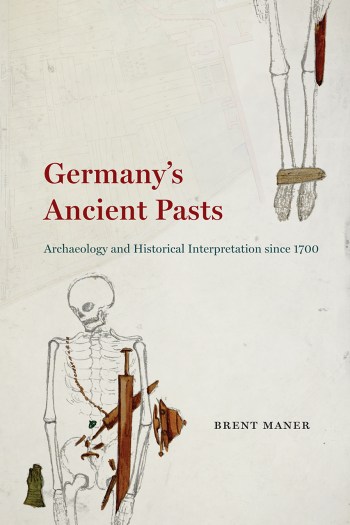 In Germany, Nazi ideology casts a long shadow over the history of archaeological interpretation. Propaganda, school curricula, and academic publications under the regime drew spurious conclusions from archaeological evidence to glorify the Germanic past and proclaim chauvinistic notions of cultural and racial superiority. But was this powerful and violent version of the distant past a nationalist invention or a direct outcome of earlier archaeological practices? By exploring the myriad pathways along which people became familiar with archaeology and the ancient past—from exhibits at local and regional museums to the plotlines of popular historical novels—this broad cultural history shows that the use of archaeology for nationalistic pursuits was far from preordained.
In Germany’s Ancient Pasts, Brent Maner offers a vivid portrait of the development of antiquarianism and archaeology, the interaction between regional and national history, and scholarly debates about the use of ancient objects to answer questions of race, ethnicity, and national belonging. While excavations in central Europe throughout the eighteenth and nineteenth centuries fed curiosity about the local landscape and inspired musings about the connection between contemporary Germans and their ‘ancestors’, antiquarians and archaeologists were quite cautious about using archaeological evidence to make ethnic claims. Even during the period of German unification, many archaeologists emphasized the local and regional character of their finds and treated prehistory as a general science of humankind. As Maner shows, these alternative perspectives endured alongside nationalist and racist abuses of prehistory, surviving to offer positive traditions for the field in the aftermath of World War II. A fascinating investigation of the quest to turn pre- and early history into history, Germany’s Ancient Pasts sheds new light on the joint sway of science and politics over archaeological interpretation.
Brent Maner is associate professor of history at Kansas State University.
C O N T E N T S
List of Illustrations
List of Abbreviations
Introduction
I. The Discovery of Germany’s Ancient Pasts
1 The Sources for Prehistory: Texts and Objects in the Eighteenth Century
2 Preparing Artifacts for History: Archaeology after the Napoleonic Wars
3 Archaeology and the Creation of Historical Places
II. The New Empire and the Ancient Past
4 Rudolf Virchow and the Anthropological Orientation of Prehistory
5 Domestic Archaeology: A Preeminently Regional Discipline
6 Narrating the National Past
III. Between Science and Ideology
7 Professionalization and Nationalism in Domestic Archaeology
8 Prehistory as a National Socialist Narrative
Epilogue
Acknowledgments
Notes
Bibliography
Index
Exhibition | Painting the Floating World

Utagawa Toyokuni, One Hundred Looks of Various Women, 1816
(Roger Weston Collection)
◊ ◊ ◊ ◊ ◊
Press release (4 October 2018) for the exhibition:
Painting the Floating World: Ukiyo-e Masterpieces from the Weston Collection
Art Institute of Chicago, 4 November 2018 — 27 January 2019
Curated by Janice Katz
The Art Institute of Chicago presents Painting the Floating World: Ukiyo-e Masterpieces from the Weston Collection, a collection formed by Roger Weston over the last twenty-five years which captures compellingly the beginning, major developments, and final flowering of ukiyo-e (pictures of the floating world) painting. Encompassing folding screens, hanging scrolls, handscrolls, and albums, these works are technically accomplished masterpieces by the most famous artists in Edo (present-day Tokyo) and beyond. Ukiyo-e comprises both paintings and prints, so it is especially meaningful that such a complete collection of paintings can be shown at a museum known for its significant holdings of prints.

Chobunsai Eishi, Woman Writing a Poem on a Fan, 1789/1801 (Roger Weston Collection).
The floating world (ukiyo) flourished in the bustling urban centers of Kamigata (Kyoto, Osaka) and Edo from the seventeenth through nineteenth centuries. People of all ranks shared in metropolitan amusements, including the Yoshiwara pleasure quarters and the kabuki theater. The extraordinary paintings in the exhibition, which focus almost exclusively on the beautiful people (bijinga) who were the celebrities of this milieu, offer a privileged, intimate view of the floating world and its many attractions. Ukiyo-e paintings were commissioned works executed by well-known artists, among them Katsushika Hokusai (1760–1849) and Kitagawa Utamaro (1753–1806). Lavish, one-of-a-kind objects, the paintings display the makers’ extraordinary technical skill and address a wide range of subjects, including actors, courtesans, geisha, musicians, and scenes of everyday life in Edo.
“When visitors walk away from this show, we want them to have an understanding that the floating world is full of individuals looking to forge a unique identity for themselves as urban, sophisticated, fashionable and trendy, just as we do in our modern-day society,” said Janice Katz, the Roger L. Weston Associate Curator of Japanese Art.
The exhibition, staged in the museum’s Regenstein Hall, will be the largest exhibition exclusively of ukiyo-e paintings in the U.S. With approximately 160 pieces of art on display, the sheer size of the exhibition is spectacular. Visitors can find parallels between ukiyo-e and present day culture—the exploration of fashion and celebrity, the desire to seek out unique experiences—as well as a thread of influence that can be traced though to the fantasy worlds of Japanese anime and manga.
The paintings are organized in chronological order throughout eight rooms, charting the birth of ukiyo-e and key moments in its evolution. To give visitors the ability to observe the skill of the artists up close, the glass cases housing the works will have a depth of just eight inches. The experience of the exhibition is further enhanced with dynamic maps of the city, educational videos, and digital tablets.
The Art Institute of Chicago will be the exclusive venue for this exhibition. A one-day international symposium will be held on November 15, 2018. In addition, a complementary exhibition in the Weston Wing and Japanese Art Galleries featuring prints and paintings from the Art Institute’s collection will be on view from October 6, 2018 to February 10, 2019. Painting the Floating World: Ukiyo-e Masterpieces from the Weston Collection is generously sponsored by Roger L. and Pamela Weston.
Janice Katz and Mami Hatayama, eds., Painting the Floating World: Ukiyo-e Masterpieces from the Weston Collection (Chicago: Art Institute of Chicago, 2018), 350 pages, ISBN: 978-0300236910, $65.
 From the seventeenth through the nineteenth century, artists in Kyoto and Edo (now Tokyo) captured the metropolitan amusements of the floating world (ukiyo in Japanese) through depictions of subjects such as the beautiful women of the Yoshiwara pleasure quarters and performers of the kabuki theater. In contrast to ukiyo-e prints by artists such as Katsushika Hokusai, which were widely circulated, ukiyo-e paintings were specially commissioned, unique objects that displayed the maker’s technical skill and individual artistic sensibility. Featuring more than 150 works from the celebrated Weston Collection, the most comprehensive of its kind in private hands and published here for the first time in English, this lavishly illustrated and meticulously researched volume addresses the genre of ukiyo-e painting in all its complexity. Individual essays explore topics such as shunga (erotica), mitate-e (images that parody or transform a well-known story or legend), and poetic inscriptions, revealing the crucial role that ukiyo-e painting played in a sophisticated urban culture.
Janice Katz is Roger L. Weston Associate Curator of Japanese Art at the Art Institute of Chicago. Mami Hatayama is curator of the Weston Collection.
Exhibition | Women Artists in Europe, Monarchy to Modernism
Press release (28 December 2018) from the DMA:
Women Artists in Europe from the Monarchy to Modernism
Dallas Museum of Art, 22 December 2018 — 9 June 2019
Curated by Nicole Myers
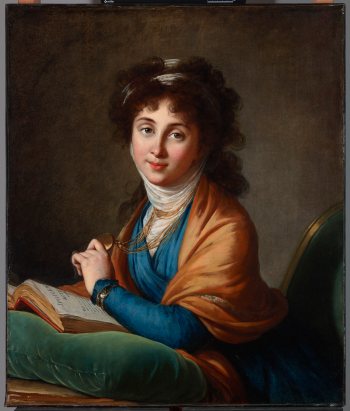
Elisabeth Louise Vigée-Lebrun, Portrait of Natalia Zakharovna Kolycheva, née Hitrovo, 1799, oil on canvas (lent by the Michael L. Rosenberg Foundation, 29.2004.13).
Spanning Europe from the late 18th through mid-20th centuries, the women artists featured in this exhibition worked at a time when prestigious art schools, exhibition venues, and commercial outlets were primarily reserved for their male counterparts. Drawn primarily from the DMA’s permanent collection, this special presentation features paintings and works on paper by artists including Elisabeth Vigée-Lebrun, Rosa Bonheur, Eva Gonzalès, Käthe Kollwitz, Gabriele Münter, and more. Although their artwork cannot be characterized by a single style, viewpoint, or technique, these artists are united by the challenges they faced in pursuing professional careers.
Underlying women’s exclusion was the widely held belief that they were biologically incapable of the intellectual and manual skills necessary to produce great art. Banned from studying the live nude model until the late 1800s, they were prevented from receiving the training necessary for depicting historical or religious subjects that glorify the human form. Instead, women were encouraged to focus on the less significant fields of portraiture, genre, and still life, and to practice drawing, pastel, and watercolor rather than oil painting. Despite this discrimination, the number of professional women artists grew rapidly from the 1850s onward. The triumph of modern art movements over traditional academic styles resulted in more opportunities for equality in the arts in the 20th century.
Women Artists in Europe from the Monarchy to Modernism, on view through June 9, 2019, is organized by the Dallas Museum of Art and curated by Nicole R. Myers, The Lillian and James H. Clark Curator of European Painting and Sculpture. The exhibition can be seen for free as part of the Museum’s general admission policy.
Exhibition | The Claggetts of Newport: Master Clockmakers

Installation view of The Claggetts of Newport: Master Clockmakers in Colonial America (Newport: Redwood Library & Athenaeum, photo by Michael Osean).
◊ ◊ ◊ ◊ ◊
Press release (via Art Daily) for the exhibition:
The Claggetts of Newport: Master Clockmakers in Colonial America
The Redwood Library and Athenæum, Newport, 13 December 2018 — 21 April 2019
Curated by Gary Sullivan and Benedict Leca
In an era when it emerged alongside New York, Boston, Philadelphia, and Charleston as one of the five main port cities of the American Enlightenment, Newport famously distinguished itself by its uniquely progressive society, but also by its cultural refinement, exemplified as much by the Redwood Library—America’s first purpose-built library and earliest public neoclassic building—as by the masterpiece clocks produced by the Claggett dynasty. The Claggetts of Newport: Master Clockmakers in Colonial America features 35 clocks, the largest assemblage of Claggett and Wady clocks ever brought together—many never exhibited publicly. It examines the range of the Claggetts’ clock production in terms of their technical sophistication, decorative finesse, and context of fabrication.
“As the pinnacle of what was often the most expensive item in an elite colonial home, these clocks reflect the cultural aspirations of early Americans, and the role that Newporters played in fashioning an American style that contrasted with European fashions,” said Redwood Executive Director and exhibition co-curator Benedict Leca.
 Drawn from a full roster of public and private collections, the exhibition includes pieces from the Metropolitan Museum of Art, Brown University, The Preservation Society of Newport County, Old Sturbridge Village Collection, and the Rhode Island Historical Society. It features twenty clocks by William Claggett, including his masterpiece: the arch-dial, eight-day quarter-striking clock in japanned case belonging to the Redwood. Thomas Claggett is represented by eleven clocks, while James Wady—to whom only eleven clocks are ascribed—by four clocks, including one using a convex block-and-shell pendulum door, a feature that typified Newport clocks. Among other highlights is a table clock with japanned surface by William Claggett; a trio of Thomas Claggett clocks in related, uniquely regional cases, one a dwarf clock and another a musical clock by him; and two uncased eight-day time and strike movements enabling visitors to peer into the mechanics of a working clock.
The exhibition includes many clocks borrowed from private collections that feature significant provenance information. Preserved by Rhode Island families, some for 300 years, the identities of the original owners of several examples are documented and early family histories are known for others, shedding light on the value, details of construction and the circumstances governing commissions.
“This is an unprecedented presentation of clocks that is unlikely ever to be duplicated. With the recent book devoted to the Claggetts by Fennimore and Hohmann, the Claggetts’ achievement as a highpoint of early American craftsmanship can now be comprehensively appreciated,” said exhibition co-curator Gary Sullivan, the leading authority on early American clocks.
Organized by the Redwood Library & Athenæum—the sole venue—The Claggetts of Newport: Master Clockmakers in Colonial America juxtaposes significant early square dial clocks with later, highly elaborate clocks featuring japanned cases and complex movements indicating the day, tides, and phases of the moon. The clocks’ increasing technical and decorative elaboration over the course of the eighteenth century coincided with the growing prosperity of Newport’s merchant class, whose patronage fueled the city’s emergence as a major colonial artistic center.
The exhibition charts a complex narrative that teases out the three distinct personalities that comprise the Claggett dynasty—William Claggett (1694–1748), his assumed relative Thomas Claggett (d. 1797), and William’s son-in-law James Wady (ca. 1706–1759). As well, the show offers insights on the network of sub-contracted specialist case makers, brass founders and glaziers that the Claggett workshop relied on to produce their clocks.
The technical expertise required to produce a clock, whereby founders cast brass parts that clockmakers filed into the finished movement and positioned inside custom casework made these more than “a great ornament to [a] Room.” The Claggett’s ascendency as clockmakers coincides with the entry of science into public discourse through newly-formed philosophical societies, such as Newport’s Literary and Philosophical Society (1730), the group integral to the founding of the Redwood Library, whose members met to discuss current political and scientific issues. William Claggett himself experimented with electricity, and evidence abounds that clocks were conceived as far more than time pieces: in a 1725 pamphlet Benjamin Franklin compares God’s regulation of the world to the movement of a clock, a metaphor used and critiqued later by the philosopher George Berkeley.
The Claggetts of Newport: Master Clockmakers in Colonial America is co-curated by Gary R. Sullivan and Benedict Leca. The Redwood gratefully acknowledges support from the Edward W. Kane and Martha J. Wallace Family Foundation, and by several donors who wish to remain anonymous. Further support for the gallery presentation comes from Cornelius C. Bond and Ann E. Blackwell, and an in-kind donation by Sandra Liotus Lighting LLC. A catalog recording the exhibition will be available in 2019.
Donald Fennimore and Frank Hohmann, with an Introduction by Dennis Carr, Claggett: Newport’s Illustrious Clockmakers (New Haven: Yale University Press, 2018), 272 pages, ISBN: 978-0300233797, $65.
New Book | National Gallery, Eighteenth-Century French Paintings
Distributed by Yale UP:
Humphrey Wine, National Gallery Catalogues: The Eighteenth-Century French Paintings (London: National Gallery Company, 2019), 632 pages, ISBN: 978-1857093384, $125.
 The impressive collection of eighteenth-century French paintings at the National Gallery, London, includes important works by Boucher, Chardin, David, Fragonard, Watteau, and many others. This volume presents over seventy detailed and extensively illustrated entries that expand our understanding of these paintings. Comprehensive research uncovers new information on provenance and on the lives of identified portrait sitters. Humphrey Wine explains the social and political contexts of many of the paintings, and an introductory essay looks at the attitude of eighteenth-century Britons to the French, as well as the market for eighteenth-century French paintings then in London salerooms.
Humphrey Wine was formerly the curator of 17th- and 18th-century French paintings at the National Gallery, London.
Edinburgh’s Collective Opens on Calton Hill
Press release (via Art Daily) for Collective in Edinburgh:
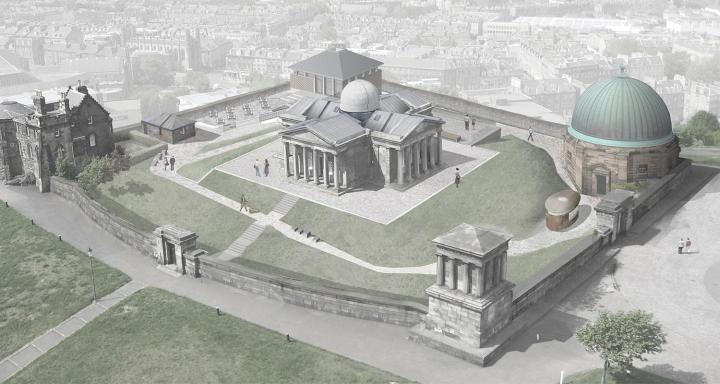
Collective—a new centre for contemporary art—opened in Edinburgh after a major restoration project at one of the capital’s World Heritage sites. Situated on top of Calton Hill, overlooking the city, Collective includes the restored City Observatory, designed by William Playfair in 1818, a new purpose-built exhibition space with panoramic viewing terrace, and a destination restaurant, The Lookout by Gardener’s Cottage. For the first time in its 200-year history the City Observatory site is freely open to the public.
The opening marks a fresh chapter in the history of the Observatory site and for Collective, an organisation active on the Scottish arts scene since 1984. Collective positions itself as a new kind of observatory, inviting the public to view the world around them through the lens of contemporary art. A selection of international and Scotland-based artists, commissioned specially for the opening, are exhibiting their work at Collective as part of an inaugural exhibition. Affinity and Allusion draws on themes connected to Calton Hill’s rich history and features the work of artists Dineo Seshee Bopape, James N Hutchinson, Alexandra Laudo, Tessa Lynch, Catherine Payton, and Klaus Weber.
The City Observatory, designed by William Playfair in 1818, played a key role in the history of astronomy and timekeeping in Edinburgh. The original telescope, installed in the Observatory in 1831, is on display. The Observatory will houses Collective’s new shop, Collective Matter, selling unique artist editions and specially commissioned products.
The Hillside is a brand-new exhibition and office space embedded in the hillside in front of the City Observatory. The space will primarily exhibit work from Collective’s Satellites Programme for emerging artists and producers in Scotland. A panoramic viewing terrace on the roof of The Hillside allows visitors to soak up the stunning views north across Leith and the Firth of Forth. The nearby City Dome, completed in 1895 as a subsidiary to the main Observatory, has been restored and will play host to a changing programme of international artists showing their work in Scotland for the first time.
A purpose-built restaurant, The Lookout, has been constructed on the northeast corner of Collective and is being managed by local partners The Gardener’s Cottage. The Lookout specialises in seasonal cooking using locally-sourced ingredients. Panoramic views from the upper floor dining area, which is cantilevered to partially float above the hillside, complete an extraordinary dining experience.
The final building to be restored as part of Collective is the Transit House. Originally used as an observatory, the building now serves as a learning and education space for visiting schools and groups. The original ‘Politician’s Clock’, so-called because it has two faces, is back on display. Before the installation of the time-ball in the nearby Nelson monument, sailors from the Port of Leith would ascend Calton Hill and use the clock (accurately set by celestial observations) to set their chronometers.
The £4.5m redevelopment is the result of a partnership between Collective and City of Edinburgh Council. Collective moved to the site in 2013 and began fundraising for the project. Funders include City of Edinburgh Council, Creative Scotland, Heritage Lottery Fund, Edinburgh World Heritage, William Grant Foundation, WREN, The Wolfson Foundation, Garfield Weston Foundation, Sylvia Waddilove Foundation UK, Pilgrim Trust, Architectural Heritage Fund, Hope Scott Trust, Idlewild Trust, Craignish Trust, and the invaluable support of many trusts, funds, and individual donors.
Exhibition | Silent Night Turns 200

From the Salzburg Museum, in celebration of the song’s 200th anniversary (with nine exhibition sites in all) . . .
Silent Night 200: The Story, the Message, the Present
Stille Nacht 200: Geschichte, Botschaft, Gegenwart
Salzburg Museum, 29 September 2018 — 3 February 2019
Curated by Peter Husty and Birgit Gampmayer
Two hundred years ago, Joseph Mohr and Franz Xaver Gruber met in Oberndorf. Mohr was born in Salzburg in 1792 and ordained a priest here. In 1815, he was appointed as a curate in Mariapfarr. Here, in 1816, he wrote the poem “Silent Night.” 1816 was a hard year for Salzburg. Salzburg had lost its independence. The year without summer brought crises and famine. The words of the carol were created under this impression; they express a longing for redemption and peace. In 1817, Mohr was moved to Oberndorf on the river Salzach. Gruber was born in 1787 in Hochburg in the Innviertel, Upper Austria; he was a teacher in Arnsdorf close by and played the organ in the Oberndorf church. For a short time, the careers of the two men crossed in Oberndorf. Here, Gruber composed the music to the poem on 24 December 1818 for Christmas Eve in the church of St Nicholas. Mohr and Gruber performed the carol themselves. Today it is sung throughout the world at Christmas. It has been translated into countless languages.
Curators: Mag. Peter Husty und Mag. Birgit Gampmayer, BA
Idea: Hon.-Prof.Mag. Dr. Martin Hochleitner
Research concept: Univ.-Prof. Dr. Thomas Hochradner ( Universität Mozarteum Salzburg)










 Enfilade
leave a comment