Exhibition | Turner and Constable: The Inhabited Landscape

John Constable, The Wheat Field, 1816, oil on canvas, 22 × 31 inches (Clark Art Institute, Gift of the Manton Art Foundation in memory of Sir Edwin and Lady Manton, 2007.8.27).
◊ ◊ ◊ ◊ ◊
Press release for the exhibition at The Clark:
Turner and Constable: The Inhabited Landscape
The Clark Art Institute, Williamstown, Massachusetts, 15 December 2018 — 10 March 2019
Curated by Alexis Goodin
Joseph Mallord William Turner (1775–1851) and John Constable (1776–1837) rose to prominence as landscape artists in early nineteenth-century Britain. Their inspired subjects, their distinctive compositions, and their innovative brushwork combined to elevate a genre traditionally considered less important than history painting and portraiture. Turner and Constable: The Inhabited Landscape explores the significance of human figures and the built environment in the landscape, as well as the personal significance of specific places to each artist.
The exhibition features more than fifty paintings, drawings and watercolors, prints, and books, a beautiful selection of which are on loan from the Yale Center for British Art and the Chapin Library at Williams College. The works in the show are primarily drawn from the Clark’s Manton Collection of British Art, created by Sir Edwin Manton and given to the Clark by the Manton Art Foundation in 2007. This transformative gift included more than 250 oil paintings, sketches, works on paper, and prints, making the Clark a center for the study of nineteenth-century British Art.
“One of the real joys of visiting the Clark is the opportunity to consider magnificent landscapes in our galleries while surrounded by the natural beauty of our own campus,” said Olivier Meslay, the Hardymon Director of the Clark. “The Manton collection is so special to us because it is a rich resource that continues to inspire our curators to consider these works through a myriad of lenses. With this exhibition we will look at landscapes in a different context—and we’re particularly excited because this concept provides a perfect opportunity to present several works that have never been shown at the Clark, while many others are rarely on view due to their delicate nature.”
Alexis Goodin, the Clark’s Curatorial Research Associate, organized the exhibition. “It’s easy to overlook the people depicted in the landscapes of Turner and Constable,” said Goodin. “Often these artists’ figures are small, quickly painted, and sometimes not anatomically correct—qualities that might make them seem less relevant to a breathtaking landscape view. When one begins identifying the people within landscapes and their actions, however, these figures can reveal social and political concerns of the time as well as the artists’ interests and connections to the places depicted. We hope this exhibition opens up a new understanding of these works for our visitors and deepens their appreciation for two of the most revered landscape painters of the nineteenth century.”
The exhibition considers a variety of elements presented in landscapes by both Turner and Constable and creates a framework for appreciating the ways in which these figures lend added meaning to the works. They include:
The Observed Landscape
Turner and Constable created a wide range of landscapes and seascapes throughout their careers. They often depicted familiar places that shed light on the personal histories of the artists. Figures incorporated into these landscapes were important to the picture’s narrative and not merely a measure of scale.
Constable, having spent his honeymoon in the seaside village of Osmington, recorded this place of personal importance. Osmington Bay (1816) reveals nature’s grandeur on an intimate scale. The figures—including a fisherman mending a net, a shepherd, and a mother with her child—show the beach as a place of both work and leisure. In the painting Osmington Village (1816–17, Yale Center for British Art), smoke billows from the chimney of the vicarage while people make their way by cart or foot along the village lane, conveying both domestic comfort and productivity within the landscape.
Laborers in the Landscape
Laborers—ploughmen, shepherds, laundresses, fishermen, sailors—populate many of Constable’s and Turner’s landscapes and seascapes. The workers’ presence animates the natural world and underscores the potential abundance of the land or sea. Contemporary accounts reveal difficult working conditions and the extreme poverty of agricultural workers, conditions often not apparent in the artists’ portrayals. The laborers’ presence invites the observer to consider how the environment shaped them, and how they influenced their surroundings. The ways in which Turner and Constable rendered laborers within their landscapes may also shed light on how they viewed the workers.
The Wheat Field (1816) presents a view across a valley in Constable’s native Suffolk. Harvesters cut down the golden wheat with scythes, reapers bundle the stalks, and gleaners collect leftover grains while a boy and his dog guard lunch. The idealized scene belies the heat of the sun and the long hours of monotonous and sometimes painful work. Constable’s inclusion of different classes working together suggests that commercial success and charity were not mutually exclusive. This sympathetic treatment of the poor came at a time when the landless classes were increasingly denied access to places that they had traditionally used to grow food or graze animals.
Laborers fill the foreground in Turner’s Saumur from the Île d’Offart, with the Pont Cessart and the Château in the Distance (c. 1830). In this scene of the town of Saumur, located on the Loire River in west central France, washerwomen spread out laundry to dry on the steps while men load cargo onto barges. The workers bring the picturesque view to life, showing the town as a center of commercial prosperity.
The Literary Landscape
Turner often turned to literary texts for source material, situating characters in settings that enhanced their stories or populating imaginary landscapes with familiar narratives. He was commissioned to design illustrations for literary publications, supplying finished watercolors that printmakers would turn into engravings used in bound volumes.
Turner spent the summer of 1831 in Scotland, sketching landscapes described in Sir Walter Scott’s poems and novels for a proposed illustrated edition of the author’s works. The project never came to fruition, but Turner worked up his drawings for a related publication. Wolf’s Hope, Eyemouth (c. 1835) is one of six finished watercolors translated into illustrations for Rev. George Wright’s Landscape-Historical Illustrations of Scotland and the Waverly Novels (1836). Wolf’s Hope, Eyemouth illustrates one of the settings in Sir Walter Scott’s novel The Bride of Lammermoor (1819), showing the harbor town where the novel’s tragic hero, Edgar Ravenswood, resided in a dilapidated castle called Wolf’s Crag.
The Built Landscape
The buildings within Constable’s and Turner’s works not only identify the geography and place their landscapes within time, but also reveal each artist’s personal connections to place. Constable found inspiration in the English countryside, often highlighting the small villages, cottages, churches, cathedrals, and other built structures that he encountered.
Salisbury Cathedral and its environs held special meaning for Constable, as his good friends and patrons the Bishop of Salisbury John Fisher and his nephew, John Fisher, later Archdeacon of Berkshire, resided there. Inspired by the majestic Gothic cathedral, he painted this important seat of the Anglican faith from many viewpoints, often emphasizing the spire towering over the plain. For Constable, a member of the Church of England, the church was not just architecture or a relic of the past, but a symbol of enduring faith. Indeed, as a seat of Anglican worship, Salisbury represented steadfastness and tradition in a time of increasing challenges to its authority, including the rise of Evangelicalism and the revival of Anglo-Catholicism brought on by the Oxford movement in the mid-1830s. The exhibition presents four works in various media depicting the cathedral—three from the Manton Collection of British Art and a fourth collected by Sterling and Francine Clark in 1945.
Turner grew up in London, and the city provided him with his earliest subjects. His watercolor The Tower of London (c. 1794) served as the basis for an engraving published in The Pocket Magazine on January 1, 1795. Viewed from across the Thames, the White Tower, built in 1078 and famously used as a prison until 1952, rises majestically above a city awash with light. Large mast ships on either side of the small composition frame the view of this historic fortress. The still water of the Thames reflects the boats and buildings, giving the scene a timeless calm. The absence of figures and narrative allows the focus to remain on the built environment.
Turner and Constable: The Inhabited Landscape is presented in the Clark’s special exhibition galleries in the Clark Center. The Clark also presents a companion installation of sixteen landscape drawings by Thomas Gainsborough in the Manton Gallery for British Art, located in the Manton Research Center, from December 1, 2018 until March 17, 2019. Fourteen of the Gainsborough drawings on view in this installation are from the Manton collection. Though recognized as one of the most fashionable portrait painters in the eighteenth century, Gainsborough made hundreds of drawings of the English landscape. Abundant with foliage, cottages, and pastoral figures, the works evoke the gentle woodland and heath of the artist’s native Suffolk and the mountainous Lake District of Cumbria. Gainsborough’s landscape drawings in this presentation reveal the artist’s fascination with mixed-media technique: graphite, chalks, ink washes, watercolor, and oil paints intermingle on toned papers.
New Book | Gems in the Early Modern World:
From Palgrave Macmillan:
Michael Bycroft and Sven Dupré, eds., Gems in the Early Modern World: Materials, Knowledge and Global Trade, 1450–1800 (London: Palgrave Macmillan, 2018), 359 pages, ISBN: 978-3319963785, $120.
 This edited collection is an interdisciplinary study of gems in the early modern world. It examines the relations between the art, science, and technology of gems, and it does so against the backdrop of an expanding global trade in gems. The eleven chapters are organised into three parts. The first part sets the scene by describing how gems moved around the early modern world, how they were set in motion, and how they were pulled together in the course of their travels. The second part is about value. It asks why people valued gems, how they determined the value of a given gem, and how the value of a gem was connected to its perceived place of origin. The third part deals with the skills involved in cutting, polishing, and mounting gems, and how these skills were transmitted and articulated by artisans. The common themes of all these chapters are materials, knowledge and global trade. The contributors to this volume focus on the material properties of gems such as their weight and hardness, on the knowledge involved in exchanging them and valuing them, and on the cultural consequences of the expanding trade in gems in Eurasia and the Americas.
Michael Bycroft is Assistant Professor of the History of Science and Technology at the University of Warwick. He completed his PhD in the History and Philosophy of Science at the University of Cambridge in 2013, and has since held fellowships at the Max Planck Institute for the History of Science and the University of Warwick. He specialises in the physical sciences in early modern Europe, and is writing a monograph on the role of precious stones in the scientific revolution.
Sven Dupré is Professor of History of Art, Science and Technology at Utrecht University and the University of Amsterdam, The Netherlands. He directs ARTECHNE, an interdisciplinary project on technique in the arts, supported by the European Research Council. Previously he was a Professor of History of Knowledge at the Freie Universität in Berlin.
C O N T E N T S
• Michael Bycroft and Sven Dupre, Introduction: Gems in the Early Modern World
• Hugo Miguel Crespo, The Plundering of the Ceylonese Royal Treasury, 1551–1553: Its Character, Cost, and Dispersal
• Christina M. Anderson, Diamond-Studded Paths: Lines of Communication and the Trading Network of the Hellemans Family, Jewellers from Antwerp
• Claire Sabel, The Impact of European Trade with Southeast Asia on the Mineralogical Studies of Robert Boyle
• Anna Grasskamp, Branches and Bones: The Transformative Matter of Coral in Ming Dynasty China
• Michael Bycroft, Boethius de Boodt and the Emergence of the Oriental/Occidental Distinction in European Mineralogy
• Marcia Pointon, Good and Bad Diamonds in Seventeenth-Century Europe
• Marieke Hendriksen, The Repudiation and Persistence of Lapidary Medicine in Eighteenth-Century Dutch Medicine and Pharmacy
• Marjolijn Bol, Polito et Claro: The Art and Knowledge of Polishing, 1100–1500
• Taylor L. Viens, Mughal Lapidaries and the Inherited Modes of Production
• Karin Hofmeester, Knowledge, Technique, and Taste in Transit: Diamond Polishing in Europe, 1500–1800
• Marlise Rijks, Gems and Counterfeited Gems in Early Modern Antwerp: From Workshops to Collections
New Book | The Game of Love in Georgian England
From Oxford UP:
Sally Holloway, The Game of Love in Georgian England: Courtship, Emotions, and Material Culture (Oxford: Oxford University Press, 2019), 256 pages, ISBN: 978-0198823070, £60 / $75.
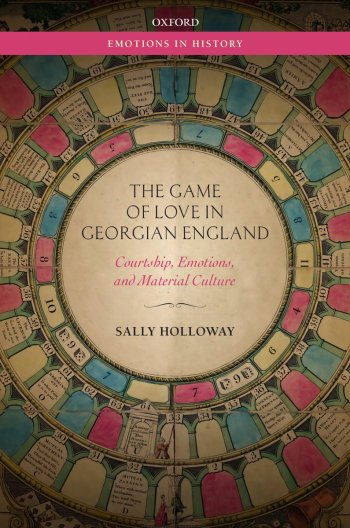 Courtship in Georgian England was a decisive moment in the life cycle, imagined as a tactical game, an invigorating sport, and a perilous journey across a turbulent sea. This volume brings to life the emotional experience of courtship using the words and objects selected by men and women to navigate this potentially fraught process. It provides new insights into the making and breaking of relationships, beginning with the formation of courtships using the language of love, the development of intimacy through the exchange of love letters, and sensory engagement with love tokens such as flowers, portrait miniatures, and locks of hair. It also charts the increasing modernization of romantic customs over the Georgian era—most notably with the arrival of the printed valentine’s card—revealing how love developed into a commercial industry. The book concludes with the rituals of disintegration when engagements went awry, and pursuit of damages for breach of promise in the civil courts.
The Game of Love in Georgian England brings together love letters, diaries, valentines, and proposals of marriage from sixty courtships sourced from thirty archives and museum collections, alongside an extensive range of sources including ballads, conduct literature, court cases, material objects, newspaper reports, novels, periodicals, philosophical discourses, plays, poems, and prints, to create a vivid social and cultural history of romantic emotions. The book demonstrates the importance of courtship to studies of marriage, relationships, and emotions in history, and how we write histories of emotions using objects. Love emerges as something that we do in practice, enacted by couples through particular socially and historically determined rituals.
Sally Holloway is the Vice Chancellor’s Research Fellow in History and History of Art at Oxford Brookes University. Holloway is an historian of emotions, gender, material culture, and romantic relationships in Georgian England. After completing her AHRC-funded PhD at Royal Holloway in 2013, she worked on the Georgians season at Historic Royal Palaces, and taught at Queen Mary University of London, Oxford Brookes University, and Richmond, The American International University in London. With Stephanie Downes and Sarah Randles, she is co-editor of Feeling Things: Objects and Emotions through History (OUP, 2018).
C O N T E N T S
Introduction
1 The Language of Love
2 Love Letters
3 Love Tokens
4 The Marketplace of Love
5 Romantic Suffering
6 Breach of Promise
Conclusion
Exhibition | Seeing the Divine: Pahari Painting of North India

Radha and Krishna Walking at Night, ca. 1775–80, Punjab Hills, Kingdom of Kangra or Guler
(New York: The Metropolitan Museum of Art)
◊ ◊ ◊ ◊ ◊
Press release for the exhibition:
Seeing the Divine: Pahari Painting of North India
The Met Fifth Avenue, New York, 22 December 2018 — 21 July 2019
Curated by Kurt Behrendt
Starting December 22, The Metropolitan Museum of Art will present an exhibition focusing on early painting styles that emerged in the Pahari courts of North India during the 17th and 18th centuries. Featuring some 20 of the most refined paintings produced in South Asia during the period, Seeing the Divine: Pahari Painting of North India will examine the innovative ways in which Pahari artists depicted the Hindu gods. By juxtaposing devotional images with emotionally charged narrative moments, the paintings gave royal patrons a novel approach to forging a personal connection with the divine through devotion (bhakti). Highlights include a rare, early 19th-century temple banner measuring 26 feet that is being shown publicly for the first time. The majority of the works on view are recent promised gifts of Steven Kossak, and they transform The Met’s ability to showcase 17th- to 18th-century North Indian painting of the highest caliber.
Working mostly in miniatures and large-format folios, Pahari artists employed remarkably innovative vocabularies. They often depicted god as a child, a lover, a terrible protector, or even a personal vision. Famous narratives such as the Ramayana and the Gita Govinda (Song of Govinda) had tremendous appeal at the Pahari courts, and the exhibition will include folios that reference both. The Monkey Leader Angada Steals Ravana’s Crown from His Fortress (ca. 1725), a folio from the Ramayana (the story of Rama’s quest to save his beloved Sita from the demon Ravana), is attributed to the master painter Manaku (active ca. 1725–60). Radha and Krishna Walking at Night (ca. 1775–80), a folio from the Gita Govinda, depicts Krishna’s emotionally charged interactions with Radha—here, the artist contrasts her solitude and longing with erotically charged encounters to emphasize the idea of unity between god and devotee.
The impressive temple banner recounts the complex story of Krishna’s rescue and marriage to his first wife, Rukmini, as well as dramatic scenes of Krishna and his many followers fighting a heroic battle in the Himalayan foothills—a battle that represents the great conflict between gods and demons to restore cosmic order.
The exhibition is organized by Kurt Behrendt, Associate Curator of the Department of Asian Art at The Metropolitan Museum of Art. It is made possible by The Miriam and Ira D. Wallach Foundation.
Call for Papers | Asia-Oceania and the French-Speaking World
From H-ArtHist:
Asia-Oceania and the French-Speaking World
University of Hong Kong, 5–6 July 2019
Proposals due by 15 February 2019
Organized by the University of Hong Kong (China) and Laval University (Canada)
The conference will be held in English or French (20-minute papers), addressing a different topic each day (see below). The deadline for applications is the 15th of February 2019. Please email fknothe@hku.hk for the ‘China in Text and Image’ workshop and Guillaume.Pinson@lit.ulaval.ca for the ‘Press’ workshop.
China in Text and Image: Documentary Writing and Art Objects in the Early Modern Era
Friday, 5 July 2019
We invite applications for 20-minute papers presenting original research on either the reception of China in France in written reports or the adaptation of China in France in objects and architecture during the 17th to the 19th centuries. We encourage colleagues in French and comparative literature, anthropology, history and art history to apply, and welcome inter-disciplinary subjects. Our ambition is to publish the papers following the conference to add to the existing scholarship on our topics a group of solidly researched essays on France-China relations and newly explored cross-cultural studies.
The French-Speaking Press of the 19th Century in the Asia-Oceania Region
Saturday, 6 July 2019
As part of the Media 19 project on the literary history of the 19th-century French-language press and the Transfopress network on the foreign-language press, the second day of our conference will focus on the French-language press in the Asia-Oceania region (China, Japan, Vietnam, Australia, New Zealand, New Caledonia, etc.). Presentations will include the development of local newspapers and the history of Francophone migration, relations with France, etc. The period under consideration will focus on the 19th century, with the possibility of excursions into the first half of the 20th century. Papers will be considered for contribution to the establishment of a world history of the French-speaking press in the 19th century, under the direction of Diana Cooper Richet and Guillaume Pinson.
New Book | The Architecture of Art History
From Bloomsbury:
Mark Crinson and Richard Williams, The Architecture of Art History: A Historiography (London: Bloomsbury, 2018), 168 pages, ISBN: 9781350020917, $82.
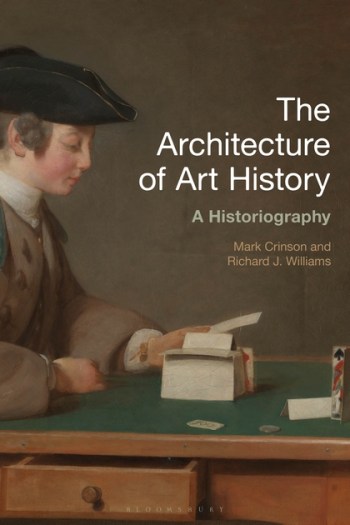 What is the place of architecture in the history of art? Why has it been at times central to the discipline, and at other times seemingly so marginal? What is its place now?
Many disciplines have a stake in the history of architecture—sociology, anthropology, human geography, to name a few. This book deals with perhaps the most influential tradition of all—art history—examining how the relation between the disciplines of art history and architectural history has waxed and waned over the last one hundred and fifty years.
In this highly original study, Mark Crinson and Richard J. Williams point to a decline in the importance attributed to the role of architecture in art history over the last century—which has happened without crisis or self-reflection. The book explores the problem in relation to key art historical approaches, from formalism, to feminism, to the social history of art, and in key institutions from the Museum of Modern Art, to the journal October. Among the key thinkers explored are Banham, Baxandall, Giedion, Panofsky, Pevsner, Pollock, Riegl, Rowe, Steinberg, Wittkower and Wölfflin. The book will provoke debate on the historiography and present state of the discipline of art history, and it makes a powerful case for the reconsideration of architecture.
Mark Crinson is Professor of Art History at the University of Manchester, where he teaches on the history of modern architecture and photography. He won the 2004 Spiro Kostof Prize for his work Modern Architecture and the End of Empire, and the 2012 Historians of British Art Prize for Stirling and Gowan: Architecture from Austerity to Affluence.
Richard Williams is Professor of Contemporary Visual Cultures at the University of Edinburgh. He has written and edited several books, including Regenerating Culture and Society (2011) and After Modern Sculpture (2000), and is a frequent contributor to The Times Higher on architecture and urbanism related topics.
C O N T E N T S
Introduction
1 The German Tradition
2 The Architectural Unconscious — Steinberg and Baxandall
3 Modernism- Institutional and Phenomenal
4 From Image to Environment — Reyner Banham’s Architecture
5 The New Art History
6 October’s Architecture
Conclusion
Exhibition | Ruben and Isabel Toledo: Labor of Love

Press release (6 December 2018) from the DIA:
Ruben and Isabel Toledo: Labor of Love
Detroit Institute of Arts, 16 December 2018 — 7 July 2019
Organized by Laurie Ann Farrell
The Detroit Institute of Arts (DIA) presents Ruben and Isabel Toledo: Labor of Love, a major exhibition of new works created by the artistic couple in response to works in the DIA’s permanent collection. This three-part exhibition project includes a large-scale installation designed by the Toledos in response to iconic Diego Rivera cartoons from his Detroit Industry Murals; additional new works by the Toledos responding to works in the DIA’s collection, located throughout the museum; and a collaboration with local nonprofit Sew Great Detroit, through which the Toledos worked with seamstresses from the organization to generate a collection of handmade limited-edition tote bags to complement the exhibition.

Francisco de Goya, Dona Amalia Bonells de Costa, ca. 1805, oil on canvas (Detroit Institute of Arts).
For Labor of Love, Ruben and Isabel Toledo produced an innovative range of new works that highlight their creative synergy, connect the past with the present, and will inspire the DIA’s visitors to understand connections between fashion and art with the works in the DIA’s collection—in new and unexpected ways.
Ruben and Isabel Toledo: Labor of Love will open at the DIA on December 16, 2018, and run through July 7, 2019. The exhibition is organized by Laurie Ann Farrell, the DIA’s Curator and Department Head for The James Pearson Duffy Department of Modern & Contemporary Art. The exhibition is free with museum admission, which is free for residents of Wayne, Oakland and Macomb counties.
Isabel Toledo (Cuban-American, b. 1961) is a renowned fashion designer and artist whose oeuvre includes the dress that Michelle Obama wore to President Barack Obama’s 2009 Inauguration. Ruben Toledo (Cuban-America, b. 1961) is an artist whose paintings and illustrations also have strong connections to fashion and style.
This exhibition marks the first time the artists have made works inspired by a major museum’s collection. Working within the framework of the DIA’s world-class, encyclopedic collection, the Toledos engaged with works by Francisco Goya, Alison Saar, Eva Hesse, Donald Judd, Robert Motherwell, and others from Central Africa and ancient Egypt. By mining the DIA’s collection as inspiration for new sculptures, paintings, drawings, and installations, the Toledos, together with the DIA, present the Museum’s collection in a new light.
Explains Farrell, “The cumulative experience of a large exhibition and the discovery of works across a variety of galleries will introduce visitors to the power and poetry of the Toledos’ collaborative process while simultaneously offering new insights into works that span cultures and time.”
Adds Salvador Salort-Pons, the DIA’s Director, President, and CEO, “Isabel and Ruben’s inspiring work in dialogue with our world class collection will infuse our building with ‘a Cuban accent.’ I am excited to see the energy of this dialogue, which together with our impactful interpretive models will help the museum fulfill its mission to ‘help visitors find personal meaning in art, individually and with each other.’ This exhibition is a good example of the ways that the DIA can resonate with a broad and diverse audience, and find new opportunities to engage people with art and fashion.”
The museum’s expansive holdings are displayed in 130 galleries spanning three floors of the 658,000-square-foot museum. Visitors will have the opportunity to discover original Toledo creations positioned alongside the works that inspired their conception within 10 different galleries ranging from ancient Egyptian through contemporary art, throughout the entire museum. A printed gallery guide will include a map of where the Toledo works are located within the galleries along with a short introductory text in both English and Spanish.
For example, in the Egyptian Galleries, Ruben and Isabel collaborated on a linen sculpture that invites viewers to consider the way ancient Egyptians took such great care of the dead, protecting the body with bandaging to prepare it for the afterlife. The Toledos’ work, Human Remains, displays how linen records the shape of the wearer by molding to the body. The geometric patterns on their sculpture are inspired by the mummy on view in the center of the gallery.
Another example is First Lady Silhouette, created by Isabel, which holds court in an Early American period room. Viewers will delight in seeing fabric used to create Michelle Obama’s lemongrass colored coat and dress adorning this new work’s breastplate on a dress that is designed to mirror those worn in the late 18th and early 19th centuries. The skirt of the dress also features Ruben’s illustrations reimagining President Barack Obama and the Former First Lady on their historic promenade to the White House in 2009.
In addition, the Toledos have designed an immersive experience set within a 10,000-square-foot temporary exhibition space. The gallery will present five original, rarely seen cartoons from Diego Rivera’s Detroit Industry Murals in the DIA’s collection alongside new works by the Toledos that explore Detroit’s history of industry and modernization. While interpreting the epic Rivera murals, the Toledos creatively draw parallels to their worlds of fashion and art. Extrapolating on the past, present, and future in art, the artists project and distill the poetic and spiritual essence that they see as essential to all of the arts.
Ruben Toledo’s Color Code paintings line the first gallery of the Labor of Love special exhibition, with four paintings of reclining women that recall Diego Rivera’s monumental women known as the Four Races in the Detroit Industry Murals. Ruben’s larger-than-life figures are artfully camouflaged through the patterned surface of their skin. The artist notes that his women have been weaponized as a commentary on our current political climate. His contemporary adaptations of Rivera’s women offer insight into the various ways that Ruben’s work bridges gaps between art and fashion.
The DIA and the Toledos partnered with the nonprofit Sew Great Detroit (SGD), a branch of Alternatives for Girls (AFG), as another component of the exhibition. The Sew Great Detroit seamstresses’ interaction with the artists offered many insights into the realities of the fashion industry—a field in which many of the participants have strong interest. This year-long partnership has been documented and will be presented as part of the exhibition. This is an unprecedented partnership for both the Toledos and the DIA.

Isabel Toledo and Ruben Toledo, Synthetic Cloud, 2018, nylon, as installed at the DIA, 2018.
◊ ◊ ◊ ◊ ◊
About Ruben and Isabel Toledo
The Cuban-born Toledos met in high school in New Jersey and married in 1984. Andy Warhol was a guiding light for them; they met him as teenagers at a Fiorucci store. Traversing the fashion, illustration and the fine art world, Warhol taught them by example the value and cultural richness of a borderless artistic world. They have utilized this creative freedom and risk-taking approach in both of their individual works and their collaborative projects. This exhibition will further advance this fearless approach by allowing them to incorporate illustration, photographic research and social anthropology as well as film-making techniques to explore new ways of demonstrating the creative cross pollination they thrive on.
A muse to her husband’s sculpture, painting and illustration, Isabel Toledo’s sculptural designs are often influenced by her husband’s creative sketches for her designs. Ruben’s surreal view of life brings humor and unconventionality to his wife’s industrial world. The Toledos’ long history of collaboration includes creating original costumes and scenography for the Broadway musical After Midnight (2014) for which Isabel Toledo received a Tony nomination for costume design. Most recently, the couple reimagined George Balanchine’s The Nutcracker for the Miami City Ballet and Music Center in Los Angeles in 2017. Their combined work over the past 30 years both inside and outside the art world has resulted in a highly personal visual language with a diverse and cohesive rhythm.
In 1985 Isabel Toledo presented her first fashion collection. She went from being a designer’s designer with an underground cult-like following to being a global household name when Michelle Obama wore her lemongrass lace ensemble to President Barack Obama’s inauguration ceremony in 2009. Isabel Toledo was presented with the third annual Couture Council Award for Artistry of Fashion from the Museum at the Fashion Institute of Technology in 2008.
Ruben is a painter, sculptor and fashion chronicler who creates incisive illustrations for top international magazines, journals and fashion retailers, including the New Yorker, Vogue, Louis Vuitton, Nordstrom, Harper’s Bazaar, Visionair and The New York Times. His work has been shown at prestigious institutions including the Costume Institute of the Metropolitan Museum of Arts, New York, the Victoria and Albert Museum in London, and the Pitti Palace in Florence.
Along with her husband, Ruben Toledo, Isabel was the recipient of the Cooper-Hewitt Design Award for their work in fashion in 2005, she was also the recipient of an Otis Critics’ award by the Los Angeles-based Otis College of Art and Design. In 2010, the Toledos were awarded honorary doctoral degrees in fine arts by Otis College in Los Angeles, CA.
About Alternatives For Girls’ Sew Great Detroit Program
Alternatives For Girls (AFG) is a Detroit-based 501(c)3 nonprofit serving homeless and high-risk girls and young women through safe shelter, street outreach, educational support, crisis intervention, and counseling. AFG’s Sew Great Detroit is a social enterprise program that provides sewing and employment training. Women in the program learn valuable skills, like machine sewing and hand finishing techniques, understanding characteristics of fabric, fabric cutting methods, and beginning design concepts. The women earn an hourly wage for their work, which is supported through contracted sewing projects.
Lecture Series | Six Georgian Cities

From The Georgian Group:
Six Georgian Cities
Art Workers’ Guild, London, February – March 2019
The Georgian Group is pleased to announce details of its Spring 2019 lecture series, Six Georgian Cities. Each of the six lectures will explore aspects of the Georgian architecture of a different English town or city in the context of its social and economic history. Lectures will be held at the Art Workers’ Guild (London WC1N 3AT) with tickets costing £15 (including wine). The dates, speakers, and locations covered are as follows:
26 February — Oxford, Geoffrey Tyack
12 March — Nottingham, Pete Smith
19 March — Bury St Edmunds, Caroline Knight
2 April — Exeter, Rosemary Yallop
9 April — Bristol, Andrew Foyle
16 April — Derby, Max Craven
Doors open at 6.00pm, lectures start at 6.30. The nearest tube stations are Russell Square and Holborn. Details, along with booking information, are available here.
Call for Papers | Women and Architecture, 1660–1830
From The Georgian Group:
‘Embroidered with Dust and Mortar’: Women and Architecture, 1660–1840
2019 Georgian Group Symposium
Society of Antiquaries, Burlington House, London, 28 September 2019
Proposals due by 31 January 2019

Henry Robert Morland, Charlotte Sophia, Queen Consort of George III (The Queen’s College Oxford).
The Georgian Group is organising a day-long symposium on the theme of Women and Architecture, 1660–1830, which will be held at the Society of Antiquaries at Burlington House, London, on Saturday 28 September 2019. Following successful conferences run by the Group in previous years on James Gibbs and the Adam brothers, the symposium will explore how women contributed to and interacted with architecture in the period 1660–1830, including, but not limited to, the following topics:
• Building, remodelling, and the repairing of country houses, town houses, churches, almshouses, and villas
• Relationships with architects and contractors
• Architectural discourse, drawing, and design
• The creation of identity through the medium of architectural space
Proposals are invited for 15- to 30-minute papers based on original research. Please send abstracts of no more than 200 words and a copy of your CV to Dr Amy Boyington (education@georgiangroup.org.uk) by the end of January 2019. Any questions regarding the symposium should be sent to the same address. Further details will be made available, and tickets will go on sale, in the spring.
Launch of Royalpalaces.com

◊ ◊ ◊ ◊ ◊
From The Society of Antiquaries of London Online Newsletter (Salon) issue 419 (11 December 2018) . . .
Royalpalaces.com
Simon Thurley FSA, one-time Curator of Historic Royal Palaces (1989–97) and Chief Executive of English Heritage (2002–15) . . . has launched Royalpalaces.com, which he describes as
“an encyclopaedic website about British royal residences . . . There is currently nowhere online that people can go to find authoritative information about royal residences from the Saxons to the present, or to find out quickly and easily about royal domestic architectural patronage. RoyalPalaces.com will eventually have nearly 150 place entries covering royal residences from Abingdon to York; most entries have an image and a plan in addition to explanatory text. The website has launched with the first 50 entries. There will also be nearly 30 monarch entries for the greatest British royal architectural patrons—the website launches with ten, including one for Queen Elizabeth II. There will also be podcasts covering various thematic issues. The first podcast deals with the tricky issue of ‘what is a palace?’—and the answer is not ‘a royal residence’. Hopefully of use to the more scholarly-minded will be the bibliographies attached to each entry. All contributions or omissions in these will be gratefully received as will notification of errors spotted.”










 Enfilade
leave a comment